
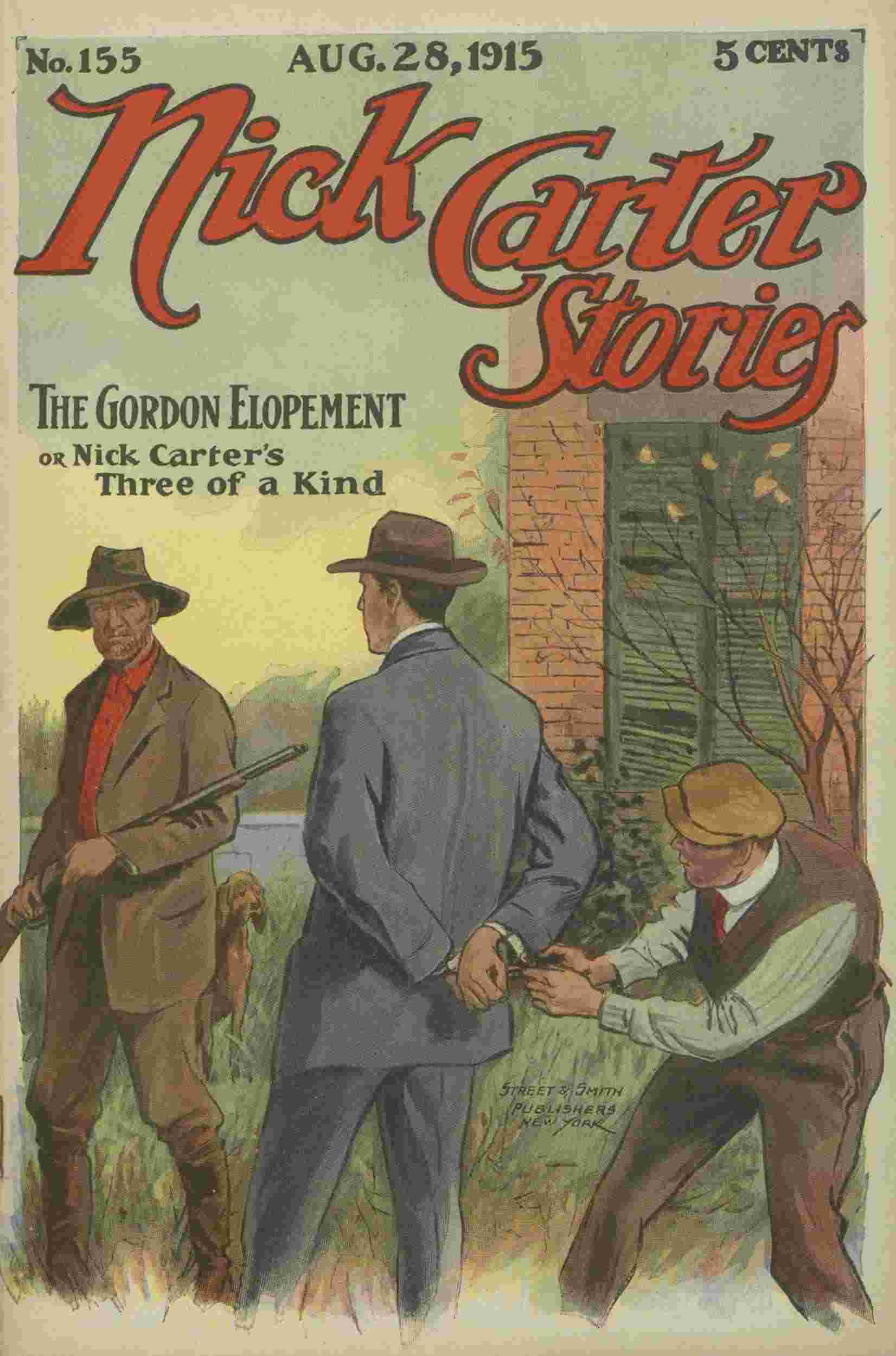
The Project Gutenberg eBook of Nick Carter Stories No. 155, August 28, 1915: The Gordon Elopement; or, Nick Carter's Three of a Kind.
Title: Nick Carter Stories No. 155, August 28, 1915: The Gordon Elopement; or, Nick Carter's Three of a Kind.
Author: Nicholas Carter
Bertram Lebhar
Release date: May 17, 2022 [eBook #68108]
Most recently updated: October 18, 2024
Language: English
Original publication: United States: Street & Smaith, 1914
Credits: David Edwards, Chuck Greif and the Online Distributed Proofreading Team at https://www.pgdp.net (Northern Illinois University Digital Library)
Issued Weekly. Entered as Second-class Matter at the New York Post Office, by Street & Smith, 79-89 Seventh Ave., New York.
Copyright, 1915, by Street & Smith. O. G. Smith and G. C. Smith, Proprietors.
Terms to NICK CARTER STORIES Mail Subscribers.
(Postage Free.)
Single Copies or Back Numbers, 5c. Each.
| 3 months | 65c. |
| 4 months | 85c. |
| 6 months | $1.25 |
| One year | 2.50 |
| 2 copies one year | 4.00 |
| 1 copy two years | 4.00 |
How to Send Money—By post-office or express money order, registered letter, bank check or draft, at our risk. At your own risk if sent by currency, coin, or postage stamps in ordinary letter.
Receipts—Receipt of your remittance is acknowledged by proper change of number on your label. If not correct you have not been properly credited, and should let us know at once.
No. 155. August 28, 1915. Price Five Cents.
THE GORDON ELOPEMENT;
Or, NICK CARTER’S THREE OF A KIND.
Edited by CHICKERING CARTER.
CHAPTER I.
AN OPEN QUESTION.
Nick Carter did not interrupt the sobbing girl. He listened patiently, grave and attentive, letting her run on in broken, desultory phrases, until her first paroxism of grief immediately following his arrival should abate sufficiently for her to tell him connectedly what had occurred.
“They may say what they will—what they will, Mr. Carter, but I cannot believe it, will not believe it,” she tearfully declared. “My faith in him is unshaken. He is incapable of such deceit, such cruelty, such terrible treachery. He is the victim of a plot, a hideous conspiracy, or some terrible crime—oh, I am sure of it! He would not betray me in this way, not for life itself! I know he would not. Arthur is above such duplicity, such terrible——”
Nick now checked her with a gesture.
“I agree with you, Miss Strickland,” he said kindly. “Arthur Gordon is, in my opinion, a thoroughly honorable man. As you are so sure of it, too, and that he is the victim of a conspiracy, you best can serve him by subduing your agitation, and telling me precisely what has occurred. I can do nothing, nor form any opinion of the case, until I know all of the circumstances.”
“Mr. Carter is right, Wilhelmina,” said her elderly uncle, Mr. Rudolph Strickland. “It is very kind of him to come out here, with his assistant, this morning. Dry your eyes, therefore, or let me talk with him. I can inform him, Mina, better than you.”
“Do so, Mr. Strickland,” said Nick, turning to him. “What has befallen Arthur Gordon, as far as you know?”
The scene of this interview, which was the beginning of one of the most extraordinary criminal cases in the career of the famous detective, was the library of a new and exceedingly fine wooden residence in one of the most beautiful rural sections of the Bronx.[Pg 3]
The hour was about ten o’clock, on a charming May morning, nearly seven months since Nick Carter first met these people, and recovered for Mr. Rudolph Strickland the costly art treasures stolen from the Fifth Avenue flat, in which he then resided, resulting also in the arrest of the notorious European crook, Mortimer Deland, together with a gang of local confederates.
Nick had frequently met Arthur Gordon since then, and he knew that this wealthy young banker and broker of Wall Street was contemplating matrimony, but he was ignorant of many of the particulars which Mr. Strickland hastened to impart.
“This is Mr. Gordon’s new house,” said he, “though he already has deeded the entire estate to Wilhelmina, who soon is to be his wife.”
“We were to be married next Wednesday evening,” put in the girl more calmly.
“This is to be their home, Mr. Carter, and I am to live with them,” Mr. Strickland continued. “Both insist that I shall dwell no longer alone in the flat I recently occupied.”
“You now are living here, I infer,” Nick remarked.
“Only Mina and I, aside from our several servants.”
“I see.”
“It was Arthur’s wish that the wedding should take place in the home he is to occupy. So he bought this fine estate of several acres and then built and furnished this beautiful residence. It was completed nearly three weeks ago.”
“It certainly is a fine place and a fine house,” Nick admitted, glancing around.
“I since have been living here with Mina, while she has been making preparations for the wedding,” Strickland went on. “Mr. Gordon has been living at home with his parents, in Riverside Drive, all the while, but he has been coming out here each afternoon after business hours[Pg 4] to direct the laborers who still are at work on various parts of the estate.”
“Was he here yesterday afternoon?” Nick inquired.
“Yes, until nearly six o’clock.”
“And then?”
“We supposed he would return to dinner at that time, as usual, and we sent one of the servants to call him from the golf links, where he went to supervise the work of some of the laborers. The servant returned in a few moments and stated that Mr. Gordon had gone.”
“Gone where?”
“That’s the question,” said Mr. Strickland. “I am stating the circumstances in the order they occurred, that you may be better able to determine whether——”
“Oh, you are too slow, Uncle Rudolph,” cried Wilhelmina, interrupting. “I cannot endure this suspense. Here, Mr. Carter, read this! It came by mail this morning. It will tell you, in a nutshell, what is said to have occurred; but I cannot believe it, will not believe it. They say—— Oh, Mr. Carter, they say that Arthur Gordon has deserted me, and eloped with his handsome stenographer!”
Nick had heard of such cases. He did not reply to the grief-stricken girl, nor make any comments. He took a letter which she, starting up while speaking, hurriedly brought from the library table and tendered with trembling hand.
It was a typewritten letter, on paper bearing the printed business heading of the missing banker, also the date of the previous day. It read as follows:
“My Dear Mina: I am writing you a few lines before leaving my office, on a subject which, though I am to see you within an hour, I have not the heart or courage to discuss with you in person.
“This is a late day, indeed, for me to discover that it is best for us to part permanently; that I would do you a far greater wrong in making you my wife, than in taking the step I am about to take. Conditions have arisen that make it imperative, however, and I can see no wise, or even possible, alternative. I shall be far away when you read this, and it is my intention never to return. I cannot ask you to forgive me. My only hope is that you can forget me, and in time find one more worthy of you.
“You already have the deed of the new place, which, with all it contains, I hope you will keep in part amendment of the wrong I have done you. Do please try to forget me.
Arthur Gordon.”
Nick Carter’s grave, clean-cut face, on which Mina Strickland’s tearful blue eyes were anxiously riveted, underwent no change while he read the letter. He handed it to Patsy Garvan, his junior assistant, who had accompanied him there, saying quietly:
“Read it, Patsy. The case evidently is one that we must investigate.”
Patsy obeyed, without replying.
“Please tell me at once, Mr. Carter,” Mina pleaded. “Do you think that——”
“That Arthur Gordon wrote it?” Nick interposed, turning to her.
“Yes.”
“Frankly, Miss Strickland, I do not.”
“Oh, thank Heaven for that!” cried the girl. “Your opinion is worth more to me than that of all the world. It must be, then, that he is the victim of[Pg 5]——”
“Stop a moment,” Nick again interrupted. “My opinion will be worth more after I know all of the circumstances. It now is based only upon the fact that all this is very unlike Arthur Gordon.”
“It is, indeed.”
“Let me question you. That will be the quickest way to bring out the salient points,” said Nick. “Answer as briefly as possible. You received the letter this morning?”
“Yes, sir,” said Mina, eager to proceed.
“The written signature is like Gordon’s?”
“Precisely.”
“You have had other letters from him, of course?”
“Yes, many, Mr. Carter.”
“Were they usually typewritten?”
“No, no, very rarely. He nearly always used a pen.”
“Do you know whether he can use a typewriter skillfully, or even easily?”
“I don’t think so,” said Mina. “I think he dictates all of his typewritten letters.”
“I doubt very much, nevertheless, that he would have dictated such a letter as this,” said Nick, when Patsy returned it to him.
“That’s true, chief, for fair.”
“Bear in mind, Mr. Carter, that it would have been dictated to the girl with whom he is said to have eloped,” put in Mr. Strickland suggestively.
“Admitting that, even, he would have been much more likely to have written so personal and private a letter,” Nick replied. “Who is his stenographer?”
“Her name is Pauline Perrot,” said Mina.
“A French girl?”
“Of French extraction, I think.”
“You have seen her?”
“Yes. She has been out here twice in the past ten days with Mr. Gordon. She boards in Fordham, through which he passes when coming out here with his touring car. He has, for that reason, frequently taken her home from his office when on his way here.”
“Is she a very attractive girl?” Nick inquired.
“I don’t think so,” said Mina, with brows knitting. “She is tall and dark, with black hair, and eyes that frighten me. I tremble when she looks at me. She fills me with awe, and—— Oh, Mr. Carter, I have felt sure there was something wrong, some calamity coming, though I could not imagine what. A cloud has been hanging over me ever since I first saw Pauline Perrot.”
“How long has she been in Gordon’s employ?”
“Four or five months, I think.”
“Have you suspected her of other than business relations with him?”
“Not for a moment,” cried Mina. “Nor do I now believe him guilty of anything wrong. I feel sure he is the victim of a plot, a conspiracy, or——”
“One moment,” said Nick. “Did he come out here with his touring car yesterday afternoon?”
“He did, but sent his chauffeur home with it. I wondered at that, Mr. Carter, for he never had done so before, nor did he offer any explanation.”
“And you did not question him?”
“No, sir.”
“Did he appear as usual?”
“Not quite,” Wilhelmina admitted.
“In what way was he different?”
“He was more serious and self-absorbed, as if he had something on his mind. He remained with us only a[Pg 6] short time, then said he was going out to see how the work on the links was progressing. He added that he would return a little later. That was the last I saw of him,” Mina concluded, with a sob.
“There is much more to this, Mr. Carter,” said Mr. Strickland. “I went out to seek him, or make further inquiries concerning him, after our servant stated that he had gone.”
“What did you learn?”
“I was told by one of the workmen that he left the links about five o’clock. When last seen by them he was walking south toward a woodland road in that locality. I continued my search in that direction, and I soon met two women who had seen him.”
“Women you knew?”
“Yes, two sisters, Mary and Ellen Dawson. They could not be mistaken, for both were employed here by Mr. Gordon to help clean and settle this house.”
“Ah, I see,” Nick nodded. “When and where did they see him?”
“About ten minutes before, at the juncture of a crossroad half a mile from where I met them,” Mr. Strickland went on. “He then was talking with Pauline Perrot. Both of the Dawson women have seen her here, and both immediately recognized her.”
“There evidently was a rendezvous,” said Nick.
“I think so,” Mr. Strickland agreed. “Gordon then had a leather suit case, but the women did not know whether it belonged to him or his companion. She was clad in a dark-green traveling costume. When Gordon saw the two women approaching, he hurried away with Miss Perrot, as if anxious to avoid recognition.”
“In which direction did they go?”
“East, through the crossroad.”
“Did you continue your search?”
“I did not, Mr. Carter, for I supposed that Arthur had unexpected business to look after, having been sought by his stenographer, as I then inferred, and that he would return during the evening, or telephone to us.”
“Have you telephoned to his residence this morning?”
“Yes, indeed. He was not at home last night, nor can his parents explain his absence. They supposed he spent the night here.”
“Have you telephoned to his Wall Street office?”
“I have, of course—about half an hour ago,” said Mr. Strickland.
“With what result?”
“Only two of the clerks then were there. They could give me no information, but I directed them to call me up at once, if Mr. Gordon came in. I have no hope of that, however, in view of the letter Mina has received.”
“It does not, indeed, seem probable,” Nick allowed.
“Added to all this,” said Mr. Strickland, “there now are rumors, probably resulting from the gossip of the Dawson women, that Gordon has eloped with Pauline Perrot. If she is not in his office at her customary hour, ten o’clock, I shall begin to fear——”
Mr. Strickland was interrupted by the ringing of a telephone on a stand in one corner, and Wilhelmina uttered a cry, and ran to the instrument.
“Wait!” Nick exclaimed. “Let me answer it.”
The girl obeyed without a remonstrance, if not quite willingly.
“Well?” queried Nick over the wire.
The response came in quick, agitated tones:[Pg 7]
“Hello! I want Mr. Gordon, if he is there, or Mr. Strickland. Hurry!”
“Mr. Gordon is not here. Who are you?”
“Mr. Beckwith, his cashier. Where can I communicate with Mr. Gordon? Do you know? He was not at home last night. I have just called up his residence. I must find him, or——”
“One moment, Mr. Beckwith,” Nick interrupted. “This is Nick Carter talking.”
“Nick Carter! Good heavens! What has occurred out there?”
“Tell me, instead, what is wrong in Gordon’s office, that you are so disturbed.”
“Wrong enough!” came the quick reply. “Cash, bonds, and securities, aggregating sixty thousand dollars, are missing from the vault. Unless Mr. Gordon removed them——”
“Wait!” Nick commanded a bit sharply. “Is Pauline Perrot there?”
“She is not. She has not come in yet.”
Nick glanced at a French clock on the mantel.
It struck the half hour at that moment, a single stroke, like a sudden death knell—the half after ten.
CHAPTER II.
THE MAN WHO ESCAPED.
Nick Carter decided instantly what must be done, also not done. He continued talking with Beckwith without a perceptible pause.
Nick questioned him briefly, obtained Pauline Perrot’s Fordham address, and he then directed him to give no publicity to the matter, but to await the arrival of Chick Carter, his chief assistant, whom he would immediately send to Gordon’s office to investigate the case.
Nick then called up the library in his Madison Avenue house and talked with Chick. He gave him a brief outline of the circumstances, together with such instructions as were necessary, and he then directed him to report in person at Gordon’s residence in the Bronx.
“It will take him a couple of hours at least,” he remarked to Patsy, after hanging up the receiver. “We can get in our work elsewhere, in the meantime, and return before he arrives.”
Naturally, of course, several pertinent questions had arisen in Nick’s mind, and which could not consistently be ignored, in spite of his high opinion of Arthur Gordon.
Was he really the writer of the letter received by Mina Strickland? Had conditions really arisen which made imperative the course he said he was about to shape?
Had he realized at that late day, indeed, that he was not as deeply in love with Wilhelmina as he had supposed? Had he, too, become helplessly infatuated with Pauline Perrot, and as an only desperate resort determined to desert Miss Strickland and elope with the stenographer?
Was it he, in that case, who had taken the cash, bonds, and securities from the vault in his office? Had he sacrificed all but that small part of his fortune, to say nothing of character, friends, and family, for a mad love for another woman?
In view of the fact that Gordon had been acting voluntarily, and in a measure had deceived the Stricklands as to his intentions the previous afternoon, Nick could not but give the foregoing questions serious con[Pg 8]sideration. He had, as observed before, known of such cases. They were common enough, in fact, and what man has done, man may do.
Nick’s face reflected none of his thoughts, however, when he turned from the telephone and stated what he had learned; and the effect upon Wilhelmina was about what he was anticipating.
“Good heavens, is it possible?” she exclaimed, ghastly with increasing apprehensions. “All that money gone from his vault? Don’t keep me in suspense, Mr. Carter. Tell me just what you think about it. Tell me——”
“I must look deeper into the matter, Miss Strickland, before I can tell you anything definite,” Nick interposed evasively. “I have not changed my opinion, such as it was, and I will lose no time in sifting the matter to the bottom. Try to be patient until I have done so.”
“I will try, Mr. Carter, at least,” she replied. “But all this must be the culmination of the terrible secret dread I have been feeling.”
“Secret dread?”
“I say that only because I have not mentioned it to any one, being unable to ascribe a definite cause for it,” Mina explained. “But it has been hanging over me like a depressing cloud ever since I first saw Pauline Perrot—ever since, in fact, the escape of that terrible criminal, Mortimer Deland, from the prison hospital.”
“Yes, I remember,” said Nick, regarding her more intently.
“You were employed by Arthur, you remember, to run him down,” she went on. “I have heard that Mortimer Deland never forgets, nor ever forgives. Since that extraordinary escape, Mr. Carter, I have lived in fear of him, for fear that he might attempt to kill Mr. Gordon, or in some terrible way avenge——”
“Pshaw!” Nick checked her kindly. “Put Deland out of your head. It is unfortunate, of course, that he fooled the hospital guards, and contrived to give them the slip.”
“Unfortunate, indeed.”
“But as far as seeking vengeance goes, it is much more probable that he immediately fled to Europe, whence he came,” Nick added. “Besides, I am the man he would seek, and not Gordon, for it was I who cornered and convicted him. There is no occasion for those apprehensions, Miss Strickland.”
“I hope not, I’m sure,” said Mina. “You are going?”
Nick had taken his hat from a table on which he had placed it.
“Yes,” he replied. “I will return in a couple of hours, however, and Chick may arrive in the meantime. We will leave no stone unturned to ferret out the truth.”
He led the way out to his touring car, in which Danny, his chauffeur, had been waiting in front of the house.
“To Fordham, Danny,” he directed. “Let her go lively.”
“Why to Fordham, chief?” questioned Patsy, when both were seated in the tonneau and the car was speeding down the long driveway to the rural road.
“To inspect Pauline Perrot’s apartments and interview her landlady,” said Nick, with rather ominous intonation.
“Do you suspect her of being a crook?”
“I think she is back of this whole business, Patsy, of whatever it consists.”
“Gee, that looks like a cinch!” declared Patsy. “Either she is playing a deep game, chief, and working it out[Pg 9] with wonderful success, or Gordon has lost his head completely and bolted with the woman.”
“The last may possibly be true, since other men have been equally foolish,” said Nick. “I find it hard to believe of Arthur Gordon, however.”
“That goes, too.”
“I doubt very much that he would have gone so far as to buy a big estate, build and furnish a fine residence, and then bolt with a girl he has known less than six months.”
“But he evidently met her voluntarily yesterday afternoon.”
“She may have wheedled him into doing so.”
“But how, if Gordon did not remove them, could she have got the bonds and securities from his vault?”
“Chick will try to find out. I have left that to him, and given him all of the necessary points. It is useless for us to speculate upon it.”
“Gee, it’s surely some case, chief, and likely to become a difficult one,” said Patsy. “It’s odd, too, that Miss Strickland has felt so apprehensive of deviltry by Mortimer Deland since his escape.”
“That’s like a girl of her sensitive nature.”
“For all that, chief, Deland must be a mighty slick gink, or he never could have given the hospital guards the slip in female attire, to say nothing of having contrived to secretly get the garments. That whole business is still a mystery.”
“And likely to continue one,” said Nick. “It looked to me like bribery, Patsy, rather than cleverness on Deland’s part, and the bribery of a prison official is difficult to expose.”
“That’s right, too.”
“It was no fault of ours, however, for we did our part when we rounded up the rascals,” Nick added. “Take the road to the left, Danny. I’ll give you the street and number after we hit the town.”
CHAPTER III.
CONFIRMATORY EVIDENCE.
It was eleven o’clock when the touring car containing the detectives stopped in front of an attractive wooden residence in a quiet and very reputable section of Fordham.
Nick directed Patsy to accompany him, while Danny waited in the car, and his ring brought an elderly, refined-looking woman to the door, whom Nick at first supposed was one of the boarders.
“I wish to see Mrs. Lord, the landlady,” he informed her.
“I am Mrs. Lord, sir,” was the reply, smiling. “Will you walk in?”
“Yes, thank you. I wish to inquire about one of your boarders.”
“One of them!” The woman laughed lightly. “I have only one, sir, and I consented to take her only to slightly increase my limited income. I do not keep what might be more properly termed a boarding house. What Miss Perrot pays me enables me to keep an extra servant, which relieves me of most of the housework. Will you be seated, gentlemen?”
They had followed her into a neatly furnished parlor, and Nick now saw plainly that she was an unassuming and thoroughly honest woman, one upon whom a crafty[Pg 10] person could very easily impose. He reasoned, too, that that might be why Pauline Perrot was established there.
“Your boarder is Miss Perrot?” he said inquiringly.
“Yes, sir.”
“Is she at home?”
“Oh, no, she never is here at this hour,” said the landlady. “She is employed as a stenographer by a New York banker, Mr. Arthur Gordon. But she now is away on a visit. She will be gone about a week.”
“Gee! that’s sure to be the longest week on record,” thought Patsy.
“When did she go, Mrs. Lord?” Nick inquired.
“She left from her office yesterday, sir, but she sent her trunk away two days ago.”
“Why did she send her trunk in advance?”
“I don’t know, sir. I did not inquire.”
“Did you know Miss Perrot before she came to board here?”
“I did not, sir. She was a stranger.”
“Do you now know anything definite about her?”
“Only what she has told me.”
“I’m afraid that is not very reliable.”
“Dear me! What do you mean?” Mrs. Lord exclaimed apprehensively. “Who are you, sir, that you question me in this way about her?”
“My name is Carter. I am a detective,” Nick now informed her. “Mr. Gordon is mysteriously missing, also a considerable fortune from his office safe. Miss Perrot is suspected of——”
“Not of having robbed Mr. Gordon?” interrupted the landlady incredulously. “Oh, I cannot believe that, sir! She has repeatedly told me that Mr. Gordon was quite likely to marry her.”
“I would not take much stock in what she has told you,” Nick dryly advised. “Nor do I think it probable that she will ever return here.”
“Well, well, you amaze me!”
“Has she been receiving any visitors while here?”
“No, sir, never!” said Mrs. Lord emphatically. “I often have wondered at that. She has no mail, nor appears to have any friends, except Mr. Gordon. He frequently has brought her home from his office, but he never came in.”
“Did she go out evenings?”
“Yes, occasionally. But she always returned at a reasonable hour, and always alone.”
“I wish to inspect her room, Mrs. Lord,” said Nick. “This is a very serious matter, or I would not make the request.”
“If all you have told me is true, sir, I cannot consistently refuse,” was the reply. “I will show you the way.”
Both Nick and Patsy followed her upstairs and into an attractively furnished front chamber.
“Everything is in order, Mr. Carter, but I have deferred sweeping and cleaning the room until the day before I expected Miss Perrot to return,” she said, when they entered.
“We will disturb nothing,” Nick replied. “Has she sent away all of her garments?”
“I cannot say, Mr. Carter. I have not looked.”
“I will do so, then, with your permission,” Nick remarked.
He did not wait for a reply, but at once began a thorough inspection of the room. In the wardrobe closet were[Pg 11] some partly worn garments, two shirt waists, a blue woolen skirt, an Eton jacket, and a single pair of button boots on the floor.
Nick examined all of these very carefully, hoping to find some suggestive mark on one of them, or evidence of some significance, but the examination proved entirely futile. They were no different from the garments of a thousand and one other young women.
The drawer of the dressing stand was empty, while the china trays on top contained only a few hairpins, a plated stickpin of no great value, and a few equally insignificant articles.
In one of the bureau drawers, however, Nick found a quantity of underwear, including two pairs of stockings, of all of which he at first made only a cursory examination. He soon noticed one curious fact, however, and remarked to Patsy:
“By Jove, this is strange!”
“What’s that, chief?” questioned Patsy, joining him at the bureau.
“All of this underwear is new,” Nick pointed out. “Not a piece of it has been worn.”
“You’re right, chief.” Patsy peered into the drawer. “That’s plain enough.”
“But why it was left here is not so plain,” said Nick. “A girl going away on a visit usually takes her best garments in preference to those she has worn.”
“That’s right, too, chief,” Patsy agreed. “But she may be well supplied.”
“I’m not at all sure that that explains it,” Nick replied dryly. “What have you there?”
“Fragments of a letter from the waste basket, also the torn envelope in which it came,” said Patsy. “It is written in French.”
“I thought you said, Mrs. Lord, that Miss Perrot has received no letters while here?” said Nick, turning to the waiting landlady. “My assistant has found one in her wastebasket.”
“I meant, sir, that she was not in the habit of receiving letters,” Mrs. Lord hastened to explain. “A letter did come for her two days ago. It was taken in and brought up to her by my servant. I really had forgotten it.”
“I understand,” smiled Nick. “I must ask you to wait, however, while I unite these fragments, so I can read the letter.”
“I am in no hurry, sir.”
“Written in French, eh?” Nick muttered, while he and Patsy seated themselves at a table. “We soon can patch it together. It may provide a clew to the girl’s identity.”
“That was my idea, chief,” nodded Patsy. “There is nothing doing in the desk. I have searched it thoroughly.”
“Is there paste in the desk?”
“Yes.”
“Get it, also a sheet of blank paper,” Nick directed. “This letter is written on only one side of the sheet. We can quickly unite the torn edges and paste it to the other.”
The task was completed in a few minutes. The following letter, dated two days before, and written in French with a pen and ink, then was brought to light:
“My Dear Pauline: You have made me heartless, thoroughly heartless, and I ought to hate you for it. I[Pg 12] am not sure that I do not. Though horribly averse to taking the hideous step upon which you insist, your threats leave me no sane alternative, none that would let me look my family and friends in the face.
“I submit to what you require, therefore, but I will not leave with you until Thursday. I must adjust many personal matters, and also prepare for the future. One cannot live on love and kisses.
“Make it Thursday, therefore, and in accord with the plans you have suggested. Not a word about it in the office to-morrow. It staggers me when I think of it, the horrible situation in which you have involved me. Some men would wipe you out of existence, as I perhaps shall—but, no, no, I could not live with human blood on my hands. Shame, sorrow, and remorse are terrible enough.
“After Thursday—— Well, we shall see!
“Arthur Gordon.”
“Great guns! What do you make of that, chief?” questioned Patsy, after both had read the letter, both being familiar with the French language.
“We will discuss it later,” Nick quietly replied. “This woman has ears, you know, and a tongue.”
“I’ve got you.”
Nick slipped the letter into his pocket, also the torn envelope, then arose and turned to the landlady.
“Do you know where Miss Perrot sent her trunk, or who took it away?” he inquired.
“I do not, Mr. Carter. A man with a wagon came after it.”
“An expressman?”
“I don’t think so. There was no name on the wagon.”
“You saw the man and the team?”
“I did, sir.”
“Can you describe them?”
“Only in a general way. The man was short, thickset, and quite dark. The horse was a gray one, and the wagon of moderate size, without a top.”
“Very good,” Nick said approvingly. “There is no doubt in my mind, Mrs. Lord, that Pauline Perrot will never return to this house. She is probably a very clever criminal.”
“In that case, Mr. Carter, I hope she never will return,” Mrs. Lord said gravely. “I am much surprised. I would not have thought it.”
“Have you missed anything from the house?”
“I have not, sir. I now see, however, that a brush and comb which I loaned her are gone from the dressing stand.”
“H’m! Is that so?”
“She may have taken them by accident when packing her trunk.”
Nick did not reply. Instead, turning to Patsy, he said:
“Raise both curtains, Patsy, as high as they will go.”
Then, dropping on his hands and knees, Nick began a sharp scrutiny of the carpet and a rug near the dressing stand, much to the amazement of the waiting woman.
For more than ten minutes he continued this inspection, and at times using a lens and picking something from the floor. When he arose he had between his fingers several black hairs, some quite long, which evidently had dropped from Pauline Perrot’s brush or comb. He inclosed them in his notebook, which he then replaced in his pocket.
“Now, Mrs. Lord, I am going to take away these few[Pg 13] garments Miss Perrot left here,” Nick informed her. “Here is my card. If any inquiries are made, which is entirely improbable, you may refer the person to me.”
The woman glanced at the card, then gazed more intently at the famous detective. She evidently had heard of him, but had not suspected his identity till then, for she said quickly:
“Very well, Mr. Carter. I am sure that anything you do will be right and proper.”
Nick bowed and glanced at Patsy.
“Roll up the garments and the pair of boots in the wardrobe closet,” he directed. “Take them out to the car. I will bring the underwear in the bureau.”
It was noon when they departed with the various articles, all that Pauline Perrot had left as links in the chain, or to tell a fateful and tragic story.
“Back to the Gordon place, Danny,” said Nick, after he and Patsy were seated.
More than half the distance had been covered, when, rounding a curve in the woodland road, two figures appeared some fifty yards in advance of the speeding car.
One was a gaunt, lop-eared hound.
The other was a roughly clad man of middle age, with a shotgun under his left arm, and under his right a large bundle. He turned quickly, as he heard the approaching car, then stepped to the middle of the road and held up the gun.
“Slow down, Danny,” Nick commanded. “That fellow wants us to stop.”
“Gee!” exclaimed Patsy, a bit derisively. “He’s got a gun. Are we up against a holdup?”
“Nothing of that kind. He has something to say to us.”
Nick was right. For when the car stopped near him, the man approached and said a bit gruffly:
“Gimme a lift, gents, will you? I want to go to Jim Bailey’s house, a mile farther on. He’s a county constable. There has been a murder.”
“A murder?” Nick echoed. “How do you know? What have you there?”
“Some things Ginger sniffed out of some underbrush near the old millpond back in the woods a piece,” said the man, with a glance at the hound. “I saw a man and a girl plugging that way early yesterday evening. She had this hat on, I’ll swear to that, and she was lugging this jacket on her arm. Have a look at them.”
The man unrolled a dark-green jacket and a stylish, velvet hat of the same hue. The latter was sadly battered and out of shape, as if beaten with a bludgeon. A crumpled handkerchief fell to the ground.
“Here are two worked letters on the handkerchief,” he added, picking it up. “P. P., as near as I can tell.”
“Pauline Perrot!” cried Patsy, momentarily excited.
He had recalled the description of the dark-green traveling suit worn by Pauline Perrot, as reported by the two women who had seen her with Arthur Gordon.
They were, indeed, the garments of the suspected girl.
All of them were soiled and—red with blood.
CHAPTER IV.
CHICK FORMS A THEORY.
It was eleven o’clock when Chick Carter, following the telephone instructions from Nick, entered Arthur Gordon’s business quarters in Wall Street to begin an investigation. He saw at once that the several clerks in the[Pg 14] latticed inclosure were somewhat excited. Business appeared to have been suspended.
Chick found Mr. Beckwith in Gordon’s private office, adjoining the business inclosure, a man well in the sixties and of a nervous temperament.
“Thank Heaven, you have arrived, Mr. Carter,” said he, when Chick entered and introduced himself. “This is terrible, terrible! Gordon mysteriously missing. Miss Perrot gone. The vault robbed of——”
“Hold your horses, Mr. Beckwith,” Chick coolly interrupted, after closing the office door. “There is nothing in going over the traces. Nick has told me most of the circumstances, as far as known. Calm yourself, and answer my questions.”
“Well, well, I will try. But there is nothing I can tell you.”
“Don’t be so sure of that.”
“Sit down, then. Come on with your questions!”
“To begin with,” said Chick, complying, “have you seen any indications that Gordon and Pauline Perrot are in love, any sign of it on the part of either?”
“No, no, never!” Beckwith quickly asserted. “Mr. Gordon is a gentleman, and soon to be married. Miss Perrot knows her place, and has always kept it, so far as I have observed.”
“At what time did she and Gordon leave here yesterday afternoon?”
“I don’t know. They were the last to leave.”
“Who was the last before them?”
“I was. It then was about four o’clock. All the other clerks had gone.”
“Where was Mr. Gordon when you left?”
“Here in his private office. He was talking with Miss Perrot.”
“Was the door open?”
“Yes.”
“Was he dictating letters, or——”
“No, he was talking with her,” Beckwith interrupted. “I could not tell what he was saying, however, for both were talking in French.”
“Have they been in the habit of doing so?”
“Sometimes. Mr. Gordon speaks the language fluently and Miss Perrot is of French descent. I think that is one reason why he employed her when she applied for a situation.”
“Has her work been satisfactory?”
“Yes, perfectly.”
“You are the cashier?”
“Yes. I have charge here, subject to Mr. Gordon’s orders, of course.”
“Did you close and lock the vault before leaving?”
“I did not. Mr. Gordon had been using two books that always are put in the vault,” Beckwith proceeded to explain. “I asked him if I should do so, and close it before leaving, but he replied that he would attend to it, and that I might go. I did so, of course, not knowing how long he might remain here.”
“That left Gordon and Miss Perrot alone here.”
“Yes.”
“Are you sure that the missing cash, bonds, and securities then were in the vault?” Chick inquired.
“I am positive about the cash, for I had put it in the vault within half an hour,” Beckwith replied. “The bonds and securities, however, were tied in several packages, and were in an interior drawer, or should have been. They[Pg 15] have been there for nearly a month, as we have had no occasion to use them.”
“Did Miss Perrot know they were there?”
“She did.”
“Has she had access to the vault when in performance of her customary duties?”
“Yes, at times. Mr. Gordon frequently sent her to the vault for books, papers, or whatever he might want.”
“Could she have opened the interior drawer containing the bonds and securities?”
“Not without a key.”
“Who has a key to it?”
“Only Mr. Gordon and myself.”
“That drawer is always kept locked, I infer?”
“Yes, certainly.”
“Could Pauline Perrot, by any means, have obtained an impression of your key to that particular drawer?”
“No, no, it would have been impossible,” Beckwith declared. “My keys are never out of my possession.”
“How about Gordon’s?”
“It might have been possible, Mr. Carter. He sometimes leaves his ring of keys hanging in the lock of his roll-top desk, after having opened it. I have seen them there, and cautioned him about it. But it is a habit of his.”
“I see,” Chick nodded. “How recently, speaking positively, can you say that the bonds and securities were in the drawer?”
“Three days,” Beckwith said promptly. “I then added a package to them. I don’t think I have opened the drawer since then.”
“Has Gordon done so?”
“I don’t think so.”
“Is there any time during business hours, Mr. Beckwith, that Pauline Perrot could have removed the bonds and securities without being seen?”
“Possibly.”
“At what time?”
“When I and some of the other clerks were out to dinner. Mr. Gordon always was here at that time. No one in the outer office would have thought it strange if Miss Perrot went into the vault. It would have been inferred that Mr. Gordon had sent her. I don’t see, nevertheless, how she could possibly have concealed the packages.”
“Pockets in her underskirts,” Chick said tersely. “That would have been child’s play. I suspect, Mr. Beckwith, that that is how the theft was committed.”
“But the cash——”
“That’s another matter,” Chick interrupted. “She may have found a chance to slip into the vault and get it before she and Gordon left there yesterday afternoon. How much cash is missing?”
“Two thousand dollars. It was in notes of large denomination, and in packages confined with paper straps.”
“Was any cash left in the vault?”
“Yes, considerable, and all of the specie.”
“That seems to confirm my belief,” said Chick. “If the theft had been deliberately committed, with no occasion for haste and fear of detection, the thief would have taken all of the bank notes, at least.”
“I see the point,” Beckwith bowed.
“And I have not the slightest doubt that Pauline Perrot was the thief,” Chick added. “Do you know whether she left here in company with Gordon?[Pg 16]”
“I know she did not,” Beckwith replied. “I have inquired in the other offices in this corridor. I could find only one person who saw Mr. Gordon leave. He was alone and was carrying a leather suit case. Mr. Dayton saw him come out and head for the corridor and stairway leading to the side door of the building.”
“Does Gordon usually go that way?”
“I don’t remember ever having seen him do so.”
“Who is Mr. Dayton?”
“He is the American agent for an English pottery concern. He has an office on the opposite side of the adjoining corridor. The elevator boy has told me that Miss Perrot left soon after four, and that she was alone. Dayton is sure it was later than that when he saw Mr. Gordon.”
“You could find no one else who saw him?”
“No, sir. I have made exhaustive inquiries.”
“Did Mr. Gordon bring in a suit case yesterday, or was there one here that you know of?” Chick questioned.
“I don’t think he has brought one in recently,” said Beckwith, shaking his head. “There may have been one here, however, in that closet,” he added, pointing to a door in one corner of the private office.
Chick arose and looked into the small wardrobe closet, but it contained nothing of special significance. He turned back, closing the door and remarking:
“You must do nothing about this matter, nor give it further publicity, until you hear from me again, or from Nick. I do not wish to question you further, but I will have a look at the vault.”
Beckwith arose to conduct him to it.
Chick made only a brief inspection of the vault, however, finding nothing further on which to base an opinion, and he then repeated his instructions to Beckwith and the other clerks and departed.
He did not immediately leave the building. He went, instead, to verify Beckwith’s statements by having a brief interview with the one man said to have seen Gordon departing the previous afternoon.
Chick found his office door a little farther down the corridor. It bore a neatly printed sign:
“Edgar Hereford Dayton, Agent.”
“Humph! That’s a good bit English, don’t you know,” he said to himself, while he scrutinized the name. “I guess ’e come from Staffordshire, all right. I’ll have a look at him.”
Trying the door, Chick found that it yielded, and he stepped into the small but well-equipped office. There was a wardrobe closet, a roll-top desk, and on a table lay a pile of illustrated business catalogues.
A man seated at the desk turned deliberately in his swivel chair and gazed at his visitor through a pair of gold-bowed glasses. He was a man of medium build, clad in a rather striking plaid suit.
He appeared to be about forty years old, a man with brown hair and a carefully trimmed beard, eyebrows that curved upward at the outer ends, a quite florid complexion, and eyes that had a keen and searching expression.
“Good morning,” said Chick, after closing the door. “You are Mr. Dayton?”
“Yaas, surely,” was the reply, with a rather affected drawl. “What can I do for you?”
“My name is Carter,” said Chick. “I have been talking with Mr. Beckwith, the cashier over in Gordon’s office. He[Pg 17]——”
“Oh, yaas!” Dayton cut in, with more manifest interest. “He was telling me about a bad mess over there, deucedly bad, I judge. I say, you’re not an inspector, are you?”
Chick smiled and took the chair to which Dayton politely waved him.
“That is what they call men of my vocation in England,” he replied. “Here, in America, we are detectives.”
“Yaas, yaas, I see,” nodded Dayton, laughing and showing his teeth. “I don’t quite get away from the home lingo, you know.”
“I inferred that you were English.”
“Yaas, that’s right, Mr. Carter. I’ve been over ’ere only a few months. Don’t ’ang round New York but part of the time. Traveling ’ere and there most of it. But I ’ave to ’ave an office ’ere, you know. I say, what can I do for you?”
Not for a moment had his keen, intent eyes left the face of the detective.
“Well, Beckwith was telling me that you saw Gordon leaving his office yesterday afternoon,” said Chick, declining a cigarette the Englishman now tendered, while he lit one for himself.
“Yaas, surely. I told Beckwith so.”
“Can you tell me precisely what time it was when you saw Gordon?”
“Well, no, I really don’t think I can,” Dayton drawled thoughtfully. “I can ’it mighty near it, though.”
“What time would you say, Mr. Dayton?”
“Well, I lunched late with Percy Brigham, a Lunnon friend ’oo is over ’ere. It must ’ave been four o’clock when I left him. I’d say it was quarter past four when I saw Mr. Gordon, then leaving his office. I was unlocking my door, and he passed right by me.”
“Are you acquainted with him?”
“Yaas, in a small way.”
“Did he speak when passing?”
“No, he did not, the which ’it me kind of funny,” said Dayton. “He looked a bit bunged up by something, I thought, so I didn’t speak to him. He went round to the back corridor, don’t you know, and that was the last I saw of him.”
“You told Beckwith, I think, that he was carrying a suit case.”
“Yaas, so he was,” Dayton quickly nodded. “A leather suit case, and I thought he must be going away.”
“Did you observe anything else about him?” Chick inquired. “Did he appear pale, or as if mentally disturbed?”
“Waal, yaas, I’d say he looked a bit punk around the ears,” Dayton drawled slowly. “I wouldn’t want you to bank too ’eavy on what I’m saying, though, for I saw him only a moment, don’t you know. I don’t think as ’ow I can add to it.”
Chick Carter was of the same opinion. There was something very insipid in this Englishman’s voice and manner, aside from his expressive eyes, and despite that he somehow impressed Chick as one whom he had seen before, the latter decided that he had nothing to gain by interrogating him further.
Chick thanked him for his information, therefore, then arose and departed. Seeking the street, he hailed the first taxicab he could see, and at once started for the Gordon residence to report to Nick.
Mr. Edgar Hereford Dayton sat for a long time gazing[Pg 18] at his desk. The minutes crept away far more rapidly than he imagined. All the while, too, his eyes had a gleam and glitter doubly intense than before.
He arose, at length, and shook his fist at the closed door.
Then, opening the wardrobe closet, he drew out a suit case, into which, with what it already contained, he crowded—a blue dress, hat, and veil, a woman’s underskirt, and smaller articles that scarce need mention.
CHAPTER V.
THE MAN WITH A DOG.
Nick Carter had a keen eye for faces, remarkably keen, and that of the man encountered while he was returning to the Gordon residence did not appeal favorably to the discerning detective.
It was an angular, swarthy face, with a sinister expression accentuated by several days’ growth of stubby beard, and a certain sly, shifty light in the fellow’s eyes aroused in Nick a feeling of suspicion.
Suppressing any betrayal of it, nevertheless, he exhibited an immediate interest in the bloodstained articles the man was displaying, asking earnestly, while he subdued Patsy Garvan with a significant nudge:
“When did you find these, my man?”
“’Twasn’t me as found them,” was the quick reply. “Ginger found them. He nosed them out. He’s got a scent like a bull moose in the hunting season. I pulled them out from under a log and some underbrush, after Ginger found them.”
“How long ago was that?” asked Nick.
“Less than half an hour.”
“And how far from here?”
“Less than a mile. I reckoned a murder——”
“One moment,” Nick interposed. “What is your name?”
“Pete Henley. I live off yonder in the crossroad a piece. I was gunning for birds around the pond when I struck this sort of game.”
“Did you find any other evidence of a murder?”
“That’s what,” nodded Henley. “Blood on the grass and bushes. Some are trampled down, and a lot of footprints and heel holes in the ground point to an ugly fight.”
“I see,” Nick said gravely. “That does look bad.”
“I did not wait to hunt for the girl’s body,” Henley went on, with grim glibness. “It might be in the pond. I reckoned I’d better rush these things to Bailey, the constable, and then show him where Ginger found them.”
Nick was quick to notice that the man invariably attributed the discovery to his dog, rather than taking it upon himself, from which there appeared to be only one logical deduction—that Henley had some covert reason for doing so.
“You can do better, Mr. Henley, than take these to the constable,” said Nick, who had merely glanced at the bloodstained articles.
“How’s that?” questioned Henley.
“I am a New York detective, Nick Carter, and I am already investigating the disappearance of the two persons you claim to have seen last evening,” Nick explained agreeably. “The man is Arthur Gordon, the banker, and the girl is his stenographer, Pauline Perrot. She is known to have worn a hat and jacket like these yesterday afternoon. Besides, her initials are on the handkerchief.[Pg 19]”
Henley’s jaw sagged perceptibly when he heard the detective’s name.
“I dunno about that,” he demurred. “D’ye mean you want me to go with you?”
“Certainly,” said Nick, in friendly fashion. “I would not permit Constable Bailey to interfere with my work on the case. I never allow anything of that kind.”
“But he might——”
“Never mind Bailey,” Nick insisted. “I will take charge of these articles, and I may want you to aid me further. So get into the car with us, Henley, and go to the Gordon place. There will be something in it for you, if you help us solve this mystery. There is room for your dog, also. Tumble in with him.”
“I dunno——”
“Nonsense! You want to see justice done, don’t you?” Nick demanded. “If you don’t——”
“Yes, yes, sure,” Henley now cried, as if suddenly hit with an idea that a persistent refusal would occasion suspicion. “That’s just what I want. That’s why I was hiking to see the constable. But I’ll go with you, Mr. Carter, and later will show you where Ginger found these things, if you say so.”
“That’s precisely what I want, Mr. Henley.”
“He’s got some nose, this dog,” Henley added, while he seized the scrawny animal and tossed him into the car. “Some nose, that’s what he’s got. Ginger can’t be beat.”
“He looks bright and intelligent,” Nick allowed pleasantly. “Sit in front with the chauffeur, Henley, but put the articles Ginger found into the tonneau. That’s the stuff. I’ll examine them after we reach the Gordon place. Let her go, Danny.”
The remaining distance was speedily covered, with merely cursory inquiries and remarks by the detective, well calculated to relieve Henley of any misgivings. Upon arriving at the house, however, he turned to Patsy and said:
“Go in ahead and tell Mr. Strickland and Wilhelmina that they must go upstairs and remain until I send for them. I don’t want them butting in. You need not explain in just those words, however.”
“I’m wise, chief,” said Patsy, springing from the car. “I’ll clear the field for you.”
“Leave the car here, Danny, and take Henley and the dog around to the kitchen,” Nick then directed. “Have the cook give Ginger some meat. You’ll kindly wait there till I’m ready to talk with you, Henley, won’t you?”
“Sure thing, Mr. Carter, if you say so,” Henley quickly consented.
“Good enough!”
“I’m right here to lend you a hand.”
Nick detected in the fellow’s narrow eyes, nevertheless, that same sly and shifty gleam he at first had noticed, a look that seemed to give the lie to his apparently agreeable consent.
Patsy returned a moment later to assist in taking the various articles into the house, stating that Wilhelmina and her uncle had complied with the detective’s request.
It was nearly one o’clock when Chick Carter arrived in a taxicab, directing the chauffeur to wait, and Patsy appeared at the door to admit him.
“Gee whiz!” he said quietly. “You’re just in time.”
“Time for what?” Chick questioned.
“To see the chief cut loose,” said Patsy. “Talk about[Pg 20] having a long head. No four-footed beast has got anything on him, ears included.”
“I’m well aware of that, Patsy, already.”
“But this yanks the bun. Wait a bit and you’ll see. Come into the library.”
Nick Carter then had been studying the evidence he had found for nearly half an hour, but he really had mentioned to Patsy only a few of his discoveries and deductions, being too absorbed in the work to discuss it.
With a lens in his hand, and a frown on his intent, clean-cut face, he was bending over a table on which the various articles had been placed, and which gave Chick some little surprise when he saw them.
“Great guns!” said he, approaching. “Are you starting a secondhand-clothing store.”
“Not by a long chalk,” said Nick. “I’m starting a ball rolling that will probably crush a gang of crooks. Sit down. Have you been to Gordon’s office?”
“Certainly.”
“What have you learned? Close the door again, Patsy.”
Chick then made his report in detail, adding confidently:
“Take it from me, Nick. Pauline Perrot is a remarkably clever crook. I’ll wager my pile that she is the one who robbed the vault, in spite of Gordon’s mysterious absence and his suspected relations with her.”
Nick smiled a bit oddly.
“Have a look at this evidence, Chick, while I tell you where we found it,” he replied. “You may change your mind.”
Chick hastened to comply, while Nick mentioned all of the essential points in the case, as thus far presented.
Chick’s face became more grave while he looked and listened. He twice read the letter found in Pauline Perrot’s wastebasket, bearing Gordon’s signature, and then he glanced at the bloodstained garments she was known to have worn when last seen with him.
“By Jove, I may be wrong, after all,” he said seriously. “The case looks different to me. It must have been Gordon himself who took the bonds and money from the vault. Are you sure this is his writing?”
“Here is a specimen of his writing,” said Nick, taking a letter from the library desk. “Compare them.”