
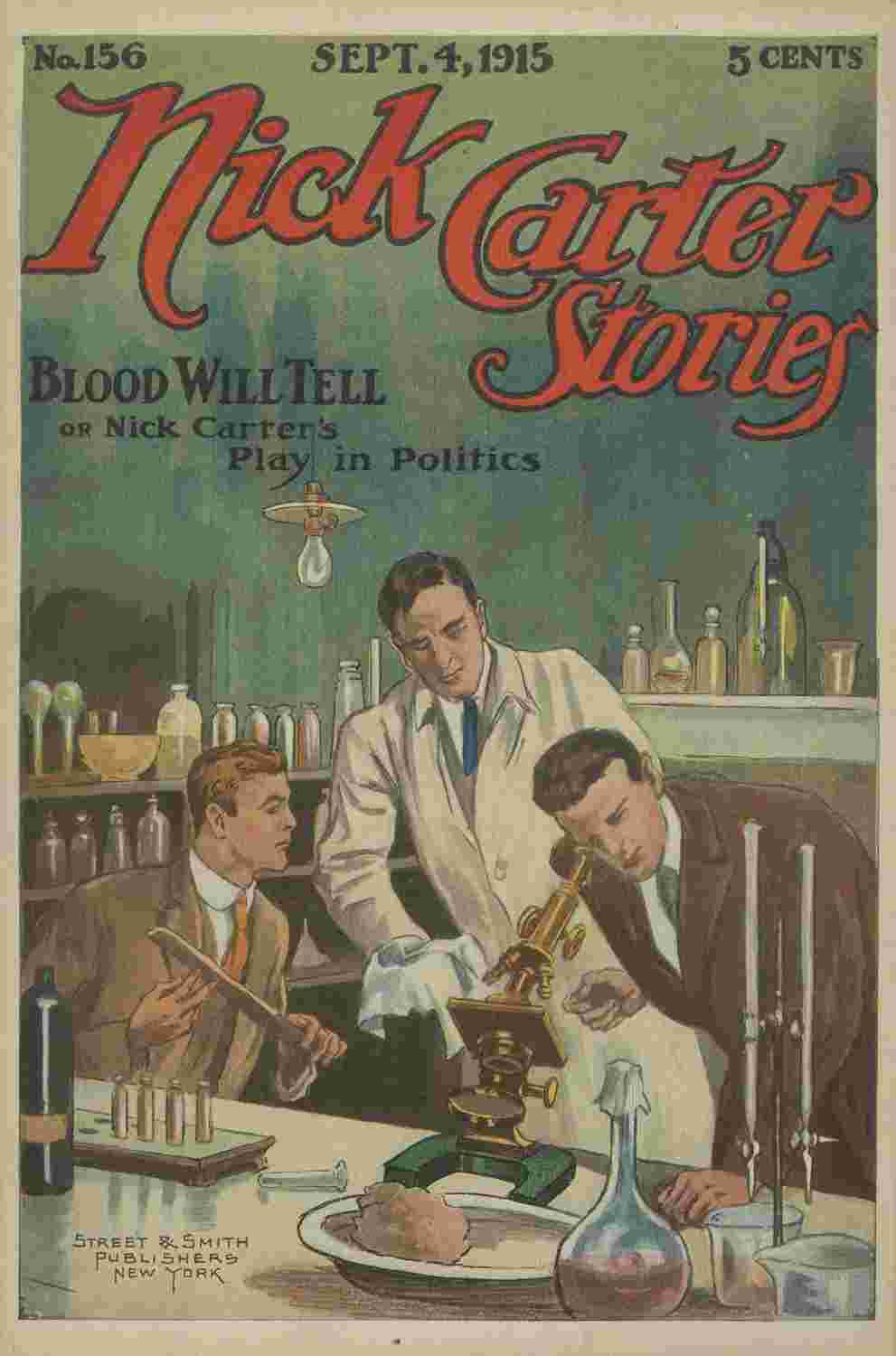
The Project Gutenberg eBook of Nick Carter Stories No. 156, September 4, 1915: Blood Will Tell; or, Nick Carter's Play in Politics
Title: Nick Carter Stories No. 156, September 4, 1915: Blood Will Tell; or, Nick Carter's Play in Politics
Author: Nicholas Carter
Contributor: W. Bert Foster
Bertram Lebhar
Release date: June 16, 2022 [eBook #68328]
Most recently updated: October 18, 2024
Language: English
Original publication: United States: Street & Smaith, 1914
Credits: David Edwards, Chuck Greif and the Online Distributed Proofreading Team at https://www.pgdp.net (Northern Illinois University Digital Library)
Issued Weekly. Entered as Second-class Matter at the New York Post Office, by Street & Smith, 79-89 Seventh Ave., New York.
Copyright, 1915, by Street & Smith. O. G. Smith and G. C. Smith, Proprietors.
Terms to NICK CARTER STORIES Mail Subscribers.
(Postage Free.)
Single Copies or Back Numbers, 5c. Each.
| 3 months | 65c. |
| 4 months | 85c. |
| 6 months | $1.25 |
| One year | 2.50 |
| 2 copies one year | 4.00 |
| 1 copy two years | 4.00 |
How to Send Money—By post-office or express money order, registered letter, bank check or draft, at our risk. At your own risk if sent by currency, coin, or postage stamps in ordinary letter.
Receipts—Receipt of your remittance is acknowledged by proper change of number on your label. If not correct you have not been properly credited, and should let us know at once.
No. 156. NEW YORK, September 4, 1915. Price Five Cents.
CHAPTER I.
THE WOMAN FOUND DEAD.
The telephone communication was from Arthur Gordon, the prominent New York banker and broker, then a candidate for election to Congress on the Fusion reform ticket—a communication so sensational in character and so imbued with alarm and anxiety on the part of the speaker, that it evoked only the following terse, decided response from Nick Carter, to whom the frantic appeal had been made:
“I will go right up there, Mr. Gordon. I will be there in ten minutes.”
“What’s the trouble?”
The inquiry came from Chick Carter, the celebrated detective’s chief assistant, when Nick arose from his swivel chair and hurriedly closed his roll-top desk.
“A murder has been committed, or said to have been,” he replied.
“A murder—where?”
“Columbus Avenue,” Nick said tersely. “Arthur Gordon is under arrest for the crime. The woman’s body was found by—but we’ll get the details later. You had better go with me. Luckily Danny is at the door with the touring car. We will lose no time.”
Both detectives were leaving Nick’s Madison Avenue residence when the last was said, hurriedly putting on their overcoats while entering his powerful motor car. In another moment both were seated in the tonneau and speeding north through the crisp air of the October morning. It then was nine o’clock.
Nick had hurriedly given Danny, his chauffeur, the Columbus Avenue address of the house in which the murder was said to have been committed, and he remarked, a bit grimly to Chick, while they settled back on the cushioned seat:[Pg 3]
“By Jove, it’s strange how Gordon repeatedly gets into trouble.”
“I should say so.”
“He certainly is up against it good and hard. It’s less than a year since we pulled him out of that scrape in which he was suspected of having killed his stenographer—that double-dyed rascal, Mortimer Deland, who fooled him so completely in female attire.”
“Yes, I remember,” Chick nodded. “But what is he now up against? What did he tell you?”
“I did not wait to learn many of the details,” Nick replied. “He has just been arrested by a plain-clothes man and a policeman. The latter was sent to his house by Detective Phelan, who evidently had learned enough to warrant his arrest.”
“Great guns! is it possible?”
“Gordon yielded submissively, of course, and was allowed to telephone to me.”
“Was he at his home in the Bronx?”
“No. He has been living with his parents in Riverside Drive during his present political campaign. His wife and her uncle, Rudolph Strickland, are with them. It is more convenient for Gordon to be in town while making his political fight, than at his Bronx residence.”
“By Jove, this comes at a bad time for him, Nick, if there really is any serious evidence against him,” Chick said gravely.
“A bad time, indeed.”
“We are almost on the eve of election. Gordon has put up a splendid fight against Madison, his Congressional opponent on the Democratic ticket. His election, though the possibility was ridiculed at first, now is conceded in many quarters, and it looks to me like a cinch—unless this affair turns the tide of public opinion,” Chick added, more seriously.
“That suggests something,” Nick replied.
“You mean?[Pg 4]”
“That this affair may be a frame-up, a dastardly scheme designed to have just the effect you mentioned. In other words, Chick, to throw Gordon down at the last moment and so insure Jack Madison’s election.”
“But Madison would not do such a beastly trick as that, nor even connive at it.”
“Don’t be so sure of it,” Nick said dryly. “Men with political ambitions, some men, at least, are capable of infernally wicked work. Madison is very anxious to carry this election, and so is the party machine. There is much depending on it.”
“That’s very true,” Chick allowed. “But I cannot believe Madison capable of such knavery, to say nothing of murder. Who is the victim?”
“Matilda Lancey.”
“The deuce you say! Her reputation is infernally bad in circles where she is well known.”
Both detectives had seen her occasionally and were aware of her shady reputation. She was a frequenter of the theaters, the best hotels and the fast restaurants, with a capacity for wine that made her, in one respect at least, a desirable patron, though in public she never went beyond certain discreet points.
Tilly Lancey, in fact, as she was familiarly known, enjoyed friendly relations with a small legion of fast society chaps and men about town, and was equally distinguished for her striking beauty, her fine figure, her costly jewels, and beautiful gowns. That she had met her death at the hands of a man of Arthur Gordon’s type seemed utterly incredible.
“Tilly Lancey, eh?” Chick muttered audibly. “So she has come to the end of her career. It has been hinted by some of the mud-slinging stump speakers, Nick, that Madison has been quite as friendly with Miss Lancey as the law allows, in view of the fact that he has a wife and family.”
“Still another reason, perhaps, why my suggestion has feet to stand on,” Nick replied. “There is nothing in speculating upon it, however, before we have learned just what has been done and what evidence has been found. Let her go lively, Danny.”
There was little occasion for the last. Danny then was running nearly at top speed up Fifth Avenue, guiding the flying car with the eye and hands of an expert.
Policemen on the crossings stared amazedly till they caught a glimpse at the face of the famous detective, and, when instantly recognized, they made no attempt to stop him. They knew that only an emergency case would take him at that high speed through the most fashionable New York thoroughfare.
Less than ten minutes had passed when Danny swerved to the curbing near the home of Miss Matilda Lancey. A taxicab was standing directly in front of the house.
It was a brownstone dwelling occupying a corner lot, one of a block of five, the house having three flats accessible through a single front door and entrance hall.
A policeman was standing on the steps. He was talking with a slender man in a plaid business suit, a man with an intellectual, or professional type of countenance, with wavy hair, a pointed beard, and gold-bowed spectacles. He had a wad of “copy paper” and pencil in his hand, and he turned quickly when Nick and Chick ascended the steps, asking politely:
“Do you object to my going in with you, Mr. Carter? I am a city news man. I will be very discreet as to the[Pg 5] story I turn in, or will be governed entirely by your wishes. I happened to be passing and saw Officer Gilroy on the steps. He told me a murder has been committed.”
“How did you happen to recognize me?” Nick inquired, pausing briefly and eying the man a bit sharply.
“I did not recognize you,” smiled the other. “Gilroy mentioned your name when your car stopped at the curbing.”
“Well, I don’t know myself just what has been done here,” said Nick. “I prefer not to grant your request immediately. You may wait here until I have looked things over, if you like, and if I then have anything to give you for publication, I will inform you.”
“Very well, sir. Thank you for that.”
“Which flat, Gilroy?”
“The first one, Mr. Carter,” said the policeman. “Detective Phelan is in there. Wait in the vestibule, Mr. Hawley, if you like,” he added to the reporter. “Mr. Carter will not forget you.”
Nick heard these added remarks, including the reporter’s name, while he entered the house with Chick. He noticed that there were several drops of dry blood on the polished, uncarpeted floor near the door of the first flat.
A polished stairway led up to the second floor. There were three women in mourning gowns seated on the upper stairs; with pale and awed gaze they turned upon the two detectives.
Nick found the door of the first flat ajar, and he entered without knocking. A large dark man about fifty years old was seated in one of the armchairs in the handsomely furnished front parlor, but he at once arose when the two detectives entered.
“I have been waiting for you, Nick,” said he, after a word in hearty greeting. “Gordon telephoned to me after his arrest, stating that you were coming here at his request, and asking me not to disturb things before you arrived. I have done very little in that line, so I decided to wait for you. That’s equivalent to admitting, you see, that I realize your head to be longer than mine.”
“Thanks, Phelan,” said Nick, smiling faintly.
“I’m thinking, however, that this job won’t require a very long head,” Phelan quickly added. “The truth sticks out all over it.”
“Involving Arthur Gordon?”
“I feel so sure of it that I sent a policeman, Jim Kennedy, to arrest him.”
“As convincing as that, is it?”
“That’s what, Nick, and there’s no telling what a man might do who has done a job of this kind. I thought I’d better get him without delay.”
Nick glanced around the room, noting a few drops of blood on the thick Wilton carpet, a scattered trail leading through a broad, curtained doorway into an adjoining room. One curtain of the portière was partly torn from its pins and was hanging awry from its walnut rod.
“Step in there and have a look,” said Phelan. “Nothing can be done for the woman, so I’ve not called a physician. She was dead and gone long ago.”
Nick drew aside the portière and entered the adjoining room. It evidently had been used for a living room, or a[Pg 6] library. In the middle of it stood a table covered with newspapers, books, and magazines.
A desk between two windows overlooking the side street, the roller shades of which still were drawn down, had been broken open and some of its contents were scattered over the floor.
Against the wall of an adjoining bedroom, accessible from a passageway leading to a dining room and kitchen, stood a sofa, on which were several handsome silk pillows. Two of them were bespattered with blood.
On the floor near one end of the sofa lay the lifeless form of the woman. She was clad in a handsome evening dress. Her bare neck and shoulders were covered with blood. Her luxuriant auburn hair was in disorder, matted with blood that had flowed from several gashes in the scalp. The skull had been beaten in with a heavy bludgeon of some kind.
She was lying on her left side, with her head nearly touching the baseboard of the wall, from which her right hand appeared to have fallen after a desperate effort to reach it, or to continue doing so.
In confirmation of this there was a coarse, angular, irregular scrawl on the wall paper, several words evidently written with a tremulous hand by the woman, and inscribed with the tip of her forefinger dipped in her own life’s blood—a scrawl ending abruptly with a direct downward stroke toward where her right hand was then lying. It was as if she had expired, or lost consciousness, at least, while making a desperate effort to write more, enough to tell in full the tragic story.
The several slanting, irregular words were legible, however, and there was no mistaking their fateful significance.
They read:
“Arthur Gordon did this to get the——”
That was all save the last downward stroke left by the falling hand.
Was it enough?
Was it all that would be required to convict, to send her assassin over the same dark river?
These were the first questions that arose in the mind of Nick Carter.
CHAPTER II.
THE HEADQUARTERS MAN.
Nick Carter took in with a few swift glances those important features of the scene already mentioned. Instead of immediately beginning a more careful inspection, however, he turned to the headquarters man and said:
“Am I to understand, Phelan, that things are about as you found them?”
“Yes. Nothing has been disturbed, Nick, of any importance.”
“Was the woman lying in that position?”
“Yes. I have not touched the body. I saw that writing on the wall, and——”
“One moment,” Nick interposed. “Who discovered the crime?”
“A girl who lives in the second flat. She came down about eight o’clock to go out to work, and she saw spots of blood on the hall floor near the door of this flat.”
“I noticed them when I entered.[Pg 7]”
“She tried the door, and found it locked. It has an automatic lock. She then rang repeatedly, being acquainted with Miss Lancey, but she could get no response.”
“Does this woman live alone here?”
“Yes, so I am told, except when entertaining her friends.”
“I see.”
“The girl then called her mother, and they hunted for Gilroy, who is on this beat. He entered through the kitchen window, forcing it open, and he then saw what had occurred. I happened to be in the precinct station when he telephoned,” added Phelan, pointing to a telephone on a stand in one corner. “I came here with Kennedy, taking temporary charge of the case, and I soon found evidence enough to warrant sending him to arrest Mr. Gordon.”
“You mean that writing on the wall?”
“Yes, partly.”
“What else?”
“I found this letter in the wastebasket,” said Phelan, taking it from his pocket. “It must have been written by Gordon, for it is on a letter sheet bearing his business heading, as does the envelope in which it came.”
“Let me see them.”
“It was mailed at two o’clock yesterday. It contains only a single line addressed to Miss Lancey, stating that Gordon would call to see her here at eleven o’clock. That must have been eleven o’clock last evening.”
Nick glanced at the brief pen-written letter. He was familiar with Gordon’s writing, and he immediately recognized it. The letter seemed to corroborate all of Phelan’s statements.
“Did you think that was evidence enough to warrant arresting Gordon?” Nick again inquired.
“I thought it enough for a starter, Nick, at least,” Phelan bluntly asserted. “I reckon I have not shot very wide of the mark.”
“Why so?”
“Because Kennedy has phoned me of other facts.”
“Namely?”
“He met Dennis Regan, a detective from the precinct station, just before he arrived at the Gordon residence,” Phelan proceeded to disclose. “He told Regan what had occurred and whom he was after. Regan decided he would not butt in, knowing I was on the case, but he waited in the grounds south of the house while Kennedy went in to see Gordon.”
“Well?”
“While he was out there, pacing up and down the gravel walk, he noticed that one of the small branches of a clump of shrubbery was partly broken off and hanging down, as if something had recently been thrown in among the shrubs, disturbing the dry leaves that had fallen from them.”
“He went to examine them, I infer.”
“That’s what. He found under the dry leaves a double-jointed jimmy. It was parted at the socket each section being about eight inches long, and both were badly stained with blood.”
“Quite a remarkable discovery,” Nick observed, with brows knitting slightly. “Anything more?”
“Well, as far as that goes, this desk evidently was forced open with just such a jimmy,” Phelan continued, turning to the desk. “Here are marks on the wood, showing plainly where the curving, wedge-shaped point[Pg 8] was forced under the top to pry it up and break the lock.”
“I see,” Nick nodded. “That’s very evident, Phelan, indeed.”
“The jimmy found by Regan has just that kind of a point.”
“Still more evidence, eh?”
“I think so, Nick. It’s a safe bet, too, that this woman’s head was broken with the same jimmy. The fractures and gashes show plainly that a bludgeon of that kind was used.”
“I agree with you,” said Nick, crouching to inspect the several terrible wounds. “Both the fractures and gashes could have been caused only with a bludgeon having one or more edges. The jimmy is probably octagonal in shape.”
“Very likely. I did not inquire about that.”
“Well, what followed?”
“Regan then decided to dip into the case,” Phelan continued. “He went into the house and found that Kennedy had discovered other evidence.”
“What kind of evidence?”
“To begin with, Nick, Gordon refused to say where he was at eleven o’clock last night. Kennedy then told him about the murder and placed him under arrest. To make a long story short, for I have not all of the details, Gordon’s evening suit, which he admits having worn last night, was found spattered with blood.”
“H’m, is that so?”
“There are stains of blood in one pocket of his overcoat, also, as if the jimmy was disjointed and thrust into it after the murder. You can see for yourself that the weapon used by the assassin is missing.”
“Yes, so I have noticed.”
“In the other pocket of Gordon’s overcoat was a disguise, a false beard and mustache. They——”
“One moment,” Nick interrupted. “Gordon saw all of this evidence, I suppose.”
“Yes, certainly.”
“What did he say about it?”
“Nothing.”
“Nothing?”
“He refused positively to make any statements whatever,” Phelan explained. “He said he would not do so until after he had conferred with you. Regan then allowed him to telephone to you, and, while waiting for Gordon to get ready to accompany him, he phoned these facts to me.”
“Where is Gordon now?”
“On his way to police headquarters, if not already there,” said Phelan. “Both Regan and Kennedy went with him.”
“Taking the evidence mentioned.”
“Yes, certainly.”
“And that’s all you know about the case?”
“Isn’t that enough?” Phelan asked bluntly. “What more would you have? It tells the story plainly enough.”
“What story?” inquired Nick tentatively. “What is your theory?”
“It can be told with a breath,” Phelan declared. “Gordon came here to get something from this woman. His letter shows that he had an appointment with her at eleven last night. She refused to give him what he wanted, evidently something which he knew was in this desk. He came prepared to get it at any cost.[Pg 9]”
“I follow you,” Nick nodded.
“When he found that she would not give it up, he killed her with the jimmy and then broke open the desk with it. Here are stains of blood on the desk, showing that it was forced after the murder was committed.”
“That appears probable,” Nick allowed.
“Gordon probably found what he wanted, and then fled,” Phelan went on. “The woman afterward revived sufficiently to realize the situation, also that she was near her end. She must have been too weak to rise, or to make herself heard. But she dragged herself near enough to the wall to write these few words on it with the tip of her finger, dipped in the pool of blood. The smooches of blood on the carpet show plainly that she dragged herself over the floor. She evidently died, or fainted, before she could complete what she would have written. That’s my theory, Carter.”
“Very good,” said Nick, a bit dryly. “All that seems very logical, Phelan, and you’re some theorist. I will look around a bit, however, and see what more I can find.”
“Go ahead,” Phelan nodded. “The day is young.”
It then was only half past nine.
Instead of immediately doing so, however, Nick abruptly changed his mind. He turned to Chick and said:
“I first must see Gordon and see what he has to say. His statements may be of aid in making an investigation. I can run down to headquarters with my car and be back here in half an hour.”
“Easily.”
“Let nothing be disturbed until I return. Admit no one, Phelan, nor give out anything for publication. Gordon is in a position to be ruined politically by this affair. I know he is the last man in the world, however, to have committed such a crime as this.”
“I agree with you, Nick, to that extent.”
“And that leads me to think it may be a frame-up, that some one is out to turn him down. I want his side of the story. I will return within an hour.”
“We’ll wait,” nodded Phelan.
“In the meantime, Chick, have a look at the back door and windows, also those in the basement, as well as the basement stairs,” Nick then directed. “Seek evidence, aside from that left by Gilroy, denoting that others were here last night and that the flat was stealthily entered.”
“I understand,” said Chick, removing his overcoat. “You go ahead and see Gordon. I’ll make sure that nothing is tampered with before you return.”
Nick hastened out by the way he had entered.
The reporter, Hawley, still was waiting in the vestibule.
“Well, Mr. Carter, what may I——” he began eagerly.
“Nothing doing,” Nick interrupted, pausing only for a moment. “The less you publish at present, the better I shall like it.”
“You mean——”
“That’s all I mean, and all I can remain to say. Bear it in mind, Mr. Hawley, and be governed accordingly.”
Nick did not wait for an answer, nor to note the effect of his somewhat curt remarks. He at once ran down the steps and entered his touring car.
“To police headquarters, Danny, at top speed,” he directed. “We have a rapid-fire case on our hands.”
Hawley came out on the steps and gazed after the speeding car. He now was frowning darkly. There was an[Pg 10] anxious gleam and glitter deep down in the narrowed eyes back of his gold-bowed spectacles. His pointed beard twitched and quivered perceptibly while he bit his lower lip.
After a moment, nevertheless, he turned calmly to the policeman and asked, with curious coolness:
“Where has he gone?”
“Give it up,” said Gilroy tersely. “He never tells where he’s going, nor what he has up his sleeve. Nick Carter isn’t that kind.”
“He might have said, at least, whether I could enter the flat and——”
“Rats!” Gilroy growled. “Did you want it written down with a slate and pencil? He as much as said you couldn’t enter. There’s nothing for you in waiting.”
Hawley waited, nevertheless.
CHAPTER III.
NICK TAKES A CHANCE.
Nick Carter found Gordon seated in a detention room at police headquarters, accompanied by Regan, Kennedy, and the police commissioner.
The two officers had arrived with their prisoner several minutes before, bringing also the evidence mentioned by Phelan. Despite the persuasive arguments of the commissioner, however, for the two men were personal friends, Gordon had positively refused to make any statements about the case, or to discuss the threatening situation in which he was involved.
He sprang up eagerly, nevertheless, when Nick entered, and a tinge of color appeared in his pale cheeks. He extended his hand, saying fervently:
“Thank Heaven, Carter, that you have arrived. I was just about to request that I might telephone to you again. I seem to be in a deucedly bad mess. I can depend only upon you to pull me out of it.”
“I will try to do so, Gordon, of course,” Nick replied, after a word of greeting for the others. “Have you told——”
“I have told nothing,” Gordon interrupted. “Nor will I, Nick, except in a private interview with you. I then will state all that I know about this infernal business.”
“Well, that can be arranged, I think,” Nick replied, turning to the commissioner. “Have you any objection?”
“None whatever, Nick,” was the reply. “I know of no man I would rather have on the case. Go as far as you like.”
The commissioner at once withdrew with Regan and Kennedy, and Nick took the chair the former vacated.
“Now, Gordon, hand me straight goods and be quick about it,” he said forcibly. “I have been to Tilly Lancey’s flat and know what has been found there, also what Regan and Kennedy have discovered that appears to incriminate you. It goes without saying, however, that I don’t take much stock in it. I must have the whole truth from you, nevertheless, if I am to pull you out of the fire.”
“Have you seen——”
“Don’t delay to question me,” Nick interrupted insistently. “I shall see all there is to be seen. Merely answer my questions as briefly as possible. Did you call on Tilly Lancey last evening?”
“Yes, I did,” Gordon admitted.[Pg 11]
“Did you mail her a letter stating that you would visit her at eleven o’clock?”
“Yes.”
“For what? What relations have you had with a woman of her stamp?”
“That can be quickly told,” said Gordon. “I was stopped on Fifth Avenue three days ago by a fashionably dressed woman, closely veiled. She asked me to give her a few minutes’ conversation, stating that she had important information for me, something that would have a favorable bearing upon my election to congress.”
“You consented?”
“Yes.”
“What followed?”
“She then said that she had in her possession a package of letters written to her by my political opponent, John Madison, the nature of which, if made public, would ruin him politically and insure his defeat.”
“H’m, I see.”
“She said that she would allow me to read them, that I might judge for myself of the effect their publication would have, and to which she would consent on conditions that she would state after I had read the letters.”
“What reply did you make?” Nick questioned.
“Naturally, being very anxious to carry this election, I questioned her further,” said Gordon. “She would reveal nothing more definite, however, unless I would call on her and examine the letters.”
“Do you mean, Gordon, that she did not then reveal her identity?” Nick inquired.
“Oh, no, not that,” Gordon said quickly. “I told her that I would not consider such a proposition from any unknown woman. She then drew her veil aside and I recognized her.”
“Matilda Lancey?”
“Yes.”
“You say you recognized her,” said Nick. “How long have you known her?”
“I never spoke to her before in my life,” Gordon earnestly assured him. “I long have known her by name and reputation, however, and I at once decided that I would not consider her proposal.”
“Quite right, I’m sure.”
“I told her so, Nick, but she insisted upon my taking her address and her telephone number, lest I should change my mind,” Gordon went on. “She said that I could communicate with her, in that case, and that was all during that meeting.”
“Well, what more?”
“I did not then intend to give the matter another thought,” said Gordon. “I could not keep it out of my mind, however, for I am having a hard political fight and seeking every possible lever with which to swing the election my way.”
“In short, Gordon, you finally decided to call on Tilly Lancey and read the Madison letters,” said Nick, interrupting.
“That’s the main point. I did, Nick, and I tried to get her by telephone yesterday morning,” bowed Gordon. “I was unable to do so, however, and I then wrote a line to her and dropped it in the mail when I went out to lunch.”
“Did you afterward hear from her or try to telephone to her?”
“No. I took it for granted that she would receive my[Pg 12] note and that I would find her at home at the time mentioned.”
“Why did you set so late an hour?”
“Because I had a political appointment which I knew would detain me until nearly eleven o’clock.”
“Enough of that, then,” said Nick. “It covers that part of the ground. At what time did you arrive at her flat?”
“It was after eleven, nearly half past.”
“You found her at home?”
“Yes.”
“Alone?”
“Yes, so far as I knew.”
“What followed?”
“I had removed my—but I am getting ahead of my story,” Gordon broke off. “Knowing the reputation of the woman, Nick, and that my face has become a very familiar one because of the political placards about town, and apprehending that I might be recognized, if seen going there, and incur adverse and unjust criticism, I resolved to visit her in disguise.”
“I see,” said Nick, without further comments.
“As I was saying,” Gordon continued, “I removed my disguise in the vestibule, and Miss Lancey admitted me a moment later. She invited me into the room back of the front parlor.”
“I know,” Nick nodded. “What then occurred?”
“She then came to the point and said plainly that she wanted to sell me the letters Madison had written to her. She stated that they were of so compromising a character that, if published, his defeat in the coming election would be inevitable.”
“That’s about what I suspected,” Nick remarked.
“She offered to give them to me and permit me to have them published, either personally or indirectly, for ten thousand dollars. She did most of the talking, Nick, and that’s about all that was said.”
“You mean——”
“I mean, of course, that I would not resort to such despicable means even to insure my election,” Gordon interrupted more forcibly. “I told her so, also what I thought of her and her proposition, and I then left the house.”
“Did she accompany you to the door?”
“No. I departed in haste and disgust, both for her and myself, for having gone there.”
“What was she doing when you left?”
“She was seated on a sofa in the rear parlor. I paused in the vestibule only to replace my disguise, and I then hastened home. That was the last I saw of her, or want to see.”
“I understand.”
“You can imagine my amazement and consternation, therefore, when I was arrested this morning for having murdered her, to say nothing of being confronted with such evidence as has been discovered,” Gordon added. “I tell you, Nick, nevertheless, that I——”
“Never mind telling me, Gordon, for time is of value,” Nick again interposed. “Merely answer my questions. Did you see the package of letters she claimed to have had?”
“I did not, Nick. She said they were in her desk.”
“Was the desk closed?”
“Yes, and locked. It is a roll top, which locks auto[Pg 13]matically when the cover is rolled completely down. I noticed that it was tightly closed.”
“It was locked, Gordon, all right,” said Nick. “Did you remove your overcoat while talking with Miss Lancey?”
“Yes.”
“Did you put it on before leaving the flat?”
“No. I put it on after reaching the street. I merely took my disguise from the pocket and put that on while in the vestibule,” Gordon thoughtfully explained. “I then hurried out to the street. I may have walked half a block before putting on my overcoat, for I was feeling a bit warm and resentful. It irritated me that the woman thought me capable of such beastly business.”
“She sized you up from her own standpoint,” Nick remarked. “Can you in any way account for spots of blood on your suit, your overcoat, and in one of the pockets of the latter?”
“No, Nick, most emphatically,” Gordon declared. “I am entirely in the dark.”
“Am I to understand, then, that you now have told me all that you know about the crime, or any circumstances that might have a bearing on it?” Nick inquired.
“Yes, absolutely all,” said Gordon. “I know nothing whatever about the crime itself, Nick, nor have I the slightest suspicion as to who committed it.”
“How did you return home?”
“I took a subway train.”
“Were you then in disguise?”
“No. I removed it before arriving at the subway station, and thrust it into my pocket.”
“Did you meet any one with whom you are acquainted?”
“I don’t think so. I noticed no one. I hurried home and went directly to bed. Really, Nick, that is all I can tell you.”
“That will answer, then,” said the detective. “Are these the articles brought from your residence?”
“Yes.”
Nick had arisen abruptly and turned to a table near one of the walls. Lying on it were the disjointed sections of a burglar’s jimmy, one of which was stained with blood; also Gordon’s evening suit, his overcoat, and the disguise worn the previous night.
Nick examined all of them carefully, noting the spots of blood on the black suit, consisting of several scattered drops on the left sleeve and left pants leg, as if bespattered from a gushing wound.
There was only a single spot on the overcoat, however, and that was near the bloodstained pocket.
“It’s a mystery to me, Nick, a damnable mystery,” said Gordon, after waiting for the detective to express an opinion. “This is likely to ruin my chances of election, to say nothing of——”
“Say nothing is what you must do,” Nick interrupted. “I will try to ferret out the truth, Gordon, before the publication of the superficial facts can do you any harm.”
“A thousand thanks, Nick,” said Gordon gratefully. “I knew I could depend on you.”
“We will confide in the commissioner, however, and I think I can prevail on him to liberate you and state that your arrest was due to a mistake.”
“Really? I would be doubly grateful for that.”
“The commissioner knows you as well as I do, Gordon, and he will realize that your defeat in the near election may result from holding you under arrest. That must be prevented, if possible.[Pg 14]”
“I will return home, Nick, and remain there subject to his orders,” said Gordon, eager to bring it about. “Or he can have an officer go there to watch me.”
“I think I can make him see, Gordon, that you are most likely the victim of a plot, rather than guilty of this crime,” Nick replied. “All this will necessitate my breaking a record to find absolute evidence in proof of it, however, and I shall leave you immediately after talking with him. You keep your mouth closed after that, and be patient till you hear from me.”
“I will do both, Nick,” Gordon assured him.
“I’ll be off, then, after a talk with the commissioner. Come with me. I also want him to hold these articles subject to my order. I think I may find a use for them.”
CHAPTER IV.
NICK’S CAPITAL WORK.
Nick Carter easily won the commissioner to his own views, and he then returned at top speed to the Columbus Avenue flat. None could have realized more keenly that time was of value, that the political fate of his friend and client, to say nothing of his life, even, depended upon what he could quickly accomplish.
Nick felt that he was equal to the emergency, however, as well as sure of his man, and he was shaping his course accordingly. It was precisely half past ten when he arrived, for the second time, at the home of the murdered woman.
Hawley, the reporter, still was waiting for information. Other reporters had arrived and were blocking the steps. Most of them recognized the detective and awaited him eagerly.
“Nothing doing, gentlemen, at present,” said Nick, threading his way between them. “It’s too early in the game. Wait till I have dug up something definite.”
“But I have been told that the Honorable Arthur Gordon has been arrested on suspicion,” said a persistent one. “Is that true, Mr. Carter?”
“No, no, quite the contrary,” Nick coolly asserted. “Gordon went down to headquarters voluntarily, merely to explain certain circumstances that seemed at that time to have a bearing on the case. That was all a mistake. Gordon is at liberty and has returned to his residence in Riverside Drive. If you publish anything to the contrary, you will make a most egregious blunder.”
“But he was placed under arrest, wasn’t he?” Hawley demanded impulsively.
Nick swung round and eyed him more sharply. There was something about him he did not fancy, something that in a vague way impressed him that they had met before, but he then was in too great haste to seriously consider the fleeting impression. He lingered only for a moment, replying a bit curtly:
“No, no, there has been no arrest. Nothing of the kind. No arrests will be made, in fact, until evidence is found that will warrant it. That’s all, gentlemen, at present.”
Nick turned with the last and strode into the hall.
Hawley gazed after him furtively, with eyes dilating and his pointed beard twitching nervously. He remained only for a moment longer, then descended the steps and hurried away.
Nick found Chick and Phelan patiently waiting for[Pg 15] him, though the former immediately greeted him with anxious inquiry.
“Well, is it as bad as it looks?”
“It’s bad enough, Chick,” Nick replied, removing his overcoat and tossing it on a chair in the front room.
“I reckoned you’d think so,” said Phelan.
Nick turned and replied more impressively:
“That isn’t all I think. I am going to confide in you, Phelan, and tell you what I have done and why I have done it.”
Phelan instantly turned more grave.
“It goes without saying, Nick, that whatever you do or have done will be for the best,” he replied. “Do you think I made a mistake in having Gordon arrested so quickly?”
“It would have been better to have deferred it,” said Nick. “I admit, nevertheless, that the circumstances seemed to warrant it.”
“I certainly thought so.”
“That’s neither here nor there, now, for I have talked with the chief and had Gordon liberated. I gave the chief my word that I would find evidence refuting that involving Gordon, and that I would also run down the real criminals. It now is up to me to make good.”
“I hope you’ve not bitten off more than you can chew,” said Phelan inelegantly.
“I don’t think so.”
“What did Gordon say for himself?” Chick inquired.
Nick then told both what Gordon had stated, also his own reasons for the steps he had taken.
“Either he did this, or he did not,” he said forcibly in conclusion. “I feel sure he did not. Who did kill this woman, then, and with what motive? We now will try to find out.”
“Gordon’s story certainly is a plausible one,” Chick declared. “It explains his visit, his letter, and why the disguise was in his pocket. All were mystifying points, as well as seriously suspicious.”
“But think what it doesn’t explain,” argued Phelan, still doubtful. “If others killed this woman after Gordon departed, and if he went directly home, as stated, how came blood on his garments, even in his overcoat pocket, as if that gory jimmy had been carried away in it? How came the jimmy under shrubbery in Gordon’s grounds? It must be the jimmy with which the woman was killed. Where are the Madison letters, if he didn’t get them, and why——”
“Hold your horses, Phelan,” Nick interrupted, then hurriedly searching the open desk. “Don’t ask so many questions. They cannot be answered in advance of an investigation. We have only Tilly Lancey’s word for it, mind you, that a package of Madison’s letters were here, aside from the fact that some one broke into the desk. They are no longer here, at all events, for I have searched it thoroughly.”
“By Jove, this may have been a job to kill two birds with one stone,” said Chick.
“What d’ye mean?” Phelan growled.
“A job not only to get the Madison letters, but also to do it in such a way to fix the crime upon Gordon and defeat him in the coming election.”
“Humph!” grunted Phelan.
“Could you find any evidence, Chick, that others were here last night?” Nick paused and inquired.
“Not an atom, Nick.[Pg 16]”
“You searched——”
“Everywhere,” Chick interrupted. “The only window tampered with is that through which Gilroy entered this morning. There is not a sign of anything more. If others were here, they must have been admitted by the woman herself or——”
“Stop a moment,” Nick cut in. “Here is a partly written letter addressed to a woman named Cora, merely an invitation to dine.”
“That’s Cora Cavendish,” said Phelan. “She has been Tilly Lancey’s running mate for a year. She’s a bird of the same feather.”
“Where does she live?” asked Chick.
“She has apartments in the Nordeck, in Forty-fourth Street. She’s a fly jade, if ever there was one.”
“Possibly, then——”
“Wait!” Nick again interrupted. “Here’s an important point. It convinces me that I am right.”
“Right in what?” came from Phelan.
“That Tilly Lancey did not write these words on the wall.”
“Great Scott! Is that so? What’s the point?”
Nick displayed the partly written letter found in the desk, then turned to the wall on which the incriminating words were inscribed.
“Notice the capital A in Gordon’s given name,” said he, pointing. “It has the proper form for the capital. Here, in this letter, are no less than three of the same capitals, and all of a different shape.”
“How different?”
“They are the enlarged form of the small letter, a form which many persons use when writing that capital,” said Nick. “If it appeared only once, it might be attributed to chance, but all three show plainly that Tilly Lancey habitually wrote the capital A in the form of the small letter. Here is the other form, however, in this writing on the wall. Don’t expect me to believe that this woman would, under such circumstances, have changed her habit of writing.”
“By Jove, that is important,” said Chick, eyes lighting.
“But why blood on the tip of her forefinger?” Phelan protested. “Isn’t that enough evidence that she——”
“It is not reliable evidence,” Nick objected, interrupting.
“But the size of her finger tip corresponds with the marks on the wall.”
“That cuts no ice,” Nick again insisted. “Clever crooks, bent upon this deception, would have dragged the woman near enough to the wall, after killing her, to grasp her lax hand and finger and forced it to inscribe the desired words. That is precisely what was done. This inconsistency in the capital A alone convinces me of that.”
“I am not so sure of it, Carter, all the same,” Phelan still objected.
“Well, I am, Phelan, and I was reasonably sure of it from the first,” said Nick.
“Why so?”
“Notice her fractured skull. Such wounds are prohibitive. Tilly Lancey did not recover consciousness, to say nothing of having revived sufficiently to write these words. Furthermore, if she had, she would not have done so.”
“You mean?”
“Here is the telephone stand scarce three feet away,” Nick continued. “With consciousness and reason re[Pg 17]stored, and sufficient strength to have dragged herself to the wall and written these words, she would have taken a simpler method to expose her assailant.”
“You mean with the telephone.”
“Certainly. It was directly in front of her. She must have seen it. Even if she could not rise, she could have tipped over the stand and got hold of the instrument. In half the time it would have taken her to dip her finger in blood and write these words, she could have told the whole story to a telephone operator, or even have called up the police.”
“By gracious, Nick, that admits of no argument,” said Chick emphatically. “She surely would have done so. The several circumstances combined leave no room for a doubt.”
“I think so, too,” Phelan nodded. “I guess you are right, Carter, after all. I blundered like a fool in getting after Gordon so quickly.”
Nick did not reply.
Crouching beside the corpse of the murdered woman, he took a lens from his pocket and examined her bloodstained finger tip, her hand and wrist, the several wounds in her matted hair, and then he surprised both of his observers by taking out his own handkerchief and dipping it in some of the partly congealed blood, afterward folding it and replacing it in his pocket.
“What’s that for?” Phelan inquired, with brows knit perplexedly.
“Further study,” Nick tersely replied, rising. “I am going to leave you, Phelan, to notify the coroner and take the necessary legal steps. Bear in mind, however, that all this is strictly confidential for the present. Publication might prove disastrous.”
“Trust me,” Phelan assured him. “I’m dumb, Nick, till you remove the seal of silence. You have something else up your sleeve, I infer.”
“Exactly.”
“Go ahead, then, and good luck. I’ll look after things here while you get in your work.”
“Good enough, Phelan,” said Nick, shaking hands with him. “I’ll reciprocate in some way when——”
“Cut that!” Phelan interrupted. “You know I am always at your service. Go ahead and get in your work.”
Nick did not delay his departure. He left the house with Chick and returned to his touring car.
“Home, Danny,” he directed. “I’ll let him drop me there, Chick, and then take you to headquarters. I want Gordon’s garments and that bloodstained jimmie. Tell the commissioner I will be responsible for their safe return. Bring them to the library.”
CHAPTER V.
NICK CARTER’S ANALYSIS.
“Yes, it is human blood. There is no question about it. It is human blood—but not from the veins of Matilda Lancey.”
These declarations came from Nick Carter about three o’clock that afternoon. They were addressed to Chick and his junior assistant, Patsy Garvan.
All three detectives then were seated at a broad zinc-covered table in Nick’s finely equipped laboratory, a large rear room in his Madison Avenue residence.
Lying on the table were the bloodstained articles belonging to Arthur Gordon, the disjointed jimmy, and also[Pg 18] the handkerchief which Nick had dipped in the blood of the murdered woman.
Near by stood a costly microscope, a stand of small test tubes, several vials containing chemicals, together with numerous other articles which Nick had been using.
He replaced on the table one section of the jimmy, while speaking, and Patsy took it up to gaze at the dark-red stains on it, remarking, with some surprise:
“Human blood, chief, but not from the veins of the murdered woman? Gee whiz! that’s mighty significant. Are you sure of it?”
“Absolutely sure,” said Nick.
“You now have tested the blood on each of these articles?” Chick inquired.
“Yes.”
“And the results are convincing?”
“Decidedly convincing,” said Nick, with a look of satisfaction on his strong, clean-cut face. “There is no question as to the reliability of a microscopic examination of particles of blood, if made by a person thoroughly informed on the subject. I have, as you know, made an exhaustive study of it.”
“I am aware of that, Nick, of course.”
“The blood of no two creatures is precisely alike,” Nick continued. “Under the microscope, and with proper tests, that of two human beings, even, presents certain distinct differences, often by a small margin, of course, but nevertheless clearly distinct.”
“So I have read,” Chick nodded.
“It is perfectly easy to tell the blood of a white man from that of a negro, that of a lower animal from that of a man, or that of one animal from that of another, as well as to determine the animal from which it comes. That is because the blood of each crystallizes in invariable definite forms.”
“Gee, that’s some study!” Patsy remarked sententiously.
“The existence of disease is also apparent under the microscope and with proper tests,” Nick went on. “Science immediately recognizes one from another. Thin, anæmic blood presents a distinctly different appearance from the strong, rich blood of a vigorous person. That’s the very point, in connection with this case, without further elaboration on the subject.”
“These bloodstains tell the story, do they?” questioned Patsy.
“They tell part of it, Patsy, with absolute certainty,” Nick replied. “The blood on my handkerchief, which we know positively came from Matilda Lancey, is very rich with red corpuscles, obviously that of a strong, healthy woman.”
“Tilly Lancey looked it,” Chick observed.
“The blood on these articles, however, shows a distinct difference,” said Nick. “There is a decided lack of the red corpuscles. It is thin and anæmic. It is human blood, nevertheless, and it came from a woman. The proportion of red corpuscles in the stains on each of these articles, with the exception of my handkerchief, plainly shows that same anæmic condition.”
“In other words, then, the stains on the jimmy and on Gordon’s garments are not caused by the blood of Tilly Lancey,” said Chick.
“They are not,” Nick replied. “I am absolutely sure of that. It is distinctly different from the blood on my handkerchief. That on these other articles came from a[Pg 19] rather frail and delicate woman, very probably with a tendency to consumption.”
“Gee whiz! that suggests something to me, chief,” said Patsy, drawing nearer the table.
“What is that?”
“I have frequently seen Tilly Lancey with the woman referred to by Phelan as her running mate, the woman named Cora Cavendish. She is just that type, chief, slender and noticeably pale, barring the rouge with which she hides it.”
“That is suggestive, indeed, Patsy,” Nick agreed. “But I already suspected that Cora Cavendish had a hand in this job.”
“Why so, chief?”
“Because I now am sure that it was a frame-up, and because the intimacy between Cora Cavendish and Tilly Lancey, now knowing that the blood on these articles came from a second woman, probably made the job possible.”
“I see.”
“In other words,” Nick added; “I suspect that Cora Cavendish and one or more confederates are responsible for the whole business. I’m doubly sure of it, in fact, if she is that anæmic type of woman.”
“By Jove, I think you may be right,” said Chick, more earnestly. “But there are a good many points that I cannot fathom.”
“To begin with?” inquired Nick.
“We must assume that Gordon has told the truth, of course, and that he left Tilly Lancey alive just before midnight.”
“Certainly.”
“And that he immediately hastened home?”
“I have no doubt of it.”
“How, then, came the blood on his garments?”
“Bear in mind, Chick, that it is not Tilly Lancey’s blood,” said Nick. “It is some that was obtained for this job. The crooks knew that human blood would be required, as tests would surely be made after the crime; but they overlooked the fact, or were ignorant of it, that tests would reveal the difference between it and that of their victim.”
“You now think, I infer, that the blood was drawn from the veins of Cora Cavendish.”
“I do,” Nick nodded. “Only a small quantity would have been required. It could have been easily obtained by an incision in one of the veins of her arm, and received in a small vial.”
“But when and how could it have been spattered upon Gordon’s garments, to say nothing of the smooches in his overcoat pocket?”
“Easily,” said Nick.
“Tell me.”
“Assume, for instance, that several persons comprised the gang. They laid their plans, paved the way to execute them, and provided themselves with the blood required.”
“Well?”
“Tilly Lancey may have been duped into admitting one of them to her flat last night, possibly more, and they may have been concealed there during her interview with Gordon. That could have been craftily accomplished by Cora Cavendish, if she was out to deceive and murder her intimate friend.”
“I admit that much, Nick, of course,” Chick allowed.
“Tilly Lancey could have been killed, then, and prob[Pg 20]ably was, immediately after Gordon left the house,” Nick continued. “She was struck down with a jimmy, which was afterward used to pry open her desk, and later carried away by her assailants.”
“But you say the blood on this jimmy is not Tilly Lancey’s blood.”
“True,” Nick nodded. “This is not the jimmy used for the murder, mind you, but one precisely like it.”
“Ah, I see.”
“The crooks were working along fine lines,” Nick pointed out. “They wanted a weapon found that would correspond with the wounds inflicted. So they got two like jimmies, one of which they stained with blood and concealed after a fashion in Gordon’s grounds. I say after a fashion, Chick, because they designedly put it where it would soon be discovered.”
“Two like jimmies, eh?” said Chick. “You may be right. I think you are, in fact, or the blood on this one would be that of the murdered woman.”
“Surely. That’s the very point.”
“But who stained this one and put it where it was found?”
“Another of the crooks, one who was waiting outside of the house while Gordon was there,” said Nick. “He was the one who had the vial of blood, also the duplicate jimmy. The vial may have been provided with a stopper like those in the bottles used by a barber, from which a few drops can be easily shaken.”
“I see the point.”
“Gordon, mind you, did not put on his overcoat until after he had walked about a block,” Nick continued. “It would have been child’s play for the crook to have followed him, and, while passing him, to have stealthily dashed a few drops of the blood on his garments.”
“That’s right, chief, for fair,” cried Patsy. “There would have been nothing to it.”
“Gordon was a bit upset, moreover, and he did not afterward notice the spots on the black cloth, which would have quickly absorbed it.”
“All that is plain enough,” Chick admitted. “But how about the overcoat pocket. How was the blood put into that?”
“It would have been equally easy.”
“By what means?”
“Very much the same,” said Nick. “The crook could have continued to follow him, taking the same seat with him in the subway train. He could have stealthily soiled his own hand with a few drops of the blood, and then slipped it for a moment into Gordon’s overcoat pocket. Any sly fellow might do that.”
“Very true,” Chick nodded. “There is no denying it.”
“He then must have followed Gordon home, where he stained the duplicate jimmy with blood and hid it under the shrubbery. All would have been very simple and easily accomplished.”
“I now admit it, Nick,” Chick said thoughtfully. “But what about the drops of blood in the front room and hall adjoining the flat?”
“That was Tilly Lancey’s blood,” said Nick. “The crooks who killed her scattered that trail of blood, that it might indicate that it had dropped from the hand of her assassin when he left the house. That naturally would appear to have been Gordon.”
“I agree with you,” Chick again assented. “You cer[Pg 21]tainly have gone deep below the surface, Nick, and developed a plausible theory.”
“Plausible!” exclaimed Patsy, a bit derisively. “Jiminy crickets! that plausible gag don’t half express it, Chick. It’s a copper-riveted cinch. There’s nothing else to it.”
“There is considerable more to it, Patsy,” Nick corrected. “The theory alone is not enough. It might fall flat on the ears of a jury of boneheads. It’s not easy to penetrate solid ivory.”
“That’s right, too,” said Patsy, laughing.
“We must clinch it, therefore, by learning positively whether Cora Cavendish had a hand in this crime. We must discover the identity of her confederates, and round them up in such a way as to fix the crime upon them.”
“That’s the proper caper, chief, for fair.”
“Have you any suspicions, Nick, as to their identity?” Chick inquired.
“Aside from Cora Cavendish?”
“Certainly.”
“Yes.”
“On what do you base it, and whom have you in mind?”
“To begin with, Chick, I base it on the probable existence of the Madison letters, and the fact that they were missing this morning from Tilly Lancey’s desk. Bear in mind that she told Gordon about them and invited him to her flat to read them. She may have told Cora Cavendish about them, also, and if double-crossed by the latter, as I suspect, she certainly had no apprehension of being murdered when she invited Gordon to her flat.”
“Surely not.”
“It is a safe assumption, then, that the package of letters was in her desk last evening, as she told him.”
“True.”
“That is further confirmed by the fact that the desk was broken open by her assailants, who probably could not find the key. If the murder of Tilly Lancey was their only object, they would not have broken open the desk.”
“True again,” Chick nodded.
“There was a package of compromising letters, then, and they now are in the hands of the woman’s assassins—barring one very possible contingency.”
“What is that?”
“That the man who wrote them, whose reputation they evidently involved, was back of the whole job in order to get the letters, and to incriminate Arthur Gordon as to insure his defeat in the coming election. He now may have the letters.”
“Jack Madison,” said Chick.
“Yes.”
“It seems incredible that he——”
“Oh, I anticipate your objection,” Nick interrupted. “But as I told you this morning, Chick, men with political ambitions, some men, I mean, are capable of any degree of knavery.”
“That’s right, too, chief,” declared Patsy.
“Madison is a strong, aggressive, bulldog type of man, and his standing as a lawyer is far from the best,” Nick added. “He was abroad without his wife and family for several weeks last year and I happen to know that Tilly Lancey then was absent from New York. They returned at pretty near the same time. One must draw one’s own conclusions. Be that as it may, I suspect Madi[Pg 22]son of knowing something about this affair, whether he was responsible for it, or not.”