
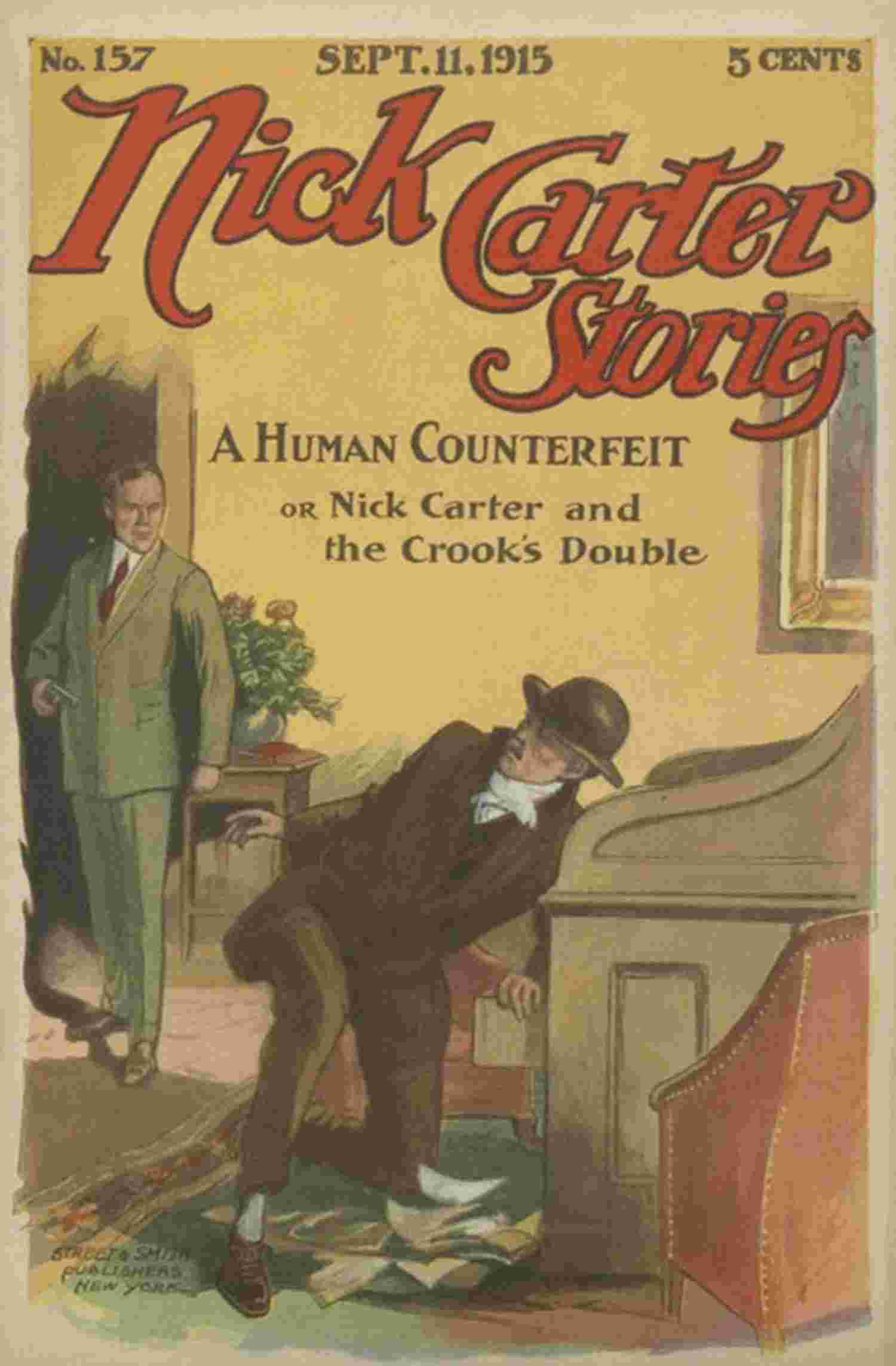
The Project Gutenberg eBook of Nick Carter Stories No. 157, September 11, 1915: A human counterfeit; or, Nick Carter and the crook's double.
Title: Nick Carter Stories No. 157, September 11, 1915: A human counterfeit; or, Nick Carter and the crook's double.
Author: Nicholas Carter
Bertram Lebhar
Release date: July 8, 2022 [eBook #68474]
Most recently updated: October 18, 2024
Language: English
Original publication: United States: Street & Smaith, 1914
Credits: David Edwards, Chuck Greif and the Online Distributed Proofreading Team at https://www.pgdp.net (Northern Illinois University Digital Library)
Issued Weekly. Entered as Second-class Matter at the New York Post Office, by Street & Smith, 79-89 Seventh Ave., New York.
Copyright, 1915, by Street & Smith. O. G. Smith and G. C. Smith, Proprietors.
Terms to NICK CARTER STORIES Mail Subscribers.
(Postage Free.)
Single Copies or Back Numbers, 5c. Each.
| 3 months | 65c. |
| 4 months | 85c. |
| 6 months | $1.25 |
| One year | 2.50 |
| 2 copies one year | 4.00 |
| 1 copy two years | 4.00 |
How to Send Money—By post-office or express money order, registered letter, bank check or draft, at our risk. At your own risk if sent by currency, coin, or postage stamps in ordinary letter.
Receipts—Receipt of your remittance is acknowledged by proper change of number on your label. If not correct you have not been properly credited, and should let us know at once.
No. 157. NEW YORK, September 11, 1915. Price Five Cents.
A HUMAN COUNTERFEIT;
Or, NICK CARTER AND THE CROOK’S DOUBLE.
Edited by CHICKERING CARTER.
CHAPTER I.
WHY WAS IT DONE?
“Extraordinary—that doesn’t half express it. I know of no word that would. To some extent, Nick, at least, men’s motives are usually discernible in their conduct. But in this case—why, there was nothing to it. It is utterly inexplicable. It was like a horrid dream, a hideous nightmare, or the mental abnormalities of a dope fiend.”
Nick Carter laughed and spread his napkin, with a significant glance at his chief assistant, Chick Carter, who sat at one side of the table, that of a private dining room in a new and fashionable New York hotel.
“Well, Mr. Clayton, if the story you have to tell warrants so remarkable a preface, it will be interesting, at least,” said the famous detective.
“Yes, Nick, and then some,” Chick agreed, smiling. “He so has aroused my curiosity that I really am all ears.”
“I don’t think I shall disappoint you,” said their companion, more gravely.
He was a fashionably clad man of thirty-five, of medium build and with clean-cut, attractive cast of features, smoothly shaved. There was in other respects nothing specially distinctive about him. He was the type of well-bred, well-informed, and thorough business man with which New York City abounds.
“Aside from the pleasure of having you dine with me, I am very glad of the privilege of telling you about my extraordinary experience,” he added, gazing across the table at Nick. “I want your opinion about it. I was tempted to call on you for advice immediately after it occurred, but there were many reasons why I did not do so. I have been terribly busy, you know, since the opening of the new Westgate six months ago, when the directors gave me entire management of the house. Busy, Mr. Carter, is [Pg 3]no name for it.”
“I can imagine so,” said Nick. “You certainly have a magnificent hotel here.”
“There is none better in the city, nor one more generously patronized by wealthy and fashionable people,” said Clayton, with a quiet display of pride. “We are getting the cream not only of local society, but also that of the traveling public. We are almost constantly crowded. It’s an honor, indeed, to be the sole manager of such a house.”
“I agree with you, Clayton, but you are the man for the position, I judge,” said Nick. “I guess the board of directors made no mistake.”
“It was partly due, perhaps, to my owning quite a block of the stock,” Clayton replied, with a smile. “Now, to return to the main matter, I will tell you of my extraordinary experience.”
“When did it occur, Clayton?” Nick inquired.
“Three months ago, Mr. Carter, during the first three days in September.”
“Three days, eh? It covered a considerable period.”
“A period of apprehension and anxiety beyond description.”
“Began at the beginning, Clayton, and tell me the whole business.”
“I can tell you only what occurred. It will be up to you to determine why it was done and what it signified.”
“I will endeavor to do so.”
“As is my custom once a week,” Clayton began, “I had been out to Washington Heights to dine with my mother, who dislikes hotel life and for whom I bought an attractive place out there three years ago. Miss Langham was with me, the young lady to whom I am engaged. She is the only daughter of Gustavus Langham, president of the Century Trust Company.’
“I am acquainted with him,” Nick observed.
“They have a suite here in the house,” Clayton added. “My only other companion was my chauffeur, Paul Hazen,[Pg 4] who was driving my touring car. We started to return about ten o’clock. We had covered less than half a mile, and had arrived at a point in the road where there are no near dwellings, when we were held up by a touring car that stopped as we were approaching, and at such an angle across the road that we could not pass it.”
“The occupants evidently had been waiting for you,” Chick remarked.
“So I presently learned, though I did not think so at the time,” Clayton replied. “One of the men in the car, the top of which was up and the side curtains on, had alighted and was looking at one of the front wheels. Two other men were getting out, and I inferred that they had met with a mishap. The moment we stopped, however, some twenty feet from them, all three approached my car, and one of them called me by name. I then supposed him a friend, whom I did not immediately recognize.”
“Was it a dark evening?” Nick inquired.
“Not at all. It was bright starlight.”
“What followed?”
“The spokesman of the party did not wait for an answer,” Clayton continued. “He drew a revolver and ordered me to get out of my car, saying that I must go with him. At the same time another drew a gun and held up my chauffeur.”
“What type of men were they?” Nick asked. “Did they appear to be ruffians?”
“Quite the contrary. They were well dressed and appeared like gentlemen, aside from their conduct. Each wore a full beard, however, and I at once suspected that they were in disguise.”
“A very natural inference, Clayton, under the circumstances.”
“They meant business, all right, for my protest was immediately checked with a more threatening command to get out of the car. I was told, nevertheless, that I would not be harmed, robbed, nor subjected to any serious inconvenience, providing I made no resistance. I was also told that their only purpose was to detain me from this hotel for a short time.”
“I follow you,” Nick nodded.
“Their spokesman, who did all of the talking, so informed Miss Langham and Hazen,” Clayton proceeded. “He commanded them to return to the hotel, and to state that I had left town for a few days. He warned them against disclosing the truth and making a stir over my abduction. He threatened, in case they did, that my life would be the forfeit. On the other hand, he promised that I should be liberated and allowed to return safely, if his instructions were rigidly obeyed.”
“Did you say anything to him except to protest against the outrage?”
“No. He wouldn’t permit it, and the interview lasted only a few moments. I saw plainly that I had no alternative but to obey, however, and I resolved to take the rascal on his word. I directed Hazen and Clara to obey the scoundrel, therefore, and to take no steps for a few days, at least.”
“I infer that they did so, since the outrage was not published.”
“Exactly. That was the reason.”
“You then went with the gang?”
“Yes. I had no alternative. Hazen was ordered to drive on with Miss Langham, and the gang waited until[Pg 5] my car had disappeared. I then was commanded to get into the other, which I did, taking a seat between two of the knaves in the tonneau.”
“Were there only three in the gang?”
“There was one other, the man who was driving the car.”
“Did he also wear a beard?”
“Yes.”
“All undoubtedly were in disguise,” said Nick.
“Sure thing,” Chick added. “Four bearded men in a bunch is very suggestive.”
“Continue. What followed, Mr. Clayton?”
“I then was blindfolded, but not bound nor gagged, though I was threatened with death if I made any disturbance. I decided to take my medicine quietly, and I so informed the rascals.”
“Otherwise you might have been roughly handled.”
“I inferred so. Ten minutes later, after a rapid ride in directions I could not possibly determine, I arrived at a house and I was guided to a room on the second floor. I have not the slightest idea where the house is located, for I was completely lost by the several turns the car had taken.”
“That was done in order to blind you.”
“No doubt.”
“What then occurred?”
“Then began the extraordinary part of the outrage,” said Clayton, with an expressive shrug of his shoulders. “The bandage was removed from my eyes. I found myself in quite a large room, the four walls of which were entirely hung with thick black cloth. Not a window or door, not a picture, not so much as a square inch of the wall paper, were visible.”
“By Jove, that was strange, indeed,” Chick remarked.
“Even the chandelier, pendant from a perfectly plain, plastered ceiling, also was covered with the same somber cloth. It was like opening one’s eyes in a chamber of horrors, or one draped in deepest mourning.”
Nick Carter smiled.
“The design of your abductors is obvious, Clayton,” said he.
“Do you think so?”
“I certainly do,” Nick nodded. “All that was done to prevent your seeing anything by which you subsequently could positively identify the room.”
“Well, well, that may be true, Nick, though I then was so affected by the mystery that that explanation did not occur to me,” said Clayton. “Nor, in fact, have I since thought of it.”
“What else did the room contain?” Nick inquired.
“Only two common wooden chairs and a narrow bed, the linen and blankets of which were perfectly plain.”
“Was the floor bare?”
“Yes. The appearance of it, however, indicated that a carpet had recently been removed.”
“Additional evidence that I am right,” said Nick, smiling again. “The rascals took care that you should see absolutely nothing by which you could identify the place. Was the room lighted with electricity, or gas?”
“Gas. One jet of the chandelier was burning.”
“What followed?”
“Only three of the scoundrels accompanied me to the room. I did not again see the fourth man until the evening of the third day of my captivity.”
“Well, what occurred?” Nick inquired.[Pg 6]
“The three men then wore black masks,” Clayton continued. “I was ordered to remove all of my clothing except my undergarments. I did so under protest, of course, and all of my discarded garments were taken from the room by one of the rascals, who passed out between two overlapping draperies and through a concealed door. He presently returned with a woolen bath robe, which I was told to put on.”
“And then?”
“A strong cord then was tied around my ankles, with about a foot of slack between them, which allowed me to hobble slowly, but effectually prevented me from flight, or attempting to do anything desperate. I then was invited to make myself at home, and told to be patient until I was liberated.”
“By Jove, that was a strange experience,” said Chick. “What do you make of it, Nick?”
“Wait till I have heard the entire story,” Nick replied. “Were you left alone in the room, Mr. Clayton?”
“Not for a moment, Nick, during all the time I was there,” said Clayton. “Two of the masked men withdrew. The third took one of the chairs and remained to guard and watch me. He was relieved by another about six o’clock the following morning, and the third relieved him about noon. This was repeated for three days and nights. Not once did I see either of them unmasked.”
“Did they talk with you?”
“Part of the time, but only on ordinary topics. They would not discuss the outrage in any respect, nor permit me to question them. On the morning following my abduction, however, I was given a pen and paper and ordered to write to Clara Langham, stating that I was well and comfortable, and that she and Hazen must not deviate from the instructions given them. I was told to add that my absence would not exceed three days. I afterward learned that the letter was mailed one hour later in New York.”
“It was dropped in town, Clayton, so that your whereabouts should not be indicated by the postmark,” said Nick.
“I inferred so, of course.”
“Were you well fed and properly treated, aside from your confinement?”
“Yes. I could not reasonably find fault. I was presented with the morning and evening newspapers, also with several magazines, and was permitted to read at will.”
“I see.”
“Not once, however, did I pass beyond those dismal black curtains, or get so much as a glimpse at anything outside of that somber room,” Clayton added, with some feeling. “Not once was I without the gloomy companionship of a masked man in one of the chairs. I saw only three of them, as I have said, but I was under frequent scrutiny of another, I am sure, whose evil eyes were watching me through some part of the somber draperies.”
“Did you hear him, that you feel so sure of it?” Nick questioned.
“No.” Clayton quickly shook his head. “I did not hear him, Nick, or see him, not once, but I frequently felt that some one was stealthily watching me.”
“And that continued for three days?”
“Yes. In the evening of the third day, Nick, my clothing was returned to me and I was told to dress. I then was blindfolded and guided from the house. Then fol[Pg 7]lowed another ride in the touring car, under the same conditions as before, and I was taken to a lonely road in an outskirt of Fordham.”
“And then?”
“I then was directed to follow the road for a quarter mile, when I would reach a trolley line into town,” Clayton said, in conclusion. “The four men then rode rapidly away, and one hour later I arrived at the Westgate, much to the relief of Miss Langham and my chauffeur, who were on the verge of reporting my abduction to the police. That’s the whole story, Nick. Now, as Chick asked, what do you make of it?”
Nick laid aside his napkin. The dinner had been progressing during Clayton’s recital, and coffee and cigars were in order.
“Well, I hardly know what to say,” Nick replied. “Have you notified the police, or taken any steps to identify your abductors?”
“I have not,” said Clayton. “They told me that any efforts along that line would be futile. I noticed the number on their touring car, but upon looking it up I found no such number. They had a doctored number plate.”
“Obviously, Clayton, they took every precaution, not only to hide their identity, but also to prevent you from identifying the house in which you were confined, in event of subsequent suspicions,” said Nick. “That they apprehended subsequent suspicion, moreover, shows plainly that they were paving the way for the execution of some later design.”
“That does seem reasonable. I have not thought of that.”
“Has anything since occurred that might have a bearing on the matter?”
“I know of nothing, Nick.”
“Everything in the hotel is all right, so far as you know?”
“Yes, indeed. Things could not be better.”
“I asked only because your abductors wanted to detain you from the hotel for a short time, or so one of them said.”
“Very true. But there is nothing wrong here. I am sure of that.”
“You have told me, then, all that you know about the affair, and you are without any suspicion concerning it?”
“Exactly. I have told you all, Nick, and am completely in the dark,” Clayton earnestly declared.
Nick knocked the ashes from his cigar and prepared to rise from the table.
“I have only this to say,” he replied, more impressively: “Be on your guard. Men never go to so much trouble, nor take such chances, Clayton, unless they have some definite and probably felonious design in view.”
“That’s true, Nick,” Chick put in.
“There certainly is something in the wind,” Nick added. “It is impossible to predict what it is, or when it will occur, but it is safe to say it relates to something with which you are identified. Otherwise, Clayton, you would never have met with such an experience. I can only warn you to be vigilant and constantly on your guard. A bomb may burst when it is least expected.”
“That’s right, too,” Chick declared, as they arose from the table. “No man, Nick, could say more.”
Mr. Chester Clayton thanked the detective for his advice and promised to be governed by it.[Pg 8]
Precisely one week later, at eleven o’clock in the morning, Nick Carter’s prediction was fulfilled.
A message from Clayton, addressed to Nick, and received in his library, called the detective to the Hotel Westgate.
It contained only half a dozen words:
“Come quickly. The bomb has burst.”
CHAPTER II.
AN AMAZING ROBBERY.
Nick Carter responded immediately to Clayton’s urgent message. It was half past eleven when he entered the magnificent new Westgate, and almost the first person he saw in the spacious and elaborately designed rotunda and main office was one of the house detectives, Nat Webber, with whom he was well acquainted.
Webber saw him entering and hurried to meet him.
“I am looking for Mr. Clayton,” said Nick. “Where will I find him?”
“He is with Mademoiselle Falloni, in her suite on the fourth floor,” said Webber, with his face reflecting no end of conflicting sentiments. “She’s up in the air a mile. So is Madame Escobar, who has the adjoining suite. Clayton has it all over both of them, however, for he’s in the air out of sight. It’s my opinion, Carter, that he has suddenly gone daffy, as mad as a March hare, or any old jack rabbit. There can be nothing else to it.”
“What do you mean?” Nick demanded. “What has occurred here?”
“I’ll tell you what I know,” said Webber. “If you can tell me what it means, Nick, you’ll be going some. About half past ten—stop a bit. Come here and let me show you. Do you see that door?”
He drew Nick toward the office inclosure while speaking and pointed to a door leading out of it to the right.
“Yes, certainly,” said Nick.
“That’s the door to Clayton’s private office,” said Webber. “There is an opposite door which opens into a corridor leading to one of the stairways, the ladies’ elevator, and the main dining room.”
“Well?”
“At half past ten,” Webber resumed; “Clayton was seen to leave the office inclosure and enter his private office. He closed the door, as he habitually does, denoting that he does not wish to be intruded upon. The clerks never interrupt him at such times except on very important business. Those are his instructions.”
“Well?” Nick repeated.
“About five minutes later Clayton came from the corridor and spoke to the head clerk, Robert Vernon, over the counter, directing the clerk to hand Mademoiselle Falloni’s jewel casket from the vault, remarking that she wanted them in her suite and that he would take the casket up to her.”
“Is that so?” Nick muttered, brows knitting.
There was no need for Webber to tell him of the tremendous value of Mademoiselle Falloni’s wonderful jewels. The world-famous prima donna, then singing Cleopatra with the International Grand Opera Company, had created a sensation and broken all records with her dazzling display of gems and jewels in her portrayal of Egypt’s ill-starred queen.
The precautions to preclude robbery, moreover, would[Pg 9] have seemed amply adequate to protect her. Three special detectives occupied her limousine during its run to and from the opera house. They guarded her dressing room between the acts. They watched her constantly when on the stage. From the moment her jewel casket was taken from the vault in the Westgate, in fact, until it was safely returned to it after each performance, these three trusty guardians never once lost sight of it.
Not less careful of her own costly jewels, which were deposited in the Westgate vault when not in use on the stage, was Madame Escobar, the celebrated Swedish contralto, to whom Detective Webber also had referred.
Half a million of money, in fact, was a conservative estimate of the value of both superb collections, though that of Mademoiselle Falloni greatly exceeded the other.
“Continue,” said Nick, gazing steadily at Webber. “Tell me the whole business.”
“That won’t take long,” returned the detective. “After five more minutes, Nick, Clayton again appeared at the office inclosure and asked for Madame Escobar’s jewel case. He remarked to Vernon that the two singers wanted to compare some of their diamonds, and that both caskets would presently be returned. Vernon did not for a moment suspect anything wrong. Who on earth, as a matter of fact, would have suspected Clayton of anything crooked? Vernon brought the jewel case from the vault and Clayton departed with it.”
“And then?”
“He came out of his private office a few minutes later, entering the clerks’ inclosure.”
“You mean through the door between the two offices?”
“Yes, certainly.”
“But when he came after the jeweled caskets, or the first one, at least, he came from the other door, and through the corridor.”
“Exactly.”
“What followed?”
“Vernon asked, when Clayton entered the inclosure, if it would not be wise to have me keep an eye on Mademoiselle Falloni’s suite,” said Webber. “Clayton asked him for what reason. I was standing near enough to hear both. Vernon replied that something might happen to the two jewel caskets, since he, meaning Clayton, had left the women alone with them.”
“What did Clayton say to that?” Nick inquired.
“Say to it?” Webber echoed. “He asked Vernon to explain, which he did, and Clayton then staggered all hearers, myself included, by declaring that he had not been out of his private office for nearly half an hour. Great guns, what a crust! Could you beat it? Could you beat it, Nick? The man has gone daffy, clean off his perch. He——”
“One moment, Webber,” said Nick, interrupting. “Where were you when Clayton came after the jewel cases?”
“Right here in the office.”
“Did you see him?”
“See him—certainly, Nick, I saw him.”
“Are you sure it was he, absolutely sure?”
“Rats!” Webber blurted derisively. “Sure of it? That’s a fat question. Do you think I’ve been hanging around here for six months and don’t know Chester Clayton by sight? I know it was he, Nick. I would stake my life on it. Here’s Vernon. Ask him.”
Nick turned to the head clerk, who had been listening[Pg 10] over the marble counter, within a few feet of which the detectives were standing.
“What do you say, Mr. Vernon?” he inquired.
“I can speak as emphatically as Mr. Webber,” was the reply. “I know positively that Mr. Clayton took both jewel cases from me.”
“You would not admit, then, that you could be mistaken?”
“Impossible—utterly impossible!” Vernon forcibly declared. “Why, Mr. Carter, he stood as near to me as you are at this moment. He is not a man who could be successfully impersonated by another.”
“Certainly not,” put in Webber flatly.
“His smooth-shaved face could not be duplicated,” added Vernon. “The man was Clayton, with Clayton’s features, eyes, voice, and manner of speaking. Furthermore, an impersonator, if that is conceivable, could not have had on Clayton’s clothing. I would have detected any change since morning. I noticed his suit, his navy-blue necktie, and his carbuncle scarfpin, when I gave him Mademoiselle Falloni’s jewel casket over the counter. Mistake—that’s utterly absurd, out of the question.”
Nick did not argue the point.
“How large is the casket?” he inquired.
“About a foot long and eight inches square on the ends,” said Vernon. “It is made of aluminum and it has two combination locks.”
“And Madame Escobar’s?”
“That is a leather-covered case, about half as large.”
“Both of these thefts, then, if such they are, took place in about twenty minutes?” said Nick inquiringly.
“Just about that, Mr. Carter,” Vernon nodded.
“What did Clayton say, or do, when informed of the circumstances?”
“He said very little, except to repeatedly assert that he had not been out of his private office,” said Vernon. “He appeared nonplused, completely staggered for a few moments, and then he suddenly ran through his private office and out into the adjoining corridor, where he began searching in all directions for a man who had been with him all the while in his private office—or so he said,” Vernon added significantly.
“Well, well, if that man can be found, he will corroborate Clayton and settle the——”
“But he cannot be found, Nick,” Webber put in forcibly. “Clayton cannot even recall his name. No man inquired for him at the desk. No man was seen going to the door of his private office. No man was seen to leave it. The elevator boy in that corridor is equally positive, on the contrary, that he saw Clayton twice on the stairs. Others saw him also, and it’s absurd to suppose all are mistaken.”
“You speak as if thoroughly convinced, Webber, that Mr. Clayton has stolen both jewel cases; that he has suddenly turned from an upright and honorable man and become a criminal,” Nick said, more forcibly.
“No, no, I don’t mean exactly that,” Webber quickly protested. “But the circumstances, Nick, certainly speak for themselves. What I really think is that Clayton has lost his mind; that his brain is turned by overwork, anxiety, and the thought of having property of such extraordinary value in the hotel vault. I think he removed the jewel cases in a state of mental aberration, from which he has not yet recovered. I don’t think he[Pg 11] now realizes that he did so, or knows what he has done with them.”
“Well, that is a more considerate view of the matter, at least,” Nick replied incredulously. “Did you overhear any conversation in the private office, Mr. Vernon, during the time Clayton claims to have been there?”
“I did not, Mr. Carter.”
“Could you ordinarily have heard it? Are voices audible to persons in the outer office when the door of the private office is closed?”
“Not unless they are raised considerably above an ordinary tone,” said Vernon. “One must speak quite loud to be heard outside.”
“Where is Clayton now?” Nick inquired.
“With Mademoiselle Falloni,” said the clerk. “He rushed up to her suite after his vain search for the visitor he claims to have had, and almost immediately he sent down the message I telephoned to you. He has not since been down here.”
“Call up my house again, Mr. Vernon,” Nick abruptly directed. “Tell whoever answers you that I want Chick and Patsy Garvan to come here immediately. Tell them to wait here for me, if they arrive before I return. Get a hall boy. I will go up to Mademoiselle Falloni’s suite at once.”
“Front!” shouted the clerk.
“The bomb has burst, indeed,” thought Nick, as he hastened toward the elevator.
CHAPTER III.
THE WOMAN WHO FAINTED.
The incidents depicted had transpired quickly. Only about half an hour had passed since the extraordinary crime was discovered, assuming it to have been a crime, rather than the irresponsible act of a man mentally unbalanced, as Detective Webber suspected.
Nick Carter did not have any faith in that theory, however, though he deferred forming any definite theory of his own until he had looked a little deeper into the circumstances. The startling news had spread through the house by that time, as appeared in the numerous guests who had gathered in the corridors, engaged in earnest discussions of the case, and observed by the detective while the elevator sped up to the fourth floor.
Nick was promptly admitted to the magnificent suite occupied by Mademoiselle Falloni and her two maids, and the scene in her apartments was about what he was expecting.
He found Mademoiselle Falloni completely prostrated by her loss. She was lying faint and pale on a luxurious couch in the parlor, in the care of her maids and a physician living in the house.
Madame Escobar, who had been called into the suite, was nearly as deeply distressed, but she had greater command of her feelings. She was in tears in an armchair.
Mr. Clayton, whom Nick had not seen since their dinner of a week before, now appeared to have gained his composure, and evidently was remaining there to do what he could to calm and encourage the two celebrated vocalists, both of whom had been guests of the hotel during the previous month of the opera season.
The only other person present was a stately, graceful girl in the twenties, as beautiful as the ideal of an old[Pg 12] master. She was very pale, however, with such manifest anxiety for Clayton that Nick immediately identified her as Clara Langham, the young lady to whom he was engaged.
“Ah, here is Mr. Carter, now,” cried Clayton, hastening to greet the detective. “We have been waiting for you, Nick. I have been trying to calm the ladies, and have succeeded only by predicting the speedy recovery of their jewels through your prompt work in this terrible case. Let me introduce you and tell you about it, that no time may be lost.”
“I already am informed of most of the known circumstances,” Nick replied, shaking hands with him. “Detective Webber and Mr. Vernon have told me. Time, as you say, may be of value.”
Clayton hastened to introduce the three ladies. The two victims of the crime brightened up perceptibly upon seeing the famous detective, though still with irrepressible sobs Mademoiselle Falloni begged him to restore her lost treasures, which Nick assured her that he would leave no stone unturned to do.
Miss Langham greeted him more calmly, saying, with girlish earnestness, nevertheless:
“I heard of the dreadful circumstances and that Chester was here, so I came to comfort him. Oh, please, Mr. Carter, don’t think for a moment that he is guilty of anything wrong. He is incapable of it. This is the outcome, I am sure of that terrible experience of three months ago, of which he has told you.”
“I think so, too, Miss Langham,” Nick replied.
“I am so glad to hear you say so. I felt sure of it the moment I heard of the terrible crime.”
“I will do all that is possible, Miss Langham, I assure you.”
Clayton then introduced the physician.
“Doctor David Guelpa,” said he. “Shake hands with Mr. Carter, doctor. He is the Hungarian specialist, Nick, who has quarters in Fifth Avenue. Luckily he was in his suite on this floor, however, when Mademoiselle Falloni was informed of the robbery. For she fainted dead away, and since has been in hysterics. I sent for Doctor Guelpa, and he came immediately.”
“I am pleased to know you, Mr. Carter, very pleased,” said the physician, while they shook hands. “I long have known you by name. Very pleased, sir, I am sure.”
Nick bowed and responded in conventional terms, at the same time viewing the Hungarian specialist a bit curiously.
Doctor Guelpa was a man of medium build and apparently about forty years old. He looked like a foreigner. His complexion was medium, also, and his head was crowned with a bushy growth of reddish-brown hair, while his lower features were covered with a mustache and a profuse crinkly beard of the same obtrusive hue.
He wore spectacles with tortoise-shell rims and bows, the lenses of which were unusually thick, and he blinked frequently in a way denoting near-sightedness and a slight nervous affection. He spoke with a slight foreign accent, moreover, but was a man of pleasing address and evident gentility.
Nick turned almost immediately to Clayton, however, saying while he took a chair:
“That we may lose no time, as you say, we will get right at this matter. I have sent for two of my assistants.[Pg 13] While waiting for them, Clayton, I wish to hear your side of the story.”
“There is no side of it, Nick,” Clayton earnestly answered. “I am outside of the whole business, barring the assertions of others that I figure in the case, I deny that emphatically. I know nothing about the crime, for such it is, of course.”
“You were in your private office when it was committed?” questioned Nick, intently regarding him.
“Yes, certainly, as I have stated.”
“In company with——”
“I don’t know with whom,” Clayton interrupted. “I entered my office about half past ten, intending to write several personal letters. I had been there only a few moments when the door was opened, that leading into the hall corridor, and an elderly, well-dressed man stepped in and asked me to spare him a few minutes upon important business.”
“A stranger?”
“Yes. He mentioned his name, but I did not note it carefully and I cannot now recall it.”
“What did he want?”
“I asked him of what his business consisted, and he said that he wanted to confer with me about special hotel rates and accommodations for a wealthy Persian prince, for whom he stated he was acting as an agent, and who is coming to America incognito with his wife and a retinue of servants.”
“You then consented to talk with him?”
“Yes. I suspected nothing, of course, and the proposition appealed to me,” Clayton explained. “I invited him to be seated, and we entered into a discussion on the matter. He appeared well informed and questioned me along various lines bearing upon the subject, at the same time making numerous entries in a notebook of the terms and other details that I mentioned.”
“I see.”
“I anticipated that I might obtain a desirable and profitable patron,” Clayton added. “Our interview lasted about twenty minutes, I should say, and he then thanked me and departed, stating that he would see me again.”
“And then?”
“I then returned to my desk and began my letters. Unable to recall the precise address of the man I was about to write, however, I stepped into the general office to get it from the bookkeeper. I then learned from Vernon what had occurred, Nick, and that was the first I knew of it, and all that I know of it.”
“You attempted, I understand, to find the stranger with whom you had been talking.”
“Yes, naturally,” nodded Clayton. “When told so positively that I had taken the jewel cases, it quickly occurred to me that I might find it necessary to establish an alibi. The stranger is the only person who can corroborate my assertions. I rushed out of the office to find him, therefore, but he had disappeared.”
“That is unfortunate,” said Nick. “Not that I personally doubt your statements, Clayton, but because his corroboration of them would dispel misgivings from the minds of others, some quite closely associated with you.”
“I realize that, Nick, most keenly,” Clayton said gravely.
“It seems utterly incredible to me, nevertheless, that Mr. Clayton has misrepresented anything, or is capable of such a crime,” Doctor Guelpa remarked, quite forcibly. “I really will never believe it.[Pg 14]”
“Thank you, doctor,” Clayton said quickly, bowing.
“Describe the man with whom you talked, Clayton,” Nick directed.
“He is an ordinary type of man, Nick, apparently about sixty years old. He has dark hair and a full beard, sprinkled with gray. He is quite tall and of rather slender build. He talked and appeared like a gentleman.”
“He wore a full beard, did he?”
“Yes.”
“It’s ten to one, then, that he was disguised.”
Doctor Guelpa laughed audibly.
“I hope you don’t imply, Mr. Carter, that one in every ten men that wear a full beard is in disguise,” said he jestingly. “I have, as you see, quite a profuse growth of whiskers.”
“Not at all, doctor,” Nick replied, smiling. “Under the circumstances involved, however, I always distrust bearded men.”
“Yes, yes, to be sure,” nodded the physician. “I appreciate the point, of course.”
“Can you recall in the stranger, Clayton, as you now remember him, any characteristic in voice, figure, or manner of speech, resembling that of either of the masked men whom you encountered three months ago?” Nick inquired.
“I cannot say that I do, Nick.”
“Well, one fact is obvious,” said the detective. “If you are not mentally wrong, Clayton, and I see no indications of it, and if your statements are true, of which I personally have not the slightest doubt, this crime was committed by a man closely resembling——”
Nick was interrupted by a quick, insistent knock on the hall door.
Mademoiselle Falloni’s maid, who then was standing near by, hastened to open it.
Madame Escobar uttered a cry, with countenance lighting, and started up from her chair.
“Courage!” she cried, addressing Mademoiselle Falloni. “Some one brings news—good news, perhaps! Courage, Helena!”
Instead, however, a stately woman in black swept into the room, a remarkably handsome woman in the fifties, but whose hair was prematurely gray, and the gravity of whose refined, almost classical face denoted that her life had not been one of all sunshine. She was fashionably clad and in street attire.
Clayton sprang up to meet her, crying impulsively:
“My mother! I did not dream it was you.”
The woman stopped short, gazing at him with wide eyes and an expression of dread on her white face.
“What is this I hear, Chester?” she cried, as if oblivious to the presence of others. “Tell me quickly. Tell me quickly, my son! You suspected of crime, of——”
“No, no; nothing of the kind,” Clayton hurriedly cried, both hands uplifted. “A crime has been committed, but I know nothing about it. The criminal was a man so like me that——”
Clayton caught his breath and stopped short.
The woman had reeled as if struck a blow, and every vestige of color had left her face.
“Like you!” she echoed, gasping. “So like you that—that——”
Doctor Guelpa started toward her.
“Careful, madame!” he cried, with hands outstretched. “Be calm, or you will[Pg 15]——”
His warning came too late.
The woman’s eyes suddenly rolled upward. Her arms dropped lax at each side. Before any observer could reach her, she fell unconscious upon the floor, as ghastly as if the hand of death had suddenly claimed her.
CHAPTER IV.
HOW NICK SIZED IT UP.
Nick Carter entered his Madison Avenue residence at four o’clock that afternoon and hurried into his library, in which Chick Carter and Patsy Garvan were awaiting him.
Their investigations in the Hotel Westgate had ended abruptly temporarily some time before. They had been productive of no more than has appeared. No additional clews were discovered. No trace of the stolen jewel cases had been found, nor any evidence or testimony obtained pointing to the identity of the thief, aside from that involving Chester Clayton, the one most important man in the house, and the only one, in fact, or a perfect counterfeit of him, could so have obtained the jewel cases from the hotel vault.
Numerous persons had been found who had seen him in the hotel office and corridor, nevertheless, or positively testified thereto; but none who had seen the stranger he described, and on whom alone he could depend to corroborate his statements and establish his innocence.
As a result of all this, both Mademoiselle Falloni and Madame Escobar had insisted that Clayton must be arrested, which was reluctantly done by Detective Webber, despite the objections of Nick Carter and his refusal to comply with the insistent demands of the famous vocalists.
The mission from which Nick was returning at four o’clock, however, appeared in his first remark.
“Well, I got him out,” he said, while removing his coat and hat.
“On bail?” Chick tersely questioned.
“Yes. I had to put up some argument, however, and his bondsmen a cool thirty thousand dollars,” said Nick, laughing a bit grimly. “I promised Judge Sadler that I would find the real crooks and recover the jewels, or, rather, I predicted it, and it now is up to us to make good.”
“Make good, chief, is right,” declared Patsy. “I’m on nettles to get at it, for fair, if I only knew where and how to begin.”
“The way will open,” Nick replied confidently.
“What’s your big idea, chief?”
“This job was done by some one living in the hotel.”
“Do you really think so?”
“I’m sure of it. No outsider could have accomplished it. It was done too quickly. The entire trick was turned in twenty minutes.”
“That’s right, too,” nodded Patsy.
“Nor could an outsider have got away with both jewel cases, taken separately, without being seen by some one in the house. The crook is a guest in the hotel, so are probably his confederates.”
“Do you think the stranger who talked with Clayton had a hand in the job?” Chick asked.
“Undoubtedly. His part was to detain Clayton in his private office until the rascal who impersonated Clayton could turn the trick.”
“But, by Jove, it seems incredible that Clayton could have been impersonated,” Chick said doubtfully. “It’s not[Pg 16] easy to counterfeit a smooth-shaved man of his type. Especially under such circumstances. He got by at least a dozen persons who are well acquainted with Clayton. Besides, Vernon noticed his garments, his necktie, and his carbuncle pin. By Jove, it seems incredible.”
Nick emphasized his reply by thumping his desk with his knuckles.
“Clayton either is guilty, or he is not,” said he. “I feel sure he is not. If I am right, and I’m going to bank the limit on it, he was impersonated by some one. You must admit that.”
“Certainly,” Chick allowed. “That goes without saying.”
“It is confirmed, moreover, by what occurred three months ago.”
“Clayton’s abduction?”
“Yes.”
“How do you now size it up?”
“It’s as plain as twice two,” said Nick. “That job was pulled off only to pave the way for this one. Clayton was abducted to be studied, that his voice, manner, facial expressions, every outside detail of him, in fact, might be perfectly imitated. You remember, Chick, that he sensed the frequent and stealthy espionage of some person whom he did not see.”
“Yes, indeed, I remember.”
“That unknown spy, take it from me, was the crook who to-day impersonated Clayton,” Nick added.
“Well, possibly.”
“Bear in mind, too, that Clayton was deprived of his outside clothing during the entire three days of his mysterious captivity. His pin was duplicated in the meantime, and a suit of clothing precisely matching his was obtained. I learned, when I questioned him privately after his mother was revived and the circumstances explained to her, that he to-day had on the very suit he wore at the time of his abduction.”
“By Jove, that is quite significant,” Chick admitted.
“Gee whiz! it’s more than that, Chick,” cried Patsy. “It’s almost convincing.”
“That’s precisely what it is, Patsy,” said Nick. “Since then, no doubt, the rascals have obtained other suits like those worn by Clayton, rather than depend upon his wearing that particular one at the time when it was necessary to commit the robbery. He probably wore it to-day by chance. The coincidence, nevertheless, is no less significant on that account.”
“Not an atom less, chief, surely.”
“Do you think, then, that they had this jewel robbery in view when they abducted Clayton?” Chick asked.
“I certainly do,” Nick replied. “Mademoiselle Falloni’s jewels have a world-wide reputation. They have been the sensation of Europe. She invariably wears them when singing Cleopatra. Her engagement in New York at this time was announced months ago, also the fact that a suite in the Westgate had been retained for her. All of these details were literally handed to the crooks by the newspapers, enabling them to definitely plan this robbery.”
“Well, all that does seem quite reasonable,” Chick nodded.
“Let’s go a step farther, then,” Nick continued. “Having thus paved the way for the crime, what was the most natural step for the crooks to have taken, or at least the one who was to impersonate Clayton?[Pg 17]”
“You say.”
“Obviously, Chick, it would have been to take quarters in the hotel, seeking apartments convenient for the job and pretending to be a reputable person. Not only could Clayton’s daily habits in the house then be observed, but suspicion after the crime would also be averted.”
“Why so?”
“Because old residents in a hotel are seldom suspected under such circumstances. Recent guests are the ones who incur distrust.”
“That also is true, Nick.”
“Furthermore, no doubt, the crooks have reasoned that no connection would be suspected between this crime and the abduction episodes of more than three months ago.”
“Nor would it have been, Nick, if Clayton had not mentioned the strange circumstances to us.”
“Possibly not. Nothing definite, at all events, would have been deduced from them,” said Nick.
“Gee! it strikes me, chief, that we ought to derive some advantage from all this,” said Patsy.
“I think that we can.”
“What’s your scheme?”
“I want you, Patsy, to return to the Westgate in disguise,” said Nick. “Get next to Vernon, the head clerk, and confide your identity to him.”
“And then?”
“Then learn from him what persons now in the house have been permanent guests for the past three months, or since a week or two earlier, having arrived there about the time of Clayton’s abduction.”
“I see the point, chief,” Patsy quickly nodded.
“There probably are not many who have been there precisely that length of time, and the books will readily supply the information. Get a list of them from Vernon, and then proceed to look them up on the quiet. Sift out who cannot be reasonably suspected. Well-known persons, those of recognized integrity, any whose apartments are badly suited for such a job—there are many ways by which you can eliminate those not reasonably to be distrusted.”
“I’ve got you, chief, dead to rights.”
“We may discover by this eliminating process some who seriously warrant suspicion,” Nick added. “You then may go a step farther, Patsy, and see what you can learn about them.”
“Trust me for that, chief. I’ll get all that’s coming to me,” declared Patsy confidently.
“You may report in person, or by telephone.”
“That will depend on what’s doing. May I act on my own judgment?”
“If sure you are right.”
“That’s good enough for me, chief. Shall I leave at once?”
“Presently.”
“By Jove, there’s one point, Nick, that I cannot get over,” insisted Chick, who had been deep in thought for several moments. “It won’t run, grapple it how I will.”
“What point is that, Chick?” Nick inquired.
“The extraordinary likeness of the thief and Clayton. I know of no man, not excluding yourself, who is so clever in the art of making up as to counterfeit a smooth-shaved, clean-cut face like that of Chester Clayton. That one point, which is inconsistent with the theory you have formed, is still in my crop. I can’t swallow it.”
“I admit the difficulty,” said Nick, smiling a bit oddly.[Pg 18] “I think there is one person, however, who could enlighten us a little on that point, if so inclined.”
“Whom do you mean?”
“Clayton’s mother—Mrs. Julia Clayton.”
“Why do you think so?”
“For two reasons,” said Nick. “First, because of something she said when she entered Mademoiselle Falloni’s suite immediately after learning about the robbery. I already have told you the circumstances.”
“But not what she said, Nick.”
“In reply to an assertion by Clayton that the robbery had been committed by some man so like him as to escape detection, she cried with a gasp, catching up only two words—‘like you! So like you that—that’—and there she collapsed, Chick, unable to finish the response she had in mind, and down she crashed upon the floor in a dead faint.”
“And you deduce from that?” Chick questioned.
“Merely that Mrs. Julia Clayton knows of some man who bears a very close likeness to her son.”
“By Jove, there may be something in that.”
“It listens good to me, all right,” put in Patsy.
“But what did she say, Nick, when she revived?”
“That is where my second reason comes in,” said Nick. “She did not volunteer to say anything about it, nor to explain her sudden collapse. She listened to Clayton’s statement of the circumstances, and appeared to feel relieved, but not a word of explanation came from her.”
“That was a bit strange, indeed.”
“I think Doctor Guelpa noticed it, also, for I detected a look of surprise in his eyes.”
“Why didn’t you question Mrs. Clayton?”
“The time was not favorable,” said Nick. “She was not in a mood to have answered personal questions. I saw that plainly enough, Chick, and I decided to defer interrogating her. I preferred, moreover to see her alone.”
“You intend doing so, then?”
“Surely.”
“When?”
“This evening. I shall call at her home on Washington Heights. I think I may find her alone.”
“In that case——”
“In that case, Chick, she will tell me what she had on her mind this morning, or I’ll know the reason why,” Nick interrupted, with ominous emphasis, while he arose from his swivel chair. “Go ahead, Patsy, along the lines I have directed. We’ll start this ball rolling.”
CHAPTER V.
PATSY STRIKES A SNAG.
Patsy Garvan never did things by halves. Soon after six o’clock that evening a dapper young man of remarkably inoffensive aspect, barring a somewhat fierce upward twist of his mustache, which was also remarkable in that it could be quickly transferred to his vest pocket—soon after six o’clock this dapper young man entered the Hotel Westgate and sauntered to the office inclosure.
Though it was a busy hour of the day and the subordinate clerks actively engaged, Patsy quickly found an opportunity to speak to Vernon, to whom he said quietly:
“Keep that same expression on your face, old top. A look of surprise might be seen by some gink whom we least suspect. I’m Garvan, Nick Carter’s assistant. In[Pg 19]vite me into that cubbyhole back of the bookkeeper’s desk. I want a bit of information from you.”
Vernon instantly grasped the situation. He nodded, while smiling and shaking hands with Patsy over the counter.
“Step around to the end of the inclosure and I’ll let you in,” he replied.
Patsy did so and was admitted, taking a chair back of the bookkeeper’s high desk, which concealed him from view of persons outside of the inclosure.
“By Jove, Garvan, I never would have recognized you,” Vernon then laughed quietly. “What can I do for you?”
Patsy told him without stating why he wanted the information, but cautioned him to say nothing about the matter.
“I can tell you in a very few minutes,” Vernon then said, more gravely. “The ledger accounts will show just who has been here during the period you mention, also just when they arrived. I will get it. We will look it over together.”
“Go ahead,” nodded Patsy.
It required, as Vernon had said, only a few minutes to learn who had been permanent guests in the hotel since the middle of August. The list was not a long one. It contained only four names, in fact, though thousands of transients had been coming and going during the same interval.
“Permanent guests did not begin to flock in, you see, until the end of the summer season,” Vernon explained.
“So much the better,” said Patsy. “This simplifies the matter. Two of these guests are women. What do you know about them?”
“Both are wealthy widows,” said Vernon. “One is seventy years old, and she has only a maid companion. The other has two daughters, who occupy the same suite with her. Her rooms are on the ninth floor.”
“Any man living with either of them?”
“No.”
“I can safely drop them then, all right,” thought Patsy. “What about this man Hanaford, of London?”
“He is an American representative of several big English woolen mills,” said Vernon. “I have known him for a long time. He is about sixty years old and is a man of unquestionable integrity.”
“What about the last, then?” questioned Patsy, assured as to the English agent. “By Jove, he’s the man the chief saw in Mademoiselle Falloni’s suite this morning—Doctor David Guelpa.”
“Yes, the same,” nodded Vernon. “I am not so sure about him.”
“What do you know about him?”
“Very little. In fact, Garvan, nothing positively reliable. He came here on the fifth of September, as you see, with a valet named John Draper.”
“Two days after Clayton’s abduction and liberation,” thought Patsy, with growing suspicion.
“He stated that he was a Hungarian physician, a throat specialist, and that he might remain indefinitely in New York,” Vernon continued. “He took an expensive suite, which he since has occupied with his valet, and a few days later he opened offices in Fifth Avenue, which he still retains. I don’t know how much business he does, Garvan, but seems to have plenty of money.”
“Is a social man?[Pg 20]”
“Not at all. He is very reserved.”
“What are his office hours? Is he usually here at eleven o’clock in the morning?” asked Patsy, quick to suspect his presence in the hotel on that particular morning.
“No, not ordinarily,” said Vernon. “He may have been detained this morning.”
“It’s very obvious that he was here, all right,” Patsy said dryly. “Does he have any mail?”
“No, none. I suppose it goes to his office.”
“Does he receive any visitors?”
“Very few. There are two men who occasionally come here to see him.”
“Do you know them?”
“No.”
“Where is his office?”
“Less than ten minutes’ walk from here,” said Vernon. “I will look up the number for you.”
“Never mind it, Vernon, at present,” said Patsy, detaining him. “On what floor is Doctor Guelpa’s suite?”
“The fourth.”
“Is it near the stairway, or elevator?”
“It adjoins the side stairway.”
“The one leading down to the corridor adjoining Clayton’s private office?”
“Yes.”
“H’m, is that so?” Patsy muttered. “This looks very much as if I had hit a promising trail.”
“You mean——”
“Never mind what I mean, Vernon, and be sure you don’t lisp a word of this, nor look at Doctor Guelpa as if you had any distrust,” cautioned Patsy. “Is his suite on the same floor as that of Mademoiselle Falloni?”
“Yes, and in the same corridor.”
“What’s the number?”
Vernon glanced at a schedule on the bookkeeper’s desk and quickly informed him, Patsy mentally retaining the number.
“Have you seen Doctor Guelpa this evening?” he then inquired.
“Yes. He went in to dinner just before you entered. It’s not time for him to come out.”
“Did Draper, the valet, come down with him?”
“I’m not sure. I saw Draper in the office just before Doctor Guelpa showed up, however, and he may be at dinner.”
“I’ll mighty soon find out,” thought Patsy; then, aloud: “That’s all, Vernon, and I’m vastly obliged. Mum’s the word, mind you.”
“Trust me, Garvan,” nodded the clerk.
Patsy thanked him again and departed. He had decided what course he would shape. He knew that he could easily learn whether Doctor Guelpa, or his valet, then was in the physician’s suite.
“If both are absent, by Jove, I’ll have a look at his rooms,” he said to himself. “They may contain something worth seeing. It may be more than a coincidence, by gracious, that he was a Charley on the spot this morning and contrived to be in mademoiselle’s suite so soon after the robbery.
“He may, if my suspicions have feet to stand on, have been out to learn what had been discovered, or was suspected, and what detectives were to be employed.
“This looks too good to me to be dropped without looking deeper, and I’ll snatch this opportunity for a peep at[Pg 21] that sawbones’ rooms before I phone the chief. A throat specialist, eh? I’ll have him by the throat sooner or later, if I find I’m on the right track.”
Patsy was seeking the fourth floor while indulging in this hopeful train of thought. He ignored the elevator and quickly mounted the several stairways, and brought up at the door of Doctor Guelpa’s suite.
It then was half past six, and many of the guests had gone down to dinner. The long, luxuriously carpeted corridor was quiet and deserted, lighted only with an incandescent lamp here and there.
Patsy listened at the door for a moment. He could hear no sound from within, nor detect any evidence of a light.
“It’s a hundred to one the sawbones is out,” he muttered. “I can woolly eye that valet, all right, if he is here. I’ll pretend I’ve got a bad throat, trouble in my pipes, and that I want to consult his jags from Hungary. He’ll be a wise gazabo, all right, if I can’t fool him.”
Patsy was folding his handkerchief in the form of a bandage, which he then fastened around his neck, turning up his coat collar, much as if the advice and aid of a physician was really necessary. Putting on a look of abject misery that would have deceived a clairvoyant, he then knocked sharply on Doctor Guelpa’s door.
It brought no response from within.
Patsy listened intently, then knocked again, with the same negative result.
“Gee! that’s good enough for me,” he muttered. “It’s a cinch that both are out, and it’s me for the inside. I’ll make this door look like thirty cents.”
Patsy had it unlocked and opened in less than thirty seconds, at all events, and he then stepped into the entrance hall. A thick portière across an inner door was closely drawn. The room beyond was in darkness. Silence reigned in the gloomy suite.
Closing the hall door, Patsy groped his way to the other and found an electric switch key on the wall near the casing. He turned it and a flood of light revealed a handsomely furnished parlor, also the partly open doors of two adjoining bedrooms.
He could see through one of them a broad bed, with other sleeping-room furnishings, also two large trunks near one of the walls.
A roll-top desk in the parlor caught his eye. The cover was raised, and he turned in that direction.
“I’ll see what that contains, for a starter,” thought Patsy. “’Twas very good of him to leave it open. I’ll go through it like a shot through a gun. The drawers first and then——”
Then, on the contrary, the hurried search he had begun abruptly ended.
The silence was broken by a threatening command from behind him, a voice so curt and cold that no sane man would have ignored it.
“Cut that! Sit down in the chair, or you’ll drop on the floor in a condition you’ll not fancy.”