
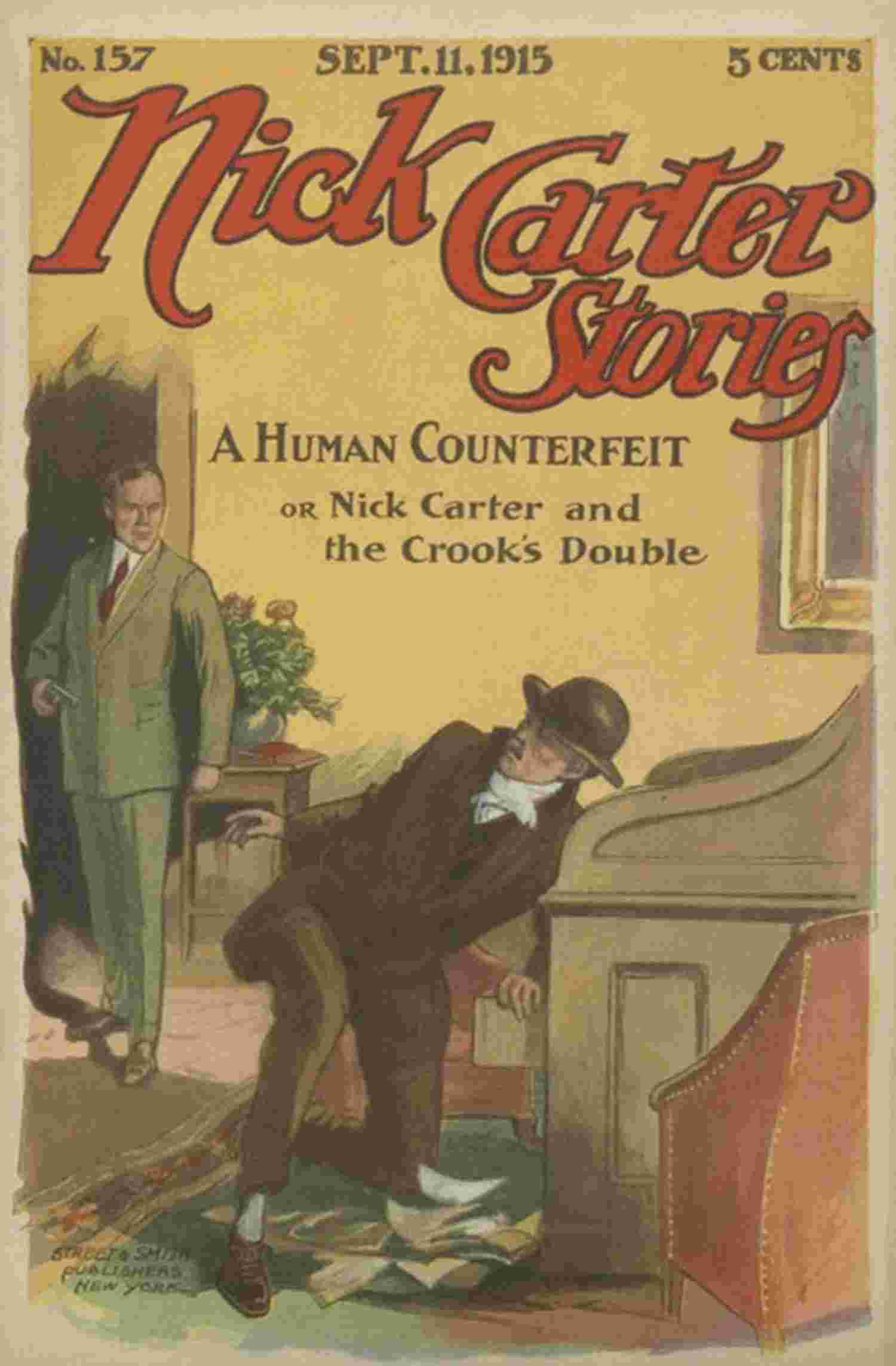
Patsy, kneeling at the desk, one of the drawers of which he had pulled open, swung round like a flash.
A tall, smoothly shaved, black-eyed man had stepped noiselessly from one of the bedrooms. There was murder in his eyes, also in his right hand.
It held a revolver, aimed point-blank at the crouching detective.[Pg 22]
CHAPTER VI.
UNDER TRUE COLORS.
Patsy Garvan realized on the instant that he had been trapped; that he was in wrong, as well as right; that the man who now held him up must have suspected something threatening, and instead of responding to the knock on the outer door, had quickly extinguished the light in the parlor and then stepped into the bedroom to await developments.
That, at least, was the way Patsy immediately sized it up.
As quickly, too, recalling the bandage around his neck and his upturned collar, he resorted to a subterfuge which he thought might serve his purpose and prevent an exposure of his true identity and designs.
Sharply eying the threatening intruder, therefore, whom he rightly inferred was the absent physician’s valet, or more properly his confederate, Patsy coolly answered:
“Don’t get miffed, old chap, and go slow with that gun. It might go off by chance, you know, and I don’t like the way it’s pointing. You’ve got me all right, and I’m not fool enough to butt my head against a brick wall.”
Draper viewed him with a scornful curl of his thin lips.
“Sit in that chair,” he repeated, revolver leveled. “Keep your hands on its arms, too, or this gun will go off in the direction it’s pointed—but not by chance.”
“You wouldn’t kill a fellow in cold blood, would you?” asked Patsy, obeying.
“Yes, or hot blood. It would matter little to me.”
“That would be foolish. You might be executed for murder.”
“Not by a long chalk. A man may protect his property with a gun, or that of his employer.”
“So I’ve heard,” Patsy dryly allowed.
“What do you want here?”
“Anything I could get worth lifting.”
“You mean that you came here to steal something?”
“Don’t I look it? How else would you size it up?”
“I asked for information.”
“Well, I’m handing you straight goods,” said Patsy. “I’m in hard sledding and in need of a lift, so I tried to get it without a formal request. I’m not good at begging. Lemme go this time, will you? I’ll never butt in here again.”
“I’ll make sure of that,” retorted Draper, with ominous significance.
Then he took a chair some six feet in front of Patsy, coolly sitting down with the revolver still poised in his hand and ready for instant use, if necessary.
Patsy realized that he was up against a man of nerve, as well as a man who would not shrink from bloodshed under the circumstances. That he was confronted by one of the gang that had abducted Clayton, moreover, and one of the gang that had stolen the jewel cases that morning, he now had not a doubt.
There was a brief period of silence, finally broken by Patsy.
“Well, what are you waiting for?” he asked. “Get busy. Do something.”
“I’m doing it.”
“Doing what?”
“Watching you.”
“You’ll not let me go, then?[Pg 23]”
“Not so you’ll notice it.”
“But we can’t remain sitting here like two catsup bottles on a shelf,” growled Patsy, with affected resentment. “Let’s come to some kind of an understanding. What are you going to do about it?”
“I haven’t decided,” said Draper, constantly alert. “You’re a thief, are you?”
“That’s what,” Patsy insisted. “I admit it, but it’s only because I’m out of a job. I’m a high-grade thief, too, as you can see by my looks.”
“Yes, you look it, all right.”
“I’ve got a room here in the house, and I pass for a decent fellow. Call up the hotel clerk, Vernon, if you doubt it, and he’ll tell you.”
“There isn’t any need of calling him,” Draper sneered. “I’m waiting for some one else.”
“Who is that?” asked Patsy, pretending ignorance.
“You’ll soon see.”
“When? How soon?”
“When he returns from dinner. He’ll say what must be done with you. He’s the big finger in this—ah, there he is. Don’t stir, or you’ll be a dead one.”
Draper’s gaze was fixed more sharply upon his helpless hearer, and his revolver again was leveled.
Patsy took him on his word and did not stir.
A key had been thrust into the hall door. The door swung open while Draper was speaking, and Doctor Guelpa strode through the narrow entrance hall.
He started slightly upon seeing the two motionless men, but if he felt any great surprise, or any consternation, he did not betray it.
“Who is this fellow, Draper?” he inquired, pausing.
“He says he’s a thief,” replied Draper, without turning an eye from Patsy.
“You caught him stealing?”
“It looks so.”
“How did it happen?”
“I was lying on my bed before lighting up, and I heard a knock on the door,” Draper proceeded to explain. “I did not bother to answer it, nor a second one, and then I heard him sneak in here. He switched on the light and began to search your desk. Then I held him up—and here he is.”
Doctor Guelpa came a little nearer and glared down at Patsy.
Patsy gave him stare for stare.
“Keep him covered, Draper,” said the physician, with ominous quietude. “So you’re a thief, are you?”
“What’s the use of denying it?” asked Patsy. “I’ve told that gink with a gun that——”
“Never mind what you told him,” Guelpa interrupted, more sharply. “Shoot him instantly, Draper, if he stirs. We can say we caught him committing a robbery.”
“That’s what I told him,” grinned Draper.
“Very likely he’s the scamp who stole Falloni’s diamonds,” added Guelpa, more sharply watching Patsy’s face.
It underwent no change evincing his identity and designs.
“I’d be a fall guy, for fair, if I came in here after getting away with that batch of jewels,” he said derisively.
“Keep him covered, Draper,” Guelpa repeated. “I’ll find out who he is.[Pg 24]”
He came nearer to Patsy, then suddenly seized one side of his mustache and jerked it from his lip.
Patsy uttered an involuntary cry of pain.
Guelpa gazed at him more sharply, with countenance turning as dark as a thundercloud, while his teeth met with a sudden, sharp snap.
“Ah, I see!” he exclaimed, half in his throat. “You’re one of those detectives whom I saw this morning. You’re that fellow Garvan.”
Patsy realized that he had nothing to gain by denying it. He laughed indifferently and replied:
“I guess that calls the turn, doctor.”
“I know it does, not guess it,” snapped Guelpa. “What do you want here?”
“I wanted to see you.”
“For what?”
“To find out whether you have learned anything more about the robbery, or whether you have any suspicion.”
“Did Nick Carter send you?”
“No. I came on my own hook.”
“You lie, you whelp,” Guelpa now said harshly. “You act only under his instructions. There can be only one reason for your coming here and breaking into my apartments. Carter thinks I know something about the robbery, or suspects me of having committed it. Isn’t that right?”
“Right for him to suspect you?” asked Patsy, undaunted by the blaze that had arisen in the physician’s eyes.
“Don’t josh me, Garvan, nor try to evade me,” Guelpa fiercely threatened. “If you do, I’ll have your infernal life. Tell me—does Carter think I committed that robbery?”
“How can I tell?” retorted Patsy defiantly. “I’m not a mind reader.”
“You know what he suspects.”
“No, I don’t,” Patsy insisted. “There is one thing I do know, however.”
“What is that?”
“That if he suspects you, Doctor Guelpa, he never so much as mentioned it to me.”
“Is that true?”
“True as gospel,” said Patsy; and it was.
Doctor Guelpa hesitated for a moment, while Draper put in with an assurance evincing his relations with the other:
“Don’t swallow that, doc, not on your life. It’s all bunk. He would not be here, not sneaking in as I caught him, if Carter had not sent him.”
“Do you think so?”
“I think it’s a cinch.”
Doctor Guelpa gazed again at Patsy. His ferocity had vanished, but there now was a gleam in his eyes that was thrice more threatening. He paused for a moment with brows darkly knit, then said abruptly:
“You may be right, Draper. Watch the whelp. I’ll fix him.”
“I’ll watch him, all right,” returned Draper, with a warning scowl.
“Gee! I’m in wrong now, for fair,” thought Patsy, thoroughly disgusted with the turn of the situation. “Fix me, eh? I wonder what’s coming. The infernal rascal has something up his sleeve. Infernal rascal is right, too, and I wish I had phoned the chief before butting in here.”
Doctor Guelpa had approached a wall cabinet directly[Pg 25] behind Patsy, who could not then see what the physician was doing.
He had opened the cabinet and taken from it a small vial and graduated glasses, into which he was pouring a quantity of brown fluid.
Having obtained the desired quantity, he transferred it from the glass, into a hypodermic syringe, the needle of which he carefully inspected.
Patsy waited a bit apprehensive all the while.
Draper watched him as a cat watches a mouse.
Doctor Guelpa closed the cabinet, then turned again toward Patsy.
“I don’t feel sure you are telling the truth, Garvan,” he said, with affected uncertainty. “If I did, I would be willing to meet you halfway and discuss this matter——”
“But I’m giving it to you straight,” Patsy insisted, interrupting. “Nick doesn’t suspect you.”
“Doesn’t he?”
“He does not, Doctor Guelpa, on the level. He has not even thought of you in connection with the robbery.”
“Before he does, then, I’ll make sure to get him and put him away. That can be done—as easily as this.”
Standing with the syringe concealed in one hand, Guelpa suddenly bowed and threw his arm around Patsy’s head, at the same time thrust the needle into his neck.
Patsy vented a growl and began to struggle, despite that Draper clapped the muzzle of the revolver against his breast.
The injection so quickly administered was a powerful one, however, and acted instantly. It sent a tingling sensation through Patsy’s veins. His strength deserted him, seeming to fly out through his toes and fingers. He tried to shout for help, but his tongue was palsied. Only a hollow gurgle came from his twitching lips.
Then, for it was all over in ten seconds, the light vanished, Guelpa’s half-smothered imprecations turned to silence, the grasp of merciless hands no longer could be felt, and Patsy lapsed into the realm of utter oblivion and was lowered to the floor, as limp and ghastly as if life had left him.
Doctor Guelpa straightened up and laid aside the syringe, while Draper thrust the revolver into his pocket.
“Easily done, doc, is right,” he said, grinning. “This was the only way. The meddlesome rat must have picked up a thread of some kind that led him here. There was nothing for us but to dispose of him before he could hand his information to others.”
“He meant it, nevertheless, when he said that Carter does not suspect me,” Doctor Guelpa declared. “We must get him, then, before he does suspect. It afterward might be too late.”
“That’s right, too,” Draper agreed quickly. “But can it be done?”
“It must be done,” Guelpa coolly insisted. “I know how and will turn the trick.”
“And then?”
“This game that we have been playing must be continued. We must throttle suspicion where we find it, and choke the cursed weed before it can spread.”
“That’s the stuff, all right.”
“We must maintain our position and good standing here, Draper, or it will be a case of bolt for us, with the police of the world out to get us. That won’t do at all,[Pg 26] Draper, not at all. We must bluff suspicion to a standstill, or down it with a club.”
“I’m with you all the while,” said Draper approvingly. “I reckon we can make good. But what’s to be done with this pup?”
“Pull out the empty trunk,” said Guelpa. “We’ll crowd him into it and ship him to my office, then lug it into Biddle’s quarters. Ring for a porter to lend you a hand with the trunk to the elevator. I’ll remark to him, or to any other inquisitive observer, that it takes too much room in my suite.”
“That can be done in ten minutes,” nodded Draper, hastening to bring one of the large trunks from the adjoining room.
Doctor Guelpa smoothed his slightly ruffled coat and bestowed a kick upon the senseless form of the detective.
“Dead easy,” said he, replying. “Cram him into it and lock it. I’ll get Scoville on the phone, in the meantime, and have him come round here with a wagon.”
Patsy Garvan heard none of this.
He was lying with his face upturned in the bright electric light, a face as ghastly as that of a corpse.
CHAPTER VII.
A LEAF FROM THE PAST.
“Wait here. I may send you instructions.”
These were Nick Carter’s brief instructions to Chick, in fact, when he left his Madison Avenue residence at seven o’clock that evening, to seek an interview with the woman who, he suspected, could supply him with a clew to the identity of Chester Clayton’s double, if not with positive information concerning him.
Danny Maloney, the detective’s chauffeur, was waiting at the curbing with his touring car. Nick gave him the necessary directions, resulting in his alighting half an hour later in front of the attractive home of Mrs. Julia Clayton, who had fainted so suddenly in Mademoiselle Falloni’s suite that morning.
“You may wait, Danny,” said Nick. “I don’t think I shall be very long.”
“Long, or short, chief, you’ll find me here,” replied Danny.
Nick strode up the gravel walk to the front door and rang the bell. Lights in the hall and one in the side rooms denoted that Mrs. Clayton had returned.
“I hope I may find her alone, or that Chester Clayton is not here,” Nick said to himself, while waiting. “She seemed averse this morning to talking of the matter in his presence. That’s one reason why I suspected that she——”
Nick’s train of thought was broken by a shadow on the figured-glass panel of the door, which was opened by a pretty servant girl in a white apron and starched cap.
“I wish to see Mrs. Clayton,” Nick informed her.
“Mrs. Clayton is not at home this evening, sir,” said the girl, a bit oddly.
“Not at home?”
“No, sir.”
Nick eyed her more sharply.
“Do you mean that she is not here, or not seeing callers?” he inquired pleasantly.
“Well, sir, she[Pg 27]——”
The girl faltered, blushing confusedly, and Nick added kindly:
“I understand. Take my card to her, please, and say that it is very important that I should see her. I think she will consent.”
The girl obeyed, returning in a very few moments.
“Walk in, sir,” she then said, smiling again. “Mrs. Clayton will see you in the library. This way, sir.”
Nick was ushered into the attractively furnished room, where he found Mrs. Julia Clayton still gazing gravely at the card he had sent in. There was something irresistibly impressive about her, a mingling of dignity and secret sadness that the detective’s sensitive nature was quick to appreciate, even while conscious of her remarkable beauty and womanly grace.
She arose immediately to greet him, extending her hand and saying:
“If I had known it was you, Mr. Carter, my servant would have been told not to keep you waiting. I have had a most distressing day, and I did not feel that I could see callers. I assure you, nevertheless, that I am very glad to see you.”
“Thank you,” Nick replied, bowing.
“For I am deeply indebted to you,” Mrs. Clayton added feelingly. “Chester telephoned to me after his arrest and liberation on bail. It is very kind of you to feel such an interest in him, and to use your influence in his behalf.”
“He is my client,” smiled Nick, taking a chair she placed for him. “I couldn’t do less than I have done.”
“But in spite of such adverse circumstances, Mr. Carter, and the fact that so many think him guilty,” she replied. “You are one man in a hundred. I know that he is innocent, of course, but I don’t know how I ever can repay you for your faith in him.”
“I will tell you how, Mrs. Clayton,” Nick said, more gravely.
“Tell me how?”
“Yes.”
“What do you mean?
“Let me begin by—pardon!” Nick broke off abruptly. “Will you permit me to close the door?”
“Yes, of course, if——”
Nick arose when she faltered, quietly closing it, then resumed his seat.
“Servants are not always trustworthy, you know, and discretion is always advisable,” he remarked. “Now, Mrs. Clayton, I will tell you what I mean.”
“Well, sir?”
“Let me begin, however, by stating that anything you say to me will be received in strict and inviolable confidence. Not even to save your son from conviction and a prison sentence, Mrs. Clayton, would I, without your permission, reveal any facts that you may disclose. You must be frank with me, therefore, and tell me what I may find it absolutely necessary to know, in order to save him.”
Mrs. Clayton had turned very pale and was trembling visibly.
“This is a strange beginning, Mr. Carter,” she replied. “What do you expect me to disclose?”
“Only the truth, Mrs. Clayton.”
“About what?”
“Your son’s double,” said Nick. “The man who so resembles Chester Clayton that he could perpetrate the crime[Pg 28] committed this morning. Who is this man? What do you know about him?”
The woman’s fine face hardened perceptibly. She appeared to nerve herself to meet a threatening situation, to oppose with tooth and nail, if necessary, the disclosures the detective evidently was determined to evoke. She drew up a little in her chair, replying more coldly:
“That seems quite impossible, Mr. Carter. What put that into your head?”
“You did,” said Nick quietly.
“I did?”
“Yes.”
“Impossible! When?”
“When you met your son this morning, Mrs. Clayton, and fainted upon learning that the robbery was committed by a man so like him that—but you could not say more,” Nick broke off. “You fell to the floor in a faint.”
“That is true, I admit, Mr. Carter——”
“And you also must admit, Mrs. Clayton, that the circumstances and your own words permit of no other interpretation,” Nick interrupted, more impressively.
“But——”
“Oh, I am not going to argue that point with you,” Nick again insisted. “I am going to make you see the matter just as it stands. Your son’s reputation and liberty are at stake. So is my reputation as a detective. Only the truth can save him. Unless you are willing to aid me by disclosing it, I shall have no alternative but to drop the case entirely and let others try to pull him out of the fire. If they fail——”
“Wait! You have said enough, Mr. Carter.”
Nick would not have done what he threatened, but he detected in the changed face of the woman that the threat would prove effective.
For Mrs. Clayton, though ghastly pale and with trembling lips as gray as ashes, took on a look of sudden determination, that of a woman who felt herself driven to the wall.
“I will tell you the truth,” she added, more firmly.
“You may safely do so,” Nick now said kindly. “It will go no further.”
“I shrink from it. Mr. Carter, chiefly for the sake of one man.”
“Your son?”
“Yes. I implore you to keep the truth from him, if that will be possible. I have kept it from him all his life.”
“I will endeavor to do so,” Nick assured her.
“I will tell you with few words, then, my unfortunate history,” Mrs. Clayton said, more calmly. “I was an English girl and lived in an outskirt of London. I was married when I was nineteen to a man I did not love, but who so had involved my father in financial difficulties that I became his wife in order to save my father from bankruptcy and dishonor.”
“I can appreciate the sacrifice,” Nick said gravely.
“My father died within a year,” Mrs. Clayton continued. “He and I were all that were left of our family. Three months later, Mr. Carter, I became the mother of twin boys.”
“Ah,” said Nick, “that is what I have suspected! Do not distress yourself by telling me too many details, Mrs. Clayton,” he added considerately. “The essential facts are all that I want.”
“They may be briefly told, Mr. Carter,” she said, with a grateful look at him. “My husband was a bad man,[Pg 29] much worse than I even dreamed of when I married him. I discovered his despicable character much too late.”
“Was he a criminal?”
“Yes.”
“May I know his name?”
“Why not? He has been dead many years. His name was Gideon Margate.”
Nick had heard of him, a notorious English crook, who had died in a German prison something like ten years before. He considerately suppressed the fact that he knew of the man, however, and said kindly:
“You are in no degree culpable, Mrs. Clayton, for the mistakes and misdeeds of your husband. What more can you tell me?”
“Two years after the birth of my children, Mr. Carter, my husband disappeared, taking with him one of my sons,” she replied. “I never saw Gideon Margate again.”
“Nor the child?”
“The child was named David. I will not undertake to tell you what I suffered from losing him, from my inability to trace him, and from my terrible fear of the life to which he would be bred.”
“That of a criminal?”
“Yes.”
“And your fears came true?”
“Terribly so.”
“Tell me the bare facts?”
“I took my maiden name, Julia Clayton, about a year after my husband disappeared,” she continued. “I suspected that he was in America, and in the hope of recovering my other son, we came here, and since have lived here. I have been in England only once since then, and that was twelve years ago. I then saw in a London newspaper the picture of a criminal who had just been sent to prison for five years for burglary.”
“You recognized him?”
“Yes.”
“Your son?”
“David Margate—yes.”
“Did you see him personally, or do anything about it?”
“Neither,” said Mrs. Clayton sadly. “What could I do? The die was cast. My husband had shaped the boy’s life. That he should become a criminal after arriving at the age of judgment and discretion showed only too plainly that he had inherited Gideon Margate’s criminal traits.”
“I agree with you,” said Nick.
“Thank God!” Mrs. Clayton fervently added; “he left me the child who had inherited my own character. Chester Clayton is above knavery and crime.”
“I agree with you again,” said Nick. “Now, Mrs. Clayton, let’s come to the points bearing upon his case. Does Chester know anything about his father and twin brother?”
“No, no, indeed,” she said quickly. “He knows only that his father is dead. He does not so much as dream that he has a brother. I could not cloud his life, mar his whole future, perhaps, by acknowledging David Margate to be my son, when I learned that he was in an English prison. It would, have been an injustice to Chester Clayton. The sacrifice would have been too great.”
“That is true,” Nick agreed. “Have you ever seen David Margate or heard anything concerning him since he was convicted in London?”
“No, I have not.[Pg 30]”
“You have no reason to believe that he is in New York, then, aside from the resemblance of the criminal who committed this jewel robbery.”
“That is my only reason. You now can appreciate why I was overcome and fainted when told of the circumstances this morning,” said Mrs. Clayton.
“That is perfectly plain,” Nick nodded. “I think, too, that we now have covered all of the ground that is material at this time. I will be governed by what you have confided to me, and will do all that I can to prevent the facts from leaking out. You may depend upon that.”
“I have no words with which to thank you, Mr. Carter.”
“Don’t try,” said Nick, smiling. “Assuming that the criminal in this case is Chester’s twin brother, and despite that he ran across him and observed the resemblance that made the crime possible, I think it is quite probable that he does not suspect the relationship. Your husband very likely never told him about you and Chester.”
“Do you really think so, Mr. Carter?”
“I do,” said Nick. “Men do not often reveal their own baseness, not even to a son. I doubt very much that David Margate knows anything about his early history.”
“I hope so, I am sure, for Chester’s sake.”
“Do you know under what name he was convicted in London?”
“I do not. I cannot recall it.”
“Was it a fictitious name?”
“Yes.”
“I will try to learn something definite about him,” said Nick. “I appreciate your confidence in me, too, and I will rigidly respect it. That is all I can say to you this evening about the case, but I will leave no stone unturned to bring it to a desirable termination, particularly in so far as you and Chester Clayton are concerned.”
Mrs. Clayton again thanked him feelingly, then remarked:
“I was somewhat surprised late this afternoon by a call from another man whom I saw in Mademoiselle Falloni’s suite this morning.”
“There was only one other man, except Chester,” said Nick. “You refer to Doctor Guelpa.”
“Yes.”
“He called here to see you?”
“Yes, about five o’clock.”
“Did he say for what reason?”
“He said that he was riding out this way and thought he would call and see if I had entirely recovered. He did all he could to revive me this morning, you know.”
Nick’s brows knit a little closer.
“Yes, I remember,” he replied. “Did he say anything about the crime, or concerning Clayton?”
“No, nothing of any consequence, Mr. Carter. He mentioned you, however, just before he left.”
“Mentioned me, eh? What did he say?”
“Only that you were very kind to stand up for Clayton under such circumstances. He asked, too, whether you had been out here to see me.”
“H’m, is that so?” thought Nick. “I was right, then, in thinking that he deduced something from this woman’s impulsive words and her sudden collapse. He suspected that I did, also, and he evidently fears that I may learn something from her. Where there is cause for fear, there are grounds for suspicion. He may be the very man, the very hotel guest whom I[Pg 31]——”
Nick ended his shrewd deductions by glancing quickly around the room. He discovered what he wanted—a telephone on a stand in one corner.
“Before I go, Mrs. Clayton, may I trouble you for a glass of water,” he requested carelessly.
“Why, yes, certainly,” she replied, rising. “I will get it for you.”
“Thank you.”
Nick watched her sweep gracefully from the room.
Then, quickly stepping to the telephone, he hooded the mouth with his hand and called up his library. Within half a minute he had Chick on the wire, but he spoke only these words:
“No time for particulars. Go to the Westgate. Watch Doctor Guelpa.”
The answer came instantly:
“I’ve got you.”
Nick resumed his seat just as Mrs. Clayton was returning through the hall.
“It will be better, much better, if she never knows,” he said to himself.
CHAPTER VIII.
NICK WALKS INTO A NET.
It was half past eight that evening when Nick Carter, returning from his interview with Mrs. Clayton, arrived at his Madison Avenue residence.
A taxicab was waiting at the curbing in front of the house, and Nick was momentarily surprised when he entered his library. Its only occupant was the visitor who had come in the taxi.
“Why, good evening, Clayton,” he said genially. “I was not expecting a call from you so quickly. I am pleased to see you, all the same.”
One thought that had instantly arisen in Nick’s mind, however, in view of his talk with Mrs. Clayton, was not reflected in his face. The thought was:
“Which one is this? Chester Clayton—or his crook double?”
Clayton, as he certainly appeared to be, replied without hesitation, without any observably intent scrutiny of the detective’s face.
“I have a reason for calling, Nick,” said he. “Your butler told me that you would probably return during the evening, so I requested the privilege of waiting here.”
“Quite right, Clayton, I’m sure.”
“He could not tell me, however, where you had gone,” Clayton added, in a way covertly inviting the detective to do so.
Nick did not do so, however, but he was quick to observe the insinuating remark and draw a natural conclusion, one that he made doubly sure did not appear in his face.
“Well, that’s not strange, Clayton,” he replied, laughing. “I had no definite destination when I went out. Besides, I seldom tell my butler where I am going, unless my mission relates to a case in which my assistants are employed. Then I usually leave word for them, as I would have done this evening, had that been the case.”
A momentary gleam, the sinister light of secret relief and satisfaction, showed like a fleeting flash in the depths of his visitor’s eyes.
“It does not matter in the least, Nick, now that you have returned,” he said quickly.[Pg 32]
“What’s on your mind?” asked Nick, taking a chair. “You said you have a reason for coming here.”
“So I have,” said Clayton, more earnestly. “I think I have a clew to the crook who got the jewels.”
“By Jove, is that so?”
“The chance is worth taking.”
“What do you mean? What kind of a clew?” asked Nick, with manifest interest.
“It came from a woman friend of mine early this evening,” Clayton proceeded to explain. “She talked with me by telephone. I have not seen her.”
“Who is she? What is her name?”
“Grace Alcott. She’s an old flame, a girl with whom I have always been quite friendly. I know her to be reliable.”
“What did she tell you?” Nick inquired.
“She said she had information for me bearing upon the robbery. She intimated, in fact, that she could put me in a way to nail the crook and recover the stolen jewels.”
“Well, well, that would be going some,” declared Nick, apparently becoming more enthusiastic. “Have you any faith in her statements, Clayton?”
“Enough to send me here, Nick,” was the reply. “One other reason is the fact that she lives just around the corner from the business quarters of a guest in the hotel.”
“I see the point. What guest?”
“The physician you met this morning.”
“Doctor Guelpa.”
“Did she mention his name, or hint at him?”
“No, nothing of that kind.”
“Why did you not go to see her, then, instead of coming here?” Nick inquired.
“For two reasons,” Clayton now explained, more hurriedly. “One, because you are handling this case and I feared that I might interfere with you if I butted in and did something of which you were ignorant.”
“I see.”
“Another, because Grace said I had better bring a detective with me, as he would more quickly appreciate the points she wanted to lay before me, and that he also would know what should be done.”
“She wanted you to call on her, then?”
“Yes, indeed, as soon as possible,” nodded Clayton. “I grabbed a taxi and rushed down here, therefore, hoping that you would go with me. I thought that was the best thing for me to do.”
“I guess it was,” Nick quickly agreed.
“Will you go?”
“Yes, yes, Clayton, by all means,” assented the detective. “There may be something in this. We cannot afford to leave any stone unturned. The sooner we go, too, the better.”
“Good enough. My taxi is outside.”
“Come on, then, and we’ll be off. I’ll not even wait to tell my butler where I am going,” Nick added, with a laugh, as they hurried out of his office.
Clayton joined with him in the laugh and followed him into the taxicab. He evidently had given the driver his instructions, for he made no move to do so. He remarked, as they settled back on the seat and rode away:
“I hope this won’t prove to be a wild-goose chase, Nick, after all.[Pg 33]”
“It ought not, surely,” Nick replied. “You say you know the girl to be reliable?”
“I have always found her so.”
“How old is she?”
“About thirty.”
“Old enough, then, to have sense and judgment.”
“So I think,” nodded Clayton. “That’s why I feel hopeful.”
“She lives back of Doctor Guelpa’s business establishment, you said?”
“Yes, directly back of it, Nick.”
“How long have you known the physician?” Nick questioned, and he instantly detected the readiness with which his companion took up the subject.
“Oh, for months, Nick,” was the reply.
“He appears to be all right, doesn’t he?”
“Yes, yes, surely! Otherwise, I would not have him in my hotel.”
“I presume so. It may be, nevertheless, that Miss Alcott has discovered something about him of a derogatory nature, her home being so near his business office.”
“Possibly,” Clayton allowed; then, with a furtive glance at Nick’s inscrutable face: “He appeared all right to you this morning, didn’t he?”
“Yes, indeed,” Nick declared. “He appeared like a perfect gentleman.”
“You saw no reason to suspect him?”
“Far from it, Clayton.”
“I guess Miss Alcott’s clew, if she really has any, relates to some one else, or something else,” Clayton now said, with less obvious interest.
“Most likely,” Nick agreed.
“We shall very soon find out.”
“True.”
“Have you formed any other suspicions since I last saw you?”
“No, none whatever,” said Nick. “I still am in the dark.”
Clayton did not add to his inquiries.
It was nine o’clock when the taxicab drew up in front of the house to which the chauffeur had been directed. He at once was dismissed by Clayton, who was the first to alight, and he then led the way up the steps and rang the bell.
It was answered by a well-built, powerful man in evening dress, whose dark features were only faintly discernible in the dimly lighted hall.
“Good evening, Scoville,” said Clayton. “I think Miss Alcott is expecting me.”
“Oh, it is you, Mr. Clayton,” was the reply. “Yes, sir, she is. Walk in, gentlemen, and come this way.”
“The butler, Nick,” Clayton whispered, taking the detective’s arm.
Nick nodded indifferently and allowed himself to be conducted through the hall.
Scoville turned into the nearest room, a front parlor, the others following.
“One moment, gentlemen,” said he. “I’ll switch on the light.”
He did so while speaking, and Nick Carter then saw into what sort of a net he had walked—but entirely voluntarily.
Three men with ready revolvers were confronting him.
Scoville instantly drew another.
Clayton, or Clayton’s double, quickly closed the door[Pg 34] through which they had entered, then turned and said sharply:
“Now, Carter, throw up your hands! If you show fight, you’ll go down and out on the instant.”
Nick raised his hands and backed against the wall. He appeared to be greatly surprised and equally resentful.
“What’s the meaning of this, Clayton?” he demanded; and the mention of the name brought laughs from the others.
They were Draper, Biddle, and Scoville, who had been mentioned by Doctor Guelpa in his apartments, also a third man who had had a hand in the robbery, one Joe Gaines.
“Oh, I’m not Clayton, Carter,” was the derisive reply. “I’m the man who looks like him. I’m the crook who got away with the sparks.”
“Good heavens!” Nick exclaimed, in seemingly increased amazement. “Is it possible?”
“You bet it’s possible!” cried Guelpa, with a sinister nod. “It’s more than that; it’s a fact. When I run across a man who looks so near like me that I can see no difference, I’m the sort of a covey who makes the most of it. You didn’t suspect Doctor Guelpa, eh? Carter, we’ve put it all over you. I’m Guelpa.”
“You?” questioned Nick, still as if astonished.
“That’s what, Carter, as sure as you’re a foot high,” the rascal declared, with an exultant leer. “Come out a little from that wall. Keep your meat hooks up, mind you, or you’ll have no further use for them. Either of these fellows would kill you at the first sign of violence. I shall do so a little later, at all events, so I don’t mind putting you wise to the whole business.”
“That’s very good of you,” Nick now replied coldly.
“Slip in behind him, Biddle, and get his weapons,” Guelpa commanded. “Fish out his darbies, also, and snap them on his wrists. Egad! could one have more satisfaction than in doing a dick with his own bracelets?”
“Not much more, doc!” cried Draper, laughing.
“Dukes behind him, Biddle. I told you I’d get him, Draper,” Guelpa triumphantly added, while two of the crooks hastened to secure the detective.
“You made good, all right.”
“He isn’t in my class.”
“Few dicks are, doc, as far as that goes.”
“Why, he told me on the way here that he didn’t suspect me,” cried Guelpa derisively. “We’ve got him dead to rights, then. He can have handed nothing to others about me.”
“Surely not.”
“And we’ll make dead sure that he never will. I suppose you wonder, Carter, what we are doing in this house.”
“Well, not seriously,” said Nick, with mocking indifference.
“It’s back of my business quarters, just as I told you.”
“You told the truth once, then, at least,” Nick said dryly.
“Yes, sure,” cried Guelpa, laughing again. “This makes a good retreat for us in case of danger. That throat-specialist gag is all phoney, a colossal bluff. I had to pose in some impressive character. We can slip from my office into this house, or the reverse, in two shakes of a lamb’s tail. We’re the bunch who got the sparks, Carter, all right, and now we’ve got you.[Pg 35]”
“Yes, that’s very obvious,” said Nick, coolly taking a chair. “Since you are so communicative, Guelpa, if that’s your name, suppose you tell me how you got away with the jewel cases so quickly.”
“Why not?” leered Guelpa, while the others laughed as if they enjoyed the detective’s blindness. “Scoville was the stranger who held Clayton in his private office. My room is on the same floor with Clayton’s. I’ve got garments like his. Never mind how and when I got them.”
“No, it’s not material,” Nick allowed dryly.
“Not at all, Carter, of course. I merely stole down the stairs, clad like Clayton, and got the first casket. Biddle, disguised as a laundress and provided with a big, covered basket, relieved me of it in the corridor, and got away with it in the basket.”
“Ah, I see,” Nick nodded.
“I then got the other and whisked it up to my rooms,” added Guelpa. “Then I hurried into my own clothing and my Hungarian hair and whiskers, and I was right on the spot when wanted by lovely Mademoiselle Falloni when she fainted. Could anything have been easier? Why, it was like money sent from home.”
“It does appear so, Guelpa, I admit.”
“I wonder you have not thought of it, Carter,” grinned the rascal.
Nick’s eyes took on a more threatening gleam. He now felt sure that this man did not suspect his relationship with Clayton, or know anything definite about his early life, as he already had predicted to Mrs. Clayton.
“Oh, I have thought of it, Guelpa,” he said, a bit curtly. “Don’t think me quite a lunkhead. I knew the crook had garments and a pin like Clayton’s. I know also when the scarfpin was duplicated. It was when you rascals abducted Clayton three months ago.”
Guelpa’s face changed like a flash.
“How did you learn that?” he cried.
“I have methods of my own for obtaining information.”
“You have, eh?”
“And that’s not all I know, Guelpa,” Nick added.
“Is that so?”
“Far from it.”
“Tell me, then, as I told you.”
Guelpa spoke with a scornful sneer, but looks of apprehension had arisen to the faces of his four confederates.
“Why not, then, as you said?” Nick retorted. “Don’t imagine for a moment, Guelpa, that you lured me blindly into a net. I knew the instant I saw you in my office this evening that you were not Chester Clayton.”
“Rot!” cried Guelpa derisively. “If you knew that, why did you walk into the trap?”
“So as to get a line on your confederates, these fellows,” said Nick curtly.
“I don’t believe it.”
“I will tell you, then, something that you will believe,” said Nick.
“What is that?”
“That your name is not Guelpa. Your true name is David Margate. You are an English crook. You were convicted of burglary twelve years ago, and sent up for five years. You are——”
“Stop!” cried Margate, ghastly white. “How did you learn that? How do you know——”
“Oh, I know that you rascals will not get away with[Pg 36] this job,” Nick sternly interrupted. “I’ll soon have you landed where——”
Guelpa, or Margate, broke in upon him with a terrible oath.
“You will, eh?” he fiercely added. “You’ll find you are wrong. You are depending upon that fellow, Garvan, but we’ve got him, also, as we’ve got you. See for yourself.”
He flung aside the portière that hung across the open door of an adjoining room, then in darkness.
Plainly visible in the light shed through the doorway, however, sat Patsy Garvan, bound and gagged and tied to a wooden chair. This was two hours after he had been transferred from the hotel, and his recovery from the drug Guelpa had injected.
“And that’s not all,” Guelpa fiercely added. “Spring open that panel, Biddle. Let him see—let him see for himself!”
Biddle touched a hidden spring in the wainscoted wall, and a panel flew open.
In the space beyond sat—the two jewel caskets stolen from the Hotel Westgate that morning.
“We’ve not had time to open them, to whack up the swag,” Guelpa went on, as if beside himself with fierce and bitter rage. “There will be time enough for that. We’ve got Garvan and we’ve got you. I’ll send you to the devil on the spot. I’ll give you a dose that will—oh, perdition, Scoville, I’ve left it in my suite. I went out in such a hurry that I forgot it. I must have it. It’s the only thing that will cause death and defy detection. I must have it. I’ll go and get it. Watch me—watch both till I return. And remember the signal—the signal! I’ll send both to the devil. Wait till I return.”
And Doctor Guelpa, after pouring forth these commands with a ferocity that precluded interruption, turned and rushed like a madman out of the house.
CHAPTER IX.
THE MAN ON THE BED.
It was more than an hour previous to the episodes last described, when Chick Carter responded to Nick’s brief instructions from Mrs. Clayton’s residence, and then set out post-haste for the Hotel Westgate.
He did not know, of course, why Nick had been led to suspect Guelpa, nor anything about what Patsy had discovered and what had befallen him. That Nick suspected Guelpa, however, and very seriously, Chick had not a doubt.
It was not eight o’clock when he approached the huge hotel, and purely by a stroke of good luck, nearing a side entrance to the house, he discovered the very man he was seeking.
Doctor Guelpa had just emerged and was hurrying away.
“By Jove, fortune favors me,” thought Chick, with a thrill of satisfaction. “This is better than I could have hoped. There must be something in the wind, or he would not be in such a hurry. If he gives me the slip, however, I’ll eat my hat. I’d give something to know what Nick has on him.”
Chick knew, however, that he needed only to follow the directions given him.
With no great difficulty, he shadowed Guelpa to his office in Fifth Avenue, a walk of about six minutes, and[Pg 37] saw him enter the dark rooms, those on the first floor of a remodeled house.
Much to Chick’s surprise, however, after waiting and watching for several minutes, no light appeared at either of the windows.
“By gracious, that’s mighty strange,” he said to himself, then concealed in an opposite doorway. “Is he remaining in there in darkness? What’s his game, in that case, and why is he—great guns! there he is, now!”
Doctor Guelpa had come hurrying around the near corner, and was evidently returning to the hotel.
Chick shadowed him again, but not without a quick survey of the opposite house and the adjoining buildings.
“I’ll swear he did not come out of that house,” he said to himself. “There is no way of getting to a back entrance from the avenue. There may be an alley leading in from the side street. Either that, or he went through the first house around the corner. Later, by Jove, I may discover which. The game seems to have just broken cover.”
Chick followed Guelpa back to the hotel and saw him enter his suite.
Not content with that, wondering what he might be doing, he crept to the door and peered through the keyhole.
The aperture, though limited, commanded a view of the parlor and the bedroom directly beyond it. Both were brightly lighted—and Chick saw enough to warrant all of the suspicions he had attributed to Nick.
He saw the man within discarding his Guelpa disguise and transforming himself into a counterfeit of Chester Clayton.
“Thundering guns!” he said to himself. “This does settle it. But what’s his next move?”
Chick concealed himself to wait and see.
Ten minutes later Guelpa stole down the side stairs and out of the house. He was just in time to catch a passing taxicab.
Chick reached the side door just in time, moreover, to hear Guelpa shout his hurried directions to the chauffeur.
“Great Scott!” he muttered, pausing. “To Nick’s residence! Why the dickens is he going there? By Jove, I have it! He has discovered that Nick suspects him and he now is out to get him. He reasons that he can fool the old war horse and get by as Clayton.
“I may be wrong, but I’ll wager that he will get well fooled himself. It’s now a thousand to one that he went to some house near his office, probably the one back of it, in order to make arrangements for holding up the chief. By gracious, that’s good enough for me to take a chance on. I’ll hike back there and await developments. There would be nothing in nailing that rascal alone. If I am right, which seems more than probable, we can get the whole gang by this other course.”
Chick knew, of course, assuming that his theory was correct, that some little time must elapse before Guelpa could return in company with Nick. He did not hurry his investigation, therefore.
He returned to Fifth Avenue and had another look at Doctor Guelpa’s business quarters.
They were in darkness, as before, with no sign of life within.
“I’ll see what I can discover around the corner,” Chick said to himself. “The rat went out that way, I’ll wager.”
His investigations in that direction took him much[Pg 38] longer. He could find no way of getting to the rear of the house to which Nick was later brought. It had, as a matter of fact, been boarded up by the rascals.
Chick then went back and picked the lock of Guelpa’s door, entering and seeking the rear exit.
He then found that it led to the rear door of the other house.
Chick arrived there just in time, moreover, to hear from the back area the arrival of Nick and Guelpa, both of whose voices he immediately recognized.
“This does settle it,” he congratulated himself. “I’ll get in there and hold up the whole gang. If I can get all of them under my guns—well, there’ll be nothing more to it.”
It took Chick some little time, however, to noiselessly force a rear basement window.
The scene in the front parlor was in rapid progress all the while.
Chick got in unheard and was stealing up to the adjoining room, just as Guelpa rushed out of the house.
It was impossible to stop him, but Chick had heard enough to show him the way.
The four men in the front parlor then were in animated discussion of what had been said. Thy had no thought of another intruder. The portière masking the door of the rear room had fallen back into place.
Chick crept into the room from the hall, and he then discovered Patsy Garvan bound to the chair. He stole nearer and liberated him, then slipped him one of his revolvers.
Not a word passed between them.
Ten seconds later, however, the portière was flung aside and both detectives stepped into the room, with revolvers leveled.
“No monkey business, gentlemen!” Chick now said sharply. “The first man who moves will be a dead one! We’ll shoot to kill!”
The threat was sufficient, or the guns.
Only one of the rascals moved, save to throw up his hands.
Scoville edged nearer the hall door, but stood with his back against it, a position certainly not inviting suspicion.
“Good work, Chick,” Nick said simply, after the crooks had been handcuffed and he had been liberated. “It is about what I was expecting.”
“We’ve landed with both feet,” declared Patsy. “All we now want is the master crook, the rat who jabbed that needle in my neck.”
“We’ll get him, all right,” said Nick. “Get those jewel cases, Patsy, and we’ll head for the hotel. You remain here, Chick, and hold up the rascal if he returns. I’ll have policemen here on the quiet in a very few moments. I’ll not risk losing the rascal by not following him.”
“I’m with you, chief,” said Patsy.
Three minutes later four policemen entered the house and took the crooks in charge.
Chick continued to wait for Guelpa.
Nick Carter and Patsy entered the Westgate a few minutes later. The first man they saw was Clayton, in the office inclosure.
“Good God!” he cried excitedly, seeing the jewel cases. “You’ve got them, Carter, you’ve got them! When and how[Pg 39]——”
Nick checked him with a gesture and placed the cases on the counter.
“Put them in the vault, Vernon, and lock it!” he commanded, turning to the thunderstruck head clerk. “You come with me, Clayton, and be quick about it.”
Clayton leaped over the counter and Nick ran to the elevator.
“I’ll show you your double, Clayton, unless I am much mistaken,” said he, as the car sped up to the fourth floor.
“My double?” gasped Clayton.
“That’s what. A fellow who looks like you. There’s nothing more to it.”
“This way, chief,” Patsy whispered, as they left the car. “I know his door. Gee whiz! I ought to.”
They arrived at it in a moment.
A light was burning in the suite.
Patsy quietly unlocked the door with his picklock, and the three men rushed through the parlor and into the bedroom.
An unconscious man was lying on the bed.
“Guelpa himself!” cried Patsy. “By thunder, chief, he has committed suicide.”
“If he has,” replied Nick, “he will have saved himself a prison term. Ring for Detective Webber. We’ll give the rascal in his charge.”
“I can’t wait—I can’t wait for that,” cried Clayton, in a frenzy of joy. “I must telephone to my mother. I must telephone to Mademoiselle Falloni. The joyous news must not be delayed. I’ll return in a couple of minutes, Carter. My God! how can I ever repay you?”
“Let him go and spread the news,” laughed Nick, as Patsy turned from the house telephone. “The crooks are booked to get theirs. As for this rascal and his—ah, here is Webber now. Look after this scoundrel, Webber, and put him where he belongs. No, no; don’t ask me to discuss the case at present. We have made good, all right, and that enough for now. As for us, Patsy, we’ll compare notes in my library, in company with Chick.”
THE END.
You will read more of the mysterious David Margate in “The Blue Veil; or, Nick Carter’s Torn Trail,” which is the title of the long, complete story you will find in the next issue, No. 158, of the Nick Carter Stories, out September 18th. You will also find an installment of the corking serial now running, together with several other interesting articles.
A BAD BOY.
For precocity, irrepressibility, and too often depravity, “Young America” in these days can hardly be surpassed. Here is a story told me the other day: A little chap, not eight years old, whose parents live in one of the fashionable parts of New York, went last week to pay a visit to his grandmother. While there, in rummaging through his grandmother’s secretaire, he came across a half dollar, and shortly afterward he was on his way downstairs to invest his “find.” He expended the whole amount in candy, and, upon his return, was enjoying it in the privacy of his room, when his grandmother put in an appearance.
“Why, Robby,” she exclaimed, taking in the situation, “where on earth did you get all that candy?[Pg 40]”
“Bought it,” was the reply.
“But where did you get the money?”
“A gentleman I met in the street gave it to me.”
“Robby, I don’t believe you are telling me the truth,” said the old lady slowly, looking her grandson in the eyes. “In fact, I am sure you are telling me a falsehood. A little bird tells me that you are.”
The boy looked at her with a somewhat incredulous expression.
“Now, come, Robby, tell me where you got that money?”
“Why don’t you ask your dickey bird?” was the ready reply of the bad boy.