
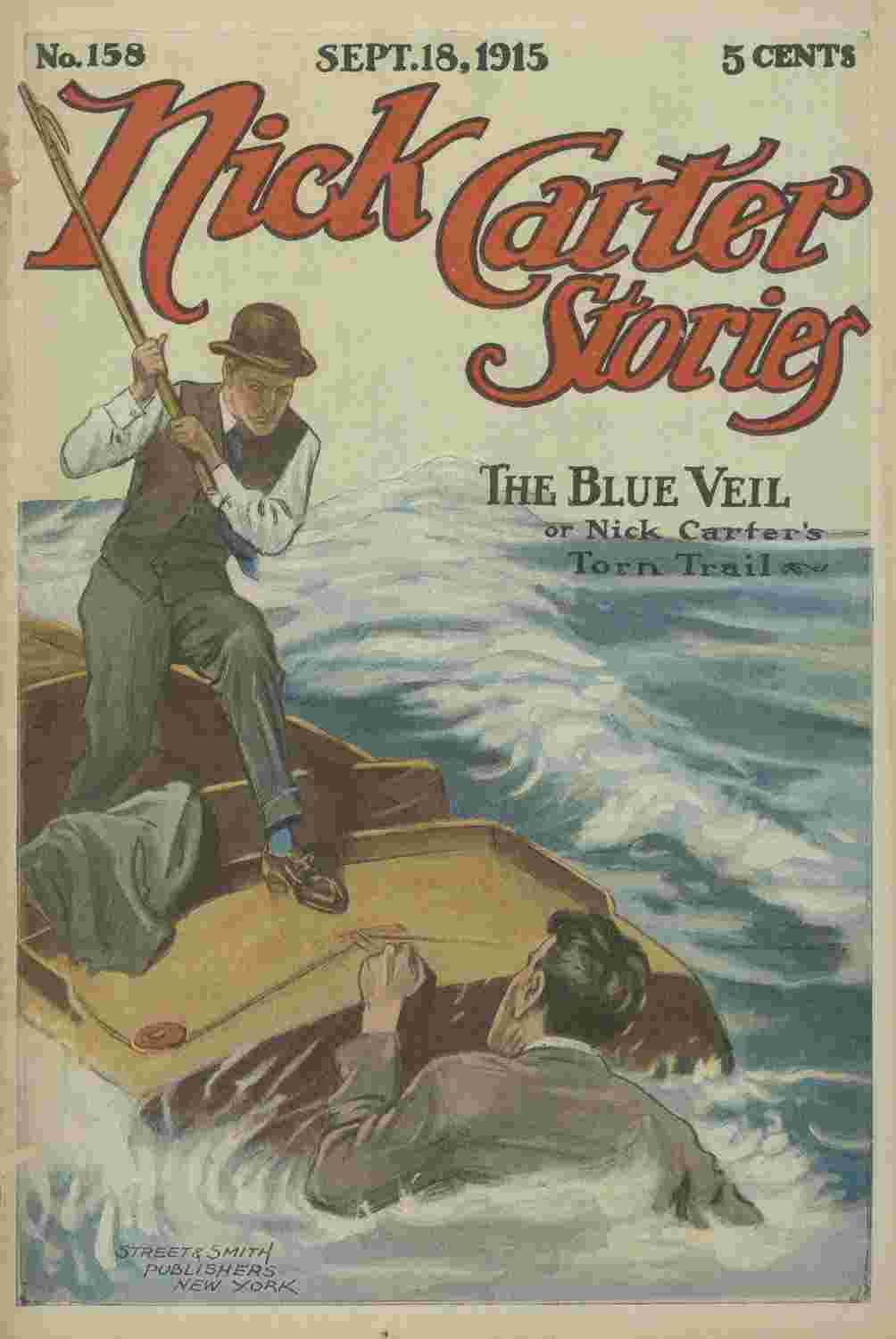
CHAPTER V.
THE NAME ON A SIGN.
It was not in the least degree by chance, but by a very remarkably clever bit of detective work, that Nick Carter had succeeded so quickly in picking up the trail of the miscreants by whom Clara Clayton had been abducted.
Only one detective in a thousand, possibly only Nick Carter himself, would so quickly have suspected Pierre Toulon of actual complicity in the daring crime; much less been able, even though suspected, to have clinched his distrust of the treacherous waiter by any such artful methods as Nick had employed. It had required the discernment and subtlety possessed only by the celebrated detective himself.
Nick keenly realized, nevertheless, that he had been very fortunate in that the victim of the crime was so self-possessed and resourceful a girl, and that the trail of the veil had been of inestimable aid to him in showing plainly in which direction her abductors had fled. The clever ruse to which she had resorted had, indeed, stimulated both detectives with additional eagerness to trace and rescue her.
Nick hurried on after parting from Chick, listening vainly for a signal from him, seeking vainly for another scrap of the blue veil, and also the while with eyes alert for any other evidence that would serve his purpose.
None rewarded his efforts. The road was so cut up with wheel tracks and tire marks, that nothing definite could be deduced from them. Nick had covered nearly two miles through the woodland road, in fact, before he made any new discovery.
Then a break in the woods brought a river into view. He could see patches of it glistening in the early-morning sunlight.
Presently, in the far distance could be discerned the church spires of a town, the dwellings of which were lost under the intervening hills.
“It must be three or four miles away,” thought Nick.[Pg 21]
“I’m blessed if I know what town it is. If I could run across some farmer living in these parts, I might get information that would aid me. Beardly—that’s not a common name. If I could find a man of that name—well, I think I would consider him open to suspicion, regardless of his looks.”
Another half mile brought a sharp turn in the road and a more open view of the river. Several scattered mills could be seen in the distance on the opposite bank, evidently sawmills, which derived their supplies from the surrounding woods.
As he rounded the turn, moreover, Nick suddenly came in view of a large, old wooden house and several outbuildings. They were some fifty yards from the road and well down upon the river bank. A swinging sign on a pole in the clearing near the front of the house denoted that it was a tavern, or a somewhat isolated road house.
“By Jove, I now am in a way to strike oil,” thought Nick, little dreaming just how he was to strike it. “Smoke is coming from the chimney. Some one in the house is up and doing. I’ll hunt him up, or her, as the case may be, and see what I can learn.”
Leaving the road, Nick glanced at the sign and read the name on it, then turned his steps toward the rear of the house, the door in front being closed, and the window curtains drawn down.
Before arriving at the rear corner, however, Nick brought up at the open door of a barroom of exceedingly primitive type, in which he found three men.
Two of them were rather roughly clad, dark-featured fellows of about thirty years of age, and both were seated at a round, bare table, each with a partly drank glass of ale before him.
The third was a brawny, red-featured man in his shirt sleeves. He was wiping the top of a dingy bar with a towel.
All looked a bit surprised when the detective’s imposing figure appeared at the open door. None evinced any deeper feeling, however, as Nick stepped in and approached the bar.
He ordered a glass of ale and remarked agreeably, with a glance at the two men at the table:
“Fine morning, gents. Drink yours down and have another.”
“Don’t mind if I do,” said one, replying.
“Good enough. What town is that up the river?” Nick asked.
The man behind the bar informed him, while drawing the ale from a faucet in the wall, and Nick took a chair at a window overlooking the grounds back of the house and the broad curve of the river.
His view of it was partly obstructed, however, by the old stable and other outbuildings. A path near them led down to a narrow, wooden float, or landing, to which a motor launch was made fast.
“You are Mr. Dugan, I take it?” Nick remarked to the man who was serving him.
“That’s right,” was the reply, with a nod.
“I read your name on the sign.”
“I have run this place for a dozen years.”
“Some distance from town, aren’t you?”
“Not too far for my business,” said Dugan, returning to wipe the bar. “There are some houses above here a piece, but I get most of my coin from parties who drive out from town.[Pg 22]”
“Sort of a road house, isn’t it?”
“That’s what.”
“You didn’t happen to hear a motor car go by last night, did you?” Nick asked carelessly.
“What time?”
“Between ten and eleven.”
“No, I didn’t,” Dugan vouchsafed, with stolid countenance. “The best road is on t’other side of the river. Did you, Morley?”
The last was addressed to one of the men at the table. He shook his head and glanced at his companion, replying readily:
“No, I heard none. Did you, Conroy?”
“What time did you say?” questioned Conroy, gazing. “I’m a bit deaf, you know.”
“Between ten and eleven,” said Nick, with voice raised.
“A motor car?”
“Yes.”
Conroy also shook his head.
“None went by at that time, sir, nor even later,” he said assuringly. “I was sitting out front till near midnight. I’d have been sure to have seen it. Here’s good luck, sir.”
And Mr. Conroy arose with his glass of ale and began to down it.
“Same to you,” returned Nick indifferently.
“Have you lost a car, sir?” questioned Dugan, gazing at him from over the bar.
“No. Some friends of mine are coming this way, and I wondered whether they had passed,” Nick exclaimed evasively. “They may stop here, perhaps, on their way. I’m tramping through these parts and they have my luggage in their car. It’s a big red one. You could not mistake it.”
“They have not been here yet,” said Dugan. “I’ll keep it in mind.”
“Oh, it don’t matter much,” Nick replied. “I’ll round them up in the next town. I used to know a man up this way named Beardly. Ever heard of him?”
“Not as I remember,” said Dugan, scratching his head.
“Beardly?” questioned Morley, still gazing at the detective. “I don’t know any Beardly in these diggings. What’s his front name?”
“Andrew,” said Nick, at random.
“I never heard of him. Did you, Jim?”
Conroy shook his head again, then finished his glass of ale and arose from the table.
“Sing out, Dugan, when breakfast is ready,” he requested, a bit gruffly. “I’m going to wash up.”
“Hold on, Jim,” put in Morley. “Wait till I get outside of this. I’ll go with you. So long, sir.”
The last was addressed to Nick, who responded with a nod, and the two men swaggered from the barroom and disappeared in a narrow, dimly lighted hall adjoining it.
Nick listened indifferently to their receding steps. There had been nothing in the conduct of either that seemed to warrant distrust, nor in the looks of either, aside from their rough attire and somewhat dissipated faces.
The same was true of Dugan also, and of his decidedly rustic and inferior road house.
Nick lingered briefly, apparently to sip his drink, therefore, and incidentally he tipped back in his chair until it touched the window casing. As he did so, glancing[Pg 23] out, he made another discovery which most detectives would have overlooked.
Beyond a corner of one of the outbuildings, and brought into view by his change of position, he observed an old dwelling and a near building of moderate size some fifty yards upstream and on the opposite bank of the river. A sign on the building caught the detective’s eye.
The name on the sign was: “B. Ardley.”
CHAPTER VI.
NICK’S SHREWD DEDUCTION.
Nick Carter read the distant sign with only indifferent interest.
“B. Ardley.”
Then, like a flash, the phonetic significance of it arose in his mind. He asked himself how it would sound if uttered aloud.
“B. Ardley,” he mentally repeated. “By Jove, that is almost like Beardly, if spoken quickly, or heard indistinctly. It must be that Patsy heard it in that way, since he could distinguish nothing more. He may have mistaken this name, B. Ardley, for Beardly. By gracious, it’s worth looking into.”
Nick’s face had reflected none of his thoughts.
Dugan still was lounging over the bar, waiting the further wishes of his unknown patron.
Nick glanced at him and remarked:
“This is a fine river, Mr. Dugan, from which a good deal of power must be derived. I see there are a number of mills farther up the stream and nearer the town. Sawmills, aren’t they?”
“Yes, sir, they are,” nodded Dugan.
“What’s that nearest one, that having a sign on top?”
“That’s not a sawmill. The man who runs that place works over old rubber and culls out the best of it. He makes it into rubber tubes and pipes.”
“What’s that name on the sign?”
“Ardley,” said Dugan unsuspiciously. “His name is Ben Ardley.”
“You’re acquainted with him, I suppose?”
“Well, not overmuch,” Dugan vouchsafed, with somewhat sharper scrutiny. “He ain’t the kind I fancy.”
“No?”
Dugan did not respond to the insinuating query. He seemed to go into his shell, as it were, and he didn’t speak again until Nick, after vainly waiting for him to do so, decided that he would not become too inquisitive. Instead, he remarked carelessly, as if the other topic had passed out of his mind:
“I suppose I must tramp to the town in order to get across the river.”
“No, you needn’t do that,” said Dugan. “There’s a ferry half a mile above here. You’ll see the sign in front of a small wooden house. The man who lives there will take you across. He keeps a boat for that purpose.”
“What’s his name?” questioned Nick.
“Jones. He’s all right. There’s a bridge, too, below here a couple of miles.”
“A bridge, eh?” thought Nick. “Does the other fork of the road lead to it?”
“Aye, it does,” nodded Dugan.
“I remember passing it,” said Nick, rising to go.[Pg 24] “Well, I’ll be plugging along. It’ll be hot walking later in the day.”
“So ’twill, sir. Drop in again when you plug this way.”
“I will, Mr. Dugan,” Nick assured him.
He now detected a tinge of sarcasm in the man’s voice, nevertheless, but he departed without betraying it.
“I’ll be likely to drop in again sooner than you imagine, or will care to see me,” thought Nick, a bit grimly. “I reckon I have brought up quite close to my quarry. Those two rats ducked out of the barroom quite suddenly, I remember, and Dugan closed his trap in a rather abrupt and significant way. I’ll skin over the river and size up Mr. Ben Ardley. That may prove more profitable than hunting farther for Beardly.”
Nick trudged on up the road, which followed the course of the river, and he presently arrived at the home of the ferryman, which was among the first of scattered dwellings which now appeared on that side of the stream.
Jones was up and out for business, it then being after seven o’clock, and Nick accompanied him down to the river bank, where they boarded a broad, flat-bottomed boat, which Jones operated with no other power than his own gaunt figure and wiry arms applied to a pair of oars.
“I stopped at Dugan’s place back yonder for a drink,” Nick remarked, when they were under way. “He seems to be a decent chap.”
Jones was not communicative. No man can say less than a rustic, when so inclined.
“Decent enough,” he allowed, in nasal tones.
“He keeps boarders, doesn’t he?” Nick inquired.
“Reckon not.”
“But I saw two men there, named Morley and Conroy.”
“Never heard of them.”
“That’s so?”
“Yep.”
Jones gazed vacantly at his cowhide boots.
Nick decided to try him on another tack.
“Do you do much business here?” he asked agreeably.
“Some,” said Jones.
“Taken any strangers over lately?”
“One.”
“Man or woman?”
“A she.”
“When was that?”
“Last Friday.”
“Three days ago,” thought Nick, a bit amused. “He’s not getting rich at that canter with this old tub. It would take a corkscrew, moreover, to draw anything out of him. I’ll try once more.”
“Who runs that place a quarter mile down the stream?” he inquired.
“Sign’s on the building,” said Jones, rowing steadily and vigorously.
“I cannot read it at this distance.”
“Name’s Ardley.”
“Do you know him.”
“Yep.”
“Anything about him?”
“Nope.[Pg 25]”
“Does he employ any help?”
“Wife. No one else. Lookin’ for a job?”
“By Jove, he’s loosening up,” thought Nick, laughing inwardly.
Further inquiries evoked nothing of any importance from the taciturn ferryman, however, who landed his passenger, accepted his fee with a grin, and immediately pushed off his rude craft and started to return.
Nick found himself at the end of a narrow lane, about a stone’s throw from two small dwellings, and he rightly inferred that it led to a more pretentious road running through the woodland farther back from the river. He arrived at it a few minutes later, then turned his steps in the direction of the Ardley place. A walk of a quarter mile brought him to a narrow road leading down to it.
Nick then paused and took from his pocket four pieces of the blue veil, which he had retained after picking them up on the opposite side of the river.
“If Chick has found any since we parted, and if my suspicions are correct, he by this time has crossed the bridge mentioned by Dugan, and he must be coming in this direction. I’ll leave a trail for him that he can not mistake. If he finds four pieces of the veil here, instead of one, he will reason that I must have put them here, for the girl would not have dropped four in one spot. That will show him the way.”
Nick dropped one blue fragment in the middle of the main road.
He then placed the other three where they could not be overlooked, and in a line plainly denoting the direction he was about to take. He lingered only to carefully put on a disguise which he thought would serve his purpose.
“Now, for Mr. Ardley,” he said to himself, striding rapidly down the diverging road.
Something like three hundred yards through the woods brought him to a clearing back of the dwelling of the now suspected man. Off to the right was the faded old building used for his rubber business. One end of the clearing was covered with old boxes, barrels, and a huge pile of refuse.
Beyond the building, which was close upon the bank of the river, could be seen one end of a deep wooden sluice, in which revolved the wheel from which Ardley evidently derived the power to operate machinery of some kind.
Nick could hear no sound of any, however, though the dash and gurgle of water through the sluice faintly reached his ears.
As he came nearer the house, a brawny, hard-featured woman of middle age appeared at the back door. Her large, angular figure was clad in a calico wrapper, much the worse for dirt and wear.
“Is Mr. Ardley at home?” Nick inquired, pausing to question her.
“He’s out in the shop,” she replied, in rasping, nasal tones.
“Is he busy?”
“He’s allas busy.”
“Any one with him?”
“No. He’s alone. You’ll find him.”
“You can bet I’ll find him,” thought Nick, far from favorably impressed with the woman. “She must be the wife Jones mentioned. She looks as if she had[Pg 26] done her share of hard work, and looks like a hard ticket, as well.”
Nick presently found the man, and his impression of the woman faded to utter insignificance. He discovered him in one end of the building, that nearest the river, evidently engaged in repairing a leather belt which hung over a wheel of part of the overhead machinery, and for a moment Nick was fairly startled by his appearance.
For Ardley was a giant in stature, a huge, hulky, red-featured man of about fifty, with a mop of hair that hung like a lion’s mane over his brow and ears. He was a type before which ordinary men wilt away to utter insignificance.
He was clad in coarse overalls, huge cowhide boots, and a thick woolen shirt, so open in front as to expose his massive neck and his great, bulging chest, covered with scraggly hair. His sleeves were rolled above his elbows, revealing a pair of brawny forearms, knotted with thick muscles and as large around as a ham.
He was, in fact, as prodigious and powerful and in a way as repulsive a man as Nick Carter ever had seen.
It was not in the detective’s nature, nevertheless, to be deterred from his purpose by this ominous aspect of the man. He saw at a glance that he was a good deal of a boor and a brute. He saw, too, that he was gifted with no art to disguise his feelings and resort to subterfuge, if caught unprepared for an accusation; and, now seriously suspecting that he knew something about the crime of the previous night, Nick resolved to bring him up to the ringbolt then and there.
Ardley’s huge face was purple from his exertions with the heavy belt, when, hearing the detective’s footsteps on the floor, he turned and saw him.
“Hello!” he cried, with a leonine growl, as if surprised.
“How are you?” returned Nick complacently.
“What d’ye want?”
“You are Mr. Ardley, I suppose?”
“Yes. What d’ye want?”
“I want to talk with you for a few minutes,” said Nick. “It’s on important business. My name is Hudson. You are not too busy, I hope.”
“Too busy!” Ardley echoed the words with a fierce, derisive snarl. “I ain’t busy only with this cussed belt. That can wait. Sure you can talk with me, Mr. Hudson.”
“Good enough.”
“I’m never too busy to talk along with a gentleman. Important business, eh? What’s it all about? Sit there, Mr. Hudson.”
Ardley, with his sonorous voice rolling forth more heartily, as deep and full as the bellow of a bull, pointed to a cheap wooden chair, near which the detective was standing.
Nick accepted the invitation unsuspiciously.
Ardley seated himself on an empty box directly in front of his visitor, scarce five feet from him. With his shoulders hunched forward, his huge head drawn down, his muscle-bound arms resting on his massive thighs, he appeared more like a great, uncouth monster than of the order of man.
“What’s it all about?” he repeated, gazing with ratty[Pg 27] eyes at the detective’s bearded face. “What’s it all about, this ’ere important business?”
“It’s about a girl who was stolen from home last night by a bunch of thugs,” said Nick, steadily eying him. “I have reason to believe they came in this direction.”
“Suppose they did?” questioned Ardley. “What’s that to me? Why d’ye question me?”
“I hoped you might have seen them.”
“Waal, you’ve got another hope.
“Or know something about them,” Nick added.
“What I know about them, Mr. Hudson, or about anything else bar the making of rubber pipes, could be written on your thumb nail,” Ardley growled, still gazing at his hearer. “I dunno anything about any thugs, much less a stolen gal.”
“Don’t you know a man named Pierre Toulon?” Nick asked, with sharper scrutiny.
“Never heard of him.”
“Or David Margate?”
“Same of him. I never heard the name.”
Nick drew up a little in his chair, working one of his revolvers into a position in his hip pocket, enabling him to instantly draw it, if necessary.
“I noticed when coming here, Mr. Ardley, that you have a telephone in your house,” said he.
“Aye, I have,” Ardley admitted, with a nod of his huge head. “What o’ that?”
“Well, I happen to know,” Nick bluntly asserted, “that Pierre Toulon telephoned to you from New York City at one o’clock last night.”
Ardley’s red eyes took on a narrow squint. He reached out and rested his brawny hand on a long wooden lever, which appeared to govern the wheel over which ran the belt on which Nick had found him at work. At the same time he asked, more sullenly:
“How’d you find that out?”
“I have methods of my own for obtaining information,” said Nick.
“You’re a detective, eh?”
“Yes.”
“I reckoned so.”
“My statement is true, isn’t it?” Nick demanded, more sternly.
“Suppose it is?” growled Ardley. “What then?”
“I want the truth from you, then, both about Pierre Toulon and the stolen girl. I intend to have it, too.”
“Suppose you don’t get it?”
“I will arrest you at once, Ardley, and take you with me,” Nick forcibly informed him.
Ardley laughed derisively.
“I guess not,” he cried.
“You have got another guess, Ardley, unless you——”
“So have you!”
Ardley had not stirred from his indifferent position until that moment, the position of a man who appeared to have no aggressive design, but who was content to rely confidently upon his prodigious strength.
With the interruption, however, his hand closed quickly on the wooden lever, which moved like a flash to one side under the swift action of his powerful arm.
Instantly a section of the floor under the detective’s chair fell straight downward, swinging on hinges like a trapdoor.
It was like having the earth itself drop from under[Pg 28] him. Coming without the slightest warning, finding him utterly unprepared for such a trick, Nick had neither time nor means by which to collect himself, or to avoid the inevitable fall.
Like a flash, together with the chair on which he was seated, Nick vanished through the floor and sped downward through empty space.
The trapdoor swung upward like a pendulum, and Ardley, venting a roar of mingled triumph and derision, jerked it back in its former position and secured it with the lever.
CHAPTER VII.
THE GANG AND THE GAME.
Nick Carter did not fall far, yet far enough to jar him from head to foot and smash to fragments the chair on which he was seated.
Nick landed in about a foot of water, moreover, drenching him to the skin, yet the chill of which served instantly to revive him.
He found himself in almost total darkness. The only light came through a chink a foot or more above his head. It served to reveal four bare, wet walls of planking, however, also the floor through which he had been precipitated, with the trapdoor now grimly closed.
Nick had heard the crash of it when Ardley closed and secured it, also the mocking roar of the monstrous rascal, and it took Nick only a moment to determine in what sort of a trap he was confined.
He could hear the gurgling of the water in the mill sluice, separated from him by one of the plank walls, and he knew that the rocky ground under his feet must be on a level with the bottom of the sluice.
“By Jove, that was a quick and unexpected trick,” he muttered, after scrambling up from the water swirling around him. “I’m in a section of the sluiceway that has been boarded in to reduce the flow of water to the wheel. If this rascal opens the gate that admits the water from the river—well, I shall be drowned like a rat in a trap.
“Did he have that infernal contrivance constructed for such emergency as that in which I placed him? This looks very much like it. I have in Chick, however, an anchor to the windward. If I can stave off a more devilish move by this scoundrel, it’s long odds that Chick will show up in time to take a hand in the game.”
It was not in Nick’s nature to hurry to meet trouble halfway. He preferred to combat it only when it overtook him.
A brief examination of the four walls in which he was confined, and which inclosed a space about eight feet square, convinced him that immediate escape was utterly impossible.
Listening, he could hear Ardley’s tread on the floor, but not a sound yet had come from the scoundrel, though several minutes had passed since he closed and secured the trap.
“By Jove, the rascal may be getting ready to open the sluice gate,” thought Nick, shifting a revolver to his side pocket. “I guess I’d better shout up to him and engage him in conversation. I must find some way to play for time.”
Nick was about to do so, glancing up at the gloomy floor, when the hurried tread of other feet fell upon[Pg 29] his ears, quickly followed by a voice which he instantly recognized.
“Well, Ben, what do you say? Have you got him? I know you have, all right. Your face shows it.”
“Margate’s voice, as sure as I’m a foot high,” thought Nick. “I have the satisfaction, at least, of having run down these rascals. That may not be all, by Jove, if they will only continue talking.”
There appeared to be no immediate reason to doubt that they would, for Ardley was triumphantly stating what had followed the detective’s entrance.
“You bet I’ve got him, Dave,” he bellowed, in conclusion. “There’s no way he can get out of the trap. I can drown him like a rat in a firkin. It’s dead lucky you telephoned to me and put me wise.”
“I did so as soon as he left the road house.”
“He showed up there, did he?”
“Yes. Morley and Conroy were having a drink in the barroom when he came in.”
“They knew him, eh?”
“Bet you!” said Margate expressively. “They came up and told me. I was just out of bed.”
“How did you know he was coming here?”
“I stole down on the stairs and heard him ask Dugan about the sign on your building,” Margate explained. “I knew by the way he spoke, then, that he would head for here. So I phoned over and put you on your guard.”
“It’s dead lucky you did,” Ardley repeated. “He would have got me, all right, if I hadn’t been wise. But I was ready for him. I had the chair right on the trapdoor. He planked himself down on it, when I told him to, like a kid on a circus seat. There was nothing to it after that. How did you fellows come over?”
“Dugan brought us in his launch.”
“Where is he?”
“He remained to make her fast. Ah, here he comes, now.”
All of this enlightening conversation was plainly heard by the listening detective. Mingled with the voices of the others, he occasionally heard those of Morley and Conroy, also the heavy tread of Dugan when he strode into the building, and Nick then knew that the entire gang was gathered there.
“So that is how it was accomplished,” he said to himself, when a momentary lull in the conversation followed Margate’s last remark. “That’s why the milk is in the coconut. But don’t get gay too quickly, you rascals, for you may throw a shoe.”
Nick’s train of thought was broken by another question from Margate.
“Have you seen him since you downed him, or heard from him?” he asked, with a more malicious ring in his voice.
“Not yet, nor a sound from below,” Ardley informed him, with a growl.
“The fall may have broken his neck,” cried Margate. “I hope it did. That would save us the trouble. Open the peek, Ardley. Let me have a look at him.”
Nick reached for his revolver. Before he could draw it, however, the quick click of a metal spring fell upon his ears, and light entered his dismal confinement through a square hole in the floor, which was nearly four feet above his head.[Pg 30]
At the same moment Margate’s threatening voice cried sharply:
“Don’t pull a gun, Carter, or I’ll drop you on the instant. I’ve got you covered.”
Nick looked up through the opening and saw the malevolent face of the rascal, also the gleam of light from the revolver aimed down at him.
“Take your hand from your pocket,” Margate sternly added. “Make sure it’s empty when you draw it out, too, or you’ll hear something drop.”
Nick removed his hand from his pocket.
“I already have heard something drop, Margate,” he coolly answered, leaning against one of the plank walls.
“You’re lucky to be alive after it,” returned Margate, with a malicious leer.
“I’m not the kind that dies easy,” Nick retorted.
“You’re booked to get yours this time, all the same.”
“Possibly.”
“You might as well take off that spinach, too,” Margate tauntingly added. “I know you, all right, and what you’re out after.”
Nick removed his disguise and thrust it into his pocket.
“I have found what I am after, Margate,” he said, more sternly.
Margate laughed derisively.
“Much good that will do you,” he replied. “You haven’t found the one whom you are after.”
“The time will come.”
“Your time will, Carter, all right,” snapped Margate, shaking the weapon at him. “It already has come, in fact. Here is where I get even with you for having queered my game of months ago. I have been lying low since then, and just waiting to frame up this job.”
“You will lie low later, Margate, take my word for it,” Nick said significantly.
Margate laughed again.
“Don’t bank on that, Carter,” he retorted. “I already have demonstrated that you are not in my class. That trick I served you in the Hotel Westgate ought to convince you of it.”
“I admit it was clever. Otherwise, you never would have got by.”
“Not more clever than that of last night,” grinned Margate. “I don’t mind telling you. I’ve got the woman, Clayton’s new wife. I’ll make him and her father pay all you robbed me of when you deprived me of Mademoiselle Falloni’s jewels.”
“I suspected that was your game,” said Nick, with seeming indifference.
“You bet it’s my game.”
“Take heed you don’t lose it.”
“Let me alone to do that,” snapped Margate, more sharply. “I’m going to pay you, too, for having sent my good friends to prison. I’ll send you to a closer confinement than they are in.”
“I’ll take your word for it.”
“I knew you were at Langham Manor last night. I knew, too, hang you, that you would instantly take on this case and set to work to trace me. How did you do it so quickly?”
“Oh, it wasn’t very difficult,” said Nick. “Such fellows as you are quite easily traced.”
“Is that so, Carter?”
“The circumstances should convince you of it.[Pg 31]”
“How did you contrive to hit my trail?”
“It’s not my habit to explain my methods,” Nick said slowly, bent upon prolonging the conversation, if possible.
Margate seemed to suspect something of the kind, for his brows knit suddenly and his eyes took on a more threatening gleam. He crouched nearer to the opening, again shaking his revolver at the helpless detective, while he cried more fiercely:
“You’d better hand it to me straight, Carter, or you’ll mighty quick get all that’s coming to you.”
“Hand you what, Margate?” Nick drawled.
“Hang it, Margate, he’s stringing you,” Conroy now cried fiercely, gazing down at Nick over the other’s shoulder. “The sooner he’s handed his, Margate, the better ’twill be for us. There’s no telling what he has up his sleeve, or who else is on the case. We may get it in the neck from another quarter.”
“That’s right, too,” snarled Ardley sonorously.
Margate seemed suddenly impressed with the same threatening possibility. He sprang up, instantly closing the opening, and swung round to Ardley.
“Will that trap fill quickly, Ben, if you open the sluice gate?” he demanded, with a murderous light in his evil eyes.
“In about three minutes, Dave,” was the reply.
“How do you open it?”
“By throwing that lever,” said Ardley, pointing to a long iron bar near the wall.
Margate’s face turned hard as flint.
“Throw it, then,” he commanded. “Throw it, Ardley, and wipe this cursed sleuth off the earth. It’s only the fate he has invited. Throw it, Ardley, and drown him like a rat in a sewer.”
Nick Carter, listening grimly, heard Ardley stride toward the iron lever.
CHAPTER VIII.
ON THE BACK TRACK.
Nick Carter had reasoned correctly concerning the night telegram which he had received from Patsy Garvan, whom he had directed to shadow Pierre Toulon when the latter returned on the special train to New York with Lenaire and the several assistants whom he had brought to Langham Manor.
Patsy expected to have a busy night, but the jaunt Toulon led him far exceeded his anticipations.
It was after twelve o’clock when the train arrived in the station, where Toulon was employed for half an hour in removing to a wagon the articles belonging to the caterer.
He no sooner was at liberty, moreover, than he hurried to the nearest hotel, where he entered a telephone booth and remained for several minutes.
It was then that Patsy heard him call for a long-distance wire, also catching the name of B. Ardley just as Toulon closed the booth door, but mistaking it for Beardly precisely as Nick afterward suspected.
Unable to overhear more, Patsy seized the opportunity to write and send the telegram to Nick, which the detective received an hour later.
Patsy then shadowed Toulon to an all-night restaurant, where the waiter ate a hearty meal, remaining there until three o’clock and then returning to the railway station, where he purchased a ticket.[Pg 32]
Patsy inquired a little later and learned that the ticket was for the same town noticed by Nick when approaching Dugan’s road house that morning, and he immediately bought one for the same place.
“There’s nothing to this,” Patsy reasoned, quickly sizing up the circumstance. “He’s going to take the back track. The rascal is going to return and join the gang that did that job last night. He probably wants his bit of the coin.
“The chief sized him up correctly, all right, and it still is up to me to stick to the frog-eating miscreant. It will be a cold day, by thunder, if I don’t have a hand in rounding up the whole bunch.”
Patsy did not think it necessary to again communicate with Nick by telegram, intending to telephone to him after reaching his destination, but the train did not enter the town until after seven o’clock that morning, and Toulon then kept Patsy on the move.
For he started at once on foot for the Ardley place, diverging from the road just before arriving there, and approaching it by a short cut through the woods.
Patsy had kept him constantly in view up to that time, avoiding observation with some little difficulty, but he lost sight of him when the rascal suddenly plunged into the woods.
“Gee whiz! it won’t do to let him give me the slip at this stage of the game,” he muttered, at once increasing his pace. “I’m dead sure he has not seen me, so he cannot have ducked in there as a ruse, bent upon holding me up. If there is any holding up to be done, by gracious, I’m the gink who is going to do it.”
Patsy quickly confirmed his reasoning upon arriving at the point where Toulon had entered the woods. There was no sign of the rascal.
Hurrying on in the direction Toulon evidently had taken, however, Patsy soon came in sight of the sign on the top of Ardley’s building, and a moment later in sight of the building itself, just as Toulon turned one corner of it on his way to the door.
It was precisely at that time that Margate ended his mocking talk with Nick, and then commanded Ardley to throw the lever that opened that floodgate to the sluice.
The unexpected arrival of Toulon caused that murderous design to be temporarily deferred, though by no means discarded, and in the interval that ensued Patsy Garvan was not idle.
“By Jove, it was to this fellow that he telephoned,” he said to himself upon again reading the sign. “Ardley must be one of the gang, and Toulon has hiked back here to join them. The entire gang may be in the building, for all I know.
“There’s a launch made fast at the river bank, but it don’t belong here, or a float would be provided for it. I’ll make a bid, by gracious, to find out who is in there and what’s doing. I can reach one of those end windows without being seen from the house. Let come what may, by thunder, I’ll have one stealthy look.”
Patsy was not slow in acting upon this determination. He sized up with a glance the possibilities of approaching the building without being seen from within.
Leaving the fringe of shrubbery at the edge of the woods, under which he had briefly lingered, Patsy stole back of the huge pile of refuse mentioned, then crawled back of several barrels and boxes, finally reaching a point some twenty feet from an end window of the building[Pg 33] and near the corner around which Toulon had disappeared only a few moments before.
Patsy now could faintly hear the sound of voices from within the building.
He shifted both of his revolvers to the side pockets of his sack coat, then crept from his concealment and peered cautiously through a lower corner of the window.
He saw and recognized Margate.
He saw Ardley with his hand on the long iron lever.
He saw Dugan, Conroy, and Morley, all of them forming so ominous a picture that Patsy instantly decided that there was more doing than he had anticipated. He could not hear what Margate was saying, however, who then was talking with Toulon, and he now went a step farther. He drew both revolvers and crept around to the open door through which Toulon had entered the building.
Patsy had arrived too late, nevertheless, to hear how Toulon had explained his unexpected return, that he had thought it necessary to report what Nick had said to him the previous night, denoting that he might have incurred the detective’s suspicion.
“It’s no use talking, Mr. Margate, I’ve got a scare on,” he was saying, when Patsy paused outside of the open door. “I went into this job under protest, you know, and only because you said it would be soft walking. I want to bolt, and I’m going to after you pay me what you agreed. I’ve got a scare——”
“What are you afraid of?” Margate demanded, interrupting.
“Well, I know what it means to be up against Nick Carter,” frowned Toulon. “He’s the worst ever, and likely to——”
“Stop a bit!” snapped Margate, with a scornful gesture. “Do you know where Nick Carter is at this moment?”
“No. Do you?” gasped Toulon, staring.
“You bet I know,” cried Margate, pointing. “He is in a trap under this floor, a trap adjoining the sluice. Do you see that lever Ardley is gripping? It opens the floodgate of the sluice. When Ardley throws it—we shall drown Nick Carter like a rat in a trap.”
Pasty’s ears tingled and his face turned as threatening as a thundercloud.
“If that big bull moose throws that lever, then, he’ll throw it over my dead body,” he said to himself, stealing close to the door and peering in to watch the huge ruffian.
Toulon stared like a man nonplused.
“Nick Carter there?” he gasped. “Drown him like a rat? But that will be murder. It means——”
“Never mind what it means, you milk-and-water monkey!” Margate fiercely cut in. “I know what it means if we let him live. I’ll wipe this cursed dick out of my path, if it’s the last thing I do in this world. Throw the lever, Ardley! Throw the lever and drown the infernal sleuth!”
Patsy Garvan was in the building before the last was said.
Before he could utter a warning cry, however, for he would have held up the entire gang without bloodshed, if possible, he saw Ardley, who was ready and willing to obey, sag back on the iron lever.
Patsy’s revolver barked on the instant.
The report rang like thunder through the old building.
The bullet went true to its mark.[Pg 34]
Ardley threw up his hands, with blood gushing from a hole in his head, and without so much as a groan he pitched forward against one of the walls. His huge figure struck a small door at that end of the building. It broke from its hinges, and the crash of it was mingled with that of the ruffian himself when both struck the floor.
Patsy did not hesitate for an instant.
“Hands up!” he yelled, striding toward the startled group. “I’ve got bullets for all, and I’ll drop the first who reaches for a gun.”
Margate did not reach for a gun. He had been struck by Ardley when the latter fell, and he was within a foot of the broken door. He moved like a flash and darted through it.
“Hang him!” thought Patsy. “The worst of the bunch.”
He fell back a step, to a position from which he could watch both doors, and also the four dismayed men who stood with their hands in the air.
CHAPTER IX.
CONVERGING FORCES.
It was a noteworthy coincidence, though by no means extraordinary, that all three detectives arrived at quite nearly the same time at the Ardley place. Each coming from a different direction, however, neither was at first aware of the presence of the other.
Chick Carter, after parting from Nick, hurried along the woodland road to the right, searching all the while for another fragment of the torn veil, but covering nearly a mile before he found one. This was, in fact, the last fragment dropped by the abducted girl during her forced flight.
“By Jove, this shows that I am on the right road, and Nick, of course, must be following the wrong one,” thought Chick, upon picking up the scrap of lace. “It would be useless for me to signal him. We are too widely separated by this time for him to hear me. Nor would there be anything in turning back and trying to overtake him and set him right. That would be a loss of valuable time. I’ll plug on, therefore, and see where the trail leads.”
It was another case of all roads leading to Rome. The distance to the Ardley place by the way Chick was taking, however, was considerably longer than that followed by Nick, which allowed for the episodes in which the latter figured while the former was covering the distance.
Half an hour brought Chick to the river and to the bridge mentioned by Dugan. He then could see in the far distance the spires of the town, but he was too far down the stream to see the road house or any of the buildings Nick had noticed.
“The rascals must have gone this way, of course, for I have passed no diverging road,” Chick rightly reasoned, while striding on across the bridge. “They may have been heading for that town, or for some isolated place near it. There is no branch road at the end of the bridge, so I cannot possibly take a wrong one. It would be encouraging, nevertheless, to find another fragment of the girl’s veil. Something evidently prevented her from dropping more of them.”
The road wound through the woods and out of view of the river after leaving the bridge, and another half hour had passed when Chick again came in sight of the[Pg 35] stream. He then could see the distant road house on the opposite bank, but no sign of any persons near it.
Dugan’s launch no longer was at the float where Nick had observed it.
Chick hurried on, and presently met with a surprise, a most agreeable one. He caught sight of another fragment of the torn veil, and of the narrow road leading toward the river.
“Eureka!” he muttered, hastening to pick it up. “Here’s another scrap, at last. The girl must have dropped it to denote that her abductors took this side road. In that case—oh, by Jove, here are three more, and lying in a line denoting——”
Chick had stopped short in the side road, and his process of reasoning then was precisely what Nick had anticipated. The circumstances, in fact, admitted of only one logical conclusion.
“By gracious, there’s nothing to it,” thought Chick, elated. “Nick has been here. No one else could have had four pieces of the veil, and surely no one else would have placed them so suggestively in this direction. He must have picked up a clew that brought him here, and he evidently figured that I would come along this road. So he left these here to direct me.”
Chick reasoned, too, that the side road must lead to a dwelling, the occupants of which Nick had been led to suspect, and he then became more cautious.
Leaving the road, lest he might possibly be seen, he struck into the woods on the left and picked his way over a low hill, a course that brought him to the edge of the clearing directly back of the Ardley dwelling.
Chick had arrived at a point, however, from which he could see only a part of the building a short distance beyond the house, and at which Margate and his confederates had arrived a few moments before. He was too far away, moreover, for their voices to reach his ears.
It so happened, too, that Toulon and Patsy Garvan then were approaching the building, but Chick had come from nearly the opposite direction, and the building itself hid them from his view.
Though unable to see any sign of Nick, a fact that somewhat mystified him, Chick made one discovery that immediately shaped his course of action.
He had arrived just in time to see Jane Ardley come out of the back door of the house, from which she walked away several yards, and then turned to gaze up intently at an attic window, so intently and for so long a time, in fact, that Chick naturally gazed in the same direction, wondering what occasioned her interest.
He then saw that the attic window was closely curtained. He could see, too, that the curtain evidently was held in place with several wooden slats running across it and nailed to the casing.
“By Jove, that window is barred,” he said to himself. “The woman is looking to see whether it can be detected from outside, or for some other equally suspicious reason. It’s dead open and shut, therefore, that some one is confined in that attic room. Is it Clara Clayton, or has Nick met with some mishap and fallen into the hands of a gang? There now seems to be no one around here but the woman. By thunder, I’ll mighty soon find out.”
Chick whipped out a revolver and thrust it into his side pocket.[Pg 36]
Jane Ardley had retraced her steps and was entering the back door of the house. She left it open and passed through the kitchen.
Chick saw her disappear into a room beyond the kitchen, and he instantly seized the opportunity presented. He darted across the clearing and crouched for a moment near the open door.
Listening, he could hear the woman moving in an interior room, but there was no sound of voices.
“She’s alone here, all right, barring whoever is on the top floor,” Chick reasoned. “I’ll get her, for a starter, and then look farther.”
He did not defer operations. He was in a proper mood for aggressive action. He stole quickly through the kitchen and to the open door of the adjoining room, in which Jane Ardley then was engaged in clearing the breakfast table.
The floor creaked under Chick’s weight, and the woman turned and saw him.
As quick as a flash she seized a knife from the table and snarled savagely:
“Who in thunder are you?”
“Tell me, instead, who you are and who is confined in your attic,” Chick sternly answered.
Before the last was fairly uttered, however, the woman went ghastly white, then dropped the knife and turned toward the nearest window.
That she was going to scream for help was obvious, and Chick’s face turned as hard as flint. He reached the woman with a bound, seized her by the throat to prevent any outcry, and forced her against the wall in one corner.
“You utter a sound, you jade, and I’ll silence you with a blow,” he threatened fiercely.
Gasping for breath, with abject fear now manifest in her evil eyes, the woman ceased struggling, and Chick quickly handcuffed her arms behind her and forced her into a small closet near by.
“Now tell me the truth,” he said sternly. “Who else is in the house, and where——”
“You’ll get nothing from me,” the woman snarled between her teeth, glaring at him with impotent fury.
“Won’t I?” snapped Chick. “I’ll not wait, then, to argue the point.”
Seizing a towel from the shelf in the closet, he quickly tied it over the woman’s mouth, then closed the closet door and locked it, removing the key.
Knowing that he had no time to lose, and apprehending that others might return to the house at any moment, Chick then hurried through a narrow adjoining hall and up two flights of stairs, all the while with eyes and ears alert, and his revolver ready for instant use.
There was no one to oppose him, however, and half a minute brought him to the door of the attic room. It was closed and locked, but a key hung on a nail in the casing. As he removed it, a girlish voice from within the room cried affrightedly:
“Who’s there?”
Chick recognized the voice, and his face lighted. He flung open the door and entered, saying heartily:
“I’m here, Mrs. Clayton, and I’ll bet you’re glad to see me.”
The scene that met his gaze was about what he was expecting. Lying on a rude bed, to which she had been[Pg 37] tied with strips of cord, was the abducted girl the detectives were seeking, still clad in her traveling costume, with her hat, gloves, and veil on a chair near by.
Chick Carter could never forget the swift change that came over her anxious, distressful white face when she beheld him. It brightened with mingled gratitude, joy, and relief that could not be expressed in words. A cry broke from her, then his familiar name, and then she gave way to hysterical weeping, which she at first could not govern.
Chick hastened to liberate her, however, and told her the danger of needless delay; and the thought of further peril served most to calm her and nerve her to immediate action.
“Oh, I am equal to anything, Mr. Carter, to escape from this dreadful place and that terrible man,” she cried, seizing her hat and rising to accompany him.
“Don’t be alarmed. We shall accomplish it,” Chick assured her, while he assisted her down the narrow stairway from the attic.
“God grant it!” she cried, still sobbing. “Oh, how can I ever repay you?”
“Don’t speak of that. Tell me, instead, how Margate contrived to lure you from the house last night,” Chick added, aiming to divert her mind from the immediate situation.
“I was deceived, terribly deceived,” replied Clara, complying while they continued to pick their way down the stairs. “I had seen no stranger enter my husband’s room. I saw him suddenly come out, however, or supposed it was he, and hasten into mine.”
“I understand,” Chick nodded.
“He was putting on his overcoat and hat,” Clara continued. “He said I must go with him at once, that he had planned to elude our guests, that he had our limousine in the road through the east park, and that my father was awaiting us in it.”
“That was the way it was done, eh?”
“How could I doubt, or distrust him,” she went on. “He had come from my husband’s room. I went with him willingly, of course, and——”
“That was perfectly natural, Mrs. Clayton, under the circumstances,” Chick put in, as they descended the lower stairway.
“We went out by the servants’ door and stairs,” said Clara. “Not until we arrived in the park road, where I saw an open motor car in the starlight, did I realize that I had been duped, that I really was in the hands of Chester Clayton’s double.”
“I see.”
“It was then too late. I was seized by him and two other men and forced to enter the car. They threatened to kill me if I uttered a cry. I did not dare do so. I was forced to go with them.”
“But you contrived to drop fragments of your veil,” said Chick admiringly.
Mrs. Clayton’s countenance lighted.
“You found them, then?” she cried inquiringly.
“You bet we found them.”
“I pretended to be crying bitterly all the while,” she went on to explain. “So I was, in fact, with my head bowed in my hands, but I contrived to tear off bits of the veil at intervals and drop them from the car. I hoped——”
“Your hope is fulfilled,” Chick interposed. “They en[Pg 38]abled us to trace you. Nick should be somewhere near here, unless he——”
He stopped short, interrupted by the sudden sharp crack of a revolver—that of Patsy Garvan, when he killed Ben Ardley.
“Great Scott!” Chick exclaimed. “Wait here, Mrs. Clayton. I’ll see what that means.”
He did not wait for an answer, but darted out through a side door of the house.
The first person he caught sight of was Margate, just leaping through the broken door of the building, some fifty yards from the house. The rascal was reaching for a revolver, and was turning toward the door at the opposite end of the building.
Margate caught sight of Chick at that moment, however, instantly recognizing him, and all that was cowardly in him leaped into play. He did not put up a fight, did not venture attempting to rescue his confederates in crime, but he turned like a mongrel cur and darted down to the launch near the river bank, bent only upon making his escape.
Chick saw his design and pursued him, whipping out a revolver. At the same moment he caught sight of Patsy Garvan and the cornered gang through the broken door. Without pausing, he yelled at the top of his lungs:
“Keep them covered, Patsy. I’ll get this other rat.”
Patsy heard him and recognized his voice. It was like sweet music, too, in Patsy’s ears. He felt, then, that he could have held up a regiment.
Margate had a considerable start on the detective, and he already had cast off the launch and was cranking the motor wheel when Chick approached the bank.
By a stroke of sheer good luck he got the ignition with the first turn of the wheel, and a swirl of bubbling black water surged out from under the boat’s low stern. She made way instantly, and Margate dropped flat near the wheel, out of range of a bullet.
Chick then was dashing down the bank at top speed.
He saw the launch start, then veer into the stream, moving faster, and he saw that her stern was swinging for a moment nearer the bank.
It was a moment when some men would have hesitated, most men, in fact—but not Chick Carter.
He dropped his revolver into his side pocket, then caught his breath for a flying leap.
He missed the moving stern with his feet, but caught the low aft rail as he fell, fiercely clinging to it and dragging astern in the wild swirl of water from the propeller, till his arm felt as if it was being pulled from his body.
Margate had seen him leap and heard him swashing astern. Seizing a boat hook, the rascal rushed aft, with murder in his evil eyes.
Chick was expecting this, and he had convinced to draw his revolver from his pocket. He saw Margate coming, saw him loom up against the blue of the sky, saw the uplifted boat hook aimed at his head, and Chick’s hand rose above the swirl and spume around him.
Bang!
There was only one shot, nor need for another.
A splurge of red covered Margate’s evil face and shirt front. He threw up both hands and pitched[Pg 39] headlong over the boat’s side, instantly sinking from view in the black, swift-flowing stream.
Chick let go of the launch, and she sped on across the river.
He paddled here and there, watching for Margate to rise to the surface, but the body did not appear.
Apprehending that Patsy might be in need of aid, Chick lingered only to feel sure that Margate had been drowned, if not killed with the bullet, and he then swam ashore and hastened up to the building.
Patsy still had his prisoners well in hand, however, with theirs still in the air.
Ardley was lying dead on the floor.
The four remaining crooks were speedily secured after Chick returned, and all that remains of the stirring case may be briefly told. They, including Ardley’s wife, were tried and convicted of the abduction, and were sent to prison for a term of years.
Margate’s body never was recovered from the river, but there seemed to be no reasonable doubt that he had been shot, or drowned.
Ten o’clock on that eventful morning found the detectives returning to Langham Manor with Clara, and the scenes of joy that followed could not be verbally described. The wedding journey had been deferred by knavery of the basest kind, but only briefly deferred—owing to the prompt and masterly work of Nick Carter and his assistants.
It may go without saying, too, that they were most liberally paid for that work by those they had served so splendidly.
THE END.
“Driven from Cover; or, Nick Carter’s Double Ruse,” will be the title of the long, complete story which you will find in the next issue, No. 159, of the Nick Carter Stories, out September 25th. In this story you will read of the great detective’s success in finally rounding up Margate. Then, too, you will also find the usual installment of the serial now running in this publication, together with many other interesting features.
DO YOU AGREE?
In an old Hindu manuscript was found this remarkable decision of a dispute. Two travelers sat down to dinner; one had five loaves, the other had three. A stranger passing by desired permission to eat with them, which they agreed to. The stranger dined, put down eight pieces of money, and departed. The proprietor of the five loaves took up five pieces and left three for the other, who objected, and claimed half. The case was brought before the chief magistrate, who gave the following judgment:
“Let the owner of the five loaves have seven pieces of money, and the owner of the three loaves one.”
Now, strange as this decision may appear at first sight, it was perfectly just; for, suppose the loaves to have been divided into three equal parts, making twenty-four parts of all the eight loaves, and each person to have eaten a third share, therefore, the stranger must have eaten seven parts of the person’s bread who had the five loaves—or fifteen parts when divided—and, of course, only one belonging to him who contributed three loaves, or nine parts.[Pg 40]