
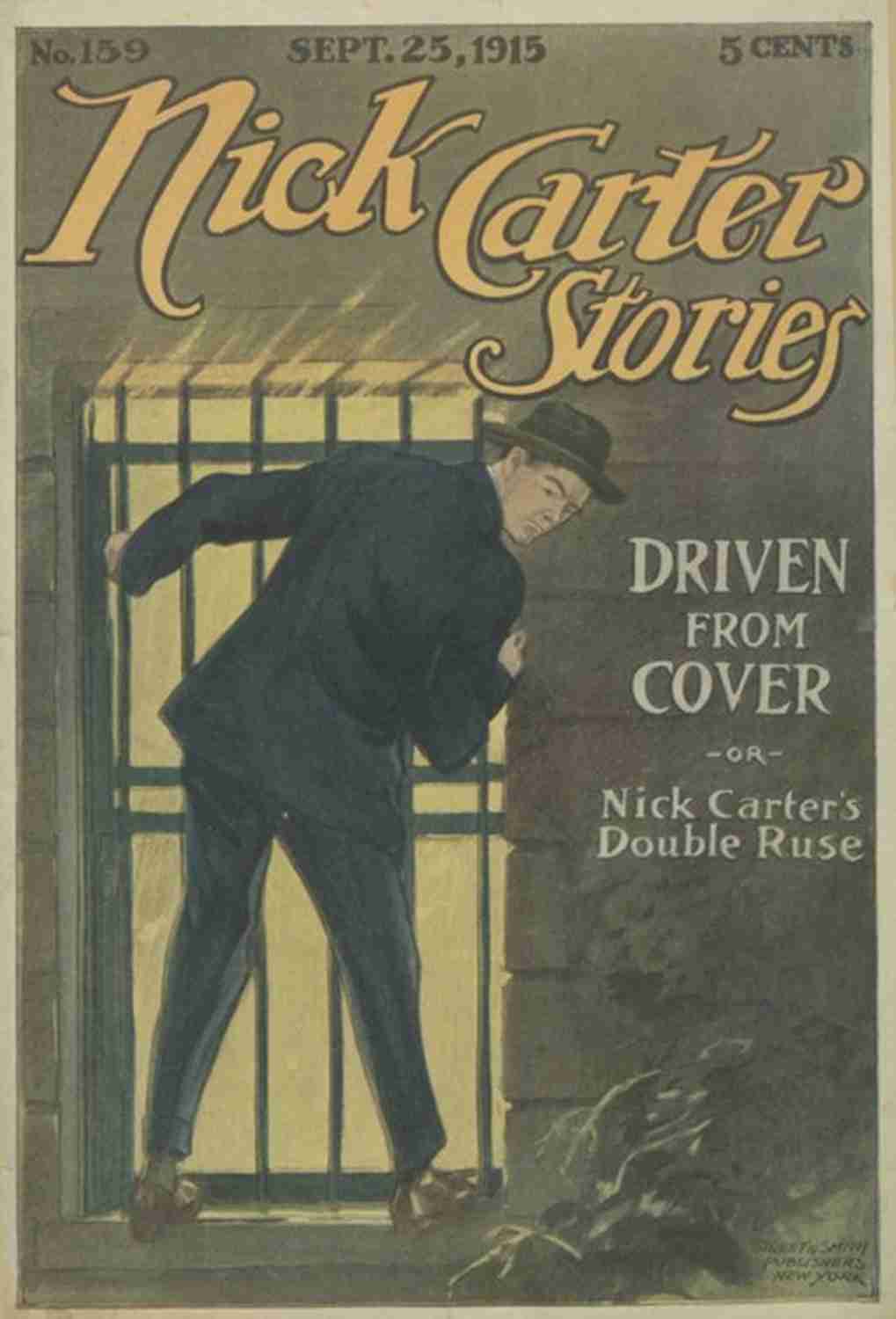
The Project Gutenberg eBook of Nick Carter Stories No. 159, September 25, 1915: Driven from cover; or, Nick Carter's double ruse.
Title: Nick Carter Stories No. 159, September 25, 1915: Driven from cover; or, Nick Carter's double ruse.
Author: Nicholas Carter
Contributor: Bertram Lebhar
Release date: June 21, 2022 [eBook #68361]
Most recently updated: October 18, 2024
Language: English
Original publication: United States: Street & Smaith, 1914
Credits: David Edwards, Chuck Greif and the Online Distributed Proofreading Team at https://www.pgdp.net (Northern Illinois University Digital Library)
Issued Weekly. Entered as Second-class Matter at the New York Post Office, by Street & Smith, 79-89 Seventh Ave., New York.
Copyright, 1915, by Street & Smith. O. G. Smith and G. C. Smith, Proprietors.
Terms to NICK CARTER STORIES Mail Subscribers.
(Postage Free.)
Single Copies or Back Numbers, 5c. Each.
| 3 months | 65c. |
| 4 months | 85c. |
| 6 months | $1.25 |
| One year | 2.50 |
| 2 copies one year | 4.00 |
| 1 copy two years | 4.00 |
How to Send Money—By post-office or express money order, registered letter, bank check or draft, at our risk. At your own risk if sent by currency, coin, or postage stamps in ordinary letter.
Receipts—Receipt of your remittance is acknowledged by proper change of number on your label. If not correct you have not been properly credited, and should let us know at once.
No. 159. NEW YORK, September 25, 1915. Price Five Cents.
CHAPTER I.
CAUSE FOR SUSPICION
Nick Carter waited, listening intently, listening vainly, with his desk telephone in his hand and the receiver at his ear.
Chick Carter, the celebrated detective’s chief assistant, sat watching him, noting each changing expression on his strong, clean-cut face, and wondering what occasioned it.
It was about nine o’clock one evening in October, and both detectives were seated in the library of Nick Carter’s spacious residence in Madison Avenue.
“Hello!” Nick now called quite sharply. “Hello!”
No answer.
“What’s the trouble?” Chick inquired. “Don’t you get a reply?”
“No, Chick, and that’s not the worst of it,” Nick said quite gravely.
“Why so? What do you mean?”
“I heard my name called just as I removed the receiver from its hook,” Nick explained. “The voice sounded like that of a woman, though I am not positive about it. Then came a single sharp crack, like the report of a revolver, or as if the telephone had dropped from the speaker’s hand and crashed upon the floor. I suspect there is something wrong.”
“Can you hear anything now?”
“Not a sound.”
“Call central,” Chick suggested. “You may learn who rang you up.”
“Presently. I still am hoping to hear something of more definite significance.”
One minute passed. It brought no sound over the wire.
The silence then was broken by a voice which Nick knew must be that of the exchange operator addressing the person who had rung him up.[Pg 3]
“Did you get him?”
No answer.
Nick waited a moment longer, then cried abruptly:
“Hello, central!”
“Well?”
“This is Nick Carter talking. I can get no reply from the party who rang me up. What’s the trouble?”
“There should be none. The circuit is not broken.”
“Did you hear any unusual sound after making the connection, as if the telephone had been dropped, or as if something occurred?”
“I did not. I will try to get the party.”
“Do so.”
Nick waited and heard the operator cry repeatedly:
“Hello! Hello! Hello!”
No answer—still no answer.
No sound so much as suggesting what had occurred, what fateful deed had been done, or what horror might then be in progress, whence the mysterious telephone call had come.
The stillness over the wire was like that of death itself.
Had death, indeed, stilled the voice heard for a fleeting moment by the detective, the voice that had uttered his name, as if a cry of appeal had been cut short when it left the lips of the speaker?
The operator spoke again.
“Mr. Carter.”
“Well?”
“There is something wrong. The circuit still is complete, but I can get no reply. The person who called you up evidently has left the telephone, but has not hung up the receiver.”
“Were you asked to hold the wire?”
“No.”
“Can you find out who called, what number, or where the telephone is located?[Pg 4]”
“I will try.”
“Do so, please, and notify me immediately.”
“I will, sir.”
Nick replaced his telephone on the library desk, then turned quickly to Chick.
“Have Danny here with the touring car as soon as possible,” he directed, referring to his chauffeur. “You had better get ready to accompany me.”
“You are going——”
“To the residence, office, or whatever the quarters may be, of the party who telephoned,” Nick interrupted. “The circumstances are decidedly ominous. We’ll find out why the milk is in the coconut.”
“I’m with you,” Chick declared, hastening to carry out the instructions given him.
Ten minutes brought the report Nick was awaiting. He then hurried through the hall, seizing his hat and overcoat, and rejoined Chick in the touring car, which had arrived at the curbing only a moment before.
“Great guns!” Chick exclaimed, upon hearing the terse directions Nick had given to Danny. “The Clayton residence, eh? Not that of Chester Clayton, our old friend and former client?”
“Yes, the same,” said Nick, now looking ominously grim and determined. “He no longer is running the Hotel Westgate, however, as when we twice served him so successfully. He now is in the banking and brokerage business with his wealthy father-in-law. The firm was established soon after his marriage with Clara Langham.”
“I know about that,” Chick replied. “But can Clayton again be up against trouble? What more have you learned?”
“Only that the phone call came from his residence,” Nick rejoined. “It is one of the most costly in Riverside Drive. Something is wrong there. The exchange operator stated again that the receiver still is off the telephone hook.”
“By Jove, that does appear decidedly ominous, Nick, in view of what you heard—a sound like the crack of a revolver.”
“That is why I apprehend trouble. We soon shall know definitely. Ten minutes will take us to the house.”
It was a palatial residence, indeed, at which they arrived within the time mentioned, and at precisely half past nine o’clock.
The night was agreeably warm for October, with a starry sky and a half-filled moon running low in the west, lending a silvery luster to the placid Hudson.
“Wait here with the car, Danny,” Nick directed, alighting at the driveway entrance to the somewhat spacious grounds, which occupied a corner and also abutted on a less pretentious rear street.
“Come on, Chick, and we’ll very soon solve the mystery.”
“Do you know of whom the family consists, Nick, besides Chester Clayton and his wife?” inquired Chick, as they walked up the driveway.
“His mother, Mrs. Julia Clayton, and his wife’s father, Mr. Gustavus Langham,” said the detective. “They also have one child about four months old. There may be others for all I know, for I have seen but little of the Claytons, mother or son, since his marriage and that extraordinary case at Langham Manor more than a year ago.”
“When Clayton’s double, Dave Margate, was wiped[Pg 5] out of existence,” Chick observed. “He was an accomplished and vicious rat, Nick, if ever there was one.”
Nick Carter did not reply. He recalled for a moment the twin relationship of the two men mentioned. He was thinking, too, of the terrible secret known only to him and the mother of these two sons, whose extraordinary resemblance to one another had made possible the two strange cases in which they had figured; one a man of wealth, character, and social distinction, the other a notorious criminal, and both ignorant of their kinship and the circumstances under which they had been separated in infancy.
Nick’s mind had turned for a moment upon this distressing bit of family history confided to him by Mrs. Julia Clayton.
It still was the skeleton in her closet. Despite the death of that vicious son, who had followed the footsteps of his criminal father, or his supposed death under circumstances warranting hardly the shadow of a doubt, there had been no further disclosure of her terrible secret.
“Let it die with him, Mr. Carter, if David Margate is really dead,” she had said confidentially to Nick, after the sensational case at Langham Manor. “God grant that it is so. Not that I am an unnatural mother, however, who can deliberately wish for the death of her own son, but because his career has been one of persistent vice and crime, and his kinship with the loyal son who bears my maiden name has been the one black shadow that I have seen threatening the happiness and welfare of Chester Clayton. He does not know; must never know. It will be better far for all concerned. Let the dead bury the dead.”
Nick agreed with her to this extent, and he was again thinking of her when, after more than a year, he strode up the driveway toward the Clayton residence—instinctively feeling himself on the threshold of another mystery.
“There is a light in the front hall,” he remarked to Chick, when they came nearer the house. “There must be some one at home.”
“Surely.”
“Come this way. I think the library also is lighted. Instead of ringing, Chick, we’ll try to obtain a look from outside.”
Nick had observed a brighter beam of light from one of the side windows. He saw it through the gloom under the porte-cochère. It streamed out over the side driveway beyond, giving a faint glow to the hazy mist that hung just above the cold earth, and lending a waxy luster to the dew-damp greensward of the near lawn.
Nick led the way in that direction, passing under the porte-cochère and by the closed door of a dimly lighted side hall. He then could see more plainly the window from which the light was shed.
It was a broad French window, obviously that of the house library, and opening upon a spacious side veranda. The interior blinds were partly raised, and one section of the window was open several inches.
“For ventilation, perhaps,” Chick whispered, with a significant glance at his companion.
Nick did not reply. He crept noiselessly up the veranda steps, and stole toward the partly open window. Through it, at first, he caught sight of only one corner of the large, beautifully furnished room.
A telephone stand was overturned and lying on the[Pg 6] floor. The instrument was lying near by, with the receiver fallen from its hook.
Nick stepped nearer, and obtained a view of the entire room.
The corpse of an elderly man was lying on the floor between the telephone stand and the library table. His face was upturned in the light from the electric chandelier. His linen and garments were saturated with blood.
He had been shot through the heart.
Seated in an armchair near the opposite wall was a solitary woman. Her fine figure was clad in a handsome evening gown of black lace, the somber hue of which accentuated her ghastly paleness and the dreadful expression then on her white face—a face attractive even then with its refined, matronly features, its lofty brow, and abundance of wavy, gray hair.
She sat gazing vacantly at the corpse, obviously that of a murdered man, but not a sound came from her ashy-gray lips. One would have thought her dead, also, but for the feverish gleam and glitter of her eyes and the piteous wringing of her shapely, jewel-bedecked hands.
It was as if, in a dazed and abnormal mental condition, she strove to cleanse them of the terrible stain, of the blood-red smears that covered them from her finger tips to her wrists.
“Good heavens!” Chick gasped, at Nick’s elbow. “Here’s murder, Nick, hands down. That woman——”
“Is Mrs. Julia Clayton,” said Nick, more calmly. “Be quiet.”
He stepped into the room and approached her, followed by Chick, but though she gazed at them with her glittering eyes turned quickly upon them, she did not stir from her chair, nor appear disturbed by their unceremonious entrance.
Nick paused in front of her, saying impressively:
“You recognize me, Mrs. Clayton, of course. Speak to me. What’s the meaning of this?”
She appeared to struggle inwardly, as if to make an effort to reply and to answer his question, but only two words, twice repeated in husky, horrified whispers, came from her drawn, gray lips:
“The scar! The scar—the scar!”
CHAPTER II.
NICK TAKES A CONFIDANT.
Nick Carter now saw plainly that Mrs. Julia Clayton had suffered no bodily injury. That she was mentally affected, however, either crazed with horror, or in an abnormal condition resulting from other causes, and that any immediate attempt to evoke from her an intelligible explanation of the circumstances would prove utterly futile—these points were equally obvious to the detective.
Nick tried again, nevertheless, gently grasping her shoulder and saying even more impressively:
“The scar! What do you mean, Mrs. Clayton? Try to collect yourself. You surely recognize me—Nick Carter, the detective. Try to tell me what has occurred here. What do you mean? What scar?”
The face of the woman underwent no change. She stared vacantly at Nick, with no sign of recognition, though she again tried to make a vain effort to answer[Pg 7] his questions. But only the same two words, repeated as before, was the result:
“The scar! The scar—the scar!”
Both detectives had seen at a glance that the man on the floor was dead, that nothing could be done for him, and the attention of both naturally had turned upon the woman, whose mental distraction and bloodstained hands indicated that she had in some way figured in the shocking crime, if such it really was.
Chick drew back a little and gazed at Nick, whose grave face now reflected not only his perplexity as to the cause for such a fatality, but also his profound regard for this woman who months before had made him the confidant of her dreadful secret. He was asking himself whether in that could be found the motive for this murder—and he glanced instinctively at the upturned face of the lifeless man on the floor.
But it was a fleshy, smooth-shaved face, that of a man well into the sixties—a face that bore not even a remote resemblance to that of David Margate, this woman’s crime-cursed son.
Besides, was it not known beyond any reasonable doubt that David Margate was dead?
Who could have doubted that either the bullet from Chick Carter’s revolver had proved effective, when a gush of blood covered the face of the reeling crook, or that death had ensued in that swift-flowing stream in the Berkshire Hills, into which Margate had fallen and disappeared, nor so much as arisen for a moment to the surface?
These recollections, Nick’s hurried inspection of the tragic scene, together with his vain inquiries addressed to Mrs. Julia Clayton—all had occupied only a very few moments, which Chick turned and asked perplexedly:
“What do you make of it? What’s the trouble with her?”
“Temporarily insane,” Nick murmured. “She cannot explain. She does not even recognize me.”
“You don’t think she is feigning?” Chick whispered.
“No, no, not for a moment. She looked precisely the same, appeared to be in precisely the same condition, when we saw her before we entered. She has undergone no change since seeing us. She is mentally deranged. She is stricken with aphasia, amnesia, or some similar condition.”
“See her hands. She may have killed this man, or——”
“One moment,” Nick interrupted. “She will remain here. We’ll have a hurried look at the evidence.”
“But what can she mean by those two words, Nick, the scar, which appears to be all she can utter? They must have some vital significance. They may supply the key to the mystery.”
“There is more of a mystery here than she can explain, Chick, while in her present condition, or than we can solve without a thorough investigation,” Nick said. “We had better begin it at once, than waste time vainly interrogating her.”
Nick turned while speaking and replaced the telephone stand, also the instrument in their customary position, but he did not delay to communicate with the exchange operator.
“There must be something here that will give us a hint at the truth,” he added. “We’ll try to find it before others show up.[Pg 8]”
“Barring these two, Nick, there seems to be no one in the house,” replied Chick, after listening briefly at the open door of the adjoining hall. “That also appears extraordinary. Where are the Claytons? Where is Mr. Langham? What has become of the servants? Why are all of them absent? If for legitimate reasons, and others have not been here since their departure, it must be that the woman killed this man in a fit of madness, of which her present condition may be the result, or——”
Chick stopped short.
A key had been thrust into the lock of the front door. The sound had reached the ears of both detectives.
Nick moved quickly, with his forefinger laid on his lips.
“Be quiet,” he cautioned. “Wait!”
He stepped back of the open door, to a position enabling him to peer through the broad, brightly lighted hall.
Chick drew back against the wall.
Mrs. Julia Clayton had not stirred from her chair, had not spoken, nor ceased the piteous wringing of her bloodstained hands. She again was gazing with wide, vacant eyes at the gory form on the floor, still with no sign that she recognized the detectives, or had the slightest interest in, or understanding of, why they were there and what they were doing.
Less than three minutes had passed since they entered the house—and another now was entering.
Was that in any way significant?
Nick Carter was much too keen to overlook that possibility, though only a bare possibility it appeared to be. He saw the front door deliberately opened and the man who complacently entered.
He was of medium height and rather slender build, a man about forty years old, with thin features, a pallid complexion, and a mustache and beard of peculiar bronze hue and oily luster. His hair was of the same remarkable color, observable when he removed his hat. It was most carefully combed and brushed, being fairly plastered down with artistic skill over his skull and brow and above his ears, lending to that part of his head which it covered the glistening smoothness of a polished bronze globe.
He had entered with a latchkey. He paused in the hall and placed his cane in a stand, then removed his hat, overcoat, and gloves, all the while quietly humming a popular song.
Gloves off, he gazed into the hatrack mirror, and, with his palms, augmented the radiant smoothness of his remarkable hair, much as if that was the one personal adornment of which he was really proud.
He hesitated at the base of the stairs, toward which he had deliberately turned, and then gazed toward the library and listened, finally wheeling abruptly and walking in that direction.
Nick drew from behind the door, and in another moment the stranger appeared on the threshold—only to recoil with a startled cry, hands in the air, and with his face gone white with alarm.
“Don’t be frightened,” said Nick, sharply regarding him. “A crime has been committed here, and we are detectives. Who are you? I suppose you reside here.”
“Detectives—crime!” The man steadied himself, yet spoke with a gasp of augmented dismay. “You do[Pg 9]n’t mean a murder? Merciful Heaven! What’s wrong with Mrs. Clayton?”
His gaze had fallen upon her, but she had not so much as glanced in his direction, nor appeared to know him, or have more interest in him than in the others.
“There is more wrong here than can be told with a breath,” Nick replied. “Step in and answer my question. To begin with, sir, who are you?”
“I am Mr. Chester Clayton’s private secretary, Rollo Garside,” said he, with a manifest effort to pull himself together.
“Do you reside here?”
“Yes, yes, certainly. Who are you? How came you here? Why——”
“Patience, Mr. Garside, and answer my questions, that I may see how best to proceed with this case,” Nick interrupted. “I’m a detective, as I have stated, and my name is Nick Carter.”
“Oh, oh, that’s very different,” Garside quickly exclaimed, countenance lighting. “I have heard Mr. Clayton speak of you. I feared at first that you were deceiving me, that you were responsible for all this, and that I might suffer the same fate.”
“There is nothing for you to fear,” Nick replied. “Do you know where Mr. Clayton has gone this evening, and the rest of the household?”
“Yes, yes, to be sure. He has gone with his wife to spend the evening with the Burtons, in Claremont Avenue. They may return at any moment, Mr. Carter, or you may reach them by telephone. The name is Calvin R. Burton.”
“Get Clayton on the phone, Chick,” Nick quickly directed. “State only that I am here and wish to see him on important business. Ask him to return immediately.”
Chick hastened to obey.
“Now, Mr. Garside, where are Mr. Langham and the servants?”
“Mr. Langham is in Washington on business. The servants were given this evening to attend the wedding of the butler, who resigned his position to-day to be married in Manhattanville. It is too early for them to have returned. I have been visiting a friend since seven o’clock, Professor Abner Busby, who lives in the rear street.”
“Mrs. Julia Clayton, then, was left alone here?”
“Yes, sir, except the baby,” nodded Garside, glancing again at the woman mentioned. “Some one had to remain here, of course, and Mrs. Clayton said she would do so that the nurse might attend the wedding with the other servants. What is the matter with her, Mr. Carter?” he anxiously added. “She does not appear to know me. She looks dazed and unnatural. Her hands are smeared with blood. Has she gone crazy? Was it she who killed Doctor Thorpe?”
He turned with a shudder while speaking and gazed again at the lifeless man on the floor.
Chick arose from the telephone at the same moment.
“I got him, Nick, all right,” he remarked. “He will start for home immediately.”
“Did he ask any questions?”
“None of any importance. He said he would be here in about ten minutes.”
“Very good.”
Nick turned again to Clayton’s private secretary. Although he had readily answered the detective’s questions,[Pg 10] he still appeared quite overcome by the tragic circumstances. That he had told the truth concerning them, however, in so far as he was able to do so, appeared quite obvious, and Nick continued his inquiries.
“You know this man, then,” said he, approaching the lifeless form.
“Yes, indeed, Mr. Carter, though I hardly recognized him at first,” was the reply. “He is Mr. Clayton’s family physician, Doctor Joseph Thorpe. His home is about two blocks from here.”
“Were you well acquainted with him?”
“No. Only since I have been in Mr. Clayton’s employ.”
“How long is that?”
“About three months. I first met Doctor Thorpe when he came to attend Mr. Clayton. That was two months ago.”
“What is the matter with Mr. Clayton?” Nick questioned, a bit bluntly. “I did not know he was ill.”
“I cannot say of what his trouble consists,” Garside replied. “He has been losing flesh and feeling quite badly for several weeks.”
“Has he been going to his office?”
“Only part of the time, one or two days each week, and he then remained only during the morning. I think, Mr. Carter, that Doctor Thorpe has found his case a rather mystifying one,” Garside gravely added.
Nick glanced at the physician, then at the strangely afflicted woman who, so far as was known, had been his one companion at the time of the murder.
“Go to the front hall, Chick, and intercept the Claytons when they enter,” Nick abruptly directed. “Detain them in the parlor and break this matter to them as considerately as possible. Don’t let them interrupt me before I have finished my investigations and ended my talk with Mr. Garside.”
“Go ahead. I’ll look after them, Nick,” Chick replied, with a nod, while he withdrew to the hall.
“Now, Mr. Garside, I want you to be perfectly frank with me,” Nick said impressively. “You have been living here several weeks. You have had a chance to observe these people. Have you ever seen indications of special friendliness between this couple?”
“Doctor Thorpe and Mrs. Julia Clayton?”
“Yes.”
“Why, I cannot say that I have,” faltered Garside, with manifest reluctance. “They appeared to be friends, of course, but—well, nothing more than that.”
“Rack your brain,” Nick insisted. “Has Doctor Thorpe been in the habit of calling here in the evening?”
“No, he has not. I don’t remember that he has ever done so before.”
“It is quite significant that he called this evening, then, when Mrs. Clayton was alone here and when even the servants were absent from the house. Don’t you think so?”
“Well, yes,” Garside slowly admitted.
“Rack your brain,” Nick repeated. “Can’t you recall any little circumstances, however trivial, denoting that they were particularly friendly, or even secretly so?”
Garside’s brows knit perceptibly and a subtle gleam appeared in his dark eyes, now fixed with searching scrutiny on the face of the detective.
“Why, since you press me so insistently, Mr. Carter, I confess that I have seen them talking together in the hall at times,” he replied.[Pg 11]
“When others were not present?”
“Yes.”
“Anything more?”
“I have noticed covert glances, also significant smiles, but I really attached no importance to them.”
“What do you now think, Mr. Garside, in view of what has occurred?” questioned Nick. “Be perfectly frank with me.”
“Why, I see at what you are driving, of course, and you may be right.”
“It looks very much to me as if something occurred which led this woman to kill the physician,” Nick quietly explained. “I found the telephone stand overturned, as if she had attempted to call for aid. She may have shot the physician when he tried to prevent her from using the instrument. This seems to be confirmed by the position of the body between the table and the telephone stand.”
“I agree with you,” Garside nodded. “It certainly does.”
“Obviously, too, here is the weapon with which the crime was committed,” Nick continued, picking up a revolver from the floor near the telephone stand. “Notice where it is lying, as if she dropped it immediately after the shooting.”
“By Jove, I begin to think you are right,” Garside agreed, with a display of increasing interest. “The revolver would have been found nearer the body, Mr. Carter, if the physician had it and this were a case of suicide.”
“Exactly,” Nick nodded. “That’s the very point.”
“Besides, a suicide theory seems utterly improbable.”
“So it does.”
“Mrs. Clayton would not have lost her head in that case, nor have touched the body. She would have called for help, and would have stated what had occurred,” Garside forcibly argued.
“Certainly,” Nick coincided. “Any sane woman would have done so.”
“Instead, as her bloodstained hands denote, she felt of the body to learn whether the physician was dead. Upon finding that she had killed him, the shock evidently threw her into her present deranged condition.”
“Undoubtedly,” said Nick. “There is no getting around it. You are stating my own views, Garside, to the letter.”
“There seems to be nothing else to it,” Garside now declared. “Notice, too, Mr. Carter, that the drawer of the library table is partly open. The revolver was taken from the drawer.”
“Are you sure of it?”
“Positively. It belongs to Mr. Clayton. I have seen it there many times. You will find its leather case in the drawer, also a box of cartridges. See for yourself.”
Nick hastened to verify these statements. He found the articles mentioned in the back part of the table drawer. They appeared to clinch in his mind the theory already expressed by the private secretary. For Nick turned abruptly to him and said:
“There is, indeed, nothing else to it. Doctor Thorpe and this woman disagreed over something. There may have been an altercation, during which she stealthily took the weapon from the drawer. Obviously, of course, the physician would not have known it was there.[Pg 12]”
“Surely not,” Garside declared.
“Mrs. Clayton, then, must have been the one who had the weapon, and it appears evident that she had some serious cause to fear the physician,” Nick forcibly reasoned. “She evidently attempted to use the telephone, moreover, probably intending to call for help, and when Doctor Thorpe tried to prevent her, possibly in a fit of passion, she became so alarmed that she shot and killed him. As you say, Mr. Garside, there seems to be nothing else to it.”
Mr. Rollo Garside smoothed his neatly plastered hair with his palms and looked as if he thoroughly agreed with the famous detective.
“Nevertheless, it seems incredible, Mr. Carter, utterly incredible,” he said tentatively. “What earthly cause can Madame Clayton have had, as she is called, to distinguish her from Mr. Chester Clayton, for standing in fear of Doctor Thorpe, even to the extreme extent of taking his life?”
“That may appear later,” said Nick.
“Possibly.”
“Physicians sometimes discover secrets, you know, from which they try to derive pecuniary advantage. I refer to those unprincipled practitioners who are not above blackmail. Doctor Thorpe may have been one of that class.”
“Possibly,” Garside repeated.
“Be that as it may,” Nick added, “we know the Claytons were not expecting him this evening, or they would have remained at home. If they——”
He cut short his remark upon hearing the front door hurriedly opened, immediately followed by the familiar voices of Clayton and his wife, addressing Chick Carter in terms of hearty greeting.
Nick quietly closed the library door, then turned quickly to Garside, saying impressively:
“They have returned. Not one word to them, Garside, about our suspicions. Leave me to handle this matter and state what seems proper.”
Garside complied without a moment’s hesitation.
“What you say goes, Mr. Carter,” he replied. “You are better able than I to determine what will be for the best.”
Nick laid his hand on the secretary’s arm.
“Let me explain,” he said, even more earnestly. “I must look deeper into this matter before I can decide what will be for the best. In the meantime, Garside, I am averse to arresting Madame Clayton. If she was justified in killing this man, or was mentally irresponsible, as now appears quite possible, I wish to shield the Claytons from needless publicity. Until I have ferreted out the true facts, therefore, I will not arrest this woman.”
“I am glad to hear you say so,” Garside quickly asserted. “I have admired her, Carter, and feel a very deep sympathy for her. There may be, as you say, a justification for the crime. It seems both needless and cruel, moreover, to arrest her while in her present condition.”
“It will be necessary, nevertheless, to temporarily hide our true suspicions and attribute this crime to some unknown assassin,” Nick pointed out impressively. “Otherwise, Garside, her arrest would become imperative. I will take all the responsibility for deferring it, pending further investigations, but you must agree to coöperate with me.[Pg 13]”
“Coöperate with you?” questioned Garside. “What do you mean? I don’t quite get you.”
“I mean that, having confided in you and informed you of my suspicions, you must agree not to disclose them,” Nick explained. “Otherwise, if I defer doing so, you would put me in wrong.”
“Ah, I see,” Garside exclaimed, eyes lighting. “In other words, Carter, you want me to keep my trap closed, or else agree with whatever views you see fit to explain.”
“Exactly,” Nick nodded.
“Enough said. You may depend on my doing so,” Garside hastened to assure him.
“Very good. Leave me to hand out statements consistent with the superficial circumstances, then, and to dig out the true facts from under the surface. That may take time, several days, possibly several weeks. In the meantime——”
“Mum’s the word, Carter, in so far as I am concerned,” Garside earnestly interrupted. “I understand you perfectly. I will be as dumb as an oyster. Take it from me, Carter, you can rely upon my secrecy and discretion.”
“Good enough,” Nick declared, extending his hand. “Shake. Sooner or later, Garside, I will repay you in some way for all this.”
CHAPTER III.
THE NEW BUTLER.
Nick Carter did not often confide in a stranger to the extent that he had confided in Mr. Chester Clayton’s private secretary.
One familiar with the habits and methods of the famous detective might reasonably infer that he had some covert motive in doing so, some ulterior object to be attained by secrecy and coöperation with Mr. Rollo Garside, though what it was would by no means appear obvious. Nor, if such was the case, did it immediately appear on the surface.
For, after three days, the mystery involving the killing of Doctor Joseph Thorpe seemed to be deeper and darker than ever, with the utmost efforts of the detectives failing to shed a ray of light on the case.
Nick Carter had, in fact, found no additional evidence beyond that discovered within an hour after the crime. A careful search later that evening and early the following morning proved utterly futile. None of the windows or doors appeared to have been tampered with, nor was there any evidence that the house had been stealthily entered.
Acting upon Nick’s advice, nevertheless, pending further investigations, the coroner found that Doctor Thorpe had been killed by an unknown assailant, under circumstances of which only Mrs. Julia Clayton was informed, and which she then was mentally unable to disclose.
Nick thus set the legal machine in operation, and the fact that he was at work on the case satisfied the authorities, the police, and the public that no stone would be left unturned to solve the mystery.
Three days, however, brought no observable results.
Madame Clayton remained in much the same condition as when the detectives had found her. Memory appeared to have deserted her. Her mind seemed to be a blank, and she was bereft of speech, not once having spoken since Nick first questioned her, despite the persuasive[Pg 14] endeavors of her grief-stricken family and professional efforts of the physicians who had been summoned.
In the care of a trained nurse, one Martha Dryden, who had had charge of the Clayton infant since its birth, she remained day after day in the same strange condition.
Doctor Thorpe was buried on the third day following the murder, the true motive for which none could conjecture, not even Nick Carter himself.
On the previous day a new butler, one John Peterson, was employed in the Clayton residence to fill the position of the one who had been married. It was this new butler who answered the bell and admitted Nick Carter about seven o’clock in the evening of the third day after the crime. It was not the first time that he had seen and admitted the detective in charge of the case.
“Good evening, Peterson,” said Nick, pausing in the hall to remove his gloves and overcoat. “Mr. Clayton is at home, I infer.”
“Yes, sir; he is, sir,” bowed Peterson. “He is alone in the library, sir.”
“I would prefer to see him alone, Peterson,” said Nick, a bit dryly.
“Very well, sir.”
“Is there any change in Madame Clayton’s condition?”
“I think not, sir. She is just the same, sir. This way, sir.”
He was a sedate, punctilious fellow, this Peterson, with a very florid face and mutton-chop whiskers, a man apparently of middle age and with an exalted appreciation of the functions of his position. One would have said with a glance, in fact, that Peterson had spent the best years of his life in the service of people of quality.
Nick followed him to the library, where Mr. Chester Clayton was awaiting him.
“Mr. Carter, sir,” said Peterson, on the threshold.
“You may close the door, Peterson,” said Clayton, waving the detective to a chair.
Peterson withdrew and the door closed upon his red face and rigid figure.
“Don’t rise, Clayton,” said Nick, while he shook hands with him. “You look pale this evening, more pale than when I saw you on the night of the crime. I venture to say you have lost thirty pounds since I lunched with you something like four months ago.”
“All of that, Nick,” said Clayton, smiling a bit wearily. “I have lost all I took on during the six months following my marriage. I seem to be slipping downhill on greased rollers. What more have you learned about this terrible business?”
“Nothing worthy of mention,” Nick replied. “I still am much in the dark. Peterson tells me there is no improvement in your mother’s condition.”
“No, none whatever,” Clayton said sadly. “She lies hour after hour like a woman in a trance. We have tried in vain to arouse her, or to evoke some sign of recognition. She——”
“We will talk of her a little later,” Nick interposed. “Tell me, instead, Clayton, how long you have been on the down grade. When did you first detect this change in your health?”
“About three months ago, Nick, as near as I can tell.”
“Did you consult a physician at that time?[Pg 15]”
“Yes. I have tried several since then, moreover, but without deriving any benefit. I have been running down and losing flesh in spite of all they can do.”
“Mr. Garside, your private secretary, tells me that you have not been going to your office for some little time.”
“Only occasionally. I have not felt able to do so. That is why I made Mr. Garside one of my household, or, rather, his predecessor, who resigned his position several weeks ago. I found it necessary to transact much of my business at home, and the aid of a private secretary was imperative.”
“I see,” Nick nodded. “Who, by the way, was Mr. Garside’s predecessor?”
“His name is John Dunbar. He was formerly a clerk in our office.”
“Previous to becoming your private secretary?”
“Yes.”
“Has he resumed his former position?”
“No. I don’t know what has become of him.”
“Why did he resign from your employ?”
“He said he intended to go West,” Clayton explained. “I think he may have done so, having seen him only once since he ended our relations.”
“When was that?”
“A day or two later. He called here to introduce Mr. Garside, whom he recommended very highly, and whom I had consented to employ on trial.”
“Just so,” Nick remarked. “I infer that Mr. Garside has proved satisfactory.”
“Yes. His position is not a difficult one, as far as that goes, and he has filled it capably. I rather like him, moreover, for he appears to be very much of a gentleman.”
“Did he have other recommendations except that of Dunbar, your former secretary?”
“No, he did not, nor did I require any.”
“As a matter of fact, then, all that you really know about Garside is what Dunbar told you,” Nick observed.
Clayton eyed him more sharply. Not only the remark, but also the detective’s voice, were tinged with a subtle, sinister significance that could not be overlooked.
“What do you mean, Nick?” he demanded. “What do you imply by that?”
“Oh, nothing of consequence, perhaps,” Nick now said carelessly.
“But you must have some reason for making that remark.”
“It merely occurred to me, Clayton, that you first noticed symptoms of illness about the time that Dunbar left and Garside came here to live,” Nick explained. “That may, of course, have been only a coincidence.”
“What else could it be?” Clayton quickly questioned. “Surely, Nick, you don’t suspect Mr. Garside of anything wrong?”
“No, no; certainly not,” Nick assured him. “He appears to be, as you say, very much of a gentleman.”
“He has my confidence, at least.”
“Of which he no doubt is entirely worthy,” Nick allowed. “Now, Clayton, a few words concerning your mother and her abnormal condition. It has, I think, com[Pg 16]pletely mystified the physicians who have been attending her.”
“Both mystified and baffled them,” bowed Clayton. “They seem to be all at sea.”
“No wonder. For, ordinarily, such a shock as Madame Clayton evidently suffered, while it might deprive one of speech and memory at the outset, soon seeks directly opposite avenues of relief. Memory returns full force, and speech really becomes the safety valve for the overwrought and disordered mind. There must, in my opinion, be some unsuspected cause for Madame Clayton’s remaining in this apathetic condition.”
“But what cause?” Clayton doubtfully questioned. “Surely, if you are right, the physicians ought to discover it.”
“Those who have been attending her may not have diagnosed her case from the standpoint I have in mind,” Nick replied, quite enigmatically. “I know of one thing, at least, that might have such an effect upon Madame Clayton.”
“You mean?”
“Scopolamine.”
“Scopolamine?”
“Yes.”
“I never heard of it. What is it?”
“A drug.”
“A drug?” Clayton echoed again, brows knitting. “But that’s out of the question, Nick? My mother never was addicted to the use of drugs of any kind.”
“Add something to that,” Nick suggested.
“Add something to it? What do you mean?”
“So far as you know,” said Nick, with a more curious expression on his strong, clean-cut face.
Clayton stared at him perplexedly for a moment.
“Nonsense!” he exclaimed. “I cannot agree with you. I know positively, Carter, that my mother never used drugs of any kind.”
“Don’t be too positive,” Nick replied. “The drug may have been administered without her knowledge.”
“By whom?”
“That’s the question. Possibly by Doctor Thorpe himself. Possibly by some one else, whose identity is not even suspected. There may be in connection with this affair, Clayton, various circumstances that we have not even dreamed of.”
“That is possible, of course,” Clayton nervously admitted. “But I cannot imagine any circumstances consistent with such a theory.”
“Don’t try to do so,” Nick replied. “Before undertaking to unearth the circumstances, Clayton, it will be better to find out positively whether I am right.”
“Can that be done?”
“I think so.”
“How? By what means?”
“Let me inform you,” Nick said, more gravely. “Scopolamine is a drug with which the majority of physicians are not very familiar. That may be why those attending her have not suspected that it figures in this case. It first came into modern scientific use within the present generation.”
“How did you learn about it?” questioned Clayton.
“That is not material,” smiled Nick. “I make it a point to learn all about everything that can be applied to criminal uses. That’s part of my business.”
“I suppose so, after all.[Pg 17]”
“It is not necessary for me to enlarge upon the qualities of scopolamine, however, and its peculiar effects upon human organisms, particularly when used in combination with morphium,” Nick continued. “It is known to produce, when persisted in, a very complete state of amnesia, frequently causing absolute loss of memory during the period it is administered, together with other effects such as are observable in Madame Clayton’s condition. All this leads me to suspect the use of scopolamine in her case, possibly in combination with other ingredients, the subtle qualities of which are not generally known.”
“How administered?” inquired Clayton.
“By hypodermic injection.”
“But who on earth, Carter, could have drugged my mother in that way? Surely no inmate of this house is guilty of such infernal deviltry.”
“That’s an open question,” said Nick. “We will not undertake to answer it, Clayton until I am convinced that I am right. In the meantime, however, you must conduct yourself precisely as if no such suspicion existed. You must not betray it by word, look, or sign. You must not confide in your wife, even, until after I have taken the steps I have in view. In other words, Clayton, absolute secrecy is imperative.”
“I see that point, of course, and will govern myself accordingly.”
“Very good.”
“But what are your plans? What steps have you in view?”
“I have been talking by telephone to-day with a Philadelphia physician and chemist, an intimate personal friend, whom I know to be an expert in the use of all kinds of drugs, and thoroughly informed as to the peculiar qualities and effects of scopolamine. If there is any man who can determine positively whether it figures in this case, that man is Doctor Grost. I have described Madame Clayton’s condition to him and he is inclined to my opinion. He has consented to come to New York and see her, and he will be here to-morrow morning. I will call here with him, Clayton, at precisely ten o’clock.”
“By Jove, I am glad to know this,” Clayton earnestly declared. “It gives me a ray of hope, at least.”
“You must be careful not to betray it, nevertheless,” Nick again cautioned him. “Conduct yourself precisely as if we had not discussed this matter, and as if my visit with Doctor Grost was not anticipated.”
“I will do so, Carter, take my word for it,” Clayton again assured him. “I will be constantly on my guard.”
“Very good,” Nick replied, rising to go. “That is all I can say to you this evening. Expect me at ten o’clock to-morrow morning in company with the Philadelphia physician. We can bank positively on one fact, Clayton, that he will speedily determine whether or not I am right.”
Clayton arose, looking vastly relieved, and accompanied the detective to the door.
CHAPTER IV.
THE RESULT OF A RUSE.
It was eight o’clock when Nick Carter left the Clayton residence. He departed without so much as a backward glance, as if he had no further interest in the house and its surroundings. He walked briskly out to his tour[Pg 18]ing car, in which Danny Maloney had been waiting, and was driven rapidly away.
One would have supposed that his visit was all aboveboard, that he was actuated with no covert designs, that he entertained no secret suspicions, aside from those he had expressed during his interview with Mr. Chester Clayton.
Earlier that evening, nevertheless, while discussing the case with his junior partner, Patsy Garvan, it was very obvious that Nick Carter had from the first been working under the surface. Their interview occurred immediately after dinner, while Nick was making ready for his call upon Clayton.
“Nothing is more effective, Patsy, than a shot from behind a masked battery,” he remarked, while knotting his cravat. “When fired at a concealed adversary, even, whose position and designs are only suspected, it is almost sure to drive him from cover.”
“There is something in that, chief, for fair,” Patsy agreed. “But why do you feel so sure you are right in suspecting Clayton’s private secretary?”
“For several reasons,” said Nick. “First, Patsy, because we can find no one else to distrust. I have spent three days in a vain search for another suspect and a reasonable motive for this murder.”
“That’s true, chief. It sure has been a vain hunt.”
“Doctor Thorpe, I have learned, was a man of strong and sterling character. Suicide is out of the question. He is absolutely above suspicion, moreover, in so far as having given Madame Clayton any cause for shooting him. The evidence, also, shows that that theory is utterly improbable, in spite of the fact that I told Garside I suspected it, and then took the precaution to bind him to secrecy.”
“But why did you suspect him so quickly, chief?”
“Because he entered so quickly after Chick and I arrived there,” Nick explained. “Scarce three minutes had passed. If not a coincidence, which I could not easily swallow, it must have been premeditated. That smacked of something wrong, of a knowledge of what had occurred, if not having had a hand in it, even.”
“I see the point,” said Patsy.
“I at once suspected, therefore, that Garside had been watching outside, that he had seen us entering the house, and that he followed us as quickly as he dared, bent upon learning how we regarded the crime, and also lest Madame Clayton might say something of definite significance, in spite of her mental derangement.”
“You decided, then, that he was responsible for that, also.”
“Certainly. That was a perfectly natural deduction, Patsy, if I was justified in suspecting him at all.”
“Sure thing, chief; so it was.”
“I immediately shaped a course, therefore, which I thought would enable me to confirm my suspicions.”
“I see.”
“I soon succeeded in doing so,” Nick continued. “I sent Chick from the room and pretended to make Garside my confidant. I soon found that he was very willing to fix the crime upon Madame Clayton. For he not only agreed with all I said to that effect, but he no sooner found that I was forming that opinion, or supposed that I was, than he began to point out evidence and circumstances in support of it. All this, mind you, regardless of the woman’s lofty character and exemplary past.[Pg 19]”
“I get you, chief,” nodded Patsy. “He evidently was afraid you might overlook something.”
“He appeared to be, certainly,” Nick replied. “He then informed me that the revolver found there belonged to Clayton, also that it had been taken from the table drawer. He did so before having examined it, Patsy, when he could not possibly have been positive of the fact.”
“He overleaped his mount, eh?”
“That is precisely what he did,” said Nick. “I then felt reasonably sure that I was justified in suspecting him.”
“He left himself open, all right.”
“I saw plainly, however, that he was a rat of more than ordinary craft and cunning. Otherwise he could not have committed the crime and planted the evidence we found there, and then got out of the house and returned in so confident and self-assured a way, all within the half hour since I had heard Madame Clayton’s voice by telephone.”
“It sure was quick work, chief,” declared Patsy.
“I at once decided, therefore, to meet the scamp with his own weapons,” Nick added. “I felt sure I could fool him and finally clinch my suspicions, providing I could throw him off his guard for a time. I have given him three days’ grace, so to speak, in which to get rid of any misgivings he may have felt. He ought to be well rid of them by this time. Now, by Jove, I propose to get after him and drive him from cover.”
“That’s the stuff, chief.”
“We must discover his game, how and why he committed the crime, and whether he had confederates,” Nick said, more forcibly. “We must make dead sure, in fact, that I am justified in suspecting him.”
“That is why you have established a new butler in the Clayton house,” observed Patsy, with an expressive grin.
“Exactly.”
“Does Clayton suspect his identity?”
“Not yet. I told him merely that I knew a man admirably qualified for the position. I had no difficulty in persuading Clayton to employ him on trial.”
“On trial, eh?” laughed Patsy. “Gee whiz! he’ll make good, chief, all right. My money goes on that.”
“If he fails, Patsy, it will be the first time,” Nick replied, smiling. “Slip into a disguise, now, and get ready to go with me. I shall leave in about five minutes.”
“I’ll be ready, chief, all right. Danny has just arrived with the touring car.”
“We will drop you about a block from the Clayton place,” Nick added. “You already know why I am going there and what I require of you. If you get a line on this suspect—well, that should open the way. You must be governed by circumstances.”
“You leave him to me, chief,” said Patsy confidently, as he hastened from the chamber in which Nick had been dressing. “I’ll get all that’s coming to me. Trust me for that.”
In the foregoing may be found not only the occasion for Nick Carter’s call upon Clayton, with a hint at the subterfuge involved, but also why he departed without a backward glance, or the slightest sign of interest in the surrounding grounds.
For Patsy Garvan had arrived there immediately after Nick entered the house, and upon him devolved the most[Pg 20] important part of the work laid out for that evening by the detective.
It was a fit night, moreover, for the task engaging Patsy. The sky was clouded, with not a solitary star relieving the inky gloom of the heavens. A gray fog hung like a thin veil near the earth, sufficiently dense to lend a sallow glow to the arc lights, and add to the obscurity in localities beyond the reach of their searching rays.
A gusty wind was blowing, driving the gray mist in confusing swirls over the Hudson, and sighing dismally through the dripping foliage of the trees adorning the grounds of the crime-cursed home of the Claytons.
Patsy did not approach the house from in front. Stealing into the grounds from the side street, he crept around the garage, then picked his way over the damp lawn, taking advantage of the deeper gloom under the trees, until he found shelter under a huge clump of rhododendrons a few feet from the driveway, and within easy view of the side veranda and the French window of the brightly lighted library.
Patsy arrived there just in time to see Peterson usher Nick into the room. Both were dimly discernible through the lace draperies and under the partly drawn shades.
“Gee whiz! there’s the new butler,” chuckled Patsy, when he caught sight of him. “I hardly expected to get my lamps on him. Stiff as a ramrod, eh? But he’ll limber up, all right, if there should be anything doing.”
Peterson, having withdrawn from the library, encountered Mr. Garside just at that moment descending the front stairs. He paused and bowed respectfully when the private secretary spoke to him.
“Mr. Clayton is engaged, Peterson?” he said inquiringly.
“Yes, Mr. Garside, sir.”
“With whom, Peterson?”
“With Mr. Carter, sir, the detective,” said Peterson, with becoming humility.
Garside eyed him more sharply.
The florid face of the butler was as inscrutable as that of the sphinx.
“I want Mr. Clayton’s signature to these letters,” Garside remarked, displaying two typewritten sheets. “It will do in the morning. Would you mind taking them up to my room, Peterson, and leaving them on my desk?”
“No, sir. Very willing, sir,” said Peterson obsequiously.
He received them with a bow and went upstairs.
Garside sauntered toward the side hall, into which he vanished, only to peer out cautiously and watch the butler until he disappeared. Then he seized a woolen cap from a rack on the wall and stole quickly toward the rear door of the house.
Patsy Garvan caught sight of him a moment later, a stealthy figure noiselessly picking his way around a corner of the house, against the lighter background of which his dark outlines were dimly discernible.
“Gee whiz! the chief sure has called the turn,” thought Patsy, instantly alert. “The rat is coming from his hole. It’s that private secretary, all right, or my lamps have gone mighty misty. Yes, by Jove, I’m right. Let the chief alone to drive him from cover.”
Garside was passing one of the lighted windows, when, for a moment, he could be seen more distinctly and his identity positively determined.
He paused briefly, then moved on like an evil shadow, darker than the surrounding darkness, until he came to[Pg 21] the veranda steps. Up these he crept, crouching on his hands and knees, until he was within a yard of the broad French window, through which he cautiously peered, lingering and listening.
“Driven from cover is right,” thought Patsy, intently watching him. “He’s out to play the eavesdropper, just as the chief suspected. What will he do next, after Nick has filled his ears with that fake story about a Philadelphia physician? It’s dollars to fried rings, now, that it will drive him to a move of some kind. It will be a chilly day, by gracious, if I fail to get next.”
Nearly half an hour passed.
Garside remained crouching on the veranda.
Patsy continued to watch him from under the rhododendrons.
The interview in the library came to an end. The crouching man crept quietly from the veranda, then stole hurriedly to a front corner of the house. He saw Nick emerge, watched him stride quickly down the driveway, and enter the touring car, departing without a backward glance; and then he straightened up, lingering for a moment, and fiercely shook his fist after the receding car.
“Good enough! That shows your true colors, all right,” muttered Patsy, still watching him. “Now, you rascal, go ahead and cut loose. I’m right here to note your next move.”
Patsy had not long to wait.
Garside lingered only until the rear red light of the touring car had disappeared in the misty distance. He did not return to the house. Instead, now moving less cautiously, he hastened toward the rear grounds, passing the garage and seeking the narrow back street adjoining the Clayton residence.
Patsy stealthily followed him.
The back street was deserted. The scattered dwellings were in darkness. An incandescent lamp here and there, looking sallow and sickly in the gray fog was all that relieved the misty gloom.
Garside soon brought up at a narrow wooden door in a high brick wall flanking one side of an old estate. He opened the door with a key and disappeared into the inclosed grounds.
Patsy paused and briefly sized up the place. He could see beyond the wall the upper part of an old stone house, shrouded in darkness. An iron grille gate in front was all that broke the stretch of the grim brick wall, which was about seven feet high, and the cement capstone of which was surmounted with a threatening array of broken bottles and jagged pieces of glass, a vicious safeguard against unwelcome intruders.
“Gee whiz! that says keep out, all right,” thought Patsy, while he made a closer inspection of the side wall. “It’s up to me to get in there, all the same. This may be where the party lives whom Garside said he was visiting on the night of the murder. Professor Abner Busby was the name he gave Nick, but it don’t appear in the city directory. I’ll have a look at the back wall.”
Patsy already had tried the wooden door and found that Garside had locked it after entering. Near the rear corner of the wall, however, he found that the branches of the tree overhung the jagged capstone, and he promptly decided that that would serve his purpose.
Quickly climbing to one of the lowest branches, Patsy worked himself out on it hand over hand, until he reached[Pg 22] a point beyond the wall, when he dropped noiselessly upon the greensward within the inclosed grounds.
Crouching in the darkness near the wall, he then had another view of the house, this time from the rear. It looked as grim and gloomy as a country jail, or the habitation of a recluse bent upon dwelling in absolute seclusion.
Only one curtained window was lighted, that of a room on the ground floor, a window in the rear wall. The rest of the house was shrouded in darkness while most of the surrounding grounds, running to rank grass and high weeds, appeared to be deserted.