
THE NEWS OF ALL NATIONS.
Smallest Knife in the World.
What is in all probability the smallest knife in the world has just been completed by M. A. Kaufman, an employee of a jewelry store of Altoona, Pa. It measures five-thirty-seconds of an inch long, has a blade less than two-sixteenths of an inch in length, and weighs a third of a grain. The handle is of solid gold, while the blade and spring are of tempered steel.
Recalls Indian Battle Back in Summer of ’65.
George L. Wilcox, O. O. Ferbrache, and others are locating the long-forgotten, neglected, and obliterated graves of Captain William D. Fouts and his men, Philip G. Alden, Edward McMahan, and Richard Gregor, who lost their lives a half century ago in the battle of Horse Creek, fought near Scottsbluff, Neb.
The work is undertaken under orders from Captain Ray B. Harper, of the quartermaster’s corps of Omaha, and the remains are to be sealed in lead caskets and removed to the military cemetery at Cottonwood Cañon, a little east of North Platte.
The graves now lie under a field of alfalfa about four miles west of the city of Scottsbluff, close by the old ruin of Fort Mitchell. This fort was first built by Bruce Husband, of the American Fur Company, and was named Fort Fontenelle, but was later named Fort Mitchell, after General Mitchell. At the time of the interment of Captain Fouts and his companions, it was called Camp Shuman, and was a substation of Fort Laramie.
It would be impossible to find these graves now, were it not for the memory of old-timers, who, thirty years ago, came into the valley, riding the range, or looking for homesteads.
During the winter of 1864-5 there were around Fort Laramie about 2,000 Indians, who professed to be friendly, and said that the war tribes had made it dangerous for them to pursue their usual vocation of hunting and trapping. Under orders they were fed and sustained through the cold winter, but the officials at the fort had good reason to believe that there were a number that were carrying word to the war braves. Every movement of the soldiers seemed to be transmitted almost instantly into the enemy’s camp.
It was therefore deemed advisable to remove the friendlies from this central scene of hostilities, and consequently, on July 11, 1865, a company of 135 soldiers, under Captain Fouts, were commissioned to act as an escort for the friendlies, who, in the number of 15,000, including squaws and papooses, were inclined to go. They were to be taken to Julesburg, and part of them to Kearney.
Captain Fouts proceeded carefully down the river on the south side, and, lest a nervous finger should press a trigger prematurely, most of the guns were unloaded. There was nothing of a suspicious note occurring except occasionally signal fires on the hills bordering the Rawhide and Sheep Creek, and occasionally a fire arrow lost itself in the dark vault of the sky.
These weird manifestations of an undercurrent of [Pg 62]hostility was naturally trying to the nerves of the families of Captain Fouts and Lieutenant Triggs, which accompanied the party, and especially so because Mrs. Eubanks and daughter, and Miss Laura Roper, recently captured from the Indians, and whose six months in captivity had familiarized them somewhat with Indian signs and their meaning, expressed grave apprehension.
On the night of June 13th, they went into camp on Horse Creek, the Indians on the west side and the soldiers on the east side of the creek. The Indians proceeded to give a dog feast, and the officers were unable to discover what was in the air.
Three hundred and eighty warriors went into council, and the outcome was a tremendous fury at certain of the white soldiers who had taken young Sioux squaws into their tents and kept them there for hours.
On the morning of the fourteenth the advance guard started with the wagons at five o’clock, the intention being to cover the eighteen miles to Camp Shuman, where they would camp in the luscious meadows adjacent and near by. The wagons were strung out for a mile or more when rapid firing was heard in the rear. Captain Fouts’ zeal for peace was the direct cause of his death.
The delay incident to loading and distributing ammunition gave the Indians an advantage. The captain had gone back across Horse Creek to hurry the Indians, and they had killed, stripped, and mutilated him, and had fled three miles toward the river and were making warlike demonstrations, while the squaws and papooses were crossing the river, riding, or swimming beside their swimming ponies.
The rear guard had at first run toward the front, but the front guard met them halfway, and together they charged after the Indians. When near at hand, Charles Elston was sent forward to offer those who would accept it and come forward peacefully, immunity from punishment. They met his offer with a shriek of defiance and charged furiously.
The Indians numbered more than five hundred warriors, and, when at a distance of about three hundred yards, they commenced firing, and it was answered in telling effect by the military. While those in front were checked by the fire of the Gallagher rifles, both flanks of the Indians advanced as if to hem them in and cut them off.
Over the hills from the west side of Horse Creek poured dozens and hundreds of the shrieking demons, and an orderly retreat was taken to the wagons, which, in the meantime, had been drawn up in a defensive circle, and hastily constructed rifle pits made.
The Indians then ceased their firing and withdrew. Seeing that they were indisposed to press their attack while the soldiers were behind defenses, and wishing to keep them engaged and at hand until reënforcements came, the officers in charge took fifty of the best mounted men and sallied out.
When out about three miles they saw a large force of Indians coming around the hills on the west side[Pg 63] of Horse Creek with the evident intention of cutting them off. Again the military retired to their intrenchments.
About nine o’clock Captain Shuman arrived with a force from Camp Shuman or Fort Mitchell, and, thus reënforced, another attack was made upon the Indians, but it was a little late. The squaws and papooses had all succeeded in crossing the river, and the warriors had followed.
The military could not follow, for it would be impractical, and perhaps impossible to cross the river at its high stage, in the face of a superior number of Indians.
A message had been sent to Fort Laramie, and Colonel Moonlight, well known for his recent summary execution of three renegade Indians, had started from the fort with two hundred and forty well-mounted men, when he met another courier with the information that the Indians had crossed the river, whereupon he crossed at the fort and took up the pursuit.
This constitutes another story, and the finish of the battle of Horse Creek, the dead being the four named in the beginning of this article, and four others were wounded. The dead were taken to Camp Shuman, the ruins of which are still distinguishable, about three hundred feet south of the west end of the Platte River Bridge, west of this city. And out southwest thereof about a quarter of a mile they were laid to rest, and there have rested for this half a century ending the middle of June. And now, from their obliterated graves, they will be removed to join their fellows, the other early guardians of the great Overland Trail, in the cemetery set aside for their honor by the national government.
Finds War Signs on Wheat and Oat Leaves.
The report in some papers that the letter W appears on wheat leaves this year and the letter B on oat leaves has set some of the farmers in the vicinity of Charlotte, Mich., to investigating. The result is that oat leaves have been found on which the letter B does seem to be quite visible, but the wheat leaves are too ripe and shriveled by rust to give an exhibit of the letter W.
It is claimed by some of the older residents that these letters appeared on the wheat and oat leaves in 1860, the year before the breaking out of the great Civil War, and they believe they indicate now a “bloody war,” in which the United States will be engaged.
These letters, it is averred, have never appeared preceding a small war, such as the Spanish-American War.
Another interpretation of these letters has been advanced to the effect they indicate that Wilson and Bryan will be contestants for the nomination for president in 1916.
This Dog is a Fire Fan.
Assistant Fire Chief Tom Davis, of Sharon, Pa., is the owner of an English bulldog whose sole diversion is running to fires. The faithful animal, now nine years old, has been absent from one alarm during his career, a record probably not equaled by any fireman in the country. The one absent mark credited against him was when he was out of the city.
The dog’s name is Peter. Chief Davis obtained him when a puppy. The animal began following his master to[Pg 64] fires, and when he was a year old he became such a fire fiend that he didn’t even bother to wait for his owner. In the days of the horse-drawn apparatus Pete was always first at the fires. His love of the smoke and flames keeps him in the midst of the blaze while it lasts. Pete is now afflicted with troubles incident to old age. When not answering an alarm, he excites the pity of everybody by the manner in which he painfully moves about. But let the fire bell sound, and the dog is off in a flash, distancing any dog that tries to keep after him.
And if an alarm should be sounded at night, Pete goes to the fire just the same. His owner runs a hotel, but sleep becomes impossible until Pete is released from the building. Chief Davis has on several occasions given orders that the dog is to be kept in the hotel when the bell rings. Docile as a lamb on every other occasion, Pete shows great anger when an effort is made to keep him away from a fire call. If perchance the hotel doors are closed, the visitor who allows Pete to get outside has made himself forever “solid” with the faithful animal. One time when penned in alone, Pete made his way from the building by going through a closed window.
Pete’s principal duty in the days of horse-drawn apparatus was to protect the horses from annoyance by strange dogs. And he always performed the duty faithfully. During the last few years of the horse apparatus the dog population seemed to know Pete’s duty, and it was only the puppy who wanted to bark at the horses’ heads. The older canines knew better. They had learned by experience that Pete meant business when he started for a dog that happened to be annoying the horses.
The advent of the motor machinery was mourned by no one more than Pete. He was unable to lead the machinery because it traveled so much faster than the horses. Several narrow escapes have taught him to remain on one side of the street. On two occasions the fire truck has felt the tear of the emergency brakes to keep from running down the dog, for he is as dear to the firemen as though he was their own. Age is telling on the animal, and he generally returns from an alarm riding on the machine. He remains at the department until the machinery is cleaned up and ready for another alarm, and then he makes his way painfully to his home.
Some years ago the fire bell began ringing at seven a. m. and seven p. m. Pete was fooled a few times, but he soon got wise. The same is true of the curfew bell. To prove the almost human intelligence of the animal, an alarm was sounded one night at nine o’clock. Pete never moved from his favorite chair in the hotel until the bell had tapped more than nine strokes. Then he was off like a flash. On this particular occasion pedestrians who have learned to make a clear path when Pete comes along thought he was on his way to the fire. Pete sent one young man sprawling on the ground by diving between his legs and he frightened a woman half to death by a leap over her baby carriage which barred his path.
A hitch in the ringing of the bell may send the human fire fiends scurrying in the wrong direction. Not so with Pete. He seems to have a sixth sense, and he gets to the scene by the shortest way possible, many times taking an altogether different course from that of the firemen.[Pg 65]
On one particular occasion the firemen were called to Sharpsville, four miles away. No alarm was sounded, and Chief Davis was not aroused, because he is a volunteer and the fire happened at midnight. But Pete sensed that something was wrong. He began barking, and finally jerked the covers from his owner’s bed. Davis was at a loss to account for the excitement. Pete kept getting more boisterous and refused to be quieted. Davis pulled on his clothes to let the animal outside. Opening a door, he met a policeman who spoke of the fire. Davis went to the scene in his automobile, and Pete was soon left behind. But the dog wasn’t lost. He arrived at the fire as the firemen were prepared to return home. The faithful animal was so weak from his run that he had to be lifted to the truck to be carried home.
Sharon firemen answer an average of seventy-five alarms of fire a year, therefore Chief Davis and all the firemen agree that Pete is entitled to credit for his record. Council has taken recognition of the animal, and he is possibly the only dog in the United States who is exonerated from wearing a license tag.
Motor Trucks Used on Mail Routes.
Motor trucks are fast taking the place of wagon stages on the inland mail lines in the sparsely settled districts of the Northwest where there are villages still distant fifty, seventy-five, and even one hundred miles from the railroad. The drivers of the trucks in making their trips over the lonely prairies—miles from towns—have a variety of experiences, as does also Uncle Sam’s mail.
Sixteen pouches of mail, including several sacks of women’s hats, lay out on the prairie during the night following the burning of the truck that carries the mail between Williston, N. D., and Watford, a distance of forty-five miles.
It was past midnight, the car was ten miles out of Watford, and the mail ten hours overdue, when, in cranking up, the engine fired back and the car caught fire. The mail was barely saved.
The driver walked in ten miles, carrying the locked pouch of registered mail and leaving the rest on the prairie for the night.
This Lake is Abode of Evil Spirits.
The most singular body of water in the United States is that of a small lake in the western portion of the State of Washington, known by the Chinook Indians as “Nao Skookum”—meaning “no good.” To the inhabitants of the Indian villages this lake is a great mystery as well as a source of great fear, for they believe the underground crevices that feed the lake are full of “evil spirits.”
The lake covers perhaps fifty acres of ground, and fish and waterfowl are more than plentiful—for about nine months of the year. North of the lake towers Mount Olympus, of the Olympic range, while to the south and west are the coast range of great hills.
In western Washington the “rainy season” usually lasts something like nine months, and a week or so after the rain sets in, “Nao Skookum” Lake grows very much in circumference and in depth, but, after a week’s dry weather, its waters vanish, taking with them the fish and, so the Chinooks declare, the waterfowl, too. When the rain stops, all the Indians in the neighbor[Pg 66]hood gather on the shore of the lake in order to get as much fish as possible while there is yet time.
Hour after hour the waters sink lower and lower, until the last of it drains down the great holes and crevices at the bottom of the lake. Underground openings of immeasurable length, and as yet untraced by human eye, take the water from the lake, till what was once the bottom of a deep body of water is open to the sky. Then and there the superstitious Indians desert the vicinity of the lake, nor will they again go near it until the rain again comes and the waters return with a rush and fill almost to overflowing what scientists claim was once the crater of a volcano. When it is empty, the Indians declare that thunderous roars and groans issue from the great crevices in the lake’s bottom, and they will not venture near it, for “it is the voice of the evil spirits,” they declare.
They again return to fish when the rain sets in and the waters surge quickly up the subterranean openings, throwing up fish and great waves and—so the ignorant Indians claim—the waterfowl. In from thirty to forty hours, where had been a great bed of mud, all is deep water, and the lake of Nao Skookum is again sparkling in the sunlight.
Scientists explain this most singular occurrence by stating that the lake is connected by means of its underground openings with great bodies of water, some on a higher level, under the great, snow-capped peaks of the mountain ranges near by, others on a lower level than itself, and that the ducks and other waterfowl come and go from the Pacific and Puget Sound. But no one can convince a Chinook of anything but that they are thrown up with the fish and the rushing waters.
American Munitions Small Potatoes.
“In my judgment, less than one million charges of artillery ammunition has been sent from this country to all the belligerents in Europe since the war broke out. This would not run any single army in Europe through a two days’ battle in which one thousand guns were used.”
This statement was made here by one of the best ordnance experts in the United States. He had before him the official figures of the department of commerce on exports of cartridges, gunpowder, and high explosives covering the eleven months of commerce up to June 1st. He declared that, in his opinion, not all of this ammunition has yet reached the front in Europe, for the reason that the belligerents themselves have been making their own supply and gathering a reserve wherever they could find it, instead of sending ammunition manufactured outside of their own country directly to the front. The reason for this is that artillery ammunition is not assembled when shipped, and has to be loaded and adjusted on arrival abroad, before it can be sent to the front.
Officials in Washington do not hesitate to say that much of the controversy over the question of shipments of war munitions to Europe comes from newspaper publications of large orders for arms and ammunition which are being placed in this country for future delivery. In many cases it is necessary for the American manufacturers to erect a brand-new plant to produce the goods, and in practically all such instances delivery is months, if not a year, away.[Pg 68][Pg 67]
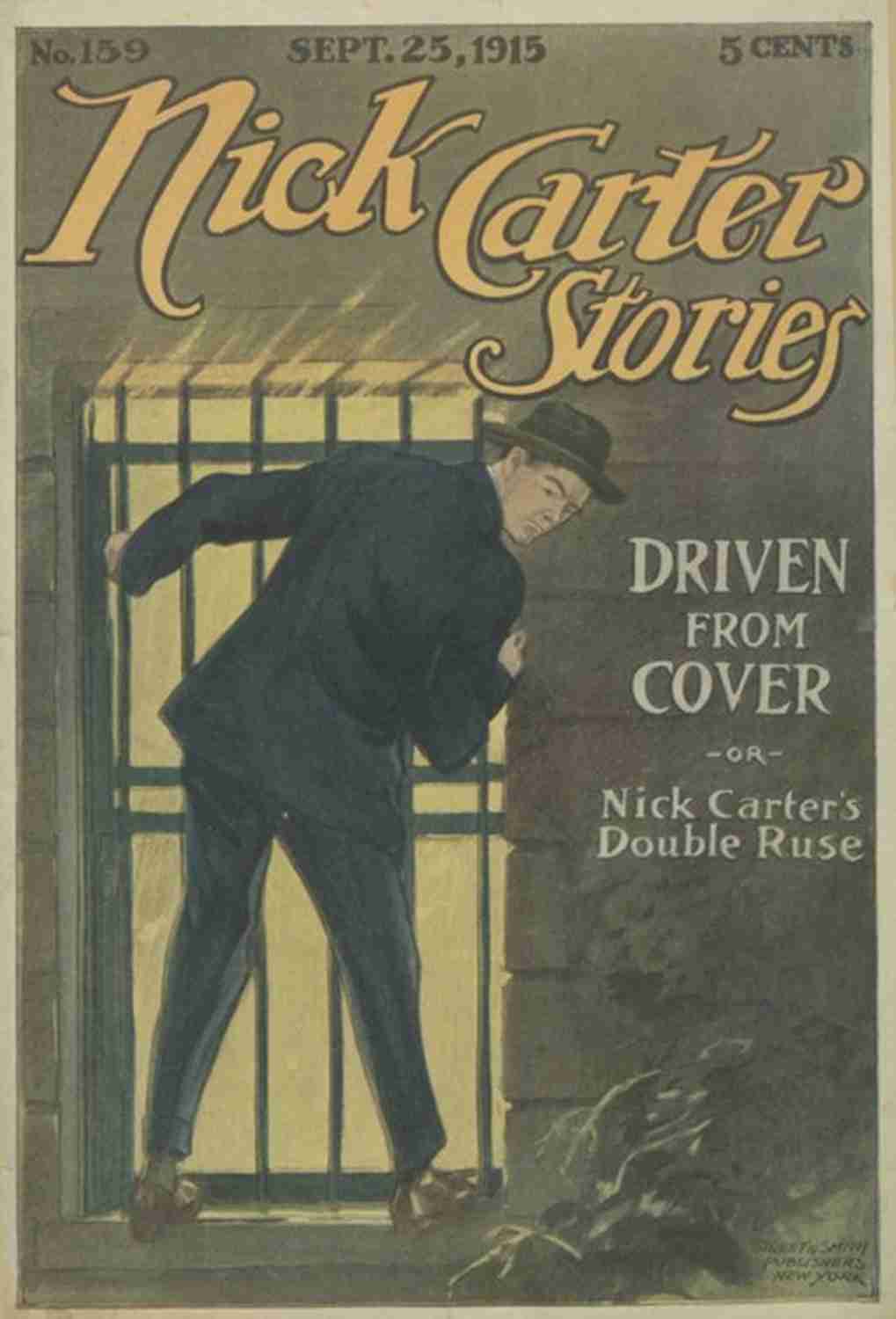
The Nick Carter Stories
ISSUED EVERY SATURDAY BEAUTIFUL COLORED COVERS
When it comes to detective stories worth while, the Nick Carter Stories contain the only ones that should be considered. They are not overdrawn tales of bloodshed. They rather show the working of one of the finest minds ever conceived by a writer. The name of Nick Carter is familiar all over the world, for the stories of his adventures may be read in twenty languages. No other stories have withstood the severe test of time so well as those contained in the Nick Carter Stories. It proves conclusively that they are the best. We give herewith a list of some of the back numbers in print. You can have your news dealer order them, or they will be sent direct by the publishers to any address upon receipt of the price in money or postage stamps.[Pg 69]
730—The Torn Card.
731—Under Desperation’s Spur.
732—The Connecting Link.
733—The Abduction Syndicate.
738—A Plot Within a Plot.
739—The Dead Accomplice.
746—The Secret Entrance.
747—The Cavern Mystery.
748—The Disappearing Fortune.
749—A Voice from the Past.
752—The Spider’s Web.
753—The Man With a Crutch.
754—The Rajah’s Regalia.
755—Saved from Death.
756—The Man Inside.
757—Out for Vengeance.
758—The Poisons of Exill.
759—The Antique Vial.
760—The House of Slumber.
761—A Double Identity.
762—“The Mocker’s” Stratagem.
763—The Man that Came Back.
764—The Tracks in the Snow.
765—The Babbington Case.
766—The Masters of Millions.
767—The Blue Stain.
768—The Lost Clew.
770—The Turn of a Card.
771—A Message in the Dust.
772—A Royal Flush.
774—The Great Buddha Beryl.
775—The Vanishing Heiress.
776—The Unfinished Letter.
777—A Difficult Trail.
782—A Woman’s Stratagem.
783—The Cliff Castle Affair.
784—A Prisoner of the Tomb.
785—A Resourceful Foe.
789—The Great Hotel Tragedies.
795—Zanoni, the Transfigured.
796—The Lure of Gold.
797—The Man With a Chest.
798—A Shadowed Life.
799—The Secret Agent.
800—A Plot for a Crown.
801—The Red Button.
802—Up Against It.
803—The Gold Certificate.
804—Jack Wise’s Hurry Call.
805—Nick Carter’s Ocean Chase.
807—Nick Carter’s Advertisement.
808—The Kregoff Necklace.
811—Nick Carter and the Nihilists.
812—Nick Carter and the Convict Gang.
813—Nick Carter and the Guilty Governor.
814—The Triangled Coin.
815—Ninety-nine—and One.
816—Coin Number 77.
NEW SERIES
NICK CARTER STORIES
1—The Man from Nowhere.
2—The Face at the Window.
3—A Fight for a Million.
4—Nick Carter’s Land Office.
5—Nick Carter and the Professor.
6—Nick Carter as a Mill Hand.
7—A Single Clew.
8—The Emerald Snake.
9—The Currie Outfit.
10—Nick Carter and the Kidnapped Heiress.
11—Nick Carter Strikes Oil.
12—Nick Carter’s Hunt for a Treasure.
[Pg 70]13—A Mystery of the Highway.
14—The Silent Passenger.
15—Jack Dreen’s Secret.
16—Nick Carter’s Pipe Line Case.
17—Nick Carter and the Gold Thieves.
18—Nick Carter’s Auto Chase.
19—The Corrigan Inheritance.
20—The Keen Eye of Denton.
21—The Spider’s Parlor.
22—Nick Carter’s Quick Guess.
23—Nick Carter and the Murderess.
24—Nick Carter and the Pay Car.
25—The Stolen Antique.
26—The Crook League.
27—An English Cracksman.
28—Nick Carter’s Still Hunt.
29—Nick Carter’s Electric Shock.
30—Nick Carter and the Stolen Duchess.
31—The Purple Spot.
32—The Stolen Groom.
33—The Inverted Cross.
34—Nick Carter and Keno McCall.
35—Nick Carter’s Death Trap.
36—Nick Carter’s Siamese Puzzle.
37—The Man Outside.
38—The Death Chamber.
39—The Wind and the Wire.
40—Nick Carter’s Three Cornered Chase.
41—Dazaar, the Arch-Fiend.
42—The Queen of the Seven.
43—Crossed Wires.
44—A Crimson Clew.
45—The Third Man.
46—The Sign of the Dagger.
47—The Devil Worshipers.
48—The Cross of Daggers.
49—At Risk of Life.
50—The Deeper Game.
51—The Code Message.
52—The Last of the Seven.
53—Ten-Ichi, the Wonderful.
54—The Secret Order of Associated Crooks.
55—The Golden Hair Clew.
56—Back From the Dead.
57—Through Dark Ways.
58—When Aces Were Trumps.
59—The Gambler’s Last Hand.
60—The Murder at Linden Fells.
61—A Game for Millions.
62—Under Cover.
63—The Last Call.
64—Mercedes Danton’s Double.
65—The Millionaire’s Nemesis.
66—A Princess of the Underworld.
67—The Crook’s Blind.
68—The Fatal Hour.
69—Blood Money.
70—A Queen of Her Kind.
71—Isabel Benton’s Trump Card.
72—A Princess of Hades.
73—A Prince of Plotters.
74—The Crook’s Double.
75—For Life and Honor.
76—A Compact With Dazaar.
77—In the Shadow of Dazaar.
78—The Crime of a Money King.
79—Birds of Prey.
80—The Unknown Dead.
81—The Severed Hand.
82—The Terrible Game of Millions.
83—A Dead Man’s Power.
84—The Secrets of an Old House.
85—The Wolf Within.
86—The Yellow Coupon.
87—In the Toils.
88—The Stolen Radium.
[Pg 71]89—A Crime in Paradise.
90—Behind Prison Bars.
91—The Blind Man’s Daughter.
92—On the Brink of Ruin.
93—Letter of Fire.
94—The $100,000 Kiss.
95—Outlaws of the Militia.
96—The Opium-Runners.
97—In Record Time.
98—The Wag-Nuk Clew.
99—The Middle Link.
100—The Crystal Maze.
101—A New Serpent in Eden.
102—The Auburn Sensation.
103—A Dying Chance.
104—The Gargoni Girdle.
105—Twice in Jeopardy.
106—The Ghost Launch.
107—Up in the Air.
108—The Girl Prisoner.
109—The Red Plague.
110—The Arson Trust.
111—The King of the Firebugs.
112—“Lifter’s” of the Lofts.
113—French Jimmie and His Forty Thieves.
114—The Death Plot.
115—The Evil Formula.
116—The Blue Button.
117—The Deadly Parallel.
118—The Vivisectionists.
119—The Stolen Brain.
120—An Uncanny Revenge.
121—The Call of Death.
122—The Suicide.
123—Half a Million Ransom.
124—The Girl Kidnapper.
125—The Pirate Yacht.
126—The Crime of the White Hand.
127—Found in the Jungle.
128—Six Men in a Loop.
129—The Jewels of Wat Chang.
130—The Crime in the Tower.
131—The Fatal Message.
132—Broken Bars.
133—Won by Magic.
134—The Secret of Shangore.
135—Straight to the Goal.
136—The Man They Held Back.
137—The Seal of Gijon.
138—The Traitors of the Tropics.
139—The Pressing Peril.
140—The Melting-Pot.
141—The Duplicate Night.
142—The Edge of a Crime.
143—The Sultan’s Pearls.
144—The Clew of the White Collar.
145—An Unsolved Mystery.
146—Paying the Price.
147—On Death’s Trail.
148—The Mark of Cain.
Dated July 17th, 1915.
149—A Network of Crime.
Dated July 24th, 1915.
150—The House of Fear.
Dated July 31st, 1915.
151—The Mystery of the Crossed Needles.
Dated August 7th, 1915.
152—The Forced Crime.
Dated August 14th, 1915.
153—The Doom of Sang Tu.
Dated August 21st, 1915.
154—The Mask of Death.
Dated August 28th, 1915.
155—The Gordon Elopement.
Dated Sept. 4th, 1915.
156—Blood Will Tell.
[Pg 72]
PRICE, FIVE CENTS PER COPY. If you want any back numbers of our weeklies
and cannot procure them from your news dealer, they can be obtained
direct from this office. Postage stamps taken the same as money.
STREET & SMITH, Publishers, 79-89 Seventh Ave., NEW YORK CITY