
CHAPTER V.
PATSY SEES A GHOST.
Patsy Garvan had moved nearly as quickly as his quarry. It had taken him only a few moments to scale the high brick wall and assure himself that the inclosed grounds were deserted, it then being evident that Garside had entered the grim old house.
Still proceeding cautiously, nevertheless, Patsy crept from under the wall and approached the lighted window. He then saw that it was protected with vertical iron bars, like that of a jail, as were the other windows on the ground floor.
The spring roller of the curtain was set at the bottom of the window, moreover, the shade drawing upward by means of a cord running through a pulley in the top of the casing. It was drawn up to about two inches from the top, and the upper section of the window was open about the same distance, obviously for ventilation.
Patsy tried vainly to peer between the curtain and the casing. The iron bars precluded his getting his head near enough to the sashes to obtain any view of the interior of the room. Indistinctly, however, he could hear the sound of voices from within, but could not distinguish what was said.
“Gee, there’s nothing to it!” he murmured, drawing back and gazing up at the narrow opening through which the faint sounds evidently came. “I must get up there and have one look, at least. I then could hear, too, all that may be said. I’ll take a chance with these bars, by thunder, let come what may.”
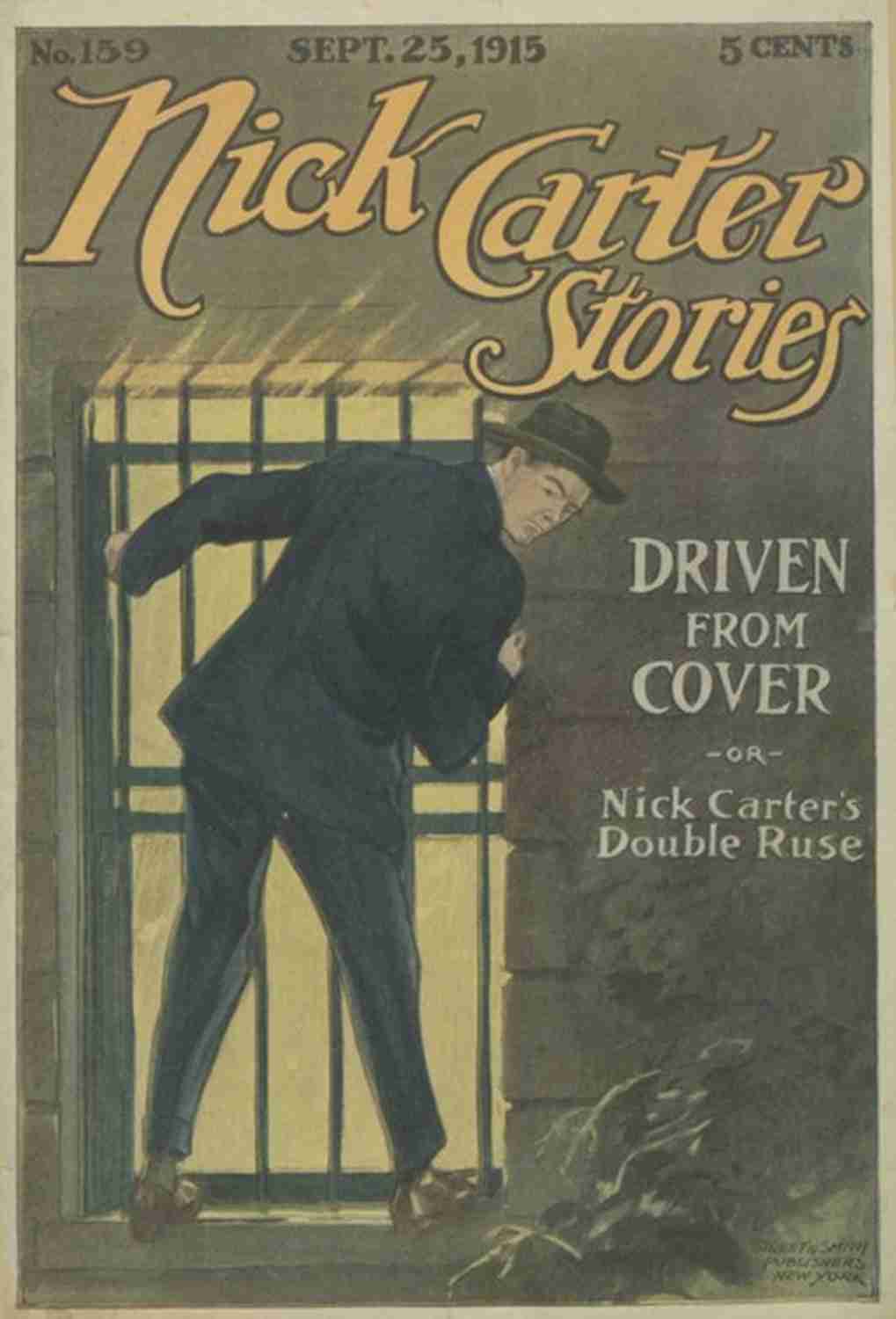
Grasping two of them, Patsy found that they were firmly fixed in the stonework. Drawing himself up until he could place his feet on the stone sill, which was about four feet from the ground, he then stood erect and found that his eyes came directly opposite the opening at the top of the window.
Pressing nearer, still clutching the bars in order to maintain his position, with his sturdy figure outlined like a black silhouette against the lighted curtain, Patsy gazed cautiously into the room, with ears alert to catch every word that was uttered.
The room, like the exterior of the house, presented an appearance of remarkable solidarity. Huge timbers supported the dark oak ceiling, smoke-begrimed and defaced with age.
Two of the wainscoted walls were flanked with deep shelves, filled with bottles, vials, jugs, carboys, and no end of paraphernalia required in a chemist’s laboratory.
A zinc-covered table occupied one side of the room. It was littered with like articles. A Bunsen burner was in operation under a retort held in a tripod, and in which[Pg 23] a dark fluid was bubbling furiously, while drops of distillation fell slowly from the end of a metal coil into a vial placed to receive them.
All this was visible in the white light from several electric lamps, as were the faces and figures of the three occupants of the spacious room, which obviously was a chemist’s laboratory.
One was a gaunt, angular man of nearly sixty, with a wrinkled, hard-featured face, thin lips, and a square jaw, a hooked nose and sunken eyes, that gleamed and glittered venomously in their cavernous sockets.
It was, plainly enough, the face of a man whose life had been a continuous round, not of enjoyments, but of disappointments, until his nature had soured and his soul rebelled, and early ambition died from his calloused heart.
Another was a woman of about the same age and of much the same aspect, as if she had been the partner of his vain hopes and consequent woes, as indeed she had. Both were cheaply and carelessly clad, bordering close upon slovenly. They were seated on common wooden chairs near the zinc-covered table.
All this paled to utter insignificance, however, in view of Patsy Garvan’s overwhelming amazement when his gaze fell upon the third person in the room. He was utterly nonplused. He could, as he afterward said, have been knocked toes up with a feather.
There was no mistaking the man, no possibility of error. The error had been made more than twelve months before.
The man was Garside—and not Garside.
His neatly plastered hair was lying on the table, also his flowing mustache and carefully trimmed beard—as artistic and effective a disguise as ever adorned the face of a stage star, or blinded the searching scrutiny of a detective to the sinister features of a crook.
He was seated directly opposite the couple described. He evidently had removed his disguise because of the heat in the room. With his thin, clean-cut features and his own close-cut hair, a more pronounced change could scarce be imagined.
For this man now had become, and in reality was—a veritable personal counterfeit of the man for whom he had been acting as a private secretary for more than three months, and in whose home he had been dwelling unsuspected—a living likeness of Chester Clayton himself.
One glance convinced Patsy Garvan of his identity, though it was like seeing a ghost, the dead alive—the man who was supposed to have been killed by a bullet from Chick Carter’s revolver, or to have been drowned in the swirling current of a stream in the Berkshire Hills.
This was the man who twice had conspired against Chester Clayton, who twice had been thwarted by Nick Carter and his assistants, the man whose true history and twin kinship with Clayton was known only by Nick and the mother then lying bereft of memory and speech in the banker’s mansion.
“Great guns!” gasped Patsy, staggered beyond description. “Have my lamps gone wrong? Is my bean twisted? That’s Chester Clayton’s double, Dave Margate, alive, too, as sure as I’m a foot high. He wasn’t drowned, then, as we supposed, nor did Chick’s bullet kill him. But it hit him, all right, and left its mark. Gee whiz! that’s what Madame Clayton meant by those two words—the[Pg 24] scar! the scar! Holy smoke! this sure sheds new light on the case.”
It was plainly visible, in the bright light that fell upon his head—a scar running like a clean-cut white mark through his dark hair, and extending nearly over the top of his head.
It told plainly, too, where Chick’s bullet had struck him, glancing from the skull without causing a fracture, but depriving him of consciousness and causing him to pitch headlong into the river, the chill of which must have quickly revived him, enabling him to escape drowning and elude discovery, though by what means Patsy could not then conjecture.
Nor was he then inclined to speculate upon it, or concerning the other features of that sensational case of months before; for that then engaging him was of paramount importance, and, despite his momentary amazement upon beholding Margate alive, by which name he now will be designated, Patsy had been alert to catch every word of the intercourse then in progress.
“Where is Dunbar? Where is Haley? Why aren’t they here, Busby, in case of need?”
These were the first words to reach Patsy’s ears, uttered with feverish impatience by David Margate, and confirming the former’s suspicion as to the identity of the occupant of the house.
“Dunbar—Clayton’s former secretary,” thought Patsy. “There is a bigger gang and been more doing, by Jove, than the chief suspects.”
Busby shook his head, replying with a rasping snarl:
“How can I tell you where they are? Neither has been here since morning.”
“Do you know, Nancy?” Margate demanded, turning to the woman.
“No, Dave, I don’t,” she replied. “They went out about noon.”
“But why are you here?” Busby questioned suspiciously. “What sent you at this hour? Is anything wrong?”
“Wrong enough,” Margate said, with asperity. “We are up against it, Busby, good and strong.”
“Up against what?”
“Suspicion.”
“Suspicion!” Busby lurched forward in his chair. “Not—not Nick Carter?”
“That’s what.”
“But you told me yesterday——”
“What I told you yesterday cuts no ice, Busby, in view of what I have overheard to-night,” Margate curtly interrupted.
“What d’ye mean?”
“I mean that I’ve been buncoed by the infernal sleuth. He has served me one of his devilish tricks. He pretended to swallow all that I handed him three nights ago, and I was fool enough to believe him. Luckily, however, I got wise to-night without his suspecting it. I’ll pay him off with his own coin. I’ll queer his present game, in spite of his scurvy ruse, and hand him goods of another color.”
Busby’s parchment-hued face had taken on a look of apprehension and anxiety, while that of his wife lost its last vestige of color.
“Does he suspect your identity?” questioned Busby.
“No, not for a moment.”
“Or me?[Pg 25]”
“No, nor you,” Margate assured him. “You are out of it entirely.”
“Thank God for that,” Busby fervently exclaimed. “I should never have gone into the cursed job. It was too long a chance.”
“But having gone into it, Busby, you cannot safely back out,” Margate said curtly. “Besides, you ought not wish to, Busby, with a million or more at stake. As for it’s being a long chance—rats! No chance is too long for me to take. I’ll make good, too, in spite of Carter and all of his kennel.”
“Do you think so?”
“I know so.”
“Why were you so upset, then, when you entered?”
“I was mad with myself, disgusted with myself, for having been blinded by the infernal meddler,” Margate declared, with a growl. “I ought to have suspected it, ought to have known he would suspect me and serve me some crafty trick. Twice burned, one surely should fear the fire. I ought to have been on my guard. Listen. I’ll tell you what I overheard to-night.”
Busby listened without interrupting, also the woman, and Margate quickly informed them of the interview between Nick Carter and Clayton.
“That’s all,” he said, in conclusion. “It’s enough, too, but it don’t break the camel’s back. Not by a long chalk.”
“Enough is right, Dave,” Busby now said grimly. “He suspects you, or he would not have questioned Clayton about you.”
“Nor have made that crack about Clayton’s illness coming on soon after he employed me.”
“Do you think he suspects your game?”
“No, not for a moment,” Margate asserted confidently. “How can he suspect it, Busby, supposing me to be dead?”
“That’s true. Nor that Dunbar threw up his job in order that you might slip in there?”
“Carter does not dream of that.”
“He soon will, all right, and something more than dream of it,” thought Patsy, elated by the important discoveries he was making.
“Nor does he suspect that Mattie Dryden is in love with me and obeying my every command,” Margate forcibly added. “It has simplified matters, my having the nurse under my thumb and willing to go the limit for my sake. I doubt that I could have found opportunities to secretly drug the old woman and keep her tongue-tied until we can pull off our deeper game. It’s dead easy for Mattie to do, however, without incurring suspicion.”
“But how did Carter get wise to our use of scopolamine?”
“That’s only a guess on his part,” Margate declared.
“He’s an infernally good guesser, then, and it puts us in bad,” growled Busby.
“Bad enough, I’ll admit; but there’s a way out.”
“Not if he brings that Philadelphia physician to the house, Dave, and——”
“Rot!” snapped Margate, interrupting. “Do you suppose for a moment, Busby, that I’m to be thwarted at this stage of the game?”
“But how can you prevent it?”
“I’ll prevent it, all right. Carter does not suspect my identity. Nor does Clayton, nor his wife, nor her father. I have fooled them all for three full months. Am I now to be balked, when all was ripe to have turned the final[Pg 26] trick, if the prying eyes of that old jade had not lit upon the truth? No, no, Busby, not on your life. I’ll play the game to a finish. I’ll get away with a million of Clayton’s fortune. Nick Carter, nor the devil himself, shall not prevent me.”
“But he will bring in that physician, Dave, as sure as fate,” Busby apprehensively insisted.
“Little good that will do him.”
“There’s another contingency, also. Even if the physician fails to detect traces of scopolamine, Carter then may begin to watch the woman, or the nurse, or——”
“No, he’ll not, Busby.”
“Why do you think so?”
“Because, blast him, he’ll have no woman to watch,” Margate cried, with more vicious vehemence.
“No woman to watch!” Busby stared at him. “What do you mean by that?”
“I mean what I say,” Margate came back at him. “I’ll tell you how it can be done. That’s why I am here to-night. I’ll beat Carter at his own game. Never again shall he foil my designs. The stake is too big for me to cry quits at this stage of the game. I’ll fool him, Busby. I’ll knock his present game on the head. I’ll tell you how it can be done.”
“Go ahead, you rascal, and tell me, also,” thought Patsy, ears alert. “I then will land you rats where you belong. Go ahead and——”
But Patsy’s train of thought ended as abruptly as it had begun.
It was cut short by a voice from behind him, that of a man who, with a companion, had quietly entered from the street a few moments before, so quietly that Patsy had not heard them. They had caught sight of his sturdy figure in black relief against the glow on the curtained window.
“Come down here, stranger, and come down with your hands up!” he cried sharply. “If you reach for a gun, or show fight, we’ll croak you on the instant. Come down here, I say, and be quick about it.”
CHAPTER VI.
THE GANG AND THE GAME.
Patsy Garvan heard, with a thrill of dismay, the threatening commands that suddenly broke the silence behind him. He heard, too, a vicious oath that came with a wolfish growl from David Margate, when he leaped from his chair and rushed toward the rear door of the house, immediately followed by Busby and the woman.
“Gee whiz! I’m caught hands down,” was the thought that leaped up in Patsy’s mind, as he turned and gazed over his shoulder.
One glance was enough to confirm his misgivings. Two men were standing about four feet behind him, both stocky, dark-featured fellows, and both held a revolver ready for instant use. That they were the two men he had heard mentioned, Dunbar and Haley, Patsy also rightly inferred.
“Come down here,” Dunbar repeated, brandishing his weapon. “Be quick about it, too, or I’ll plug you with a bullet.”
Patsy saw that he had no sane alternative, that his own promising designs were nipped in the bud, and that the discovery of his identity by Margate was almost inevitable.[Pg 27]
He met the situation with characteristic coolness, nevertheless, though thoroughly disgusted with the ominous turn of affairs. He sprang down from the window, replying curtly:
“Save your bullets. You may need them later.”
“Now or later matters little to us,” snapped Dunbar, thrusting his revolver under Patsy’s nose. “Shove up your hands and give an account of yourself. What do you want here?”
“You wouldn’t fancy hearing just what I want,” Patsy said dryly.
He had no opportunity to say more, for Margate and Busby rushed out of the house at that moment, and Patsy found himself confronted by the four men, and his escape a decidedly remote possibility.
“What’s this, Dunbar?” Margate demanded sharply. “Who is the fellow. What was he doing here?”
“It’s easy to say what he was doing, Dave,” replied Dunbar, pointing to the window. “It’s not so easy to say who he is.”
“He’s an infernal spy, Dave, that’s what he is,” put in Haley.
“We’ll very soon find out,” said Margate, glaring at Patsy in the faint glow cast from the curtained window. “Bring him into the house. Keep him covered, mind you, and shoot him if he lowers a finger.”
“Let me alone for that,” growled Dunbar. “Get a move on, young fellow, or you’ll hear something drop.”
Patsy made no comments, nor offered any resistance. He followed Margate and Busby into the house, their two confederates bringing up in the rear. He heard one of them close and bolt the heavy door, while he passed through a dimly lighted passageway, and he presently found himself confronted by all four in the glare of the chemist’s laboratory.
Margate, in his apprehension and excitement, had not delayed to resume his disguise. Viewing Patsy in the bright light, moreover, he instantly penetrated that worn by the detective, partly because of the suspicion he already entertained.
“Just as I thought,” he cried quickly. “He is one of Carter’s push, that bright rat known as Patsy Garvan. Get his guns, Haley, and secure his hands behind him. Be sure you make them fast. Push up that window, Busby, and pull the curtain to the top. We’ll mighty soon find out what sent him here and where we stand.”
He tore off Patsy’s disguise while speaking, and his confederates hastened to obey his commands. In less time than would be required to describe their doings in detail, Patsy was deprived of his two revolvers, his arms secured behind him, the window closed, and the curtain completely drawn, precluding further observation from outside.
Margate, in the meantime, appeared to regain his composure. That he regarded Patsy’s presence there as exceedingly ominous, moreover, was manifest in the expression that had settled on his white, hard-set face. It reflected all that was devilish in his nature, giving the lie to his outward calmness, and evincing the vicious determination and designs back of his self-restraint. Such men are most to be feared.
“Now, Haley, slip out and have a look around the house,” he directed. “Make sure that no one else is nosing around here. I reckon you’ll find no one. I think I now see through Carter’s game of this evening and why[Pg 28] this rat is here. If I am right, we shall never leave here alive to tell the story. Slip out and have a look, Haley, nevertheless. We’ll take no needless chances.”
Haley pulled his woolen cap over his brow and hastened from the house.
Margate pointed to the chair directly opposite that which he had taken.
“Sit down, Garvan, and feel yourself at home!” he commanded, with ominous politeness. “You may as well, since you are booked to remain here.”
Patsy obeyed, sitting down and speaking for the first time since entering the house.
“Is that so?” he inquired indifferently.
“Decidedly so.”
“Well, this is not so bad,” Patsy dryly observed, gazing around.
“It will be bad enough, Garvan, you’ll find,” Margate more sternly informed him. “Your work of to-night will prove disastrous for you. The discovery of my identity is the worst discovery you could have made. It leaves me no alternative.”
“You mean?”
“I must effectually silence you.”
“Ah, I see.”
“And that can be done in only one way.”
“By wiping me off the map, I suppose?”
“Exactly. Dead men tell no tales.”
“So I have heard,” said Patsy, as complacently as if discussing the price of ice. “Nevertheless, Mr. Margate, I am glad that I have unmasked you. I will confess, too, that I was never more surprised in my life. So I am to be turned toes up, am I?”
“As sure as you are looking at me at this moment,” Margate coldly informed him.
“Well, that’s reasonably sure,” said Patsy. “I almost feel myself going. Before the final trick is turned, however, I really wish you would answer one question.”
“What question, Garvan?”
“How the dickens did you contrive to give us the slip a year ago?”
Margate smiled derisively.
Patsy knew that he was exceedingly proud of his evil exploits, and he felt sure that he would answer the question. His chief motive for asking it, however, was to gain time in which to consider his own situation, and to devise, if possible, a way of escape from the fate that threatened him.
“That puzzles you, does it?” said Margate, still with a sinister smile.
“Very much,” Patsy frankly admitted. “How did you accomplish it?”
“Oh, you Carters are not the whole shooting match,” Margate coldly answered. “If Chick Carter’s bullet had struck me half an inch lower, nevertheless, it would have ended me,” he added, pointing to the scar on his head.
“I guessed that much,” nodded Patsy.
“But ‘a miss is as good as a mile,’” said Margate. “It knocked me out, and I pitched overboard. Luckily, however, the chill of the water instantly revived me.”
“But you did not rise to the surface,” said Patsy. “Chick was dead sure of that.”
“Not for some little time. It was not necessary.”
“You can live under water, eh?[Pg 29]”
“I did at that time, Garvan, long enough to reach a point where none of you ferrets were looking for me.”
“But how did you turn the trick?” Patsy persisted.
“With a piece of rubber pipe about two feet long,” Margate coolly informed him. “I had picked it up on the launch, apprehending trouble, and slipped it into my pocket. When I found myself rising to the surface, knowing I was in bad and a gone goose if I was seen, I slipped one end of the tube into my mouth and thrust the other end above the surface, in order to breathe through the pipe. I then paddled downstream with the current, and without showing on the surface. That’s all there was to it, Garvan. A very simple trick, you see.”
Patsy expressed his appreciation with a nod.
“Much obliged,” he said tersely. “It was more than a simple trick, Mr. Margate. It was a very clever one. You lived up to your reputation, Margate, for fair.”
Margate’s eyes took on a more sinister gleam.
“I fooled you completely, didn’t I?” he exclaimed.
“You certainly did,” Patsy admitted.
“Nick Carter still thinks I am dead, doesn’t he?”
Patsy hesitated, not inclined to further expose his own hand, and Margate quickly added, with a sharper ring in his sinister voice:
“Oh, you need not reply. I already know it. If Carter had the slightest suspicion that I am alive, you would have been informed of it, and would have felt no surprise when you saw me. That’s as plain as twice two.”
“Well, I guess you are right,” Patsy admitted, unable to deny it.
“I know I am right.”
“Let it go at that, then.”
Patsy spoke with an indifference that Margate was quick to resent. He drew up in his chair. A look of intense hatred and bitter contempt appeared on his drawn, white face.
“No, I’ll not let it go at that,” he retorted. “I’ll hand you the whole business, if only to show you how little we fear Nick Carter and his entire push. It will never go farther through your lips. I’ll make dead sure of that.”
His frowning observers, mute observers of the scene, appeared surprised at these daring declarations, but none ventured to interfere.
Patsy was less surprised, for he was quick to detect the bitter feelings that impelled the rascal. Nor did he object, of course, for he was more than willing for him to continue.
Margate did so without hardly a moment’s hesitation.
“I have a good cause to hate him, Garvan, as you very well know, but I do not fear him,” he went on, with icy asperity. “Nick Carter never saw the day that he could throw me down and keep me down. I now see through his scheme of to-night. He suspects me of the Thorpe murder. He feared that I would play the eavesdropper this evening, knowing that he was closeted with Clayton, and he left you to watch me, Garvan, while he cleared out as if void of suspicion.”
“That calls the turn, Margate, all right,” said Patsy, seeing nothing to be lost by admitting it, and aiming to lead him on.
“It was one of Carter’s crafty tricks, a ruse I ought to have suspected. But it’s booked to fall flat. For having got you, Garvan, he shall never know what you have learned, nor what becomes of you.[Pg 30]”
“I can see my finish, all right,” Patsy dryly allowed.
“You are not the only one booked for a finish,” Margate quickly asserted. “It’s Nick Carter’s fault, not mine, that your death and theirs have become necessary. I could have played my game without that, if he had kept out of it.”
“You’re out to get part of Clayton’s fortune, are you?”
“Most of it, Garvan, would hit nearer the mark.”
“How can that be done?”
“It can be done, all right, in spite of Nick Carter and the slip-up of three nights ago,” Margate curtly predicted. “My likeness to Clayton makes it possible. It can be done like breaking sticks.”
“You look precisely like him, all right,” nodded Patsy.
“No need of telling me that. I twice have taken advantage of our resemblance, and I framed up this job more than three months ago. The only difficulty lay in the fact that he had become much more fleshy than I, and that had to be overcome.”
“How overcome?”
“By reducing him to my weight, of course.”
“Evidently, Margate, that now has been done.”
“You bet it has, Garvan, and I’m the one who accomplished it,” Margate declared, still impelled with vicious pride. “I framed up the whole job. I took Dunbar into it and had him resign his position, only that I might become Clayton’s private secretary and make myself familiar with his home habits and every detail of his business.”
“What was the need of that?” inquired Patsy, though the audacious project now was becoming quite plain to him.
Margate laughed derisively.
“You now would see my scheme, Garvan, if you were not so thick-headed,” he replied. “I’m going to abduct Clayton for about a week, with the help of these good friends of mine. I shall take his place during that time, discarding my disguise and assuming not only most of his domestic duties, but also obtain complete control of his business affairs. A week will suffice, Garvan. I can in that time get away with all of the cash, bonds, and securities he possesses, which I already know aggregate more than a million. I can get all of them, Garvan, and turn them into cash within a week. Let me alone for that.”
“Oh, I see!” exclaimed Patsy. “Though Clayton is to be abducted, his private secretary is the one who will appear to have suddenly vanished.”
“Exactly,” nodded Margate. “I shall become Chester Clayton long enough to get in my work. Then I will completely vanish. You can safely gamble on that.”
“It’s a clever scheme, Mr. Margate,” said Patsy, as if impressed with the feasibility of the audacious scheme. “No less accomplished a man than you, nevertheless, could pull off such a job.”
“I’ll make good, all right.”
“Very likely.”
“And in spite of Nick Carter,” Margate added, with a sneer.
“I really begin to think so,” Patsy allowed, as dismally as if he really meant it. “How have you contrived to reduce Clayton’s flesh and bring him down to your weight?”
“By means of a compound Busby has provided. Tha[Pg 31]t’s why he’s in the game. I gave him the formula, and he delivered the goods.”
“How could you administer it to Clayton without his knowledge?”
“Easily,” said Margate, with an evil leer. “It is tasteless and colorless. It was only necessary to inject it into Clayton’s cigars.”
“Ah, I see,” said Patsy. “Very clever, Margate, indeed. I remember that you are well informed about certain kinds of drugs and poisons, chiefly those that serve your own evil ends. It strikes me, Margate, that——”
“Never mind what strikes you,” snarled Busby, interrupting, after a whispered conference with Dunbar and Haley, the latter having returned a few moments before.
Margate swung round in his chair.
“How long is this to continue, Dave?” Busby impatiently added. “What’s to be gained by it? There’s no telling what more Carter may have up his sleeve. He already suspects enough to throw us down, if all you have said is true and he shows up to-morrow with that Philadelphia specialist. What’s to be done to head him off? I’m not so sure it can be done. You certainly are wasting time, Dave, wasting time.”
Margate jerked out his watch and glanced at it. His countenance changed like a flash.
“You are right, Busby,” he cried, starting up from his chair. “It can be done, all right, as I soon will show you. No ruse by Nick Carter shall foil us at this stage of the game. We already have thwarted him by getting Garvan into our clutches. This way, all of you, for half a minute. I can tell you in less time how it may be done.”
He strode to one corner of the laboratory, where, for several minutes, he talked in earnest whispers with his three confederates.
Patsy Garvan could only wait and watch them. That they would kill him without shrinking, in order to carry out their knavish designs, he had not a doubt. That was plainly manifested in their evil faces.
So, too, was the seeming feasibility of the steps now advocated by Margate to thwart the threatening efforts of Nick Carter. That his project would serve their purpose, that they still had their infamous game well in hand, all finally seemed to agree.
For Busby suddenly turned and hastened to one of the shelves, from which he selected a small vial and gave it to Margate, remarking grimly:
“One injection of that will do the business.”
“Leave us to do the rest, then,” returned Margate, then hastily resuming his disguise. “Look after this rat, Busby, and keep a constant eye on him. You had better drug him, also, to relieve you of further trouble. We can turn the trick in half an hour. One o’clock sharp, Dunbar, mind you, in the gloom under the porte-cochère.”
“We’ll be there, Dave,” said Dunbar, with an assuring nod.
“And back here in thirty minutes,” Margate added, about to go. “Leave me to prepare the way.”
“Gee whiz, but he seems to feel dead sure of it!” thought Patsy, grimly watching him. “It’s dead lucky, too, that the chief has an anchor to the windward. Though one ruse appears to have failed, he may make good with the other.[Pg 32]”
CHAPTER VII.
PETERSON GETS BUSY.
It was after ten o’clock that evening when Margate returned to the Clayton residence. He entered with a key by the way of the side door. A glance at the windows while approaching the stately mansion told him that most of the household were abed.
Margate hung his cap in the side hall and smoothed with his palms his neatly plastered hair, effectively hiding the scar caused by Chick Carter’s bullet many months before. He observed that a dim light was burning in the library. Upon stepping quietly into the main hall, moreover, he discovered the new butler.
Peterson was nodding sleepily in a chair near the main stairway. He started slightly upon hearing the other, then quickly arose, rubbing his eyes and bowing respectfully.
“You need not have waited for me, Peterson,” Margate said pleasantly, pausing and regarding him intently.
“It’s the doors, sir,” said Peterson, explaining.
“The doors?”
“It has been my custom, Mr. Garside, sir, to be sure they are locked before going to bed. I do not mind waiting up, sir.”
“I met a friend and remained longer than I intended,” said Margate, smiling.
“I do not mind, sir,” repeated the butler.
“That’s very good of you. Has Mr. Clayton retired?”
“He has, Mr. Garside, sir.”
“How long did the detective remain here, Peterson?”
“About half an hour, sir, as I remember.”
“Did he bring any good news?”
“I cannot say, sir.”
“I thought that Mr. Clayton might, perhaps, have mentioned something to you,” Margate observed, in an explanatory way.
“He did not, Mr. Garside, sir,” said Peterson humbly.
“I see there is a light in the library.”
“I left it for you, Mr. Garside, sir,” Peterson explained. “I thought you might not wish to retire at once, sir, when you came in.”
“That was very thoughtful, Peterson, I’m sure, but I shall presently do so. By the way, Peterson, I may be busy in my room to-morrow morning, in case Mr. Clayton gives me any work to be done at that time,” Margate added, steadily regarding his hearer. “There is something you can do for me.”
“I will be very glad to do it, Mr. Garside, sir,” said Peterson, bowing obsequiously.
“Very good. If Mr. Carter calls during the morning, I wish you would quietly come to my room and inform me. There are a few questions I wish to ask him about a personal matter—a purely personal matter, Peterson, I assure you.”
“Yes, Mr. Garside, sir.”
Peterson’s ruddy face appeared incapable of any material change.
“Will you quietly do so?”
“I will, Mr. Garside, sir.”
“Thank you, Peterson. You are a very accommodating fellow. By the way, here is something for which I have no great use,” Margate added, producing a bank note and slipping it into the butler’s hand. “Favor me by accepting it.[Pg 33]”
Peterson smiled now, and appeared pleased.
“Thank you, Mr. Garside, sir,” he said, with some feeling. “Thank you very much, sir.”
“There is more, Peterson, where that came from,” Margate remarked significantly.
“I hope so, sir,” smiled Peterson. “I am glad to hear it, sir.”
“Any service you can do for me, Peterson, will always be well repaid.”
“No doubt, sir. Really, sir, I have not a doubt of it,” Peterson vouchsafed.
“By the way, what about Madame Clayton this evening?” questioned Margate, still pausing at the base of the stairs.
“She is just the same, Mr. Garside, sir,” said Peterson, at once serious and solemn again.
“That’s too bad.”
“Too bad, sir, indeed.”
“The nurse is with her to-night?”
“Yes, Mr. Garside, sir.”
“Favor me, Peterson, by tapping on the door and asking her to step into the hall. She gave me a prescription to be filled. I have done so and wish to hand it to her,” said Margate, displaying a vial wrapped in white paper. “I wish to say a word to her about it, something the druggist mentioned.”
“I will call her, sir,” bowed Peterson.
“One moment.”
“Yes, sir.”
“Are you coming downstairs again?”
“Only to put out the lights, sir, and look after the doors.”
“Do so before you go up, then,” said Margate. “That will save you the trouble of returning.”
“Very well, sir,” bowed Peterson. “Thank you, sir.”
Margate waited at the base of the stairs. There was a sinister gleam in his eyes, a cruel smile on his lips. He thought he had rightly sized up the butler. He felt reasonably sure that he could, if occasion required it, rely upon Peterson for almost any service for which he was liberally paid.
Peterson returned in about five minutes, and they went upstairs together.
The butler extinguished the hall light, leaving the lower floor of the house in darkness.
A dim light burned on the second floor.
Peterson tapped lightly on the door of a side chamber. It brought the nurse into the hall—a slender girl in the twenties, with thin features, reddish hair, and shifty gray eyes. She nodded and smiled, with a quick glance at the private secretary.
“Thank you, Peterson,” Margate said quietly. “That’s all, my good fellow. You may go up to bed. I will turn out the light in this hall for you.”
“Very well, sir,” bowed Peterson, evidently unsuspicious. “Thank you, sir. Good night, miss. Good night, sir.”
“Good night, Peterson.”
The butler turned away and vanished up the servants’ stairway.
Margate took the hands of the nurse, slipping the vial into one of them, and for five minutes he remained in whispered conversation with her, giving her such instructions as served his purpose. Then he extinguished the hall light and went to his room.
Half an hour passed.[Pg 34]
The silence in the crime-cursed house was unbroken.
Its gloom was relieved only by a faint thread of light under the door of the chamber in which Madame Clayton was lying.
Then, for the hundredth part of a second, a swift gleam appeared on the servants’ stairway. It shot downward, danced for an instant over the stairs and wall, then vanished.
It appeared again in about a minute. It lingered for several seconds. A figure was vaguely discernible in the gloom back of the swiftly moving ray, a figure stealing noiselessly down the stairs—that of Peterson, the house butler.
He crept down as silently as a shadow, as if he was far from being a novice in such stealthy work.
He stole to the door of Madame Clayton’s chamber, crouching there in the darkness, and peered through the keyhole.
He could see the form of the unconscious woman lying on the bed.
He saw, too, that of the nurse bending above her, watching her intently, with an empty hypodermic syringe in her hand.
“Just in time,” thought Peterson. “Too late to prevent it, but not too late to see what has been done. That may serve as well.”
He stole away as he had come, but not to return to his room. He remained crouching near the top of the servants’ stairway, waiting patiently in the inky darkness, minute after minute, until a tall, old-fashioned clock in the lower hall struck one.
Then a beam of light from another quarter dispelled the gloom.
Margate stole out of his chamber and crept down the front stairs.
The nurse stepped into the hall and waited, holding a bundle of garments under her arm.
Margate returned in about three minutes in company with two men—Dunbar and Haley.
Peterson sat watching them from the top of the stairs.
He saw them enter the room, all three men, from which they presently emerged with a heavy burden—the senseless woman.
Moving noiselessly, they bore her down the stairs and out of the house.
Peterson started up to follow them, then resumed his seat on the top stair.
His way was barred and pursuit precluded by the nurse, still lingering in the dimly lighted hall.
CHAPTER VIII.
THE CLOSING NET.
Nick Carter was called early to the Clayton residence the following morning. He was summoned by a frantic telephone call from Chester Clayton, informing him what had occurred the previous night, or what he supposed had occurred, and Nick lost no time in responding, in company with Danny Maloney.
It was about seven o’clock when his touring car sped up the driveway and stopped under the porte-cochère.
“Wait here, Danny,” said Nick, springing out.
Peterson admitted him, looking more serious and solemn than ever.
“This way, Mr. Carter, sir,” he said, while Margate also[Pg 35] approached through the hall to greet him. “Mr. Clayton is waiting for you in the library.”
Nick followed him and shook hands with Margate, then posing as boldly as ever in the assumed character of the private secretary.
“This is terrible business, Carter, terrible,” he said, with subdued earnestness, while they paused for a few seconds in the hall. “We are literally overwhelmed, all of us.”
“Clayton told me only that his mother is missing and that the nurse has fled,” Nick replied. “Is nothing more known, Garside, of the circumstances?”
“Only what is contained in a note left by the nurse.”
“What does that state?”
“Merely that she fell asleep about two o’clock and did not awaken until after three,” Margate earnestly reported. “She then found that Madame Clayton was not in her room, also that some of her clothing was missing. Terribly alarmed, yet fearing to arouse the house, she at once began a search for her, hoping to find her and lead her back to her room. She found, instead, that the side door of the house was open, and she then knew that Madame Clayton must have gone out-of-doors.”
“The nurse left this information in writing?” Nick put in.
“Yes, in a hurriedly penciled letter,” Margate nodded. “She states that she made a hurried search in the grounds, but could not find Madame Clayton, and that she then returned to the house.”
“And then?”
“She then realized, evidently, that she had been very culpable and feared the censure and punishment she had incurred,” Margate went on. “For she adds that she did not dare to remain here, but was going to leave with what clothing she could carry away. That’s all that her letter states, Carter, but it seems to cover the ground.”
“I agree with you, Garside, as far as it goes,” said Nick, as gravely as if he really meant it. “Who discovered their absence?”
“Peterson, the butler, when he came down from his room. He saw that the door of Madame Clayton’s chamber was open, which is very unusual, and he looked in and found that both women were missing. He then notified me, Carter, and I aroused Mr. Clayton and his wife. Both are nearly overwhelmed by the calamity.”
“No wonder. How long ago was this?”
“Less than half an hour. We notified you immediately.”
“I will have just a word with them,” said Nick.
“Command me in any way, Carter, if I can be of service,” Margate artfully pleaded, briefly checking him.
“Presently,” Nick nodded. “I will see you again in a moment.”
He hastened into the library with the last, where he found both Clayton and his wife, the latter in tears and both ghastly with consternation and anxiety.
Nick said what he could to encourage them, at the same time hurriedly inspecting the letter left by Martha Dryden, and he then observed that Margate had followed him into the room. This was precisely what he had anticipated—and wanted.
“What have you done, Clayton, beyond sending for me?” he abruptly inquired.
“Nothing whatever,” Clayton declared, with a groan. “I’m all upset. I know not what to do.”
“One thing must be done without delay, then, for a[Pg 36] starter,” said Nick. “We must try to trace the missing woman.”
“That’s what I have advised,” Margate said quickly.
“Certainly. That’s the first step to be taken.”
“I will go with you, Carter, and——” Clayton began.
“No, no, don’t think of it,” Nick interrupted decidedly. “You are in no fit condition for such work. Besides, it will require only two or three to effectively cover the ground. I have my chauffeur, and Garside no doubt will be glad to aid me.”
“Most assuredly,” Margate cried, eyes lighting. “We should, I think, start in at once.”
“We will do so,” said Nick, turning. “You remain here with your wife, Clayton, till we have ended our search. That will not take long. If it proves futile, I then will decide what next must be done. Come with me, Garside. We’ll pick up Danny on our way out.”
They left the house by the side door, Nick quickly informing Danny of their mission, while Margate pointedly observed:
“Your chauffeur had better go one way, Carter, while we take another direction. Why not let him tackle the front street?”
“Because there is no need of that.”
“Why no need of it?” Margate frowned quickly.
“Because Madame Clayton did not go that way,” Nick explained, now shaping his course in accord with what he thought the rascal really wanted. “She would surely have been seen and detained, if not recognized and brought back here. It is safe to assume that she went through the rear street, where there are few persons even during the day, and only scattered dwellings.”
“That’s right, Carter, after all,” declared Margate, with face lighting. “She must have gone that way.”
“It’s that way for us, therefore,” said Nick, while they walked rapidly through the rear grounds, quickly reaching the deserted street. “Danny now can go one way, Garside, while we go the other.”
“Let him go to the right, then, while we seek her in this direction,” Margate quickly suggested, pointing in the direction of the Busby place, less than an eighth of a mile away.
Nick consented without a moment’s hesitation.
“Come on, then,” said he. “That way for you, Danny.”
Danny hurried away in the direction indicated.
“I’m deucedly sorry for this one reason, Garside, at least,” Nick gravely remarked, as they hastened through the narrow street.
“What reason is that, Mr. Carter?” Margate inquired, with a covert leer.
“Because I had a Philadelphia specialist coming here this morning to diagnose Madame Clayton’s illness.”
“Is that so?”
“Yes. I would have called with him about ten o’clock.”
“What’s the big idea? What do you suspect?”
“I have not quite liked the looks of that nurse, Garside, from the start,” Nick glibly explained.
“That so?”
“She don’t look good to me. I’m far from sure that she has not been drugging Madame Clayton,” Nick added.
“But what could she gain from that?”
“I’ve got to dig deeper into the case, Garside, before I can answer that question.”
“It’s doubly necessary, then, for us to find Madame Clayton.[Pg 37]”
“Exactly.”
“We may succeed in doing so. She surely could not have gone very far in her weak and abnormal condition.”
“So I think,” Nick agreed. “That’s why I have undertaken to trace her.”
They had come within view of Busby’s upper windows while they were talking.
Margate gazed sharply ahead, then glanced back over his shoulder.
The narrow street was deserted in both directions. As well as one could have told, no mortal eye was observing the two hurrying men.
Margate drew out a white handkerchief, holding it conspicuously in his hand for a moment and then wiping his face with it.
Nick Carter did not appear to observe him. He had known from the first, nevertheless, that the rascal was trying to lure him to some place where, no doubt, Patsy Garvan had been cornered the previous night, he having failed to report the result of this espionage.
Nick now was convinced, too, that his companion had signaled to some one in the grim stone house which they were rapidly approaching.
This was confirmed a moment later, for Busby himself suddenly appeared at the grille gate, when the two men were scarce ten feet from it.
“We might inquire of this fellow,” Margate suggested quietly.
“We will, Garside,” Nick muttered.
There was no need for inquiries, however, for Busby stepped out and quickly accosted them, with a look of grave concern on his wrinkled face.
“I say, gents, you’re not looking for a stray woman, are you?” he asked, glancing from one to the other.
“That’s precisely what we are looking for,” Nick replied, with well-feigned eagerness.
“By gracious, then, it’s lucky I happened out here just as you came along,” declared Busby, with manifest relief.
“An elderly woman,” Nick added.
“That’s right. She pulled my bell along about three o’clock this morning,” said Busby, pointing. “I came out and found her sitting on the sidewalk. She was only partly dressed and didn’t seem to be right in the head. I took her in and my wife put her to bed. We don’t know who she is from a side of leather. I’ve sent for a doctor, but he hasn’t showed up. I was just coming out to look for him.”
“By Jove, this is good news, indeed, Carter,” cried Margate, clapping the detective on the shoulder. “I’ll go in with you and make sure there is no mistake, and I then will rush back and relieve Mr. Clayton and his wife.”
“Good enough!” Nick exclaimed, as if utterly void of suspicion. “Lead the way, my man, and permit us to identify this woman. If the lady for whom we are seeking, you shall be well paid for what you have done.”
“You, too, shall be well paid for what you have done,” thought Margate grimly, while both hastened into the inclosed grounds.
Nick heard Busby close and lock the heavy grille gate, but the sound brought no ominous misgivings to the mind of the detective. He already knew that the net he had spread was fast closing tightly around his victims.
Busby, having closed the gate, hurried on ahead.
Nick followed him up the steps and into the grim old house, into a dimly lighted, bare-looking hall, [Pg 38]Margate bringing up in the rear and quickly closing the door.
“This way, gents,” said Busby. “We’ve put the lady in a bedroom on this floor.”
He hastened into a rear parlor while speaking, Nick following.
As the detective crossed the threshold, he received a violent push from behind, a shove that sent him nearly across the room.
Nick turned like a flash and found himself confronted, not by two men, but by four—Margate, Busby, and their two confederates of the previous night, each with a revolver aimed point-blank at his head.
CHAPTER IX.
THE LAST CALL.
Twenty minutes later found Nick Carter seated in the chemist’s laboratory, not only seated there, but tied hand and foot with stout cords and securely bound to his chair.
His companions were the four men by whom he had been held up—precisely as he had expected to be.
There was only one other occupant of the room—Patsy Garvan.
He was lying on the floor in one corner, insensible from a drug administered by Busby the previous night.
Margate had removed his disguise and tossed it upon the table. That he had the famous detective helplessly in his power, he had not the shadow of a doubt. It had impelled him to do what he had done the night before, when talking with Patsy Garvan—to vaunt his evil exploits, to boast of what he was about to accomplish, to express his vicious hatred of his hearer, and much that he had said to Patsy, he now had said to Nick.
Not one of his confederates had ventured to interfere.
Aside from his surprise at beholding Margate, whose identity he really had not suspected, the effect of all that the rascal had been saying was not manifest in the detective’s face. He had appeared as unmoved and severe as a man of bronze while he mutely listened.
Not until Busby began to growl with impatience, whereupon Margate seemed about to end the scene, did Nick take steps to prolong it, knowing well what soon must occur.
“Get Clayton’s fortune, eh?” he then remarked, picking up a prediction Margate had just made. “So that has been your game, much in line with what you twice have attempted. Do you expect to meet with more success this third time, Margate, that you have declared yourself so boldly?”
Margate laughed derisively and pointed to the senseless form of the detective’s assistant.
“Does that, with your own situation, look like success?” he questioned, with a mocking sneer. “Oh, I’ve got you this time, Carter, and there is no loophole through which you can escape. You undertook last night to trap me with a ruse, but I have turned the tables on you. I have you where I want you, where I long have wanted you, and, as for the game I am playing—well, I shall make good. I will stake my life upon that.”
“Your life may be the price, Margate.”
“Not through your agency, Carter.”
“You evidently have overlooked one danger with which you are menaced,” Nick said sternly.[Pg 39]
Margate’s brows knit quickly.
“What is that?” he demanded.
“The murder of Doctor Thorpe.”
“Rot! That cuts no ice.”
“No?”
“You have dug into that in vain, Carter. You can make nothing of it. You could form no theory consistent with the circumstances. I have been sure of that from the first.”
Nick thought of this man’s mother, of her terrible secret, of the trust she had reposed in him, and he withheld the words that would have caused Margate’s evil heart to have sunk like lead. He said simply, yet impressively:
“I know more, Margate, than I did at first.”
“What do you imply by that?” snapped Margate suspiciously.
“I think I now can guess why Doctor Thorpe was killed, and also prove who killed him.”
“Rot! What theory have you now formed?”
“Madame Clayton telephoned to me, Margate, just before the fatal shot was fired. I heard her voice and the report of the weapon.”
“But she spoke only your name,” Margate impulsively cried. “I’m sure of that, and——”
“Stop!” Nick sternly interrupted. “You could not be sure of it, could not possibly know it—if you had not been there.”
Margate recoiled with a scowl.
“You see that you betray yourself, Margate, if that were necessary,” Nick quickly added. “But it is not, Margate, since I now can guess precisely what occurred and what caused the crime.”
“You can, eh?” Margate’s voice took on a husky harshness.
“Easily,” snapped Nick, more sharply. “Madame Clayton saw by chance that scar on your head, probably that very evening, and she suspected your identity. That must have been after her son and his wife left the house. Doctor Thorpe called only incidentally, presumably to see Clayton. Burdened with her terrible discovery, she confided your criminal career and her consequent fears to the physician, and he advised her to call me by telephone and confer with me. She attempted to do so, and you, returning home and approaching the open French window at the time, and apprehending that your present knavish game would be thwarted—you shot him to prevent his revealing what the woman had told him. You then overcame her, or she may have fainted, and you drugged her and threw her into the condition in which I found her, bent upon keeping her so till you could carry out your designs upon Clayton. You planted the evidence that I found, and you since have had the woman’s nurse in your employ. That, Margate, is how and why it was done. There is little need to add to these details, little to assert that they are true, and that——”
Nick broke off abruptly.
Busby’s wife had appeared at the laboratory door.
Margate swung round like a flash, with his ghastly face showing plainly how near Nick had come to the truth. He started up, crying harshly:
“Why are you here, Nancy? What do you want? Leave us to send these infernal sleuths to perdition.”
Nancy Busby did not fear him.
“I’m here with a reason,” she retorted. “There’s a man at the front door to see you.[Pg 40]”
“See me?” cried Margate, staring. “What man?”
“He says his name is Peterson, and as how he’s got a message for you.”
Nick Carter’s face did not change by so much as a shadow.
“Peterson!” Margate spoke, with a gasp. “Don’t be alarmed, mates. He’s the house butler. He must have seen me coming here, or this way. Wait while I see what he wants.”
“He will not keep you waiting long,” thought Nick, with grim satisfaction.
Margate had hurriedly replaced his disguise, and he now hastened to the front door and opened it.
Peterson stood bowing on the steps, sedate and solemn, but with an unusual gleam in his eyes.
“Why are you here, Peterson?” Margate demanded, governing his voice with an effort. “What do you want?”
“Well, Mr. Garside, sir, it’s like this,” Peterson deliberately explained. “I want, Mr. Garside, sir, a hand in the game you are playing, and a bit of the stake.”
Other figures, with weapons drawn, were stealing nearer the door, hugging the wall of the house.
“If I’m not to have it, Mr. Garside, sir—I want you, instead!”
Peterson rang out the last with a voice that Margate remembered only too well, the voice of the man who had sent a bullet at his head long months before. And Peterson’s revolver leaped from his pocket and covered the staggering crook.
“Heavens above!” Margate gasped, while reeling. “Chick Carter!”
Then the fiend in him arose supreme, or in his brain a maddening vision of the electric chair. With a fierce shriek, regardless of the weapon, he leaped at Chick Carter’s throat.
Chick met him halfway and tried to grapple him and avoid shooting him, but the weapon was discharged almost on the instant.
Margate’s muscles went lax, his knees gave way under him. He uttered one groan, with head drooping, then fell from the detective’s arms and rolled down the stone steps, shot through the heart.
“This way, boys!” Chick shouted, dashing through the hall. “Nail every man.”
There was little need to thus instruct the half dozen officers who were following him—and little need for their display of weapons. For when they poured into the laboratory, the three dismayed crooks threw their hands into the air, nor lowered them save for the manacles.
The two women, Busby’s wife and Martha Dryden, were secured a little later, and one and all subsequently received long prison terms for their crimes.
One alone, Dave Margate, had gone to a higher tribunal for punishment.
In view of Nick Carter’s deductions, which covered most of the ground, together with what had passed between Patsy and Margate, but little need be added to these closing pages.
Patsy was quickly revived with an antidote, grimly supplied by Busby after he found himself under arrest, and the young detective was none the worse for his experience.
Madame Clayton was found in an upper room, still unconscious. But she afterward was restored and entirely recovered, when her story of the murder confirmed the conclusions at which Nick already had arrived. Her[Pg 41] secret died with her recreant son, for the detective’s lips were forever sealed, and others never knew of the twin relationship.
Nick Carter slipped in enough fiction to form a consistent story, in his report of the case, and Mr. Chester Clayton, nor the public, never knew the whole truth. It was better so, far better—and so it may be left.
THE END.
“The Yellow Label; or, Nick Carter and the Society Looters,” will be the title of the long, complete story which you will find in the next issue, No. 160, of the Nick Carter Stories, out October 2d. In this story Nick Carter pits his ability against a gang of crafty society crooks. Then, too, you will also find an installment of the serial now running in this publication, together with several other articles of interest.