
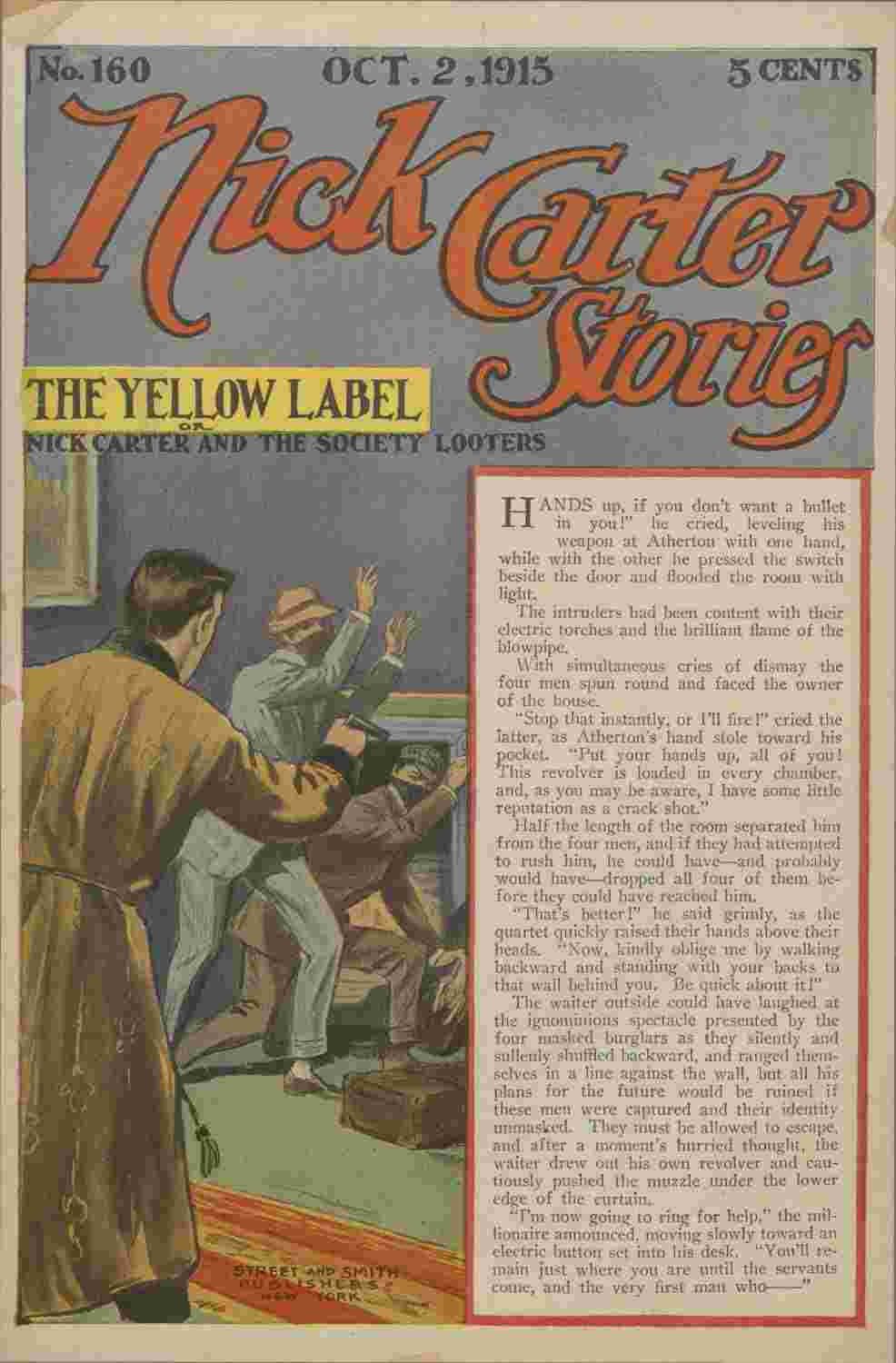
CHAPTER IX.
MAX REVEALS HIMSELF.
“I want to become a member of your gang, or organization, or secret society, or whatever you call it,” Max informed him coolly. “I want to share your excitements, your risks, and your plunder. That’s all I ask. Take me into partnership, and you’ll not only secure my silence about last night, but you’ll also have enlisted a valuable and experienced recruit, though I say it myself.”
Alfred Atherton rose to his feet and paced the room for a moment or two. At length he halted and once more planted himself in front of his caller.
“You’re a remarkable fellow, Max,” he said, with just a suspicion of irony in his voice. “By your unaided wit you have discovered what all the trained intelligence of the police has failed to discover, or even to suspect. I congratulate you.
“You’re quite right,” he went on. “Frost and Kinsley and Tufts and myself are all members of a secret society, which obtains its revenues from the public by means of burglary, arson, forgery, impersonation, and similar unconventional methods. The society was founded by myself some years ago, and I have the honor of being its president.
“At first it consisted of less than a dozen members, but at the present time it numbers over a hundred. At first we did not bother about a name for it, but one day, in a fit of jocular inspiration, I christened it ‘The Order of the Philosopher’s Stone,’ and the name has stuck to it ever since.”
“A curious name,” suggested Max. “What made you choose a name like that?”
“You’re an intelligent fellow, and you seem to be well read,” was the answer. “Doubtless, therefore, you’ll remember that the ‘Philosopher’s Stone’ was the name given by the alchemists of the middle ages to the touchstone for which they were always searching, and which they believed would change the baser metals into gold. Well, all our members are very fond of gold, and everything which can be converted into gold—the Massey jewels, for instance—so what better name could I have found for our organization?”
“The Philosopher’s Stone is also the name of your yacht, isn’t it?”
“Yes, but the yacht really isn’t mine. Strictly speaking, it belongs to the society, and is chiefly used for the purpose of smuggling our loot out of the country. The officers and crew are all members of the organiza[Pg 21]tion, of course, and so are the servants in this apartment.”
He paused, and regarded Max Berne with a mocking smile.
“And so are the servants in this apartment,” he repeated meaningly. “As I said just now, my dear Max, you’re a remarkably clever fellow in your way, but doesn’t it begin to strike you that you were rather foolish to come here and threaten me?”
“No, I can’t say that it does,” was the calm reply.
Atherton shrugged his shoulders.
“Then you’re not as bright as I thought you were,” he declared. “I’ve been very frank and open with you. I’ve admitted that I’m a criminal; I’ve involved the most important members of our board of directors, and I’ve told you quite a lot about the society itself. Hasn’t it occurred to you to wonder why I’ve been so indiscreet?”
“I suppose because you’re going to admit me into the society,” the waiter answered promptly.
Atherton’s laugh had a disagreeable ring.
“Not at all,” he said. “Better guess again, Max. I’ve told you so much because I know you will never be able to reveal what I’ve told you to any one else. In other words—I’m sorry to say it, because I’m really fond of you in a way—you’ll never leave this apartment alive!”
As he spoke, he touched a bell, and in hardly more time than it takes to tell it, three stalwart menservants glided into the room.
“Fine specimens, aren’t they?” queried Atherton. “I call them my bodyguard. As I’ve told you, they’re all members of the order, and are sworn to obey my commands even at the cost of their own lives. Now, perhaps you see that you’ve made a little mistake in coming here so trustfully?”
But the waiter never turned a hair. He toyed with his revolver, glanced for a second at the street below, and then coolly studied the newcomers, making no attempt to rise from his chair.
“These melodramatic proceedings leave me cold,” he said wearily. “I’m quite able to defend myself with this old friend here, and, what’s more, if you or these fellows were to attempt to molest me, I should instantly smash this window and shout for help.”
“I’m afraid that wouldn’t be of much use to you,” Atherton informed him. “You would be dead long before anybody arrived, and my men here would unanimously swear that you had attacked me, and that I had shot you in self-defense. You hadn’t thought of that, I suppose?”
“I confess I hadn’t,” Max returned, unmoved. “Perhaps there’s something, though, which you haven’t thought of. My death wouldn’t save you from exposure and ruin. I wasn’t born yesterday, Mr. Alfred Knox Atherton. Before I came here, I wrote out and signed a full account of all that happened at Meadowview last night. I gave the paper to my wife, and I told her that if I hadn’t returned by six o’clock she was to take the document to police headquarters.”
Atherton bit his lip, and a spasm of baffled rage distorted his face.
“Your wife!” he snarled.
“The most charming woman in the world,” the waiter assured him, in the silkiest of voices, but with a curious touch of sincerity. “You may perhaps have heard of her,[Pg 22] for she has an international reputation. Her name is Elaine Wilhelm, and she’s sometimes called ‘The Countess!’”
Atherton uttered a shout that was a curious blend of amazement and delight.
“Elaine Wilhelm—The Countess!” he cried. “You don’t mean it! Then you—you are Johann Wilhelm?”
“‘The Count,’ at your service!” murmured the man, rising from his chair and bowing low.
CHAPTER X.
THE COUNT IS WELCOMED ROYALLY.
Atherton dismissed the servants with a peremptory wave of his hand.
“I shan’t need you now,” he said.
Then he turned to his visitor.
“Why on earth didn’t you tell me this at first?” he demanded. “There was no need for you to try to gain admission to our society by threats. Surely, you might have known that you had only to mention your name to be welcomed with open arms.
“And your wife, too,” he added. “In fact, if you won’t be offended at my saying so, your wife will be almost more welcome than yourself. Only last week I was saying to Frost that I’d give five thousand dollars if I could lay my hands on Elaine Wilhelm. We know what you’ve both done and can do, how you defied the police again and again in a dozen cities, over here, and most of the capitals of Europe. We’ll give you a royal welcome, both of you, but it just happens that your wife will come in particularly handy at the present time.”
“She’s a handy person at any time,” remarked the Count, with a laugh, “and the police would give more than five thousand to get their hands on her. I don’t suppose that you want her in the same sense that the police do.”
“Hardly,” returned Atherton. “We want the Countess because we have a scheme in view which can only be carried out by a woman of exceptional ability and courage. Unfortunately, we have no such woman in our society, and that’s why I’ve been longing to get in touch with your remarkable side partner. She’s the very one I want.”
“May I ask what the scheme is?”
“Of course. Briefly, it’s a plan for kidnaping old Enoch Pyle’s grandson, and holding him for ransom.”
“Who is Enoch Pyle?”
“You have heard of ‘Pyle’s Pink Pellets’?”
“Who hasn’t?”
“Well, Enoch Pyle is the originator and proprietor. He’s a millionaire two or three times over, but he’s uncouth and uneducated. He and his wife, who is as impossible as himself, live at a place called Pyle’s Park, which is a few miles on this side of Freehold. You passed the place on your motor cycle this morning.”
“And who is his grandson?”
“The boy’s name is Tommy Pyle. He’s the son of Enoch’s only boy, who died years ago. His mother is gone, too, and Mr. and Mrs. Pyle have taken him in, of course. Some day he’ll inherit Pyle’s pile, so to speak.”
“How old is he?”
“About five. He’s the apple of the old man’s eye, and if we could kidnap him, I haven’t a doubt that old Enoch[Pg 23] would not hesitate to give a quarter of a million—or even a half—to get him back.”
The Count nodded.
“It oughtn’t to be a difficult matter to kidnap a child of five,” he said.
“But it is in this case. Some gypsies tried it a couple of years ago, and ever since then old Pyle has been haunted by the fear of another attempt. The boy’s bedroom is provided with steel-lined shutters and electric alarms. Whenever he goes outside the grounds—and most of the time in them, for that matter—he’s accompanied by two burly guards armed with revolvers. In fact, he could not be more carefully guarded if he were a royal prince.”
“Then how do you propose to get hold of him?”
“It was Jackson Frost who suggested the scheme. Now that I’ve told you what sort of people the Pyles are, you won’t be surprised to hear that none of the best people call on them or invite them to their house. That’s a very sore spot with Mr. and Mrs. Pyle, who long for social recognition. There’s Mrs. Brook-White, for instance. She lives quite near to the Pyles, and is the acknowledged leader of society in that neighborhood. You’ve heard of her, in all probability? If she were to drop in at the Park some afternoon and take tea with them, their cup of joy would be filled to overflowing.”
“But what has this to do with kidnaping old Pyle’s grandson?”
“Everything. Frost’s idea is this: He suggests that we select some capable woman who can look and act the part, disguise her as Mrs. Brook-White, and send her to the Park in a swagger motor car. The Pyles have only seen the lady at a distance, so they would be taken in. The supposed Mrs. Brook-White would chat with them, take tea with them, and ask to see the boy. In some clever way she would get him to ride with her as far as the Park gates. The old people would be delighted with such condescension; the boy would be lifted into the car, the car would dash off, the coveted Tommy would be smuggled aboard our yacht—and there you are!”
“Very neat,” commented Wilhelm, whose surname had suggested his sobriquet of the Count. “I didn’t think Frost had brains enough to concoct such a clever scheme, but why haven’t you carried it out before?”
“Because, as I’ve already told you, we couldn’t find a woman with the requisite daring and ability to impersonate the aristocratic Mrs. Brook-White. But your wife—— Ah, your wife! She’s the very woman! Do you think she would be willing to play the part?”
“I’m sure she would,” replied the German, without a moment’s hesitation. “And she would play it to perfection.”
Alfred Atherton glanced at his watch.
“There’s no doubt about it,” he said, with conviction. “I must be going now, though. I promised to lunch with Tufts at two. Frost and Kinsley will be there, and one or two others. Will you join us? I’ll take you there in my car, which is outside, and I’ll introduce you to your fellow members. We can then discuss the scheme in greater detail, and afterward, if you’ll be so good, you might take me home with you and present me to your charming wife.”
The Count approved of this suggestion, and a few minutes later he and Alfred Atherton were on their way to Professor Tufts’ house.[Pg 24]
CHAPTER XI.
AN ANGEL VISITS PYLE’S PARK.
A week had elapsed.
It was four o’clock in the afternoon, and in the drawing-room at Pyle’s Park, Mr. and Mrs. Enoch Pyle were having tea.
The custom did not come naturally to them, but they believed it was the proper thing, and so they adopted it. It was particularly a trial to the old man, who, since his retirement, had been obliged to fight hard against an ingrained preference for shirt sleeves and slippers; but he had denied himself heroically, for the most part.
The merest glance about the room, with its costly furniture and costlier pictures and statuary, was enough to show that its owner was a man of great wealth; but one might have looked in vain for any signs of culture or good taste.
For Enoch Pyle and his wife, as Atherton has said, were old-fashioned country people, who had had few advantages.
Having said this, however, it is only fair to say that they had their good points—many of them. There was nothing mean or uncharitable about them. They were kind-hearted, hospitable, and generous to a fault.
At the same time, it must be admitted that they dearly loved “society”—at a distance—and that it was the greatest disappointment of their lives that none of the neighboring social lights would have anything to do with them.
At the moment the old couple were talking about the “sensational affair,” as the newspapers called it, at Meadowview—the attempted burglary of the Massey jewels, and the wounding of Francis Massey’s arm.
For unluckily—from the standpoint of The Order of the Philosopher’s Stone—the rich haul had not been carried away. The jewel cases had not yet been placed in the waiting bag when the Count had fired, and that unlooked-for shot, coming from some mysterious quarter, had so unnerved the rascals for the time being that they had decamped without their booty.
Probably, also, they had feared with good reason, that the shot would alarm the household and bring the servants about their ears in short order.
At any rate, Johann Wilhelm had subsequently learned, to his deep disgust, that the burglary had been unsuccessful with all he had done.
“I heard down in the village to-day,” said Mr. Pyle, “that the doctors ain’t very encouragin’. They’re afraid they’ll have to ampytate Mr. Massey’s hand. They say the bones——”
“I wish you wouldn’t talk about bones at tea time!” protested his wife. “It don’t seem proper, and it sort of takes my appetite away.”
“Excuse me, ma,” Mr. Pyle said humbly, and lapsed into silence.
“Ain’t the police discovered any clew to the thieves yet?” his wife asked presently.
“Neither hide nor hair of one,” was the answer. “An’ that reminds me of somethin’ else I heard in the village to-day. Mr. Massey has gone and sent for Nick Carter.”
“That’s what he’d ought to have done a week ago,” declared his wife. “Has Mr. Carter been to the house yet?”
“He’s there this afternoon. Him and one of his as[Pg 25]sistants—Chick, I think they call him. I’ll bet it won’t be long before they find a clew.”
Mr. Pyle helped himself to another piece of buttered toast, then he coughed uneasily.
“Do you know, ma,” he said, “I’ve been wonderin’ if we oughtn’t to call at Meadowview and leave a card—jest to show our sympathy, you know. What d’you think?”
“I don’t know what to think,” sighed Mrs. Pyle. “I was readin’ a book on etiquette this mornin’, and it said when any of our friends was sick, it was the correct thing to stop at the house and leave your card. But we couldn’t honestly say that Mr. Massey was a friend of ours, could we? He’s never taken no notice of us since we came here. In fact,” she added bitterly, “none of ’em takes any notice of us. We could buy lots of ’em up and never miss the money, but——”
Suddenly she paused, and her eyes grew round and big with excitement. She was sitting near a window, and could see the drive which ran from the entrance gates to the front door of the house.
“Enoch,” she said breathlessly, “there’s a moty car comin’ up the drive! Such a swell turnout, too. Who can it be?”
Mr. Pyle hurriedly set down his cup, tiptoed to the window, and cautiously peered out from behind the curtain. By that time the car had pulled up outside the front door, and an aristocratic-looking, fashionably dressed lady of middle age was in the act of stepping out.
“Marier,” gasped Mr. Pyle, staggering back from the window, “as sure as you live, it’s—it’s Mrs. Brook-White comin’ to call on us.”
“And me in my second-best dress!” groaned Mrs. Pyle agitatedly. “Ain’t that jest my luck! Put your tie straight, Enoch! Pull down your vest! And wipe that butter off your chin!”
In frantic haste the worthy couple strove to make themselves more presentable. A few moments of nerve-racking suspense followed, then the liveried footman flung open the door and announced:
“Mrs. Brook-White!”
Elaine—for it was she, of course—sailed into the room with an air that a queen might have envied. Her disguise was perfect, and her acting superb.
“My dear Mrs. Pyle!” she gushed, tripping forward and holding out her hand to that agitated woman, “I know what you must have been thinking of me for not having called upon you before. I’ve really wanted so much to, you know, ever since you came here, but you see, my time is so fully occupied—and this is your husband, is it? Charmed to make your acquaintance, Mr. Pyle! What a delightful place you have here. I hope now that I’ve made the plunge, that I shall be able to come often—if you’ll let me.”
“As often as you like, ma’am,” said Mr. Pyle, who hardly knew whether he was standing on his head or his heels. “We’ll be tickled to death to have you! But won’t you sit down?”
“And won’t you have a cup of tea?” asked Mrs. Pyle, when Elaine had seated herself.
The girl murmured her thanks, and the footman was dispatched in quest of another cup and a fresh supply of cakes and buttered toast. By the time these arrived, Elaine had completely won the hearts of her hosts, and had put them quite at their ease.[Pg 26]
“By the way,” she said presently, in her most dulcet tones, “you have a little nephew living with you, haven’t you? Or is it a grandson?”
CHAPTER XII.
THE KIDNAPING.
“A grandson,” replied Mr. Pyle. “Such a cute little feller, too! Only five, but as big as most boys of seven or eight. He’s all we’ve got, you see, and some day all this will be his. Would you like to see him, Mrs. White?”
“Don’t be foolish, Enoch!” protested his wife. “A lady like Mrs. White ain’t interested in children.”
“Indeed, I am!” declared Elaine. “I should dearly love to see the little man. Where is he?”
“In the nursery,” said Mr. Pyle. “I’ll bring him down.”
The proprietor of Pyle’s Pink Pellets left the room, and presently returned, leading Tommy by the hand—a curly-headed little chap wearing his first sailor’s suit.
The boy was naturally shy at first, but he soon succumbed to Elaine’s charming manners, and allowed her to take him on her knee.
How Mr. and Mrs. Pyle beamed! Here was their grandson sitting on the lap of a real social leader! Without a doubt, it was the proudest moment of their lives.
Presently Elaine announced that she must go.
“This has been a most delightful visit,” she said, “but I’m afraid it must come to an end, as all good things do. You’ll come and see me soon, though, won’t you, and bring Tommy with you? I’ve quite set my heart on it.”
She rose to her feet and held out her hand to the boy.
“Will you escort me to my car, Tommy?” she asked, with a dazzling smile.
The lad shyly took her hand, and they walked out of the room, Mr. and Mrs. Pyle following close behind them.
“This is a much nicer car than any of ours,” Tommy announced, as Elaine took her seat, and the chauffeur solicitously tucked her in. “I wish we had a car like this, granddad.”
“I’m sure you have much nicer ones as it is,” the girl said, patting him on the head. “You just think this is better, because it is new to you. However, if you like it, would you care to ride with me as far as the gate?”
“Yes,” Tommy said eagerly. “Can I go, granddad?”
Elaine turned to Mr. Pyle.
“Do you think you can trust me with him as far as the road?” she asked, throwing him a mischievous glance.
The glance struck home, and Mr. Pyle looked at her reproachfully.
“What a question!” he ejaculated. “Of course, I’d trust him with you anywhere. You—you can have anything we’ve got, Mrs. White.”
“That’s perfectly dear of you!” she said, holding out her hand to assist Tommy to climb into the car; then turned to the driver. “Go slowly down the drive,” she said, “so that Tommy’s ride won’t come to an end too soon, and stop at the gates.”
The chauffeur—who was none other than the Count in[Pg 27] disguise—touched his cap, and the car began to move slowly down the drive.
Mr. and Mrs. Pyle walked beside it, responding to Elaine’s lively sallies in their slow, embarrassed way, and feeling several inches taller than they had felt an hour ago.
At last the car reached the gates and turned into the road. Wilhelm glanced ahead and saw that the way was clear, after which he looked back over his shoulder at Elaine, who replied, with an almost imperceptible nod.
Then suddenly the car leaped forward like a thing alive, and the next instant it was thundering along the road with the speed of an express train.
Mr. Pyle let out a cry of alarm, but no thought of treachery crossed his mind.
He merely thought the chauffeur had made a mistake, and had increased the speed of the machine instead of shutting off the power.
“Stop! stop!” he shouted, running after the car. “Shut off your engine and put on your brakes!”
Mrs. Pyle meanwhile stood still and wrung her hands. She was certain that the big car was running wild and that a terrible accident was imminent.
Then an extraordinary thing occurred.
The dignified Mrs. Brook-White—or, rather, the lady who Mr. and Mrs. Pyle believed to be Mrs. Brook-White—turned around in her seat with a mocking laugh, and daintily blew them a farewell kiss.
Mr. Pyle could hardly believe his eyes.
To use his own words, he was “completely flabbergasted.” He pulled up with a gasp of incredulous bewilderment, and even as he did so, the car swung around a turn in the road and vanished from sight.
It was evident that Tommy Pyle was to have a much longer ride than either he or his grandparents anticipated, but where that ride would end, no one could say—except “Mrs. Brook-White,” her eminently respectable-looking chauffeur, and certain of the leading members of The Order of the Philosopher’s Stone.
CHAPTER XIII.
NICK COMES TO MEADOWVIEW.
It was quite true, as Mr. Pyle had heard, that Francis Massey had sent for Nick Carter.
He had first left the case in the hands of the local police, but when at the end of a week they had frankly confessed that they were baffled, he had wired for Nick Carter.
The detective promptly responded to the summons, and arrived at Meadowview in one of his private cars, accompanied by Chick and Captain, their police dog.
Massey received them in the study, his right hand swathed in bandages, and his left arm in a sling.
“If I had followed my own inclination,” he said, “I should have sent for you at first. I was persuaded to place the matter in the hands of the police, but although they have been searching and investigating and inquiring and cross-examining for just a week, they’re as far as ever from discovering any clew to the identity of the scoundrels. I sincerely trust you will be more successful.”
The detective looked a little dubious.
“You haven’t improved my chances by waiting a week before sending for me. However, I’ll do my best, of course. Needless to say, I’ve read the newspaper accounts[Pg 28] of the case, but I should be glad to hear your version of the affair.”
“If you’ve read the newspapers,” replied Massey, “I don’t suppose I can tell you anything that will be very new. We’d been to the opera—my wife and daughters and myself—and, in the ordinary course of events, we should have returned about half past twelve. Owing to engine troubles and a blow-out, however, it was just after two when we got here.
“We were all rather tired,” he continued, “and we decided to go straight to bed. Before my wife and daughters retired, however, they handed me their jewels. I placed the latter in their proper cases, brought them to this room, and locked them in that safe.”
He pointed to the mutilated safe in the corner. It was empty now, but was otherwise in the same condition as when the burglars had left it.
“After I’d locked up the jewels,” Massey resumed, “I switched off the lights and went to bed. For some reason or other I could not get to sleep at once, and when I’d been in bed about half an hour I thought I heard somebody moving in the study. I got up quietly, put on a dressing gown and slippers, armed myself with a revolver, and stole downstairs.
“When I’d crept up to the door here,” he went on, “I distinctly heard men at work in the room. I waited for a few seconds, and then I suddenly flung the door open and sprang in, switching on the lights as I did so. One glance showed me that the safe had been forced and the jewels removed. Two men were about to stow the cases in a leather bag, and two others were packing up the apparatus with which they had opened the safe.”
“All the four men wore masks, I understand,” Nick put in.
“That’s true.”
“So you never saw their faces?”
“Unfortunately I did not. From the cut of their clothes, however, and the appearance of their hands, I judged them to be men of a much superior type to the common housebreaker. Their hands were as white as my own, and their clothes were as good as those I’m wearing at this moment.”
“That’s interesting. Now, tell me what you did.”
Massey described how he had covered the men with his revolver, and had ordered them to raise their hands and stand with their backs to the wall.
“They obeyed without a word,” he said. “I thought I’d cowed them, and that I only had to ring for help in order to make my capture complete. But evidently they had posted a fifth man outside the window, to keep watch, and just as I was about to ring the bell—this bell on the desk—the scoundrel fired at me through the window and broke my wrist.”
“Did you ever see the fifth man?”
“No, I should never have known of his existence had he not fired. It was very clever on their part to leave him out there.”
“I see. What happened next?”
“Then for a moment the four masked men seemed almost as startled as myself—at least, so it appeared to me, although I had troubles of my own just then, and was hardly in a position to study them at my leisure. At any rate, panic seized them, I suppose, owing to the fear that the shot would be heard all over the house. The pain of my shattered wrist made it impossible for[Pg 29] me to do anything more. I was helpless, and the jewels were at their mercy, but, to my amazement, they seemed to forget all about them.”
“They bolted at once?”
Massey nodded.
“Yes,” he answered. “They rushed to the window, tore down the curtain in their haste, and took to their heels through the grounds.
“The report of the revolver had aroused the household,” he continued, “and, in a remarkably short time, the servants were scouring the grounds in all directions. Two of them saw a man in the act of mounting a motor cycle in the little lane at the back here. They tried to capture him, but he got away, and from that day to this nothing more has been seen or heard of any of the five of them.”
“The man whom your servants saw in the lane—was he one of those in the study?”
“Apparently not. My people describe him as a young man of rather foreign appearance, wearing a dark-blue suit. There was no such man in this room. It seems clear to me that he was the one who was posted outside the window, and who fired at me.”
“He escaped, you say, on a motor cycle? How did the others get away?”
“The police have a theory that they came here in a motor car, in which they afterward made their escape. If is only a theory, however. At least, there doesn’t seem to be any proof. There was a heavy thunder shower an hour or two later, and that may have obliterated the marks of the car.”
“They left the jewels behind, I understand.”
“Yes, and they also left their apparatus and the leather bag in which they were about to pack the jewels when I disturbed them. Would you like to see the things?”
The continuation of this story will be found in the first issue of DETECTIVE STORY MAGAZINE, out October 5th. See the announcement on the next page, telling about this new magazine, which in future will contain, not only Nick Carter stories, but many other narratives dealing with the detective art.
It will be published twice a month, and the price will be ten cents a copy.
GETTING OUT OF A DIFFICULTY.
At a certain school, one day, the teacher had occasion to examine his class in arithmetic, previous to the final examination.
On finding that he had a very dilatory boy, and thinking to make him look a fool, he set him the under-mentioned task:
If a man was to fall down a well fifty feet deep, how long would it take him to get out if, for every foot he climbed, he fell down two?
The boy started figuring out the above sum.
After filling six slates with figures, the teacher stopped him, and asked what he was doing.
“Trying to get that man out of the well, sir,” replied the boy.
“But that’s not the way to do it.”
“I don’t know,” said the boy. “Just you give me another half a dozen slates. I’ll get that man out of the well if I have to take him right through to China.[Pg 30]”
Announcement
Extraordinary
Readers of Nick Carter Stories, and lovers of narratives dealing with the detective art and the solving of mysterious crimes, there is a great treat coming to you. Nick Carter Stories has outgrown its present form and we are going to publish it in magazine style. It will be edited by Nicholas Carter, and will be called DETECTIVE STORY MAGAZINE. It will be published on the fifth and twentieth of each month, and will contain, besides a rattling good serial, telling of the exploits of Nick Carter, serials and short stories dealing with the detective art in all its forms. The stories will be the very best that can be obtained, and the magazine will contain one hundred and twenty-eight pages of them. The first number will be out October fifth. Don’t miss it, and get your copy early, or you will get left, for they will sell fast.[Pg 31]
SNAPSHOT ARTILLERY.
By BERTRAM LEBHAR.
(This interesting story was commenced in No. 153 of Nick Carter Stories. Back numbers can always be obtained from your news dealer or the publishers.)
CHAPTER XXXII.
THE OUTLAW NABBED.
Although Mayor Henkle had declared his intention of removing Chief of Police Hodgins from office as a result of the Bulletin’s revelation of the police conditions which prevailed in Oldham, he had not done so.
There were several reasons why his honor had changed his mind about taking this step. In the first place, Hodgins was the mayor’s wife’s cousin, and his honor feared that Mrs. Henkle would have something to say if he fired her relative. Tyrant thought he was at the city hall, the Honorable Martin Henkle stood in considerable awe of his little wife.
A second reason was that if he had removed Hodgins on account of those snapshots, the mayor, in order to be consistent, would have had to dismiss from the department the delinquent policemen whose pictures had appeared in the Bulletin. Some of these men had a strong political pull, and Mayor Henkle was disinclined to take such action against them.
Besides, the Chronicle, at the mayor’s suggestion, had published a long editorial denouncing those police snapshots as atrocious fakes, and denying that the members of the force were really guilty of the misconduct of which the Bulletin’s pictures had seemed to convict them. Consequently, the mayor could not have punished his chief of police without going back on the administration organ.
So Chief Hodgins still held on to his job. But he was not happy. The fact that Hawley had come back to Oldham, and was once more at work with his camera, was one of the things which prevented him from being so.
Goaded by the jeers and snarls of the mayor and by his own frantic desire for vengeance, he sought desperately to capture the Camera Chap; but, try as he would, he could not succeed in laying hands on that elusive man.
Hawley had become a veritable will-o’-the-wisp. Although every member of the force was as anxious as the chief to catch him, and kept a sharp lookout for him day and night, he seemed as immune from capture as a mosquito buzzing around the head of an armless man.
Hodgins stationed detectives outside the Bulletin office, in the hope of being able to apprehend him when he came to deliver the pictures; but, greatly to his chagrin, these sleuths reported that the Camera Chap did not come to the Bulletin office. Evidently anticipating this ambush, he had made secret arrangements with Carroll to get the films to the Bulletin without bringing them in person; but what this method was the police were unable to find out.
Hodgins also sent detectives, armed with a warrant, up to the mountain retreat of Hawley’s host; but the latter informed the policemen that he had not seen the Camera Chap for several days. Evidently Hawley, anticipating this move, too, had seen fit to change his boarding house; and the police were unable to find his present residence.
Through the medium of the Chronicle, the chief of police appealed to all good citizens to aid in the capture[Pg 32] of the “notorious camera bandit.” Had this appeal met with a general response, the chances are that Hawley would soon have been caught; but, fortunately for him, the sympathies of the citizens of Oldham were largely on his side. The new anticamera law was not proving at all popular. People thought it a shame that the Bulletin should be discriminated against, and the public in general was rather pleased than otherwise by Hawley’s success in dodging the police.
But at last Hawley’s phenomenal luck deserted him. Chief Hodgins, strolling along Main Street one afternoon, saw a sight which astonished him so much that for a moment he was inclined to believe himself a victim of hallucinations.
There, only a few yards ahead of him, stood a man with a camera in his hand, photographing an ornamental fountain in which several urchins were paddling and splashing—a thing forbidden by law, but ignored by the indolent police.
It was the Camera Chap! His profile was turned toward the chief, and the latter recognized him at first glance.
With a gasp of joy, Hodgins bounded forward. Hawley was so intent upon getting a focus that he did not perceive his danger until a heavy hand clutched him roughly by the coat collar and a hoarse voice exclaimed:
“Got you at last! Try to get away, and I’ll let daylight into you!”
Hodgins had drawn his revolver as he rushed toward the Camera Chap, and he pressed the barrel of the weapon against his prisoner’s ribs. It was not usual for him to indulge in such spectacular gun play when making an arrest for a misdemeanor, but he had the legal right to shoot if his prisoner attempted to escape, and so bitter was he against Hawley that he would not have hesitated to avail himself of that right if the latter had made it necessary.
But the Camera Chap proved to be a most submissive prisoner. Although he knew that he was booked now for a six months’ stay in the county jail, he accepted the situation with a rueful smile. The prospect was decidedly unpleasant, but there was nothing to be gained by “going up in the air.”
Hodgins slipped handcuffs on his wrists, and marched him to police headquarters. Thrusting him into a cell and bidding the turnkey keep a vigilant watch over him, the chief hurried to the city hall to tell the mayor the good news.
Half an hour later, as the Camera Chap sat in his cell, pondering on how he was going to get out of this predicament, there came to his ears the sound of a violent detonation, as though somebody had exploded a dynamite bomb in the vicinity of the headquarters building.
Hawley wondered greatly as to the meaning of this. As the hours went by, he wondered, too, why he was not taken before a magistrate, instead of being kept at police headquarters. He put both of these questions to the turnkey, but could get no answer from that taciturn official.
At length, however, his curiosity was satisfied in a most startling manner. The door of his cell was suddenly opened, and a powerfully built man, struggling desperately in the grip of two burly policemen, was dragged into the cage.[Pg 33]
As the iron gate closed with a clang, Hawley turned to this new captive in great astonishment.
“Ye gods, Fred!” he exclaimed. “Have they got you, too? What on earth for?”
Carroll, bleeding from a deep gash on his left temple, and badly bruised about the face, laughed bitterly.
“There’s been a tragedy,” he said. “The Chronicle Building has been blown up by dynamite, and old man Gale killed—or, at least, fatally injured. And that fathead, Hodgins, accuses me of being responsible for the outrage.”
CHAPTER XXXIII.
A BOMB OUTRAGE.
Chief of Police Hodgins had been to the city hall to tell the mayor the good news that the Camera Chap had been captured, and was on his way back to police headquarters when the explosion in the Chronicle Building occurred.
As he passed the office of Gale’s newspaper, the chief thought that he might as well drop in and tell his old friend the glad tidings, too. He knew that the proprietor of the Chronicle and his son would be delighted to hear that Hawley’s wings had been clipped at last, and that Mayor Henkle had agreed that the “young desperado” must be sent to jail, public sentiment to the contrary notwithstanding.
Hodgins was just about to enter the building when there came a violent report, followed instantly by a crash and loud cries of alarm.
“Great grief!” he gasped. “What has happened? Sounds as if a bomb had gone off. And it came from inside the building, too!”
Rushing up the stairs, which were strewn with pieces of plaster that the explosion had torn from the walls, the chief entered the private office of Delancey Gale—or, to be more exact, all that was left of the private office.
The room was a total wreck. Its door had been torn from its hinges; the panes of the two windows were completely blown out; the ceiling had come down; great holes had been torn in the plastering of the walls; the office furniture was smashed.
And, stretched on the floor, lying so still that Hodgins thought at first that he surely must be dead, was old Delancey Gale, so badly banged up by the explosion that his face was scarcely recognizable.
In the hope that there might still be some life left in that inert form, the chief of police grabbed the telephone which stood on the ruin of what had been a fine mahogany desk. Fortunately the instrument was still in working order, and in a few minutes he had the hospital on the wire, and was imploring them to send an ambulance to the Chronicle office with as little delay as possible.
When the ambulance surgeon arrived, he announced that there was still a spark of life left in the proprietor of the Chronicle, but that it was exceedingly doubtful whether he would survive his injuries.
“Anybody else hurt, chief?” the surgeon inquired, as he and his driver placed the wounded man on a stretcher and prepared to take him to the hospital.
“It seems not,” Hodgins replied. “A couple of chaps in the reporters’ room got a few scratches, I’m told; but nobody except poor Gale is injured seriously. The whole[Pg 34] building was jarred by the explosion, but most of its force seems to have been confined to this room.”
“How did it happen?” the surgeon inquired, as he lifted one end of the stretcher and started to carry the unconscious man to the ambulance.
“Looks to me like a bomb outrage,” the police official replied, with a scowl. “See that clockwork affair over there on the floor? I reckon it was that contraption which caused the damage. But I ain’t had time to make an investigation. I’ve got my suspicions, though, as to who is responsible for this atrocity.”
Just as they were lifting the stretcher into the ambulance, young Gale pushed his way through the crowd which had gathered on the sidewalk. He had gone out on an errand for his father about an hour before the explosion, and the sight of the ambulance and the crowd gathered in front of the Chronicle office was the first intimation he had that anything was wrong. His face was white as he approached Chief Hodgins.
“Is the governor dead?” he inquired hoarsely.
“Not quite,” was the gruff reply. “But the doc says he don’t stand much show. What do you know about this explosion, my boy?”
“Nothing at all,” Gale replied nervously. “I can’t understand how it happened.”
“I reckon I’ve got a pretty clear idea how it happened, all right,” growled Hodgins. “Somebody sent the old gent an infernal machine. The pieces of it are lying on the floor of the office now. And it ain’t hard to guess who that somebody was, eh?”
“No, indeed,” young Gale replied. “My father has only one enemy—at least, only one who would be capable of such a cowardly attack. That cad, Carroll, is responsible for this, as sure as you’re standing here, chief! I demand that you place him under arrest at once!”
“You won’t have to ask that of me twice,” Hodgins replied grimly. “My fingers are just itching to get hold of that big stiff’s coat collar. But first let us go in and look the ground over, and see if we can’t find a little more evidence against him. Suspicion ain’t evidence, you know.”
A more affectionate son might have preferred to accompany the ambulance to the hospital, in order to be present, or near at hand, while the surgeons made a thorough examination of his father’s injuries; but this course did not seem to suggest itself to Gale.
Eagerly he followed the chief of police up the plaster-strewn stairway to the wrecked private office of the proprietor of the Chronicle.
They examined the fragments of the exploded infernal machine, and found there some clews which caused Gale to turn excitedly to Hodgins.
“It’s Carroll, sure enough!” he cried triumphantly. “We’ve got enough evidence here to send him to the chair, if the governor dies, and to prison for life if he doesn’t. Come on, chief; let’s march to the Bulletin office and place him under arrest.”
The chief of police took the precaution of providing himself with an escort of four stalwart members of his force before he went to arrest the proprietor of the Bulletin.
Not possessing the sunny, placid disposition of his friend Hawley, Carroll’s indignation took the form of physical resistance when he learned the intentions of his visitors concerning himself. Hodgins and his posse had[Pg 35] to send for reënforcements before they could get him out of the building.
That was why the proprietor of the Bulletin presented such a battered appearance when he joined the Camera Chap in the cell at police headquarters.
CHAPTER XXXIV.
DUBIOUS PROSPECTS.
“The Chronicle office blown up!” exclaimed Hawley, staring at his cellmate in horrified astonishment. “Who could have done it, Fred?”
“I don’t know who did it,” the proprietor of the Bulletin answered, with a scowl, applying his handkerchief to the deep cut in his scalp which Chief Hodgins had inflicted with the butt of his revolver. “I only know that I didn’t have anything to do with the outrage.”
“Of course you didn’t, old man,” said the Camera Chap soothingly. “I know you too well to believe you capable of anything like that. What grounds have they for trying to put it up to you?”
Carroll laughed grimly. “Oh, they claim to have plenty of evidence—enough to send me to the chair, if old Gale dies. Hodgins told me that the box in which the infernal machine was inclosed has been identified as a box which was previously in my possession. He claims, too, that they have the wrapper of the package, and that the address is in my handwriting. If they can prove these things, they’ve got a strong case against me.”
“If they can prove them!” exclaimed Hawley, with a confident laugh. “But of course there’s no danger of that. The whole thing is a palpable frame-up.”
“There’s no doubt about its being a frame-up,” said Carroll; “but I’m not so sure that it’s palpable. Hodgins is an expert at manufacturing evidence, and if he’s careful not to make any breaks, he’ll probably be able to convince a jury that he’s got the goods on me. You see, Frank, there’s the question of motive to be considered. I’m afraid they’ve got me there.”
“Motive?” the Camera Chap repeated, with an interrogative inflection.
“Certainly. Everybody in Oldham is aware of the enmity which existed between myself and the Gales. Isn’t it only natural that I should be the first person suspected of sending that infernal machine?”
“Not at all,” Hawley protested indignantly. “You are illogical at your own expense, Fred. Even assuming that you could be coward enough to have done such a thing—which, of course, is quite out of the question, old man—what logical reason could you have had for resorting to such desperate tactics? You were winning. Everything was going your way. You had no cause to use violence.”
Carroll brightened up a trifle at this argument. “I suppose there’s something in that,” he agreed, once more dabbing with his handkerchief at the gash on his temple.
“By the way, old man,” said Hawley, noticing this act; “you haven’t told me yet how you came by that cut and battered countenance. You weren’t in the Chronicle Building when the explosion took place, were you?”
“Not exactly,” Carroll answered, with a sheepish grin. “I received these wounds in the Bulletin Building. When Hodgins and his men came and told me that they wanted me for sending that bomb, I—well, I’m afraid I lost my temper for a little while.[Pg 36]”
Hawley shook his head disapprovingly. “That was foolish of you, old man. I gave you credit for possessing more poise. What will the citizens of Oldham say when they learn that the man who is to be their next mayor was so lawless as to resist arrest?”
Carroll laughed bitterly. “Don’t deceive yourself about any strong chance of my being Oldham’s next mayor. That’s out of the question now. Even if I’m fortunate enough to be able to clear myself of this charge in court, I’ll have a hard job convincing the public that I didn’t send that bomb to the Chronicle office. You ought to have seen how the crowds on the streets acted when I was being brought here. Their attitude was so ugly that I was afraid they were going to take me away from the police and string me to a lamp-post. The people of this town are always willing to believe the worst of a man. You never saw such a community of backbiters. I guess this arrest means the finish of my political aspirations.”
“Nonsense!” Hawley returned reassuringly. “Don’t worry about that, Fred. The public may be inclined to suspect you at first, but we’ll soon swing them around to our side again. We’re going to put you in the mayor’s chair, old man, in spite of this little trouble.”
“We?” exclaimed Carroll pointedly. “Good heavens, man, you don’t seem to realize your own position at all!” He laid his hand sympathetically upon his friend’s shoulder. “Poor old chap! There’s precious little you’ll be able to do between now and election. Even if I do manage to get out of this mess, your goose is cooked for sure. There isn’t any doubt that they’ll send you to jail for six months for taking pictures without a license. They’ve got a clear case against you, and I can’t see how you’re going to get out of it.”
The Camera Chap smiled. “Yes, I must admit that it does look very much as if I’m slated to spend the next six months in practicing the gentle art of converting large stones into little ones. You are wrong in supposing that I don’t realize the position I’m in, Fred.”
“Then how the deuce can you be so cheerful?” Carroll demanded. “By jinks, Frank, you’re the most unselfish fellow I’ve ever met! Here you are worrying about me, and trying to cheer me up, when you have plenty of cause to be brooding over your own impending fate.”
Hawley shrugged his shoulders. “What’s the use of brooding? I’ve never seen anybody get any farther by doing that. Besides, I’m not absolutely positive that I’m going to jail. I’ve still got a faint ray of hope.”
“What is it?” Carroll inquired eagerly.
“The New York Sentinel,” the Camera Chap replied. “If I can get word to Tom Paxton, I haven’t any doubt he’ll come to my rescue with bells on. The good old Sentinel stands by its men through thick and thin, and, although I don’t quite see how he’s going to work it, I am hopeful that Tom Paxton will find some way of saving me from jail.
“The trouble is, though,” he added, “how the deuce am I going to get word to him? Hodgins isn’t going to let me get in touch with my friends, if he can help it.”
“But he wouldn’t dare do that,” Carroll protested indignantly. “It is illegal. It is your constitutional right to confer——”
“Pshaw! A little thing like a prisoner’s constitutional rights doesn’t bother our friend Hodgins,” the Camera Chap interrupted. “Besides, it is a condition and not a theory which confronts us. I asked the turnkey to let me[Pg 37] send a telegram from here, and was curtly refused. The man told me that he had orders not to let me communicate with any one. They wouldn’t even let me send word of my arrest to you. Still, I am confident that I’ll be able to find some way of getting a C. Q. D. call to the Sentinel.”
“You don’t have to worry about that,” Carroll assured him. “Word has already been sent to the Sentinel. I guess by this time, Frank, Paxton is aware of your predicament.”
“Why, what do you mean?” Hawley demanded eagerly.
“I mean that as soon as I heard of your arrest, old man, I took the liberty of wiring to Paxton, advising him of the situation,” Carroll explained.
“And you took that step without waiting to consult with me?” It seemed to Carroll that there was a trace of resentment in the Camera Chap’s tone.
“Yes; I remembered how you used to hate to appeal to the paper when you were in difficulties in the days when I was on the Sentinel staff. I was afraid that you wouldn’t hear of letting Paxton know of your plight, so I decided to go ahead on my own hook. Hope you’re not mad with me for doing so, old man?”
“Mad with you? I should say not, indeed,” Hawley replied, with a joyous laugh. “I am mighty glad that you sent that telegram, Fred. Generally, as you say, I don’t like to bother the paper when I’m in trouble; but this is one of the times when I can’t get along without the Sentinel’s help.”
CHAPTER XXXV.
A C. Q. D. CALL.
Only a few days previous, Tom Paxton, managing editor of the New York Sentinel, had received a letter from the Camera Chap. It ran as follows: