
THE NEWS OF ALL NATIONS.
How Missouri River Lowers Land Surfaces.
The Missouri River carries more silt than any other large river in the United States, except possibly the Rio Grande and the Colorado. It gathers annually from the country that it drains more than 123,000,000 tons of silt and soluble matter, some of which it distributes over the flood plains below to form productive agricultural lands, but most of which finds its way at last to the Gulf of Mexico.
It is by means of data of this kind that geologists compute the rate at which the lands are being worn away. It has been shown the Missouri River is lowering the surface of the land drained by it at the rate of one foot in 6,036 years. The surface of the United States as a whole is now being worn down at the rate of one foot in 9,120 years.
It has been estimated that if this erosive action of the streams of the United States could have been concentrated on the Isthmus of Panama, it would have dug in seventy-three days the canal which has just been completed after ten years’ work, with the most powerful appliances yet devised by man.
Boy’s Life Like Fiction.
Like a romance reads the tale of Benny Wittig, picked up as Eddy Sires by the police several days ago, and the happy climax of the story came in his restoration to his mother, Mrs. Frank Hitchcock, of Peoria, Ill.
The story begins with the death of Judge Wittig, near Latham, Ill., eleven years ago. His wife was sick, and misfortune had followed him, so that all he had was mortgaged and seized for debt. His two sons, Benny, aged six, and Louis, aged nine, were placed in the Lutheran Kinderfreund. Benny was adopted by a family named Sires, while Louis was taken by a family living near Nashville, Ill.
The Sires family went to Kentucky, tired of the boy, and abandoned him in the town of Somerset. The youngster beat his way by hook or crook to the Far West, and his first recollection of places he visited is of Los Angeles, Cal. Afterward he lived for over a year in Salt Lake City, where he attended school. He found other friends in Denver, and attended school there, also. It was while beating his way back to Kentucky to find his supposed parents—Sires—that he happened into Peoria. The police suspected that the handsome seventeen-year-old boy was a runaway, and detained him while investigating.
His story, though it seemed improbable, interested Chief Rhoades, who communicated with the police at Somerset and is awaiting a reply.
Meantime the story got into the city papers, and Mrs. Inez Ware and Miss Josephine Hitchcock, sister and half sister of the boy, called at police headquarters and identified him as Benny Wittig. In the good old storybook way, a scar on his neck established his identity, although the striking resemblance between the ladies and the boy is so great that it alone is convincing.
The mother, Mrs. Wittig, had married Frank Hitchcock and moved to Peoria. She is now partially paralyzed.[Pg 59] She had made inquiries and put forth every effort she could to find her boys, and was successful in locating Louis, the eldest, who had led a dog’s life as a bound boy. He had learned that his name was Wittig, and in a Decatur paper had read of the marriage of a Mrs. Wittig and Hitchcock. He wrote to her on the chance of her being his mother, and their relationship was established. He now conducts a prosperous garage.
Benny is now seventeen years old. He has been a wanderer for nine of the intervening years since his father’s death, and the chain of happenings that have restored him to his mother is one that is read of in works of fiction, but seldom in real life.
Red and Green Light Tests.
It is strange how the color of a light makes it more or less visible, irrespective of its actual brilliancy. To test this, place two lights of the same color—two candles of the same size will do—in two tin boxes, and in each box perforate a pinhole. Cover one pinhole with green glass and one with red, and place them in a perfectly dark room.
To a normal person the green light will appear five times brighter when viewed obliquely than when viewed directly, but the red light behaves in the opposite way. Most people will pick up the green light when looking in some other direction and will be quite conscious of its presence, but when they turn their eyes directly toward it, they will not see it at all. The faint red light, on the other hand, will not be noticed at all until looked at directly, then it appears quite bright, but the instant the eyes are turned away from it it is gone.
New Mosquito Eradicator.
A genius of Jackson, Miss., has invented an electric motor which is to act as a mosquito exterminator. His plan is to have his motor revolve at just the right speed to make a humming noise like that of buzzing mosquitoes. That attracts all the insects in the neighborhood, and, as the motor is surrounded with a metal screen, charged with a powerful current, the mosquitoes alighting on it are instantly electrocuted.
Nonskid Banana Peel Discovered.
According to a news item wired from San Francisco, we are soon to have with us what one writer calls “the nonskid banana peel.” The edible interior remains about the same as the ordinary kind, we are told, but the new covering presents a new boon to humanity that should make its discoverer famous, if not wealthy. The genius who is said to be able to produce a nice large banana with a coat like sandpaper is one Frederick Boegle, employed at the Burbank experiment farm near Hayward, Cal.
The discoverer of the so-called “nonskid peel,” as a casing for the delectable contents guaranteed to be found inside, explains that the new fruit was obtained by crossing the ordinary banana with the cactus pear. Boegle says the new fruit has the usual delicious taste of banana,[Pg 60] but that the peeling may be dropped on the sidewalk with perfect safety to pedestrians.
If this is the precise case, then the peeling must be “nonskid” on the inside as well as the outer, but this is not to be considered, says a Blade expert, as it is contrary to all horticultural laws, past or present. Therefore, he says, if the “nonskid peel” happens to be dropped with the “nonskid” side downward, then the same old, treacherous, greasy, deadly, never-failing, calamitous thing will no doubt bring down its victims as it has always done since the Duke of Plazzatora, away back in the days and voyages of Christopher Columbus, discovered the banana and also that by craftily laying a strip of its covering in the way of Don Frijolo de Mountebank, he could rid himself of a powerful rival and thus get closer to the new world’s discoverer as well as to the beautiful and charming Donna Isabella de Mendoza, back there in Spain.
But time will tell.
Boy Banjoist, Local Wonder.
Little Victor Vanover is the champion banjoist of the “neck o’ the woods” at Freeling, Va. Though Victor is a mere midget, and has passed only his seventh milepost on the road of life, he can handle his banjo with all the grace and dexterity that ordinarily comes through years of practice, and, what is more to the young musician’s credit, he takes up the instrument in a perfectly natural way, and without any apparent desire to “show off,” and he is well aware of both his powers and limitations.
Victor began to practice at the age of five with a natural aptitude, and now he can “pick” any tune that he has ever heard, and that, too, with a clearness that would almost put to shame many professional banjoists.
Among the tunes that he can pick may be mentioned: “Cumberland Gap,” “Old Joe Clark,” “Casey Jones,” “The Blind Coon Dog,” “The Ship That Never Returned,” “Sourwood Mountain,” “The Gambling Man,” “New River Train,” and “Walking in the Parlor.”
Quicksand Devours Big Plant.
Three laborers were killed and eight injured as they fled in terror to solid earth when quicksand devoured the big plant and three surrounding acres of land of the Knickerbocker Cement Co., at Greenport, not far from Hudson, N. Y. Here is a list of what was swallowed by the vortex:
A large power house.
An eighty-foot concrete smokestack.
A concrete storehouse.
A large frame barn which held three horses and an automobile, all of which were buried.
A huge quantity of material, including forty thousand tons of trap rock.
Nick Altrock a Laugh Maker.
Nick Altrock, who, since the departure of Arlie Latham and “Germany” Schaeffer for other fields, is the only diamond clown remaining with the main show, forced a big laugh in the frolic between the Yanks and the Senators in New York not long ago, when an injury to a player threatened to cast a gloom over the festivities.
Fisher and several other Yankees started to run Shanks down between second and third, and the pitcher finally[Pg 61] dashed up behind the runner and slammed him on the back with the clenched ball. The pellet happened to strike Shanks on the spine, and he crumpled up and dropped in his tracks.
As he was being revived, and the spectators were on tiptoes to know the extent of his hurt, Nick rushed upon the field, hit himself on the head, and pretended to fall unconscious. He picked himself up when his teammate revived, and staggered toward the bench with him. The performance broke the strain, made everybody laugh, and both Senators were cheered throughout the stands.
Summer and Winter Butter.
Scientific experiments have demonstrated that, contrary to the general belief, the yellow color of cream and butter is not necessarily an indication of their richness. It was discovered long ago that most vegetable matter contains a yellow substance called carotin, because it exists abundantly in carrots.
It is this substance contained in the cow’s feed that gives rise to the color of milk and butter. Carotin is most abundant in the green forage available in spring and summer so that milk and butter produced then are more yellow than in the winter, although the percentage of fat in winter milk often is actually higher than in the rich-looking product obtained in summer.
Lightning Throws Bugler.
Lightning struck the projecting room of a motion-picture show in the brigade camp of the Sixth United States Infantry, at Douglas, Ariz., during a recent violent electrical storm. The bolt was deflected into the officers’ section, throwing several of them down. Musician Greenspan was hit while in the act of blowing taps. He was thrown several feet, his head finally resting in a bucket of tar. His bugle was destroyed.
Bitten by Huge Water Snake.
Emil Nichau, an assistant in the office of City Engineer Wager, at Sandusky, Ohio, was bitten three times on the right hand by a large water snake while he was gathering lilies in the Black Channel section, between Cedar Point and West Huron. While he was quite sick for some time, he had fully recovered a few hours later.
The snake was killed. It measured fifty-two inches in length and nine and one-half inches in circumference at the thickest part of its body.
Can’t Stop This Swimmer.
Incased in a straitjacket and carrying fifteen pounds of iron chain as a sort of extra ballast, Henry Elionsky swam from the Battery, New York, to Bay Ridge. The distance was about five miles and the time was two hours and forty minutes.
Elionsky was helped by the rushing tide. He had several narrow escapes from the harbor craft, and once a tugboat came within thirty feet of running him down.
Robber Chief Gets Twenty-five Years.
Henry Starr, of Chandler, Okla., pleaded guilty to bank robbery in the district court, and was sentenced to twenty-five years in the penitentiary. He was charged with the robbery of two banks at Stroud, Okla., into which he led his gang last March and took five thousand dollars.[Pg 62] Starr was wounded and four of his men—Claude Sawyer, “Bud” Maxfield, Charles Johnson, and Louis Estes—were captured.
Starr’s life has been full of action. He has made rich hauls in bank, robberies, engaged in the looting of trains, battled with posses seeking to arrest him, aided in quelling a jail outbreak, and unsuccessfully tried to reform following a pardon by President Roosevelt in 1903.
Highway Built in One Day.
When ten thousand volunteer workers, engaged in the construction of an interstate highway between Paducah, Ky., and Memphis, Tenn., laid down their picks at six o’clock at night, they had completed, in its most important details, the entire roadway for 150 miles.
To put the finishing touches to that section of the road from Paducah to the Kentucky State line, work was continued the next day. Congressmen, judges, city and county officials along the line of the highway were among the most active workers. Dinner was served by the women of the various cities and towns along the route.
Joe Shugrue’s Eyes Better.
Joe Shugrue, the Jersey City lightweight boxer, recovered his sight and will go on the stage. He made up his mind that he might as well use his dramatic talent while he gives his eyes plenty of time to recover from the operation performed on them some months ago.
Sees Black Cat is Injured.
Black-cat superstition has been thoroughly confirmed, for, when James Jensen, of St. Paul, Minn., was bowling down the residence district on a motor cycle, a black cat crossed just in front of him. One moment later he crashed into the rear of Ed Fisher’s automobile.
Police and physicians are caring for Jensen, and he is going to look for the cat.
Polecat is Basely Libeled.
Some one has said that the polecat never takes a bath, and that he is afraid of water. He is wrong, and Doctor D. O. Norton, of Fort Collins, Col., is ready to prove the assertion. He recently returned from a fishing trip in North Park, where he tempted the rainbow in the Platte.
One morning his attention was attracted to six young animals which were playing on a sand bar a short distance away. A careful observation disclosed that they were of the genus skunk.
With “safety first” uppermost in his mind, the doctor crawled cautiously to a point of vantage, from which he could watch the animals more closely, and declares that after they had apparently tired of play, all six ran to the water and swam out into the swift current as though they had been so many ducks.
Trouble with His Turtles.
Chickens come home to roost, and so do turtles. A few days ago there were eight turtles in the basin around the fountain in the center of Commercial Park, at Columbus, Ind. A big snapping turtle declared war on the fish in the basin. The turtle killed a three-pound bass, and the little turtles “chewed up” several sunfish. Then Pres[Pg 63]ton Shaw, park custodian, fished out the turtles, gave each of them a swift kick, and told them never to return.
Interval of several days to change reels.
Then came one of the exiled turtles, snooping around the wall that surrounds the basin, and saw no welcome sign. But that made no difference to the turtle. It finally scaled the wall, dropped into the water with a contented “plunk,” and was home again. However, the custodian found the turtle before it had time to take a nap. He yanked it out, gave it two swift kicks this time, and threatened to use harsh words if it comes back again.
Lineman Battles Big Eagle.
Walter B. Sutton, of Bridgeton, N. J., a telephone lineman, while at work on a pole in the country near here, was attacked by a large eagle. Sutton saw the bird coming, and, as it swooped, he withdrew his hooks and quickly slid to the ground. The eagle followed and attacked him savagely.
Sutton had only his bare hands to defend himself and beat off the bird as best he could until finding a large stone, with which he was able to stun the bird with a well-directed blow. Grasping it by the neck, he choked it until it was helpless, and, taking it to his automobile, wired it fast, so that he could handle it safely.
He brought the big bird to his home, and now has it in a coop. It measures seven feet from tip to tip.
Blind Telephone Operator.
Despite total blindness, K. S. Thompson, of Erie, Ill., is an efficient telephone operator. He says it is much easier for him to hold his position than it was for him to get it in the first place, the telephone company having been doubtful as to his ability to make good.
Thompson overcomes his handicap by a very keen sense of hearing and by some added touches to his exchange equipment. In “plugging in” he depends upon brass points along a special designation strip. Sense of touch makes it possible for him to perceive which line he is plugging in on, and it is said that he makes fewer mistakes than are made by the usual full-visioned operator.
The blind operator takes much interest in his work and is constantly striving to improve his service.
No Border for United States Flag.
The recent display of an American flag with a white border around it, by a society at Fort Dodge, Iowa, promoting world peace, caused Attorney General Cosson to issue instructions to the Fort Dodge authorities to take action if the display is repeated.
Attorney General Cosson instructed the Fort Dodge authorities to invoke the law against mutilation of the flag, if it became necessary.
Birthday Party for a Horse.
Mrs. M. K. Grant, one of the wealthiest women in Wilmington, Del., gave a party in honor of the fourteenth birthday of her pet carriage horse, Prince Grant. The affair took place in the stable, where a luncheon was served to the stablemen, the household servants of the Grant family being at their command. An orchestra furnished music.
The horse, a roan gelding, with a trotting record of 2:23¼ has been in possession of Mrs. Grant since it was[Pg 64] a colt. Prince Grant shared in the celebration to the extent of eating four plates of ice cream, six pieces of cake, and a box of candy. He was gayly decorated with ribbons.
Every year, since the horse was three years old, Mrs. Grant has celebrated his birthday.
Boy Adopted by Nine Mothers.
Every one has heard of a cat with nine lives. But did any one ever hear of a boy with nine mothers?
Los Angeles has one. His name is Charles Fulmer. Here’s the why and wherefore:
Fulmer recently finished Manual Arts High School. His teachers say they can see in him the budding genius who will, some day, give to the world great, new discoveries in medicine and surgery.
But he has none other than himself to whom to look, or he didn’t have until the City Mothers of Los Angeles—nine of ’em—adopted him.
City Mother Mrs. Bret Harte Harris, one of the nine, is so sure their protégé is worth troubling about, she has voluntarily set about seeking a position for him that will help him to secure the wherewithal and the time to pursue his studies. All the other City Mothers are lending first aid.
This adoption scheme is just one of a thousand humanitarian acts which the City Mothers’ bureau of Los Angeles has put into effect in its effort to aid the young people of the city in any way within its power.
Conductor Fights Hobos.
This is the story of how L. G. Moyer, conductor, of Fairbury, Neb., cleaned up a bunch of hobos and compelled several of them to seek local physicians for repairs:
When Passenger No. 8 pulled out for the East, probably fifty “sons of rest” attempted to ride out, but part of them were forced to get off while the others hid and made their get-away. The first section of ninety-four, of which Moyer was conductor, was due out for Council Bluffs at six o’clock, but did not start until eleven o’clock.
About twenty-five hobos got in a box car. The train stopped at the main-line switch, and Moyer got in the car and ordered the tramps out. They offered resistance, and he cleaned up the bunch with an iron brake rod in a very short time.
The tramps had given the train crews all kinds of grief recently. Every outgoing crew has had trouble ridding the train from ten to one hundred of these passengers. This last bunch are bitter toward Moyer, and declare they will remain here until they kill him.
Takes Hikes Barefooted.
Eugene Willard, of Chelsea, Mass., easily is the champion barefoot walker of the United States. A dozen years ago Willard decided to take up barefoot pedestrianism as a pastime, and has kept at it ever since. Of course, he occasionally gets out his shoes, brushes off the dust which has accumulated on them, and puts them on, but he doesn’t keep them on any longer than is absolutely necessary.
“Barefoot Gene,” as he is known in his home city, has made some long barefoot walks. One of those was between Philadelphia, Pa., and St. Louis, Mo., and at[Pg 65] another time he covered the entire distance between Savannah, Ga., and Tampa, Fla. He has under consideration a barefoot walk between Boston, Mass., and El Paso, Texas.
In Prison Twenty-one Years, Weds.
After serving twenty-one years in the Joliet Penitentiary, William Roach, paroled last week, is on his honeymoon. Roach was sent up for murder. Toward the latter part of his sentence he became a “trusty.” As trusty he was allowed to visit the town. On one of his visits he met Hannah Edwards, who worked in the restaurant owned by her mother, Mrs. William Edwards.
Although Roach never knew that he would be free, he was unable to keep from falling in love. Once a week he saw Hannah, and then the authorities decided that he had been in prison long enough. Roach was paroled. He came back to Chicago, and went to his old home in Wilmette. And then he returned to Joliet for Hannah. They were married by the Reverend T. de Witt Tanner.
Shot Stealing Bread for Starving Family.
Shot twice through the body as he was attempting to steal a loaf of bread from the rear gallery of the home of Joseph Haseman, John Reou, of New Orleans, La., was rushed to the Charity Hospital. From his hospital cot he explained the motive for the attempted theft.
“My eight children were crying all night for food,” he said. “I listened to their sobs until I could not bear their suffering any longer. So I went out to steal them a loaf of bread.”
Haseman, who is a street-car conductor, did the shooting. He has been arrested. The police say the case is the most pitiful that has come under their notice in several years. The charge against Reou will probably be dropped.
One of the bullets Haseman fired at the father of eight hungry children struck him in the right arm and another in the left side. Neither of the wounds is considered serious.
Reou, now broken in health and spirits, married twenty-one years ago. He has always borne a good reputation, which is vouched for by several members of the police department who know him and by friends and former employers. Recently he lost his position as a clerk in a grocery store because his eyesight was failing and his health was broken. He tried many times to get work, and failed. Gradually the small sum saved by him and his wife was gone.
His oldest daughter, Julia, aged twenty, got a position which pays her six dollars a week. Charles, his oldest son, aged sixteen, took a position as office boy, and earns two and one-half dollars a week. Olivia, another daughter, aged twelve, receives a half dollar a week for helping a dressmaker. The house they live in costs them twelve dollars per month.[Pg 66]
Pay as You Wish
We’ll send you a genuine Lachnite for you to wear for 10 full days. If you can tell it from a real diamond send it back at our expense. Costs but 1-30th as much. If you decide to keep it pay only a few cents a month. Write for catalog.
Genuine Lachnite Gems
keep their dazzling fire forever. Set in solid gold. Cut by world renowned diamond cutters. Will stand fire and acid tests. All kinds of jewelry at astounding low prices. Easy payments. WRITE TODAY.
H. Lachman Co., 12 N. Michigan Av., Chicago Dept. 2347
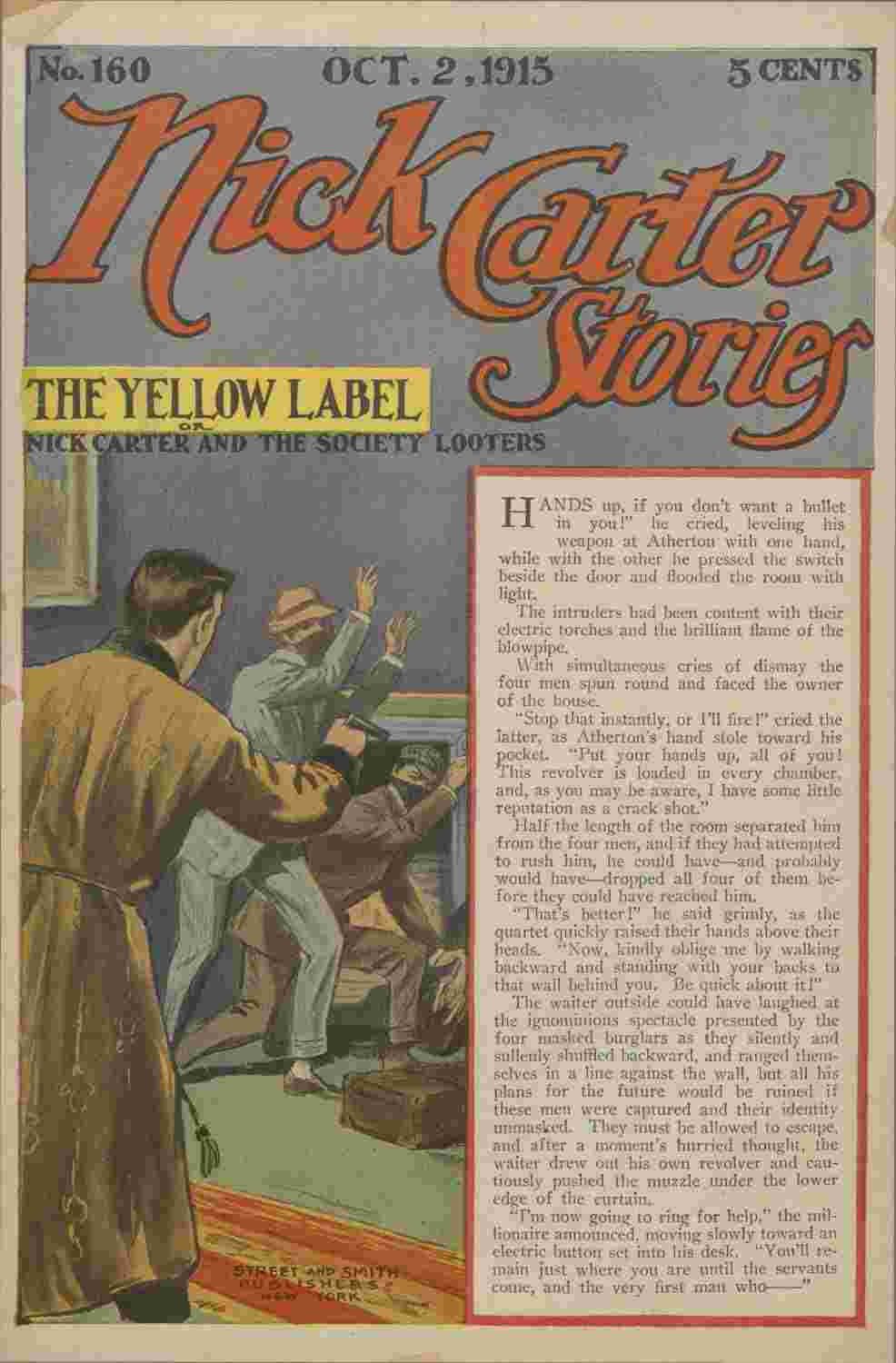
The Nick Carter Stories
ISSUED EVERY SATURDAY BEAUTIFUL COLORED COVERS
When it comes to detective stories worth while, the Nick Carter Stories contain the only ones that should be considered. They are not overdrawn tales of bloodshed. They rather show the working of one of the finest minds ever conceived by a writer. The name of Nick Carter is familiar all over the world, for the stories of his adventures may be read in twenty languages. No other stories have withstood the severe test of time so well as those contained in the Nick Carter Stories. It proves conclusively that they are the best. We give herewith a list of some of the back numbers in print. You can have your news dealer order them, or they will be sent direct by the publishers to any address upon receipt of the price in money or postage stamps.[Pg 69]
730—The Torn Card.
731—Under Desperation’s Spur.
732—The Connecting Link.
733—The Abduction Syndicate.
738—A Plot Within a Plot.
739—The Dead Accomplice.
746—The Secret Entrance.
747—The Cavern Mystery.
748—The Disappearing Fortune.
749—A Voice from the Past.
752—The Spider’s Web.
753—The Man With a Crutch.
754—The Rajah’s Regalia.
755—Saved from Death.
756—The Man Inside.
757—Out for Vengeance.
758—The Poisons of Exili.
759—The Antique Vial.
760—The House of Slumber.
761—A Double Identity.
762—“The Mocker’s” Stratagem.
763—The Man that Came Back.
764—The Tracks in the Snow.
765—The Babbington Case.
766—The Masters of Millions.
767—The Blue Stain.
768—The Lost Clew.
770—The Turn of a Card.
771—A Message in the Dust.
772—A Royal Flush.
774—The Great Buddha Beryl.
775—The Vanishing Heiress.
776—The Unfinished Letter.
777—A Difficult Trail.
782—A Woman’s Stratagem.
783—The Cliff Castle Affair.
784—A Prisoner of the Tomb.
785—A Resourceful Foe.
789—The Great Hotel Tragedies.
795—Zanoni, the Transfigured.
796—The Lure of Gold.
797—The Man With a Chest.
798—A Shadowed Life.
799—The Secret Agent.
800—A Plot for a Crown.
801—The Red Button.
802—Up Against It.
803—The Gold Certificate.
804—Jack Wise’s Hurry Call.
805—Nick Carter’s Ocean Chase.
807—Nick Carter’s Advertisement.
808—The Kregoff Necklace.
811—Nick Carter and the Nihilists.
812—Nick Carter and the Convict Gang.
813—Nick Carter and the Guilty Governor.
814—The Triangled Coin.
815—Ninety-nine—and One.
816—Coin Number 77.
NEW SERIES
NICK CARTER STORIES
1—The Man from Nowhere.
2—The Face at the Window.
3—A Fight for a Million.
4—Nick Carter’s Land Office.
5—Nick Carter and the Professor.
6—Nick Carter as a Mill Hand.
7—A Single Clew.
8—The Emerald Snake.
9—The Currie Outfit.
10—Nick Carter and the Kidnapped Heiress.
11—Nick Carter Strikes Oil.
12—Nick Carter’s Hunt for a Treasure.
[Pg 70]13—A Mystery of the Highway.
14—The Silent Passenger.
15—Jack Dreen’s Secret.
16—Nick Carter’s Pipe Line Case.
17—Nick Carter and the Gold Thieves.
18—Nick Carter’s Auto Chase.
19—The Corrigan Inheritance.
20—The Keen Eye of Denton.
21—The Spider’s Parlor.
22—Nick Carter’s Quick Guess.
23—Nick Carter and the Murderess.
24—Nick Carter and the Pay Car.
25—The Stolen Antique.
26—The Crook League.
27—An English Cracksman.
28—Nick Carter’s Still Hunt.
29—Nick Carter’s Electric Shock.
30—Nick Carter and the Stolen Duchess.
31—The Purple Spot.
32—The Stolen Groom.
33—The Inverted Cross.
34—Nick Carter and Keno McCall.
35—Nick Carter’s Death Trap.
36—Nick Carter’s Siamese Puzzle.
37—The Man Outside.
38—The Death Chamber.
39—The Wind and the Wire.
40—Nick Carter’s Three Cornered Chase.
41—Dazaar, the Arch-Fiend.
42—The Queen of the Seven.
43—Crossed Wires.
44—A Crimson Clew.
45—The Third Man.
46—The Sign of the Dagger.
47—The Devil Worshipers.
48—The Cross of Daggers.
49—At Risk of Life.
50—The Deeper Game.
51—The Code Message.
52—The Last of the Seven.
53—Ten-Ichi, the Wonderful.
54—The Secret Order of Associated Crooks.
55—The Golden Hair Clew.
56—Back From the Dead.
57—Through Dark Ways.
58—When Aces Were Trumps.
59—The Gambler’s Last Hand.
60—The Murder at Linden Fells.
61—A Game for Millions.
62—Under Cover.
63—The Last Call.
64—Mercedes Danton’s Double.
65—The Millionaire’s Nemesis.
66—A Princess of the Underworld.
67—The Crook’s Blind.
68—The Fatal Hour.
69—Blood Money.
70—A Queen of Her Kind.
71—Isabel Benton’s Trump Card.
72—A Princess of Hades.
73—A Prince of Plotters.
74—The Crook’s Double.
75—For Life and Honor.
76—A Compact With Dazaar.
77—In the Shadow of Dazaar.
78—The Crime of a Money King.
79—Birds of Prey.
80—The Unknown Dead.
81—The Severed Hand.
82—The Terrible Game of Millions.
83—A Dead Man’s Power.
84—The Secrets of an Old House.
85—The Wolf Within.
86—The Yellow Coupon.
87—Tn the Toils.
88—The Stolen Radium.
[Pg 71]89—A Crime in Paradise.
90—Behind Prison Bars.
91—The Blind Man’s Daughter.
92—On the Brink of Ruin.
93—Letter of Fire.
94—The $100,000 Kiss.
95—Outlaws of the Militia.
96—The Opium-Runners.
97—In Record Time.
98—The Wag-Nuk Clew.
99—The Middle Link.
100—The Crystal Maze.
101—A New Serpent in Eden.
102—The Auburn Sensation.
103—A Dying Chance.
104—The Gargoni Girdle.
105—Twice in Jeopardy.
106—The Ghost Launch.
107—Up in the Air.
108—The Girl Prisoner.
109—The Red Plague.
110—The Arson Trust.
111—The King of the Firebugs.
112—“Lifter’s” of the Lofts.
113—French Jimmie and His Forty Tiheves.
114—The Death Plot.
115—The Evil Formula.
116—The Blue Button.
117—The Deadly Parallel.
118—The Vivisectionists.
119—The Stolen Brain.
120—An Uncanny Revenge.
121—The Call of Death.
122—The Suicide.
123—Half a Million Ransom.
124—The Girl Kidnapper.
125—The Pirate Yacht.
126—The Crime of the White Band.
127—Found in the Jungle.
128—Six Men in a Loop.
129—The Jewels of Wat Chang.
130—The Crime in the Tower.
131—The Fatal Message.
132—Broken Bars.
133—Won by Magic.
134—The Secret of Shangore.
135—Straight to the Goal.
136—The Man They Held Back.
137—The Seal of Gijon.
138—The Traitors of the Tropics.
139—The Pressing Peril.
140—The Melting-Pot.
141—The Duplicate Night.
142—The Edge of a Crime.
143—The Sultan’s Pearls.
144—The Clew of the White Collar.
145—An Unsolved Mystery.
146—Paying the Price.
147—On Death’s Trail.
148—The Mark of Cain.
Dated July 17th, 1915.
149—A Network of Crime.
Dated July 24th, 1915.
150—The House of Fear.
Dated July 31st, 1915.
151—The Mystery of the Crossed Needles.
Dated August 7th, 1915.
152—The Forced Crime.
Dated August 14th, 1915.
153—The Doom of Sang Tu.
Dated August 21st, 1915.
154—The Mask of Death.
Dated August 28th, 1915.
155—The Gordon Elopement.
Dated Sept. 4th, 1915.
156—Blood Will Tell.[Pg 72]
PRICE, FIVE CENTS PER COPY. If you want any back numbers of our weeklies and cannot procure them from your news
dealer, they can be obtained direct from this office. Postage stamps taken the same as money.
STREET & SMITH, Publishers, 79-89 Seventh Ave., NEW YORK CITY