
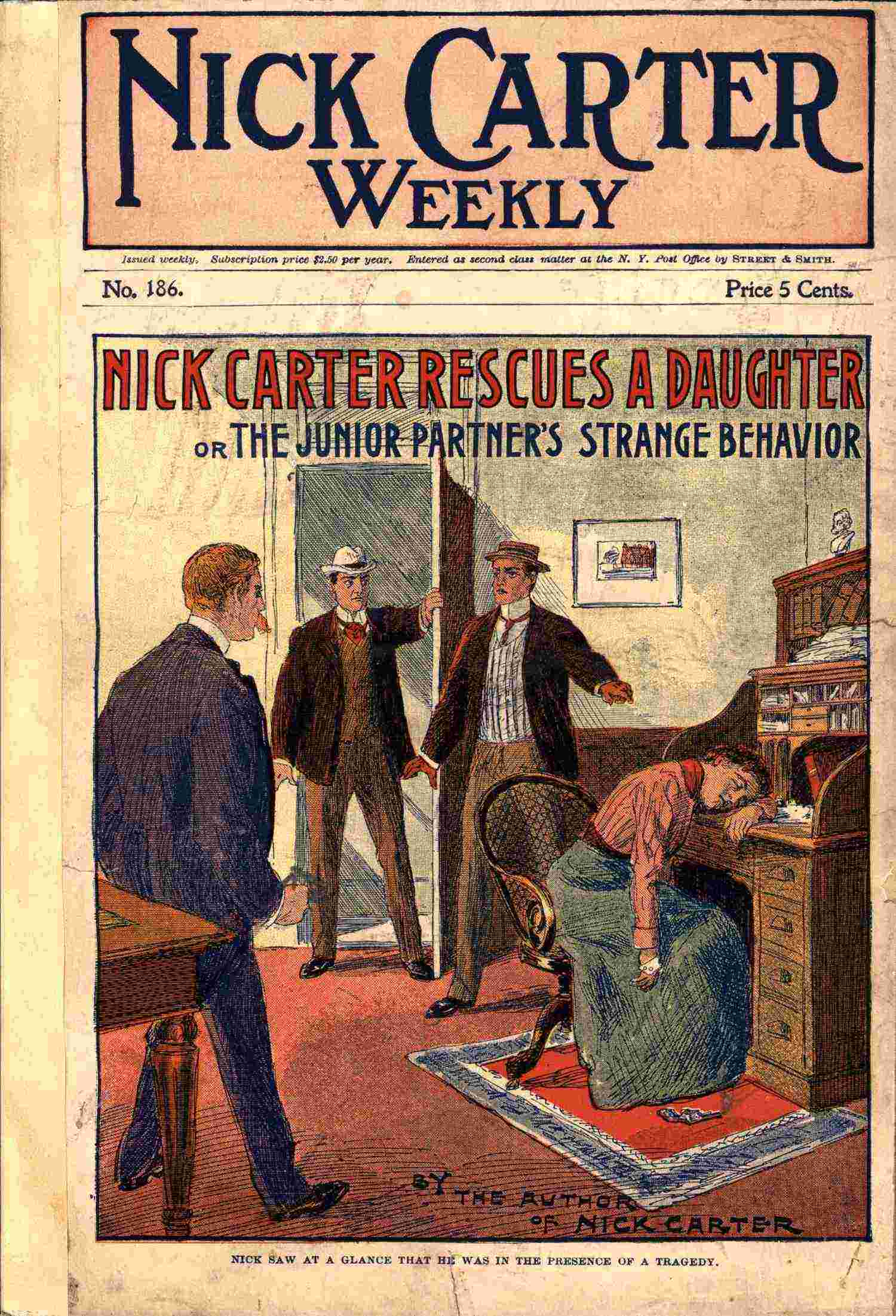
The Project Gutenberg eBook of Nick Carter weekly No. 186, July 21, 1900: Nick Carter rescues a daughter; or, The junior partner's strange behavior.
Title: Nick Carter weekly No. 186, July 21, 1900: Nick Carter rescues a daughter; or, The junior partner's strange behavior.
Author: Nicholas Carter
Release date: September 23, 2022 [eBook #69032]
Most recently updated: October 19, 2024
Language: English
Original publication: United States: Street & Smith, 1897
Credits: David Edwards, Chuck Greif and the Online Distributed Proofreading Team at https://www.pgdp.net (Northern Illinois University Digital Library)
|
Contents: Some typographical errors have been corrected; a list follows the text. (etext transcriber's note) |
Entered according to Act of Congress in the year 1900 by Street & Smith, in the Office of the Librarian of Congress,
Washington, D. C.
Entered as second class Matter at the New York, N. Y., Post Office.
Issued weekly. Subscription price, $2.50 per year. July 21, 1900.
No. 186. Street & Smith, Publishers. NEW YORK. 238 William St., N. Y. 5 Cents.
Nick Carter Rescues a Daughter;
OR,
THE JUNIOR PARTNER’S STRANGE BEHAVIOR.
————
By the Author of “NICK CARTER.”
————
{2}
CHAPTER I.
THE DEAD GIRL.
Nick Carter glanced at his watch as he entered the street door of the Borden Building, New York City.
It was exactly half-past five o’clock in the afternoon.
“I am just on time,” mused the great detective, as he hurried toward the elevator.
Neatly folded and stowed away in one of his inside pockets was a note, which he had received by a messenger on the forenoon of that day. The note, written on a typewriter, was not signed, and ran as follows:
“Nicholas Carter, New York City. Dear Sir: Please call at room 59, Borden Building, at half-past five o’clock this afternoon on important business. Do not fail.”
There was such an air of mystery about the message that Nick concluded he would respond, and promptly to the minute he was at the place named in the note.
The Borden Building is one of those struc{3}tures in lower New York City which are used almost exclusively as offices.
It was Saturday afternoon, and when Nick found that the elevator was not running he was not surprised.
Evidently most of the offices in the building closed on Saturdays before this late hour.
A young man neatly, almost foppishly, dressed, had entered the building ten seconds ahead of Nick and was near the first landing on the stairs walking up when Nick placed his foot on the first step ready to follow.
Just then there came ringing through the building the sound of the footsteps of some one flying down the stairs in precipitate haste.
Nick, by looking up, saw that the person making the furious descent was a boy about fourteen years old.
The well-dressed young man stopped when he heard the boy coming, and as the latter reached him he grasped the lad by the coat, and brought him up with a jerk.{4}
“What in thunder ails you?” growled the young man.
For a moment the boy could not utter a word. His face was white as chalk, his teeth were chattering in his head, and he trembled so that it seemed he must fall in a heap.
The young man gave him a vigorous shake and cried:
“Can’t you speak? What have you done? Where are you going?”
Then the lad found power to chatter:
“Oh-h, Mr. Ga-a-ay, she’s de-de-dead.”
“She’s dead? Who’s dead, you fool?”
“Mi-Miss Langdon,” gasped the lad.
“Miss Langdon dead? Why, what do you mean? Speak!”
“She’s been mu-mu-mur-dered.”
“What! Where?”
“Up there in the of-of-office.”
“Are you telling me the truth?”
“Indeed I am. Somebody sh-sh-shot her.”
“Then go call the police, and be quick,” said the young man, as he let go of the boy’s collar and hastened his ascent of the stairs.
The lad continued his precipitous descent to the street, and Nick followed the young man upward. He saw the latter stop on the fifth floor, and disappear through an open door-way.
When Nick reached the same place, he noted with much interest that the No. 59 was painted on the door through which the other man had passed.
Instantly he asked himself:
“Has my mysterious note anything to do with what occurred beyond this door?”
Nick passed through the open door, and found himself inside a large general office used by a law firm.
The name of the firm was also on the door. It was:
Bridgely & Byke,
Attorneys-at-Law.
At the other end of the room a door stood ajar, giving entrance to a private office. Be{5}yond this door Nick heard high-pitched voices in altercation.
He rightly guessed that whatever the tragedy might be, its location was in that rear office.
Therefore, he crossed the large room, threw the communicating door open, and, standing in the doorway, took in the scene at a sweeping glance.
There were two men in the medium-sized office.
One was the man who had preceded him up the stairs.
The man whom the boy had called Mr. Gay.
The other was an older man, perhaps thirty-five years of age, tall, stockily built, with a slight stoop in the shoulder, possessing a rather cold, cynical-looking face, and a pair of gray eyes, which had a habit of trying to bore holes into everything upon which they centered.
This man at the time of Nick’s appearance stood leaning against a flat-topped table with one side of his face toward the door. He saw Nick as soon as the latter pushed the door wide open.
The other man’s back was toward the door, and Nick’s presence was not known to him immediately.
He was just saying, his remarks being addressed to the older man:
“Do you think anybody will believe your story?”
The speaker was pointing to something before him.
That something was the form of a young woman seated in a chair before an open scroll-topped desk. One arm hung helplessly at her side, and she had, apparently, partly fallen forward until her head and left arm rested upon the desk.
Nick recognized in this form the victim of a tragedy.{6}
Before the detective had time to move a step forward, the elder man, with those gray eyes focused upon Nick’s face, said:
“What do you want?”
“I want to know what has been going on here.”
The younger man had wheeled around facing Nick, and he, in turn, asked:
“Who are you?”
“I am Nick Carter.”
To Nick’s surprise the young man moved back several steps as if annoyed or confused, and the elder scowled without removing his gray eyes from Nick’s face.
The latter advanced to the desk where the form of the young woman reclined, and made a quick examination.
There was a bullet wound in her right temple. The ball had pierced her brain, and she was dead.
On the right hand was a glove into which the fingers had been fitted, but the thumb and upper part of the hand were still bare.
The first inference drawn from this fact was that she had been shot while engaged in putting on her gloves preparatory to leaving the office.
In the minute which followed, Nick made one of his lightning ocular inspections of the premises, in which very little was left to be discovered.
At the end of that time the sound of many rushing footsteps was heard coming up the stairs.
All this time the two men in the room with him remained silent and inactive.
Nick walked into the main office, and met the first man of the ascending throng at the door.
It was a young policeman, whom Nick happened to know quite well.
“Ah, Brown!” exclaimed Nick, confronting the officer at the threshold, “I’m glad ’tis you. You’ll understand me without a lengthy explanation.{7}”
“Who are you?” panted Brown, for Nick of course, was in disguise.
“I am Nick Carter. There has been a crime committed back there, and until I know more about it you must keep everybody out. Let none of these curiosity-seekers intrude.”
“I am at your service, Mr. Carter,” said Brown. “Lord, I’m glad you’re here. Seems to me you always bob up when anything happens. What is it? Murder?”
“I want to find out. Is there anybody with you?”
“Yes, McCarthy is coming, but he’s so fat it’s hard and slow work for him to get up all these stairs. Here he is now.”
Some one rapped on the door at that instant. Brown admitted a policeman, who was blowing like a porpoise.
“Bad cess to thim shtairs!” gasped McCarthy, “an’ thor had bin tin more ov ’em, sure it’s a dead mon I’d be this minute.”
“Well, McCarthy, just take charge of this door, and see that no one enters who has no right. Those who have a right, and whom I want to come in, are persons who have been in this building within the last hour, and the boy who carried you the news.”
Brown opened the door and beckoned to the boy to enter. The latter drew back as if about to fly again, but a man near by grasped him by the shoulder and pushed him toward the door.
“Who are you?” inquired Nick.
“I’m the janitor,” was the reply.
“Then come in, too.”
Still keeping hold of the terrified boy, the janitor entered the office and the door was once more closed in the face of the crowd, which by this time numbered nearly a score.
“Brown, I want you to summon the coroner, or one of his deputies just as soon as you can get him here.”
Brown asked no questions, but left on his mission instantly.{8}
“What’s your name?” asked Nick, turning to the janitor.
“Bush—John Bush, sir.”
“Then, Mr. Bush, I want you to look out among the people in that crowd in the hall and identify anybody who has offices in this building.”
McCarthy held the door ajar while the janitor scanned the eager faces in the crowd.
“There is Mr. Grote, Mr. Kennedy, and Miss Lucas,” was his report.
“Tell them to come in,” commanded Nick, in a low voice.
“Will Mr. Grote, Mr. Kennedy, and Miss Lucas come in?” said the janitor, addressing his words to the collection of people in the hall.
The three persons answering to these names crowded their way forward, and were admitted.
Then the door closed again.
To the five people inside, not including the policeman, Nick said:
“You will wait in this room until further orders. Meanwhile, officer,” turning and addressing McCarthy, “let no one else in until Brown returns with the coroner, and see that nobody meantime leaves by that door.”
Nick turned toward the inner room to find the young, stylishly-dressed man looking out, much interested at what had been going on in the larger office.
CHAPTER II.
THE GLOVE ON THE DEAD GIRL’S HAND.
Nick returned to the rear room. His first act was probably a surprise to both the men whom he had found there when he first entered.
In short, he requested the two men to step into the outer office.
They complied rather hesitatingly.
He followed them, and closed the communicating door.{9}
Then he coolly took a seat near by, and waited for the coroner.
Fifteen minutes after Brown started to bring the coroner, he returned in company with that official.
Nick met the coroner quietly, and lost no time in making himself known to him.
Then he requested Brown to send the crowd on the outside about their business, and again cautioned McCarthy to let no one of those in the large office go out.
This done, he preceded the coroner into the rear office, and closed the door behind them.
The coroner took a quick inventory of the surroundings, and then turned to Nick for information.
The detective related everything just as it occurred to him, except that he made no mention of the type-written note which had brought him to the scene at such a strange time.
“And what have you learned of the case from those two men, Mr. Carter?” inquired the coroner.
“Nothing. I have asked not a single question, preferring to wait till you got here to receive the story of the case as these people can or will give it.”
“That is quite complimentary, I am sure, Mr. Carter. Whom shall we question first?”
“Before we question anybody let me tell you about a few things I have noted in this office.”
“All right—go on.”
“The victim was shot in the right temple.”
“I see.”
“From the position of the body the shot must have been fired by some one standing in front of that window, or the shot must have come from across the street and through the open window.”
The coroner noticed that the desk on which the dead woman had fallen was almost{10} exactly in front of an open window and about twelve feet from it.
He glanced across the street and discovered that a window in an opposite building was directly in line with the office window and the desk.
“You think the shot was fired by some one standing in that window over there?”
“I did not say so. On the contrary, I found this pistol lying directly under the victim’s dependent hand.”
“Suicide?”
“I am expressing no opinion, just stating facts,” quietly remarked Nick, as the coroner took a pistol from him and examined it.
The weapon was of Smith & Wesson make, had six chambers, was peculiarly mounted, and on a silver plate inlaid in the handle were the initials “E. L.”
One of the chambers contained the empty shell of a cartridge. The other four were loaded.
The coroner stooped, and inspected the wound in the head of the victim.
“I see no powder marks on her face,” he said, looking up at Nick.
“There are none. Besides, I call your attention to the condition of the right hand.”
The coroner’s eyes turned quickly to the hand of the corpse, which hung at the side of the body.
“Ha! I see. She was putting on her glove, and couldn’t have handled the pistol herself.”
“Not unless she fired the shot with her left hand.”
“But the bullet entered the right temple?”
“I am not sure of it.”
“But see. Here is the wound,” cried the coroner, pointing to the little blue spot on the side of the girl’s face, which was turned up to their gaze.
“Yes, that is a wound. But the bullet might have come out at that place instead of going in.{11}”
“Oh! Then there is a wound on the other side of the head; the side which lies upon the desk.”
“I think there is.”
“You think. Don’t you know—have you not raised the head to see?”
“I have not raised the head to see, but I know there is.”
“Why, how do you know if you have not seen?”
“Because here is the fatal bullet, and it not only went into her head, but clean through it.”
“Where did you find it?”
“In that corner of the room back there.”
“Why, that is almost behind the body?”
“Yes. The bullet passed through her head, hit the steam coil on the other side of the desk, and carromed at an acute angle, fetching up in the corner where I found it.”
“It was surely not suicide,” mused the coroner.
“It may not have been,” responded Nick.
“She would certainly not have stopped while putting on her gloves to commit suicide?”
“You say gloves. There is but one glove,” remarked Nick, dryly.
“Only one in sight. We shall find the other, I presume, if we make search.”
“I doubt it.”
“Why?”
“Because the glove she partly put on that hand is not her own.”
“Not her own? Why, man, how do you know?”
“Because it is fully a size too small for her.”
“But——”
“You would say she has it partly on. That is true, but if you examine it carefully you will see that the fingers would not even go in as far as the ends. The glove could not have been forced on her hands.{12}”
“Then whose is it?”
“I don’t know,” said Nick, who meanwhile had walked across the office and was examining a woman’s light sack which hung from a hook on the wall. “It certainly didn’t belong to her, for here is the pair she used.”
He held up a pair of gloves of an entirely different color, and probably several sizes larger than that which was partially on the hand of the corpse.
“Well, by Jove!” muttered the coroner.
Nick had reached down again into the pocket in which he found the gloves. This time he fished out a lady’s pocket-book. Without opening it, he carried it across the room and gently pulled the glove from the stiffening fingers of the dead girl.
Then he rolled the three gloves and the pocket-book up together, and put them all away in an inside pocket of his coat.
“With your permission, I’ll take charge of these important articles of evidence,” he said to the coroner.
The latter nodded assent, and asked:
“What is in the pocket-book?”
“We’ll find out later when I’ve time to examine it. Now, we must get together our facts by questioning those people out there one at a time.”
“A good idea.”
“But, before we begin, I want to make a request.”
“Name it.”
“That you postpone the inquest from day to day till I have a chance to get to the very bottom of the mystery.”
“Willingly, my boy, and meantime I’ll not bother my brains about it, because I know what Nick Carter cannot fathom in a case like this will never be found out.”
“Thank you. Now, we will call in and question our first witness.”
“Who will it be? the elder of the two men—the one who must have been here first after the tragedy or when it occurred?{13}”
“No, I think I’ll first hear what the younger and more fashionably dressed one of the two has to tell. I’ll call him in.”
So saying, Nick went to the dividing door, opened it, and beckoned to the man who had preceded him up the stairs only a few seconds to the scene of the tragedy.
The young man entered the rear office, plainly laboring under great excitement. Nick closed and locked the door, invited his witness to take a seat, and lost no time in beginning his examination.
CHAPTER III.
WHAT THE CONFIDENTIAL CLERK KNEW.
“In order to get down to the facts in this case,” began Nick, addressing the young man, “it will be necessary to apply for information to those who are supposed to be in possession of the knowledge we seek. We have, therefore, called you in first to set us on the way in our inquiry.”
“I am ready to answer any question which it is in my power to do?” responded the young man, trying hard to repress his nervousness.
“What is your name?”
“Oscar Gay.”
“What is your business?”
“Confidential clerk.”
“For whom?”
“Bridgely & Byke.”
“Where are Messrs. Bridgely & Byke now?”
“Mr. Byke is in Europe—has been away about one month.”
“And Bridgely?”
“Bridgely has been dead more than a year.”
“Then Byke represents the firm as it existed before the death of the senior partner—he constitutes the firm?”
Gay hesitated and shuffled uneasily in his seat for a few moments before he replied:{14}
“The firm name remains the same, but Mr. Byke has a partner.”
“Who?”
“Victor Redway.”
“The man I found in this room with you a while ago?”
“Yes.”
“This Redway, do I understand you, took a place in the firm after Bridgely’s death?”
“Yes, sir.”
“And before that?”
“He was the confidential clerk of the firm.”
“Then you succeeded in the place made vacant by him when he was admitted to partnership by Mr. Byke?”
“I did.”
“Now, Mr. Gay, who was that dead girl—she was scarcely more than a girl.”
“Her name was Estelle Langdon. She was the office stenographer and type-writer.”
“Where did she live?”
“Somewhere up in Harlem.”
“Was she married?”
Gay’s eyes gave a quick flash toward Nick’s face at this question—a fact the detective mentally noted without pretending to notice it. The answer came almost immediately.
“Not that anybody was aware of.”
“Has she relatives?”
“None—I believe.”
“How long have you known her?”
“About six months since she came here.”
“What do you know about the way she died?”
“Nothing, except what I saw as I entered the office just before you came.”
“Tell us what that was—what you saw.”
“The body was lying there just as it is now. Mr. Redway was near by on the side next to the window. When I entered, his body was in a bent position, and one hand was extended toward the pistol on the floor.”
“About to pick it up?{15}”
“Either that, or had just laid it down.”
Nick came to a dead halt in his queries at this answer, and sat for thirty seconds looking Gay straight in the face. The latter became plainly uncomfortable under the detective’s glance.
“Did you ever see that pistol before?” inquired Nick, when he once more continued his examination.
“I did.”
“To whom did it belong?”
“To Victor Redway.”
“But the initials ‘E. L.,’ how do you account for them?”
“I can’t account for them. They were on the pistol as long as I knew Redway to possess it.”
“How long is that?”
“Several months.”
“Did Redway carry this pistol regularly?”
“He never carried it.”
“Then where did he keep it?”
“In the drawer of his desk over there.”
Gay nodded to the flat-topped desk setting against the wall to the right of the open window, and almost directly behind the corpse.
“You are sure of that statement?”
“Yes, I have seen it there often.”
“Didn’t he keep the desk locked?”
“No. I never knew him to carry a key to the desk.”
“Then Miss Langdon could have got the pistol herself had she chosen?”
“I suppose so.”
“What was the relationship of Redway and Miss Langdon?”
“What do you mean?”
“Were they on friendly terms?”
“Oh, yes.”
“Very confidential?”
“No, hardly that, I guess. Not in the presence of any one else, anyhow.”
“Might they have been lovers?”
“If they were, no one knew it.{16}”
“Did they ever quarrel?”
“Not to my knowledge.”
“They occupied this office together?”
“Yes.”
“Where is your desk?”
“In that other private office,” pointing to an adjoining room into which a door gave communication a little to the right of the desk on which the body lay, and separated from the office they were in by a heavy division wall. The door was closed, but a transom above the door stood wide open, as Nick was quick to note.
He lost no time in fixing in his mind the location of this room in its connection with the other two.
It formed the L to the suite, and had no direct communication with the large or general office. There were two doors only to this third room. One connected it with the room in which the body was found and the other opened into the hall.
Therefore, to get into that room, it was necessary to enter either directly from the hall or through both the other offices.
“This is Mr. Byke’s private office, I suppose?”
“Yes.”
“And you, as his confidential clerk, have your desk in there?”
“Only in his absence; when he is at home, I occupy a desk in the large office.”
“Were you in there at your desk to-day?”
“Not since noon.”
“You were absent since noon?”
“Yes, until I returned just in time to be ‘in at the death.’”
There was a bad attempt to smile, as this was said, but the smile was painfully forced.
“Then you know nothing about the manner of the tragedy?”
“Nothing.”
“You and Redway were exchanging hot words when I surprised you. What was it that passed between you?{17}”
“I accused him of having killed Miss Langdon.”
“And what reply did he make?”
“He was insolent. Asked me what I intended to do about it, and wanted to know what proofs I had to fortify my charges.”
“And then?”
“You came almost before I could reply.”
“And have you any proofs?”
“Nothing but suspicion.”
“On what is that suspicion based?”
“Well, I’ve noticed that Miss Langdon has been growing fond of him for the last few months. She showed it frequently. I imagined that he at first received her preferences with pleasure, but that of late they had become annoying to him.”
“That is the result of observation only?”
“That is all. I may be mistaken, too, you know.”
“Has Redway a family?”
“Do you mean is he married?”
“Yes. Has he a wife, children, or relatives with whom he lives?”
“I believe not—not that any one knows of.”
“Where does he live?”
“In bachelor apartments on Fifty-fifth street.”
“That will do for the present, Mr. Gay.”
The young man arose, and started to go into the other private room by way of the communicating door, but Nick stopped him.
“Not there, Mr. Gay. You will be so kind as to remain in the outer office until we have questioned the other parties.”
Gay scowled and went reluctantly back to the large office.
Nick gave the coroner a significant look, and remarked:
“He seems to be very anxious to get into that closed room, but he’ll not do it till I’ve had a look in there first myself.{18}”
“What do you make of this Oscar Gay?” asked the coroner.
“Nothing—yet. We’ll now see what Victor Redway has to say.”
CHAPTER IV.
THE JUNIOR PARTNER’S STRANGE BEHAVIOR.
Victor Redway entered the room of death looking pale and worried. He cast a glance at the body of the dead girl, and a perceptible shudder shook his frame.
Nick lost no time in “doing business” with the junior member of the law firm.
“Your name is Victor Redway?” began Nick.
Redway nodded assent.
“The junior member of this law firm?”
“As Mr. Gay informed you, I presume.”
There was a decided sneer in the reply.
“Mr. Gay has told us a number of things. How many of them were truth remains to be seen.”
As Nick said this, he did not fail to notice that Redway seemed pleased with the latter part of the sentence.
“The two men are enemies, if not openly, then unavowed,” thought Nick. To Redway he said:
“We have called you in here to get your version or story of the tragedy so far as you are willing to give it.”
“Willing to give it? What do you mean?”
“Why, this: I am a detective; this is the coroner; you are a lawyer. This is not an inquest, nor yet a preliminary hearing; you are not under oath. There may be circumstances about the death of that girl which you do not desire to tell. Indeed, it might be to your interest not to talk of it at all.”
Redway looked at Nick long and steadily. At last he said:
“I think I understand you. You believe I killed her?”
“I have no belief one way or the other.{19} It is my business to prove, to know, not to believe.”
“But I am suspected?”
“The law will undoubtedly look to you to make a satisfactory explanation of your knowledge of the crime, or your ignorance of it.”
“Well, suppose you ask me your questions.”
“You will answer?”
“Some of them, perhaps. As a lawyer, I may choose to remain silent on some points—for the present, at least.”
“Then I’ll begin at the beginning. Mr. Redway, did you kill that girl?”
The answer came without hesitation, and accompanied by the faintest touch of a smile.
“I certainly did not.”
“Do you know who did?”
The answer to this question was not given so spontaneously, and the smile gave way just an instant to the shadow of a frown. After only a moment of hesitation, Redway replied:
“No, I do not.”
“Do you believe she committed suicide?”
“My belief on that score is not of any value.”
“Do you know whether she had any cause to kill herself?”
“No.”
“Did you ever hear her threaten to kill herself?”
“Not directly.”
“Will you explain?”
“Well, she once dropped the remark that if she ever married, and her husband deserted her for another woman she would, she believed, kill herself.”
“Ah!”
“But she would first kill the man who deceived her and the woman who robbed her of her rights?”
“Oh! What called forth this declaration?{20}”
“The story of a client who had suffered somewhat in the same manner.”
“How did she hear the story?”
“I told it to her.”
“She was not married?”
“Not to my knowledge.”
“Had she a lover?”
“How should I know.”
“Were you and she not on confidential terms?”
“Why should we be?”
“You two were in here together a great deal.”
“True, as man and employee. I am not one to become confidential with an office attache.”
“Not even with a pretty woman?”
“Especially not with a woman of any kind.”
There was a hard, bitter ring to these words, which Nick did not fail to make a note of.
“Yet you told her the story of that deceived client.”
“There was a reason for that.”
“What reason?”
Redway frowned again, and answered:
“That is something I refuse to say.”
“You were not her lover, Mr. Redway?”
An angry flush mounted the young lawyer’s brow, and he replied:
“The question is not worthy of an answer.”
“You are sure you never gave her cause to believe you thought more of her than any other young woman?”
“I don’t pretend to know what is in any woman’s mind.”
“But your treatment of her——”
“Was of a business kind entirely.”
“Well, we’ll leave that part of the subject and come down to the tragedy. Were you in the room when the fatal shot was fired?”
“Why, no, certainly not.”
“Where were you?{21}”
“On the street.”
“Was there any one in the office at the time?”
“I don’t know.”
“When you came in you found her lying there on that desk dead?”
Nick once more noticed just the mote of a hesitation in the reply.
“Yes, she was sitting there in that chair stone dead.”
“How long had you been out of the office?”
“Ten or fifteen minutes—maybe longer.”
“Where had you gone?”
“To the street.”
“To any particular place?”
“Yes.”
“You had an object in leaving the office for the street?”
“Perhaps.”
“But had you not?”
“Oh, yes. There usually is an object in all we do.”
“Well, what was your object in this instance?”
“I think I will not answer that question.”
“Very well. When you went out, what was Miss Langdon doing?”
“Putting her desk in order.”
“Preparatory to leaving?”
“I supposed so.”
“Was it her time to go home?”
“It was past the time.”
“What had detained her?”
“I don’t know. A woman’s whim, perhaps.”
“Did you say anything to her as you went out?”
“Yes.”
“What?”
“She asked me: ‘Are you going, Mr. Redway,’ and I replied: ‘Yes.’”
“She meant to ask whether you were leaving for the day?{22}”
“I suppose so.”
“And you deceived her?”
“No. I had no intention then of coming back.”
“What changed your mind?”
“A mere whim. I couldn’t answer you intelligently on that point.”
“You mean you will not,” thought Nick.
“When you came in you found her dead?” Nick continued.
“Yes, I said so before.”
“Any one else in the office?”
“No.”
“You gave no immediate alarm?”
“No.”
“Why?”
“Because I realized from the first that it was an awkward fix for me to be in, any way I could manage it.”
“So you remained?”
“Yes.”
“What did you do here alone with the corpse?”
Redway’s gray eyes once more turned sharply on Nick’s face before he made reply.
“I spent a few minutes trying to find some trace of the crime, and at the same time figuring upon my own danger.”
“So you waited for some one to come in?”
“I waited till some one did come in.”
“Who was it?”
“Jack Marston—the office boy.”
“How long after you returned was it till Jack Marston appeared?”
“I don’t know. A man under such circumstances hasn’t much knowledge of time.”
“Did you send him to summon the police?”
“I made him understand that Miss Langdon had been killed, and—well, he did the rest without waiting for directions.”
Again that faint smile twitched the corners of Redway’s stern mouth.
“And while he was gone Gay came in?”
“Yes.{23}”
“When he entered the door where were you?”
“At the side of the corpse.”
“What were you doing?”
“I had just stooped to pick up the pistol.”
“Oh! But you didn’t pick it up?”
“Why, no! In my personal contact with Gay I forgot it.”
Nick gave a quiet chuckle in his innermost soul at so neatly trapping a lawyer.
“Whose pistol was it, Mr. Redway?”
“Mine.”
“Where was it when you saw it last before you saw it on the floor near the dead girl?”
“In the drawer of my desk over there.”
“When was that?”
“This morning.”
“Was it loaded?”
“Yes.”
“Every chamber?”
“I remember distinctly filling the chambers with cartridges yesterday, and I have not fired one of them since.”
Nick noted the evasive answer.
“Were you in the habit of keeping it loaded?”
“No. On the contrary, I seldom had a cartridge in it. Yesterday I bought some and filled the chambers.”
“What for?”
“I intended it for the benefit of a cat which spends the midnight keeping people awake.”
“Another evasive answer,” mentally noted Nick.
“Well?”
“Well, I went away without taking it with me. Hence it lay there all day loaded.”
“Did Miss Langdon know the pistol was in that drawer?”
“I suppose she did. The drawer was never locked, and she frequently went there to get things out of it.”
“That is all I have to ask you at present, Mr. Redway. Will you have the kindness to{24} remain in the outer office till we have a talk with the office boy?”
“I have no choice but to oblige you,” came the sarcastic reply, and the junior partner left the room.
The coroner looked at Nick with a puzzled expression on his face.
“What do you make of Mr. Redway?” he asked.
“Nothing yet, but there is a good deal more to learn which may place Mr. Redway in an entirely different light. Now for Jack Marston. I depend on the boy for information which may be most valuable.”
CHAPTER V.
THE MYSTERIOUS LADY CALLER.
Jack Marston labored under extreme terror in the presence of the dead girl—so much so that Nick spent five minutes getting the lad’s mind in condition to answer questions coherently. Then he began on the lad cautiously.
“How long have you been office boy for Bridgely & Byke, Jack?” asked the detective.
“Nearly two years.”
“What are your hours?”
“I get here at eight o’clock, and this time of year go home generally at five.”
“The office is closed up at that time?”
“The janitor generally takes it to clean up. Sometimes he don’t get in till later.”
“Do you lock up when you go away?”
“No, the janitor does that.”
“Who leaves the first generally?”
“Mr. Byke, when he’s here.”
“And when he’s not here?”
“Why, Mr. Gay. Mr. Gay has been out a good deal since Mr. Byke went to Europe. He went away to-day about eleven o’clock, and told me he wasn’t coming back, but he did come, late as it was.”
“Are you always the last to leave?{25}”
“No, sir! Sometimes Mr. Redway stays here later than five, but he never keeps me.”
“And Miss Langdon?”
“She always left when I did—at five o’clock. The elevator stops running then.”
“But she didn’t leave at five to-day?”
“I guess not, sir.”
“How does it come you returned to-day after your hour for going home?”
“Mr. Redway sent me on an errand.”
“What kind of an errand?”
“To take his watch to a jeweler’s on Broadway to be cleaned.”
“What time was that?”
“Ten minutes before five.”
“And told you to come back?”
“No, sir; he said I needn’t come back. But the jeweler’s place was closed on account of a death in the family and I came back with the watch.”
“Did you give him the watch?”
“No, sir, I forgot it. I was so scared.”
“Where is it?”
“In my pocket.”
“Let me see it.”
The boy handed to Nick a magnificent gold hunting case watch. Merely glancing at it, Nick said:
“I’ll return this to Mr. Redway. You needn’t tell him that the jeweler’s place was closed.”
“But——”
“No buts about it, lad. I am Nick Carter, and represent Superintendent Byrnes, and this is the coroner. You do what I tell you and no harm shall come to you.”
Nick saw he was dealing with a naturally bright, quick-witted and honest lad.
“Now, then, Jack, tell me. Who was here in these offices when you left to take Mr. Redway’s watch to the jeweler’s?”
“Nobody, except him and Miss Langdon.”
“That was ten minutes before five.”
“Yes, sir.{26}”
“You are sure that he didn’t follow you to the street?”
“Not that I saw. He had just come in from the street about ten minutes before.”
“Oh!”
“Yes, sir, he went out with a lady, and was gone nearly half an hour.”
“Who was she?”
“I don’t know. I never saw her before.”
“What kind of looking lady was she?”
“Young and very handsome.”
“Whom did she ask for when she came?”
“For Mr. Redway.”
“Did she not give a name?”
“No, sir. I asked her for her name. But she replied with a question, ‘Is he in there?’ Then she walked back, opened the door, came in here and shut it.”
“Before the door closed I heard Mr. Redway say, ‘What—you here?’”
“Where was Miss Langdon?”
“Out at lunch.”
“What time was that?”
“When the lady came?”
“Yes.”
“About half-past two o’clock.”
“And how long did she stay?”
“Till a quarter past four.”
“Was in there all that time with Mr. Redway?”
“Yes, sir.”
“Did no one disturb them?”
“No, sir. Mr. Redway gave me orders soon after the lady went in that he was not to be disturbed by anybody. So I sent several parties away.”
“But Miss Langdon?”
“She came back about a quarter of three and sat out there in the big office with me till the lady went away.”
“Didn’t she appear to be curious about the strange visitor?”
“Not one bit till the lady went out and she saw her. Then she got somewhat excited.{27}”
“She saw the woman as the latter went out?”
“Yes, sir. Miss Langdon was in the big office as Mr. Redway and the lady went through on their way to the elevator. Mr. Redway said to me as he passed, ‘I’ll be back soon, Jack,’ and accompanied the lady downstairs.”
“I don’t believe either of them saw Miss Langdon, who was sitting in the corner, sort of behind the door.”
“And you say the sight of the strange woman excited her?”
“Very much. As soon as they were on the elevator she began asking questions about the woman, and seemed to be very much worked up, though up to that time she scarcely seemed to give the lady visitor a thought.”
“Was Miss Langdon inclined to grow excited?”
“No, sir. On the contrary, she was nearly always quiet and easy-going.”
“What did she do till Mr. Redway returned?”
“Walked around in that office there nervously, and seemed as if she couldn’t wait till he got back.”
“Well, when he came back—what then?”
“He went right back to the office, and left the door open behind him. Miss Langdon shut it herself.”
“Ah! that is interesting. Go on.”
“I didn’t hear much that was said, though I might had I cared to listen, for Miss Langdon’s voice was raised to a high pitch.”
“Did you hear anything?”
“Yes. I couldn’t help it. She almost shrieked the words.”
“What words?”
“Why, these: ‘If I was sure of it, her life wouldn’t be worth a penny.’”
“Were they still quarreling when you were sent out with Mr. Redway’s watch?”
“No, sir. At least, she seemed to have cooled off considerable.{28}”
“When you came in what was Mr. Redway doing?”
“Washing his hands in that stationary basin over there,” said Jack, pointing to a lavatory behind a screen in one corner of the office.
“What did he say?”
“He seemed very much surprised and somewhat confused. I saw Miss Langdon lying on the desk that way, and, remembering the scene between them, I asked:
“‘Why, Mr. Redway, what ails her?’
“He said: ‘Jack, she has met with an awful accident.’
“Then I went up, and as soon as I saw she was dead I ran as fast as I could downstairs and met Mr. Gay coming up.”
“Did you ever see this pistol, Jack?”
“Yes, sir, often.”
“Where?”
“In Mr. Redway’s desk over there.”
“When did you see it last?”
“Yesterday.”
“Where?”
“In Miss Langdon’s hands.”
“What was she doing with it?”
“Loading it.”
“What for?”
“She said Mr. Redway had loaned it to her to shoot a cat.”
Nick’s mind instantly reverted to Redway’s evasive words about shooting cats.
“But she didn’t use it, I guess?” ventured Nick.
“I don’t know, but I reckon she tried it.”
“Why?”
“The pistol was not there last night after she went away.”
“Are you sure?”
“Quite sure. I went to the drawer for some blanks, and the pistol was gone, though the box of cartridges was still there.”
“Did you see the pistol this evening?”
“I haven’t seen it since till now.{29}”
“It was on the floor, almost at the touch of Miss Langdon’s hand.”
“The one which hung down—had the glove on?”
“Yes.”
“You are mistaken, sir.”
“What do you mean?”
“I noticed the hand with the glove on when I went to look at her. There was no pistol near it.”
“You may not have noticed it.”
“I would have seen it if it had been there,” insisted Jack.
With a caution to the lad to keep sealed lips for a day or two Nick dismissed him.