
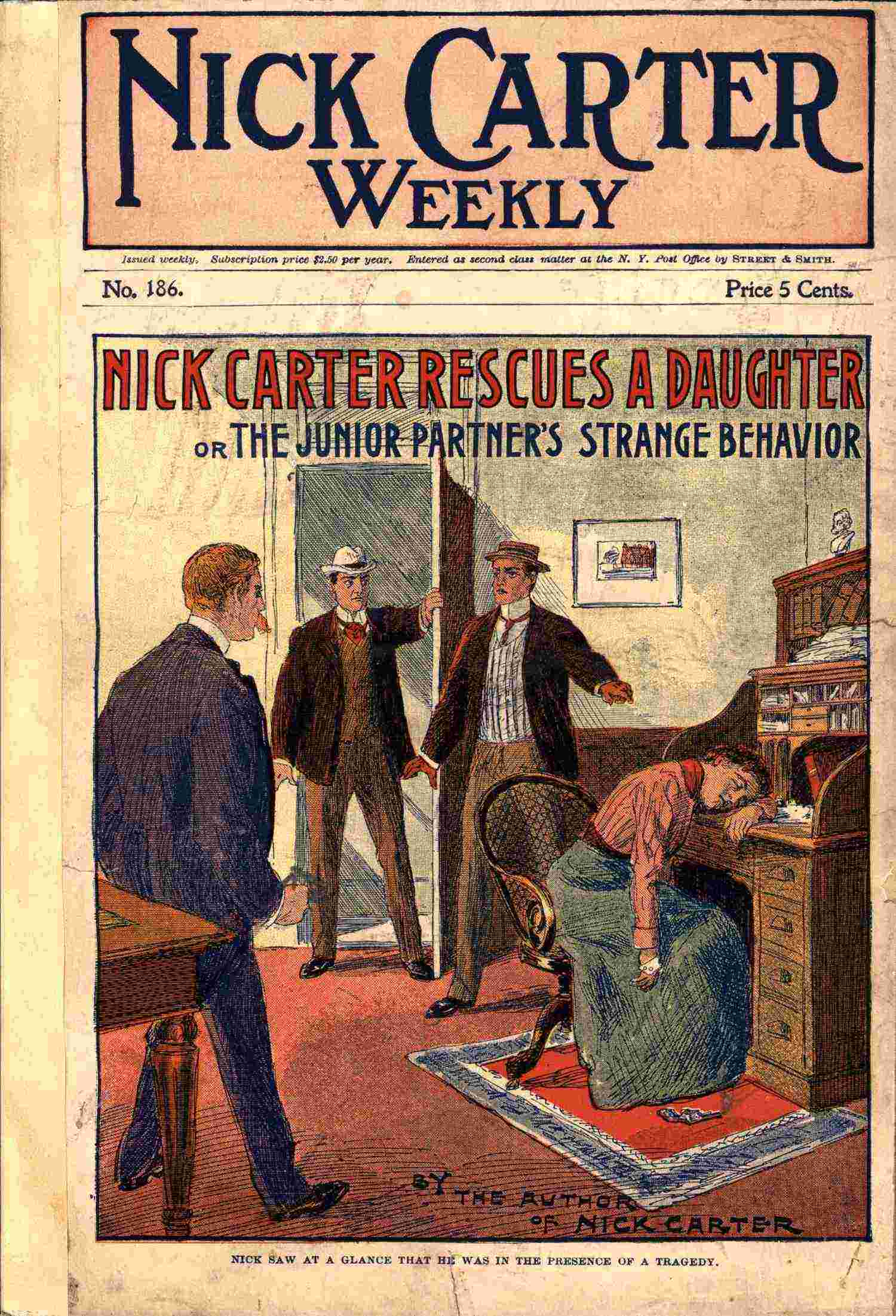
CHAPTER VI.
WHAT THE STRANGE WOMAN SAW FROM ACROSS THE STREET.
The janitor was the next person called and questioned.
“You take charge of the offices every evening to clean them out and lock them up, do you not?” asked Nick.
“I do, sir.”
“What time do you generally begin that work?”
“Usually right after five o’clock, when Mr. Redway leaves.”
“But you did not come to these offices at five o’clock to-day, nor yet as early as half-past five?”
“True, sir. I had been asked to wait till six o’clock.”
“Asked to wait till six? By whom?”
“By Miss Langdon, God rest her soul!”
“Did she say why she wanted you to wait?”
“She said she would be busy till that time.”
Nick’s mind instantly reverted to the type-written message which had summoned him to the place of the tragedy.
“Besides sir,” continued the janitor, “Mr. Redway did not leave at five o’clock as usual.”
“How do you know that?{30}”
“I saw him go downstairs five minutes after the elevator stopped, and it stopped at five o’clock.”
“This is important information. Did you see him come up again?”
“No, sir; but somebody came up about five minutes after he went down, for I heard the man’s steps. I was busy in an office two floors below, however, and didn’t look out to see who it was.”
“Were there any other persons in the building at that time?”
“Only the three persons out there in that room. They occupy offices two flights above, and are here every day till six o’clock.”
“Did you hear a pistol shot?”
“No, sir, I did not.”
“Isn’t that strange?”
“It does seem so, sir.”
“Was there any unusual noise about the time the shot may have been fired?”
“Only once, sir.”
“What was the noise?”
“A wagon loaded with bar iron passed on the street below and made a great clatter.”
“About what time was that?”
“Near five o’clock.”
“Before or after Redway went downstairs?”
“Just before, if I remember rightly.”
Mr. Kennedy, Mr. Grote and Miss Lucas were then called in together and questioned concerning what they knew of the affair.
Neither had any knowledge which at first could throw light on the subject in hand.
They had been at work in their offices, two floors above, and neither heard a pistol shot.
“Do any of you remember the noise of a heavily loaded wagon which passed through the street below about five o’clock?” inquired Nick.
Mr. Grote remembered it distinctly, and for a good reason.
When questioned for the reason, he replied{31} that at the time Miss Lucas was standing at the window looking down the street. He had called to her, and the din was so great he was compelled to raise the pitch of his voice and call three times before she heard him.
Miss Lucas then remembered the circumstance, but was not aware of any unusual noise at the time. There might have been such a noise, however, but her attention was wholly engrossed just then by something else.
“What was it that interested you so much?” asked Nick. “Something you saw in the street?”
“No, something I saw in a window across the street.”
“What did you see?”
“A woman.”
“Why did the woman prove so interesting?”
“Because from her actions I thought she was watching something which was going on in this building.”
“Ah! now we are getting at something important. What made you believe she was watching this building?”
“Because when she first came to that window she looked out boldly, fearlessly and carelessly; suddenly she drew back and hid her face behind the edge of the window, seemingly on the watch and anxious not to be noticed herself.”
“Well?”
“She sat thus probably five minutes. Then, springing to her feet, she almost ran away from the window and disappeared.”
“What window was it through which she looked?”
Miss Lucas pointed directly across the street and answered:
“That one.”
She had designated the window which Nick had previously noticed to be on a line with the open window of Redway’s private office and the desk of the dead girl.{32}
Miss Lucas supplemented her information by saying:
“Our offices are directly above these, and I was looking down at the woman—or rather at the place from which she had disappeared a minute before when Mr. Grote called me.”
“Could you see the woman’s features?”
“Distinctly when she first came to the window.”
“Had you ever seen her before?”
“Only once.”
“When?”
“To-day—this afternoon as I was going out to lunch.”
“Where was she?”
“She got into the elevator as I got out.”
“What time was that?”
“About half-past two o’clock.”
Nick had no doubt that the woman at the window was Redway’s mysterious visitor.
Mr. Kennedy and Miss Lucas were dismissed with a caution to repeat none of their information to any one else.
Nick requested Mr. Grote to remain a few minutes.
After Kennedy and the typewriter had gone back to the private office Nick whispered to the coroner:
“Make a pretense of trying to get some further information from Grote, just to keep up the hum of conversation, while I take a look in the private office of Mr. Byke.”
So, while the coroner engaged Mr. Grote in further conversation, Nick silently used his pick-lock, entered the private office of Mr. Byke and remained for nearly ten minutes.
When he returned to Redway’s office he locked the communicating door behind him, and then said:
“Mr. Grote, as a representative of Superintendent Byrnes, I ask you to mention to no one the fact that you saw me enter that room just now. It may be of great concern to innocent parties who are in danger at this time{33} that my visit to Mr. Byke’s office shall not be known to any one save our three selves for the present.”
“You can rely on me, sir, to be mum on the subject.”
“Thank you, and that is all.”
Nick himself accompanied Mr. Grote to the large office, and, addressing the two policemen, said:
“Mr. McCarthy, all these good people, except Mr. Redway, of whom we wish to ask a few more questions, may go. Mr. Brown, you will see that they have free access to their offices or the street.”
Then, turning to Redway, the detective said:
“I would like to get a little more information from you, Mr. Redway. Will you be so kind as to step back into your office with me once more?”
“Nobody could refuse a gentleman so polite as you,” was the sarcastic reply.
Once inside, and the door locked, Nick proceeded without delay to his task.
“Mr. Redway, you told me that you had been on the street, and when you came back you found Miss Langdon dead.”
“You have stated the case correctly, sir.”
“What time was it when you left Miss Langdon here alive and went down to the street?”
“I cannot give you the exact time.”
“Was it before or after five?”
“Before.”
“How do you know?”
“Because I rode down in the elevator, and the elevator boy never makes a trip after five o’clock.”
“You are sure you rode down in the elevator?”
“Why, certainly I am.”
“Do you know where the elevator boy lives?”
“No, but the janitor can tell you. He has his address.{34}”
The response was so feebly made that Nick was somewhat puzzled.
“Where was your office boy when you went out?”
“I had just sent him to the jeweler’s with my watch.”
“How long before?”
“Only a few minutes.”
“How long did you remain on the street?”
“Ten or fifteen minutes, probably.”
“Why did you come up, go down and return the second time?”
“What do you mean?”
“Well, you say you rode down in the elevator a little before five and came back ten or fifteen minutes later. Why did you go down almost directly afterward and return the second time?”
“I did not.”
“But the janitor saw you going down the stairs about a quarter past five.”
“I beg the janitor’s pardon, but he saw nothing of the kind.”
“You deny, then, that you walked downstairs about that time?”
“Most emphatically. I have not walked downstairs in this building to-day.”
“When you were coming up did you have occasion to retrace your steps for a short distance?”
“No, sir.”
“You came straight up without turning back once?”
“Yes.”
“Is the janitor a truthful man?”
“So far as I know, he is.”
“If he declares, then, that he saw you go down the stairs at ten or fifteen minutes after five, or at any time after five o’clock, what would you say?”
“That he either lied or was mistaken.”
“Now, Mr. Redway, you refused to tell me why you went to the street on that last trip{35} down and where you were. Do you still refuse to answer?”
“I do.”
“A lady visited you in this office this afternoon.”
Redway’s face flushed and then grew pale. A cold, desperate gleam came into his gray eyes and his lips closed tightly.
“Do you deny that, too?” asked Nick, after Redway showed no intention of replying to the statement of fact.
“I do not.”
“Who was she?”
“That I refuse to tell.”
“And the nature of her business here?”
“Is my affair solely—and hers.”
“Are you sure it was not also Miss Langdon’s affair?”
“Quite sure.”
“After she went away you and Miss Langdon had a quarrel?”
“No, sir, we had not.”
“But Miss Langdon’s voice was heard in a highly pitched and exciting key talking to you in here?”
“Miss Langdon was mistress of her own voice. I repeat, we had no quarrel.”
“What was she saying to you while she was so excited?”
“I surely cannot tell you.”
“Why?”
“It concerned only herself, and she is dead. Her affairs are sacred so far as I am concerned.”
“You left the building with your lady visitor?”
“Yes.”
“Where did you take her?”
“To the elevated railroad station.”
“Where does she live?”
“You will have to get that information from her.”
“Have you seen the lady since you left her at the elevated railroad station?{36}”
“Mr. Carter, there is no use in your asking me any further questions or of my answering any more.”
“Then I presume, Mr. Redway, you are lawyer enough to understand your position,” remarked Nick.
“Oh, yes! I must submit to arrest on suspicion. But I have no fears. There is nothing in the case to fix the crime on me.”
“Do you know how Miss Langdon died?”
“I believe you asked me that question before, and I answered it. I do not.”
“Then, till we find out, you will have to submit to detention.”
“Imprisoned, you mean. Well, I am ready.”
Nick, accompanied by Officer Brown, took Redway to the nearest police justice, where a commitment was sworn out, and Redway was lodged in the Tombs.
Before he left the Borden Building, however, Nick questioned the janitor again about the person who went down the stairs shortly after five o’clock.
“Are you positive it was Mr. Redway?”
“Sure as I live I am.”
“No mistaking some one else for him?”
“How could I? There’s no one else wears such a sky-blue suit, such a straw hat with a black band or has such a long blonde mustache.”
When Nick heard this answer, calling up Redway’s peculiar dress and appearance, he couldn’t doubt the janitor’s word. Then he got the address of the elevator boy, and turned the case over to the coroner with this personal request:
“Postpone your inquest from day to day, until I have had a little more time to look into this affair.”
Redway once safely in the Tombs, Nick went straight to the home of the elevator boy. He found the lad at supper, and knew the news of the tragedy in the Borden Building could not yet have reached him.{37}
“I am trying to find Mr. Redway,” explained Nick, “and I thought you might tell me where he is.”
“Why, he has rooms somewhere on Fifty-fifth street, I believe. Did you look in the directory?”
“Yes! He isn’t there. Was he in the office to-day?”
“Sure!”
“You saw him?”
“Why, yes, several times. He rode up and down with me.”
“How many times?”
“Oh, four or five, maybe!”
“Was any one with him on any of the trips?”
“There was a stunning-looking young lady with him once when he went down.”
“Was that the last time he went down?”
“No, he came back half an hour later and went down with me on my last trip at just five o’clock.”
This information confirmed Redway’s statement, and was a puzzler for Nick. He had reason now to know that if the janitor was correct in his testimony Redway must have come up almost immediately by the stairs, gone down the second time by the same way and returned a second time by the stairs.
The case had a very puzzling complexion at this particular place.
“When did you see Mr. Gay last?” asked Nick.
“Mr. Gay left the office about eleven o’clock and didn’t come back any more.”
“Did anybody inquire of you during the day for the offices of Bridgely & Byke?”
Nick expected the boy to say that the strange lady did. The reply was rather disappointing.
“Only one old fellow—an old man who rode up about half-past two or three o’clock.”
“How long did he stay?{38}”
“I don’t know. He didn’t go down with me. Guess he must have walked.”
“Half-past two or three o’clock,” said Nick to himself. “The office boy told me that several parties came in while the strange woman was closeted with Redway and that he sent them all away. This old man was one of them, I suppose.”
Then, for the time being, Nick dismissed all thoughts of the old man from his mind. But the existence of that personage was destined soon to be recollected with startling force.
CHAPTER VII.
NICK AND CHICK IN CONFERENCE.
The great detective’s next move was to go straight home and summon his right-hand man, Chick, for a conference.
Without a waste of words or time he put his assistant in possession of all the facts of the case up to that minute.
When he finally ended the details with an account of his visit to the elevator boy he threw himself back in his chair and gave Chick a look which meant:
“That is all. What do you think of it?”
The latter returned his chief’s stare for a full minute; then he uttered the single word:
“Well?”
Nick echoed the monosyllable:
“Well?”
“I guess you have a pretty deep case on your hands,” smiled Chick. “But I’ll wager my watch against your toothpick on one point.”
“Which is?”
“That though you’ve locked Redway up in the Tombs you don’t believe he killed the girl.”
“You would win the toothpick if I took your bet. Still, I might be mistaken.”
“I don’t believe you are, and I shouldn’t be surprised if you had some testimony back{39} of all that which you have revealed which puts this Redway in a better light than ever.”
“Chick, you are a good pupil; I’m proud of you.”
“Thanks. I will go further, and say that I believe you think Redway knows who killed the girl, or how she died, and that he is shielding somebody.”
“You must have learned mind-reading with your other accomplishments,” smiled Nick. “Maybe you can tell me who it is that he is trying to shield?”
“Not unless it be the strange woman.”
“Humph! We must find that woman and learn more about her,” was the non-committal reply. “Chick, there is another character I want watched, and you’re the very one to do it.”
“Who?”
“The confidential clerk—Gay.”
“Oh, ho!”
“I don’t like him. Besides, there is a mystery about him.”
“Well?”
“He was absent from the building most of the day, but he managed to be in at the death.”
“Did you ask him what had brought him back at that particular time?”
“No.”
“Why?”
“It would have told him that he was under suspicion. Best to have him off his guard.”
“You have other evidence to involve him?”
“Yes.”
“I thought so. What is it?”
“I told you about my quick, hurried secret visit to the office of the senior member of the firm?”
“Yes. What did you discover in there?”
“Not much, and yet a good deal. There was a mirror so fixed near the ceiling that a person standing or sitting near the connecting door could see reflected everything which{40} went on in the other room where the tragedy occurred.”
“And, as the transom above the door was open, could hear as well?”
“Yes.”
“I see. That office was supposed to be deserted all the afternoon?”
“Correct.”
“Yet some one was concealed in there, and heard and saw all that was said and done in Redway’s office?”
“I believe so. Whoever it was, he or she made a mistake.”
“By forgetting to remove the mirror?”
“Exactly. And unless I am much mistaken that mirror will trap the person we want.”
“How?”
“If it disappears from its place high up there on the wall before to-morrow—and I think it will.”
“I see, I see. You have arranged to find out who goes into that office?”
“Yes. The janitor will keep me posted.”
“Can you trust him?”
“I think so.”
“But how about his seeing Redway go downstairs at the time he says he did?”
“I believe he saw some one go down at that time.”
“Who? Redway?”
“That I am not ready to answer. It is one of the knotty places in the mystery.”
“Nick, who wrote that note to you?”
“I have no doubt it was the girl who was killed.”
“What was her object?”
“She had serious work for a detective, or she would not have sent for me. The girl wrote another note on her typewriter to-day besides the one sent to me.”
“To whom?”
“I don’t know; it is not addressed. I’ll show it to you.”
Nick produced the dead girl’s pocketbook,{41} from which he took a typewritten slip, on which was this message:
“You failed to keep your engagement last night. I’ll give you just one more chance. Meet me to-night at the same place, 8:30 sharp, and be ready to come to some definite understanding with me. If you fail me this time I will consider myself absolved from my oath.”
“Nick, this is the key to the whole tragedy.”
“I think so, too.”
“The note was never delivered.”
“Certainly not.”
“Why?”
“For want of an opportunity—that’s clear.”
“She may have backed down after writing it.”
“You believe the note was intended for Gay, and that he gave her the slip to-day before she had a chance to get it to him?”
“Right you are, lad.”
“Did he go away from the office suddenly, without telling any one?”
“Yes, except the office boy, whom he told just as he went out, leaving word for Redway that he would not be back during the day. Of course, Miss Langdon got the message indirectly.”
“Well, what else?”
“This.”
Nick produced Redway’s watch and opened the back of the case. When he turned the inside toward Chick the latter looked upon the portrait of a lovely little girl of six or seven years of age.
“Who is she?” asked Nick, as he gazed admiringly at the beautiful face.
“That we must find out.”
“Does she look like Redway?”
“No. She has none of his features that I can see. Yet I believe it will be found that the child plays a prominent part in the tragedy by some indirect method.{42}”
“Why do you think so?”
“Because there is a slight resemblance between her face and the face of the girl who was killed.”
“Ah! that makes the child an important character in the case. What is your next move, Nick?”
“There is no next move. It must be a series of moves in which I need your help and the aid of Ida.”
“Well, map out your business.”
“First, I want to find the mysterious woman.
“Secondly, I want to find that little girl.
“Thirdly, I want to discover where Estelle Langdon went last night—in order to discover her place of meeting with the party to whom she addressed that note.
“Fourthly, I want Gay shadowed.”
“Well, which part of the job is mine?”
“I’m going to turn Gay over to you.”
“All right. Gay’s my meat.”
“I’ll look up the handsome, mysterious woman myself.”
“And Ida?”
“I’ll send Ida to the home of the dead girl to get information there.”
“Perhaps you can give me an idea where I’ll find Gay?”
“I think I can. Go down to the Borden Building, and wait till he comes there.”
“To-night?”
“Certainly! He’ll wait till some of the excitement dies out in that vicinity. Then he’ll visit that private office, or I am greatly mistaken.”
Ida was brought into the case at this stage and instructed in the part she was expected to play.
CHAPTER VIII.
NICK BEGINS TO SOLVE THE RIDDLE.
Having partaken of a hasty supper, and having changed his disguise, Nick went{43} downtown again to the neighborhood of the tragedy.
He did not go to the Borden Building this time, but to that one across the street, in which was the office out of whose window he was convinced the strange woman had seen the tragedy as it occurred in the office of Bridgely & Byke.
The building was locked up for the night, but Nick had no trouble in finding the janitor, who lived in one of the upper rooms, but who at that hour was on the street discussing with his acquaintances the tragedy of the Borden Building.
Oh, yes! He—the janitor—knew whose offices were exactly opposite Bridgely & Byke’s—they belonged to Lawyer John Woodford.
With Lawyer John Woodford’s address in his possession, obtained from the directory, Nick started uptown in search of him.
He found the lawyer at home, and was pleasantly received.
Nick inquired about a lady, whom he believed had been in Mr. Woodford’s office that afternoon about five o’clock, but of whom he had lost all trace soon after.
Yes, Mr. Woodford admitted that a woman had called to see him about that hour. He was out at the time, and his office boy asked her to sit down and wait.
She did wait for a little while, when, without saying a word, she passed hastily out of the office, almost running as she went.
He had come in a few minutes later when the boy related the circumstance to him.
He had no means of knowing whether he had ever seen the lady or not, or of knowing who she was. She left no name; indeed, left nothing to identify her but a glove.
Here the lawyer pulled a lady’s kid glove from his pocket and held it up before Nick’s eyes.{44}
“She left this behind in her unceremonious departure,” the lawyer said.
Nick recognized it at once as the mate to the glove which was found partly on the hand of the dead girl.
With some reluctance, and apparent misgivings as to the policy, Lawyer Woodford permitted Nick to take the glove away with him.
As the detective was about to leave, Woodford seemed to recollect something, and said:
“Oh, by the way, perhaps I know who can tell you more about that lady!”
“Indeed?”
“Yes. My boy told me that she had scarcely disappeared down the stairs—she didn’t wait for the elevator—when Mr. Redway, of the firm of Bridgely & Byke, stepped off the elevator, and inquired for the lady. He seemed much disappointed when told she was gone.”
This was intensely interesting news to Nick.
“Did Redway follow her?” inquired Nick.
“Why, no. The stupid boy did not tell him she walked or ran downstairs, else he might have followed her. Do you know, I think she was trying to avoid Redway. I’d advise you to see Redway.”
Again Nick examined the directory. This time he looked for the name “Oscar Gay,” but didn’t find it. The name was not in the New York Directory for the current year.
He then turned to the Brooklyn Directory, and found the name, with the address, on Brooklyn Heights.
It didn’t take him long to go over to the place, which he found was a middle-class boarding-house.
The landlady informed him that Gay had not been a boarder with her for ten months.
He went to New York somewhere, but she never learned exactly where.
“Was there any reason for his leaving?” asked the detective.{45}
“None that I’m sure of. There was a young lady boarding here at the same time, and we thought they were rather sweet on each other. She left, too, a few days after him, and I haven’t heard a word of either since.”
“What was the young woman’s name?”
“Let’s see: she was a typewriter, and her name was—was—was Langdon—Estelle Langdon.”
Though Nick had not discovered Gay’s address by his trip to Brooklyn, he had obtained information that was almost equally as valuable, and he went back to New York very much elated.
He returned to his house to meet with a surprise, which was almost dumfounding.
As he entered, his servant said a lady was waiting to see him in the library.
He proceeded straightway to receive his visitor.
She sat in the gloom as Nick entered, and it was not till he had turned up the light that the surprise came.
Even then it required ten or fifteen seconds for him to arrive at his startling discovery.
The moment his eyes fell upon the face of the woman before him a conviction forced itself upon him that he had seen her before.
Then came the more forcible conviction that it was a striking resemblance and not a recollection of features.
Her face had almost a counterpart in a younger, smaller countenance on which he had recently looked.
It was a twin picture to the portrait of the child in the back of Redway’s watch—was the face of the woman before him.
Instantly Nick knew that he was in the presence of Redway’s mysterious visitor of the afternoon.
What good luck had sent her to him?
“You have been waiting to see me?” said Nick, inquiringly.{46}
“If you are the detective, Nick Carter, I have,” was her reply, as she looked intently into his face.
“Well, I am Nick Carter, at your service.”
“I have heard of your great professional skill, sir, and have come to seek your help in a case that to me has recently become more than a matter of life and death. I am rich, and can pay you well for your services.”
“What is the nature of these services?”
“To find my child.”
“I thought so,” was Nick’s mental response.
“Boy or girl?” he asked.
“A girl.”
“How old?”
“Nearly seven years old.”
“Are you a widow?”
“No, sir,” with a flush. “My husband is alive.”
“But you don’t live with him?”
“I do not. We have not lived together for five years.”
“And he has your child hidden away?”
“Yes.”
“What is your name?”
“Evelyn Lock.”
“Have you a picture of the little girl?”
“No, sir. I haven’t seen her since she was less than two years old.”
The tears came into her eyes, and a sob broke from her lips as she said it.
“Why have you not searched for the child before?”
“I have, but it was only within the last day or two that I have been able to locate her—abductor.”
“Her father, you mean?”
“Yes, sir.”
“You are not a resident of New York?”
“No. I am an Englishwoman. My home is Birmingham. The last five years I have searched the world over with no success, till, by accident, I found the child’s father here in New York to-day.{47}”
“He knows you are here?”
“Yes,” reluctantly.
“Is a reconciliation with him impossible?”
“It is—now.”
Nick began to fear that he understood the meaning of that last word, “now.”
“You say ‘now.’ Were you willing to be reconciled until recently?”
“Yes; I loved him dearly—never ceased to love him in spite of the fact that he robbed me of my child, for I know he was cruelly deceived about me, and had I been guilty of all which he had cause to believe me guilty of, I would have deserved to lose him, and my child, too.”
“Why do you say that a reconciliation now is impossible?”
“I cannot tell you that.”
“Is the cause on your side or his?”
“On his.”
Nick concluded he would now force the situation.
“You say you do not know how your little girl looks now?”
“Yes, sir. Remember, I have not seen her for five years.”
“Then I’ll let you see what she looks like.”
As Nick spoke he took Redway’s watch from his pocket, opened the back of the case, and presented to the astonished young woman the portrait of the sweet face set therein.
At first she could only gaze at it in utter stupefaction.
Then, realizing what it meant, she gave a great cry, pressed the portrait to her lips again and again, and ended all by—woman-like—fainting.
Nick caught her just in time to save the watch from slipping from her grasp. His experience with fainting women was large and varied. The means of resuscitation were near at hand, and he soon had his fair visitor back to consciousness.
Her first question was:{48}
“Where did you get it?”
“The watch?”
“Yes, yes!”
“Indirectly from its owner.”
“From—from——”
“From Victor Redway. He is your husband, and the father of the missing child.”
The woman bent her head in silent assent.
“Is Victor Redway his real name?”
“Part of it. The full name is Victor Redway Lock.”
“Oh, yes—your married name. What is the little girl’s name.”
“Estelle Langdon Lock.”
It was one of those periods in Nick Carter’s life when sudden surprise nearly struck him dumb.
What did it mean? This woman’s little girl and the concealed child of Redway bearing the name of the girl who had so mysteriously met her death that afternoon.
As soon as Nick had time to pull his wits together, he inquired:
“After whom was the child named?”
“After my aunt—my mother’s only sister.”
“Where is she now?”
“She has been dead some six years. She died broken-hearted. Her life and mine were most wretchedly alike.”
“How so?”
“Her husband deserted her, taking their only child, a girl, away with him.”
“Where did they go?”
“I don’t know. They disappeared, were never heard of again, and I suppose both are dead.”
“Why did the girl go with the father and desert the mother?”
“She was her father’s idol, and he hers. She took his side of the quarrel.”
“What was her name?”
“Same as her mother—Estelle. But what has all this to do with my child?{49}”
“More, much more, than you suspect, madame,” replied Nick, firmly.
“In what way—explain?”
“Presently. You recognize the portrait of your child in that watch?”
“Oh, yes! May I keep the watch?”
“If you answer me truly two questions.”
“Ask them.”
Nick produced the glove which had been taken from the dead girl’s hand, and held it up before her.
“Is this your glove?”
She turned pale, but answered firmly and promptly:
“It is. Where——”
“And this one, too?”
“Yes, sir; that, too. Where did you get them?”
“This one,” designating the first one, “was found in the private office of Victor Redway this evening.
“This one,” elevating the other glove, “was dropped in the law office of John Woodford, just across the street from Redway’s office.”
The woman had turned deadly pale, and Nick thought once she would faint again. So he gave her time to rally, which she did quite bravely. Then he went on:
“When you dropped the last glove in Woodford’s office you were sitting at his window watching a scene going on in Redway’s office, just across the street.
“In that scene a girl in Redway’s office was trying to get this other glove, the mate, on her left hand.”
Nick paused long enough to make his recital the more dramatic.
“While she was thus engaged, and while you were watching her, somebody killed her, shot her—murdered her in cowardly, cold blood.”
Mrs. Lock sat as if chiseled from stone. If she had the power of speech, she made no{50} attempt to use it. So Nick concluded the dramatic situation.
“You do not know who that girl was, but I believe you do know who fired the shot which deprived her of life.
“Now, I am going to tell you who the victim was, and then I’ll ask you to tell me who was the assassin.
“You did not recognize the girl, I suppose?”
A negative shake of the head was the only response.
“But you begin to suspect.”
“Ah, my God!” came the response, in a whispering gasp.
“The girl whom you saw murdered was our cousin, Estelle Langdon. Now, who was it that fired the shot?”
The answer came almost as Nick expected.
For the second time Mrs. Lock lost consciousness. She had fainted again.
CHAPTER IX.
A HUSBAND’S LOVE.
When Mrs. Lock had once more regained consciousness, Nick gave her a stimulant, and let her have plenty of time to come into full possession of her reasoning faculties before he pressed her further about what she had seen from Lawyer Woodford’s window.
When he did resume the subject, it was by saying:
“Take time to think the situation over seriously, Mrs. Lock, and then give me your answer.”
“I can give you your answer now,” she replied, in a voice which was weak and trembling. “All the answer I have to give?”
“By telling me what you saw from Lawyer Woodford’s window.”
“I do not admit that I saw anything from Lawyer Woodford’s window.”
“But you saw something. You were there when the shot was fired which killed your{51} cousin. You are probably the only living witness who saw the deed done.”
“Ah! And yet you expect me to admit it, and tell what I am supposed to have seen?”
“Yes.”
“And why do you think I would do so, if it was as you suppose?”
“Not if it was as I suppose, but as I know. I’ll tell you why I not only think but feel sure you’ll conceal nothing from me.”
“Well?”
“Because you’ll do anything to save your husband.”
“To save him?”
The emphasis which she put on the word “save” was a full confession to the astute detective. She realized it almost as soon as the three words were uttered.
But Nick’s next sentence somewhat relieved her mind, as well as mystified her.
“You think you saw him kill Estelle Langdon?”
“I think I saw him. Why——”
Again an accented word had made a confession, and she once more halted in confusion.
“I am anxious to get at the bottom of a conspiracy of some kind, and I can do it by having the benefit of your statement of just what happened in that room as you saw it from across the street.”
“Mr. Carter, you say this to trap me.”
“As Heaven is my judge, Mrs. Lock, I do not.”
“You believe my husband is innocent of that crime?”
“I am sure of it, but circumstances are against him now.”
“They say, Mr. Carter, that you are the soul of honor.”
“If I have that reputation it is earned, and you may rely on it that I will not sacrifice it at your expense, Mrs. Lock.{52}”
“It seems almost inexplicable to me, but something prompts me to trust you.”
“I do not believe you will ever regret it, if you do.”
“I’ll do it,” with a great sigh, as if of relief. “Yet the first statement I make must seem like sending the man I love to his death.”
“You believe you saw your husband fire the shot that killed Estelle Langdon?”
“Yes.”
“There was nothing to obstruct your view?”
“No—nothing.”
“You were seen to draw back from the window and partly conceal yourself. Why did you do that?”
“Because I supposed I had been seen by Victor, and it was what I wanted to avoid.”
“Ah, ha! Now, we are getting onto interesting ground. You did not go to Woodford’s office, then, for the purpose of spying upon your husband?”
“Surely not. I did not know Woodford’s window commanded a view of Victor’s office until I saw him come into the room where the girl sat.”
“Why did you go to Woodford’s?”
“To ask his advice and aid.”
“In what?”
“In an attempt at reconciliation with my husband, or to gain possession of my little girl. I thought I had made some progress in my interview with Victor, and I sorely needed advice.”
“How did it happen you went to Woodford?”
“I met him at Newport. When he heard I was practically friendless in America, he gave me his office card and gallantly offered to assist me, if I ever needed his aid. I had the card with me, and went to the address.”
“Redway says he saw you as far as the elevated station?{53}”
“So he did, but I left the station without taking the train and went to hunt up Mr. Woodford.”
“Had you no other friend to whom you could go for advice and aid—one you knew better?”
“One I knew better? Yes. But not one whom I thought I could trust, especially in this particular case.”
“Why not in this particular case?”
Mrs. Lock showed a little confusion, while she frankly replied:
“Because the gentleman to whom I had become somewhat attached in a friendly way, and to whom I gave my confidence, has lately shown a disposition too much like that of a lover; indeed, he has gone to such an extent as to propose divorce and then marriage.”
“That is quite interesting.”
“He has even tempted me with the promise to find and restore to me my child, if I would reward him by eloping with him to some European country.”
Nick was becoming intensely interested.
“Of course I could not go to him for advice or aid in the case as you understand it, Mr. Carter.”
“Of course not, Mrs. Lock. What is this—er—gentleman’s name?”
“Oscar Gay.”
It required all of the great detective’s powers of control to conceal from Mrs. Lock the intense satisfaction which the information gave him.
“How did you come to know this Gay?”
“We board at the same place on West Forty-sixth street.”
“What is his business?”
“He’s a lawyer.”
“Where is his office?”
“That I don’t know.”
“Of course not,” muttered Nick.
“Now, then, Mrs. Lock, you thought you saw your husband shoot that girl?{54}”
“God help me! Yes.”
“Describe exactly what you saw.”
“When I first went to the window, and sat down in plain view, I did not notice the office on the opposite side of the street.
“The boy said Mr. Woodford would not be gone ten minutes, and I looked at my watch to see whether he told the truth.”
“Good!” exclaimed Nick. “What time was it?”
“Three minutes to five o’clock.”
“Well?”
“As I put my watch away, I looked across the street into the opposite window.”
“What did you see?”
“My husband and a girl, seemingly in some controversy. At that moment Victor looked across and saw me.
“That was when I drew back into partial concealment.
“Almost immediately afterward Victor crossed the room, and left by an opposite door. The girl sat down in a chair by a desk, and began to put on a glove.
“Scarcely two minutes had passed, when, to my surprise, I saw my husband walk back into the office from the opposite door.
“He came straight over toward the window, and seemed to be looking across at my window just for a moment.
“For an instant he disappeared from my view. In a few moments he came directly in front of the window. I saw he had a pistol in his hand.
“The girl was still busy with the glove. Without warning, he took deliberate aim, and fired. The girl fell back in the chair, and her head dropped forward on her chest.”
“And he?”
“Why, he seemed to glance over toward my window, presenting his full face. Then he disappeared on the side of the window whence he came when he produced the pistol.
“Almost directly after, he crossed the room{55} once more, and again disappeared through the door by which he had entered.
“Then I rushed out of Mr. Woodford’s office.
“In my dire distress and anxiety to get my child away from him I came to you, having heard that you scarcely ever failed in work intrusted to your care.”
“Well, you did the best thing you ever did in your life, Mrs. Lock, when you came to me.”
“Why?”
“Because you’ll save your husband’s honor, if not his life, and I think will regain not only your child, but his love also.”
“My God! Do not taunt me!”
“I speak the truth, Mrs. Lock. The man whom you saw commit the crime was not your husband.”
“Not my husband? Why, the clothes—that long, blonde mustache—the light, long hair—surely——”
“The clothes were a duplicate suit. The hair and mustache were false. The assassin was a well-arranged double of your husband, who took pains that you should see the deed done.
“There was a screen setting close by the window which could easily have been pushed across to shut off your view. But it wasn’t.”
“Why are you so sure it was a double—a disguised man who did the deed?”
“First, because the proof is clear that the crime was done with a full knowledge by the murderer that you saw it, and with due care that you should see it.”
“Well?”
“Your husband, if capable of murder, would surely not have an object in doing it before your eyes, but on the contrary.
“Then you saw your husband leave the room at about two minutes before five?”
“Yes.”
“I have the testimony of the elevator-boy{56} that he went right to the elevator, and descended to the street.”
“Go on, please.”
“It would take him some time to go around to the building in which Woodford’s offices are situated, probably five minutes.”
“Go on—go on!”
“He did go around, however, for Mr. Woodford said his boy told him that Redway came to the door and inquired for you almost before you had been gone ten seconds. You did not leave by the elevator?”
“No. I was so excited I rushed down the stairs.”
“And he stepped out of the elevator while you were on the stairs going down.”
“Good Heaven!”
“So, you see, your husband can prove a perfect alibi. The deed was done while he was going from his office to Woodford’s.”
“Has he furnished you with this proof?”
“No; he has gone to jail without a word of defense. When he returned, he found the girl dead.
“He then placed her body on the desk, with one arm near her head, and the other hanging by her side. Under this hand he placed his pistol.”
“How do you know?”
“Because you say the assassin left the body leaning back in the chair. It was found in a different position.
“Because, according to your testimony, the assassin got the pistol from the desk where Redway kept it, and put it back there when he had finished his work.”
“Why did Victor arrange the position of the body that way, and place the pistol under the hand?”
“To suggest suicide, and to shield the assassin. When the suicide theory would not hold, he was willing to be thought guilty rather than say a word to throw suspicion on the person he firmly believes killed Estelle Langdon.{57}”
“What person?”
“You. He believes you shot her from your position across the street and fled. The position of the body, and the wound, certainly gave that impression; for who could believe that the assassin would take a position in front of a public window to fire the shot?”
“And he did this—for me?”
“Can a man prove his love more completely?”
Mrs. Lock let her face fall into her hands, while the hot tears trickled from between her fingers, and she sobbed:
“Oh, Victor, Victor!”
Nick let her alone in her weeping.
When she finally dried her eyes and looked up, he asked:
“Have you—do you own a pistol, Mrs. Lock?”
“Yes.”
“And had it with you this afternoon?”
“Yes. How did you know?”
“Shrewdly guessed it. Redway knew you had it?”
“He did?”
Mrs. Lock’s face flushed, and Nick did not ask her to tell him how Redway knew it.
He took Redway’s pistol from his pocket, and showed it to her.
“Is your pistol like this?”
“It is a duplicate. Victor bought the two at the same time. Mine has his initials on it, and his has mine.”
“Then he thought there would be no danger of the bullet and his pistol not corresponding,” smiled Nick.
“Who could the disguised assassin have been?”
“Can’t you guess?”
“I guess? Why, who do I know—surely not——”
“Yes. Oscar Gay.”
“Merciful Heaven! What was his object?”
“First, to get rid of a wife.{58}”
“A wife?”
“He and your cousin, I think we’ll find, were privately married. By fixing the crime on Redway, he would remove your husband. In that way he expected to free himself and you, and make his marriage with you easy.”
“But I never would have married him.”
“Don’t be too sure.”
“I didn’t love him.”
“But you loved your child?”
“Yes, yes!”
“I am willing to risk my professional reputation on the guess that he has the little girl’s whereabouts in his possession, and would have used her to get your consent to become his wife.”
Mrs. Lock shuddered.
Just then a knock came to the door. The servant announced that Miss Ida had returned and wished to report.
“Admit her,” was Nick’s command.