
The Project Gutenberg eBook of Notes on the Book of Deuteronomy, Volume I
Title: Notes on the Book of Deuteronomy, Volume I
Author: Charles Henry Mackintosh
Release date: December 6, 2012 [eBook #41571]
Most recently updated: October 23, 2024
Language: English
Credits: Produced by Júlio Reis, Moisés S. Gomes, Julia Neufeld and
the Online Distributed Proofreading Team at
http://www.pgdp.net
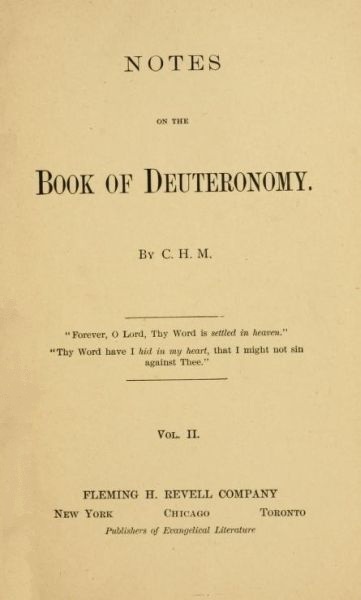
NOTES
on the book of
DEUTERONOMY
Volume I
C. H. MACKINTOSH
"Forever, O Lord, Thy Word is settled in heaven."
"Thy Word have I hid in my heart, that I might not sin
against Thee."
LOIZEAUX BROTHERS
Neptune, New Jersey
FIRST EDITION 1880
TWENTY-SEVENTH PRINTING 1965
LOIZEAUX BROTHERS, Inc., PUBLISHERS
A Nonprofit Organization, Devoted to the Lord's Work
and to the Spread of His Truth
NEPTUNE, NEW JERSEY
PRINTED IN THE UNITED STATES OF AMERICA
PREFATORY NOTE
TO THE AMERICAN EDITION
As several persons in America have, without any authority whatever from me, undertaken to publish my four[1] volumes of "Notes," I deem it my duty to inform the reader that I have given full permission to Messrs. Loizeaux Brothers to publish an edition of those books in such form as they shall consider most suitable.
C. H. MACKINTOSH.
6 West Park Terrace, Scarborough,
May 1st, 1879.
PREFACE
The value and importance of the Word of God cannot be over-estimated at the present moment. Its integrity and authority are being assailed from almost every quarter and in every form of attack. "If the foundations be destroyed, what can the righteous do?" (Ps. xi. 3.)
Infidel thoughts and principles are not limited to a few literary and speculative minds, as they were fifty years ago, but are now asserted by many who ought to be the true guardians of Christianity and the defenders of the Bible as a revelation from God.
In this way the multitude of the simple and unsuspecting are deceived. If the style of address be pleasing, few care to compare what they have been hearing with the holy Scriptures. The conscience not being aroused, they take no further trouble.
But what of the state of immortal souls, under such a ministry, in view of eternity? On whom does the weight of responsibility rest? Fine-spun theories will never awaken a soul asleep in sin: the lost sinner must be brought face to face with the plain Word of God and the solemn realities of eternity. His voice must be heard. All is absolute, positive, and definite here, whatever infidelity may say. "The Word of the Lord endureth forever."
The burden of the following pages, I am thankful to find, is well calculated to meet and counteract the looseness and indefiniteness of the prevailing teaching of the present day.
And this, I may also say, is the burden of the book of Deuteronomy. The Jewish lawgiver presses with great earnestness the Word of Jehovah on the heart of Israel. It is not a book of ceremonials, but the reminding of the people of their obligation to keep the commandments, the statutes, and the judgments of the Lord.
This is the first moral duty of man in every age—implicit obedience and submission to the revealed will of God. Moses speaks to the children of Israel as a father, and appeals to them in the most tender and loving way. "Hearken, O Israel," he says, "unto the statutes and unto the judgments which I teach you ... ye shall not add unto the word which I command you, neither shall ye diminish aught from it, that ye may keep the commandments of the Lord your God which I command you." And again, he says, "Thou shalt bind them for a sign upon thine hand, and they shall be as frontlets between thine eyes. And thou shalt write them upon the posts of thy house, and on thy gates."
The welfare of the people individually and nationally depended on their faithfully observing these oft-repeated laws. To neglect them was to bring upon themselves the displeasure and chastening of the God of Israel.
But more need not be said here on these subjects. The reader will find in the following pages the most ample unfolding and practical application of these divine exhortations and warnings. But the writer has not confined himself to what Deuteronomy teaches, but has enlarged on what it suggests. In this way we have brought before us the grand cardinal truths of Christianity: a wide circle of truth is embraced, and much that applies to the individual Christian, the family, the household, and the Church of God will be found in the accompanying book.
It now goes forth with the earnest desire that the Lord may be graciously pleased to use it for the glory of His own name, the help of His people, and the eternal blessing of many precious souls.
A. M.
London, November, 1880.
CONTENTS
NOTES
ON
THE BOOK OF DEUTERONOMY
The character of the book on which we now enter is quite as distinct as that of any of the four preceding sections of the Pentateuch. Were we to judge from the title of the book, we might suppose that it is a mere repetition of what we find in previous books. This would be a very grave mistake. There is no such thing as mere repetition in the Word of God. Indeed, God never repeats Himself, either in His Word or in His works. Wherever we trace our God, whether on the page of holy Scripture or in the vast fields of creation, we see divine fullness, infinite variety, marked design; and just in proportion to our spirituality of mind will be our ability to discern and appreciate these things. Here, as in all beside, we need the eye anointed with heavenly eye-salve. What a poor idea must the man entertain of inspiration who could imagine for a moment that the fifth book of Moses is a barren repetition of what is to be found in Exodus, Leviticus, and Numbers! Why, even in human composition we should not expect to find such a flagrant imperfection, much less in the perfect revelation which God has so graciously given us in His holy Word. The fact is, there is not, from cover to cover of the inspired volume, a single superfluous sentence, not one redundant clause, not one statement without its own distinct meaning—its own direct application. If we do not see this, we have yet to learn the depth, force, and meaning of the words, "All scripture is given by inspiration of God."
Precious words! Would they were more thoroughly understood in this our day! It is of the utmost possible importance that the Lord's people should be rooted, grounded, and settled in the grand truth of the plenary inspiration of holy Scripture. It is to be feared that laxity as to this most weighty subject is spreading in the professing church to an appalling extent. In many quarters it has become fashionable to pour contempt upon the idea of plenary inspiration. It is looked upon as the veriest childishness and ignorance. It is regarded by many as a great proof of profound scholarship, breadth of mind, and original thinking to be able, by free criticism, to find out flaws in the precious volume of God. Men presume to sit in judgment upon the Bible as though it were a mere human composition. They undertake to pronounce upon what is and what is not worthy of God. In fact, they do virtually sit in judgment upon God Himself. The present result is, as might be expected, utter darkness and confusion, both for those learned doctors themselves and for all who are so foolish as to listen to them. And as for the future, who can conceive the eternal destiny of all those who shall have to answer before the judgment-seat of Christ for the sin of blaspheming the Word of God, and leading hundreds astray by their infidel teaching?
We shall not, however, occupy time in dwelling upon the sinful folly of infidels and skeptics (even though called Christians), or their puny efforts to cast dishonor upon that peerless volume which our gracious God has caused to be written for our learning. They will some day or other find out their fatal mistake. God grant it may not be too late! And as for us, let it be our deep joy and consolation to meditate upon the Word of God, that so we may ever be discovering some fresh treasure in that exhaustless mine—some new moral glories in that heavenly revelation!
The book of Deuteronomy holds a very distinct place in the inspired canon. Its opening lines are sufficient to prove this.—"These be the words which Moses spake unto all Israel on this side Jordan in the wilderness, in the plain over against the Red Sea, between Paran, and Tophel, and Laban, and Hazeroth, and Dizahab."
Thus much as to the place in which the lawgiver delivered the contents of this marvelous book. The people had come up to the eastern bank of the Jordan, and were about to enter upon the land of promise. Their desert wanderings were nearly ended, as we learn from the third verse, in which the point of time is as distinctly marked as is the geographical position in verse 1.—"It came to pass in the fortieth year, in the eleventh month, on the first day of the month, that Moses spake unto the children of Israel, according unto all that the Lord had given him in commandment unto them."
Thus, not only have we both time and place set forth with divine precision and minuteness, but we also learn, from the words just quoted, that the communications made to the people in the plains of Moab were very far indeed from being a repetition of what has come before us in our studies on the books of Exodus, Leviticus, and Numbers. Of this we have further and very distinct proof in a passage in chapter xxix. of the book on which we are now entering.—"These are the words of the covenant which the Lord commanded Moses to make with the children of Israel in the land of Moab, beside the covenant which He made with them in Horeb."
Let the reader note particularly these words. They speak of two covenants—one at Horeb and one in Moab; and the latter, so far from being a mere repetition of the former, is as distinct from it as any two things can be. Of this we shall have the fullest and clearest evidence in our study of the profound book which now lies open before us.
True, the Greek title of the book, signifying the law a second time, might seem to give rise to the idea of its being a mere recapitulation of what has gone before; but we may rest assured it is not so. Indeed, it would be a very grave error to think so. The book has its own specific place. Its scope and object are as distinct as possible. The grand lesson which it inculcates, from first to last, is obedience; and that, too, not in the mere letter, but in the spirit of love and fear—an obedience grounded upon a known and enjoyed relationship—an obedience quickened by the sense of moral obligations of the weightiest and most influential character.
The aged lawgiver—the faithful, beloved, and honored servant of the Lord was about to take leave of the congregation. He was going to heaven and they were about to cross the Jordan, and hence his closing discourses are solemn and affecting in the very highest degree. He reviews the whole of their wilderness history, and that, too, in a manner most touching and impressive. He recounts the scenes and circumstances of their forty eventful years of desert life, in a style eminently calculated to touch the deepest moral springs of the heart. We hang over these most precious discourses with wonder and delight. They possess an incomparable charm, arising from the circumstances under which they were delivered, as well as from their own divinely powerful contents. They speak to us no less effectively than to those for whom they were specially intended. Many of the appeals and exhortations come home to us with a power of application as if they had been uttered but yesterday.
And is it not thus with all Scripture? Are we not continually struck with its marvelous power of adaptation to our own very state, and to the day in which our lot is cast? It speaks to us with a point and freshness as if it were written expressly for us—written this very day. There is nothing like Scripture. Take any human writing of the same date as the book of Deuteronomy; if you could lay your hand on some volume written three thousand years ago, what would you find? A curious relic of antiquity—something to be placed in the British Museum, side by side with an Egyptian mummy, having no application whatever to us or to our time—a musty document—a piece of obsolete writing, practically useless to us, referring only to a state of society and to a condition of things long since passed away and buried in oblivion.
The Bible, on the contrary, is the book for to-day. It is God's own book—His perfect revelation. It is His own very voice speaking to each one of us. It is a book for every age, for every clime, for every class, for every condition—high and low, rich and poor, learned and ignorant, old and young. It speaks in a language so simple that a child can understand it, and yet so profound that the most gigantic intellect cannot exhaust it. Moreover, it speaks right home to the heart; it touches the deepest springs of our moral being; it goes down to the hidden roots of thought and feeling in the soul; it judges us thoroughly. In a word, it is, as the inspired apostle tells us, "quick and powerful, and sharper than any two-edged sword, piercing even to the dividing asunder of soul and spirit, and of the joints and marrow, and is a discerner of the thoughts and intents of the heart." (Heb. iv. 12.)
And then mark the marvelous comprehensiveness of its range. It deals as accurately and as forcibly with the habits and customs, the manners and maxims of the nineteenth century of the Christian era as with those of the very earliest ages of human existence. It displays a perfect acquaintance with man in every stage of his history. The London of to-day and the Tyre of three thousand years ago are mirrored, with like precision and faithfulness, on the sacred page. Human life, in every stage of its development, is portrayed by a master-hand in that wonderful volume which our God has graciously penned for our learning.
What a privilege to possess such a book!—to have in our hands a divine revelation!—to have access to a book, every line of which is given by inspiration of God!—to have a divinely given history of the past, the present, and the future! Who can estimate aright such a privilege as this?
But then, this book judges man—judges his ways—judges his heart. It tells him the truth about himself. Hence man does not like God's book. An unconverted man would vastly prefer a newspaper or a sensational novel to the Bible. He would rather read the report of a trial in one of our criminal courts than a chapter in the New Testament.
Hence, too, the constant effort to pick holes in God's blessed book. Infidels in every age and of every class have labored hard to find out flaws and contradictions in holy Scripture. The determined enemies of the Word of God are to be found, not only in the ranks of the vulgar, the coarse, and the demoralized, but amongst the educated, the refined, and the cultivated. Just as it was in the days of the apostles, "certain lewd fellows of the baser sort," and "devout and honorable women"—two classes so far removed from each other socially and morally—found one point in which they could heartily agree, namely, the utter rejection of the Word of God and of those who faithfully preached it. (Comp. Acts xiii. 50 with xvii. 5.) So we ever find that men who differ in almost every thing else, agree in their determined opposition to the Bible. Other books are let alone. Men care not to point out defects in Virgil, in Horace, in Homer, or Herodotus; but the Bible they cannot endure, because it exposes them and tells them the truth about themselves and the world to which they belong.
And was it not exactly the same with the living Word—the Son of God—the Lord Jesus Christ when He was here among men? Men hated Him because He told them the truth. His ministry, His words, His ways—His whole life was a standing testimony against the world; hence their bitter and persistent opposition. Other men were allowed to pass on, but He was watched and waylaid at every turn of His path. The great leaders and guides of the people "sought to entangle Him in His talk," to find occasion against Him, in order that they might deliver Him to the power and authority of the governor. Thus it was during His marvelous life; and at the close, when the blessed One was nailed to the cross between two malefactors, these latter were let alone; there were no insults heaped upon them—the chief priests and elders did not wag their heads at them. No; all the insults, all the mockery, all the coarse and heartless vulgarity—all was heaped upon the divine Occupant of the centre cross.
Now, it is well we should thoroughly understand the real source of all the opposition to the Word of God—whether it be the living Word or the written Word. It will enable us to estimate it at its real worth. The devil hates the Word of God—hates it with a perfect hatred; and hence he employs learned infidels to write books to prove that the Bible is not the Word of God, that it cannot be, inasmuch as there are mistakes and discrepancies in it; and not only so, but in the Old Testament we find laws and institutions, habits and practices, unworthy of a gracious and benevolent Being.
To all this style of argument we have one brief and pointed reply. Of all these learned infidels we simply say, They know nothing whatever about the matter. They may be very learned, very clever, very deep and original thinkers, well made up in general literature, very competent to give an opinion on any subject within the domain of natural and moral philosophy, very able to discuss any scientific question; moreover, they may be very amiable in private life—truly estimable characters—kind, benevolent, philanthropic, beloved in private and respected in public,—all this they may be, but being unconverted, and not having the Spirit of God, they are wholly unfit to form, much less to give, a judgment on the subject of holy Scripture. If any one wholly ignorant of astronomy were to presume to sit in judgment on the principles of the Copernican system, these very men of whom we speak would at once pronounce him utterly incompetent to speak, and unworthy to be heard on such a subject. In short, no one has any right whatever to offer an opinion on a matter with which he is unacquainted. This is an admitted principle on all hands; and therefore its application in the case now before us cannot justly be called in question.
Now, the inspired apostle tells us, in his first epistle to the Corinthians, that "the natural man receiveth not the things of the Spirit of God; for they are foolishness unto him; neither can he know them, because they are spiritually discerned." This is conclusive. He speaks of man in his natural state, be he ever so learned, ever so cultivated. He is not speaking of any special class of men, but simply of man in his unconverted state—man destitute of the Spirit of God. Some may imagine that the apostle refers to man in a state of barbarism, or savage ignorance. By no means; it is simply man in nature, be he a learned philosopher or an ignorant clown. "He cannot know the things of the Spirit of God." How, then, can he form or give a judgment as to the Word of God? How can he take it upon him to say what is or what is not worthy of God to write? And if he is audacious enough to do so (as, alas! he is), who will be foolish enough to listen to him? His arguments are baseless, his theories worthless, his books only fit for the wastepaper basket; and all this, be it observed, on the universally admitted principle above stated, that no one has any title to be heard on a subject of which he is wholly ignorant.
In this way we dispose of the whole tribe of infidel writers. Who would think of listening to a blind man on the subject of light and shade? And yet such a man has much more claim to be heard than an unconverted man on the subject of inspiration. Human learning, however extensive and varied—human wisdom, however profound, cannot qualify a man to form a judgment upon the Word of God. No doubt a scholar may examine and collate MSS. simply as a matter of criticism; he may be able to form a judgment as to the question of authority for any particular reading of a passage; but this is a different matter altogether from an infidel writer undertaking to pronounce judgment upon the revelation which God has, in His infinite goodness, given to us. We maintain that no man can do this. It is only by the Spirit, who Himself inspired the holy Scriptures, that those Scriptures can be understood and appreciated. The Word of God must be received upon its own authority. If man can judge it or reason upon it, it is not the Word of God at all. Has God given us a revelation, or has He not? If He has, it must be absolutely perfect in every respect; and being such, it must be entirely beyond the range of human judgment. Man is no more competent to judge Scripture than he is to judge God. The Scriptures judge man; not man the Scriptures.
This makes all the difference. Nothing can be more miserably contemptible than the books which infidels write against the Bible. Every page, every paragraph, every sentence, only goes to illustrate the truth of the apostle's statement, that "the natural man receiveth not the things of the Spirit of God; ... neither can he know them, because they are spiritually discerned." Their gross ignorance of the subject with which they undertake to deal is only equaled by their self-confidence. Of their irreverence we say nothing; for who would think of looking for reverence in the writings of infidels? We might perhaps look for a little modesty were it not that we are fully aware of the bitter animus which lies at the root of all such writings, and renders them utterly unworthy of a moment's consideration. Other books may have a dispassionate examination; but the precious book of God is approached with the foregone conclusion that it is not a divine revelation, because, forsooth, infidels tell us that God could not give us a written revelation of His mind.
How strange! Men can give us a revelation of their thoughts (and infidels have done so pretty plainly), but God cannot! What folly! What presumption! Why, we may lawfully inquire, could not God reveal His mind to His creatures? Why should it be thought a thing incredible? For no reason whatever, but because infidels would have it so. The wish is, in this case assuredly, father to the thought. The question raised by the old serpent in the garden of Eden nearly six thousand years ago, has been passed on from age to age by all sorts of skeptics, rationalists, and infidels, namely, "Hath God said?" We reply, with intense delight, Yes; blessed be His holy name, He has spoken—spoken to us. He has revealed His mind; He has given us the holy Scriptures. "All scripture is given by inspiration of God, and is profitable for doctrine, for reproof, for correction, for instruction in righteousness; that the man of God may be perfect [αρτιος], thoroughly furnished unto all good works." And again, "Whatsoever things were written aforetime were written for our learning, that we through patience and comfort of the Scriptures might have hope." (2 Tim. iii. 16, 17; Rom. xv. 4.)
The Lord be praised for such words! They assure us that all Scripture is given of God, and that all Scripture is given to us. Precious link between the soul and God! What tongue can tell the value of such a link? God has spoken—spoken to us. His Word is a rock against which all the waves of infidel thought dash themselves in contemptible impotency, leaving it in its own divine strength and eternal stability. Nothing can touch the Word of God. Not all the powers of earth and hell, men and devils combined can ever move the Word of God. There it stands, in its own moral glory, spite of all the assaults of the enemy, from age to age. "Forever, O Lord, Thy Word is settled in heaven." "Thou hast magnified Thy Word above all Thy name." What remains for us? Just this: "Thy Word have I hid in my heart, that I might not sin against Thee." Here lies the deep secret of peace. The heart is linked to the throne—yea, to the very heart of God by means of His most precious Word, and is thus put in possession of a peace which the world can neither give nor take away. What can all the theories, the reasonings, and the arguments of infidels effect? Just nothing. They are esteemed as the dust of the summer threshing-floor. To one who has really learnt, through grace, to confide in the Word of God—to rest on the authority of holy Scripture, all the infidel books that ever were written are utterly worthless, pointless, powerless; they display the ignorance and terrible presumption of the writers; but as to Scripture, they leave it just where it ever has been and ever will be—"settled in heaven," as immovable as the throne of God.[2] The assaults of infidels cannot touch the throne of God, neither can they touch His Word; and, blessed be His name, neither can they touch the peace that flows through the heart that rests on that imperishable foundation. "Great peace have they that love Thy law, and nothing shall offend them." "The Word of our God shall stand forever." "All flesh is as grass, and all the glory of man as the flower of grass. The grass withereth, and the flower thereof falleth away; but the Word of the Lord endureth forever. And this is the Word which by the gospel is preached unto you." (1 Pet. i. 24, 25.)
Here we have the same precious golden link again. The Word which has reached us in the form of glad tidings is the Word of the Lord which endureth forever; and hence our salvation and our peace are as stable as the Word on which they are founded. If all flesh is as grass, and all the glory of man as the flower of grass, then what are the arguments of infidels worth? They are as worthless as withered grass or a faded flower; and the men who put them forth and those who are moved by them will find them to be so, sooner or later. Oh, the sinful folly of arguing against the Word of God—arguing against the only thing in all this world that can give rest and consolation to the poor, weary human heart—arguing against that which brings the glad tidings of salvation to poor lost sinners—brings them fresh from the heart of God!
But we may perhaps here be met by the question so often raised, and which has troubled many and led them to fly for refuge to what is called "the authority of the church." The question is this: "How are we to know that the book which we call the Bible is the Word of God?" Our answer to this question is a very simple one—it is this: The One who has graciously given us the blessed book can give us also the certainty that the book is from Him. The same Spirit who inspired the various writers of the holy Scriptures can make us know that those Scriptures are the very voice of God speaking to us. It is only by the Spirit that any one can discern this. As we have already seen, "the natural man receiveth not the things of the Spirit of God; ... neither can he know them, because they are spiritually discerned." If the Holy Spirit does not make us know, and give us the certainty that the Bible is the Word of God, no man or body of men can possibly do it; and on the other hand, if He does give us the blessed certainty, we do not need the testimony of man.
We freely admit that on this great question a shadow of uncertainty would be positive torture and misery; but who can give us certainty? God alone. If all the men upon earth were to agree in their testimony to the authority of holy Scripture—if all the councils that ever sat, all the doctors that ever taught, all the fathers that ever wrote, were in favor of the dogma of plenary inspiration—if the universal church, if every denomination in christendom were to assent to the truth that the Bible is, in very deed, the Word of God—in a word, if we had all the human authority that could possibly be had in reference to the integrity of the Word of God, it would be utterly insufficient as a ground of certainty; and if our faith were founded on that authority, it would be perfectly worthless. God alone can give us the certainty that He has spoken in His Word; and blessed be His name, when He gives it, all the arguments, all the cavilings, all the quibblings, all the questionings of infidels, ancient and modern, are as the foam on the water, the smoke from the chimney-top, or the dust on the floor. The true believer rejects them as so much worthless rubbish, and rests in holy tranquillity in that peerless revelation which our God has graciously given us.
It is of the very last possible importance for the reader to be thoroughly clear and settled as to this grave question, if he would be raised above the influence of infidelity on the one hand and superstition on the other. Infidelity undertakes to tell us that God has not given us a book-revelation of His mind—could not give it: Superstition undertakes to tell us that even though God has given us a revelation, yet we cannot be assured of it without man's authority, nor understand it without man's interpretation. Now it is well to see that by both alike we are deprived of the precious boon of holy Scripture. And this is precisely what the devil aims at. He wants to rob us of the Word of God; and he can do this quite as effectually by the apparent self-distrust that humbly and reverently looks to wise and learned men for authority, as by an audacious infidelity that boldly rejects all authority, human or divine.
Take a case. A father writes a letter to his son at Canton—a letter full of the affection and tenderness of a father's heart. He tells him of his plans and arrangements, tells him of every thing that he thinks would interest the heart of a son—every thing that the love of a father's heart could suggest. The son calls at the post-office in Canton to inquire if there is a letter from his father. He is told by one official that there is no letter, that his father has not written and could not write—could not communicate his mind by such a medium at all, that it is only folly to think of such a thing. Another official comes forward, and says, Yes; there is a letter here for you, but you cannot possibly understand it; it is quite useless to you, indeed it can only do you positive mischief inasmuch as you are quite unable to read it aright. You must leave the letter in our hands, and we will explain to you such portions of it as we consider suitable for you. The former of these two officials represents Infidelity; the latter, Superstition. By both alike would the son be deprived of the longed-for letter—the precious communication from his father's heart. But what, we may inquire, would be his answer to these unworthy officials? A very brief and pointed one we may rest assured. He would say to the first, I know my father can communicate his mind to me by letter, and that he has done so. He would say to the second, I know my father can make me understand his mind far better than you can. He would say to both, and that, too, with bold and firm decision. Give me up at once my father's letter; it is addressed to me, and no man has any right to withhold it from me.
Thus, too, should the simple-hearted Christian meet the insolence of Infidelity and the ignorance of Superstition—the two special agencies of the devil, in this our day, in setting aside the precious Word of God. "My Father has communicated His mind, and He can make me understand the communication."—"All Scripture is given by inspiration of God;" and, "Whatsoever things were written aforetime were written for our learning." Magnificent answer to every enemy of God's precious and peerless revelation, be he rationalist or ritualist!
We do not attempt to offer any apology to the reader for this lengthened introduction to the book of Deuteronomy. Indeed we are only too thankful for an opportunity of bearing our feeble testimony to the grand truth of the divine inspiration of the holy Scriptures. We feel it to be our sacred duty, as most surely it is our high privilege, to press upon all to whom we have access, the immense importance—yea, the absolute necessity of the most uncompromising decision on this point. We must faithfully maintain, at all cost, the divine authority, and therefore the absolute supremacy and all-sufficiency, of the Word of God at all times, in all places, for all purposes. We must hold to it that the Scriptures, having been given of God, are complete, in the very highest and fullest sense of the word; that they do not need any human authority to accredit them, or any human voice to make them available: they speak for themselves, and carry their own credentials with them. All we have to do is to believe and obey, not to reason or discuss. God has spoken it: it is ours to hearken, and yield an unreserved and reverent obedience.
This is one grand leading point throughout the book of Deuteronomy, as we shall see in the progress of our meditations; and never was there a moment, in the history of the Church of God, in which it was more needful to urge home on the human conscience the necessity of implicit obedience to the Word of God. It is, alas! but little felt. Professing Christians, for the most part, seem to consider that they have a right to think for themselves—to follow their own reason, their own judgment, or their own conscience. They do not believe that the Bible is a divine and universal guide-book. They think there are very many things in which we are left to choose for ourselves; hence the almost numberless sects, parties, creeds, and schools of thought. If human opinion be allowed at all, then, as a matter of course, one man has as good a right to think as another; and thus it has come to pass that the professing church has become a proverb and a by-word for division.
And what is the sovereign remedy for this widespread disease? Here it is: Absolute and complete subjection to the authority of holy Scripture. It is not men going to Scripture to get their opinions and their views confirmed; but going to Scripture to get the mind of God as to every thing, and bowing down their whole moral being to divine authority. This is the one pressing need of the day in which our lot is cast—reverent subjection, in all things, to the supreme authority of the Word of God. No doubt, there will be variety in our measure of intelligence, in our apprehension and appreciation of Scripture; but what we specially urge upon all Christians is that condition of soul, that attitude of heart expressed in those precious words of the psalmist, "Thy Word have I hid in mine heart, that I might not sin against Thee." This, we may rest assured, is grateful to the heart of God. "To this man will I look, even to him that is poor and of a contrite spirit, and trembleth at My Word."
Here lies the true secret of moral security. Our knowledge of Scripture may be very limited; but if our reverence for it be profound, we shall be preserved from a thousand errors—a thousand snares. And then there will be steady growth. We shall grow in the knowledge of God, of Christ, and of the written Word; we shall delight to draw from those living and exhaustless depths of holy Scripture, and to range through those green pastures which infinite grace has so freely thrown open to the flock of Christ. Thus shall the divine life be nourished and strengthened; the Word of God will become more and more precious to our souls, and we shall be lead, by the powerful ministry of the Holy Ghost, into the depth, fullness, majesty, and moral glory of holy Scripture. We shall be delivered completely from the withering influences of all mere systems of theology, high, low, or moderate—a most blessed deliverance! We shall be able to tell the advocates of all the schools of divinity under the sun that whatever elements of truth they may have in their systems we have in divine perfectness in the Word of God; not twisted and tortured to make them fit into a system, but in their right place in the wide circle of divine revelation which has its eternal centre in the blessed Person of our Lord and Saviour Jesus Christ.
CHAPTER I.
"These be the words which Moses spake unto all Israel on this side Jordan in the wilderness, in the plain over against the Red Sea, between Paran, and Tophel, and Laban, and Hazeroth, and Dizahab. (There are eleven days' journey from Horeb, by the way of Mount Seir, unto Kadesh-barnea.)"
The inspired writer is careful to give us, in the most precise manner, all the bearings of the place in which the words of this book were spoken in the ears of the people. Israel had not yet crossed the Jordan; they were just beside it, and over against the Red Sea where the mighty power of God had been so gloriously displayed nearly forty years before. The whole position is described with a minuteness which shows how thoroughly God entered into every thing that concerned His people. He was interested in all their movements and in all their ways. He kept a faithful record of all their encampments. Their was not a single circumstance connected with them, however trifling, beneath His gracious notice. He attended to every thing. His eye rested continually on that assembly as a whole, and on each member in particular. By day and by night He watched over them. Every stage of their journey was under His immediate and most gracious superintendence. There was nothing, however small, beneath His notice; nothing, however great, beyond His power.
Thus it was with Israel in the wilderness of old, and thus it is with the Church now—the Church as a whole, and each member in particular. A Father's eye rests upon us continually, His everlasting arms are around and underneath us day and night. "He withdraweth not His eyes from the righteous." He counts the hairs of our heads, and enters, with infinite goodness, into every thing that concerns us. He has charged Himself with all our wants and all our cares. He would have us to cast our every care on Him, in the sweet assurance that He careth for us. He most graciously invites us to roll our every burden over on Him, be it great or small.
All this is truly wonderful. It is full of deepest consolation. It is eminently calculated to tranquilize the heart, come what may. The question is, Do we believe it? are our hearts governed by the faith of it? Do we really believe that the almighty Creator and Upholder of all things, who bears up the pillars of the universe, has graciously undertaken to do for us all the journey through? Do we thoroughly believe that "the Possessor of heaven and earth" is our Father? and that He has charged Himself with all our wants from first to last? Is our whole moral being under the commanding power of those words of the inspired apostle, "He that spared not His own Son, but delivered Him up for us all, how shall He not with Him also freely give us all things?" Alas! it is to be feared that we know but little of the power of these grand yet simple truths. We talk about them, we discuss them, we profess them, we give a nominal assent to them; but with all this, we prove, in our daily life—in the actual details of our personal history, how feebly we enter into them. If we truly believed that our God has charged Himself with all our necessities—if we were finding all our springs in Him—if He were a perfect covering for our eyes and a resting-place for our hearts, could we possibly be looking to poor creature-streams, which so speedily dry up and disappoint our hearts? We do not and cannot believe it. It is one thing to hold the theory of the life of faith, and another thing altogether to live that life. We constantly deceive ourselves with the notion that we are living by faith, when in reality we are leaning on some human prop, which sooner or later is sure to give way.
Reader, is it not so? Are we not constantly prone to forsake the Fountain of living waters, and hew out for ourselves broken cisterns, which can hold no water? And yet we speak of living by faith! We profess to be looking only to the living God for the supply of our need, whatever that need may be, when, in point of fact, we are sitting beside some creature-stream and looking for something there. Need we wonder if we are disappointed? How could it possibly be otherwise? Our God will not have us dependent upon aught or any one but Himself. He has, in manifold places in His Word, given us His judgment as to the true character and sure result of all creature-confidence. Take the following most solemn passage from the prophet Jeremiah: "Cursed be the man that trusteth in man, and maketh flesh his arm, and whose heart departeth from the Lord. For he shall be like the heath in the desert, and shall not see when good cometh; but shall inhabit the parched places in the wilderness, in a salt land and not inhabited." And then mark the contrast—"Blessed is the man that trusteth in the Lord, and whose hope the Lord is: for he shall be as a tree planted by the waters, and that spreadeth out her roots by the river, and shall not see when heat cometh, but her leaf shall be green; and shall not be careful in the year of drought, neither shall cease from yielding fruit." (Jer. xvii. 5-8.)
Here we have, in language divinely forcible, clear, and beautiful, both sides of this most weighty subject put before us. Creature-confidence brings a certain curse; it can only issue in barrenness and desolation. God, in very faithfulness, will cause every human stream to dry up—every human prop to give way, in order that we may learn the utter folly of turning away from Him. What figure could be more striking or impressive than those used in the above passage?—"A heath in the desert," "parched places in the wilderness," "a salt land not inhabited." Such are the figures used by the Holy Ghost to illustrate all mere human dependence—all confidence in man.
But on the other hand, what can be more lovely or more refreshing than the figures used to set forth the deep blessedness of simple trust in the Lord?—"A tree planted by the waters," "spreading out her roots by the rivers," the leaf ever green, the fruit never ceasing. Perfectly beautiful! Thus it is with the man who trusteth in the Lord, and whose hope the Lord is. He is nourished by those eternal springs that flow from the heart of God. He drinks at the Fountain, life-giving and free. He finds all his resources in the living God. There may be "heat," but he does not see it; "the year of drought" may come, but he is not careful. Ten thousand creature-streams may dry up, but he does not perceive it, because he is not dependent upon them; he abides hard by the ever-gushing Fountain. He can never want any good thing. He lives by faith.
And here, while speaking of the life of faith—that most blessed life, let us clearly understand what it is, and carefully see that we are living it. We sometimes hear this life spoken of in a way by no means intelligent. It is not unfrequently applied to the mere matter of trusting God for food and raiment. Certain persons who happen to have no visible source of temporal supplies—no settled income—no property of any kind, are singled out and spoken of as "living by faith," as if that marvelous and glorious life had no higher sphere or wider range than temporal things—the mere supply of our bodily wants.
Now, we cannot too strongly protest against this most unworthy view of the life of faith. It limits its sphere and lowers its range in a manner perfectly intolerable to any one who understands aught of its most holy and precious mysteries. Can we for a moment admit that a Christian who happens to have a settled income of any kind is to be deprived of the privilege of living by faith? Or, further, can we permit that life to be limited and lowered to the mere matter of trusting God for the supply of our bodily wants? Does it soar no higher than food and raiment? Does it give no more elevated thought of God than that He will not let us starve or go naked?
Far away, and away forever, be the unworthy thought! The life of faith must not be so treated. We cannot allow such a gross dishonor to be offered to it, or such a grievous wrong done to those who are called to live it. What, we would ask, is the meaning of those few but weighty words, "The just shall live by faith"? They occur, first of all, in Habakkuk ii. They are quoted by the apostle in Romans i, where he is, with a master-hand, laying the solid foundations of Christianity. He quotes them again in Galatians iii, where he is, with intense anxiety, recalling those bewitched assemblies to those solid foundations which they, in their folly, were abandoning. Finally, he quotes them again in chapter x. of his epistle to the Hebrews, where he is warning his brethren against the danger of casting away their confidence and giving up the race.
From all this we may assuredly gather the immense importance and practical value of the brief but far-reaching sentence, "The just shall live by faith." But to whom does it apply? Is it only for a few of the Lord's servants, here and there, who happen to have no settled income? We utterly reject the thought. It applies to every one of the Lord's people. It is the high and happy privilege of all who come under the title—that blessed title, "The just." We consider it a very grave error to limit it in any way. The moral effect of such limitation is most injurious. It gives undue prominence to one department of the life of faith which, if any distinction be allowable, we should judge to be the very lowest. But in reality, there should be no distinction: the life of faith is one. Faith is the grand principle of the divine life from first to last. By faith we are justified, and by faith we live; by faith we stand, and by faith we walk. From the starting-post to the goal of the Christian course it is all by faith.
Hence, therefore, it is a serious mistake to single out certain persons who trust the Lord for temporal supplies, and speak of them as living by faith, as if they alone did so. And not only so, but such persons are held up to the gaze of the Church of God as something wonderful; and the great mass of Christians are led to think that the privilege of living by faith lies entirely beyond their range. In short, they are led into a complete mistake as to the real character and sphere of the life of faith, and thus they suffer materially in the inner life.
Let the Christian reader, then, distinctly understand that it is his happy privilege, whoever he be or whatever be his position, to live a life of faith, in all the depth and fullness of that word. He may, according to his measure, take up the language of the blessed apostle, and say, "The life that I live in the flesh, I live by the faith of the Son of God, who loved me, and gave Himself for me." Let nothing rob him of this high and holy privilege which belongs to every member of the household of faith. Alas! we fail. Our faith is weak, when it ought to be strong, bold, and vigorous. Our God delights in a bold faith. If we study the gospels, we shall see that nothing so refreshed and delighted the heart of Christ as a fine bold faith—a faith that understood Him and drew largely upon Him. Look, for example, at the Syrophenician in Mark vii, and the centurion in Luke vii.
True, He could meet a weak faith—the very weakest. He could meet an "If Thou wilt" with a gracious "I will"—an "If Thou canst" with "If thou canst believe, all things are possible." The faintest look, the feeblest touch, was sure to meet with a gracious response; but the Saviour's heart was gratified and His spirit refreshed when He could say, "O woman, great is thy faith; be it unto thee even as thou wilt;" and again, "I have not found so great faith, no, not in Israel."
Let us remember this. We may rest assured it is the very same to-day as when our blessed Lord was here amongst men. He loves to be trusted, to be used, to be drawn upon. We can never go too far in counting on the love of His heart or the strength of His hand. There is nothing too small, nothing too great for Him; He has all power in heaven and on earth; He is head over all things to His Church; He holds the universe together; He upholds all things by the word of His power. Philosophers talk of the forces and laws of nature: the Christian thinks with delight of Christ, His hand, His Word, His mighty power. By Him all things were created, and by Him all things consist.
And then His love! What rest, what comfort, what joy, to know and remember that the almighty Creator and Upholder of the universe is the everlasting Lover of our souls! that He loves us perfectly; that His eye is ever upon us, His heart ever toward us; that He has charged Himself with all our wants, whatever these wants may be—whether physical, mental, or spiritual! There is not a single thing within the entire range of our necessities that is not treasured up for us in Christ. He is Heaven's treasury—God's storehouse, and all this for us.
Why, then, should we ever turn to another? Why should we ever, directly or indirectly, make known our wants to a poor fellow-mortal? Why not go straight to Jesus? Do we want sympathy? Who can sympathize with us like our most merciful High-Priest, who is touched with the feeling of our infirmities? Do we want help of any kind? Who can help us like our almighty Friend, the Possessor of unsearchable riches? Do we want counsel or guidance? Who can give it like the blessed One who is the very wisdom of God, and who is made of God unto us wisdom? Oh, let us not wound His loving heart, and dishonor His glorious name by turning away from Him. Let us jealously watch against the tendency so natural to us to cherish human hopes, creature-confidences, and earthly expectations. Let us abide hard by the Fountain, and we shall never have to complain of the streams. In a word, let us seek to live by faith, and thus glorify God in our day and generation.
We shall now proceed with our chapter; and in so doing, we would call the reader's attention to verse 2. It is certainly a very remarkable parenthesis. "(There are eleven days' journey from Horeb, by the way of Mount Seir, unto Kadesh-barnea.)" Eleven days! and yet it took them forty years! How was this? Alas! we need not travel far for the answer. It is only too like ourselves. How slowly we get over the ground! What windings and turnings! How often we have to go back and travel over the same ground again and again! We are slow travelers, because we are slow learners. It may be we feel disposed to marvel how Israel could have taken forty years to accomplish a journey of eleven days; but we may, with much greater reason, marvel at ourselves. We, like them, are kept back by our unbelief and slowness of heart; but there is far less excuse for us than for them, inasmuch as our privileges are so very much higher.
Some of us have much reason to be ashamed of the time we spend over our lessons. The words of the blessed apostle do but too forcibly apply to us—"For when for the time ye ought to be teachers, ye have need that one teach you again which be the first principles of the oracles of God; and are become such as have need of milk, and not of strong meat." Our God is a faithful and wise as well as a gracious and patient Teacher. He will not permit us to pass cursorily over our lessons. Sometimes, perhaps, we think we have mastered a lesson, and we attempt to move on to another; but our wise Teacher knows better, and He sees the need of deeper ploughing. He will not have us mere theorists or smatterers: He will keep us, if need be, year after year at our scales until we learn to sing.
Now, while it is very humbling to us to be so slow in learning, it is very gracious of Him to take such pains with us, in order to make us sure. We have to bless Him for His mode of teaching as for all beside—for the wonderful patience with which He sits down with us over the same lesson again and again, in order that we may learn it thoroughly.[3]
"And it came to pass in the fortieth year, in the eleventh month, on the first day of the month, that Moses spake unto the children of Israel, according unto all that the Lord had given him in commandment unto them." (Ver. 3.) These few words contain a volume of weighty instruction for every servant of God—for all who are called to minister in the Word and doctrine. Moses gave the people just what he himself had received from God—nothing more, nothing less. He brought them into direct contact with the living Word of Jehovah. This is the grand principle of ministry at all times. Nothing else is of any real value. The Word of God is the only thing that will stand. There is divine power and authority in it. All mere human teaching, however interesting—however attractive at the time, will pass away and leave the soul without any foundation to rest upon.
Hence it should be the earnest, jealous care of all who minister in the assembly of God, to preach the Word in all its purity, in all its simplicity; to give it to the people as they get it from God; to bring them face to face with the veritable language of holy Scripture. Thus will their ministry tell, with living power, on the hearts and consciences of their hearers. It will link the soul with God Himself, by means of the Word, and impart a depth and solidity which no human teaching can ever produce.
Look at the blessed apostle Paul. Hear him express himself on this weighty subject.—"And I, brethren, when I came to you, came not with excellency of speech or of wisdom, declaring unto you the testimony of God. For I determined not to know any thing among you, save Jesus Christ, and Him crucified. And I was with you in weakness, and in fear, and in much trembling. And my speech and my preaching was not with enticing words of man's wisdom, but in demonstration of the Spirit and of power." What was the object of all this fear and trembling? "That your faith should not stand in the wisdom of men, but in the power of God." (1 Cor. ii. 1-5.)
This true-hearted faithful servant of Christ sought only to bring the souls of his hearers into direct personal contact with God Himself. He sought not to link them with Paul. "Who then is Paul, and who is Apollos, but ministers by whom ye believed?" All false ministry has for its object the attaching of souls to itself. Thus the minister is exalted, God is shut out, and the soul left without any divine foundation to rest upon. True ministry, on the contrary, as seen in Paul and Moses, has for its blessed object the attaching of the soul to God. Thus the minister gets his true place—simply an instrument, God is exalted, and the soul established on a sure foundation which can never be moved.
But let us hear a little more from our apostle on this most weighty subject. "Moreover, brethren, I declare unto you the gospel which I preached unto you, which also ye have received, and wherein ye stand; by which also ye are saved, if ye keep in memory what I preached unto you, unless ye have believed in vain. For I delivered unto you first of all that which I also received"—nothing more, nothing less, nothing different—"how that Christ died for our sins according to the Scriptures; and that He was buried, and that He rose again the third day according to the Scriptures."
This is uncommonly fine. It demands the serious consideration of all who would be true and effective ministers of Christ. The apostle was careful to allow the pure stream to flow down from its living source—the heart of God, into the souls of the Corinthians. He felt that nothing else was of any value. If he had sought to link them on to himself, he would have sadly dishonored his Master, done them a grievous wrong, and he himself would most assuredly suffer loss in the day of Christ.
But no; Paul knew better. He would not, for worlds, lead any to build upon himself. Hear what he says to his much-loved Thessalonians.—"For this cause also thank we God without ceasing, because, when ye received the Word of God which ye heard of us, ye received it not as the word of men, but as it is in truth, the Word of God, which effectually worketh also in you that believe." (1 Thess. ii. 13.)
We feel solemnly responsible to commend this grave and important point to the serious consideration of the Church of God. If all the professed ministers of Christ were to follow the example of Moses and Paul, in reference to the matter now before us, we should witness a very different condition of things in the professing church. But the plain and serious fact is, that the Church of God, like Israel of old, has wholly departed from the authority of His Word. Go where you will, and you find things done and taught which have no foundation in Scripture. Things are not only tolerated but sanctioned and stoutly defended which are in direct opposition to the mind of Christ. If you ask for the divine authority for this, that, and the other institution or practice, you will be told that Christ has not given us directions as to matters of church government; that in all questions of ecclesiastical polity, clerical orders, and liturgical services, He has left us free to act according to our consciences, judgment, or religious feelings; that it is simply absurd to demand a "Thus saith the Lord" for all the details connected with our religious institutions: there is a broad margin left to be filled up according to our national customs and our peculiar habits of thought. It is considered that professing Christians are left perfectly free to form themselves into so-called churches, to choose their own form of government, to make their own arrangements, and to appoint their own office-bearers.
Now the question which the Christian reader has to consider is, "Are these things so?" Can it be that our Lord Christ has left His Church without guidance as to matters so interesting and momentous? Can it be possible that the Church of God is worse off, in the matter of instruction and authority, than Israel? In our studies on the books of Exodus, Leviticus, and Numbers, we have seen (for who could help seeing?) the marvelous pains which Jehovah took to instruct His people as to the most minute particulars connected with their public worship and private life. As to the tabernacle, the temple, the priesthood, the ritual, the various feasts and sacrifices, the periodical solemnities, the months, the days, the very hours, all was ordered and settled with divine precision. Nothing was left to mere human arrangement. Man's wisdom, his judgment, his reason, his conscience, had nothing whatever to do in the matter. Had it been left to man, how should we ever have had that admirable, profound, and far-reaching typical system which the inspired pen of Moses has set before us? If Israel had been allowed to do what (as some would fain persuade us) the Church is allowed, what confusion, what strife, what division, what endless sects and parties, would have been the inevitable result!
But it was not so. The Word of God settled every thing. "As the Lord commanded Moses." This grand and influential sentence was appended to every thing that Israel had to do, and to every thing they were not to do. Their national institutions and their domestic habits—their public and their private life, all came under the commanding authority of "Thus saith the Lord." There was no occasion for any member of the congregation to say, I cannot see this, or, I cannot go with that, or, I cannot agree with the other. Such language could only be regarded as the fruit of self-will. He might just as well say, I cannot agree with Jehovah. And why? Simply because the Word of God had spoken as to every thing, and that, too, with a clearness and simplicity which left no room whatever for human discussion. Throughout the whole of the Mosaic economy there was not the breadth of a hair of margin left in which to insert the opinion or the judgment of man. It pertained not to man to add the weight of a feather to that vast system of types and shadows which had been planned by the divine mind, and set forth in language so plain and pointed, that all Israel had to do was to obey—not to argue, not to reason, not to discuss, but to obey.
Alas! alas! they failed, as we know. They did their own will; they took their own way; they did "every man that which was right in his own eyes." They departed from the Word of God, and followed the imaginations and devices of their own evil heart, and brought upon themselves the wrath and indignation of offended Deity, under which they suffer till this day, and shall yet suffer unexampled tribulation.
But all this leaves untouched the point on which we are just now dwelling. Israel had the oracles of God, and these oracles were divinely sufficient for their guidance in every thing. There was no room left for the commandments and doctrines of men. The Word of the Lord provided for every possible exigence, and that Word was so plain as to render human comment needless.
Is the Church of God worse off, as regards guidance and authority, than Israel of old? Are Christians left to think and arrange for themselves in the worship and service of God? Are there any questions left open for human discussion? Is the Word of God sufficient, or is it not? Has it left any thing unprovided for? Let us hearken diligently to the following powerful testimony: "All Scripture is given by inspiration of God, and is profitable for doctrine, for reproof, for correction, for instruction in righteousness; that the man of God may be perfect [αρτιος] throughly furnished unto all good works." (2 Tim. iii.)
This is perfectly conclusive. Holy Scripture contains all that the man of God can possibly require to make him perfect, to equip him thoroughly for every thing that can be called a "good work." And if this be true as to the man of God individually, it is equally true as to the Church of God collectively. Scripture is all-sufficient—for each, for all. Thank God that it is so! What a signal mercy to have a divine guide-book! Were it not so, what should we do? whither should we turn? what would become of us? If we were left to human tradition and human arrangement in the things of God, what hopeless confusion! what clashing of opinions! what conflicting judgments! And all this of necessity, inasmuch as one man would have quite as good a right as another to put forth his opinion and to suggest his plan.
We shall perhaps be told that, notwithstanding our possession of the holy Scripture, we have, nevertheless, sects, parties, creeds, and schools of thought almost innumerable. But why is this? Simply because we refuse to submit our whole moral being to the authority of holy Scripture. This is the real secret of the matter—the true source of all those sects and parties which are the shame and sorrow of the Church of God.
It is vain for men to tell us that these things are good in themselves—that they are the legitimate fruit of that free exercise of thought and private judgment which form the very boast and glory of Protestant Christianity. We do not and cannot believe for a moment that such a plea will stand before the judgment-seat of Christ. We believe, on the contrary, that this very boasted freedom of thought and independence of judgment are in direct opposition to that spirit of profound and reverent obedience which is due to our adorable Lord and Master. What right has a servant to exercise his private judgment in the face of his master's plainly expressed will? None whatever. The duty of a servant is simply to obey—not to reason or to question, but to do what he is told. He fails, as a servant, just in so far as he exercises his own private judgment. The most lovely moral trait in a servant's character is implicit, unquestioning, and unqualified obedience. The one grand business of a servant is to do his master's will.
All this will be fully admitted in human affairs; but in the things of God, men think themselves entitled to exercise their private judgment. It is a fatal mistake. God has given us His Word; and that Word is so plain, that wayfaring men, though fools, need not err therein. Hence, therefore, if we were all guided by that Word,—if we were all to bow down in a spirit of unquestioning obedience to its divine authority, there could not be conflicting opinions and opposing sects. It is quite impossible that the voice of holy Scripture can teach opposing doctrines. It cannot possibly teach one man Episcopacy; another, Presbyterianism; and another, Independency. It cannot possibly furnish a foundation for opposing schools of thought. It would be a positive insult offered to the divine volume to attempt to attribute to it all the sad confusion of the professing church. Every pious mind must recoil, with just horror, from such an impious thought. Scripture cannot contradict itself; and therefore if two men or ten thousand men are exclusively taught by Scripture, they will think alike.
Hear what the blessed apostle says to the church at Corinth—says to us, "Now I beseech you, brethren, by the name of our Lord Jesus Christ" (mark the mighty moral force of this appeal) "that ye all speak the same thing, and that there be no divisions among you; but that ye be perfectly joined together in the same mind, and in the same judgment."
Now the question is, how was this most blessed result to be reached? Was it by each one exercising the right of private judgment? Alas! it was this very thing that gave birth to all the division and contention in the assembly at Corinth, and drew forth the sharp rebuke of the Holy Ghost. Those poor Corinthians thought they had a right to think and judge and choose for themselves, and what was the result? "It hath been declared unto me of you, my brethren, by them which are of the house of Chloe, that there are contentions among you. Now this I say, that every one of you saith, I am of Paul; and I of Apollos; and I of Cephas; and I of Christ. Is Christ divided?"
Here we have private judgment and its sad fruit—its necessary fruit. One man has quite as good a right to think for himself as another; and no man has any right whatsoever to force his opinion upon his fellow. Where, then, lies the remedy? In flinging to the winds our private judgments, and reverently submitting ourselves to the supreme and absolute authority of holy Scripture. If it be not thus, how could the apostle beseech the Corinthians to "speak the same thing, and to be perfectly joined together in the same mind, and in the same judgment"? Who was to prescribe the "thing" that all were to "speak"? In whose "mind" or whose "judgment" were all to be "perfectly joined together"? Had any one member of the assembly, however gifted or intelligent, the slightest shadow of a right to set forth what his brethren were to speak, to think, or to judge? Most certainly not. There was one absolute, because divine, authority to which all were bound, or rather privileged, to submit themselves. Human opinions, man's private judgment, his conscience, his reason—all these things must go for what they are worth; and most assuredly they are perfectly worthless as authority. The Word of God is the only authority; and if we are all governed by that, we shall "all speak the same thing," and "there will be no divisions among us;" but we shall "be perfectly joined together in the same mind, and in the same judgment."
Lovely condition! But, alas! it is not the present condition of the Church of God; and therefore it is perfectly evident that we are not all governed by the one supreme, absolute, and all-sufficient authority—the voice of holy Scripture—that most blessed voice that can never utter one discordant note—a voice ever divinely harmonious to the circumcised ear.
Here lies the root of the whole matter. The Church has departed from the authority of Christ, as set forth in His Word. Until this is seen, it is only lost time to discuss the claims of conflicting systems, ecclesiastical or theological. If a man does not see that it is his sacred duty to test every ecclesiastical system, every liturgical service, and every theological creed by the Word of God, discussion is perfectly useless. If it be allowable to settle things according to expediency—according to man's judgment, his conscience, or his reason, then verily we may as well at once give up the case as hopeless. If we have no divinely settled authority—no perfect standard—no infallible guide, we cannot see how it is possible for any one to possess the certainty that he is treading in the true path. If indeed it be true that we are left to choose for ourselves, amid the almost countless paths which lie around us, then farewell to all certainty—farewell to peace of mind and rest of heart—farewell to all holy stability of purpose and fixedness of aim. If we cannot say of the ground we occupy, of the path we pursue, and of the work in which we are engaged, "This is the thing which the Lord hath commanded," we may rest assured we are in a wrong position, and the sooner we abandon it the better.
Thank God, there is no necessity whatever for His child or His servant to continue for one hour in connection with what is wrong. "Let every one that nameth the name of Christ depart from iniquity." But how are we to know what is iniquity? By the Word of God. Whatever is contrary to Scripture, whether in morals or in doctrines, is iniquity, and I must depart from it, cost what it may. It is an individual matter.—"Let every one."—"He that hath ears."—"He that overcometh."—"If any man hear My voice."
Here is the point. Let us mark it well. It is Christ's voice. It is not the voice of this good man or that good man; it is not the voice of the church, the voice of the fathers, the voice of general councils, but the voice of our own beloved Lord and Master. It is the individual conscience in direct, living contact with the voice of Christ—the living, eternal Word of God—the holy Scriptures. Were it merely a question of human conscience or judgment or authority, we are at once plunged in hopeless uncertainty, inasmuch as what one man might judge to be iniquity, another might consider to be perfectly right. There must be some fixed standard to go by—some supreme authority from which there can be no appeal; and, blessed be God, there is. God has spoken; He has given us His Word; and it is at once our bounden duty, our high privilege, our moral security, our true enjoyment, to obey that Word.
Not man's interpretation of the Word, but the Word itself. This is all-important. We must have nothing—absolutely nothing between the human conscience and divine revelation. Men talk to us about the authority of the church. Where are we to find it? Suppose a really anxious, earnest, honest soul, longing to know the true way. He is told to listen to the voice of the church. He asks, Which church? Is it the Greek, Latin, Anglican, or Scotch church? Not two of them agree. Nay, more; there are conflicting parties, contending sects, opposing schools of thought, in one and the self-same body. Councils have differed, fathers have disagreed, popes have anathematized one another. In the Anglican Establishment, we have high-church, low-church, and broad-church, each differing from the rest. In the Scotch or Presbyterian church, we have the Established church, the United Presbyterian, and the Free church. And then if the anxious inquirer turns away in hopeless perplexity from those great bodies, in order to seek guidance amid the ranks of Protestant dissenters, is he likely to fare any better?
Ah! reader, it is perfectly hopeless. The whole professing church has revolted from the authority of Christ, and cannot possibly be a guide or an authority for any one. In the second and third chapters of the book of Revelation, the church is seen under judgment, and the appeal, seven times repeated, is, "He that hath an ear, let him hear"—what? The voice of the church? Impossible! The Lord could never direct us to hear the voice of that which is itself under judgment. Hear what, then? "Let him hear what the Spirit saith unto the churches."