
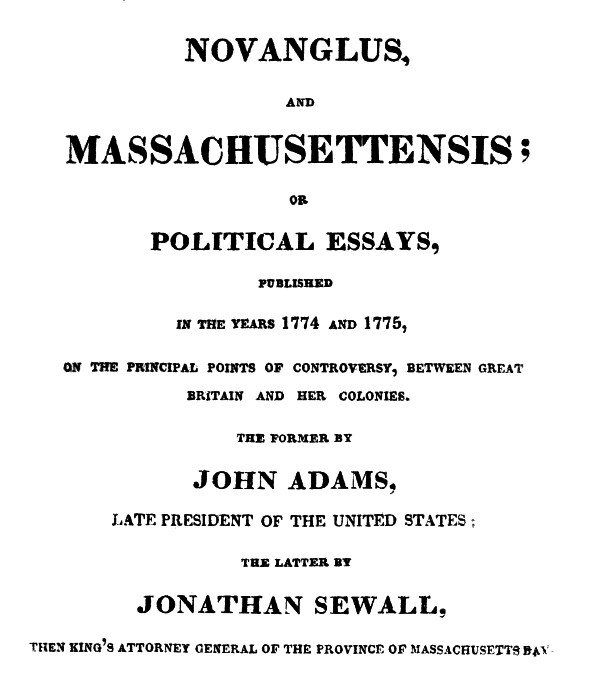
NOTE.
Hostilities, at Lexington, between Great Britain and her colonies, commenced on the nineteenth of April, two days succeeding the publication of this last essay. Several others were written, and sent to the printers of the Boston Gazette, which were probably lost, amidst the confusion occasioned by that event.
MASSACHUSETTENSIS.
ADDRESSED
To the Inhabitants of the Province of Massachusetts Bay,
December 12, 1774.
MY DEAR COUNTRYMEN,
WHEN a people, by what means soever, are reduced to such a situation, that every thing they hold dear, as men and citizens, is at stake, it is not only excuseable, but even praiseworthy for an individual to offer to the public any thing, that he may think has a tendency to ward off the impending danger; nor should he be restrained from an apprehension that what he may offer will be unpopular, any more than a physician should be restrained from prescribing a salutary medicine, through fear it might be unpalatable to his patient.
The press, when open to all parties and influenced by none, is a salutary engine in a free state, perhaps a necessary one to preserve the freedom of that state; but, when a party has gained the ascendancy so far as to become the licensers of the press, either by an act of government, or by playing off the resentment of the populace against printers and authors, the press itself becomes an engine of oppression or licentiousness, and is as pernicious to society, as otherwise it would be beneficial. It is too true to be denied, that ever since the origin of our controversy with Great Britain, the press, in this town, has been much devoted to the partizans of liberty; they have been indulged in publishing what they pleased, fas vel nefas, while little has been published on the part of government. The effect this must have had upon the minds of the people in general is obvious; they must have formed their opinion upon a partial view of the subject, and of course it must have been in some degree erroneous. In short, the changes have been rung so often upon oppression, tyranny and slavery, that, whether sleeping or waking, they are continually vibrating in our ears; and it is now high time to ask ourselves, whether we have not been deluded by sound only.
My dear countrymen, let us divest ourselves of prejudice, take a view of our present wretched situation, contrast it with our former happy one, carefully investigate the cause, and industriously seek some means to escape the evils we now feel, and prevent those that we have reason to expect.
We have been so long advancing to our present state, and by such gradations, that perhaps many of us are insensible of our true state and real danger. Should you be told that acts of high treason are flagrant through the country, that a great part of the province is in actual rebellion, would you believe it true? Should you not deem the person asserting it, an enemy to the province? Nay, should you not spurn him from you with indignation? Be calm, my friends; it is necessary to know the worst of a disease, to enable us to provide an effectual remedy. Are not the bands of society cut asunder, and the sanctions that hold man to man, trampled upon? Can any of us recover a debt, or obtain compensation for an injury, by law? Are not many persons, whom once we respected and revered, driven from their homes and families, and forced to fly to the army for protection, for no other reason but their having accepted commissions under our king? Is not civil government dissolved? Some have been made to believe that nothing short of attempting the life of the king, or fighting his troops, can amount to high treason or rebellion. If, reader, you are one of those, apply to an honest lawyer, (if such an one can be found) and enquire what kind of offence it is for a number of men to assemble armed, and forcibly to obstruct the course of justice, even to prevent the king's courts from being held at their stated terms; for a body of people to seize upon the king's provincial revenue; I mean the monies collected by virtue of grants made by the general court to his majesty for the support of his government, within this province; for a body of men to assemble without being called by authority, and to pass governmental acts; or for a number of people to take the militia out of the hands of the king's representative, or to form a new militia, or to raise men and appoint officers for a public purpose, without the order or permission of the king, or his representative; or for a number of men to take to their arms, and march with a professed design of opposing the king's troops; ask, reader, of such a lawyer, what is the crime, and what the punishment; and if, perchance, thou art one that hast been active in these things, and art not insensibility itself, his answer will harrow up thy soul.
I assure you, my friends, I would not that this conduct should be told beyond the borders of this province; I wish it were consigned to perpetual oblivion; but alas, it is too notorious to be concealed; our news-papers have already published it to the world; we can neither prevent nor conceal it. The shaft is already sped, and the utmost exertion is necessary to prevent the blow. We already feel the effects of anarchy; mutual confidence, affection, and tranquility, those sweetners of human life, are succeeded by distrust, hatred, and wild uproar; the useful arts of agriculture and commerce are neglected for caballing, mobbing this or the other man, because he acts, speaks, or is suspected of thinking different from the prevailing sentiment of the times, in purchasing arms, and forming a militia; O height of madness! with a professed design of opposing Great Britain. I suspect many of us have been induced to join in these measures, or but faintly to oppose them, from an apprehension that Great Britain would not, or could not exert herself sufficiently to subdue America. Let us consider this matter. However closely we may hug ourselves in the opinion, that the parliament has no right to tax or legislate for us, the people of England hold the contrary opinion as firmly. They tell us we are a part of the British empire; that every state, from the nature of government, must have a supreme, uncontrolable power, co-extensive with the empire itself; and that that power is vested in parliament. It is as unpopular to deny this doctrine in Great Britain, as it is to assert it in the colonies; so there is but little probability of serving ourselves at this day by our ingenious distinctions between a right of legislation for one purpose, and not for another. We have bid them defiance; and the longest sword must carry it, unless we change our measures. Mankind are the same, in all parts of the world. The same fondness for dominion that presides in the breast of an American, actuates the breast of an European. If the colonies are not a part of the British empire already, and subject to the supreme authority of the state, Great Britain will make them so. Had we been prudent enough to confine our opposition within certain limits, we might have stood some chance of succeeding once more; but alas, we have passed the Rubicon. It is now universally said and believed, in England, that if this opportunity of reclaiming the colonies, and reducing them to a sense of their duty is lost, they, in truth, will be dismembered from the empire, and become as distinct a state from Great Britain, as Hanover; that is, although they may continue their allegiance to the person of the king, they will own none to the imperial crown of Great Britain, nor yield obedience to any of her laws, but such as they shall think proper to adopt. Can you indulge the thought one moment, that Great Britain will consent to this? For what has she protected and defended the colonies against the maritime powers of Europe, from their first British settlement to this day? For what did she purchase New-York of the Dutch? For what was she so lavish of her best blood and treasure in the conquest of Canada, and other territories in America? Was it to raise up a rival state, or to enlarge her own empire? Or if the consideration of empire was out of the question, what security can she have of our trade, when once she has lost our obedience? I mention these things, my friends, that you may know how people reason upon the subject in England, and to convince you that you are much deceived, if you imagine that Great Britain will accede to the claims of the colonies, she will as soon conquer New-England as Ireland or Canada, if either of them revolted; and by arms, if the milder influences of government prove ineffectual. Perhaps you are as fatally mistaken in another respect. I mean, as to the power of Great Britain to conquer. But can any of you, that think soberly upon the matter, be so deluded as to believe that Great Britain, who so lately carried her arms with success to every part of the globe, triumphed over the united powers of France and Spain, and whose fleets give law to the ocean, is unable to conquer us? Should the colonies unite in a war against Great Britain (which by the way is not a supposable case) the colonies south of Pennsylvania would be unable to furnish any men; they have not more than is necessary to govern their numerous slaves, and to defend themselves against the Indians. I will suppose that the northern colonies can furnish as many, and indeed more men than can be used to advantage; but have you arms fit for a campaign? If you have arms, have you military stores, or can you procure them? When this war is proclaimed, all supplies from foreign parts will be cut off. Have you money to maintain the war? Or had you all those things, some others are still wanting, which are absolutely necessary to encounter regular troops, that is discipline, and that subordination, whereby each can command all below him, from a general officer to the lowest subaltern; these you neither have nor can have in such a war. It is well known that the provincials in the late war were never brought to a proper discipline, though they had the example of the regular troops to encourage, and the martial law to enforce it. We all know, notwithstanding the province law for regulating the militia, it was under little more command than what the officers could obtain from treating and humouring the common soldiers; what, then, can be expected from such an army as you will bring into the field, if you bring any, each one a politician, puffed up with his own opinion, and feeling himself second to none? Can any of you command ten thousand such men? Can you punish the disobedient? Can all your wisdom direct their strength, courage or activity to any given point? Would not the least disappointment or unfavourable aspect cause a general dereliction of the service? Your new-fangled militia have already given us a specimen of their future conduct. In some of their companies, they have already chosen two, in others, three sets of officers, and are as dissatisfied with the last choice as the first. I do not doubt the natural bravery of my countrymen; all men would act the same part in the same situation. Such is the army with which you are to oppose the most powerful nation upon the globe. An experienced officer would rather take his chance with five thousand British troops, than with fifty thousand such militia. I have hitherto confined my observations to the war within the interior parts of the colonies, let us now turn our eyes to our extensive sea coast, and that we find wholly at the mercy of Great Britain; our trade, fishery, navigation, and maritime towns taken from us the very day that war is proclaimed. Inconceivably shocking the scene; if we turn our views to the wilderness, our back settlements a prey to our ancient enemy, the Canadians, whose wounds received from us in the late war, will bleed afresh at the prospect of revenge, and to the numerous tribes of savages, whose tender mercies are cruelties. Thus with the British navy in the front, Canadians and savages in the rear, a regular army in the midst, we must be certain that whenever the sword of civil war is unsheathed, devastation will pass through our land like a whirlwind; our houses be burnt to ashes; our fair possessions laid waste, and he that falls by the sword, will be happy in escaping a more ignominious death.
I have hitherto gone upon a supposition, that all the colonies, from Nova-Scotia to Georgia, would unite in the war against Great Britain; but I believe, if we consider coolly upon the matter, we shall find no reason to expect any assistance out of New-England; if so, there will be no arm stretched out to save us. New England, or perhaps this self-devoted province will fall alone the unpitied victim of its own folly, and furnish the world with one more instance of the fatal consequences of rebellion.
I have as yet said nothing of the difference in sentiment among ourselves. Upon a superficial view we might imagine that this province was nearly unanimous; but the case is far different. A very considerable part of the men of property in this province, are at this day firmly attached to the cause of government; bodies of men, compelling persons to disavow their sentiments, to resign commissions, or to subscribe leagues and covenants, has wrought no change in their sentiments; it has only attached them more closely to government, and caused them to wish more fervently, and to pray more devoutly, for its restoration. These, and thousands beside, if they fight at all, will fight under the banners of loyalty. I can assure you that associations are now forming in several parts of this province, for the support of his majesty's government and mutual defence; and let me tell you, whenever the royal standard shall be set up, there will be such a flocking to it, as will astonish the most obdurate. And now, in God's name, what is it that has brought us to this brink of destruction? Has not the government of Great Britain been as mild and equitable in the colonies, as in any part of her extensive dominions? Has not she been a nursing mother to us, from the days of our infancy to this time? Has she not been indulgent almost to a fault? Might not each one of us at this day have sat quietly under his own vine and fig-tree, and there have been none to make us afraid, were it not for our own folly? Will not posterity be amazed, when they are told that the present distraction took its rise from a three penny duty on tea, and call it a more unaccountable frenzy, and more disgraceful to the annals of America, than that of the witchcraft?
I will attempt in the next paper to retrace the steps and mark the progressions that led us to this state. I promise to do it with fidelity; and if any thing should look like reflecting on individuals or bodies of men, it must be set down to my impartiality, and not to a fondness for censuring.
MASSACHUSETTENSIS.
ADDRESSED
To the Inhabitants of the Province of Massachusetts Bay,
December 19, 1774.
MY DEAR COUNTRYMEN,
I ENDEAVOURED last week to convince you of our real danger, not to render you desperate, but to induce you to seek immediately some effectual remedy. Our case is not yet remediless, as we have to deal with a nation not less generous and humane, than powerful and brave; just indeed, but not vindictive.
I shall, in this and successive papers, trace this yet growing distemper through its several stages, from the first rise to the present hour, point out the causes, mark the effects, shew the madness of persevering in our present line of conduct, and recommend what, I have been long convinced, is our only remedy. I confess myself to be one of those, that think our present calamity is in a great measure to be attributed to the bad policy of a popular party in this province; and that their measures for several years past, whatever may have been their intention, have been diametrically opposite to their profession,—the public good; and cannot, at present, but compare their leaders to a false guide, that having led a benighted traveller through many mazes and windings in a thick wood, finds himself at length on the brink of a horrid precipice, and, to save himself, seizes fast hold of his follower, to the utmost hazard of plunging both headlong down the steep, and being dashed in pieces together against the rocks below.
In ordinary cases we may talk in the measured language of a courtier; but when such a weight of vengeance is suspended over our heads, by a single thread, as threatens every moment to crush us to atoms, delicacy itself would be ill-timed. I will declare the plain truth wherever I find it, and claim it as a right to canvass popular measures and expose their errors and pernicious tendency, as freely as governmental measures are canvassed, so long as I confine myself within the limits of the law.
At the conclusion of the late war, Great Britain found that though she had humbled her enemies, and greatly enlarged her own empire, that the national debt amounted to almost one hundred and fifty millions, and that the annual expence of keeping her extended dominions in a state of defence, which good policy dictates no less in a time of peace than war, was increased in proportion to the new acquisitions. Heavy taxes and duties were already laid, not only upon the luxuries and conveniences, but even the necessaries of life in Great Britain and Ireland. She knew that the colonies were as much benefitted by the conquests in the late war, as any part of the empire, and indeed more so, as their continental foes were subdued, and they might now extend their settlements not only to Canada, but even to the western ocean.—The greatest opening was given to agriculture, the natural livelihood of the country, that ever was known in the history of the world, and their trade was protected by the British navy. The revenue to the crown, from America, amounted to but little more than the charges of collecting it. She thought it as reasonable that the colonies should bear a part of the national burden, as that they should share in the national benefit. For this purpose the stamp-act was passed. The colonies soon found that the duties imposed by the stamp-act would be grievous, as they were laid upon custom-house papers, law proceedings, conveyancing, and indeed extended to almost all their internal trade and dealings. It was generally believed through the colonies, that this was a tax not only exceeding our proportion, but beyond our utmost ability to pay. This idea, united the colonies generally in opposing it. At first we did not dream of denying the authority of parliament to tax us, much less to legislate for us. We had always considered ourselves, as a part of the British empire, and the parliament, as the supreme legislature of the whole. Acts of parliament for regulating our internal polity were familiar. We had paid postage agreeable to act of parliament, for establishing a post-office, duties imposed for regulating trade, and even for raising a revenue to the crown without questioning the right, though we closely adverted to the rate or quantum. We knew that in all those acts of government, the good of the whole had been consulted, and whenever through want of information any thing grievous had been ordained, we were sure of obtaining redress by a proper representation of it. We were happy in our subordination; but in an evil hour, under the influence of some malignant planet, the design was formed of opposing the stamp-act, by a denial of the right of parliament to make it. The love of empire is so predominant in the human breast, that we rarely find an individual content with relinquishing a power that he is able to retain; never a body of men. Some few months after it was known that the stamp-act was passed, some resolves of the house of burgesses in Virginia, denying the right of parliament to tax the colonies, made their appearance. We read them with wonder; they savoured of independence; they flattered the human passions; the reasoning was specious; we wished it conclusive. The transition, to believing it so, was easy; and we, and almost all America, followed their example, in resolving that the parliament had no such right. It now became unpopular to suggest the contrary; his life would be in danger that asserted it. The newspapers were open to but one side of the question, and the inflammatory pieces that issued weekly from the press, worked up the populace to a fit temper to commit the outrages that ensued. A non-importation was agreed upon, which alarmed the merchants and manufacturers in England. It was novel, and the people in England then supposed, that the love of liberty was so powerful in an American merchant, as to stifle his love of gain, and that the agreement would be religiously adhered to. It has been said, that several thousands were expended in England, to foment the disturbances there. However that may be, opposition to the ministry was then gaining ground, from circumstances, foreign to this. The ministry was changed, and the stamp-act repealed. The repealing statute passed, with difficulty however, through the house of peers, near forty noble lords protested against giving way to such an opposition, and foretold what has since literally come to pass in consequence of it. When the statute was made, imposing duties upon glass, paper, India teas, &c. imported into the colonies, it was said, that this was another instance of taxation, for some of the dutied commodities were necessaries, we had them not within ourselves, were prohibited from importing them from any place except Great Britain, were therefore obliged to import them from Great Britain, and consequently, were obliged to pay the duties. Accordingly newspaper publications, pamphlets, resolves, non-importation agreements, and the whole system of American opposition was again put in motion. We obtained a partial repeal of this statute, which took off the duties from all the articles except teas. This was the lucky moment when to have closed the dispute. We might have made a safe and honorable retreat. We had gained much, perhaps more than we expected. If the parliament had passed an act declaratory of their right to tax us, our assemblies had resolved, ten times, that they had no such right. We could not complain of the three-penny duty on tea as burdensome, for a shilling which had been laid upon it, for the purpose of regulating trade, and therefore was allowed to be constitutional, was taken off; so that we were in fact gainers nine-pence in a pound by the new regulation. If the appropriation of the revenue, arising from this statute was disrelished, it was only our striking off one article of luxury from our manner of living, an article too, which if we may believe the resolves of most of the towns in this province, or rely on its collected wisdom in a resolve of the house of representatives, was to the last degree ruinous to health. It was futile to urge its being a precedent, as a reason for keeping up the ball of contention; for, allowing the supreme legislature ever to want a precedent, they had many for laying duties on commodities imported into the colonies. And beside we had great reason to believe that the remaining part of the statute would be repealed, as soon as the parliament should suppose it could be done with honor to themselves, as the incidental revenue arising from the former regulation, was four fold to the revenue arising from the latter. A claim of the right, could work no injury, so long as there was no grievous exercise of it, especially as we had protested against it, through the whole, and could not be said to have departed from our claims in the least. We might now upon good terms have dropped the dispute, and been happy in the affections of our mother country; but that is yet to come. Party is inseperable from a free state. The several distributions of power, as they are limited by, so they create perpetual dissentions between each other, about their respective boundaries; but the greatest source is the competition of individuals for preferment in the state. Popularity is the ladder by which the partizans usually climb. Accordingly, the struggle is, who shall have the greatest share of it. Each party professes disinterested patriotism, though some cynical writers have ventured to assert, that self-love is the ruling passion of the whole. There were two parties in this province of pretty long standing, known by the name of whig and tory, which at this time were not a little imbittered against each other. Men of abilities and acknowledged probity were on both sides. If the tories were suspected of pursuing their private interest through the medium of court favor, there was equal reason to suspect the whigs of pursuing their private interest by the means of popularity. Indeed some of them owed all their importance to it, and must in a little time have sunk into obscurity, had these turbulent commotions then subsided.
The tories and whigs took different routs, as usual. The tories were for closing the controversy with Great Britain, the whigs for continuing it; the tories were for restoring government in the province, which had become greatly relaxed by these convulsions, to its former tone; the whigs were averse to it; they even refused to revive a temporary riot act, which expired about this time. Perhaps they thought that mobs were a necessary ingredient in their system of opposition. However, the whigs had great advantages in the unequal combat; their scheme flattered the people with the idea of independence; the tories' plan supposed a degree of subordination, which is rather an humiliating idea; besides there is a propensity in men to believe themselves injured and oppressed whenever they are told so. The ferment, raised in their minds in the time of the stamp-act, was not yet allayed, and the leaders of the whigs had gained the confidence of the people by their successes in their former struggles, so that they had nothing to do but to keep up the spirit among the people, and they were sure of commanding in this province. It required some pains to prevent their minds settling into that calm, which is ordinarily the effect of a mild government; the whigs were sensible that there was no oppression that could be either seen or felt; if any thing was in reality amiss in government, it was its being too lax. So far was it from the innocent being in danger of suffering, that the most atrocious offenders escaped with impunity. They accordingly applied themselves to work upon the imagination, and to inflame the passions; for this work they possessed great talents; I will do justice to their ingenuity; they were intimately acquainted with the feelings of man, and knew all the avenues to the human heart. Effigies, paintings, and other imagery were exhibited; the fourteenth of August was celebrated annually as a festival in commemoration of a mob's destroying a building, owned by the late Lieutenant Governor, which was supposed to have been erected for a stamp-office; and compelling him to resign his office of stamp-master under liberty tree; annual orations were delivered in the old south meeting house, on the fifth of March, the day when some persons were unfortunately killed by a party of the twenty-ninth regiment; lists of imaginary grievances were continually published; the people were told weekly that the ministry had formed a plan to enslave them; that the duty upon tea was only a prelude to a window tax, hearth tax, land tax, and poll tax; and these were only paving the way for reducing the country to lordships. This last bait was the more easily swallowed, as there seems to be an apprehension of that kind hereditary to people of New-England; and were conjured by the duty they owed themselves, their country, and their God, by the reverence due to the sacred memory of their ancestors, and all their toils and sufferings in this once inhospitable wilderness, and by their affections for unborn millions, to rouse and exert themselves in the common cause. This perpetual incantation kept the people in continual alarm. We were further stimulated by being told, that the people of England were depraved, the parliament venal, and the ministry corrupt; nor were attempts wanting to traduce Majesty itself. The kingdom of Great Britain was depicted as an ancient structure, once the admiration of the world, now sliding from its base, and rushing to its fall. At the same time we were called upon to mark our own rapid growth, and behold the certain evidence that America was upon the eve of independent empire.
When we consider what effect a well written tragedy or novel has on the human passions, though we know it to be all fictitious, what effect must all this be supposed to have had upon those, that believed these high wrought images to be realities?
The tories have been censured for remissness in not having exerted themselves sufficiently at this period. The truth of the case is this; they saw and shuddered at the gathering storm, but durst not attempt to dispel it, lest it should burst on their own heads. Printers were threatened with the loss of their bread, for publishing freely on the tory side. One Mr. Mein was forced to fly the country for persisting in it.
All our dissenting ministers were not inactive on this occasion. When the clergy engage in a political warfare, religion becomes a most powerful engine, either to support or overthrow the state. What effect must it have had upon the audience to hear the same sentiments and principles, which they had before read in a newspaper, delivered on Sundays from the sacred desk, with a religious awe, and the most solemn appeals to heaven, from lips which they had been taught, from their cradles, to believe could utter nothing but eternal truths? What was it natural to expect from a people bred under a free constitution, jealous of their liberty, credulous, even to a proverb, when told their privileges were in danger, thus wrought upon in the extreme? I answer, outrages disgraceful to humanity itself. What mischief was not an artful man, who had obtained the confidence and guidance of such an enraged multitude, capable of doing? He had only to point out this or the other man, as an enemy of his country; and no character, station, age, or merit could protect the proscribed from their fury. Happy was it for him, if he could secrete his person, and subject his property only to their lawless ravages. By such means, many people naturally brave and humane, have been wrought upon to commit such acts of private mischief and public violence, as will blacken many a page in the history of our country.
I shall next trace the effects of this spirit, which the whigs had thus infused into the body of the people, through the courts of common law, and the general assembly, and mark the ways and means, whereby they availed themselves of it, to the subversion of our charter constitution, antecedent to the late acts of parliament.
MASSACHUSETTENSIS.
ADDRESSED
To the Inhabitants of the Province of Massachusetts Bay,
December 26, 1774.
MY DEAR COUNTRYMEN,
TO undertake to convince a person of his error, is the indispensible duty, the certain, though dangerous test of friendship. He that could see his friend persevering in a fatal error, without reminding him of it, and striving to reclaim him, through fear that he might thereby incur his displeasure, would little deserve the sacred name himself. Such delicacy is not only false, but criminal. Were I not fully convinced upon the most mature deliberation, that I am capable of, that the temporal salvation of this province depends upon an entire and speedy change of measures, which must depend upon a change of sentiment, respecting our own conduct, and the justice of the British nation, I never should have obtruded myself on the public. I repeat my promise, to avoid personal reflection, as much as the nature of the task will admit of; but will continue faithfully to expose the wretched policy of the whigs, though I may be obliged to penetrate the arcana, and discover such things as, were there not a necessity for it, I should be infinitely happier in drawing a veil over, or covering with a mantle. Should I be so unfortunate as to incur your displeasure, I shall nevertheless think myself happy, if I can but snatch one of my fellow-subjects as a brand out of the burning.
Perhaps some may imagine that I have represented too many of my countrymen, as well as the leading whigs, in an unjust point of light, by supposing these so wicked as to mislead, or those so little circumspect as to be misled, in matters of the last importance. Whoever has been conversant with the history of man, must know that it abounds with such instances. The same game, and with the same success, has been played in all ages, and all countries.
The bulk of the people are generally but little versed in matters of state. Want of inclination or opportunity to figure in public life, makes them content to rest the affairs of government in the hands, where accident or merit has placed them. Their views and employments are confined to the humbler walks of business or retirement. There is a latent spark however, in their breasts, capable of being kindled into a flame; to do this has always been the employment of the disaffected. They begin by reminding the people of the elevated rank they hold in the universe, as men; that all men by nature are equal; that kings are but the ministers of the people; that their authority is delegated to them by the people for their good, and they have a right to resume it, and place it in other hands, or keep it themselves, whenever it is made use of to oppress them. Doubtless there have been instances where these principles have been inculcated to obtain a redress of real grievances, but they have been much oftener perverted to the worst of purposes. No government, however perfect in theory, is administered in perfection; the frailty of man does not admit of it. A small mistake, in point of policy, often furnishes a pretence to libel government, and persuade the people that their rulers are tyrants, and the whole government a system of oppression. Thus the seeds of sedition are usually sown, and the people are led to sacrifice real liberty to licentiousness, which gradually ripens into rebellion and civil war. And what is still more to be lamented, the generality of the people, who are thus made the dupes of artifice, and the mere stilts of ambition, are sure to be losers in the end. The best they can expect, is to be thrown neglected by, when they are no longer wanted; but they are seldom so happy; if they are subdued, confiscation of estate and ignominious death are their portion; if they conquer, their own army is often turned upon them, to subjugate them to a more tyranical government than that they rebelled against. History is replete with instances of this kind; we can trace them in remote antiquity, we find them in modern times, and have a remarkable one in the very country from which we are derived. It is an universal truth, that he that would excite a rebellion, whatever professions of philanthropy he may make, when he is insinuating and worming himself into the good graces of the people, is at heart as great a tyrant as ever wielded the iron rod of oppression. I shall have occasion hereafter to consider this matter more fully, when I shall endeavour to convince you how little we can gain, and how much we may lose, by this unequal, unnatural, and desperate contest. My present business is, to trace the spirit of opposition to Great Britain through the general court, and the courts of common law. In moderate times, a representative that votes for an unpopular measure, or opposes a popular one, is in danger of losing his election the next year; when party runs high, he is sure to do it. It was the policy of the whigs to have their questions, upon high matters, determined by yea and nay votes, which were published with the representatives' names in the next gazette. This was commonly followed by severe strictures and the most illiberal invectives upon the dissentients; sometimes they were held up as objects of resentment, of contempt at others; the abuse was in proportion to the extravagance of the measure they opposed. This may seem not worth notice, but its consequences were important. The scurrility made its way into the dissentient's town, it furnished his competitor with means to supplant him, and he took care to shun the rock his predecessor had split upon. In this temper of the times, it was enough to know who voted with Cassius and who with Lucius, to determine who was a friend and who an enemy to the country, without once adverting to the question before the house. The loss of a seat in the house was not of so much consequence; but when once he became stigmatized as an enemy to his country, he was exposed to insult; and if his profession or business was such, that his livelihood depended much on the good graces of his fellow citizens, he was in danger of losing his bread, and involving his whole family in ruin.
One particular set of members, in committee, always prepared the resolves and other spirited measures. At first they were canvassed freely, at length would slide through the house without meeting an obstacle. The lips of the dissentients were sealed up; they sat in silence, and beheld with infinite regret the measures they durst not oppose. Many were borne down against their wills, by the violence of the current; upon no other principle can we reconcile their ostensible conduct in the house to their declarations in private circles. The apparent unanimity in the house encouraged the opposition out of doors, and that in its turn strengthened the party in the house. Thus they went on mutually supporting and up-lifting each other. Assemblies and towns resolved alternately; some of them only omitted resolving to snatch the sceptre out of the hands of our sovereign, and to strike the imperial crown from his sacred head.
A master stroke in politics respecting the agent, ought not to be neglected. Each colony has usually an agent residing at the court of Great Britain. These agents are appointed by the three branches of their several assemblies; and indeed there cannot be a provincial agent without such appointment. The whigs soon found that they could not have such services rendered them from a provincial agent, as would answer their purposes. The house therefore refused to join with the other two branches of the general court in the appointment. The house chose an agent for themselves, and the council appointed another. Thus we had two agents for private purposes, and the expence of agency doubled; and with equal reason a third might have been added, as agent for the Governor, and the charges been trebled.
The additional expence was of little consideration, compared with another inconvenience that attended this new mode of agency. The person appointed by the house was the ostensible agent of the province, though in fact he was only the agent of a few individuals that had got the art of managing the house at their pleasure. He knew his continuing in office depended upon them. An office, that yielded several hundred pounds sterling annually, the business of which consisted in little more than attending the levees of the great, and writing letters to America, was worth preserving. Thus he was under a strong temptation to sacrifice the province to a party; and ecchoed back the sentiments of his patrons.
The advices continually received from one of the persons, that was thus appointed agent, had great influence upon the members of the house of more moderate principles. He had pushed his researches deep into nature, and made important discoveries: they thought he had done the same in politics, and did not admire him less as a politician, than as a philosopher. His intelligence as to the disposition of his majesty, the ministry, the parliament and the nation in general, was deemed the most authentic. He advised us to keep up our opposition, to resolve, and re-resolve, to cherish a military spirit, uniformly holding up this idea, that if we continued firm, we had nothing to fear from the government in England. He even proposed some modes of opposition himself. The spirited measures were always ushered into the house with a letter from him. I have been sometimes almost ready to suspect him of being the primum mobile, and, that like the man behind the curtain at a puppet-shew, he was playing off the figures here with his own secret wires. If he advised to these measures contrary to his better knowledge, from sinister views, and to serve a private purpose, he has wilfully done the province irreparable injury. However, I will do him justice; he enjoined it upon us to refrain from violence, as that would unite the nation against us; and I am rather inclined to think that he was deceived himself, with respect to the measures he recommended, as he has already felt the resentment of that very government, which he told us there was nothing to fear from. This disposition of the house could not have produced such fatal effects, had the other two branches of the legislature retained their constitutional freedom and influence. They might have been a sufficient check.
The councellors depended upon the general assembly for their political existence; the whigs reminded the council of their mortality. If a councellor opposed the violent measures of the whigs with any spirit, he lost his election the next May. The council consisted of twenty-eight. From this principle, near half that number, mostly men of the first families, note and abilities, with every possible attachment to their native country, and as far from temptation as wealth and independence could remove them, were tumbled from their seats in disgrace. Thus the board, which was intended to moderate between the two extremes of prerogative and privilege, lost its weight in the scale, and the political balance of the province was destroyed.
Had the chair been able to retain its own constitutional influence, the loss of the board would have been less felt; but no longer supported by the board, that fell likewise. The Governor by the charter could do little or nothing without the council. If he called upon a military officer to raise the militia, he was answered, they were there already. If he called upon his council for their assistance, they must first enquire into the cause. If he wrote to government at home to strengthen his hands, some officious person procured and sent back his letters.
It was not the person of a Bernard or Hutchinson that made them obnoxious; any other governors would have met with the same fate, had they discharged their duty with equal fidelity; that is, had they strenuously opposed the principles and practices of the whigs; and when they found that the government here could not support itself, wrote home for aid sufficient to do it. And let me tell you, had the intimations in those letters, which you are taught to execrate, been timely attended to, we had now been as happy a people as good government could make us. Gov. Bernard came here recommended by the affections of the province over which he had presided. His abilities are acknowledged. True British honesty and punctuality are traits in his character, too strongly marked to escape the eye of prejudice itself. We know Governor Hutchinson to be amiable and exemplary in private life. His great abilities, integrity and humanity were conspicuous, in the several important departments that he filled, before his appointment to the chair, and reflect honour on his native country. But his abilities and integrity, added to his thorough knowledge of the province, in all its interests and connexions, were insufficient in this case. The constitution itself was gone, though the ancient form remained; the spirit was truly republican. He endeavoured to reclaim us by gentle means. He strove to convince us by arguments, drawn from the first principles of government; our several charters, and the express acknowledgments of our ancestors, that our claims were inconsistent with the subordination due to Great Britain; and if persisted in, might work the destruction of those that we were entitled to. For this he was called an enemy to his country, and set up as a mark for the envenomed arrows of malice and party rage. Had I entertained a doubt about its being the governor, and not the man that was aimed at, the admirable facility with which the newspaper abuse was transferred from Gov. Hutchinson to his humane and benevolent successor, Gen. Gage, almost as soon as he set foot on our shore, would have removed it.
Thus, disaffection to Great Britain being infused into the body of the people, the subtle poison stole through all the veins and arteries, contaminated the blood, and destroyed the very stamina of the constitution. Had not the courts of justice been tainted in the early stages, our government might have expelled the virus, purged off the peccant humors, and recovered its former vigour by its own strength. The judges of the superior court were dependant upon the annual grants of the general court for their support. Their salaries were small, in proportion to the salaries of other officers in the government, of less importance.
They had often petitioned the assembly to enlarge them, without success. They were at this time reminded of their dependance. However, it is but justice to say, that the judges remained unshaken, amid the raging tempests, which is to be attributed rather to their firmness than situation. But the spirit of the times was very apparent in the juries. The grand jurors were elective; and in such places where libels, riots, and insurrections were the most frequent, the high whigs took care to get themselves chosen. The judges pointed out to them the seditious libels on governors, magistrates, and the whole government to no effect. They were enjoined to present riots and insurrections, of which there was ample evidence, with as little success.
It is difficult to account for so many of the first rate whigs being returned to serve on the petit jury at the term next after extraordinary insurrections, without supposing some legerdemain in drawing their names out of the box. It is certain that notwithstanding swarms of the most virulent libels infested the province, and there were so many riots and insurrections, scarce one offender was indicted, and I think not one convicted and punished. Causes of meum et tuum were not always exempt from party influence. The mere circumstance of the whigs gaining the ascendency over the tories, is trifling. Had the whigs divided the province between them, as they once flattered themselves they should be able to do, it would have been of little consequence to the community, had they not cut asunder the very sinews of government, and broke in pieces the ligaments of social life in the attempt. I will mention two instances, which I have selected out of many, of the weakness of our government, as they are recent and unconnected with acts of parliament. One Malcolm, a loyal subject, and as such entitled to protection, the evening before the last winter sessions of the general court, was dragged out of his house, stript, tarred and feathered, and carted several hours in the severest frost of that winter, to the utmost hazard of his life. He was carried to the gallows with an halter about his neck, and in his passage to and from the gallows, was beaten with as cruel stripes as ever were administered by the hands of a savage. The whipping, however, kept up the circulation of his blood, and saved the poor man's life. When they had satiated their malice, they dispersed in good order. This was transacted in the presence of thousands of spectators; some of whom were members of the general court. Malcolm's life was despaired of several days, but he survived and presented a memorial to the general assembly, praying their interposition. The petition was read, and all he obtained was leave to withdraw it. So that he was destitute of protection every hour, until he left the country, as were thousands beside, until the arrival of the king's troops. This originated from a small fracas in the street, wherein Malcolm struck, or threatened to strike a person that insulted him, with a cutlass, and had no connection with the quarrel of the times, unless his sustaining a small post in the customs made it.
The other instance is much stronger than this, as it was totally detached from politics. It had been suspected that infection had been communicated from an hospital, lately erected at Marblehead, for the purpose of innoculating the small-pox, to the town's people. This caused a great insurrection; the insurgents burnt the hospital; not content with that, threatened the proprietors, and many others, some of the first fortunes and characters in the town, with burning their houses over their heads, and continued parading the streets, to the utmost terror of the inhabitants several days. A massacre and general devastation was apprehended. The persons threatened, armed themselves, and petitioned the general assembly, which was then sitting, for assistance, as there was little or no civil authority in the place. A committee was ordered to repair to Marblehead, report the facts, and enquire into the cause. The committee reported the facts nearly as stated in the petition. The report was accepted, and nothing farther done by the assembly. Such demonstrations of the weakness of government induced many persons to join the whigs, to seek from them that protection, which the constitutional authority of the province was unable to afford.
Government at home, early in the day, made an effort to check us in our career, and to enable us to recover from anarchy without her being driven to the necessity of altering our provincial constitution, knowing the predilection that people always have for an ancient form of government. The judges of the superior court had not been staggered, though their feet stood in slippery places, they depended upon the leading whigs for their support. To keep them steady, they were made independent of the grants of the general assembly: but it was not a remedy any way adequate to the disease. The whigs now turned their artillery against them, and it played briskly. The chief justice, for accepting the crown grant, was accused of receiving a royal bribe.
Thus, my friends, those very persons that had made you believe that every attempt to strengthen government and save our charter was an infringement of your privileges, by little and little destroyed your real liberty, subverted your charter constitution, abridged the freedom of the house, annihilated the freedom of the board, and rendered the governor a mere doge of Venice. They engrossed all the power of the province into their own hands. A democracy or republic it has been called, but it does not deserve the name of either; it was, however, a despotism cruelly carried into execution by mobs and riots, and more incompatible with the rights of mankind, than the enormous monarchies of the East. The absolute necessity of the interposition of parliament is apparent. The good policy of the act for regulating the government in this province, will be the subject of some future paper. A particular enquiry into the despotism of the whigs will be deferred for a chapter on congresses. I shall next ask your attention to a transaction, as important in its consequences, and perhaps more so, than any I have yet mentioned; I mean the destruction of the tea, belonging to the East-India company. I am sensible of the difficulty of the task, in combating generally received opinions. It is hard work to eradicate deep-rooted prejudice. But I will persevere. There are hundreds, if not thousands, in the province, that will feel the truth of what I have written, line by line as they read it, and as to those who obstinately shut their eyes against it now, haply the fever of the times may intermit, there may be some lucid interval, when their minds shall be open to truth, before it is too late to serve them; otherwise it will be revealed to them in bitter moments, attended with keen remorse and unutterable anguish. Magna est veritas et prevalebit.
MASSACHUSETTENSIS.
ADDRESSED
To the Inhabitants of the Province of Massachusetts Bay,
January 2, 1775.
MY DEAR COUNTRYMEN,
PERHAPS by this time some of you may enquire who it is, that suffers his pen to run so freely? I will tell you; it is a native of this province, that knew it before many that are now basking in the rays of political sunshine, had a being. He was favored not by whigs or tories, but the people, with such a stand in the community, as that he could distinctly see all the political manœuvres of the province. He saw some with pleasure, others with pain. If he condemns the conduct of the whigs, he does not always approve of the conduct of the tories. He dwells upon the misconduct of the former, because we are indebted to that for bringing us into this wretched state, unless the supineness of the latter, at some periods, and some impolitic efforts to check the whigs in their career, at others, that served like adding fuel to the fire, ought to be added to the account. He is now repaying your favors, if he knows his own heart, from the purest gratitude and the most undissembled patriotism, which will one day be acknowledged. I saw the small seed of sedition, when it was implanted; it was, as a grain of mustard. I have watched the plant until it has become a great tree; the vilest reptiles that crawl upon the earth, are concealed at the root; the foulest birds of the air rest upon its branches. I now would induce you to go to work immediately with axes and hatchets, and cut it down, for a twofold reason; because it is a pest to society, and lest it be felled suddenly by a stronger arm and crush its thousands in the fall.
An apprehension of injustice in the conduct of Great Britain towards us, I have already told you was one source of our misery. Last week I endeavoured to convince you of the necessity of her regulating, or rather establishing some government amongst us. I am now to point out the principles and motives upon which the blockade act was made. The violent attack upon the property of the East-India company, in the destruction of their tea, was the cause of it. In order to form a right judgment of that transaction, it is necessary to go back and view the cause of its being sent here. As the government of England is mixt, so the spirit or genius of the nation is at once monarchial, aristocratical, democratical, martial and commercial. It is difficult to determine which is the most predominant principle, but it is worthy of remark, that, to injure the British nation upon either of these points, is like injuring a Frenchman in the point of honor. Commerce is the great source of national wealth; for this reason it is cherished by all orders of men from the palace to the cottage. In some countries, a merchant is held in contempt by the nobles; in England they respect him. He rises to high honors in the state, often contracts alliances with the first families in the kingdom, and noble blood flows in the veins of his posterity. Trade is founded upon persons or countries mutually supplying each other with their redundances. Thus none are impoverished, all enriched, the asperities of human life worne away, and mankind made happier by it. Husbandry, manufacture and merchandize are its triple support; deprived of either of these, it would cease.
Agriculture is the natural livelihood of a country but thinly inhabited, as arts and manufactures are of a populous one. The high price of labour prevents manufactures being carried on to advantage in the first, scarcity of soil obliges the inhabitants to pursue them in the latter. Upon these, and considerations arising from the fertility and produce of different climates, and such like principles, the grand system of the British trade is founded. The collected wisdom of the nation has always been attentive to this great point of policy, that the national trade might be so balanced and poised, as that each part of her extended dominions might be benefitted, and the whole concentre to the good of the empire. This evinces the necessity of acts for regulating trade.
To prevent one part of the empire being enriched at the expence and to the impoverishing of another, checks, restrictions, and sometimes absolute prohibitions are necessary. These are imposed or taken off as circumstances vary. To carry the acts of trade into execution, many officers are necessary. Thus, we see a number of custom-house officers, so constituted as to be checks and controuls upon each other, and prevent their swerving from their duty, should they be tempted, and a board of commissioners appointed to superintend the whole, like the commissioners of the customs in England. Hence also arises the necessity of courts of admiralty.
The laws and regulations of trade, are esteemed in England, as sacred. An estate made by smuggling or pursuing an illicit trade, is there looked upon as filthy lucre, as monies amassed by gaming, and upon the same principle, because it is obtained at the expence, and often ruin of others. The smuggler not only injures the public, but often ruins the fair trader.
The great extent of sea-coast, many harbours, the variety of islands, the numerous creeks and navigable rivers, afford the greatest opportunity to drive an illicit trade, in these colonies, without detection. This advantage has not been overlooked by the avaricious, and many persons seem to have set the laws of trade at defiance. This accounts for so many new regulations being made, new officers appointed, and ships of war, from time to time, stationed along the continent. The way to Holland and back again is well known, and by much the greatest part of the tea that has been drank in America for several years, has been imported from thence and other places, in direct violation of law. By this the smugglers have amassed great estates, to the prejudice of the fair trader. It was sensibly felt by the East-India company; they were prohibited from exporting their teas to America, and were obliged to sell it at auction in London; the London merchant purchased it, and put a profit upon it when he shipt it for America; the American merchant, in his turn, put a profit upon it, and after him the shopkeeper; so that it came to the consumer's hands, at a very advanced price. Such quantities of tea were annually smuggled that it was scarcely worth while for the American merchant to import tea from England at all. Some of the principal trading towns in America were wholly supplied with this commodity by smuggling; Boston however continued to import it, until advice was received that the parliament had it in contemplation to permit the East-India company to send their teas directly to America. The Boston merchants then sent their orders conditionally to their correspondents in England, to have tea shipt for them in case the East-India company's tea did not come out; one merchant, a great whig, had such an order lying in England for sixty chests, on his own account, when the company's tea was sent. An act of parliament was made to enable the East-India company to send their tea directly to America, and sell it at auction there, not with a view of raising a revenue from the three penny duty, but to put it out of the power of the smugglers to injure them by their infamous trade. We have it from good authority, that the revenue was not the consideration before parliament, and it is reasonable to suppose it; for had that been the point in view, it was only to restore the former regulation, which was then allowed to be constitutional, and the revenue would have been respectable. Had this new regulation taken effect, the people in America would have been great gainers. The wholesale merchant might have been deprived of some of his gains; but the retailer would have supplied himself with this article, directly from the auction, and the consumer reap the benefit, as tea would have been sold under the price that had been usual, by near one half. Thus the country in general would have been great gainers, the East-India company secured in supplying the American market with this article, which they are entitled to by the laws of trade, and smuggling suppressed, at least as to tea. A smuggler and a whig are cousin germans, the offspring of two sisters, avarice and ambition. They had been playing into each others hands a long time. The smuggler received protection from the whig, and he in his turn received support from the smuggler. The illicit trader now demanded protection from his kinsman, and it would have been unnatural in him to have refused it; and beside, an opportunity presented of strengthening his own interest. The consignees were connected with the tories, and that was a further stimulus. Accordingly the press was again set to work, and the old story repeated with addition about monopolies, and many infatuated persons once more wrought up to a proper pitch to carry into execution any violent measures, that their leaders should propose. A bold stroke was resolved upon. The whigs, though they had got the art of managing the people, had too much sense to be ignorant that it was all a mere finesse, not only without, but directly repugnant to law, constitution and government, and could not last always. They determined to put all at hazard, and to be aut Cæsar aut nullus. The approaching storm was foreseen, and the first ship that arrived with the tea, detained below Castle William. A body meeting was assembled at the old south meeting-house, which has great advantage over a town meeting, as no law has yet ascertained the qualification of the voters; each person present, of whatever age, estate or country, may take the liberty to speak or vote at such an assembly; and that might serve as a screen to the town where it originated, in case of any disastrous consequence. The body meeting consisting of several thousands, being thus assembled, with the leading whigs at its head, in the first place sent for the owner of the tea ship, and required him to bring her to the wharf, upon pain of their displeasure; the ship was accordingly brought up, and the master was obliged to enter at the custom house. He reported the tea, after which twenty days are allowed for landing it and paying the duty.
The next step was to resolve. They resolved that the tea should not be landed nor the duty paid, that it should go home in the same bottom that it came in, &c. &c. This was the same as resolving to destroy it, for as the ship had been compelled to come to the wharf, and was entered at the custom house, it could not, by law, be cleared out, without the duties being first paid, nor could the governor grant a permit for the vessel to pass Castle William, without a certificate from the custom house of such clearance, consistent with his duty. The body accordingly, ordered a military guard to watch the ship every night until further orders. The consignees had been applied to, by the selectmen, to send the tea to England, they answered that they could not; for if they did, it would be forfeited by the acts of trade, and they should be liable to make good the loss to the East India company. Some of the consignees were mobbed, and all were obliged to fly to the castle, and there immure themselves. They petitioned the governor and council to take the property of the East India company under their protection. The council declined being concerned in it. The consignees then offered the body to store the tea under the care of the selectmen or a committee of the town of Boston, and to have no further concern in the matter until they could send to England, and receive further instructions from their principals. This was refused with disdain. The military guard was regularly kept in rotation till the eve of the twentieth day, when the duties must have been paid, the tea landed, or be liable to seizure; then the military guard was withdrawn, or rather omitted being posted, and a number of persons in disguise, forcibly entered the ships, (three being by this time arrived) split open the chests, and emptied all the tea, being of 10,000l. sterling value, into the dock, and perfumed the town with its fragrance. Another circumstance ought not to be omitted: the afternoon before the destruction of the tea, the body sent the owner of one of the ships to the governor to demand a pass; he answered, that he would as soon give a pass for that as any other vessel, if he had the proper certificate from the custom house; without which he could not give a pass for any, consistent with his duty. It was known that this would be the answer, when the message was sent, and it was with the utmost difficulty that the body were kept together till the messenger returned. When the report was made, a shout was set up in the galleries and at the door, and the meeting immediately dispersed. The governor had, previous to this, sent a proclamation by the sheriff, commanding the body to disperse; they permitted it to be read, and answered it with a general hiss. These are the facts, as truly and fairly stated, as I am able to state them. The ostensible reason for this conduct, was the tea's being subject to the three-penny duty. Let us take the advocates for this transaction upon their own principle, and admit the duty to be unconstitutional, and see how the argument stands. Here is a cargo of tea subject upon its being entered and landed, to a duty of three-pence per pound, which is paid by the East India company or by their factors, which amounts to the same thing. Unless we purchase the tea, we shall never pay the duty; if we purchase it, we pay the three-pence included in the price: therefore, lest we should purchase it, we have a right to destroy it. A flimsy pretext! and either supposes the people destitute of virtue, or that their purchasing the tea was a matter of no importance to the community; but even this gauze covering is stript off, when we consider that the Boston merchants, and some who were active at the body meeting, were every day importing from England, large quantities of tea subject to the same duty and vending it unmolested; and at this time had orders lying in their correspondent's hands, to send them considerable quantities of tea, in case the East-India company should not send it themselves.
When the news of this transaction arrived in England, and it was considered in what manner almost every other regulation of trade had been evaded by artifice, and when artifice could no longer serve, recourse was had to violence; the British lion was roused. The crown lawyers were called upon for the law; they answered, high treason. Had a Cromwell, whom some amongst us deify and imitate in all his imitable perfections, had the guidance of the national ire, unless compensation had been made to the sufferers immediately upon its being demanded, your proud capital had been levelled with the dust; not content with that, rivers of blood would have been shed to make atonement for the injured honor of the nation. It was debated whether to attaint the principals of treason. We have a gracious king upon the throne; he felt the resentment of a man, softened by the relentings of a parent. The bowels of our mother country yearned towards her refractory, obstinate child.
It was determined to consider the offence in a milder light, and to compel an indemnification for the sufferers, and prevent the like for the future, by such means as would be mild, compared with the insult to the nation, or severe, as our future conduct should be; that was to depend upon us. Accordingly the blockade act was passed, and had an act of justice been done in indemnifying the sufferers, and an act of loyalty in putting a stop to seditious practices, our port had long since been opened. This act has been called unjust, because it involves the innocent in the same predicament with the guilty; but it ought to be considered, that our newspapers had announced to the world, that several thousands attended those body meetings, and it did not appear that there was one dissentient, or any protest entered. I do not know how a person could expect distinction, in such a case, if he neglected to distinguish himself. When the noble lord proposed it in the house of commons, he called upon all the members present, to mention a better method of obtaining justice in this case; scarce one denied the necessity of doing something, but none could mention a more eligible way. Even ministerial opposition was abashed. If any parts of the act strike us, like the severity of a master, let us coolly advert to the aggravated insult, and perhaps we shall wonder at the lenity of a parent. After this transaction, all parties seem to have lain upon their oars, waiting to see what parliament would do. When the blockade act arrived, many and many were desirous of paying for the tea immediately, and some who were guiltless of the crime, offered to contribute to the compensation; but our leading whigs must still rule the roost, and that inauspicious influence that had brought us hitherto, plunged us still deeper in misery. The whigs saw their ruin connected with a compliance with the terms of opening the port, as it would furnish a convincing proof of the wretchedness of their policy in the destruction of the tea, and they might justly have been expected to pay the money demanded themselves, and set themselves industriously to work to prevent it, and engage the other colonies to espouse their cause.
This was a crisis too important and alarming to the province to be neglected by its friends. A number of as respectable persons as any in this province, belonging to Boston, Cambridge, Salem and Marblehead, now came forward, publicly to disavow the proceedings of the whigs, to do justice to the much injured character of Mr. Hutchinson, and to strengthen his influence at the court of Great Britain, where he was going to receive the well deserved plaudit of his sovereign, that he might be able to obtain a repeal or some mitigation of that act, the terms of which they foresaw, the perverseness of the whigs would prevent a compliance with. This was done by several addresses, which were subscribed by upwards of two hundred persons, and would have been by many more, had not the sudden embarkation of Mr. Hutchinson prevented it. The justices of the court of common pleas and general sessions of the peace for the county of Plymouth, sent their address to him in England. There were some of almost all orders of men among these addressers, but they consisted principally of men of property, large family connections, and several were independent in their circumstances, and lived wholly upon the income of their estates. Some indeed might be called partizans; but a very considerable proportion were persons that had of choice kept themselves at a distance from the political vortex; had beheld the competition of the whigs and tories without any emotion, while the community remained safe; had looked down on the political dance in its various mazes and intricacies, and saw one falling, another rising, rather as a matter of amusement; but when they saw the capital of the province upon the point of being sacrificed by political cunning, it called up all their feelings.
Their motives were truly patriotic. Let us now attend to the ways and means by which the whigs prevented these exertions producing such effects. Previous to this, a new, and until lately, unheard of, mode of opposition had been devised, said to be the invention of the fertile brain of one of our party agents, called a committee of correspondence. This is the foulest, subtlest, and most venomous serpent that ever issued from the eggs of sedition. These committees generally consist of the highest whigs, or at least there is some high whig upon them, that is the ruling spirit of the whole. They are commonly appointed at thin town meetings, or if the meetings happen to be full, the moderate men seldom speak or act at all, when this sort of business comes on. They have been by much too modest. Thus the meeting is often prefaced with, "at a full town meeting," and the several resolves headed with nem. con. with strict truth, when in fact, but a small proportion of the town have had a hand in the matter. It is said that the committee for the town of Boston was appointed for a special purpose, and that their commission long since expired. However that may be, these committees when once established, think themselves amenable to none, they assume a dictatorial style, and have an opportunity under the apparent sanction of their several towns, of clandestinely wreaking private revenge on individuals, by traducing their characters, and holding them up as enemies to their country, wherever they go, as also of misrepresenting facts and propagating sedition through the country. Thus, a man of principle and property, in travelling through the country, would be insulted by persons, whose faces he had never before seen; he would often feel the smart without suspecting the hand that administered the blow. These committees, as they are not known in law, and can derive no authority from thence, lest they should not get their share of power, sometimes engross it all; they frequently erect themselves into a tribunal, where the same persons are at once legislators, accusers, witnesses, judges, and jurors, and the mob the executioners. The accused has no day in court, and the execution of the sentence is the first notice he receives. This is the channel through which liberty matters have been chiefly conducted the summer and fall past. This accounts for the same distempers breaking out in different parts of the province, at one and the same time, which might be attributed to something supernatural, by those that were unacquainted with the secret conductors of the infection. It is chiefly owing to these committees, that so many respectable persons have been abused, and forced to sign recantations and resignations; that so many persons, to avoid such reiterated insults, as are more to be deprecated by a man of sentiment than death itself, have been obliged to quit their houses, families, and business, and fly to the army for protection; that husband has been separated from wife, father from son, brother from brother, the sweet intercourse of conjugal and natural affection interrupted, and the unfortunate refugee forced to abandon all the comforts of domestic life. My countrymen, I beg you to pause and reflect on this conduct. Have not these people, that are thus insulted, as good a right to think and act for themselves in matters of the last importance, as the whigs? Are they not as closely connected with the interest of their country as the whigs? Do not their former lives and conversations appear to have been regulated by principle, as much as those of the whigs? You must answer, yes. Why, then, do you suffer them to be cruelly treated for differing in sentiment from you? Is it consistent with that liberty you profess? Let us wave the consideration of right and liberty, and see if this conduct can be reconciled to good policy. Do you expect to make converts by it? Persecution has the same effect in politics, that it has in religion; it confirms the sectary. Do you wish to silence them, that the inhabitants of the province may appear unanimous? The maltreatment they receive, for differing from you, is undeniable evidence that we are not unanimous. It may not be amiss to consider, that this is a changeable world, and time's rolling wheel may ere long bring them uppermost; in that case I am sure you would not wish to have them fraught with resentment. It is astonishing, my friends, that those who are in pursuit of liberty, should ever suffer arbitrary power, in such an hideous form and squalid hue, to get a footing among them. I appeal to your good sense; I know you have it, and hope to penetrate to it, before I have finished my publications, notwithstanding the thick atmosphere that now envelopes it. But to return from my digression, the committee of correspondence represented the destruction of the tea in their own way; they represented those that addressed Gov. Hutchinson, as persons of no note or property, as mean, base wretches, and seekers that had been sacrificing their country in adulation of him. Whole nations have worshipped the rising, but if this be an instance, it is the only one of people's worshipping the setting sun. By this means the humane and benevolent, in various parts of the continent, were induced to advise us not to comply with the terms for opening our port, and engage to relieve us with their charities, from the distress that must otherwise fall upon the poor. Their charitable intentions ascend to heaven, like incense from the altar, in sweet memorial before the throne of God; but their donations came near proving fatal to the province. It encouraged the whigs to persevere in injustice, and has been the means of seducing many an honest man into the commission of a crime, that he did not suspect himself capable of being guilty of. What I have told you, is not the mere suggestions of a speculatist; there are some mistakes as to numbers, and there may be some as to time and place, partly owing to miscopying, and partly to my not always having had the books and papers necessary to greater accuracy, at hand; but the relation of facts is in substance true, I had almost said, as holy writ. I do not ask you to take the truths of them from an anonymous writer. The evidence of most of them is within your reach; examine for yourselves. I promise that the benefit you will reap therefrom will abundantly pay you, for the trouble of the research; you will find I have faithfully unriddled the whole mystery of our political iniquity. I do not address myself to whigs or tories, but to the whole people. I know you well. You are loyal at heart, friends to good order, and do violence to yourselves in harboring, one moment, disrespectful sentiments towards Great Britain, the land of our forefathers' nativity, and sacred repository of their bones; but you have been most insidiously induced to believe that Great Britain is rapacious, cruel, and vindictive, and envies us the inheritance purchased by the sweat and blood of our ancestors. Could that thick mist, that hovers over the land and involves in it more than Egyptian darkness, be but once dispelled, that you might see our Sovereign, the provident father of all his people, and Great Britain a nursing mother to these colonies, as they really are, long live our gracious king, and happiness to Britain, would resound from one end of the province to the other.