
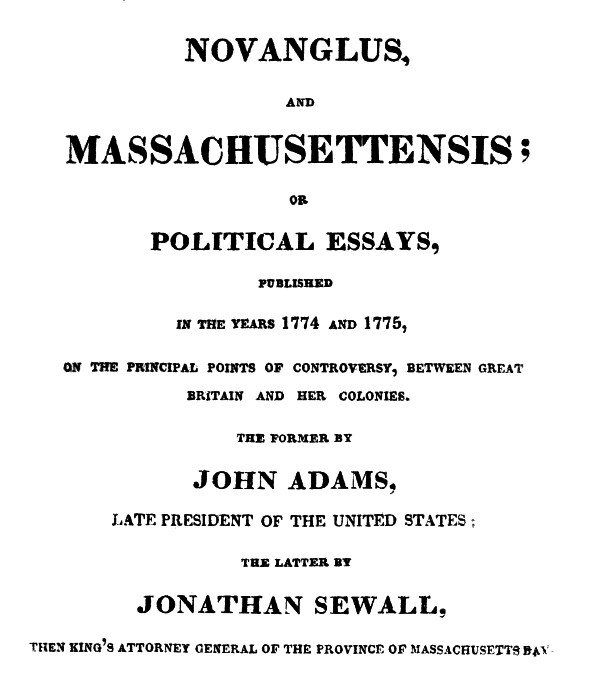
MASSACHUSETTENSIS.
ADDRESSED
To the Inhabitants of the Province of Massachusetts Bay,
January 9, 1775.
MY DEAR COUNTRYMEN,
SOME of you may perhaps suspect that I have been wantonly scattering firebrands, arrows, and death, to gratify a malicious and revengeful disposition. The truth is this. I had seen many excellent detached pieces, but could see no pen at work to trace our calamity to its source, and point out the many adventitious aids, that conspired to raise it to its present height, though I impatiently expected it, being fully convinced that you wait only to know the true state of facts, to rectify whatever is amiss in the province, without any foreign assistance. Others may be induced to think, that I grudge the industrious poor of Boston their scantlings of charity. I will issue a brief in their favour. The opulent, be their political sentiments what they may, ought to relieve them from their sufferings, and those who, by former donations, have been the innocent cause of protracting their sufferings, are under a tenfold obligation to assist them now; and at the same time to make the most explicit declarations, that they did not intend to promote, nor ever will join in rebellion. Great allowances are to be made for the crossings, windings, and tergiversations of a politician; he is a cunning animal, and as government is said to be founded in opinion, his tricks may be a part of the arcana imperii. Had our politicians confined themselves within any reasonable bounds, I never should have molested them; but when I became satisfied, that many innocent, unsuspecting persons were in danger of being seduced to their utter ruin, and the province of Massachusetts Bay in danger of being drenched with blood and carnage, I could restrain my emotions no longer; and having once broke the bands of natural reserve, was determined to probe the sore to the bottom, though I was sure to touch the quick. It is very foreign from my intentions to draw down the vengeance of Great Britain upon the whigs; they are too valuable a part of the community to lose, if they will permit themselves to be saved. I wish nothing worse to the highest of them, than that they may be deprived of their influence, till such time as they shall have changed their sentiments, principles, and measures.
Sedition has already been marked through its zigzag path to the present times. When the statute for regulating the government arrived, a match was put to the train, and the mine, that had been long forming, sprung, and threw the whole province into confusion and anarchy. The occurrencies of the summer and autumn past are so recent and notorious, that a particular detail of them is unnecessary. Suffice it to say, that every barrier that civil government had erected for the security of property, liberty and life, was broken down, and law, constitution and government trampled under foot by the rudest invaders. I shall not dwell upon these harsh notes much longer. I shall yet become an advocate for the leading whigs; much must be allowed to men, in their situation, forcibly actuated by the chagrin of disappointment, the fear of punishment, and the fascination of hope at the same time.
Perhaps the whole story of empire does not furnish another instance of a forcible opposition to government, with so much apparent and little real cause, with such apparent probability without any possibility of success. The stamp-act gave the alarm. The instability of the public councils from the Greenvillian administration to the appointment of the Earl of Hillsborough to the American department, afforded as great a prospect of success, as the heavy duties imposed by the stamp-act, did a colour for the opposition. It was necessary to give the history of this matter in its course, offend who it would, because those acts of government, that are called the greatest grievances, became proper and necessary, through the misconduct of our politicians, and the justice of Great Britain towards us, could not be made apparent without first pointing out that. I intend to consider the acts of the British government, which are held up as the principal grievances, and inquire whether Great Britain is chargeable with injustice in any one of them; but must first ask your attention to the authority of parliament. I suspect many of our politicians are wrong in their first principle, in denying that the constitutional authority of parliament extends to the colonies; if so, it must not be wondered at, that their whole fabric is so ruinous. I shall not travel through all the arguments that have been adduced, for and against this question, but attempt to reduce the substance of them to a narrow compass, after having taken a cursory view of the British constitution.
The security of the people from internal rapacity and violence, and from foreign invasion, is the end and design of government. The simple forms of government are monarchy, aristocracy, and democracy; that is, where the authority of the state is vested in one, a few, or the many. Each of these species of government has advantages peculiar to itself, and would answer the ends of government, were the persons intrusted with the authority of the state, always guided, themselves, by unerring wisdom and public virtue; but rulers are not always exempt from the weakness and depravity which make government necessary to society. Thus monarchy is apt to rush headlong into tyranny, aristocracy to beget faction, and multiplied usurpation, and democracy, to degenerate into tumult, violence, and anarchy. A government formed upon these three principles, in due proportion, is the best calculated to answer the ends of government, and to endure. Such a government is the British constitution, consisting of king, lords and commons, which at once includes the principal excellencies, and excludes the principal defects of the other kinds of government. It is allowed, both by Englishmen and foreigners, to be the most perfect system that the wisdom of ages has produced. The distributions of power are so just, and the proportions so exact, as at once to support and controul each other. An Englishman glories in being subject to, and protected by such a government. The colonies are a part of the British empire. The best writers upon the law of nations tell us, that when a nation takes possession of a distant country, and settles there, that country, though separated from the principal establishment, or mother country, naturally becomes a part of the state, equal with its ancient possessions. Two supreme or independent authorities cannot exist in the same state. It would be what is called imperium in imperio, the height of political absurdity. The analogy between the political and human body is great. Two independent authorities in a state would be like two distinct principles of volition and action in the human body, dissenting, opposing, and destroying each other. If, then, we are a part of the British empire, we must be subject to the supreme power of the state, which is vested in the estates of parliament, notwithstanding each of the colonies have legislative and executive powers of their own, delegated, or granted to them for the purposes of regulating their own internal police, which are subordinate to, and must necessarily be subject to the checks, controul, and regulation of the supreme authority.
This doctrine is not new, but the denial of it is. It is beyond a doubt, that it was the sense both of the parent country, and our ancestors, that they were to remain subject to parliament. It is evident from the charter itself; and this authority has been exercised by parliament, from time to time, almost ever since the first settlement of the country, and has been expressly acknowledged by our provincial legislatures. It is not less our interest, than our duty, to continue subject to the authority of parliament, which will be more fully considered hereafter. The principal argument against the authority of parliament, is this; the Americans are entitled to all the privileges of an Englishman; it is the privilege of an Englishman to be exempt from all laws, that he does not consent to in person, or by representative. The Americans are not represented in parliament, and therefore are exempt from acts of parliament, or in other words, not subject to its authority. This appears specious; but leads to such absurdities as demonstrate its fallacy. If the colonies are not subject to the authority of parliament, Great Britain and the colonies must be distinct states, as completely so, as England and Scotland were before the union, or as Great Britain and Hanover are now. The colonies in that case will owe no allegiance to the imperial crown, and perhaps not to the person of the king, as the title to the crown is derived from an act of parliament, made since the settlement of this province, which act respects the imperial crown only. Let us wave this difficulty, and suppose allegiance due from the colonies to the person of the king of Great Britain. He then appears in a new capacity, of king of America, or rather in several new capacities, of king of Massachusetts, king of Rhode-Island, king of Connecticut, &c. &c. For if our connexion with Great Britain by the parliament be dissolved, we shall have none among ourselves, but each colony become as distinct from the others, as England was from Scotland, before the union. Some have supposed that each state, having one and the same person for its king, is a sufficient connection. Were he an absolute monarch, it might be; but in a mixed government, it is no union at all. For as the king must govern each state, by its parliament, those several parliaments would pursue the particular interest of its own state; and however well disposed the king might be to pursue a line of interest, that was common to all, the checks and controul that he would meet with, would render it impossible. If the king of Great Britain has really these new capacities, they ought to be added to his titles; and another difficulty will arise, the prerogatives of these new crowns have never been defined or limited. Is the monarchical part of the several provincial constitutions to be nearer or more remote from absolute monarchy, in an inverted ratio to each one's approaching to, or receding from a republic? But let us suppose the same prerogatives inherent in the several American crowns, as are in the imperial crown of Great Britain, where shall we find the British constitution, that we all agree we are entitled to? We shall seek for it in vain in our provincial assemblies. They are but faint sketches of the estates of parliament. The houses of representatives, or Burgesses, have not all the powers of the house of commons; in the charter governments they have no more than what is expressly granted by their several charters. The first charters granted to this province did not empower the assembly to tax the people at all. Our council boards are as destitute of the constitutional authority of the house of lords, as their several members are of the noble independence, and splendid appendages of peerage. The house of peers is the bulwark of the British constitution, and through successive ages, has withstood the shocks of monarchy, and the sappings of democracy, and the constitution gained strength by the conflict. Thus the supposition of our being independent states, or exempt from the authority of parliament, destroys the very idea of our having a British constitution. The provincial constitutions, considered as subordinate, are generally well adapted to those purposes of government, for which they were intended; that is, to regulate the internal police of the several colonies; but have no principle of stability within themselves; they may support themselves in moderate times, but would be merged by the violence of turbulent ones, and the several colonies become wholly monarchical, or wholly republican, were it not for the checks, controuls, regulations, and supports of the supreme authority of the empire. Thus the argument, that is drawn from their first principle of our being entitled to English liberties, destroys the principle itself, it deprives us of the bill of rights, and all the benefits resulting from the revolution of English laws, and of the British constitution.
Our patriots have been so intent upon building up American rights, that they have overlooked the rights of Great Britain, and our own interest. Instead of proving that we were entitled to privileges, that our fathers knew our situation would not admit us to enjoy, they have been arguing away our most essential rights. If there be any grievance, it does not consist in our being subject to the authority of parliament, but in our not having an actual representation in it. Were it possible for the colonies to have an equal representation in parliament, and were refused it upon proper application, I confess I should think it a grievance; but at present it seems to be allowed, by all parties, to be impracticable, considering the colonies are distant from Great Britain a thousand transmarine leagues. If that be the case, the right or privilege, that we complain of being deprived of, is not withheld by Britain, but the first principles of government, and the immutable laws of nature, render it impossible for us to enjoy it. This is apparently the meaning of that celebrated passage in Governor Hutchinson's letter, that rang through the continent, viz: There must be an abridgment of what is called English liberties. He subjoins, that he had never yet seen the projection, whereby a colony, three thousand miles distant from the parent state, might enjoy all the privileges of the parent state, and remain subject to it, or in words to that effect. The obnoxious sentence, taken detached from the letter, appears very unfriendly to the colonies; but considered in connection with the other parts of the letter, is but a necessary result from our situation. Allegiance and protection are reciprocal. It is our highest interest to continue a part of the British empire; and equally our duty to remain subject to the authority of parliament. Our own internal police may generally be regulated by our provincial legislatures, but in national concerns, or where our own assemblies do not answer the ends of government with respect to ourselves, the ordinances or interposition of the great council of the nation is necessary. In this case, the major must rule the minor. After many more centuries shall have rolled away, long after we, who are now bustling upon the stage of life, shall have been received to the bosom of mother earth, and our names are forgotten, the colonies may be so far increased as to have the balance of wealth, numbers and power, in their favour, the good of the empire make it necessary to fix the seat of government here; and some future George, equally the friend of mankind, with him that now sways the British sceptre, may cross the Atlantic, and rule Great Britain, by an American parliament.
MASSACHUSETTENSIS.
ADDRESSED
To the Inhabitants of the Province of Massachusetts Bay,
January 16, 1775.
MY DEAR COUNTRYMEN,
HAD a person, some fifteen years ago, undertaken to prove that the colonies were a part of the British empire or dominion, and as such, subject to the authority of the British parliament, he would have acted as ridiculous a part, as to have undertaken to prove a self-evident proposition. Had any person denied it, he would have been called a fool or madman. At this wise period, individuals and bodies of men deny it, notwithstanding in doing it they subvert the fundamentals of government, deprive us of British liberties, and build up absolute monarchy in the colonies; for our charters suppose regal authority in the grantor; if that authority be derived from the British crown, it pre-supposes this territory to have been a part of the British dominion, and as such subject to the imperial sovereign; if that authority was vested in the person of the king, in a different capacity, the British constitution and laws are out of the question, and the king must be absolute as to us, as his prerogatives have never been circumscribed. Such must have been the sovereign authority of the several kings, who have granted American charters, previous to the several grants; there is nothing to detract from it, at this time, in those colonies that are destitute of charters, and the charter governments must severally revert to absolute monarchy, as their charters may happen to be forfeited by the grantees not fulfilling the conditions of them, as every charter contains an express or implied condition.
It is curious indeed to trace the denial and oppugnation to the supreme authority of the state. When the stamp-act was made, the authority of parliament to impose internal taxes was denied; but their right to impose external ones, or in other words, to lay duties upon goods and merchandize was admitted. When the act was made imposing duties upon tea, &c. a new distinction was set up, that the parliament had a right to lay duties upon merchandize for the purpose of regulating trade, but not for the purpose of raising a revenue: that is, the parliament had good right and lawful authority to lay the former duty of a shilling on the pound, but had none to lay the present duty of three pence. Having got thus far safe, it was only taking one step more to extricate ourselves entirely from their fangs, and become independant states, that our patriots most heroically resolved upon, and flatly denied that parliament had a right to make any laws whatever, that should be binding upon the colonies. There is no possible medium between absolute independence, and subjection to the authority of parliament. He must be blind indeed that cannot see our dearest interest in the latter, notwithstanding many pant after the former. Misguided men! could they once overtake their wish, they would be convinced of the madness of the pursuit.
My dear countrymen, it is of the last importance that we settle this point clearly in our minds; it will serve as a sure test, certain criterion and invariable standard to distinguish the friends from the enemies of our country, patriotism from sedition, loyalty from rebellion. To deny the supreme authority of the state, is a high misdemeanor, to say no worse of it; to oppose it by force is an overt act of treason, punishable by confiscation of estate, and most ignominious death. The realm of England is an appropriate term for the ancient realm of England, in contradistinction to Wales and other territories, that have been annexed to it. These as they have been severally annexed to the crown, whether by conquest or otherwise, became a part of the empire, and subject to the authority of parliament, whether they send members to parliament or not, and whether they have legislative powers of their own or not.
Thus Ireland, who has perhaps the greatest possible subordinate legislature, and sends no members to the British parliament, is bound by its acts, when expressly named. Guernsey and Jersey are no part of the realm of England, nor are they represented in parliament, but are subject to its authority: and, in the same predicament are the American colonies, and all the other dispersions of the empire. Permit me to request your attention to this subject a little longer; I assure you it is as interesting and important, as it is dry and unentertaining.
Let us now recur to the first charter of this province, and we shall find irresistible evidence, that our being part of the empire, subject to the supreme authority of the state, bound by its laws and entitled to its protection, were the very terms and conditions by which our ancestors held their lands, and settled the province. Our charter, like all other American charters, are under the great seal of England; the grants are made by the king, for his heirs and successors; the several tenures to be of the king, his heirs and successors; in like manner are the reservations. It is apparent the king acted in his royal capacity, as king of England, which necessarily supposes the territory granted, to be a part of the English dominions, holden of the crown of England.
The charter, after reciting several grants of the territory to sir Henry Roswell and others, proceeds to incorporation in these words: "And for as much as the good and prosperous success of the plantations of the said parts of New England aforesaid, intended by the said sir Henry Roswell and others, to be speedily set upon, cannot but chiefly depend, next under the blessing of almighty God, and the support of our royal authority, upon the good government of the same, to the end that the affairs of business, which from time to time shall happen and arise concerning the said lands and the plantations of the same may be the better managed and ordered, we have further hereby, of our especial grace, certain knowledge and mere motion given, granted and confirmed, and for us, our heirs and successors, do give, grant and confirm unto our said trusty and well beloved subjects, sir Henry Roswell, &c. and all such others as shall hereafter be admitted and made free of the company and society hereafter mentioned, shall from time to time and at all times, forever hereafter, be by virtue of these presents, one body corporate, politic in fact and name by the name of the governor and company of the Massachusetts Bay, in New England; and them by the name of the governor and company of the Massachusetts Bay, in New England, one body politic and corporate in deed, fact and name. We do for us our heirs and successors make, ordain, constitute and confirm by these presents, and that by that name they shall have perpetual succession, and that by that name they and their successors shall be capable and enabled as well to implead and to be impleaded, and to prosecute, demand and answer and be answered unto all and singular suits, causes, quarrels and actions of what kind or nature soever; and also to have, take, possess, acquire and purchase, any lands, tenements and hereditaments, or any goods or chattels, the same to lease, grant, demise, aliene, bargain, sell and dispose of as our liege people of this our realm of England, or any other corporation or body politic of the same may do." I would beg leave to ask one simple question, whether this looks like a distinct state or independent empire? Provision is then made for electing a governor, deputy governor, and eighteen assistants. After which, is this clause: "We do for us, our heirs and successors, give and grant to the said governor and company, and their successors, that the governor or in his absense the deputy governor of the said company, for the time being, and such of the assistants or freemen of the said company as shall be present, or the greater number of them so assembled, whereof the governor or deputy governor and six of the assistants, at the least to be seven, shall have full power and authority to choose, nominate and appoint such and so many others as they shall think fit, and shall be willing to accept the same, to be free of the said company and body, and them into the same to admit and to elect and constitute such officers as they shall think fit and requisite for the ordering, managing and dispatching of the affairs of the said governor and company and their successors, and to make laws and ordinances for the good and welfare of the said company, and for the government and ordering of the said lands and plantations, and the people inhabiting and to inhabit the same, as to them from time to time shall be thought meet: So as such laws and ordinances be not contrary or repugnant to the laws and statutes of this our realm of England."
Another clause is this, "And for their further encouragement, of our especial grace and favor, we do by these presents, for us, our heirs, and successors, yield and grant to the said governor and company and their successors, and every of them, their factors and assigns, that they and every of them shall be free and quit from all taxes, subsidies and customs in New England for the space of seven years, and from all taxes and impositions for the space of twenty-one years, upon all goods and merchandize, at any time or times hereafter, either upon importation thither, or exportation from thence into our realm of England, or into other of our dominions, by the said governor and company and their successors, their deputies, factors and assigns, &c."
The exemption from taxes for seven years in one case, and twenty one years in the other, plainly indicates that after their expiration, this province would be liable to taxation. Now I would ask by what authority those taxes were to be imposed? It could not be by the governor and company, for no such power was delegated or granted to them; and besides it would have been absurd and nugatory to exempt them from their own taxation, supposing them to have had the power, for they might have exempted themselves. It must therefore be by the king or parliament; it could not be by the king alone, for as king of England, the political capacity in which he granted the charter, he had no such power, exclusive of the lords and commons, consequently it must have been by the parliament. This clause in the charter is as evident a recognition of the authority of the parliament over this province, as if the words, "acts of parliament," had been inserted, as they were in the Pennsylvania charter. There was no session of parliament after the grant of our charter until the year 1640. In 1642 the house of commons passed a resolve, "that for the better advancement of the plantations in New England, and the encouragement of the planters to proceed in their undertaking, their exports and imports should be freed and discharged from all customs, subsidies, taxations and duties until the further order of the house;" which was gratefully received and recorded in the archives of our predecessors. This transaction shews very clearly in what sense our connection with England was then understood. It is true, that in some arbitrary reigns, attempts were made by the servants of the crown to exclude the two houses of parliament, from any share of the authority over the colonies; they also attempted to render the king absolute in England; but the parliament always rescued the colonies, as well as England from such attempts.
I shall recite but one more clause of this charter, which is this, "And further our will and pleasure is, and we do hereby for us, our heirs and successors, ordain, declare and grant to the said governor and company, and their successors, that all and every of the subjects of us, our heirs and successors which shall go to and inhabit within the said land and premises hereby mentioned to be granted, and every of their children which shall happen to be born there, or on the seas in going thither, or returning from thence, shall have and enjoy all liberties and immunities of free and natural subjects, within any of the dominions of us, our heirs or successors, to all intents, constructions and purposes whatsoever, as if they and every of them were born within the realm of England." It is upon this, or a similar clause in the charter of William and Mary that our patriots have built up the stupendous fabric of American independence. They argue from it a total exemption from parliamentary authority, because we are not represented in parliament.
I have already shewn that the supposition of our being exempt from the authority of parliament, is pregnant with the grossest absurdities. Let us now consider this clause in connection with the other parts of the charter. It is a rule of law, founded in reason and common sense, to construe each part of an instrument, so as the whole may hang together, and be consistent with itself. If we suppose this clause to exempt us from the authority of parliament, we must throw away all the rest of the charter, for every other part indicates the contrary, as plainly as words can do it; and what is still worse, this clause becomes felo de se, and destroys itself; for if we are not annexed to the crown, we are aliens, and no charter, grant, or other act of the crown can naturalize us or entitle us to the liberties and immunities of Englishmen. It can be done only by act of parliament. An alien is one born in a strange country out of the allegiance of the king, and is under many disabilities though residing in the realm; as Wales, Jersey, Guernsey, Ireland, the foreign plantations, &c. were severally annexed to the crown, they became parts of one and the same empire, the natives of which are equally free as though they had been born in that territory which was the ancient realm. As our patriots depend upon this clause, detached from the charter, let us view it in that light. If a person born in England removes to Ireland and settles there, he is then no longer represented in the British parliament, but he and his posterity are, and will ever be subject to the authority of the British parliament. If he removes to Jersey, Guernsey, or any other parts of the British dominions that send no members to parliament, he will still be in the same predicament. So that the inhabitants of the American colonies do in fact enjoy all the liberties and immunities of natural born subjects. We are entitled to no greater privileges than those that are born within the realm; and they can enjoy no other than we do, when they reside out of it. Thus, it is evident that this clause amounts to no more than the royal assurance, that we are a part of the British empire; are not aliens, but natural born subjects; and as such, bound to obey the supreme power of the state, and entitled to protection from it. To avoid prolixity, I shall not remark particularly upon other parts of this charter, but observe in general, that whoever reads it with attention, will meet with irresistible evidence in every part of it, that our being a part of the English dominions, subject to the English crown, and within the jurisdiction of parliament, were the terms upon which our ancestors settled this colony, and the very tenures by which they held their estates.
No lands within the British dominions are perfectly allodial; they are held mediately or immediately of the king, and upon forfeiture, revert to the crown. My dear countrymen, you have many of you been most falsely and wickedly told by our patriots, that Great Britain was meditating a land tax, and seeking to deprive us of our inheritance; but had all the malice and subtilty of men and devils been united, a readier method to effect it could not have been devised, than the late denials of the authority of parliament, and forcible oppositions to its acts. Yet, this has been planned and executed chiefly by persons of desperate fortunes.
MASSACHUSETTENSIS.
ADDRESSED
To the Inhabitants of the Province of Massachusetts Bay,
January 23, 1775.
MY DEAR COUNTRYMEN,
IF we carry our researches further back than the emigration of our ancestors, we shall find many things that reflect light upon the object we are in quest of. It is immaterial when America was first discovered or taken possession of by the English. In 1602 one Gosnold landed upon one of the islands, called Elizabeth islands, which were so named in honor of queen Elizabeth, built a fort, and projected a settlement; his men were discouraged, and the project failed. In 1606, king James granted all the continent from 34 to 45 degrees, which he divided into two colonies, viz. the southern or Virginia, to certain merchants at London, the northern or New England, to certain merchants at Plymouth in England. In 1607, some of the patentees of the northern colony began a settlement at Sogadahoc; but the emigrants were disheartened after the trial of one winter, and that attempt failed of success. Thus this territory had not only been granted by the crown for purposes of colonization, which are to enlarge the empire or dominion of the parent state, and to open new sources of national wealth; but actual possession had been taken by the grantees, previous to the emigration of our ancestors, or any grant to them. In 1620, a patent was granted to the adventurers for the northern colony, incorporating them by the name of the council for the affairs of New Plymouth. From this company of merchants in England, our ancestors derived their title to this territory. The tract of land called Massachusetts, was purchased of this company, by sir Henry Roswell and associates; their deed bears date March 19th, 1627. In 1628 they obtained a charter of incorporation, which I have already remarked upon. The liberties, privileges and franchises, granted by this charter, do not perhaps exceed those granted to the city of London and other corporations within the realm. The legislative power was very confined; it did not even extend to levying taxes of any kind; that power was however assumed under this charter, which by law worked a forfeiture; and for this among other things, in the reign of Charles the second, the charter was adjudged forfeited, and the franchises seized into the king's hands. This judgment did not affect our ancestors' title to their lands, that were not derived originally from the charter, though confirmed by it, but by purchase from the council at Plymouth, who held immediately under the crown. Besides, our ancestors had now reduced what before was a naked right to possession, and by persevering through unequalled toils, hardships and dangers, at the approach of which other emigrants had fainted, rendered New England a very valuable acquisition both to the crown and nation. This was highly meritorious, and ought not to be overlooked in adjusting the present unhappy dispute; but our patriots would deprive us of all the merit, both to the crown and nation, by severing us from both. After the revolution, our ancestors petitioned the parliament to restore the charter. A bill for that purpose passed the house of commons, but went no further. In consequence of another petition, king William and queen Mary granted our present charter, for uniting and incorporating the Massachusetts, New Plymouth, and several other territories into one province. More extensive powers of legislation, than those contained in the first charter, were become necessary, and were granted; and the form of the legislature made to approach nearer to the form of the supreme legislature. The powers of legislation are confined to local or provincial purposes and further restricted by these words, viz. So as the same be not repugnant or contrary to the laws of this our realm of England. Our patriots have made many nice distinctions and curious refinements, to evade the force of these words; but after all, it is impossible to reconcile them to the idea of an independent state, as it is to reconcile disability to omnipotence. The provincial power of taxation is also restricted to provincial purposes, and allowed to be exercised over such only as are inhabitants or proprietors within the province. I would observe here, that the granting subordinate powers of legislation, does not abridge or diminish the powers of the higher legislatures; thus we see corporations in England and the several towns in this province vested with greater or lesser powers of legislation, without the parliament, in one case, or the general court in the other, being restrained, from enacting those very laws, that fall within the jurisdiction of the several corporations. Had our present charter been conceived in such equivocal terms, as that it might be construed as restraining the authority of parliament, the uniform usage ever since it passed the seal, would satisfy us that its intent was different. The parliament, in the reign when it was granted, long before and in every reign since, has been making statutes to extend to the colonies, and those statutes have been as uniformly submitted to as authoritative, by the colonies, till within ten or a dozen years. Sometimes acts of parliament have been made, and sometimes have been repealed in consequence of petitions from the colonies. The provincial assemblies often refer to acts of parliament in their own, and have sometimes made acts to aid their execution. It is evident that it was the intention of their majesties, to grant subordinate powers of legislation, without impairing or diminishing the authority of the supreme legislature. Had there been any words in the charter, that precluded that construction, or did the whole taken together contradict it, lawyers would tell us, that the king was deceived in his grant, and the patentees took no estate by it, because the crown can neither alienate a part of the British dominions, nor impair the supreme power of the empire. I have dwelt longer on this subject, than I at first intended, and not by any means done it justice, as to avoid prolix narratives and tedious deduction, I have omitted perhaps more than I have adduced, that evinces the truth of the position, that we are a part of the British dominions, and subject to the authority of parliament. The novelty of the contrary tenets, will appear by extracting a part of a pamphlet, published in 1764, by a Boston gentleman, who was then the oracle of the whigs, and whose profound knowledge in the law and constitution is equalled but by few.
"I also lay it down as one of the first principles from whence I intend to deduce the civil rights of the British colonies, that all of them are subject to, and dependent on Great Britain; and that therefore as over subordinate governments, the parliament of Great Britain has an undoubted power and lawful authority to make acts for the general good, that by naming them, shall and ought to be equally binding, as upon the subjects of Great Britain within the realm. Is there the least difference, as to the consent of the colonists, whether taxes and impositions are laid on their trade, and other property by the crown alone, or by the parliament? As it is agreed on all hands, the crown alone cannot impose them, we should be justifiable in refusing to pay them, but must and ought to yield obedience to an act of parliament, though erroneous, till repealed."
"It is a maxim, that the king can do no wrong; and every good subject is bound to believe his king is not inclined to do any. We are blessed with a prince who has given abundant demonstrations, that in all his actions, he studies the good of his people, and the true glory of his crown, which are inseperable. It would therefore be the highest degree of impudence and disloyalty, to imagine that the king, at the head of his parliament, could have any but the most pure and perfect intentions of justice, goodness and truth, that human nature is capable of. All this I say and believe of the king and parliament, in all their acts; even in that which so nearly affects the interests of the colonists; and that a most perfect and ready obedience is to be yielded to it while it remains in force. The power of parliament is uncontroulable but by themselves, and we must obey. They only can repeal their own acts. There would be an end of all government, if one or a number of subjects, or subordinate provinces should take upon them so far to judge of the justice of an act of parliament, as to refuse obedience to it. If there was nothing else to restrain such a step, prudence ought to do it, for forcibly resisting the parliament and the king's laws is high treason. Therefore let the parliament lay what burdens they please on us, we must, it is our duty to submit and patiently bear them, till they will be pleased to relieve us."
The Pennsylvania Farmer, who took the lead in explaining away the right of parliament to raise a revenue in America, speaking of regulating trade, tells us, that "he who considers these provinces as states distinct from the British empire, has very slender notions of justice, or of their interest; we are but parts of a whole, and therefore there must exist a power somewhere to preside, and preserve the connection in due order. This power is lodged in parliament, and we are as much dependant on Great Britain as a perfectly free people can be on another." He supposes that we are dependant in some considerable degree upon Great Britain; and that that dependance is nevertheless consistent with perfect freedom.
Having settled this point, let us reflect upon the resolves and proceedings of our patriots. We often read resolves denying the authority of parliament, which is the imperial sovereign, gilded over with professions of loyalty to the king, but the golden leaf is too thin to conceal the treason. It either argues profound ignorance or hypocritical cunning.
We find many unsuspecting persons prevailed on openly to oppose the execution of acts of parliament with force and arms. My friends, some of the persons that beguiled you, could have turned to the chapter, page and section, where such insurrections are pronounced rebellion, by the law of the land; and had not their hearts been dead to a sense of justice, and steeled against every feeling of humanity, they would have timely warned you of your danger. Our patriots have sent us in pursuit of a mere ignis fatuus, a fascinating glare devoid of substance; and now when we find ourselves bewildered, with scarce one ray of hope to raise our sinking spirits, or stay our fainting souls, they conjure up phantoms more delusive and fleeting, if possible, than that which first led us astray. They tell us, we are a match for Great Britain. The twentieth part of the strength that Great Britain could exert, were it necessary, is more than sufficient to crush this defenceless province to atoms, notwithstanding all the vapouring of the disaffected here and elsewhere. They tell us the army is disaffected to the service. What pains have our wretched politicians not taken to attach them to it? The officers conceive no very favourable opinion of the cause of the whigs, from the obloquy with which their General hath been treated, in return for his humanity, nor from the infamous attempts to seduce the soldiers from his majesty's service. The policy of some of our patriots has been as weak and contemptible, as their motives are sordid and malevolent; for when they found their success, in corrupting the soldiery, did not answer their expectations, they took pains to attach them firmer to the cause they adhered to, by preventing the erecting of barracks for their winter quarters, by which means many contracted diseases, and some lives were lost, from the unwholesome buildings they were obliged to occupy; and, as though some stimulus was still wanting, some provocation to prevent human nature revolting in the hour of battle, they deprived the soldiers of a gratification never denied to the brute creation; straw to lie on. I do not mention this conduct to raise the resentment of the troops; it has had its effect already; and it is proper you should know it; nor should I have blotted paper in relating facts so mortifying to the pride of man, had it not been basely suggested that there would be a defection should the army take the field. Those are matters of small moment, compared to another, which is the cause they are engaged in. It is no longer a struggle between whigs and tories, whether these or those shall occupy posts of honour, or enjoy the emoluments of office, nor is it now whether this or the other act of parliament shall be repealed. The army is sent here to decide a question, intimately connected with the honour and interest of the nation, no less than whether the colonies shall continue a part of, or be for ever dismembered from the British empire. It is a cause in which no honest American can wish our politicians success, though it is devoutly to be wished, that their discomfiture may be effected without recourse being had to the ultima ratio—the sword. This, our wretched situation, is but the natural consequence of denying the authority of parliament, and forcibly opposing its acts.
Sometimes we are amused with intimations that Holland, France or Spain, will make a diversion in our favour. These, equally with the others, are suggestions of despair. These powers have colonies of their own, and might not choose to set a bad example, by encouraging the colonies of any other state to revolt. The Dutch have too much money in the English funds, and are too much attached to their money to espouse our quarrel. The French and Spaniards have not yet forgot the drubbing they received from Great Britain last war; and all three fear to offend that power which our politicians would persuade us to despise.
Lastly, they tell us that the people in England will take our part, and prevent matters from coming to extremity. This is their fort, where, when driven from every other post, they fly for refuge.
Alas, my friends! our congresses have stopped up every avenue that leads to that sanctuary. We hear, by every arrival from England, that it is no longer a ministerial, (if it ever was) but a national cause. My dear countrymen, I deal plainly with you. I never should forgive myself if I did not. Are there not eleven regiments in Boston? A respectable fleet in the harbour? Men of war stationed at every considerable port along the continent? Are there not three ships of the line sent here, notwithstanding the danger of the winter coast, with more than the usual complement of marines? Have not our congresses, county, provincial, and continental, instead of making advances for an accommodation, bid defiance to Great Britain? He that runs may read.
If our politicians will not be pursuaded from running against the thick bosses of the buckler, it is time for us to leave them to their fate, and provide for the safety of ourselves, our wives, our children, our friends, and our country.
I have many things to add, but must now take my leave, for this week, by submitting to your judgment whether there be not an absolute necessity of immediately protesting against all traitorous resolves, leagues, and associations, of bodies of men, that appear to have acted in a representative capacity. Had our congresses been accidental or spontaneous meetings, the whole blame might have rested upon the individuals that composed them; but as they appear in the character of the people's delegates, is there not the utmost danger of the innocent being confounded with the guilty, unless they take care timely to distinguish themselves?
MASSACHUSETTENSIS.
ADDRESSED
To the Inhabitants of the Province of Massachusetts Bay,
January 30, 1775.
MY DEAR COUNTRYMEN,
AS the oppugnation to the king in parliament tends manifestly to independence, and the colonies would soon arrive at that point, did not Great Britain check them in their career; let us indulge the idea, however extravagant and romantic, and suppose ourselves for ever separated from the parent state. Let us suppose Great Britain sinking under the violence of the shock, and overwhelmed by her ancient hereditary enemies; or what is more probable, opening new sources of national wealth, to supply the deficiency of that which used to flow to her through American channels, and perhaps planting more loyal colonies in the new discovered regions of the south, still retaining her pre-eminence among the nations, though regardless of America.
Let us now advert to our own situation. Destitute of British protection, that impervious barrier, behind which, in perfect security, we have increased to a degree almost exceeding the bounds of probability, what other Britain could we look to when in distress? What succedaneum does the world afford to make good the loss? Would not our trade, navigation, and fishery, which no nation dares violate or invade, when distinguished by British colours, become the sport and prey of the maritime powers of Europe? Would not our maritime towns be exposed to the pillaging of every piratical enterprise? Are the colonies able to maintain a fleet, sufficient to afford one idea of security to such an extensive sea-coast? Before they can defend themselves against foreign invasions, they must unite into one empire; otherwise the jarring interests, and opposite propensities, would render the many headed monster in politics, unwieldly and inactive. Neither the form or seat of government would be readily agreed upon; more difficult still would it be to fix upon the person or persons, to be invested with the imperial authority. There is perhaps as great a diversity between the tempers and habits of the inhabitants of this province, and the tempers and habits of the Carolinians, as there subsists between some different nations; nor need we travel so far; the Rhode-Islanders are as diverse from the people of Connecticut, as those mentioned before. Most of the colonies are rivals to each other in trade. Between others there subsist deep animosities, respecting their boundaries, which have heretofore produced violent altercations, and the sword of civil war has been more than once unsheathed, without bringing these disputes to a decision. It is apparent that so many discordant, heterogeneous particles could not suddenly unite and consolidate into one body. It is most probable, that if they were ever united, the union would be effected by some aspiring genius, putting himself at the head of the colonists' army (for we must suppose a very respectable one indeed, before we are severed from Britain) and taking advantage of the enfeebled, bleeding, and distracted state of the colonies, subjugate the whole to the yoke of despotism. Human nature is every where the same; and this has often been the issue of those rebellions, that the rightful prince was unable to subdue. We need not travel through the states of ancient Greece and Rome, or the more modern ones in Europe, to pick up the instances, with which the way is strewed; we have a notable one in our own. So odious and arbitrary was the protectorate of Cromwell, that when death had delivered them from the dread of the tyrant, all parties conspired to restore monarchy; and each one strove to be the foremost in inviting home, and placing upon the imperial throne, their exiled prince, the son of the same Charles, who, not many years before, had been murdered on a scaffold. The republicans themselves now rushed to the opposite extreme, and had Charles 2d. been as ambitious, as some of his predecessors were, he might have established in England a power more arbitrary, than the first Charles ever had in contemplation.
Let us now suppose the colonies united, and moulded into some form of government. Think one moment of the revenue necessary to support this government, and to provide for even the appearance of defence. Conceive yourselves in a manner exhausted by the conflict with Great Britain, now staggering and sinking under the load of your own taxes, and the weight of your own government. Consider further, that to render government operative and salutary, subordination is necessary. This our patriots need not be told of; and when once they had mounted the steed, and found themselves so well seated as to run no risk of being thrown from the saddle, the severity of their discipline to restore subordination, would be in proportion to their former treachery in destroying it. We have already seen specimens of their tyranny, in their inhuman treatment of persons guilty of no crime, except that of differing in sentiment from the whigs. What then must we expect from such scourges of mankind, when supported by imperial power?
To elude the difficulty resulting from our defenceless situation, we are told that the colonies would open a free trade with all the world, and all nations would join in protecting their common mart. A very little reflection will convince us that this is chimerical. American trade, however beneficial to Great Britain, while she can command it, would be but as a drop of the bucket, or the light dust of the balance, to all the commercial states of Europe. Besides, were British fleets and armies no longer destined to our protection, in a very short time, France and Spain would recover possession of those territories, that were torn, reluctant and bleeding from them, in the last war, by the superior strength of Britain. Our enemies would again extend their line of fortification, from the northern to the southern shore; and by means of our late settlements stretching themselves to the confines of Canada, and the communications opened from one country to the other, we should be exposed to perpetual incursions from Canadians and savages. But our distress would not end here; for when once these incursions should be supported by the formidable armaments of France and Spain, the whole continent would become their easy prey, and would be parcelled out, Poland like. Recollect the consternation we were thrown into last war, when Fort William Henry was taken by the French. It was apprehended that all New England would be overrun by their conquering arms. It was even proposed, for our own people to burn and lay waste all the country west of Connecticut river, to impede the enemies march, and prevent their ravaging the country east of it. This proposal come from no inconsiderable man. Consider what must really have been our fate, unaided by Britain last war.
Great Britain aside, what earthly power could stretch out the compassionate arm to shield us from those powers, that have long beheld us with the sharp, piercing eyes of avidity, and have heretofore bled freely, and expended their millions to obtain us? Do you suppose their lust of empire is satiated? Or do you suppose they would scorn to obtain so glorious a prize by an easy conquest? Or can any be so visionary or impious, as to believe that the Father of the Universe will work miracles in favour of rebellion? And after having, by some unseen arm, and mighty power, destroyed Great Britain for us, will in the same mysterious way defend us against other European powers? Sometimes we are told, that the colonies may put themselves under the protection of some one foreign state; but it ought to be considered, that to do that, we must throw ourselves into their power. We can make them no return for protection, but by trade; and of that they can have no assurance, unless we become subject to their laws. This is evident by our contention with Britain.
Which state would you prefer being annexed to; France, Spain, or Holland? I suppose the latter, as it is a republic. But are you sure, that the other powers of Europe would be idle spectators; content to suffer the Dutch to engross the American colonies, or their trade? And what figure would the Dutch probably make in the unequal contest? Their sword has been long since sheathed in commerce. Those of you that have visited Surinam, and seen a Dutch governor dispensing at discretion his own opinions for law, would not suddenly exchange the English for Dutch government.
I will subjoin some observations from the Farmer's letters. "When the appeal is made to the sword, highly probable it is, that the punishment will exceed the offence, and the calamities attending on war outweigh those preceding it. These considerations of justice and prudence, will always have great influence with good and wise men. To these reflections it remains to be added, and ought forever to be remembered, that resistance in the case of the colonies against their mother country, is extremely different from the resistance of a people against their prince. A nation may change their king, or race of kings, and retaining their ancient form of government, be gainers by changing. Thus Great Britain, under the illustrious house of Brunswick, a house that seems to flourish for the happiness of mankind, has found a felicity unknown in the reigns of the Stewarts. But if once we are separated from our mother country, what new form of government shall we adopt, or where shall we find another Britain to supply our loss? Torn from the body, to which we are united by religion, laws, affection, relation, language and commerce, we must bleed at every vein. In truth, the prosperity of these provinces is founded in their dependance on Great Britain."
MASSACHUSETTENSIS.
ADDRESSED
To the Inhabitants of the Province of Massachusetts Bay,
February 6, 1775.
MY DEAR COUNTRYMEN,
WHEN we reflect upon the constitutional connection between Great Britain and the colonies, view the reciprocation of interest, consider that the welfare of Britain, in some measure, and the prosperity of America wholly depends upon that connection; it is astonishing, indeed, almost incredible, that one person should be found on either side of the Atlantic, so base, and destitute of every sentiment of justice, as to attempt to destroy or weaken it. If there are none such, in the name of Almighty God, let me ask, wherefore is rebellion, that implacable fiend to society, suffered to rear its ghastly front among us, blasting, with haggard look, each social joy, and embittering every hour?
Rebellion is the most atrocious offence, that can be perpetrated by man, save those which are committed more immediately against the supreme Governor of the Universe, who is the avenger of his own cause. It dissolves the social band, annihilates the security resulting from law and government; introduces fraud, violence, rapine, murder, sacrilege, and the long train of evils, that riot, uncontrouled, in a state of nature. Allegiance and protection are reciprocal. The subject is bound by the compact to yield obedience to government, and in return, is entitled to protection from it; thus the poor are protected against the rich; the weak against the strong; the individual against the many; and this protection is guaranteed to each member, by the whole community. But when government is laid prostrate, a state of war, of all against all commences; might overcomes right; innocence itself has no security, unless the individual sequesters himself from his fellowmen, inhabits his own cave, and seeks his own prey. This is what is called a state of nature. I once thought it chimerical.
The punishment inflicted upon rebels and traitors, in all states, bears some proportion to the aggravated crime. By our law, the punishment is, "That the offender be drawn to the gallows, and not be carried, or walk; that he be hanged by the neck, and then cut down alive; that his entrails be taken out and burned while he is yet alive; that his head be cut off; that his body be divided into four parts; that his head and quarters be at the king's disposal." The consequences of attainder, are forfeiture and corruption of blood.
"Forfeiture is two-fold, of real and personal estate; by attainder in high treason a man forfeits to the king all his lands and tenements of inheritance, whether fee simple, or fee tail; and all his rights of entry on lands and tenements, which he had at the time of the offence committed, or at any time afterwards to be for ever vested in the crown. The forfeiture relates back to the time of the treason being committed, so as to avoid all intermediate sales and incumberances; even the dower of the wife is forfeited. The natural justice of forfeiture, or confiscation of property, for treason, is founded in this consideration, that he, who has thus violated the fundamental principles of government, and broken his part of the original contract between king and people, hath abandoned his connections with society; hath no longer any right to those advantages, which before belonged to him purely as a member of the community, among which social advantages the right of transferring or transmitting property to others, is one of the chief. Such forfeitures, moreover, whereby his posterity must suffer, as well as himself, will help to restrain a man, not only by the sense of his duty and dread of personal punishment, but also by his passions and natural affections; and will influence every dependant and relation he has to keep him from offending." 4 Black. 374. 375.
It is remarkable, however, that this offence, notwithstanding it is of a crimson colour, and the deepest dye, and its just punishment is not confined to the person of the offender, but beggars all his family, is sometimes committed by persons, who are not conscious of guilt. Sometimes they are ignorant of the law, and do not foresee the evils they bring upon society; at others, they are induced to think that their cause is founded in the eternal principles of justice and truth, that they are only making an appeal to heaven, and may justly expect its decree in their favour. Doubtless many of the rebels, in the year 1745, were buoyed up with such sentiments, nevertheless they were cut down like grass before the scythe of the mower; the gibbet and scaffold received those that the sword, wearied with destroying, had spared; and what loyalist shed one pitying tear over their graves? They were incorrigible rebels, and deserved their fate. The community is in less danger, when the disaffected attempt to excite a rebellion against the person of the prince, than when government itself is the object, because in the former case the questions are few, simple, and their solutions obvious, the fatal consequences more apparent, and the loyal people more alert to suppress it in embryo; whereas, in the latter, a hundred rights of the people, inconsistent with government, and as many grievances, destitute of foundation, the mere creatures of distempered brains, are pourtrayed in the liveliest colours, and serve as bugbears to affright from their duty, or as decoys to allure the ignorant, the credulous and the unwary, to their destruction. Their suspicions are drowned in the perpetual roar for liberty and country; and even the professions of allegiance to the person of the king, are improved as means to subvert his government.
In mentioning high treason in the course of these papers, I may not always have expressed myself with the precision of a lawyer; they have a language peculiar to themselves. I have examined their books, and beg leave to lay before you some further extracts, which deserve your attention. To levy war against the king, was high treason by the common law, 3 inst. 9. This is also declared to be high treason by the stat. of 25 Edw. 3. c. 2. and by the law of this province, 8 W. 3. c. 5. Assembling in warlike array, against a statute, is levying war against the king, 1 Hale 133. So to destroy any trade generally, 146. Riding with banners displayed, or forming into companies; or being furnished with military officers; or armed with military weapons, as swords, guns, &c. any of these circumstances carries the speciem belli, and will support an indictment for high treason in levying war, 150. An insurrection to raise the price of servants' wages was held to be an overt-act of this species of treason, because this was done in defiance of the statute of labourers; it was done in defiance of the king's authority, 5 Bac. 117 cites 3 inst. 10. Every assembling of a number of men, in a warlike manner, with a design to redress any public grievance, is likewise an overt-act of this species of treason, because this being an attempt to do that by private authority, which only ought to be done by the king's authority, is an invasion of the prerogative, 5 Bac. 117 cites 3 inst. 9. Ha. p. c. 14. Kel. 71. Sid. 358. 1. Hawk. 37. Every assembling of a number of men in a warlike manner, with an intention to reform the government, or the law, is an overt-act of this species of treason, 5 Bac. 117. cites 3 inst. 9. 10. Poph. 122. Kel. 76. 7. 1 Hawk. 37. Levying war may be by taking arms, not only to dethrone the king, but under pretence to reform religion, or the laws, or to remove evil councellors, or other grievances, whether real or pretended, 4 Black. 81. Foster 211. If any levy war to expulse strangers; to deliver men out of prison; to remove councellors, or against any statute; or to any other end, pretending reformation of their own heads, without warrant, this is levying war against the king, because they take upon them royal authority, which is against the king, 3 inst. 9. If three, four, or more, rise to pull down an inclosure, this is a riot; but if they had risen of purpose to alter religion, established within the realm, or laws, or to go from town to town generally, and cast down inclosures, this is a levying of war (though there be no great number of conspirators) within the purview of this statute; because the pretence is public and general, and not private in particular, 3 inst. 9. Foster 211. If any, with strength and weapons, invasive and defensive, do hold and defend a castle or fort, against the king and his power, this is levying of war against the king, 3 inst. 10. Foster 219. 1 Hale 149. 296.
It was resolved by all the judges of England in the reign of Henry the 8th, that an insurrection against the statute of labourers, for the enhancing of salaries and wages, was a levying of war against the king, because it was generally against the king's law, and the offenders took upon them the reformation thereof, which subjects by gathering of power, ought not to do, 3 inst. 10. All risings in order to effect innovations of a public and general concern, by an armed force, are, in construction of law, high treason within the clause of levying war. For though they are not levelled at the person of the king, they are against his royal majesty. And besides, they have a direct tendency to dissolve all the bonds of society, and to destroy all property, and all government too, by numbers and an armed force, Foster 211. In Benstead's case, Cro. car. 593. At a conference of all the justices and barons, it was resolved, that going to Lambeth house, in warlike manner, to surprize the archbishop, who was a privy counsellor (it being with drums and a multitude) to the number of three hundred persons, was treason; upon which Foster, page 212, observes, that if it did appear by the libel, which he says was previously posted up at the exchange, exhorting the apprentices to rise and sack the bishop's house, upon the Monday following, or by the cry of the rabble, at Lambeth house, that the attempt was made on account of measures the king had taken, or was then taking at the instigation, as they imagined, of the archbishop, and that the rabble had deliberately and upon a public invitation, attempted by numbers and open force, to take a severe revenge upon the privy counsellor for the measures the sovereign had taken or was pursuing, the grounds and reasons of the resolutions would be sufficiently explained, without taking that little circumstance of the drum into the case. And he delivers as his opinion, page 208, that no great stress can be laid on that distinction taken by Ld. C. J. Hale, between an insurrection with, and one without the appearance of an army formed under leaders, and provided with military weapons, and with drums, colours, &c. and says, the want of these circumstances weighed nothing with the court in the cases of Damaree and Purchase, but that it was supplied by the number of the insurgents. That they were provided with axes, crows, and such like tools, furor arma ministrat; and adds, page 208, the true criterion in all these cases, is, quo animo, did the parties assemble, whether on account of some private quarrel, or, page 211, to effect innovations of a public and general concern, by an armed force. Upon the case of Damaree and Purchase, reported 8 stat. in. 218. to 285. Judge Foster observes, page 215, that "since the meeting houses of protestant dissenters are, by the toleration act taken under protection of the law, the insurrection in the present case, being to pull down all dissenting protestant meeting-houses, was to be considered as a public declaration of the rabble against that act, and an attempt to render it ineffectual by numbers and open force."
If there be a conspiracy to levy war, and afterwards war is levied, the conspiracy is, in every one of the conspirators, an overt act of this species of treason, for there can be no accessary in high treason, 5 Bac. 115. cites 3 inst. 9. 10. 138 Hales P. C. 14. Kel. 19. 1 Hawk. 38. A compassing or conspiracy to levy war is no treason, for there must be a levying of war in facto. But if many conspire to levy war, and some of them do levy the same according to the conspiracy, this is high treason in all, for in treason all are principals, and war is levied, 3 inst. 9. Foster 213.
The painful task of applying the above rules of law to the several transactions that we have been eye witnesses to, will never be mine. Let me however intreat you, to make the application in your own minds; and those of you that have continued hitherto faithful among the faithless, Abdiel like, to persevere in your integrity; and those of you that have been already ensnared by the accursed wiles of designing men, to cast yourselves immediately upon that mercy, so conspicuous through the British constitution, and which is the brightest jewel in the imperial diadem.
MASSACHUSETTENSIS.