
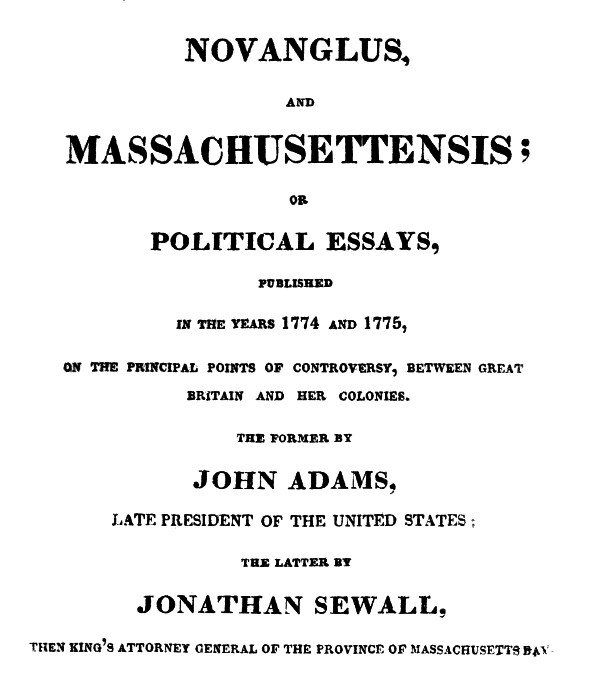
ADDRESSED
To the Inhabitants of the Province of Massachusetts Bay,
March 27, 1775.
MY DEAR COUNTRYMEN,
OUR patriots exclaim, "that humble and reasonable petitions from the representatives of the people have been frequently treated with contempt." This is as virulent a libel upon his majesty's government, as falshood and ingenuity combined could fabricate. Our humble and reasonable petitions have not only been ever graciously received, when the established mode of exhibiting them has been observed, but generally granted. Applications of a different kind, have been treated with neglect, though not always with the contempt they deserved. These either originated in illegal assemblies, and could not be received without implicitly countenancing such enormities, or contained such matter, and were conceived in such terms, as to be at once an insult to his majesty, and a libel on his government. Instead of being decent remonstrances against real grievances, or prayers for their removal, they were insidious attempts to wrest from the crown, or the supreme legislature, their inherent, unalienable prerogatives or rights.
We have a recent instance of this kind of petition, in the application of the continental congress to the king, which starts with these words: "A standing army has been kept in these colonies ever since the conclusion of the late war, without the consent of our assemblies." This is a denial of the king's authority to station his military forces in such parts of the empire, as his majesty may judge expedient for the common safety. They might with equal propriety have advanced one step further, and denied its being a prerogative of the crown to declare war, or conclude a peace, by which the colonies should be affected, without the consent of our assemblies. Such petitions carry the marks of death in their faces, as they cannot be granted but by surrendering some constitutional right at the same time; and therefore afford grounds for suspicion at least, that they were never intended to be granted, but to irritate and provoke the power petitioned to. It is one thing to remonstrate the inexpediency or inconveniency of a particular act of the prerogative, and another to deny the existence of the prerogative. It is one thing to complain of the inutility or hardship of a particular act of parliament, and quite another to deny the authority of parliament to make any act. Had our patriots confined themselves to the former, they would have acted a part conformable to the character they assumed, and merited the encomiums they arrogate.
There is not one act of parliament that respects us, but would have been repealed, upon the legislators being convinced, that it was oppressive; and scarcely one, but would have shared the same fate, upon a representation of its being generally disgustful to America. But, by adhering to the latter, our politicians have ignorantly or wilfully betrayed their country. Even when Great Britain has relaxed in her measures, or appeared to recede from her claims, instead of manifestations of gratitude, our politicians have risen in their demands, and sometimes to such a degree of insolence, as to lay the British government under a necessity of persevering in its measures to preserve its honour.
It was my intention, when I began these papers, to have minutely examined the proceedings of the continental congress, as the delegates appear to me to have given their country a deeper wound, than any of their predecessors had inflicted, and I pray God it may not prove an incurable one; but am in some measure anticipated by Grotius, Phileareine, and the many pamphlets that have been published; and shall therefore confine my observations to some of its most striking and characteristic features.
A congress or convention of committees from the several colonies, constitutionally appointed by the supreme authority of the state, or by the several provincial legislatures, amenable to, and controulable by the power that convened them, would be salutary in many supposeable cases. Such was the convention of 1754; but a congress otherwise appointed, must be an unlawful assembly, wholly incompatible with the constitution, and dangerous in the extreme, more especially as such assemblies will ever chiefly consist of the most violent partizans. The prince, or sovereign, as some writers call the supreme authority of a state, is sufficiently ample and extensive to provide a remedy for every wrong, in all possible emergencies and contingencies; consequently a power, that is not derived from such authority, springing up in a state, must encroach upon it, and in proportion as the usurpation enlarges itself, the rightful prince must be diminished; indeed, they cannot long subsist together, but must continually militate, till one or the other be destroyed. Had the continental congress consisted of committees from the several houses of assembly, although destitute of the consent of the several governors, they would have had some appearance of authority; but many of them were appointed by other committees, as illegally constituted as themselves. However, at so critical and delicate a juncture, Great Britain being alarmed with an apprehension, that the colonies were aiming at independence on the one hand, and the colonies apprehensive of grievous impositions and exactions from Great Britain on the other; many real patriots imagined, that a congress might be eminently serviceable, as they might prevail on the Bostonians to make restitution to the East India company, might still the commotions in this province, remove any ill-founded apprehensions respecting the colonies, and propose some plan for a cordial and permanent reconciliation, which might be adopted by the several assemblies, and make its way through them to the supreme legislature. Placed in this point of light, many good men viewed it with an indulgent eye, and tories, as well as whigs, bade the delegates God speed.
The path of duty was too plain to be overlooked; but unfortunately some of the most influential of the members were the very persons that had been the wilful cause of the evils they were expected to remedy. Fishing in troubled waters had long been their business and delight; and they deprecated nothing more than that the storm they had blown up, should subside. They were old in intrigue, and would have figured in a conclave. The subtility, hypocrisy, cunning, and chicanery, habitual to such men, were practised with as much success in this, as they had been before in other popular assemblies.
Some of the members, of the first rate abilities and characters, endeavoured to confine the deliberations and resolves of the congress to the design of its institution, which was "to restore peace, harmony, and mutual confidence," but were obliged to succumb to the intemperate zeal of some, and at length were so circumvented and wrought upon by the artifice and duplicity of others, as to lend the sanction of their names to such measures, as they condemned in their hearts. Vide a pamphlet published by one of the delegates, entitled, "A candid examination, &c."
The congress could not be ignorant of what every body else knew, that their appointment was repugnant to, and inconsistent with every idea of government, and therefore wisely determined to destroy it. Their first essay that transpired, and which was matter of no less grief to the friends of our country, than of triumph to its enemies, was the ever memorable resolve approbating and adopting the Suffolk resolves, thereby undertaking to give a continental sanction to a forcible opposition to acts of parliament, shutting up the courts of justice, and thereby abrogating all human laws, seizing the king's provincial revenue, raising forces in opposition to the king's, and all the tumultuary violence, with which this unhappy province had been rent asunder.
This fixed the complexion, and marked the character of the congress. We were, therefore, but little surprized, when it was announced, that as far as was in their power, they had dismembered the colonies from the parent country. This they did by resolving, that "the colonists are entitled to an exclusive power of legislation in their several provincial legislatures." This stands in its full force, and is an absolute denial of the authority of parliament respecting the colonies.
Their subjoining that, "from necessity they consent to the operation (not the authority) of such acts of the British parliament, as are (not shall be) bona fide restrained to external commerce," is so far from weakening their first principle, that it strengthens it, and is an adoption of the acts of trade. This resolve is a manifest revolt from the British empire. Consistent with it, is their overlooking the supreme legislature, and addressing the inhabitants of Great Britain, in the style of a manifesto, in which they flatter, complain, coax, and threaten alternately; and their prohibiting all commercial intercourse between the two countries: with equal propriety and justice the congress might have declared war against Great Britain; and they intimate that they might justly do it, and actually shall, if the measures already taken prove ineffectual. For in the address to the colonies, after attempting to enrage their countrymen by every colouring and heightning in the power of language, to the utmost pitch of frenzy, they say, "the state of these colonies would certainly justify other measures than we have advised; we were inclined to offer once more to his majesty the petition of his faithful and oppressed subjects in America," and admonish the colonists to extend their views to mournful events, and to be in all respects prepared for every contingency.
This is treating Great Britain as an alien enemy; and if Great Britain be such, it is justifiable by the law of nations. But their attempt to alienate the affections of the inhabitants of the new conquered province of Quebec from his majesty's government, is altogether unjustifiable, even upon that principle. In the truly jesuitical address to the Canadians, the congress endeavour to seduce them from their allegiance, and prevail on them to join the confederacy. After insinuating that they had been tricked, duped, oppressed and enslaved by the Quebec bill, the congress exclaim, why this degrading distinction? "Have not Canadians sense enough to attend to any other public affairs, than gathering stones from one place and piling them up in another? Unhappy people; who are not only injured but insulted." "Such a treacherous ingenuity has been exerted, in drawing up the code lately offered you, that every sentence, beginning with a benevolent pretention, concludes with a destructive power; and the substance of the whole divested of its smooth words, is that the crown and its ministers shall be as absolute throughout your extended province, as the despots of Asia or Africa. We defy you, casting your view upon every side, to discover a single circumstance promising, from any quarter, the faintest hope of liberty to you or your posterity, but from an entire adoption into the union of these colonies." The treachery of the congress in this address is the more flagrant, by the Quebec bill's having been adapted to the genius and manners of the Canadians, formed upon their own petition, and received with every testimonial of gratitude. The public tranquility has been often disturbed by treasonable plots and conspiracies. Great Britain has been repeatedly deluged by the blood of its slaughtered citizens, and shaken to its centre by rebellion. To offer such aggravated insult to British government was reserved for the grand continental congress. None but ideots or madmen could suppose such measures had a tendency to restore "union and harmony between Great Britain and the colonies." Nay! The very demands of the congress evince, that that was not in their intention. Instead of confining themselves to those acts, which occasioned the misunderstanding, they demand a repeal of fourteen, and bind the colonies by a law not to trade with Great Britain, until that shall be done. Then, and not before, the colonists are to treat Great Britain as an alien friend, and in no other light is the parent country ever after to be viewed; for the parliament is to surcease enacting laws to respect us forever. These demands are such as cannot be complied with, consistent with either the honor or interest of the empire, and are therefore insuperable obstacles to a union via congress.
The delegates erecting themselves into the states general or supreme legislature of all the colonies, from Nova Scotia to Georgia, does not leave a doubt respecting their aiming, in good earnest, at independency: this they did by enacting laws. Although they recognize the authority of the several provincial legislatures, yet they consider their own authority as paramount or supreme; otherwise they would not have acted decisively, but submitted their plans to the final determination of the assemblies. Sometimes indeed they use the terms request and recommend; at others they speak in the style of authority. Such is the resolve of the 27th of September: "Resolved from and after the first day of December next, there be no importation into British America from Great Britain or Ireland of any goods, wares or merchandize whatsoever, or from any other place of any such goods, wares or merchandize, as shall have been exported from Great Britain or Ireland, and that no such goods, wares or merchandize imported, after the said first day of December next, be used or purchased." October 15, the congress resumed the consideration of the plan for carrying into effect the non-importation, &c. October 20, the plan is compleated, determined upon, and ordered to be subscribed by all the members: they call it an association, but it has all the constituent parts of a law. They begin, "We his majesty's most loyal subjects the delegates of the several colonies of, &c. deputed to represent them in a continental congress," and agree for themselves and the inhabitants of the several colonies whom they represent, not to import, export or consume, &c. as also to observe several sumptuary regulations under certain penalties and forfeitures, and that a committee be chosen in every county, city and town, by those who are qualified to vote for representatives in the legislature, to see that the association be observed and kept, and to punish the violators of it; and afterwards, "recommend it to the provincial conventions, and to the committees in the respective colonies to establish such further regulations, as they may think proper, for carrying into execution the association." Here we find the congress enacting laws, that is, establishing, as the representatives of the people, certain rules of conduct to be observed and kept by all the inhabitants of these colonies, under certain pains and penalties, such as masters of vessels being dismissed from their employment; goods to be seized and sold at auction, and the first cost only returned to the proprietor, a different appropriation made of the overplus; persons being stigmatized in the gazette, as enemies to their country, and excluded the benefits of society, &c.
The congress seem to have been apprehensive that some squeamish people might be startled at their assuming the powers of legislation, and therefore, in the former part of their association say, they bind themselves and constituents under the sacred ties of virtue, honor, and love to their country, afterwards establish penalties and forfeitures, and conclude by solemnly binding themselves and constituents under the ties aforesaid, which include them all. This looks like artifice: but they might have spared themselves that trouble; for every law is or ought to be made under the sacred ties of virtue, honor and a love to the country, expressed or implied, though the penal sanction be also necessary. In short, were the colonies distinct states, and the powers of legislation vested in delegates thus appointed, their association would be as good a form of enacting laws as could be devised.
By their assuming the powers of legislation, the congress have not only superseded our provincial legislatures, but have excluded every idea of monarchy; and not content with the havock already made in our constitution, in the plenitude of their power, have appointed another congress to be held in May.
Those, that have attempted to establish new systems, have generally taken care to be consistent with themselves. Let us compare the several parts of the continental proceedings with each other.
The delegates call themselves and constituents "his majesty's most loyal subjects," his majesty's most faithful subjects affirm, that the colonists are entitled "to all the immunities and privileges granted and confirmed to them by royal charters," declare that they "wish not a diminution of the prerogative, nor solicit the grant of any new right or favour," and they "shall always carefully and zealously endeavour to support his royal authority and our connection with Great Britain;" yet deny the king's prerogative to station troops in the colonies, disown him in the capacity in which he granted the provincial charters; disclaim the authority of the king in parliament; and undertake to enact and execute laws without any authority derived from the crown. This is dissolving all connection between the colonies and the crown, and giving us a new king, altogether incomprehensible, not indeed from the infinity of his attributes, but from a privation of every royal prerogative, and not leaving even a semblance of a connection with Great Britain.
They declare, that the colonists "are entitled to all the rights, liberties and immunities of free and natural born subjects within the realm of England," and "all the benefits secured to the subject by the English constitution," but disclaim all obedience to British government; in other words, they claim the protection, and disclaim the allegiance. They remonstrate as a grievance that "both houses of parliament have resolved that the colonists may be tried in England for offences, alleged to have been committed in America, by virtue of a statute passed in the thirty-fifth year of Henry the eighth; and yet resolve that they are entitled to the benefit of such English statutes, as existed at the time of their colonization, and are applicable to their several local and other circumstances." They resolve that the colonists are entitled to a free and exclusive power of legislation in their several provincial assemblies; yet undertake to legislate in congress.
The immutable laws of nature, the principles of the English constitution, and our several charters are the basis, upon which they pretend to found themselves, and complain more especially of being deprived of trials by juries; but establish ordinances incompatible with either the laws of nature, the English constitution, or our charter; and appoint committees to punish the violaters of them, not only without a jury, but even without a form of trial.
They repeatedly complain of the Roman Catholic religion being established in Canada; and in their address to the Canadians, ask, "If liberty of conscience be offered them in their religion by the Quebec bill," and answer, "no: God gave it to you and the temporal powers, with which you have been and are connected, firmly stipulated for your enjoyment of it. If laws, divine and human, could secure it against the despotic caprices of wicked men, it was secured before."
They say to the people of Great Britain, "place us in the same situation, that we were in, at the close of the last war, and our harmony will be restored." Yet some of the principal grievances, which are to be redressed, existed long before that era, viz. The king's keeping a standing army in the colonies; judges of admiralty receiving their fees, &c. from the effects condemned by themselves; counsellors holding commissions during pleasure, exercising legislative authority; and the capital grievance of all, the parliament claiming and exercising over the colonies a right both of legislation and taxation. However the wisdom of the grand continental congress may reconcile these seeming inconsistencies.
Had the delegates been appointed to devise means to irritate and enrage the inhabitants of the two countries, against each other, beyond a possibility of reconciliation, to abolish our equal system of jurisprudence, and establish a judicatory as arbitrary, as the Romish inquisition, to perpetuate animosities among ourselves, to reduce thousands from affluence to poverty and indigence, to injure Great Britain, Ireland, the West Indies, and these colonies, to attempt a revolt from the authority of the empire, and finally to draw down upon the colonies the whole vengeance of Great Britain; more promising means to effect the whole could not have been devised than those the congress adopted. Any deviation from their plan would have been treachery to their constituents, and an abuse of the trust and confidence reposed in them. Some idolaters have attributed to the congress the collected wisdom of the continent. It is as near the truth to say, that every particle of disaffection, petulance, ingratitude, and disloyalty, that for ten years past have been scattered through the continent, were united and consolidated in them. Are these thy Gods, O Israel!
MASSACHUSETTENSIS.
ADDRESSED
To the Inhabitants of the Province of Massachusetts Bay,
April 3, 1775.
MY DEAR COUNTRYMEN,
THE advocates for the opposition to parliament often remind us of the rights of the people, repeat the Latin adage vox populi vox Dei, and tell us that government in the dernier resort is in the people; they chime away melodiously, and to render their music more ravishing, tell us, that these are revolution principles. I hold the rights of the people as sacred, and revere the principles, that have established the succession to the imperial Crown of Great Britain, in the line of the illustrious house of Brunswick; but that the difficulty lies in applying them to the cause of the whigs, hic labor hoc opus est; for admitting that the collective body of the people, that are subject to the British empire, have an inherent right to change their form of government, or race of kings, it does not follow, that the inhabitants of a single province, or of a number of provinces, or any given part under a majority of the whole empire, have such a right. By admitting that the less may rule or sequester themselves from the greater, we unhinge all government. Novanglus has accused me of traducing the people of this province. I deny the charge. Popular demagogues always call themselves the people, and when their own measures are censured, cry out, the people, the people are abused and insulted. He says, that I once entertained different sentiments from those now advanced. I did not write to exculpate myself. If through ignorance, inadvertence or design, I have heretofore contributed in any degree, to the forming that destructive system of politics that is now in vogue, I was under the greater obligation thus publicly to expose its errors, and point out its pernicious tendency. He suggests, that I write from sordid motives. I despise the imputation. I have written my real sentiments not to serve a party (for, as he justly observes, I have sometimes quarreled with my friends) but to serve the public; nor would I injure my country to inherit all the treasures that avarice and ambition sigh for. Fully convinced, that our calamities were chiefly created by the leading whigs, and that a persevering in the same measures that gave rise to our troubles would complete our ruin, I have written freely. It is painful to me to give offence to an individual, but I have not spared the ruinous policy of my brother or my friend; they are both far advanced. Truth, from its own energy, will finally prevail; but to have a speedy effect, it must sometimes be accompanied with severity. The terms whig and tory have been adopted according to the arbitrary use of them in this province, but they rather ought to be reversed; an American tory is a supporter of our excellent constitution, and an American whig a subverter of it.
Novanglus abuses me, for saying, that the whigs aim at independence. The writer from Hampshire county is my advocate. He frankly asserts the independency of the colonies without any reserve; and is the only consistent writer I have met with on that side of the question. For by separating us from the king as well as the parliament, he is under no necessity of contradicting himself. Novanglus strives to hide the inconsistencies of his hypothesis, under a huge pile of learning. Surely he is not to learn, that arguments drawn from obsolete maxims, raked out of the ruins of the feudal system, or from principles of absolute monarchy, will not conclude to the present constitution of government. When he has finished his essays, he may expect some particular remarks upon them. I should not have taken the trouble of writing these letters, had I not been satisfied that real and permanent good would accrue to this province, and indeed to all the colonies, from a speedy change of measures. Public justice and generosity are no less characteristic of the English, than their private honesty and hospitality. The total repeal of the stamp act, and the partial repeal of the act imposing duties on paper, &c. may convince us that the nation has no disposition to injure us. We are blessed with a king that reflects honor upon a crown. He is so far from being avaricious, that he has relinquished a part of his revenue; and so far from being tyrannical, that he has generously surrendered part of his prerogative for the sake of freedom. His court is so far from being tinctured with dissipation, that the palace is rather an academy of the literati, and the royal pair are as exemplary in every private virtue, as they are exalted in their stations. We have only to cease contending with the supreme legislature, respecting its authority, with the king respecting his prerogatives, and with Great Britain respecting our subordination; to dismiss our illegal committees, disband our forces, despise the thraldom arrogant congresses, and submit to constitutional government, to be happy.
Many appear to consider themselves as procul a Jove a fulmine procul; and because we never have experienced any severity from Great Britain, think it impossible that we should. The English nation will bear much from its friends; but whoever has read its history must know, that there is a line that cannot be passed with impunity. It is not the fault of our patriots if that line be not already passed. They have demanded of Great Britain more than she can grant, consistent with honor, her interest, or our own, and are now brandishing the sword of defiance.
Do you expect to conquer in war? War is no longer a simple, but an intricate science, not to be learned from books or two or three campaigns, but from long experience. You need not be told that his majesty's generals, Gage and Haldimand, are possessed of every talent requisite to great commanders, matured by long experience in many parts of the world, and stand high in military fame: that many of the officers have been bred to arms from their infancy, and a large proportion of the army now here, have already reaped immortal honors in the iron harvest of the field.—Alas! My friends, you have nothing to oppose to this force, but a militia unused to service, impatient of command, and destitute of resources. Can your officers depend upon the privates, or the privates upon the officers? Your war can be but little more than mere tumultuary rage: and besides, there is an awful disparity between troops that fight the battles of their sovereign, and those that follow the standard of rebellion. These reflections may arrest you in an hour that you think not of, and come too late to serve you. Nothing short of a miracle could gain you one battle; but could you destroy all the British troops that are now here, and burn the men of war that command our coast, it would be but the beginning of sorrow; and yet without a decisive battle, one campaign would ruin you. This province does not produce its necessary provision, when the husbandman can pursue his calling without molestation: what then must be your condition, when the demand shall be increased, and the resource in a manner cut off? Figure to yourselves what must be your distress, should your wives and children be driven from such places, as the king's troops shall occupy, into the interior parts of the province, and they as well as you, be destitute of support. I take no pleasure in painting these scenes of distress. The whigs affect to divert you from them by ridicule; but should war commence, you can expect nothing but its severities. Might I hazard an opinion, but few of your leaders ever intended to engage in hostilities, but they may have rendered inevitable what they intended for intimidation. Those that unsheath the sword of rebellion may throw away the scabbard, they cannot be treated with, while in arms; and if they lay them down, they are in no other predicament than conquered rebels. The conquered in other wars do not forfeit the rights of men, nor all the rights of citizens, even their bravery is rewarded by a generous victor; far different is the case of a routed rebel host. My dear countrymen, you have before you, at your election, peace or war, happiness or misery. May the God of our forefathers direct you in the way that leads to peace and happiness, before your feet stumble on the dark mountains, before the evil days come, wherein you shall say, we have no pleasure in them.
MASSACHUSETTENSIS.
LETTERS
FROM THE
HON. JOHN ADAMS,
TO THE
HON. WM. TUDOR, AND OTHERS,
ON THE
EVENTS OF THE AMERICAN REVOLUTION.
TO THE EDITOR OF THE WEEKLY REGISTER.
Quincy, January 14, 1818.
Mr. Niles,
IN a former letter I hazarded an opinion, that the true history of the American revolution could not be recovered. I had many reasons for that apprehension; one of which I will attempt to explain.
Of the determination of the British cabinet to assert and maintain the sovereign authority of parliament over the colonies, in all cases of taxation and internal policy, the first demonstration which arrived in America was an order in council to the officers of the customs in Massachusetts Bay, to carry into execution the acts of trade, and to apply to the supreme judicature of the province for writs of assistance, to authorise them to break and enter all houses, cellars, stores, shops, ships, bales, casks, &c. to search and seize all goods, wares, and merchandizes, on which the taxes imposed by those acts had not been paid.
Mr. Cockle, of Salem, a deputy under Mr. Paxton, of Boston, the collector of the customs, petitioned the superior court in Salem, in November, 1760, for such a writ. The court doubted its constitutionality, and consequently its legality; but as the king's order ought to be considered, they ordered the question to be argued before them, by counsel, at the next February term in Boston.
The community was greatly alarmed. The merchants of Salem and of Boston, applied to Mr. Otis to defend them and their country, against that formidable instrument of arbitrary power. They tendered him rich fees; he engaged in their cause, but would accept no fees.
JAMES OTIS, of Boston, sprung from families among the earliest of the planters of the colonies, and the most respectable in rank, while the word rank, and the idea annexed to it, were tolerated in America. He was a gentleman of general science, and extensive literature. He had been an indefatigable student during the whole course of his education in college, and at the bar. He was well versed in Greek and Roman history, philosophy, oratory, poetry, and mythology, His classical studies had been unusually ardent, and his acquisitions uncommonly great. He had composed a treatise on Latin prosody, which he lent to me, and I urged him to print. He consented. It is extant, and may speak for itself. It has been lately reviewed in the Anthology by one of our best scholars, at a mature age, and in a respectable station. He had also composed, with equal skill and great labour, a treatise on Greek prosody. This he also lent me, and, by his indulgence, I had it in my possession six months. When I returned it, I begged him to print it. He said there were no Greek types in the country, or, if there were, there was no printer who knew how to use them. He was a passionate admirer of the Greek poets, especially of Homer; and he said it was in vain to attempt to read the poets in any language, without being master of their prosody. This classic scholar was also a great master of the laws of nature and nations. He had read Puffendorph, Grotius, Barbeyrac, Burlamaqui, Vattel, Heineccius; and, in the civil law, Domal, Justinian, and, upon occasions, consulted the corpus juris at large. It was a maxim which he inculcated on his pupils, as his patron in profession, Mr. Gridley, had done before him, "that a lawyer ought never to be without a volume of natural or public law, or moral philosophy, on his table, or in his pocket." In the history, the common law, and statute laws of England, he had no superior, at least in Boston.
Thus qualified to resist the system of usurpation and despotism, meditated by the British ministry, under the auspices of the earl of Bute, Mr. Otis resigned his commission from the crown, as advocate general, an office very lucrative at that time, and a sure road to the highest favours of government in America, and engaged in the cause of his country without fee or reward. His argument, speech, discourse, oration, harangue—call it by which name you will, was the most impressive upon his crowded audience of any, that I ever heard before or since, excepting only many speeches by himself in Faneuil Hall, and in the House of Representatives, which he made from time to time, for ten years afterwards. There were no stenographers in those days. Speeches were not printed; and all that was not remembered, like the harangues of Indian orators, was lost in air. Who, at the distance of fifty seven years, would attempt, upon memory, to give even a sketch of it. Some of the heads are remembered, out of which Livy or Sallust would not scruple to compose an oration for history. I shall not essay an analysis or a sketch of it, at present. I shall only essay an analysis or a sketch of it, at present. I shall only say, and I do say in the most solemn manner, that Mr. Otis's oration, against writs of assistance, breathed into this nation the breath of life.
Although Mr. Otis had never before interfered in public affairs, his exertions, on this single occasion, secured him a commanding popularity with the friends of their country, and the terror and vengeance of her enemies; neither of which ever deserted him.
At the next election, in May, 1761, he was elected, by a vast majority, a representative in the legislature, of the town of Boston, and continued to be so elected annually for nine years. Here, at the head of the country interest, he conducted her cause with a fortitude, prudence, ability and perseverance which has never been exceeded in America, at every sacrifice of health, pleasure, profit and reputation, and against all the powers of government, and all the talents, learning, wit, scurrility and insolence of its prostitutes.
Hampden was shot in open field of battle. Otis was basely assassinated in a coffee house, in the night, by a well dressed banditti, with a commissioner of the customs at their head.
During the period of nine years, that Mr. Otis was at the head of the cause of his country, he held correspondence with gentlemen in England, Scotland and various colonies in America. He must have written and received many letters, collected many pamphlets, and, probably, composed manuscripts, which might have illustrated the rising dawn of the revolution.
After my return from Europe, I asked his daughter whether she had found among her father's manuscripts, a treatise on Greek prosody? With hands and eyes uplifted, in a paroxysm of grief, she cried, "Oh! sir, I have not a line from my father's pen. I have not even his name in his own hand writing." When she was a little calmed, I asked her, "Who has his papers? Where are they?" She answered, "They are no more. In one of those unhappy dispositions of mind, which distressed him after his great misfortune, and a little before his death, he collected all his papers and pamphlets and committed them to the flames.—He was several days employed in it."
I cannot enlarge. I submit this hint to your reflections. Enclosed is a morsel of verse, written soon after Mr. Otis's death, by a very young gentleman, who is now one of our excellent magistrates. If you do not think fit to print this letter and that verse, I pray you to return them to
JOHN ADAMS.
On the death of James Otis, killed by lightning, at Andover, soon after the peace of 1783, written at the time.
|
When flush'd with conquest and elate with pride, Britannia's monarch Heaven's high will defy'd; And, bent on blood, by lust of rule inclin'd, With odious chains to vex the freeborn mind; On these young shores set up unjust command, And spread the slaves of office round the land; Then Otis rose, and, great in patriot fame, To list'ning crowds resistance dar'd proclaim. From soul to soul the bright idea ran, The fire of freedom flew from man to man, His pen, like Sidney's, made the doctrine known, His tongue, like Tully's, shook a tyrant's throne. Then men grew bold, and, in the public eye, The right divine of monarchs dar'd to try; Light shone on all, despotic darkness fled— And for a SENTIMENT a nation bled. From men, like Otis, INDEPENDENCE grew, From such beginnings empire rose to view. Born for the world, his comprehensive mind Scann'd the wide politics of human kind: Bless'd with a native strength and fire of thought, With Greek and Roman learning richly fraught, Up to the fountain head he push'd his view, And from first principles his maxims drew. 'Spite of the times, this truth he blaz'd abroad, "The people's safety is the law of God."[2] For this he suffered; hireling slaves combin'd To dress in shades the brightest of mankind. And see they come, a dark designing band, With Murder's heart and Execution's hand. Hold, villains! Those polluted hands restrain; Nor that exalted head with blows profane! A nobler end awaits his patriot head; In other sort he'll join the illustrious dead. Yes! when the glorious work which he begun, Shall stand the most complete beneath the sun— When peace shall come to crown the grand design, His eyes shall live to see the work divine.— The Heavens shall then his generous spirit claim, "In storms as loud as his immortal fame."[3] Hark!—the deep thunders echo round the skies! On wings of flame the eternal errand flies. One chosen, charitable bolt is sped, And Otis mingles with the glorious dead. |
TO THE SAME.
Quincy, February 13, 1818.
Mr. Niles,
THE American Revolution was not a common event. Its effects and consequences have already been awful over a great part of the globe. And when and where are they to cease?
But what do we mean by the American revolution? Do we mean the American war? The revolution was effected before the war commenced. The revolution was in the minds and hearts of the people. A change in their religious sentiments, of their duties and obligations. While the king, and all in authority under him, were believed to govern in justice and mercy according to the laws and constitution derived to them from the God of nature, and transmitted to them by their ancestors—they thought themselves bound to pray for the king and queen and all the royal family, and all in authority under them; as ministers ordained of God for their good. But when they saw those powers renouncing all the principles of authority, and bent upon the destruction of all the securities of their lives, liberties and properties, they thought it their duty to pray for the continental congress and all the thirteen state congresses, &c.
There might be, and there were others, who thought less about religion and conscience, but had certain habitual sentiments of allegiance and loyalty derived from their education; but believing allegiance and protection to be reciprocal, when protection was withdrawn, they thought allegiance was dissolved.
Another alteration was common to all. The people of America had been educated in an habitual affection for England as their mother country; and while they thought her a kind and tender parent (erroneously enough, however, for she never was such a mother) no affection could be more sincere. But when they found her a cruel Beldam, willing like lady Macbeth, to "dash their brains out," it is no wonder if their filial affections ceased and were changed into indignation and horror.
This radical change in the principles, opinions, sentiments and affections of the people, was the real American revolution.
By what means, this great and important alteration in the religious, moral, political and social character of the people of thirteen colonies, all distinct, unconnected and independent of each other, was begun, pursued and accomplished, it is surely interesting to humanity to investigate, and perpetuate to posterity.
To this end it is greatly to be desired that young gentlemen of letters in all the states, especially in the thirteen original states, would undertake the laborious, but certainly interesting and amusing task, of searching and collecting all the records, pamphlets, newspapers, and even handbills, which in any way contributed to change the temper and views of the people and compose them into an independent nation.
The colonies had grown up under constitutions of government so different, there was so great a variety of religions, they were composed of so many different nations, their customs, manners and habits had so little resemblance, and their intercourse had been so rare and their knowledge of each other so imperfect, that to unite them in the same principles in theory and the same system of action, was certainly a very difficult enterprise. The complete accomplishment of it, in so short a time and by such simple means, was perhaps a singular example in the history of mankind. Thirteen clocks were made to strike together; a perfection of mechanism which no artist had ever before effected.
In this research, the glorioles of individual gentlemen and of separate states is of little consequence. The means and the measures are the proper objects of investigation. These may be of use to posterity, not only in this nation, but in South America and all other countries. They may teach mankind that revolutions are no trifles, that they ought never to be undertaken rashly; nor without deliberate consideration and sober reflection; nor without a solid, immutable, eternal foundation of justice and humanity; nor without a people possessed of intelligence, fortitude and integrity sufficient to carry them with steadiness, patience, and perseverance, through all the vicissitudes of fortune, the fiery trials and melancholy disasters they may have to encounter.
The town of Boston early instituted an annual oration on the fourth of July, in commemoration of the principles and feelings which contributed to produce the revolution. Many of those orations I have heard, and all that I could obtain I have read. Much ingenuity and eloquence appears upon every subject, except those principles and feelings. That of my honest and amiable neighbour, Josiah Quincy, appeared to me the most directly to the purpose of the institution. Those principles and feelings ought to be traced back for two hundred years, and sought in the history of the country from the first plantations in America. Nor should the principles and feelings of the English and Scotch towards the colonies, through that whole period ever be forgotten. The perpetual discordance between British principles and feelings and of those of America, the next year after the suppression of the French power in America, came to a crisis, and produced an explosion.
It was not until after the annihilation of the French dominion in America, that any British ministry had dared to gratify their own wishes, and the desire of the nation, by projecting a formal plan for raising a national revenue from America, by parliamentary taxation. The first great manifestation of this design was by the order to carry into strict exertions those acts of parliament which were well known by the appellation of the acts of trade, which had lain a dead letter, unexecuted for a half a century, and some of them, I believe, for nearly a whole one.
This produced, in 1760 and 1761, an awakening and a revival of American principles and feelings, with an enthusiasm which went on increasing, till in 1775 it burst out in open violence, hostility and fury.
The characters, the most conspicuous, the most ardent and influential in this revival, from 1760 to 1766, were, first and foremost, before all and above all, James Otis; next to him was Oxenbridge Thatcher; next to him, Samuel Adams; next to him, John Hancock; then Dr. Mayhew; then Dr. Cooper and his brother. Of Mr. Hancock's life, character, generous nature, great and disinterested sacrifices, and important services, if I had forces, I should be glad to write a volume. But this I hope will be done by some younger and abler hand. Mr. Thatcher, because his name and merits are less known, must not be wholly omitted.—This gentleman was an eminent barrister at law, in as large practice as any one in Boston. There was not a citizen of that town more universally beloved for his learning, ingenuity, every domestic and social virtue, and conscientious conduct in every relation of life. His patriotism was as ardent as his progenitors had been ancient and illustrious in this country. Hutchinson often said, "Thatcher was not born a plebeian, but he was determined to die one." In May, 1763, I believe, he was chosen by the town of Boston one of their representatives in the legislature, a colleague with Mr. Otis, who had been a member from May 1761, and he continued to be re-elected annually till his death in 1765, when Mr. Samuel Adams was elected to fill his place, in the absence of Mr. Otis, then attending the congress at New York. Thatcher had long been jealous of the unbounded ambition of Mr. Hutchinson, but when he found him not content with the office of lieut. governor, the command of the castle and its emoluments, of judge of probate for the county of Suffolk, a seat in his majesty's council in the legislature, his brother in-law secretary of state by the king's commission, a brother of that secretary of state, a judge of the supreme court and a member of council, now in 1760 and 1761, soliciting and accepting the office of chief justice of the superior court of judicature, he concluded, as Mr. Otis did, and as every other enlightened friend of his country did, that he sought that office with the determined purpose of determining all causes in favor of the ministry at St. James's, and their servile parliament.
His indignation against him henceforward, to 1765, when he died, knew no bounds but truth. I speak from personal knowledge. For, from 1758 to 1765, I attended every superior and inferior court in Boston, and recollect not one, in which he did not invite me home to spend evenings with him, when he made me converse with him as well as I could, on all subjects of religion, morals, law, politics, history, philosophy, belles lettres, theology, mythology, cosmogony, metaphysics,—Lock, Clark, Leibnits, Bolingbroke, Berckley,—the pre-established harmony of the universe, the nature of matter and of spirit, and the eternal establishment of coincidences between their operations, fate, foreknowledge, absolute; and we reasoned on such unfathomable subjects as high as Milton's gentry in pandemonium; and we understood them as well as they did, and no better. To such mighty mysteries he added the news of the day, and the tittle tattle of the town. But his favourite subject was politics, and the impending threatening system of parliamentary taxation and universal government over the colonies. On this subject he was so anxious and agitated that I have no doubt it occasioned his premature death. From the time when he argued the question of writs of assistance, to his death he considered the king, ministry, parliament and nation of G. B. as determined to new model the colonies from the foundation; to annul all their charters, to constitute them all royal governments; to raise a revenue in America by parliamentary taxation; to apply that revenue to pay the salaries of governours, judges and all other crown officers; and, after all this, to raise as large a revenue as they pleased, to be applied to national purposes at the exchequer in England; and further to establish bishops and the whole system of the church of England, tythes and all, throughout all British America. This system, he said, if it was suffered to prevail, would extinguish the flame of liberty all over the world; that America would be employed as an engine to batter down all the miserable remains of liberty in Great Britain and Ireland, where only any semblance of it was left in the world. To this system he considered Hutchinson, the Olivers and all their connections, dependants, adherents, shoelickers, &c. entirely devoted. He asserted that they were all engaged with all the crown officers in America and the understrappers of the ministry in England, in a deep and treasonable conspiracy to betray the liberties of their country, for their own private, personal and family aggrandizement. His philippicks against the unprincipled ambition and avarice of all of them, but especially of Hutchinson, were unbridled; not only in private, confidential conversations, but in all companies and on all occasions. He gave Hutchinson the sobriquet of "Summa Potestatis," and rarely mentioned him but by the name of "Summa." His liberties of speech were no secrets to his enemies. I have sometimes wondered that they did not throw him over the bar, as they did soon afterwards major Hawley. For they hated him worse than they did James Otis, or Samuel Adams, and they feared him more, because they had no revenge for a father's disappointment of a seat on the superior bench to impute to him, as they did to Otis; and Thatcher's character through life had been so modest, decent, unassuming; his morals so pure, and his religion so venerated, that they dared not attack him. In his office were educated to the bar, two eminent characters, the late judge Lowell, and Josiah Quincy, aptly called the Boston Cicero. Mr. Thatcher's frame was slender, his constitution delicate; whether his physicians overstrained his vessels with mercury, when he had the small pox by inoculation at the castle, or whether he was overplied by public anxieties and exertions, the small pox left him in a decline from which he never recovered. Not long before his death he sent for me to commit to my care some of his business at the bar. I asked him whether he had seen the Virginia resolves: "Oh yes—they are men! they are noble spirits! It kills me to think of the lethargy and stupidity that prevails here. I long to be out. I will go out. I will go out. I will go into court, and make a speech which shall be read after my death, as my dying testimony against this infernal tyranny which they are bringing upon us." Seeing the violent agitation into which it threw him, I changed the subject as soon as possible, and retired. He had been confined for some time. Had he been abroad among the people, he would not have complained so pathetically of the "lethargy and stupidity that prevailed," for town and country were all alive; and in August became active enough, and some of the people proceeded to unwarrantable excesses, which were more lamented by the patriots than by their enemies. Mr. Thatcher soon died, deeply lamented by all the friends of their country.
Another gentleman, who had great influence in the commencement of the revolution, was doctor Jonathan Mayhew, a descendant of the ancient governor of Martha's Vineyard. This divine had raised a great reputation both in Europe and America, by the publication of a volume of seven sermons in the reign of king George the second, 1749, and by many other writings, particularly a sermon in 1750, on the thirtieth of January, on the subject of passive obedience and non-resistance; in which the saintship and martyrdom of king Charles the first are considered, seasoned with wit and satire superior to any in Swift or Franklin. It was read by every body; celebrated by friends and abused by enemies. During the reigns of king George the first and king George the second, the reigns of the Stuarts, the two Jameses and the two Charleses, were in general disgrace in England. In America they had always been held in abhorrence. The persecutions and cruelties suffered by their ancestors under those reigns, had been transmitted by history and tradition, and Mayhew seemed to be raised up to revive all their animosities against tyranny, in church and state, and at the same time to destroy their bigotry, fanaticism and inconsistency. David Hume's plausible, elegant, fascinating and fallacious apology, in which he varnished over the crimes of the Stuarts, had not then appeared. To draw the character of Mayhew would be to transcribe a dozen volumes. This transcendant genius threw all the weight of his great fame into the scale of his country in 1761, and maintained it there with zeal and ardor till his death in 1766. In 1763 appeared the controversy between him and Mr. Apthorp, Mr. Caner, Dr. Johnson and archbishop Secker, on the charter and conduct of the society for propagating the gospel in foreign parts. To form a judgment of this debate I beg leave to refer to a review of the whole, printed at the time and written by Samuel Adams, though by some, very absurdly and erroneously, ascribed to Mr. Apthorp. If I am not mistaken, it will be found a model of candor, sagacity, impartiality, and close, correct reasoning.
If any gentleman supposes this controversy to be nothing to the present purpose, he is grossly mistaken. It spread an universal alarm against the authority of parliament. It excited a general and just apprehension, that bishops and diocesses and churches, and priests, and tythes, were to be imposed on us by parliament. It was known, that neither king, nor ministry, nor archbishops, could appoint bishops, in America, without an act of parliament, and if parliament could tax us, they could establish the church of England, with all its creeds, articles, tests, ceremonies, and tythes, and prohibit all other churches, as conventicles, and schism shops.
Nor must Mr. Cushing be forgotten. His good sense and sound judgment, the urbanity of his manners, his universal good character, his numerous friends and connections, and his continual intercourse with all sorts of people, added to his constant attachment to the liberties of his country, gave him a great and salutary influence from the beginning in 1760.
Let me recommend these hints to the consideration of Mr. Wirt, whose life of Mr. Henry I have read with great delight. I think that after mature investigation, he will be convinced, that Mr. Henry did not "give the first impulse to the ball of independence," and that Otis, Thatcher, Samuel Adams, Mayhew, Hancock, Cushing, and thousands of others, were labouring for several years at the wheel, before the name of Henry was heard beyond the limits of Virginia.
If you print this, I will endeavour to send you something concerning Samuel Adams, who was destined to a longer career, and to act a more conspicuous, and perhaps a more important part than any other man. But his life would require a volume. If you decline printing this letter, I pray you to return it as soon as possible to,
Sir, Your humble servant,
JOHN ADAMS.
TO MR. WIRT.
Quincy, January 5, 1818.
Sir,
YOUR sketches of the life of Mr. Henry have given me a rich entertainment. I will not compare them to the Sybil, conducting Æneas to see the ghosts of departed sages and heroes in the region below, but to an angel, convoying me to the abodes of the blessed on high, to converse with the spirits of just men made perfect. The names of Henry, Lee, Bland, Pendleton, Washington, Rutledge, Dickinson, Wythe, and many others, will ever thrill through my veins with an agreeable sensation. I am not about to make any critical remarks upon your works, at present. But, sir,
|
Erant heroes ante Agamemnona multi. Or, not to garble Horace, Vixere fortes ante Agamemnona Multi: sed omnes illacrimabiles Urgentur, ignotique longa Nocte, carent quia vate sacro. |
If I could go back to the age of thirty five, Mr. Wirt, I would endeavour to become your rival; not in elegance of composition, but in a simple narration of facts, supported by records, histories, and testimonies, of irrefragable authority. I would adopt, in all its modesty, your title, "Sketches of the life and writings of James Otis, of Boston." And, in imitation of your example, I would introduce portraits of a long catalogue of illustrious men, who were agents in the revolution, in favor of it or against it.
Jeremiah Gridley, the father of the bar in Boston, and the preceptor of Pratt, Otis, Thatcher, Cushing, and many others; Benjamin Pratt, chief justice of New-York; colonel John Tynge, James Otis, of Boston, the hero of the biography; Oxenbridge Thatcher, Jonathan Sewall, attorney general and judge of admiralty; Samuel Quincy, solicitor general; Daniel Leonard, now chief justice of Bermuda; Josiah Quincy, the Boston Cicero; Richard Dana and Francis Dana, his son, first minister to Russia, and afterwards chief justice; Jonathan Mayhew, D. D. Samuel Cooper, D. D. Charles Chauncey, D. D. James Warren and his wife; Joseph Warren, of Bunker's Hill; John Winthrop, professor at Harvard college, and a member of council; Samuel Dexter, the father; John Worthington, of Springfield; Joseph Hawley, of Northampton, and James Lovel, of Boston; governors Shirley, Pownal, Bernard, Hutchinson, Hancock, Bowdoin, Adams, Sullivan, and Gerry; lieutenant governor Oliver, chief justice Oliver, judge Edmund Trowbridge, judge William Cushing, and Timothy Ruggles, ought not to be omitted. The military characters, Ward, Lincoln, Warren, Knox, Brooks, Heath, &c. must come in of course. Nor should Benjamin Kent, Samuel Swift, or John Reed, be forgotten.
I envy none of the well merited glories of Virginia, or any of her sages or heroes. But, sir, I am jealous, very jealous, of the honour of Massachusetts.
The resistance to the British system, for subjugating the colonies, began in 1760, and in the month of February, 1761, James Otis electrified the town of Boston, the province of Massachusetts bay, and the whole continent, more than Patrick Henry ever did in the whole course of his life. If we must have panegyrics and hyperboles, I must say, that if Mr. Henry was Demosthenes, and Mr. Richard Henry Lee, Cicero, James Otis was Isaiah and Ezekiel UNITED.
I hope, sir, that some young gentleman, of the ancient and honourable family of "The Searchers," will hereafter do impartial justice, both to Virginia and Massachusetts.
After all this freedom, I assure you, sir, it is no flattery, when I congratulate the nation on the acquisition of an attorney general of such talents and industry as your "Sketches" demonstrate.
With great esteem, I am, Sir,
Your friend and humble servant,
JOHN ADAMS.
Mr. Wirt, Attorney General of the United States.
TO THE SAME.
Quincy, January 23, 1819.
Sir,
I THANK you for your kind letter of the 12th of this month. As I esteem the character of Mr. Henry, an honour to our country, and your volume a masterly delineation of it, I gave orders to purchase it as soon as I heard of it, but was told it was not to be had in Boston. I have seen it only by great favour on a short loan. A copy from the author would be worth many by purchase. It may be sent to me by the mail.
From a personal acquaintance, perhaps I might say a friendship, with Mr. Henry, of more than forty years, and from all that I have heard or read of him, I have always considered him as a gentleman of deep reflection, keen sagacity, clear foresight, daring enterprise, inflexible intrepidity, and untainted integrity; with an ardent zeal for the liberties, the honour, and felicity of his country, and his species. All this, you justly as I believe, represent him to have been. There are, however, remarks to be made upon your work, which, if I had the eyes and hands, I would, in the spirit of friendship, attempt. But my hands, and eyes, and life, are but for a moment.
When congress had finished their business, as they thought, in the autumn of 1774, I had, with Mr. Henry, before we took leave of each other, some familiar conversation, in which I expressed a full conviction, that our resolves, declarations of rights, enumeration of wrongs, petitions, remonstrances, and addresses, associations, and non-importation agreements, however they might be expected in America, and however necessary to cement the union of the colonies, would be but waste water in England. Mr. Henry said, they might make some impression among the people of England, but agreed with me that they would be totally lost upon the government. I had but just received a short and hasty letter, written to me by major Joseph Hawley, of Northampton, containing "a few broken hints," as he called them, of what he thought was proper to be done, and concluding with these words, "after all we must fight." This letter I read to Mr. Henry, who listened with great attention; and as soon as I had pronounced the words, "after all we must fight," he raised his head, and with an energy and vehemence that I can never forget, broke out with "by G—d, I am of that man's mind." I put the letter into his hand, and when he had read it, he returned it to me, with an equally solemn asseveration, that he agreed entirely in opinion with the writer. I considered this as a sacred oath, upon a very great occasion, and could have sworn it as religiously as he did, and by no means inconsistent with what you say, in some part of your book, that he never took the sacred name in vain.
As I knew the sentiments with which Mr. Henry left congress, in the autumn of 1774, and knew the chapter and verse from which he had borrowed the sublime expression, "we must fight," I was not at all surprised at your history, in the 122d page, in the note, and in some of the preceding and following pages. Mr. Henry only pursued, in March, 1775, the views and vows of November, 1774.
The other delegates from Virginia returned to their state in full confidence, that all our grievances would be redressed. The last words that Mr. Richard Henry Lee said to me, when we parted, were, "we shall infallibly carry all our points. You will be completely relieved; all the offensive acts will be repealed; the army and fleet will be recalled, and Britain will give up her foolish project."
Washington only was in doubt, He never spoke in public. In private he joined with those who advocated a non-exportation, as well as a non-importation agreement. With both he thought we should prevail; without either, he thought it doubtful, Henry was clear in one opinion, Richard Henry Lee in an opposite opinion, and Washington doubted between the two. Henry, however, appeared in the end to be exactly in the right.
Oratory, Mr. Wirt, as it consists in expressions of the countenance, graces of attitude and motion, and intonation of voice, although it is altogether superficial and ornamental, will always command admiration, yet it deserves little veneration. Flashes of wit, coruscations of imagination and gay pictures, what are they? Strict truth, rapid reason and pure integrity are the only essential ingredients in sound oratory. I flatter myself, that Demosthenes, by his "action! action! action!" meant to express the same opinion. To speak of American oratory, ancient or modern, would lead me too far, and beyond my depth.
I must conclude with fresh assurances of the high esteem of your humble servant,
JOHN ADAMS.
William Wirt, Esq.
Attorney General of the United States.