
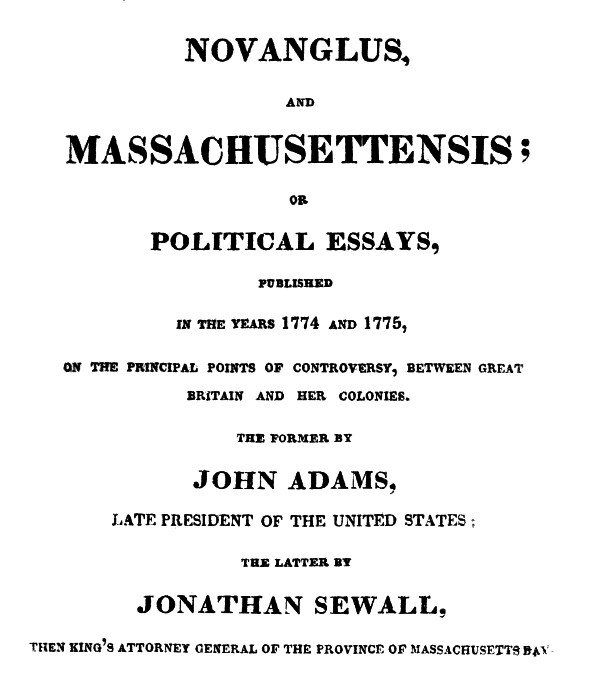
TO THE HON. WM. TUDOR.
Quincy, February 25, 1818.
DEAR SIR,
AS Mr. Wirt has filled my head with James Otis, and as I am well informed, that the honourable Mr. ******** *****, alias ********, alias *** *****, &c. roundly asserts, that Mr. "Otis had no patriotism," and that "he acted only from revenge of his father's disappointment of a seat at the Superior Bench," I will tell you a story which may make you laugh, if it should not happen to melt you into tears.
Otis belonged to a club, who met on evenings, of which club William Molineux, whose character you know very well, was a member. Molineux had a petition before the legislature, which did not succeed to his wishes, and he became for several evenings sour, and wearied the company with his complaints of services, losses, sacrifices, &c. and said, "that a man who has behaved as I have, should be treated as I am, is intolerable," &c. Otis had said nothing, but the company were disgusted and out of patience, when Otis rose from his seat, and said, "come, come, Will, quit this subject, and let us enjoy ourselves. I also have a list of grievances, will you hear it?" The club expected some fun, and all cried out, "Aye! Aye! let us hear your list."
"Well, then, Will; in the first place I resigned the office of advocate general, which I held from the crown which produced me; how much, do you think?" "A great deal, no doubt," said Molineux. "Shall we say two hundred sterling a year?" "Aye, more I believe," said Molineux. "Well, let it be 200; that for ten years is two thousand. In the next place, I have been obliged to relinquish the greatest part of my business at the bar. Will you set that at 200 more?" "Oh I believe it much more than that." "Well let it be 200. This for ten years makes two thousand. You allow, then, I have lost 4000l. sterling." "Aye, and more too," said Molineux.
"In the next place, I have lost an hundred friends; among whom were the men of the first rank, fortune and power in the province. At what price will you estimate them?" "Damn them," said Molineux, "at nothing. You are better without them than with them." A loud laugh. "Be it so," said Otis.
"In the next place, I have made a thousand enemies; amongst whom are the government of the province and the nation. What do you think of this item?" "That is as it may happen," said Molineux.
"In the next place, you know I love pleasure. But I have renounced all amusement for ten years. What is that worth to a man of pleasure?" "No great matter," said Molineux, "you have made politics your amusement." A hearty laugh.
"In the next place, I have ruined as fine health and as good a constitution of body, as nature ever gave to man." "This is melancholy indeed," said Molineux. "There is nothing to be said upon that point."
"Once more," said Otis, holding his head down before Molineux, "look upon this head!" (where was a scar in which a man might bury his finger.) "What do you think of this? And what is worse, my friends think I have a monstrous crack in my scull." This made all the company very grave, and look very solemn. But Otis setting up a laugh, and with a gay countenance, said to Molineux, "Now, Willy, my advice to you is, to say no more about your grievances; for you and I had better put up our accounts of profit and loss in our pockets, and say no more about them, lest the world should laugh at us."
This whimsical dialogue put all the company, and Molineux himself into good humour, and they passed the rest of the evening in joyous conviviality.
It is provoking, and it is astonishing, and it is mortifying, and it is humiliating to see, how calumny sticks, and is transmitted from age to age. Mr. ****** is one of the last men I should have expected to have swallowed that execrable lie, that Otis had no patriotism. The father was refused an office worth 1200l. old tenor, or about 120l. sterling, and the refusal was no loss, for his practice at the bar was worth much more; for Colonel Otis was a lawyer in profitable practice, and his seat in the legislature gave him more power and more honour; for this refusal the son resigned an office which he held from the crown, worth twice the sum. The son must have been a most dutiful and affectionate child to the father. Or rather, most enthusiastically and frenzically affectionate.
I have been young, and now am old, and I solemnly say, I have never known a man whose love of his country was more ardent or sincere; never one, who suffered so much; never one, whose services for any ten years of his life, were so important and essential to the cause of his country, as those of Mr. Otis from 1760 to 1770.
The truth is, he was an honest man, and a thorough taught lawyer. He was called upon in his official capacity as advocate general by the custom house officers, to argue their cause in favour of writs of assistants. These writs he knew to be illegal, unconstitutional, destructive of the liberties of his country; a base instrument of arbitrary power, and intended as an entering wedge to introduce unlimited taxation and legislation by authority of parliament. He therefore scorned to prostitute his honour and his conscience, by becoming a tool. And he scorned to hold an office which could compel him or tempt him to be one. He therefore resigned it. He foresaw as every other enlightened man foresaw, a tremendous storm coming upon his country, and determined to run all risques, and share the fate of the ship, after exerting all his energies to save her, if possible. At the solicitation of Boston and Salem, he accordingly embarked and accepted the command.
To attribute to such a character sinister or trivial motives is ridiculous. You and Mr. Wirt have "brought the old man out," and I fear he will never be driven in again, till he falls into the grave.
JOHN ADAMS.
TO THE HON. WM. TUDOR.
Quincy, March 29, 1818.
DEAR SIR,
IS your daughter, Mrs. ******, who I am credibly informed, is one of the most accomplished ladies, a painter? Are you acquainted with Miss ***** *****, who I am also credibly informed is one of the most accomplished ladies, and a painter? Do you know Mr. Sargent? Do you correspond with your old companion in arms, Col. John Trumbull? Do you think Fisher will be an historical painter?
Whenever you shall find a painter, male or female, I pray you to suggest a scene and subject.
The scene is the council chamber of the old town house in Boston. The date is the month of February, 1761, nine years before you came to me in Cole lane. As this is five years before you entered college, you must have been in the second form of master Lovell's school.
That council chamber was as respectable an apartment, and more so too, in proportion, than the house of lords or house of commons in Great Britain, or that in Philadelphia in which the declaration of independence was signed in 1776.
In this chamber, near the fire, were seated five judges, with lieutenant governor Hutchinson at their head, as chief justice; all in their new fresh robes of scarlet English cloth, in their broad bands, and immense judicial wigs. In this chamber was seated at a long table all the barristers of Boston, and its neighbouring county of Middlesex, in their gowns, bands and tye-wigs. They were not seated on ivory chairs; but their dress was more solemn and more pompous than that of the Roman Senate, when the Gauls broke in upon them. In a corner of the room must be placed wit, sense, imagination, genius, pathos, reason, prudence, eloquence, learning, science, and immense reading, hung by the shoulders on two crutches, covered with a cloth great coat, in the person of Mr. Pratt, who had been solicited on both sides but would engage on neither, being about to leave Boston forever, as chief justice of New York.
Two portraits, at more than full length, of king Charles the second, and king James the second, in splendid golden frames, were hung up in the most conspicuous side of the apartment. If my young eyes or old memory have not deceived me, these were the finest pictures I have seen. The colours of their long flowing robes and their royal ermines were the most glowing, the figures the most noble and graceful, the features the most distinct and characteristic: far superior to those of the king and queen of France in the senate chamber of congress. I believe they were Vandyke's. Sure I am there was no painter in England capable of them at that time. They had been sent over without frames, in governor Pownal's time. But as he was no admirer of Charleses or Jameses, they were stowed away in a garret among rubbish, till governor Bernard came, had them cleaned, superbly framed, and placed in council for the admiration and imitation of all men, no doubt with the concurrence of Hutchinson and all the junto; for there has always been a junto. One circumstance more. Samuel Quincy and John Adams had been admitted barristers at that term. John was the youngest. He should be painted, looking like a short thick fat archbishop of Canterbury, seated at the table, with a pen in his hand, lost in admiration, now and then minuting those despicable notes which you know that ******** ******** stole from my desk, and printed in the Massachusetts Spy, with two or three bombastic expressions interpolated by himself; and which your pupil, judge Minot, has printed in his history.
You have now the stage and the scenery. Next follows a narration of the subject. I rather think that we lawyers ought to call it a brief of the cause.
When the British ministry received from general Amherst his despatches, announcing his conquest of Montreal, and the consequent annihilation of the French government and power in America, in 1759, they immediately conceived the design and took the resolution of conquering the English colonies, and subjecting them to the unlimited authority of parliament. With this view and intention, they sent orders and instructions to the collector of the customs in Boston, Mr. Charles Paxton, to apply to the civil authority for writs of assistance, to enable the custom house officers, tide waiters, land waiters, and all, to command all sheriffs and constables to attend and aid them in breaking open houses, stores, shops, cellars, ships, bales, trunks, chests, casks, packages of all sorts, to search for goods, wares and merchandizes, which had been imported against the prohibitions, or without paying the taxes imposed by certain acts of parliament, called "The Acts of Trade," i. e. by certain parliamentary statutes, which had been procured to be passed from time to time, for a century before, by a combination of selfish intrigues between West India planters and North American royal governors. These acts never had been executed, and there never had been a time when they would have been, or could have been, obeyed.
Mr. Paxton, no doubt consulting with governor Bernard, lieutenant governor Hutchinson, and all the principal crown officers, and all the rest of the Junto, thought it not prudent to commence his operations in Boston. For obvious reasons, he instructed his deputy collector in Salem, Mr. Cockle, to apply by petition to the superior court, in November, 1760, then sitting in that town, for writs of assistance. Stephen Sewall was then chief justice of that court, an able man, an uncorrupted American, and a sound whig, a sincere friend of liberty, civil and religious. He expressed great doubts of the legality of such a writ, and of the authority of the court to grant it. Not one of his brother judges uttered a word in favor of it; but as it was an application on the part of the crown, it must be heard and determined. After consultation, the court ordered the question to be argued at the next February term, in Boston, i. e. in 1761.
In the mean time chief justice Sewall died, and lieutenant governor Hutchinson was appointed chief justice of that court in his stead. Every observing and thinking man knew that this appointment was made for the direct purpose of deciding this question, in favour of the crown, and all others in which it should be interested.
An alarm was spread far and wide. Merchants of Salem and Boston applied to Mr. Pratt, who refused, and to Mr. Otis and Mr. Thatcher, who accepted, to defend them against this terrible menacing monster, the writ of assistance. Great fees were offered, but Otis, and I believe Thatcher, would accept of none. "In such a cause," said Otis, "I despise all fees."
I have given you a sketch of the stage and the scenery, and a brief of the cause; or, if you like the phrase better, of the tragedy, comedy or farce.
Now for the actors and performers. Mr. Gridley argued with his characteristic learning, ingenuity and dignity, and said every thing that could be said in favour of Cockle's petition, all depending, however, on the "If the parliament of Great Britain is the sovereign legislator of all the British empire."
Mr. Thatcher followed him on the other side, and argued with the softness of manners, the ingenuity, the cool reasoning which were peculiar to his amiable character.
But Otis was a flame of Fire! With a promptitude of classical allusions, a depth of research, a rapid summary of historical events and dates, a profusion of legal authorities, a prophetic glare of his eyes into futurity, and a rapid torrent of impetuous eloquence he hurried away all before him. American independence was then and there born. The seeds of patriots and heroes to defend the Non Sine Diis Animosus Infans; to defend the vigorous youth were then and there sown. Every man of an immense crowded audience appeared to me to go away as I did, ready to take arms against writs of assistance. Then and there was the first scene of the first act of opposition to the arbitrary claims of Great Britain. Then and there the child Independence was born. In fifteen years, i. e. in 1776, he grew up to manhood and declared himself free.
The court adjourned for consideration, and after some days at the close of the term, Hutchinson chief justice arose and said, "The court has considered the subject of writs of assistance, and can see no foundation for such a writ; but as the practise in England is not known, it has been thought best, to continue the question to next term, that in the mean time opportunity may be given to write to England for information concerning the subject." In six months the next term arrived; but no judgment was pronounced; nothing was said about writs of assistance; no letters from England, and nothing more was said in court concerning them.—But it was generally reported and understood that the court clandestinely granted them; and the custom house officers had them in their pockets, though I never knew that they dared to produce and execute them in any one instance.
Mr. Otis's popularity was without bounds. In May, 1761, he was elected into the house of representatives, by an almost unanimous vote. On that week I happened to be at Worcester attending a court of common pleas of which, brigadier Ruggles was chief justice. When the news arrived from Boston, you can have no idea of the consternation among the government people. Chief justice Ruggles at dinner at colonel Chandler's on that day, said, "Out of this election will arise a damn'd faction, which will shake this province to its foundation."
For ten years afterwards Mr. Otis, at the head of his country's cause, conducted the town of Boston and the people of the province with a prudence and fortitude, at every sacrifice of personal interest and amidst unceasing persecution, which would have done honour to the most virtuous patriot or martyr of antiquity.
I fear I shall make you repent of bringing out the old gentleman.
JOHN ADAMS.
TO THE HON. WM. TUDOR.
Quincy, April 5, 1818.
DEAR SIR,
IN Mr. Wirt's elegant and eloquent panegyrick on Mr. Henry I beg your attention from page 56 to page 67, the end of the second section, where you will read a curious specimen of the agonies of patriotism in the early stages of the revolution. "When Mr. Henry could carry his resolutions but by one vote, and that against the influence of Randolph, Bland, Pendleton, Wythe and all the old members whose influence in the house had till then been unbroken; and when Peyton Randolph afterwards president of congress swore a round oath, he would have given 500 guineas for a single vote; for one vote would have divided the house, and Robinson was in the chair, who he knew would have negatived the resolution."
And you will also see the confused manner in which they were first recorded, and how they have since been garbled in history. My remarks at present will be confined to the anecdote in page 65.
Cæsar had his Brutus, Charles the first, his Cromwell, and George the third. Treason cried the speaker—treason, treason, echoed from every part of the house. Henry finished his sentence by the words, "may profit by their example." If this be treason make the most of it.
In judge Minot's history of Massachusetts Bay, volume second, in page 102 and 103, you will find another agony of patriotism in 1762, three years before Mr. Henry's. Mr. Otis suffered one of equal severity in the house of representatives of Massachusetts. Judge Minot's account of it is this.
The remonstrance offered to the governor was attended with aggravating circumstances. It was passed, after a very warm speech, by a member in the house, and at first contained the following offensive observation.
"For it will be of little consequence to the people whether they were subject to George or Louis; the king of Great Britain, or the French king; if both were arbitrary, as both would be, if both could levy taxes without parliament." Though judge Minot does not say it, the warm speech was from the tongue, and the offensive observation, from the pen of James Otis; when these words of the remonstrance were first read in the house, Timothy Pain, Esq. a member from Worcester, in his zeal for royalty, though a very worthy and very amiable man, cried out, treason! treason! the house however were not intimidated, but voted the remonstrance with all the treason contained in it, by a large majority; and it was presented to the governor by a committee of which Mr. Otis was a member.
Judge Minot proceeds—"The governor was so displeased with the passage, that he sent a letter to the speaker, returning the message to the house; in which he said, that the king's name, dignity and cause, were so improperly treated that he was obliged to desire the speaker to recommend earnestly to the house, that it might not be entered upon the minutes in the terms in which it then stood. For if it should, he was then satisfied they would again and again, wish that some part of it were expunged, especially if it should appear, as he doubted not it would when he entered upon his vindication, that there was not the least ground for the insinuation, under colour of which, that sacred and well beloved name was so disrespectfully brought into question."
Upon the reading of this letter, the exceptionable clause was struck out of the message.
I have now before me a pamphlet printed in 1763, by Edes & Gill, in Queen-street, Boston, entitled a vindication of the conduct of the house of representatives of the province of the Massachusetts Bay, more particularly in the last session of the general assembly, by James Otis, Esq. a member of said house, with this motto—
|
Let such, such only, tread this sacred floor, Who dare to love their Country and be poor; Or good, tho' rich, humane and wise, tho' great, Jove give but these, we've nought to fear from fate. |
I wish I could transcribe the whole of this pamphlet, because it is a document of importance in the early history of the revolution, which ought never to be forgotten. It shows in a strong light the heaves and throes of the burning mountain, three years at least, before the explosion of the volcano in Massachusetts or Virginia.
Had judge Minot ever seen this pamphlet, could he have given so superficial an account of this year, 1762? There was more than one "warm speech" made in that session of the legislature; Mr. Otis himself, made many. A dark cloud hung over the whole continent; but it was peculiarly black and threatening over Massachusetts and the town of Boston, against which devoted city the first thunderbolts of parliamentary omnipotence were intended and expected to be darted. Mr. Otis, from his first appearance in the house in 1761, had shewn such a vast superiority of talents, information and energy to every other member of the house, that in 1763 he took the lead as it were of course. He opened the session with a speech, a sketch of which he has given us himself. It depends upon no man's memory. It is warm; it is true. But it is warm only with loyalty to his king, love to his country, and exultations in her exertions in the national cause.
This pamphlet ought to be reprinted and deposited in the cabinet of the curious. The preface, is a frank, candid and manly page, explaining the motive of the publication, viz: the clamours against the house for their proceedings, in which he truly says.—"The world ever has been, and ever will be pretty equally divided, between those two great parties, vulgarly called the winners and the losers; or to speak more precisely, between those who are discontented that they have no power, and those who think they never can have enough." Now it is absolutely impossible to please both sides either by temporizing, trimming or retreating; the two former justly incur the censure of a wicked heart; the latter that of cowardice, and fairly and manfully fighting the battle, and it is in the opinion of many worse than either. On the 8th of September, A. D. 1762, the war still continuing in North America and the West Indies, governor Bernard made his speech to both houses, and presented a requisition of sir Jeffery Amherst, that the Massachusetts troops should be continued in pay during the winter.
Mr. Otis made a speech, the outlines of which he has recorded in the pamphlet, urging a compliance with the governor's recommendation and general Amherst's requisition; and concluding with a motion for a committee to consider of both.
A committee was appointed, of whom Mr. Otis was one, and reported not only a continuance of the troops already in service, but an addition of nine hundred men, with an augmented bounty to encourage their enlistment.
If the orators on the 4th of July, really wish to investigate the principles and feelings which produced the revolution, they ought to study this pamphlet and Dr. Mayhew's sermon on passive obedience and non-resistance, and all the documents of those days. The celebrations of independence have departed from the object of their institution, as much as the society for the propagation of the gospel in foreign parts have from their charter. The institution had better be wholly abolished, than continued an engine of the politics and feelings of the day, instead of a memorial of the principles and feelings of the revolution half a century ago, I might have said for two centuries before.
This pamphlet of Mr. Otis exhibits the interesting spectacle of a great man glowing with loyalty to his sovereign, proud of his connection with the British empire, rejoicing in its prosperity, its triumphs and its glory, exulting in the unexampled efforts of his own native province to promote them all: but at the same time grieving and complaining at the ungenerous treatment that province had received from its beginning from the mother country, and shuddering under the prospect of still greater ingratitude and cruelty from the same source. Hear a few of his words, and read all the rest.
"Mr. Speaker—This province has upon all occasions been distinguished by its loyalty and readiness to contribute its most strenuous efforts for his majesty's service. I hope this spirit will ever remain as an indelible characteristic of this people," &c. &c. "Our own immediate interest therefore, as well as the general cause of our king and country requires, that we should contribute the last penny and the last drop of blood, rather than by any backwardness of ours, his majesty's measures should be embarrassed: and thereby any of the enterprises that may be planned for the regular troops, miscarry. Some of these considerations I presume, induced the assembly upon his majesty's requisition, signified last spring by lord Egremont, so cheerfully and unanimously to raise thirty three hundred men for the present campaign; and upon another requisition signified by sir Jeffery Amherst to give a handsome bounty for enlisting about nine hundred more into the regular service. The colonies, we know, have often been blamed without cause; and we have had some share of it. Witness the miscarriage of the pretended expedition against Canada, in queen Ann's time, just before the infamous treaty of Utrecht. It is well known by some now living in this metropolis, that the officers both of the army and navy, expressed their utmost surprise at it upon their arrival. To some of them no doubt, it was a disappointment; for in order to shift the blame of this shameful affair from themselves, they endeavoured to lay it upon the New England colonies.
"I am therefore clearly for raising the men," &c. &c. "This province has, since the year 1754, levied for his majesty's service as soldiers and seamen, near thirty thousand men, besides what have been otherwise employed. One year in particular it was said that every fifth man was engaged in one shape or another.—We have raised sums for the support of this war, that the last generation could hardly have formed any idea of. We are now deeply in debt," &c. &c.
On the 14th of September, the house received a message from the governor, containing a somewhat awkward confession of certain expenditures of public money with advice of council, which had not been appropriated by the house. He had fitted out the Massachusetts sloop of war, increased her establishment of men, &c. Five years before, perhaps this irregularity might have been connived at or pardoned; but, since the debate concerning writs of assistance, and since it was known that the acts of trade were to be enforced, and a revenue collected by authority of parliament, Mr. Otis's maxim, that "taxation without representation was tyranny," and "that expenditures of public money, without appropriations by the representatives of the people, were unconstitutional, arbitrary and therefore tyrannical," had become popular proverbs. They were common place observations in the streets. It was impossible that Otis should not take fire upon this message of the governor. He accordingly did take fire, and made that flaming speech which judge Minot calls "a warm speech" without informing us who made it or what it contained. I wish Mr. Otis had given us this warm speech as he has the comparatively cool one, at the opening of the session. But this is lost forever. It concluded however, with a motion for a committee to consider the governor's message and report. The committee was appointed, and Otis was the first after the speaker.
The committee reported the following answer and remonstrance, every syllable of which is Otis:
"May it please your Excellency:
"The house have duly attended to your excellency's message of the eleventh inst. relating to the Massachusetts sloop, and are humbly of opinion that there is not the least necessity for keeping up her present complement of men, and therefore desire that your excellency would be pleased to reduce them to six, the old establishment made for said sloop by the general court. Justice to ourselves, and to our constituents obliges us to remonstrate against the method of making or increasing establishments by the governor and council.
"It is in effect, taking from the house their most darling privilege, the right of originating all taxes.
"It is, in short, annihilating one branch of legislation. And when once the representatives of the people give up this privilege, the government will very soon become arbitrary.
"No necessity therefore, can be sufficient to justify a house of representatives in giving up such a privilege; for it would be of little consequence to the people, whether they were subject to George or Louis, the king of Great Britain or the French king; if both were arbitrary, as both would be, if both could levy taxes without parliament.
"Had this been the first instance of the kind, we might not have troubled your excellency about it; but lest the matter should go into precedent, we earnestly beseech your excellency, as you regard the peace and welfare of the province, that no measures of this nature be taken for the future, let the advice of council be what it may."
This remonstrance being read, was accepted by a large majority, and sent up and presented to his excellency by a committee of whom Mr. Otis was one.
But here, Mr. Tudor, allow me, a digression, an episode. Lord Ellenborough in the late trial of Hone, says "the Athanasian Creed is the most beautiful composition that ever flowed from the pen of man."
I agree with his lordship, that it is the most consummate mass of absurdity, inconsistency and contradiction that ever was put together. But I appeal to your taste and your conscience, whether the foregoing remonstrance of James Otis is not as terse a morsel of good sense, as Athanasius's Creed is of nonsense and blasphemy?
The same day the above remonstrance was delivered, the town was alarmed with a report, that the house had sent a message to his excellency, reflecting on his majesty's person and government, and highly derogatory to his crown and dignity, and therein desired, that his excellency would in no case take the advice of his majesty's council.
The governor's letter to the speaker, is as judge Minot represents it. Upon reading it, the same person who had before cried out, treason! treason! when he first heard the offensive words, now cried out, "rase them! rase them!" They were accordingly expunged.
In the course of the debate, a new and surprising doctrine was advanced. We have seen the times, when the majority of a council by their words and actions have seemed to think themselves obliged to comply with every thing proposed by the chair, and to have no rule of conduct but a governor's will and pleasure. But now for the first time it was asserted, that the governor in all cases was obliged to act according to the advice of council, and consequently would be deemed to have no judgment of his own.
In page 17, Mr. Otis enters on his apology, excuse or justification of the offensive words: which, as it is as facetious as it is edifying, I will transcribe at length in his own words, viz:
"In order to excuse, if not altogether justify the offensive passage, and clear it from ambiguity, I beg leave to premise two or three data. 1. God made all men naturally equal. 2. The ideas of earthly superiority, pre-eminence and grandeur, are educational, at least acquired, not innate. 3. Kings were, and plantation governors should be made for the good of the people, and not the people for them. 4. No government has a right to make hobby-horses, asses and slaves of the subjects; nature having made sufficient of the former, for all the lawful purposes of man, from the harmless peasant in the field, to the most refined politician in the cabinet; but none of the last, which infallibly proves they are unnecessary. 5. Though most governments are de facto arbitrary, and consequently the curse and scandal of human nature, yet none are de jure arbitrary. 6. The British constitution of government, as now established in his majesty's person and family, is the wisest and best in the world. 7. The king of Great Britain is the best, as well as the most glorious monarch upon the globe, and his subjects the happiest in the universe. 8. It is most humbly presumed, the king would have all his plantation governors follow his royal example, in a wise and strict adherence to the principles of the British constitution, by which in conjunction with his other royal virtues, he is enabled to reign in the hearts of a brave and generous, a free and loyal people. 9. This is the summit, the ne plus ultra of human glory and felicity. 10. The French king is a despotic arbitrary prince, and consequently his subjects are very miserable.
"Let us now take a more careful review of this passage, which by some out of doors has been represented as seditious, rebellious, and traitorous. I hope none, however, will be so wanting to the interest of their country, as to represent the matter in this light on the east side of the Atlantic, though recent instances of such a conduct might be quoted, wherein the province has, after its most strenuous efforts, during this and other wars been painted in all the odious colours, that avarice, malice, and the worst passions could suggest.
"The house assert, that it would be of little consequence to the people, whether they were subject to George or Louis; the king of Great Britain or the French king, if both were arbitrary as both would be, if both could levy taxes without parliament. Or in the same words transposed without the least alteration of the sense. It would be of little consequence to the people, whether they were subject to George the king of Great Britain, or Louis the French king, if both were arbitrary, as both would be, if both could levy taxes without parliament.
"The first question that would occur to a philosopher, if any question could be made about it, would be, whether it were true? But truth being of little importance, with most modern politicians, we shall touch lightly on that topic, and proceed to inquiries of a more interesting nature.
"That arbitrary government implies the worst of temporary evils, or at least the continual danger of them, is certain. That a man would be pretty equally subject to these evils, under every arbitrary government, is clear. That I should die very soon after my head should be cut off, whether by a sabre or a broad sword, whether chopped off to gratify a tyrant, by the Christian name of Tom, Dick, or Harry, is evident. That the name of the tyrant would be of no more avail to save my life, than the name of the executioner, needs no proof. It is therefore manifestly of no importance what a prince's christian name is, if he be arbitrary, any more indeed if he were not arbitrary. So the whole amount of this dangerous proposition, may at least, in one view be reduced to this, viz: It is of little importance what a king's christian name is. It is, indeed, of importance, that a king, a governor, and all other good christians, should have a christian name, but whether Edward, Francis, or William, is of none, that I can discern. It being a rule, to put the most mild and favourable construction upon words, that they can possibly bear, it will follow, that this proposition is a very harmless one, that cannot by any means tend to prejudice his majesty's person, crown, dignity, or cause, all which I deem equally sacred with his excellency.
"If this proposition will bear an hundred different constructions, they must all be admitted before any that imports any bad meaning, much more a treasonable one.
"It is conceived the house intended nothing disrespectful to his majesty, his government, or governor, in those words. It would be very injurious to insinuate this of a house, that upon all occasions has distinguished itself by a truly loyal spirit, and which spirit possesses at least nine hundred and ninety nine in a thousand, of their constituents throughout the province. One good natured construction at least seems to be implied in the assertion, and that pretty strongly, viz: that in the present situation of Great Britain and France, it is of vast importance to be a Britain rather than a Frenchman, as the French king is an arbitrary, despotic prince, but the king of Great Britain is not so de jure, de facto, nor by inclination; a greater difference on this side the grave cannot be found, than that which subsists between British subjects and the slaves of tyranny.
"Perhaps it may be objected, that there is some difference even between arbitrary princes; in this respect at least, that some are more vigorous than others. It is granted; but, then, let it be remembered, that the life of man is a vapour, that shall soon vanish away, and we know not who may come after him, a wise man or a fool; though the chances before and since Solomon have ever been in favour of the latter. Therefore it is said of little consequence. Had it been no instead of little, the clause upon the most rigid stricture might have been found barely exceptionable.
"Some fine gentlemen have charged the expression as indelicate. This is a capital impeachment in politics, and therefore demands our most serious attention. The idea of delicacy, in the creed of some politicians, implies, that an inferior should, at the peril of all that is near and dear to him, i. e. his interest, avoid, every the least trifle that can offend his superior. Does my superior want my estate? I must give it him, and that with a good grace; which is appearing, and, if possible, being really obliged to him, that he will condescend to take it. The reason is evident; it might give him some little pain or uneasiness to see me whimpering, much more openly complaining, at the loss of a little glittering dirt. I must according to this system, not only endeavour to acquire myself, but impress upon all around me, a reverence and passive obedience, to the sentiments of my superior, little short of adoration. Is the superior in contemplation a king, I must consider him as God's Vicegerent, cloathed with unlimited power, his will the supreme law, and not accountable for his actions, let them be what they may, to any tribunal upon earth. Is the superior a plantation governor? He must be viewed, not only as the most excellent representation of majesty, but as a viceroy in his department, and quoad provincial administration, to all intents and purposes, vested with all the prerogatives that were ever exercised by the most absolute prince in Great Britain.
"The votaries of this sect, are all monopolizers of offices, peculators, informers, and generally the seekers of all kinds. It is better, say they, to "give up any thing, and every thing quietly, than contend with a superior, who, by his prerogative, can do, and as the vulgar express it, right or wrong, will have whatever he pleases. For you must know, that according to some of the most refined and fashionable systems of modern politics, the ideas of right and wrong, and all the moral virtues, are to be considered only as the vagaries of a weak and distempered imagination in the possessor, and of no use in the world, but for the skilful politician to convert to his own purposes of power and profit. With these
|
"The love of country is an empty name; For gold they hunger, but ne'er thirst for fame." |
"It is well known, that the least "patriotic spark" unawares "catched" and discovered, disqualifies a candidate from all further preferment in this famous and flourishing order of knights errant. It must, however, be confessed, that they are so catholic as to admit all sorts, from the knights of the post, to a garter and star, provided they are thoroughly divested of the fear of God, and the love of mankind; and have concentrated all their views in dear self, with them the only "sacred and well beloved name" or thing in the universe. See Cardinal Richlieu's Political Testament, and the greater Bible of the Sect, Mandeville's Fable of the Bees. Richlieu expressly, in solemn earnest, without any sarcasm or irony, advises the discarding all honest men from the presence of a prince, and from even the purlieus of a court. According to Mandeville, "the moral virtues are the political offspring which flattery begot upon pride." The most darling principle of the great apostle of the order, who has done more than any mortal towards diffusing corruption, not only through the three kingdoms, but through the remotest dominions, is, that every man has his price, and that if you bid high enough you are sure of him.
"To those who have been taught to bow at the name of a king, with as much ardor and devotion as a papist at the sight of a crucifix, the assertion under examination may appear harsh; but there is an immense difference between the sentiments of a British house of commons remonstrating, and those of a courtier cringing for a favour. A house of representatives here, at least, bears an equal proportion to a governor, with that of a house of commons, to the king. There is indeed one difference in favour of a house of representatives; when a house of commons address the king, they speak to their sovereign, who is truly the most august personage upon earth. When a house of representatives remonstrate to a governor, they speak to a fellow subject, though a superior who is undoubtedly entitled to decency and respect; but I hardly think to quite so much reverence as his master.
"It may not be amiss to observe, that a form of speech may be in no sort improper, when used arguendo, or for illustration, speaking of the king; which same form may be very harsh, indecent and ridiculous, if spoken to the king.
"The expression under censure has had the approbation of divers gentlemen of sense, who are quite unprejudiced to any party. They have taken it to imply a compliment, rather than any indecent reflection upon his majesty's wise and gracious administration. It seems strange, therefore, that the house should be so suddenly charged by his excellency, with "impropriety, groundless insinuations," &c.
"What cause of so bitter repentance, 'again and again,' could possibly have taken place, if this clause had been printed in the journal, I cannot imagine. If the case be fairly represented, I guess the province can be in no danger from a house of representatives daring to speak plain English when they are complaining of a grievance. I sincerely believe that the house had no disposition to enter into any contest with the governor or council. Sure I am, that the promoters of this address had no such view. On the contrary, there is the highest reason to presume, that the house of representatives will at all times rejoice in the prosperity of the governor and council, and contribute their utmost assistance in supporting those two branches of the legislature in all their just rights and pre-eminence. But the house is, and ought to be, jealous and tenacious of its own privileges; these are a sacred deposit, entrusted by the people, and the jealousy of them is a godly jealousy."
Allow me now, Mr. Tudor, a few remarks: 1. Why has the sublime compliment of "treason! treason!" made to Mr. Henry, in 1765, been so celebrated, when that to Mr. Otis, in 1762, three years before, has been totally forgotten? Because the Virginia Patriot has had many trumpeters, and very loud ones; but the Massachusetts Patriot none, though false accusers and vile calumniators in abundance.
2. I know not whether judge Minot was born in 1762. He certainly never saw, heard, felt, or understood any thing of the principles or feelings of that year. If he had, he could not have given so frosty an account of it. The "warm speech" he mentions, was an abridgment or second edition of Otis's argument in 1761, against the execution of the acts of trade. It was a flaming declaration against taxation without representation. It was a warning voice against the calamities that were coming upon his country. It was an ardent effort to alarm and arouse his countrymen against the menacing system of parliamentary taxation.
3. Bernard was no great thing, but he was not a fool. It is impossible to believe, that he thought the offensive passage treason or sedition, of such danger and importance as he represented it. But his design was to destroy Otis. "There is your enemy," said Bernard, (after a Scottish general) "if ye do not kill him, he will kill you."
4. How many volumes are concentrated in this little fugitive pamphlet, the production of a few hurried hours, amidst the continual solicitations of a crowd of clients; for his business at the bar at that time was very extensive and of the first importance; and amidst the host of politicians, suggesting their plans and schemes, claiming his advice and directions!
5. Look over the declarations of rights and wrongs issued by congress in 1774. Look into the declaration of independence, in 1776. Look into the writings of Dr. Price and Dr. Priestly. Look into all the French constitutions of government; and to cap the climax, look into Mr. Thomas Paine's common sense, crisis, and rights of man; what can you find that is not to be found in solid substance in this "vindication of the house of representatives?"
6. Is it not an affront to common sense, an insult to truth, virtue, and patriotism, to represent Patrick Henry, though he was my friend as much as Otis, as the father of the American revolution, and the founder of American independence? The gentleman who has done this, sincerely believed what he wrote I doubt not; but he ought to be made sensible, that he is of yesterday, and knows nothing of the real origin of the American revolution.
7. If there is any bitterness of spirit discernible in Mr. Otis's vindication, this was not natural to him. He was generous, candid, manly, social, friendly, agreeable, amiable, witty, and gay, by nature, and by habit honest, almost to a proverb, though quick and passionate against meanness and deceit. But at this time he was agitated by anxiety for his country, and irritated by a torrent of slander and scurrillity, constantly pouring upon him from all quarters.
Mr. Otis has fortified his vindication, in a long and learned note, which, in mercy to my eyes and fingers, I must borrow another hand to transcribe, in another sheet.
[Here follow quotations from Locke on government, Part II. Ch. IV. Id. Ch. XI. Id. Ch. XIV. B. I. Ch. II. and B. II. Ch. II.]
"This other original Mr. Locke has demonstrated to be the consent of a free people. It is possible there are a few; and I desire to thank God there is no reason to think there are many among us, that cannot bear the names of liberty and property, much less, that the things signified by those terms, should be enjoyed by the vulgar. These may be inclined to brand some of the principles advanced in the vindication of the house, with the odious epithets seditious and levelling. Had any thing to justify them been quoted from colonel Algernon Sydney, or other British martyrs to the liberty of their country, an outcry of rebellion would not be surprising. The authority of Mr. Locke has therefore been preferred to all others, for these further reasons. 1st. He was not only one of the most wise as well as most honest, but the most impartial man that ever lived. 2d. He professedly wrote his discourses on government, as he himself expresses it, "to establish the throne of the great restorer king William; to make good his title in the consent of the people, which being the only one of all lawful governments, he had more fully and clearly than any prince in Christendom, and to justify to the world the people of England, whose love of liberty, their just and natural rights, with their resolution to preserve them, saved the nation when it was on the brink of slavery and ruin." By this title, our illustrious sovereign, George 3d, (whom God long preserve) now holds. 3. Mr. Locke was as great an ornament, under a crowned head, as the church of England ever had to boast of. Had all her sons been of his wise, moderate, tolerant principles, we should probably never have heard of those civil dissentions, that have so often brought the nation to the borders of perdition. Upon the score of his being a churchman, however, his sentiments are less liable to those invidious reflections and insinuations, that high flyers, jacobites, and other stupid bigots, are apt too liberally to bestow, not only upon dissenters of all denominations, but upon the moderate; and therefore infinitely the most valuable part of the church of England itself."
Pardon the trouble of reading the letter, from your habitual partiality for your friend.
JOHN ADAMS.
TO THE HON. WM. TUDOR.
Quincy, April 15, 1818.
DEAR SIR,
I HAVE received your obliging favour of the 8th, but cannot consent to your resolution to ask no more questions. Your questions revive my sluggish memory. Since our national legislature have established a national painter—a wise measure, for which I thank them, my imagination runs upon the art, and has already painted, I know not how many, historical pictures. I have sent you one, give me leave to send another. The bloody rencontre between the citizens and the soldiers, on the 5th of March, 1770, produced a tremendous sensation throughout the town and country. The people assembled first at Faneuil Hall, and adjourned to the old South Church, to the number, as was conjectured, of ten or twelve thousand men, among whom were the most virtuous, substantial, independent, disinterested and intelligent citizens.—They formed themselves into a regular deliberative body, chose their moderator and secretary, entered into discussions, deliberations and debates, adopted resolutions, appointed committees. What has become of these records, Mr. Tudor? Where are they? Their resolutions in public were conformable to those of every man in private, who dared to express his thoughts or his feelings, "that the regular soldiers should be banished from the town, at all hazards." Jonathan Williams, a very pious, inoffensive and conscientious gentleman, was their moderator. A remonstrance to the governor, or the governor and council, was ordained, and a demand that the regular troops should be removed from the town. A committee was appointed to present this remonstrance, of which Samuel Adams was the chairman.
Now for the picture. The theatre and the scenery are the same with those at the discussion of writs of assistance. The same glorious portraits of king Charles II. and king James II. to which might be added, and should be added, little miserable likenesses of Gov. Winthrop, Gov. Bradstreet, Gov. Endicott and Gov. Belcher, hung up in obscure corners of the room. Lieut. Gov. Hutchinson, commander in chief in the absence of the governor, must be placed at the head of the council table. Lieut. Col. Dalrymple, commander in chief of his majesty's military forces, taking rank of all his majesty's counsellors, must be seated by the side of the lieutenant governor and commander in chief of the province. Eight and twenty counsellors must be painted, all seated at the council board. Let me see, what costume? What was the fashion of that day, in the month of March? Large white wigs, English scarlet cloth cloaks, some of them with gold laced hats, not on their heads, indeed, in so august a presence, but on a table before them. Before these illustrious personages appeared Samuel Adams, a member of the house of representatives and their clerk, now at the head of the committee of the great assembly at the old South church. Thucidydes, Livy or Sallust would make a speech for him, or, perhaps, the Italian Bota, if he had known any thing of this transaction, one of the most important of the revolution; but I am wholly incapable of it; and, if I had vanity enough to think myself capable of it, should not dare to attempt it. He represented the state of the town and the country; the dangerous, ruinous and fatal effects of standing armies in populous cities in time of peace, and the determined resolution of the public, that the regular troops, at all events, should be removed from the town. Lieutenant governor Hutchinson, then commander in chief, at the head of a trembling council, said, "he had no authority over the king's troops, that they had their separate commander and separate orders and instructions, and that he could not interfere with them." Mr. Adams instantly appealed to the charter of the province, by which the governor, and in his absence the lieutenant governor, was constituted "commander in chief of all the military and naval power within its jurisdiction." So obviously true and so irrefragable was the reply, that it is astonishing that Mr. Hutchinson should have so grossly betrayed the constitution, and so atrociously have violated the duties of his office by asserting the contrary. But either the fears or the ambition of this gentleman, upon this and many other occasions, especially in his controversy with the two houses, three years afterwards, on the supremacy of parliament, appear to have totally disarranged his understanding. He certainly asserted in public, in the most solemn manner, a multitude of the roundest falshoods, which he must have known to be such, and which he must have known could be easily and would certainly be detected, if he had not wholly lost his memory, even of his own public writing. You, Mr. Tudor, knew Mr. Adams from your childhood to his death. In his common appearance, he was a plain, simple, decent citizen, of middling stature, dress and manners. He had an exquisite ear for music, and a charming voice, when he pleased to exert it.—Yet his ordinary speeches in town meetings, in the house of representatives and in congress, exhibited nothing extraordinary; but upon great occasions, when his deeper feelings were excited, he erected himself, or rather nature seemed to erect him, without the smallest symptom of affectation, into an upright dignity of figure and gesture, and gave a harmony to his voice, which made a strong impression on spectators and auditors, the more lasting for the purity, correctness and nervous elegance of his style.
This was a delicate and a dangerous crisis. The question in the last resort was, whether the town of Boston should become a scene of carnage and desolation or not? Humanity to the soldiers conspired with a regard for the safety of the town, in suggesting the wise measure of calling the town together to deliberate. For nothing short of the most solemn promises to the people, that the soldiers should, at all hazards, be driven from the town, had preserved its peace. Not only the immense assemblies of the people, from day to day, but military arrangements from night to night, were necessary to keep the people and the soldiers from getting together by the ears. The life of a red coat would not have been safe in any street or corner of the town. Nor would the lives of the inhabitants have been much more secure. The whole militia of the city was in requisition, and military watches and guards were every where placed. We were all upon a level; no man was exempted; our military officers were our only superiors. I had the honor to be summoned in my turn, and attended at the state house with my musket and bayonet, my broadsword and cartridge box, under the command of the famous Paddock. I know you will laugh at my military figure; but I believe there was not a more obedient soldier in the regiment, nor one more impartial between the people and the regulars. In this character I was upon duty all night in my turn. No man appeared more anxious or more deeply impressed with a sense of danger on all sides, than our commander Paddock. He called me, common soldier as I was, frequently to his councils. I had a great deal of conversation with him, and no man appeared more apprehensive of a fatal calamity to the town, or more zealous by every prudent measure to prevent it. Such was the situation of affairs, when Samuel Adams was reasoning with lieutenant governor Hutchinson and lieutenant colonel Dalrymple. He had fairly driven them from all their outworks, breastworks and entrenchments, to their citadel. There they paused and considered and deliberated. The heads of Hutchinson and Dalrymple were laid together in whispers for a long time: when the whispering ceased, a long and solemn pause ensued, extremely painful to an impatient and expecting audience. Hutchinson, in time, broke silence; he had consulted with colonel Dalrymple, and the colonel had authorized him to say that he might order one regiment down to the castle, if that would satisfy the people. With a self-recollection, a self-possession, a self-command, a presence of mind that was admired by every man present, Samuel Adams arose with an air of dignity and majesty, of which he was sometimes capable, stretched forth his arm, though even then quivering with palsy, and with an harmonious voice and decisive tone, said, "if the lieutenant governor or colonel Dalrymple, or both together, have authority to remove one regiment, they have authority to remove two; and nothing short of the total evacuation of the town by all the regular troops, will satisfy the public mind or preserve the peace of the province."
These few words thrilled through the veins of every man in the audience, and produced the great result. After a little awkward hesitation, it was agreed that the town should be evacuated and both regiments sent to the castle.
After all this gravity it is merry enough to relate that William Molineaux, was obliged to march side by side with the commander of some of their troops, to protect them from the indignation of the people, in their progress to the wharf of embarcation for the castle. Nor is it less amusing that lord North, as I was repeatedly and credibly informed in England, with his characteristic mixture of good humour and sarcasm, ever after called these troops by the title of "Sam Adams's two regiments."
The painter should seize upon the critical moment when Samuel Adams stretched out his arm, and made his last speech.
It will be as difficult to do justice, as to paint an Apollo; and the transaction deserves to be painted as much as the surrender of Burgoyne. Whether any artist will ever attempt it, I know not.
JOHN ADAMS.
TO THE HON. WM. TUDOR.
Quincy, April 23, 1818.
DEAR SIR,
YOUR letter of the 5th has been received. Your judgment of Mr. Wirt's biography of my friend, Mr. Henry, is in exact unison with my own. I have read it with more delight than Scott's romances in verse and prose, or Miss Porter's Scottish Chiefs, and other novels.
I am sorry you have introduced me. I could wish my own name forgotten, if I could develope the true causes of the rise and progress of American revolution and independence.
Why have Harmodius and Brutus, Coligni and Brederode, Cromwell and Napoleon failed, and a thousand others? Because human nature cannot bear prosperity. Success always intoxicates patriots as well as other men; and because birth and wealth always, in the end, overcome popular and vulgar envy, more surely than public interest.
The causes of our parties during and since the revolution, would lead me too far.
You cannot ask me too many questions. I will answer them all according as strength shall be allowed to your aged and infirm friend,
JOHN ADAMS.
TO THE HON. WM. TUDOR.
Quincy, May 12, 1818.
DEAR SIR,
IN my letters to you, I regard no order. And I think, I ought to make you laugh sometimes: otherwise my letters would be too grave, if not too melancholy. To this end, I send you Jemmibellero, "the song of the drunkard" which was published in Fleet's "Boston Evening Post," on the 13th of May, 1765. It was universally agreed to have been written by Samuel Waterhouse, who had been the most notorious scribbler, satyrist and libeller, in the service of the conspirators, against the liberties of America, and against the administration of governor Pownal, and against the characters of Mr. Pratt and Mr. Tyng. The rascal had wit. But is ridicule the test of truth? You see the bachanalian ha! ha! at Otis's prosodies Greek and Latin; and you see the encouragement of scholarship in that age. The whole legion, the whole phalanx, the whole host of conspirators against the liberties of America, could not have produced Mr. Otis's Greek and Latin prosodies. Yet they must be made the scorn of fools. Such was the character of the age, or rather of the day. Such have been and such will be the rewards of real patriotism in all ages and all over the world.—I am, as ever, your old friend and humble servant,
JOHN ADAMS.
TO THE HON. WM. TUDOR.
Quincy, June 1, 1818.
DEAR SIR,
NO man could have written from memory Mr. Otis's argument of four or five hours, against the acts of trade, as revenue laws, and against writs of assistants, as a tyrannical engine to execute them, the next day after it was spoken. How awkward, then, would be an attempt to do it after a lapse of fifty seven years? Nevertheless, some of the heads of his discourse are so indelibly imprinted on my mind, that I will endeavour to give you some very short hints of them.
1. He began with an exordium, containing an apology for his resignation of the office of advocate general in the court of admiralty; and for his appearance in that cause in opposition to the crown, and in favour of the town of Boston, and the merchants of Boston and Salem.
2. A dissertation on the rights of man in a state of nature. He asserted, that every man, merely natural, was an independent sovereign, subject to no law, but the law written on his heart, and revealed to him by his Maker, in the constitution of his nature, and the inspiration of his understanding and his conscience. His right to his life, his liberty, no created being could rightfully contest. Nor was his right to his property less incontestible. The club that he had snapped from a tree, for a staff or for defence, was his own. His bow and arrow were his own; if by a pebble he had killed a partridge or a squirrel, it was his own. No creature, man or beast, had a right to take it from him. If he had taken an eel, or a smelt, or a sculpion, it was his property. In short, he sported upon this topic with so much wit and humour, and at the same time so much indisputable truth and reason, that he was not less entertaining than instructive. He asserted, that these rights were inherent and inalienable. That they never could be surrendered or alienated but by ideots or madmen, and all the acts of ideots and lunatics were void, and not obligatory by all the laws of God and man. Nor were the poor negroes forgotten. Not a Quaker in Philadelphia, or Mr. Jefferson, of Virginia, ever asserted the rights of negroes in stronger terms. Young as I was, and ignorant as I was, I shuddered at the doctrine he taught; and I have all my life time shuddered, and still shudder, at the consequences that may be drawn from such premises. Shall we say, that the rights of masters and servants clash, and can be decided only by force? I adore the idea of gradual abolitions! But who shall decide how fast or how slowly these abolitions shall be made?
3. From individual independence he proceeded to association. If it was inconsistent with the dignity of human nature to say, that men were gregarious animals, like wild horses and wild geese, it surely could offend no delicacy to say they were social animals by nature; that they were mutual sympathies; and, above all, the sweet attraction of the sexes, which must soon draw them together in little groups, and by degrees in larger congregations, for mutual assistance and defence. And this must have happened before any formal covenant, by express words or signs, was concluded. When general counsels and deliberations commenced, the objects could be no other than the mutual defence and security of every individual for his life, his liberty, and his property. To suppose them to have surrendered these in any other way than by equal rules and general consent, was to suppose them ideots or madmen, whose acts were never binding. To suppose them surprised by fraud, or compelled by force, into any other compact, such fraud and such force could confer no obligation. Every man had a right to trample it under foot whenever he pleased. In short, he asserted these rights to be derived only from nature, and the author of nature; that they were inherent, inalienable, and indefeasible by any laws, pacts, contracts, covenants, or stipulations, which man could devise.
4. These principles and these rights were wrought into the English constitution as fundamental laws. And under this head he went back to the old Saxon laws, and to Magna Charta, and the fifty confirmations of it in parliament, and the execrations ordained against the violators of it, and the national vengeance which had been taken on them from time to time, down to the Jameses and Charleses; and to the petition of rights and the bill of rights, and the revolution. He asserted, that the security of these rights to life, liberty, and property, had been the object of all those struggles against arbitrary power, temporal and spiritual, civil and political, military and ecclesiastical, in every age. He asserted, that our ancestors, as British subjects, and we, their descendants, as British subjects, were entitled to all those rights, by the British constitution, as well as by the law of nature, and our provincial charter, as much as any inhabitant of London or Bristol, or any part of England; and were not to be cheated out of them by any phantom of "virtual representation," or any other fiction of law or politics, or any monkish trick of deceit and hypocrisy.
5. He then examined the acts of trade, one by one, and demonstrated, that if they were considered as revenue laws, they destroyed all our security of property, liberty, and life, every right of nature, and the English constitution, and the charter of the province. Here he considered the distinction between "external and internal taxes," at that time a popular and common-place distinction. But he asserted there was no such distinction in theory, or upon any principle but "necessity." The necessity that the commerce of the empire should be under one direction, was obvious. The Americans had been so sensible of this necessity, that they had connived at the distinction between external and internal taxes, and had submitted to the acts of trade as regulations of commerce, but never as taxations, or revenue laws. Nor had the British government, till now, ever dared to attempt to enforce them as taxations or revenue laws. They had laid dormant in that character for a century almost. The navigation act he allowed to be binding upon us, because we had consented to it by our own legislature. Here he gave a history of the navigation act of the first of Charles 2d. a plagiarism from Oliver Cromwell. This act had laid dormant for fifteen years. In 1675, after repeated letters and orders from the king, governor Winthrop very candidly informs his majesty, that the law had not been executed, because it was thought unconstitutional; parliament not having authority over us.
I shall pursue this subject in a short series of letters. Providence pursues its incomprehensible and inscrutable designs in its own way, and by its own instruments. And as I sincerely believe Mr. Otis to have been the earliest and the principal founder of one of the greatest political revolutions, that ever occurred among men, it seems to me of some importance, that his name and character should not be forgotten. Young men should be taught to honour merit, but not to adore it. The greatest men have the greatest faults.
JOHN ADAMS.