
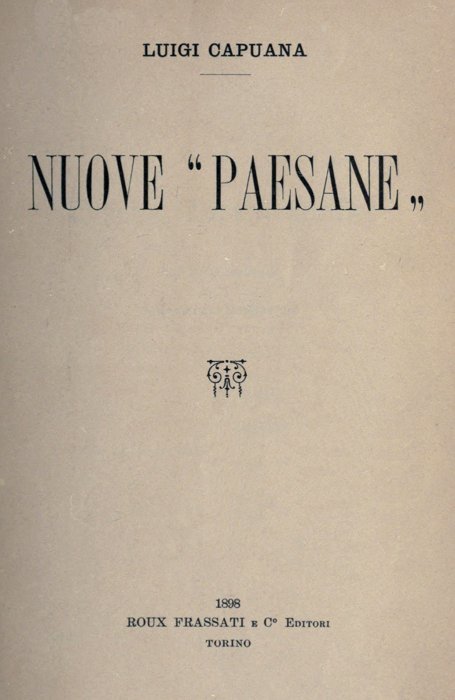
The Project Gutenberg eBook of Nuove "Paesane"
This ebook is for the use of anyone anywhere in the United States and
most other parts of the world at no cost and with almost no restrictions
whatsoever. You may copy it, give it away or re-use it under the terms
of the Project Gutenberg License included with this ebook or online
at www.gutenberg.org. If you are not located in the United States,
you will have to check the laws of the country where you are located
before using this eBook.
Title: Nuove "Paesane"
Author: Luigi Capuana
Release date: April 28, 2013 [eBook #42608]
Most recently updated: October 23, 2024
Language: Italian
Credits: E-text prepared by Carlo Traverso, Claudio Paganelli, Barbara Magni, and the Online Distributed Proofreading Team (http://www.pgdp.net) from page images generously made available by Internet Archive (http://archive.org)
*** START OF THE PROJECT GUTENBERG EBOOK NUOVE "PAESANE" ***
The Project Gutenberg eBook, Nuove "Paesane", by Luigi Capuana
| Note: | Images of the original pages are available through Internet Archive. See https://archive.org/details/nuovepaesane00capuuoft |
LUIGI CAPUANA
NUOVE “PAESANE„
1898
ROUX FRASSATI e Co Editori
TORINO
PROPRIETÀ LETTERARIA
A
Eugenio Torelli-Viollier
con animo gratissimo
Luigi Capuana.
Roma, 15 agosto 1898.
INDICE
| Il Barone di Fontane Asciutte | Pag. 1 |
| Un Tipo | 53 |
| Il Mulo di Rosa | 63 |
| Un Eccentrico | 83 |
| Il Fascio del Cavaliere | 97 |
| Le verginelle | 119 |
| Donna Stràula | 139 |
| Zi' Gamella | 157 |
| La casa nuova | 175 |