
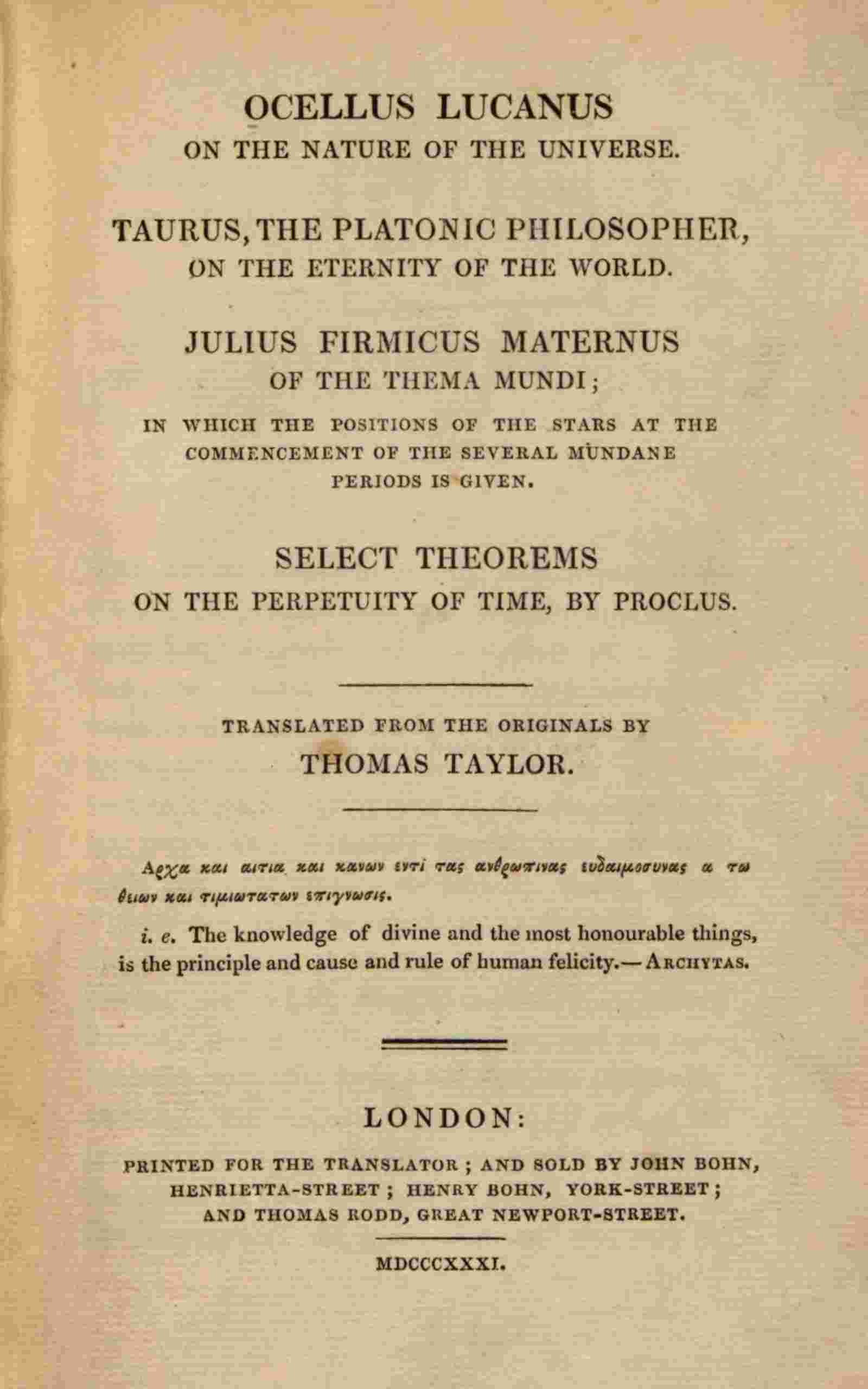
OCELLUS LUCANUS ON LAWS.
A FRAGMENT PRESERVED BY STOBÆUS, ECLOG. PHYS.
LIB. I. CAP. 16.
Life, connectedly—contains in itself bodies; but of this, soul is the cause. Harmony comprehends, connectedly, the world; but of this, God is the cause. Concord binds together families and cities; and of this, law is the cause. Hence, there is a certain cause and nature which perpetually adapts the parts of the world to each other, and never suffers them to be disorderly and without connection. Cities, however, and families, continue only for a short time; the progeny of which, and the mortal nature of the matter of which they consist, contain in themselves the cause of dissolution; for they derive their subsistence from a mutable and perpetually passive nature. For the destruction[23] of things which are generated, is the salvation of the matter from which they are generated. That nature, however, which is perpetually moved[24] governs, but that which is always passive[25] is governed; and the one is in capacity prior, but the other posterior. The one also is divine, and possesses reason and intellect, but the other is generated, and is irrational and mutable.
FOOTNOTES:
[23] In the original, απογενεσις; but the true reading is doubtless απωλεια, and Vizzanus has in his version interitus. What is here said by Ocellus is in perfect conformity with the following beautiful lines of our admirable philosophic poet, Pope, in his Essay on Man:
[24] i. e. The celestial region.
[25] i. e. The sublunary region.