
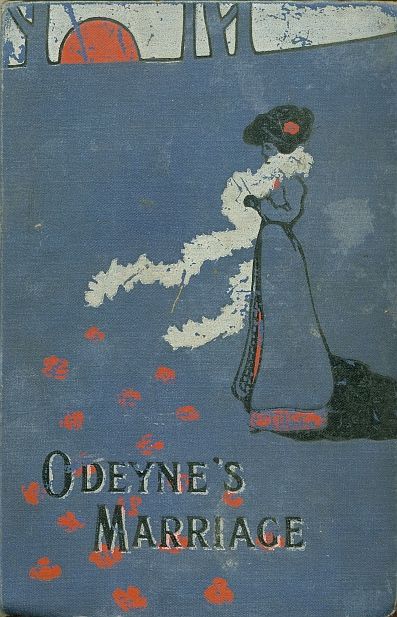
The Project Gutenberg eBook of Odeyne's marriage
Title: Odeyne's marriage
Author: Evelyn Everett-Green
Release date: May 15, 2025 [eBook #76100]
Language: English
Original publication: London: John F. Shaw and Co, 1900
Credits: Al Haines
Odeyne's Marriage.
BY
EVELYN EVERETT-GREEN,
AUTHOR OF "ARNOLD INGLEHURST"; "EUSTACE MARCHMONT";
"HER HUSBAND'S HOME," ETC.
NEW EDITION.
LONDON:
JOHN F. SHAW AND CO.,
48, PATERNOSTER ROW, E.C.
COPYRIGHT BOOKS UNIFORM WITH THIS VOLUME.
CLEARED FOR ACTION . . . . . . . W. B. ALLEN.
EXILES OF FORTUNE . . . . . . . DR. GORDON STABLES.
A REAL HERO . . . . . . . . . . G. STEBBING.
A TANGLED WEB . . . . . . . . . E. S. HOLT.
BEATING THE RECORD . . . . . . . G. STEBBING.
THRO' UNKNOWN WAYS . . . . . . . L. E. GUERNSEY.
IN SHIPS OF STEEL . . . . . . . DR. GORDON STABLES.
IN CLOISTER AND COURT . . . . . E. EVERETT-GREEN.
THE UGLY DUCKLING . . . . . . . HANS ANDERSEN.
ODEYNE'S MARRIAGE . . . . . . . E. EVERETT-GREEN.
ENGLAND'S HERO PRINCE . . . . . DR. GORDON STABLES.
ANDERSEN'S FAIRY TALES . . . . . H. C. ANDERSEN.
FACING FEARFUL ODDS . . . . . . DR. GORDON STABLES.
SHOULDER TO SHOULDER . . . . . . DR. GORDON STABLES.
EDGAR NELTHORPE . . . . . . . . ANDREW REED.
WINNING AN EMPIRE . . . . . . . G. STEBBING.
HONOUR NOT HONOURS . . . . . . . DR. GORDON STABLES.
IDA VANE . . . . . . . . . . . . ANDREW REED.
GRAHAM'S VICTORY . . . . . . . . G. STEBBING.
THE END CROWNS ALL . . . . . . . EMMA MARSHALL.
HER HUSBAND'S HOME . . . . . . . E. EVERETT-GREEN.
FOSTER SISTERS . . . . . . . . . L. E. GUERNSEY.
DOROTHY'S STORY . . . . . . . . L. T. MEADE.
A TRUE GENTLEWOMAN . . . . . . . EMMA MARSHALL.
BEL MARJORY . . . . . . . . . . L.T. MEADE.
WINNING GOLDEN SPURS . . . . . . H. M. MILLER.
ON TO THE RESCUE . . . . . . . . DR. GORDON STABLES.
DASHING DAYS OF OLD . . . . . . DR. GORDON STABLES.
TWO SAILOR LADS . . . . . . . . DR. GORDON STABLES.
IN SEARCH OF FORTUNE . . . . . . DR. GORDON STABLES.
ENGLAND, HOME, AND BEAUTY . . . DR. GORDON STABLES.
HEARTS OF OAK . . . . . . . . . DR. GORDON STABLES.
OLD ENGLAND ON THE SEA . . . . . DR. GORDON STABLES.
LONDON: JOHN F. SHAW & CO.,
48, PATERNOSTER ROW, E.C.
CONTENTS.
CHAPTER I.
CHAPTER II.
CHAPTER III.
CHAPTER IV.
CHAPTER V.
CHAPTER VI.
CHAPTER VII.
CHAPTER VIII.
CHAPTER IX.
CHAPTER X.
CHAPTER XI.
CHAPTER XII.
CHAPTER XIII.
CHAPTER XIV.
CHAPTER XV.
CHAPTER XVI.
CHAPTER XVII.
CHAPTER XVIII.
CHAPTER XIX.
CHAPTER XX.
CHAPTER XXI.
CHAPTER XXII.
ODEYNE'S MARRIAGE.
CHAPTER I.
ANTICIPATION.
"And so this is really Desmond's wedding-day?" remarked the dainty invalid, as she donned a remarkably becoming cap, and settled herself comfortably upon her pillows. "Well, to be sure, it is natural enough, I suppose, but somehow he has always seemed such a boy. Really I find it difficult to realise him with a wife. I wonder how the poor girl will get on."
"The poor girl, mother; really I do not think she is to be pitied. I think she has done uncommonly well for herself—a country clergyman's daughter," answered Maud, with a lifting of the delicate dark brows that showed a trace of superciliousness.
"That is just the whole point of the matter, my dear. If he had selected a bride out of his own world she would have known exactly what to expect from her marriage—she would have understood the risk she ran with a youth of Desmond's temperament; but this rustic maiden probably knows nothing, and will not even be on her guard. It makes me anxious for them both."
Maud looked up quickly, knitting her brows somewhat.
"But, mother, Desmond is steady enough now. He has never been more than a little wild and extravagant at Oxford, and so many young men are that. I am sure the last year or two he has been a model of discretion, and his marriage will sober him down still more—at least that is generally supposed to be the effect it has."
"I hope it may—perhaps that is his best chance. Oh no, Maud, I am not running down your brother—you need not give me such black looks. But facts are stubborn things, and it is no use trying to blink them; and the fact remains that your beloved Desmond has never yet stood up with any success against temptation. When there is no special inducement to take him out of the beaten path, he keeps to it pretty steadily; but he cannot withstand temptation, and anyone can lead him, who goes to work the right way."
"You talk as if Desmond were a pitiably weak creature, and I am sure he is anything but that."
The mother smiled a little, and shrugged her shoulders with an almost imperceptible gesture.
"We will not discuss the matter further. Desmond is one of the most attractive men I have ever seen in my life, though I am his mother that say it. He is a great many charming things, as we all know. Let us endow him with all the cardinal virtues as well, if you will. I have no objection, certainly."
Maud made no immediate reply. It was no new thing that her mother's conversation irritated her a good deal more than she would ever have admitted. But the friction was too chronic to be much noticed, and it was not long before she spoke again.
"I almost wish I had gone, after all. I think you could have spared me for two days, mother."
"I am sure I could. I told you so all along, but I thought you rather wished for a valid excuse for staying away."
"Well, I believe I did then, and now I am rather sorry. It seemed as if Desmond were almost throwing himself away, to marry like that. He could have made a really good match if he had liked, and this girl has nothing, I suppose?"
"She has a good old name and a charmingly pretty face, if her photographs do not flatter her outrageously. Of course Desmond might have done better; but then, again, he might have done worse—got into some tiresome or dangerous entanglement, so we will not fall foul of his engagement to Miss Hamilton. Why, they will be positively getting married at this very moment—yes, I wish you had been there, Maud. You could have told me all about it afterwards—how the bride behaved, and what the dresses were like, though, to be sure, in a place like that they would be nothing much to look at. Why, whoever can that be, coming at this hour of the morning? Oh, very likely only a friend to ask at the door after me."
"I think it is surely Beatrice," said Maud a moment later. "I am sure that is her step on the stairs."
"Beatrice—impossible! Beatrice is in town——"
"Is she indeed?" cried a clear, vibrating voice from without; and the next moment the door was thrown open to admit the entrance of a very stylish-looking figure, whose every movement was accompanied by the rustle of silk and the sweeping sound of rich raiment.
Beatrice Vanborough had the knack of producing an impression wherever she went. She was decidedly good-looking, but many better-looking women would attract less notice. Her figure was more perfect than her face, and she had the art of dress almost in perfection—dress in her own style, that is; and her style was to be rather extreme in richness and abundance of adornment. Still, she contrived never to look over-dressed in an ostentatious way, and was greatly admired wherever she went. She spoke with a good deal of gesture, and had several little mannerisms that some people called affectations; but she was abundantly good-natured, and delighted to do anyone a kindness, especially if it did not put her out at all personally, and she was a marked contrast in most external ways to her quiet sister Maud, albeit an excellent understanding existed between them.
"Yes, here I am, you see. We ran down last night, Algy and I. Ascot fairly knocked me up—it was so fearfully hot, I felt like being grilled alive every hour of the day, and then Algy was unlucky, and that made the dear boy a bit bearish; so on the whole we decided that a week of country air would do us good, and here we are. And so Desmond is really being married to-day? Why, Maud, it is too bad of you not to be there. I did my best to get Algy to the scratch, but a country parson's family was altogether too much for him. My lord would not budge an inch, and I could not well go without him; but you ought to be ashamed of yourself. It looks as if his family held aloof, and really I am delighted that the dear boy has taken a wife and settled down. And it will be such an advantage to get the Chase inhabited again. I trust the little rustic maid will not be altogether too ingenuous and rustic. I mean to make great friends with her, and regularly initiate her into the mysteries of fashionable life."
"Well, it will be a very good thing if you do take her in hand; you will do it better than Maud, and I must not attempt much, or I shall get the character of the interfering mother-in-law directly. Yes, I hope it will turn out happily for both; but I could wish he had taken a fancy to someone of whom his family knew more."
"Oh, do you think so? Now, I quite like the idea of the new element about to be introduced. Give me novelty above all things! And is it really true that Desmond is going into the business? That seems to me the most wonderful thing of all. Our bright, careless Desmond to turn into a City merchant! You should have seen how Algy and I laughed when we heard the news. Algy gives him a month before he throws the whole concern overboard."
The mother smiled, and made one of her little indescribable gestures, of which Beatrice's seemed the exaggerated copy; but Maud took up the cudgels, and replied with grave directness—
"I do not see why you should laugh. I think it is a very sensible thing to do. A man is always better for an occupation; and perhaps in time there will be a family to provide for, and it would be much better not to let the business slip out of his hands altogether."
"Sensible! why of course it is sensible; it is the appalling sensibility of the arrangement that is the joke of it. It seems to me that the little bride must have an eye to the main chance, in making such a stipulation, in which case I have hopes of her. She will be better than a fortune to him, if she can only induce him to stick to the collar, and interest himself in the mercantile house. I know what idle men are like"; and she made a little expressive gesture with her daintily-gloved hands.
Maud said nothing, but let her sister rattle away as she would. It was always rather entertaining to hear Beatrice talk, and it did her mother good to be amused. Of course, if they would persist in misunderstanding Desmond, and making jokes about him, it was not her fault. She was the only one in the family who really appreciated him.
"I sent her the loveliest wedding present—really when the time came I took great credit to myself for making up my mind to part with it at all. Algy did grumble at the bill; but one couldn't be stingy to the bride of the only son of the house. It was the sweetest necklace of pearls you ever saw in your life. If she has a complexion she will be enchanted with them. She wrote me a very pretty letter of thanks, but I don't think she had the least idea of the value of them. I think she will turn out a dear little girl. I quite love her already. I wish I could see her now. I offered to superintend the making of the wedding dress at my own woman's; but no, the child had the exquisite innocence to prefer her own dressmaker. I fear my lady will find that she must have another wedding dress made, to face the county in, but she can find all that out for herself in time. I do not think we shall find her lacking in a species of sound common-sense."
"I sent her a dressing-bag," said Mrs. St. Claire, who was looking roused and interested, "and Maud some silver, I don't exactly remember what. Of course she will find more gifts of mine at the Chase when she gets there. Have you seen the place since it was done up for them, Beatrice? Really you ought to go; it looks charming. Desmond has been mighty particular in his orders, I can tell you. He has spent a lot of money over it, you may be sure."
"And quite right too. He has plenty, and he ought to keep up his position in the place. He cannot have spent his income these past years, and he is right in making his home comfortable before settling down. Seen it? No, how could I have seen it? I have not been in these parts for an age. Happy thought! we will drive over there this afternoon, Maud, whilst mother has her nap. I told Algy not to expect me back to lunch. We will certainly go home viâ the Chase."
So after the midday meal Mrs. Vanborough's carriage was ordered, and the two sisters set off for a visit to their old home.
The Chase, though within thirty miles of the great metropolis, was still to all intents and purposes a country house. It lay in the midst of lovely scenery, not far from the valley of the Thames, was surrounded by wooded hills and running water, and formed altogether a charming retreat, despite the fact that mansions and villas showed a disposition to crop up in the vicinity, and people began to prognosticate that in the course of time the place might be much spoilt by over-building. But for the present, at least, that danger was not imminent, and in no case could the house itself suffer very much, for it was surrounded by its own small but well-wooded park, some fifty acres in extent, and nothing could be seen from the windows of the living-rooms but the gardens and grass-land and fine timber belonging to it.
The Chase was a thorough-going, old-fashioned house, such as are growing more and more scarce every year, with gable ends, twisted chimneys, and great cross-way beams let into the brickwork at intervals.
It was by no means a very grand house, as such things go in these days, for many of the rooms were low, some of the ceilings were intersected by heavy rafters, and the oak panelling, of which there was much in the house, was worm-eaten, and the carving a good deal defaced.
But for all that it was a home-like and comfortable place, deliriously quaint, and not really gloomy, although some people might be disposed to call it so.
It was the kind of house that seemed to want young life about it—children's footsteps pattering up and down the passages, children's voices babbling in the still old rooms. It was a house that would be a paradise for children, and seemed to cry out for their presence. It had been built two or three centuries back, by a remote ancestor of the St. Claires, but had passed out of their hands for many generations, and known a variety of different owners.
The father of Desmond and his sisters had started in life with the resolve to buy back the old place, and with very tolerable hopes of success. His father was then partner in a thriving mercantile house, with the prospect of soon becoming the head. In time this consummation was achieved. The business throve under the careful management of an honest and hard-headed man of business.
The son found himself a rich man whilst still comparatively young, and as he was an only child he had things all in his own hands.
The Chase was bought and restored, it was entailed in due course upon the eldest son and his eldest son, and the proprietor quitted this life when the call came with the feeling that he had at least lived to fulfil the dream of his childhood.
Into this fair inheritance young Desmond had stepped, and was about to take up his abode in the home of his childhood. As the sisters stepped across the threshold Beatrice looked round with her curious eyes, for it was many years since she had seen her old home, and she was eager to note what changes time had wrought in the place. The people who had rented it after their father's death had not been in the society affected by Beatrice after her marriage, and the tenancy had only recently expired.
"Ah, the dear old hall—that delightful square staircase—how I remember it all again! Well, really, Desmond has a very pretty taste if this decoration and furniture is his choice. That stained glass is just what was wanted to give the dim religious light one expects in such a place as this, and these skins and quaint old armour and other accessories are delightfully in keeping with the old furniture I remember so well. Were you his aide-de-camp, Maud? Really, it is quite charming. I hope the little girl will have education to appreciate it, and not hanker after apple-green hangings and magenta table-covers. Not but what gay colours are rather coming to the front once again. Well, every fashion has its day, and we are so constituted that we all rave over the newest thing out, no matter how intrinsically hideous it may be. Oh, not you, Maud; you go on in the even tenor of your way, quite superior to all the fluctuations of fashion. Gracious goodness, who are these? Surely people cannot think that the bridal couple have already arrived? Who on earth can be calling now?"
"Pray don't agitate yourself, Beatrice; it's only some of the Ritchies coming to see the house now that it's ready. I told them they might. You know they will be Odeyne's nearest neighbours, so naturally they take great interest in it all; and they were our playfellows, too, you know."
"Know—I should think I did know! My dear, it is a fact they never allow us to forget. Well, they are excellent good folks, and will doubtless suit Odeyne down to the ground. But I think if they are coming round too, I will postpone the pleasure of a thorough tour till another day. You will not mind walking back if I take the carriage home? I really think I must be getting back to Algy now."
Maud smiled, not without a touch of satire.
"Oh, by all means satisfy your wifely instincts. The walk is nothing. Don't let me stand in Algernon's way. Well, Cissy, so you have found your way up, have you? Everybody seems to choose the wedding-day to visit the house, you see."
The girl thus addressed—a maiden with a demure little face and a pair of merry, saucy-looking eyes, generally hidden beneath very long black lashes—came towards the sisters with outstretched hand. She was followed by a pair of brothers, both tall and well-grown, but without any great share of external finish of manner. The trio were the children of the doctor of the place, and the sons, who had both elected to follow their father's profession, had been mainly brought up at home, only leaving Harlington for the necessary hospital work prior to examination. Cuthbert was by this time his father's junior partner, whilst Tom was still studying and not yet qualified. Both young men had the reputation of being very clever; but talent without grace and finish of manner had no attractions for Mrs. Vanborough, and she openly avowed that the Ritchies bored her to the verge of distraction.
But there was nothing of this to be detected in the greeting which she bestowed on the young girl and her two brothers. Beatrice was far too much the accomplished woman of the world to be betrayed into the least gaucherie or want of manner. She listened to Cissy's outspoken raptures with the pleasantest possible of smiles.
"It is perfectly lovely. I never saw anything more delicious. How your little boy will like playing here, Beatrice! It is such a perfect house for children. How well I remember the romps we had all together here long ago!"
Beatrice gave the least little look of amusement at her sister out of the corner of her eyes, as she answered with admirable cordiality—
"Ah, perhaps he will; I had not thought of that. He is scarcely of an age to discriminate much as to his surroundings."
"Oh, I don't know. I think children are much more discriminating than people think, and notice much more too. I know we all did——"
But Beatrice was already on the way to her carriage, making gracious little farewell gestures as she moved.
To hear Cissy Ritchie's raptures or theories upon children was a little too much. She felt she must escape at all costs.
If there was one thing that bored her more than another it was to be expected to give an account of the perfections of her handsome, sturdy, year-old son. In her own way she was fond and proud of him, but to get up any kind of enthusiasm about him was a thing she had declined from the first.
Possibly her absence was a relief to the rest. Mrs. Vanborough, with her rustling silk, her elegance, and her vivid personality, had a way of being a trifle overpowering; perhaps this was what she desired in certain circumstances.
At any rate, after she was gone Cissy grew more confidential and eager, whilst "the boys," as it was the fashion to call the doctor's two tall sons, seemed to come out of their shell of reserve, and looked, in consequence, less awkward and shy.
"I can't think how you could keep away, Maud. I should have been dying of curiosity to see her."
"Ah, that is a complaint of which you die daily," interpolated Tom in his dry way; "Maud knows better."
"Are you not in a dreadful hurry to see her? I don't know how I should ever endure to let one of the boys marry a girl I had never seen. Tom, why do you laugh? You might do such a thing, you know. You are a dreadful boy for keeping a secret. Nobody can find out if you don't mean them to."
"Well, I am glad to hear that at any rate. I will take a leaf out of Desmond's book one of these days, and bring you home a stranger for a sister. I should like to see the meeting."
"It would not be interesting," said Cuthbert. "Cissy would run into her arms and swear an eternal sisterhood on the spot. Cissy has the good old-fashioned family feeling finely developed. A relation is a relation, to be swallowed whole without the least reservation. That is the advantage of having Scotch blood in our veins. We can take to anyone who bears our name."
Whilst the boys rattled on in the half-nonsensical, half-speculative way characteristic more or less of the whole family, Cissy stole a furtive glance at Maud, as if to see how she was feeling on the subject—whether she was prepared to take the new sister in this unquestioning fashion. Perhaps Cissy's quick sympathies gave her a greater insight into Maud's nature than most people possessed, and enabled her to guess that the marriage of her brother was not a source of unmixed pleasure to her. Truth to tell, Maud was not a little disappointed at the turn matters had taken. She had never fancied that Desmond would settle down to matrimony in his early manhood, and she had indulged bright dreams of what life would be like at the Chase, with Desmond the master and she his housekeeper and companion.
The girl had a love of power, as well as a passionate attachment to her old home; and the news that her brother was engaged to a stranger, of whom they knew nothing, brought with it a sense of disappointment none the less keen because borne in utter silence. And Cissy guessed at the existence of some such feeling, though she was far too shrewd and tactful to betray any such knowledge, and so, as they made the tour of the house together, Maud found something soothing in her presence, and was glad to let her talk and indulge pleasant little fancies about the coming bride, and the pleasure it would be to both her and Desmond to have a sister so near at hand.
Somehow, with Cissy at her side, Maud felt that it would not be hard to love that new sister, and give her the welcome that would seal their friendship at once; but when she was left alone in the shadowy house, with the ghosts of departed fancies lingering all around, and the sunny influence of a truly warm heart removed, then the old soreness, akin to jealousy, came creeping back, and with it a miserable feeling of antagonism towards the woman who had come between her brother and herself.
"I shall never care for her, I know I never shall, and that will make it all the worse, because Desmond will be angry—he will never understand. Besides, why should he? He never loved me as I loved him. He would say that we were very good friends, and nothing more. It is always the way with women, I suppose—some women, at any rate—to give their all, and get nothing, or almost nothing, in return. Well, I suppose I can bear it as well as anyone else; but oh, Desmond, do not ask too much—do not expect me to love your wife for your sake."
But though Maud was thus open with herself she might not quite have liked to hear the remark made by Tom Ritchie as the brothers and sisters turned homewards again.
"It strikes me," said that astute young man, "that however much in love Mrs. Desmond St. Claire may be with her husband, and however happy they are, and will be, together, that she will have rather a rough time of it with Desmond's relations."
CHAPTER II.
ODEYNE'S HOME.
Odeyne stepped out of the long French window which opened upon the lawn, but instead of joining the family party, grouped together beneath the sweeping boughs of the great cedar tree, she shrank away into the friendly shadow of the willow arbour hard by, and looked across the sunny vista, with eyes in which there was a sparkle of suspicious moisture, albeit there was no look of unhappiness in the girl's fair face, but rather an expression of deep content.
And yet, now that the last day in the old home had really come, Odeyne found it in her heart to wonder how she had ever made up her mind to leave it, and to go out into the great unknown world, even with Desmond at her side. It was a great mystery to her even now, the strange, new, overpowering love which had crept into her life and changed its whole tenor—had made her willing to leave her sheltered home and all the tender associations of her childhood—father, mother, sisters, and brothers, including even Guy, her dearly-beloved twin, from whom she had vowed a hundred times that no power on earth should ever part her. Sometimes it seemed as if it could only be a dream, from which she should soon awake; but, then, Desmond was no dream; he had grown to be as the girl's second self, and it had become an impossibility to picture life without him.
She wanted a little time for quiet thought. She had been indoors writing the last letters (in all probability) that would ever be signed Odeyne Hamilton, and she had promised to join the others at afternoon tea beneath the old cedar; but the tray was not yet brought out, though the party had all assembled in the cool retreat, and she wanted to sit a few minutes looking at them all, herself unobserved, so as to carry away with her a picture that would ever after be a source of pleasure and tender satisfaction.
For there was not one face missing in the dear group. There was the father, with the snowy head—the typical clergyman, even to the beautiful benevolent sweetness of expression, which surely ought to characterise the faces of those whose lives are specially dedicated to the feeding of Christ's flock; the mother, all gentle seriousness, with unselfish love shining in her eyes, and making lovely the whole countenance, even though some anxious fears could not but mingle in sympathy with her child's happiness. Then there was tall, manly Edmund—every inch the soldier—and Walter, his father's curate, so good and steady, who had never given his parents one hour of real anxiety or pain. There was bright, capable Mary, a model eldest daughter and sister, and the three girls yet in the schoolroom and nursery—Patty, Flossy, and Nesta, the pets and plagues of the house. And last, though by no means least, there was Guy—Guy with the thin, pale, intellectual face, the broad brow, beautiful dark eyes, and the ever-changing lights and shades flickering always in them.
It was upon Guy's face that Odeyne's glance rested most long and most lovingly, for it was after all Guy who would miss her most.
For Guy had lived always at home, on account of his delicate health, and his twin sister had shared alike in his studies and his amusements, had been his nurse in sickness and his comrade in health, till the two had grown to be almost shadows of one another.
It had always seemed to the girl as if Guy's lack of physical strength had been in some sort her fault, as if she had taken an undue share of it, rather to his detriment.
One delicate child in a pair of twins was nothing uncommon; but it seemed to her as if it ought to have been the girl, not the boy, who should be called on to take the extra burden of ill-health, whereas, in this case, she was endowed with an unusually strong physique, and had hardly known a day's illness in her life, whilst Guy had gone through pretty well every misery to which flesh is heir.
There was a strong likeness between this brother and sister. Both had the same straight level brows, the same expressive eyes of dark grey, that looked almost black in shadow, and the same delicate, regular features.
But the smooth, rounded cheek of the girl was tinged with a beautiful bloom, and her every movement spoke of an overflowing vitality and power of enjoyment.
It was pleasant to watch Odeyne walk, or carry on any active employment: there was a dainty grace and precision in her movements, as characteristic as it was unstudied, which gave a subtle gratification to the spectator, and showed an amount of healthy physical training of a perfectly feminine kind that it is refreshing to meet with in these days of extremes.
Guy's movements, on the contrary, were slow and languid, and his oval face wore the pallor of confirmed ill-health. At the same time he was stronger and better than he had ever been in his life before, and, but for this marked improvement of the past year, it may be doubtful whether even handsome and gallant Desmond St. Claire would have urged his suit with any measure of success.
It was Guy's keen eyes that detected his sister in her shady retreat, and detaching himself unobserved from the group beneath the cedar, he took a circuitous path that brought him at length to her side.
"Well, Odeyne, in maiden meditation lost? A penny for your thoughts, Schwesterling mein."
But at the caressing touch of his hand upon her shoulder, and the sound of the old familiar pet name, the moisture on the girl's long eyelashes resolved itself into very decided drops, which made her brother's face and the sunny garden swim before her in a golden mist.
"Oh, Guy, I don't know how I have ever done it. I don't know how to go through with it now. It seems almost wicked to go away and leave you all. Am I right? Oh, I wish I were sure."
"My dearest child, you must not encourage these foolish thoughts," was the calm rejoinder, spoken in Guy's low, even tones, that despite their quietness and evenness betrayed to the girl, who knew every cadence of his voice, an amount of feeling that he would never openly display. "You are only doing what every woman does at one time or another in her life—or at least the great majority of them. What is it that troubles you at the last? You have not quarrelled desperately with Desmond since the morning?"
But Odeyne's glance was serious and grave, and tinged with a sort of wistful anxiety.
"You know it is not that. It is no fear of Desmond. I think it is fear of myself. Guy, do you remember how I so often grew almost discontented and cross because our lives were so quiet, so shielded, so far removed from the struggle and battle of life? Well, those thoughts of rebellion are troubling me now—now that I am going out into the world to be my own mistress, as people say. You do not know what I would give to feel that there would always be mother to turn to. I wish I had never been discontented. How is it one never values what one has until it is going to be taken away?"
Guy put his arm caressingly round her neck, as he knelt on one knee beside her. The slanting light from the westering sun twinkled into their leafy retreat in a myriad golden shafts, interspersed with flickering shadows, the breeze rustled the leaves overhead, the birds began to twitter softly after their midday silence. A sort of restful hush seemed over all the world, and the sense of farewell was fast stealing over the heart of brother and sister alike.
"Odeyne," he said tenderly, "you have little enough to reproach yourself with, I am sure. I suppose it is implanted in our very nature—that longing to go out and try conclusions with the world. Even I know something of it, though I should make so poor a figure there. I think you will give us all reason to be proud of you. You were always cut out more or less for the part of the great lady. You must let me soon come to you in the new home. I want to see you at the head of your own table, queening it in your own house."
She smiled then, but the look on her face did not change.
"That is part of the trouble, I think. It is only lately I have realised that Desmond is rich, and has a large house, and a lot of servants, and that things will be very different from what I have been accustomed to here. I feel so small and inexperienced, and so young. If only it were not so far away! If only I could have mother to go to for advice!"
"You will have Desmond."
There was a soft light in the girl's eyes. She looked very lovely at that moment, her brother thought.
"Yes, I shall have Desmond; but that is not quite what I mean. I want somebody who will tell home-truths to me—Desmond always says everything I do is right. You will be a help when you come, Guy, in many ways; but I shall want mother dreadfully sometimes, I know."
"After you have been married some time, possibly Desmond will indulge your taste for home-truths more freely."
"Oh yes, I daresay he will. He has plenty of will of his own; I do not like men who have not. But, Guy, I am so distrustful of myself. I am afraid I may grow too fond of pleasure and luxury, and the things that seem to be coming to me. Do you remember all my castles in the air about the big house I was to have some day, and the horses and carriages, and grand way of living, and how I always said that that was just what I should like? Well, now that Desmond has talked to me about the Chase, and all the things that go on there, and what will be expected of us, it is just as if I were getting everything I had coveted—if that is not too strong a word to use—and I am afraid I may grow too fond of pleasure, and the bright, butterfly life that we seem to be going to lead. You know, Guy, I am very fond of pleasure—very fond of it indeed—though here, with father and mother and all the influences round us, I have not done anything to make them fear for me. Oh, I wish it did not seem all quite so strange! Suppose I grow careless and vain and idle, and become a trouble to you all, how sad it would be!"
"I do not think there is very much fear of that, Schwesterling; you have your sheet-anchor fast, I am sure."
A new look crossed the girl's face.
"Oh, I hope so, Guy; that is the great comfort of all. I could never dare to go away but for that"; then after a little pause she added very softly: "You will pray for me always when I am gone, Guy; for I know there will be so many more temptations, and I feel so ignorant and so weak."
He pressed her hand by way of answer. Even to each other this brother and sister were reserved as to their deeper feelings, though they knew them to be in accord. Guy stood looking straight out before him with a look of fine concentration on his face, whilst the girl wiped the tears from her cheek, and presently looked up with a smile in her sweet eyes.
"There, I am better now. I think I just wanted a little talk with you all to myself. Let us go to the others now. I must not be long away. Every hour is precious to-day."
"Ah, yes, let us come. We shall think of this afternoon when to-morrow comes, and there is a great blank in the house. You will be the best off; you will not be aware of it. No, no, little one, do not look like that. It is all right, and I shall like to think of you and Desmond having a good time together. You have been cooped up quite long enough in one place. It is right that some of the birds should leave the nest. Only I suppose you do not want me to say I shall not miss you at first. It would be but a poor compliment after all these long years of willing service. Am I to be allowed to thank you for them before you take wing, little sister?"
"Please not, Guy, unless you want to make me cry again, and I hate to cry. If one once begins there is no leaving off, and tears are so perilously near one's eyes to-night," with a tremulous little laugh. "Besides, Desmond will soon be here, and he would be distressed. Men cannot quite understand what leaving home is like to us."
"And I do not think he has ever known a home like this either," answered Guy, as they moved away together. "You will have to develop the domestic instinct in him, Odeyne."
There was laughter and the soft sound of happy voices round the tea-table that evening, for all were determined that to-morrow's bride should not be saddened on her last day at home, by the thought of the regrets her absence could not but cause.
She was marrying, with the full consent of her parents, a man who was passionately attached to her, and of whom the whole family was very fond.
He had come for six months to the Rectory last year to read with Mr. Hamilton for an examination, and had in that time made himself beloved by all, for his never-failing flow of happy spirits, his warm-hearted, affectionate disposition, and for the way in which he had grown into the family circle, and shared their joys and sorrows almost as if they were his own. Of his "people," as he called them, and his prospects he had spoken but little. Not that there was any mystery about the matter: he was very open about himself and his own affairs. He had lost his father when he was seventeen, and his mother had elected to go abroad with his two sisters whilst he spent his time first at a tutor's and then at college. Meantime the family house was let to strangers; for it was entailed on Desmond, the only son, and he did not see any use in living there alone. Since his coming of age things had not materially changed until about a year ago, when Mrs. St. Claire had returned to England, and had settled down in a smaller house, about half-way between her old home and the house where her elder daughter spent much of her time.
Beatrice St. Claire had made a fairly brilliant marriage, and was now the Hon. Mrs. Vanborough, with a town house and a country house, being herself a leader in a small social circle. Maud was still at home with her mother, and both were naturally anxious that Desmond should return and settle near them. They had never come to the remote Devonshire village to see his future wife—they were very busy at home, and shrank, as it seemed, from the long journey; but both had written in a kind and genial fashion, and Maud would have certainly been present at the wedding, had it not been that Mrs. St. Claire had been overtaken by a sharp attack of illness the previous week, which kept both her and her daughter at home.
It was a disappointment to all parties, though not what it would have been had Desmond known more of his nearest relatives. But though he always spoke of them with warm affection he had been too much separated from them and their life of late years, to have very much in common; and the home of his betrothed was far more of a home for him than the residence of his mother. Perhaps Mrs. Hamilton was the most disappointed at the absence of Desmond's mother. She felt a great anxiety to know what manner of woman it was who would be henceforth the nearest confidante and adviser of her dearly-loved daughter. She often found herself wishing that she knew more about the life into which her child was about to step—more about the man himself, into whose hands they were about to commit their treasure. True, in one sense of the word, they knew everything—he kept nothing back—not even the fact that at Oxford he had been more than a little extravagant, and had been in serious disgrace more than once with the authorities for his wild pranks and misdemeanours of various kinds. No one could be more open than Desmond was, and no one could express more contrition for past follies, or a livelier determination to amend in the future. And then he and Odeyne loved one another. There could be no manner of doubt as to that, and when all was said and done there was nothing in the young man's past career to justify the loving parents from withholding their consent, despite sundry fears and forebodings on the part of the anxious mother. Indeed, from a worldly standpoint, Odeyne was doing very well for herself, as young Desmond was very well off, and would be likely to add to his income as time went on, for he had finally decided, mainly through the advice of his future father-in-law, to enter the large mercantile house in which his own father's fortune had been made, and to be more than a mere name upon the books. Mr. Hamilton had a not ungrounded horror of an idle man, and as Desmond showed no special leaning towards any profession the Rector strongly urged him to take the place open to him in the business house, and make himself a power there. He need not give his whole time to it; but at least it would save him from some of the temptations that so closely beset a wealthy man actually without employment. The Chase was so situated that it was easy to run up to town from it three or four times a week, and Desmond, after a little vacillating, and not unnatural distaste of "harness," had decided to take the advice pressed upon him, and was by this time quite pleased at the prospect, and full of the wonders he was going to accomplish when once he had his hand on the reins.
His bright, sanguine temperament was one of his great charms. Perhaps he owed it in part to the Irish blood that ran in his veins—though for several generations his immediate ancestors had been English—at any rate he had a happy buoyancy of disposition that made his company delightful, and endeared him to all with whom he came in contact.
There was certainly something peculiarly winning and attractive in the face that was bent over Odeyne an hour later, as the lovers, so soon to be united, stood together in the dewy garden, not talking much, but pacing side by side in quiet contentment, glancing now and then at each other with eyes that were eloquent of love. Desmond St. Claire was just four-and-twenty, tall, broad-shouldered, but with plenty of suppleness and grace in the free movements of his strong limbs, as also in his whole bearing and carriage, particularly the pose of the head, which had a very characteristic set of its own, that might have been called haughty but for the open, smiling brightness which was the prevailing expression of the handsome, bronzed face. The young man looked like one of Fortune's favourites. Guy used to tell him he also looked like an only son.
"One can see you've had no brothers to bully you, or take you down a peg every now and then," he said to him early on in their acquaintance; "it's easy to see you have always been surrounded by adoring women-folk." And though this last statement was hardly correct in its literal sense, it was none the less true that Desmond had been used from childhood to be made much of, and to consider himself a personage of some importance; nor had his training done very much, so far, to eradicate the idea; though it is but fair to say the young man was hardly aware that he held it. There was no bumptious self-assertion about him. On the contrary, he was more disposed to under-value his own attainments, and to admire others above himself. Still, notwithstanding all this, he could not rid himself of the air of a prosperous and rather important personage, and Odeyne found no fault with the little air of distinction that he wore with so much of boyish ease and grace. She liked, too, above all else, the tender, protecting manner he always assumed towards herself when they were alone together. Odeyne had won the reputation at home of being slightly independent, and anything but desirous of constant protection in the little details of her daily life; indeed, she seemed rather protector than in need of care herself, in her relations not only with Guy, but also with her mother and little sisters. Yet none the less did she find a great sweetness in depending upon Desmond, and feeling that he was watching over her and upholding her in all their mutual relations. Odeyne was too true a woman not to delight in this feeling, however little it might seem to some to be a part of her nature.
To-night Desmond was in an unusually serious mood, but the girl was content that it should be so. They walked for some time in silence, and then he said tenderly and softly—
"You have had a very happy home here, my darling; sometimes I feel half afraid of taking you away. Suppose I fail to make you happy. Suppose the day should come when you should repent that you had ever married me."
"That day never could come, Desmond," answered the girl in clear, low tones, with an upward glance more eloquent than words.
"I trust not, dearest; but one never knows what may happen——"
"Nothing that happens could bring that to pass," was the quick reply. "I know we may have trouble and sorrow—no lives are quite exempt from that; and why should we expect it? But do you not know that trouble shared with you would be sweeter than any ease and pleasure enjoyed alone? The more sorrow fell to your lot, the more I should want to be with you to share it."
He turned and clasped her in his arms.
"God bless you, sweet love, for those words," he said, with a quiver in his voice. "I only trust I may be worthy of the treasure I shall take to myself to-morrow."
"If God does bless us," answered Odeyne in a whisper, "we need not be afraid of the future, or what it will bring. I am so glad you said that, Desmond. I can't talk about things, but I want us—oh, so much, to feel alike in everything."
"My darling, we will. You shall teach me to be like your own sweet self. This home has always been a living lesson to me. If we can make our own like it I shall be content."
"Oh, if we could!" cried the girl with beaming eyes. "Ah, Desmond, let us try. We may come a good deal short of our ideal, but at any rate we will try."
He smiled as he caressed her curly hair. The old brightness had come back to his face. Desmond's grave moods were seldom of long continuance.
"By all means, dearest, let us try. Only you may not find it quite such an easy matter as you think now, to model our future household upon that of a rustic rectory. Here we live in Arcadia; there it will be—well, different."
There was a sweet, grave brightness upon Odeyne's face on the morrow, as she stood before the altar of the quaint little parish church where she had been christened, and repeated after her father the solemn words that made her the wife of Desmond St. Claire. Behind her stood her sisters, and those nearest and dearest; whilst at her side stood the man of her choice, and before her was the strange future life, which seemed to stretch itself out in rainbow tints.
The bells clashed out a merry peal as she left the church; all the village was en fête to see Miss Odeyne's wedding. In the absence of the bridegroom's relations every face was familiar and beloved—for Desmond was mighty popular in the little village he knew so well.
It seemed a wedding all smiles and no tears, and even when the moment of farewell came the smiles predominated, despite the mist that obscured the visions of some of the party who watched the departure of the bride.
"They are all your brothers and sisters now, Desmond," said the young wife, leaning forward to take one last view of the crowd of dear, familiar faces.
"Of course they are," he answered, his fingers closing upon hers, his hat in his hand, waving a glad farewell salute. "I never had any brothers of my own, and all yours are mine now. We will have them all down to the Chase for our first Christmas there, if we don't get them before. You shall never feel that marriage has made the least bit of a barrier between you, my loyal little wife; only you will give yourself to me for just a little while without any rivals in your heart, will you not?"
At that question Odeyne turned to her husband with a beautiful light in her eyes, and answered—
"Desmond, you know that you are always first now. Whatever lies before us in the future you will always find me by your side. We have taken each other for better for worse."
He took her hand and carried it to his lips.
"It shall never be for worse, my darling!" he cried, "I will promise you that!"
CHAPTER III.
FAREWELLS AND GREETINGS.
"Oh, Miss Odeyne—I beg your pardon, I mean Mrs. St. Claire, but it seems as if my tongue would never learn the new name rightly—I've got a favour to ask of you that I've been longing all the time to talk to you about, and now the time's come it seems as if I didn't know how to say it rightly."
"Why, Alice, have you turned shy all in a moment, or do you think I have changed in a few weeks?" and Odeyne glanced at the girl's downcast face with an encouraging smile. "Well, you shall have your wish, and brush out my hair for me, and you can talk to me as you do it, and let me hear what this wonderful favour is."
Alice Hanbury was a pretty, neat-fingered damsel, who had been all her life more or less at the Rectory, and had received her training for domestic service under the kindly eye of the mistress. She had of late years been employed chiefly in the capacity of sewing maid, on account of her deftness with her fingers and love for her needle, and it had been said from time to time in the family that Alice ought to be a lady's maid, she had so much taste and cleverness in all the details of the toilet. For the past year or more she had attached herself especially to Odeyne, and it was her great delight to be permitted to dress the girl's abundant hair, or to array her for any simple festivity to which she might be going. So it had not surprised Odeyne on this particular occasion that Alice should follow her to her room to ask leave to assist her to dress for dinner, and she had willingly consented, for her month of wifehood had not damped in the smallest her interest in every detail connected with the old life, and to that old life the maid entirely belonged.
This unexpected visit to the old home on the conclusion of the wedding tour had come as a delightful surprise to Odeyne—a surprise planned by her husband, and valued tenfold as proof of the tender love he bore her. It had been arranged between Desmond and her parents without her knowledge, and only when the train was approaching the well-known country had she suspected his purpose, or understood the merry, mischievous glances and speeches which had been perplexing her all day. And now, after a week of unalloyed happiness, the last evening had once more come; but Odeyne was not sad to-night, for Desmond was now her husband, and there was no room in her faithful heart for anything but the truest love and confidence.
"Well, Alice, I am waiting to hear what this wonderful favour can be. You may be quite sure I will do anything for you that I can." And there was a pleasant consciousness now in the girl's mind that she had the power to do a good deal for her old friends or dependents. A month's experience of life as a rich man's wife had not been lost upon her. It could not help being a pleasant experience, and just now everything was tinged with a golden halo.
"Oh, miss—I mean ma'am—if you would only take me away with you to-morrow! I could be quite ready, indeed I could, and I have so set my heart upon it. They all say you must have a maid to wait upon you in your grand new house, and though I may not be so fine as some you could get, I know your ways, and no new maid would serve you as faithful as I would. I've spoken to the missus and Miss Mary, and they both approve if you do. And oh, Miss Odeyne, do take me! The house isn't like itself without you, and I would so like to go with you to your new home."
"Well, Alice, if you really mean it, I shall be very glad. Your mistress was speaking about it to me the other day, and we decided that, as she can spare you, and as it is only right you should 'better yourself,' as they say, you should come to me at the Chase. I shall be very glad, you may be sure, but I should like you to think it over carefully first. It is a serious thing to leave home and the place in which one's life has always been passed, and to begin again in quite a new one. You will get larger wages, and your life may be more lively and amusing, but, Alice, there will be more temptations too, and you ought to think carefully before you make your decision. I should be so very sorry if any harm came to you from having followed me."
"But, ma'am, I don't see how it could; I should be with you. It will be almost the same as if I was here."
"I am afraid it will be hardly that, Alice," answered the young wife, with a smile and a sigh, "though I shall do my best to make it so. But you must think it over and talk to your mother, and if you decide that you really wish it, you can come to me any time that you like."
"Oh, but, ma'am, I have spoken to mother already, and she is as pleased as can be. She thinks I should be better away, because of that Jim Rich, who won't let me alone"; and Alice tossed her head and blushed a little, for that was the name of one of her admirers, and she was conscious of having given him more encouragement than was altogether fair, considering she never intended marrying him. "And indeed, Miss Odeyne, it was she who bid me ask if I mightn't go away with you to-morrow. I saw her this very afternoon, and it was that that put it into my head. I could be quite ready, indeed I could, and I should be so glad to get away quiet before anybody knew."
Odeyne looked thoughtfully at the girl, half understanding her eagerness, half afraid to gratify it. She saw that Alice was very pretty. She suspected she had reasons for wishing to get away to a new place, but she wondered if it would be really kind to take her. Her innocent little vanities and coquetries were very harmless here, but might they not get her into trouble elsewhere?
"Well, is the weighty matter settled yet?" asked a clear voice at the door, and Odeyne looked up, relieved to see her elder sister before her. Mary always knew what to do for the best.
"Ah, Mary, you have come in good time to give us your advice. This foolish Alice wants to leave you all to come with me to-morrow. What must I say to her?"
Mary sat down and heard all that there was to hear, and, to the great delight of the little Alice, decided in her favour.
"It will be better for her to go, as she has set her heart on it," she explained to her sister, as they went downstairs together. "She is unsettled here and is anxious to go elsewhere, and she will be far safer with you than anywhere else we could place her. My own opinion is that she will get married before very long. She attracts a good deal of notice with her pretty face and dainty little ways. She will very likely marry rather above her own class, as she has rather grand ideas, and is certainly hardly suited to the life of a working man's wife. Poor little Alice! I hope she may be happy; at least she will have a mistress who will look well after her, and more than that no one can do."
It was a happy evening for Odeyne. After dinner she sat in the curtained nook beside the open window, and one and another of the dear ones came and had a little quiet talk with her. She was so happy, and Desmond so devoted, that the anxious fears experienced at one time or another could not but be laid at rest, at least for a while. Guy looked with keen scrutiny into his sister's face and then smiled.
"One needn't condole with you yet then, Schwesterling; you seem to have found out 'how to be happy though married.'"
Odeyne laughed softly to herself.
"At least I shall not commit myself to any lamentations yet. I will leave your sharp eyes to find out the domestic discord when you come to see us. And when will that be, Guy? I shall not feel that the Chase is quite a proper home until you have been to see us there."
"Oh, I will come all in good time, never fear, but not just at once. It is a mistake for the relations to be too thick on the ground at first. You will want a few months to get settled down to the new life. It would not be fair to Desmond to come crowding in too fast. He will want his wife to himself for the first spell at any rate."
"Desmond is too unselfish to be exacting, and he is so very fond of you all too."
"Well, you will have Edmund at any rate close at hand. How pleased you must have been to hear of that appointment! Five years of him almost at your gates. He will be quite a tame cat about your place."
"It will be delightful," said Odeyne with shining eyes; "I have had a lingering hope of something of the kind ever since I realised that the regimental depot was so near the Chase. Desmond was almost as pleased as I. You cannot think how anxious he is that I shall be happy, and not miss you all too much. He is so good to me, Guy."
It was almost the only time Odeyne had allowed herself to praise her husband quite so openly as in these few words. She was not wont to gush at all, and Desmond was too near and too dear for her to speak much of him. So that though her happiness and his devotion were tolerably patent to all, she had said little of it in words; and it was not without a feeling of keen pleasure that the mother, seeking the quiet retreat in which her child had ensconced herself, overheard these last words, before she herself was seen.
"I am pleased indeed to hear it, my darling," she said, as she took the chair Guy had vacated in her favour. "I would not ask you such a question, and indeed one has but to look at your face to read an answer of the best kind there. Still, it is good hearing, and will help us to send you on your way with lighter hearts; but, my darling, there is one question your mother would like to ask you before you go to begin the new life, but I will not do so unless you tell me I may. I would not intrude——"
"Mother, darling, how could you? As if there were anything in the world I would not tell you. I love to talk everything over with you. Only I don't want to bore people with my affairs, and I know it sounds so silly to be always praising one's husband."
"You need never fear tiring me either with praise or any kind of confidence, little daughter. I love Desmond dearly; he is almost like one of my own boys. What I wanted to ask you, my dear child—just the one little doubt that troubles me sometimes—will Desmond help you to rule your household in the fear and love of God? Will he think of the welfare of others in the ordering of his daily life? So much will depend upon the atmosphere, of your house—if you understand what I mean by that. You will have responsibilities resting upon you, darling, such as you have never known before. There will be many lives in the future more or less influenced for good or evil by yours. If you are lax and careless, others will become so, almost as a matter of course, whilst in proportion as you show a regard for what is of paramount importance, so will your dependents be led to do the same. You cannot live for yourselves alone—none of us can. We have duties towards others that we cannot rid ourselves of, however much we may wish. You understand that, my child? I know you wish to do right; but do you quite understand that you will be in the position of one whose actions will be watched by many, and who will have a wide-spreading influence over many lives?"
"Mother dear, I think I do, and indeed I will try. I do want to do what is right—to make our home like this."
"And will Desmond help you?"
"Oh, I think so. He is so kind and considerate whenever we make plans together. Of course he is a little reserved—men always are—and I am not very good at talking either; but he means well, I know. He has very beautiful thoughts sometimes—only you know he has never had a home of his own like ours, so it is hardly to be expected for him to feel just as I do."
"But you will help him and lead him? He loves you so dearly that he will do much for your sake; and remember, my dear child, that much—very much—depends on beginnings. Try to begin well, and the habit once formed will, in itself, be a help. You will understand better as you go on what I mean, and your mother's prayers will be with you always that you may be guided right."
"Your home—our home—my darling. Do you think it will ever be as dear as the old one?"
Desmond looked with fond pride into the sweet face of his bride as he put this question, and caught the look of sparkling happiness in her dewy eyes.
"Desmond, it is lovely—you never told me half. How I wish they could all see it! I shall never be able to make them understand how beautiful it all is. I am almost afraid of being mistress of such a house. Oh! suppose I do not give you nice dinners—suppose I make a dreadful muddle of the housekeeping? Whatever will you say?"
He laughed and kissed her fondly.
"Well, in that awful contingency we will get in a housekeeper to relieve you of all the distasteful offices. My wife is not going to be allowed to worry herself over disagreeable duties. She is to be a lady at large, ready to do the honours of the Chase, and go about to all the festivities, and make the county belles die of envy. Oh, yes, my love, I shall say what I please now. You are my property; I shall be as proud of you as ever I like. I am going to make my little wife a very important person, and if you think that housekeeping details will bore or worry you, we will get a woman in forthwith to relieve you of the burden."
"Now! Desmond, how can you talk such nonsense? as if I were quite a goose! Why, I am appalled as it is at the number of servants we seem to have—if those were the servants we saw drawn up in the hall to welcome us. I do not think we can possibly want them all, let alone another. Little Alice will be quite superfluous, I fear."
"Not a bit of it. You must have your own maid. And as for the rest, you will find you want them all. My mother has made all the arrangements of that kind, and she knows what the house wants; she lived here long enough to be an authority on such points."
"Your mother—Oh! Desmond, shall we go and see her this first evening? Would she like it?"
"Oh, she would like it well enough; but don't you think it would be rather a bore for us? I want my wife all to myself."
She gave him a quick kiss. She liked to hear him speak after this fashion, but her answer was decided.
"I think it would be nice to go. I want to see her so much; and you know she must be so eager to see you again. Yes, let us go, Desmond dear. You must really be impatient to see your mother."
Desmond submitted, only stipulating that they should return home for dinner. They had spent the previous night in London, and had come down early to the Chase, so that there would be plenty of time for the proposed visit.
The young husband was very particular as to the appearance his wife presented; hut, though her dresses were country made and very plain, they fitted her to perfection, and suited her so well that even his fastidious eye could find no fault. Odeyne was quite amused at his anxiety as to what impression she made, but gradually came to understand it better.
It was a new thing to have out a carriage and pair of horses, to go a distance of less than two miles, and to sit behind two men-servants; but Odeyne could not help feeling a little innocent exaltation in her grandeur—with a hope that it was not wrong to find it all so delightful—and as they neared the abode of her mother-in-law, she had other things to think of.
Desmond's mother! How she would love her! She should never feel that she had lost her son by his marriage. No wife ought ever to stand between a mother and her son; but before she had got to the end of her train of thought the carriage stopped, and she found herself following Desmond into a lofty room, rather dim, and redolent of some subtle perfume, but furnished in the sumptuous way that was quite new to the inexperienced country girl.
The next moment her hands were taken by a pair of thin, cold ones, and she found herself kissed French-fashion on both cheeks; but somehow she was not able to put her arms about her new mother's neck, as she had always intended—not that there was any lack of cordiality in the voice that said—