
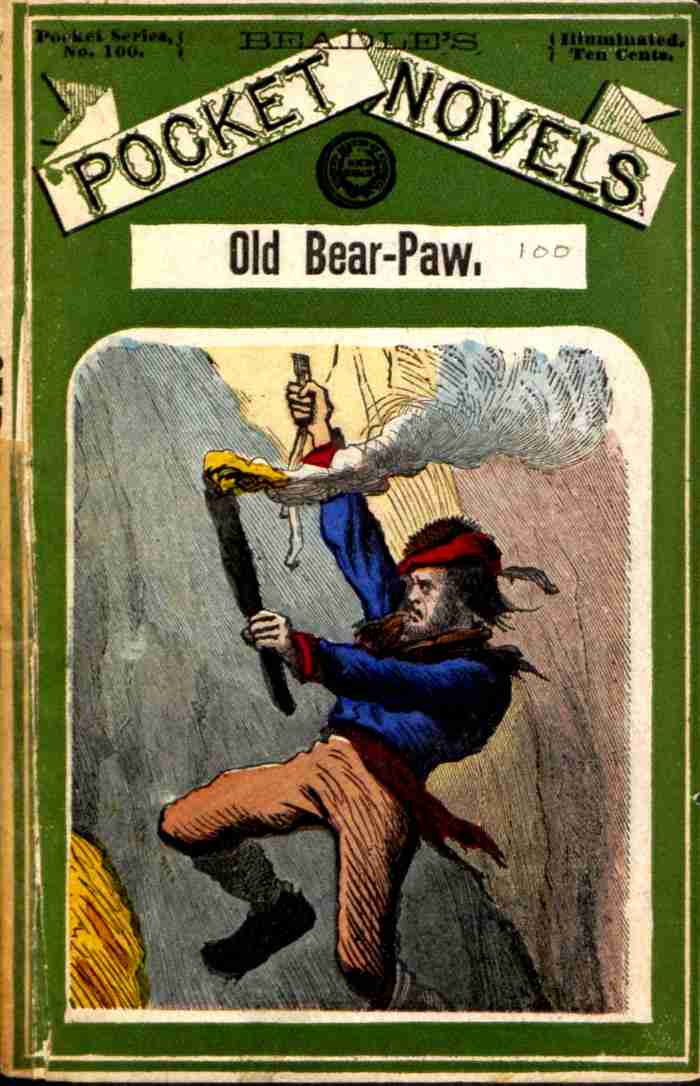
The Project Gutenberg eBook of Old Bear-Paw, the trapper king; or, The love of a Blackfoot queen
Title: Old Bear-Paw, the trapper king; or, The love of a Blackfoot queen
Author: Henry M. Avery
Release date: July 12, 2022 [eBook #68513]
Most recently updated: October 18, 2024
Language: English
Original publication: United States: Beadle and Adams, 1872
Credits: David Edwards, Mary Meehan and the Online Distributed Proofreading Team at https://www.pgdp.net (Northern Illinois University Digital Library)
OLD BEAR-PAW,
THE TRAPPER KING;
OR,
THE LOVE OF A BLACKFOOT QUEEN.
BY MAJ. MAX MARTINE.
AUTHOR OF POCKET NOVEL No. 67. "SHARP-EYE."
NEW YORK:
BEADLE AND ADAMS, PUBLISHERS,
98 WILLIAM STREET.
Entered according to Act of Congress, in the year 1873 by
BEADLE AND ADAMS,
In the office of the Librarian of Congress, at Washington.
CHAPTER I.
THE BROKEN CHIEF.
"I wonder what has become of that everlasting Yankee? He promised to meet me here at noon, yet I have stood here and seen the shadows of these old pines lengthen for the last hour. Surely something must have happened to detain him, for he never deceived me yet, and I do not like to believe he will commence now—"
"Yew are 'tarnal right; he won't!" interrupted the second speaker, who was no other than the "everlasting Yankee" himself.
Thus soliloquized the celebrated scout, Lew Kelly, and thus replied his tried friend and companion, Jehiel Filkins, as they stood upon a peak of the Black Hills, west a five-day's ride from Fort Randall—the nearest place where white men could be found, for they were already in the hunting-grounds of the Blackfeet.
The two scouts, well-mounted, and armed to the teeth, were spending a sort of vacation in that dreaded vicinity to satisfy themselves as to the truth of certain rumors, rife at Fort Randall and Yankton, concerning the gold, which it was asserted was laying around loose in the ravines and damp, dark gulches of the Black Hills; and of the existence, in the hills and valleys of the North-west, of bear, elk, antelope and beaver, which an adventurous scout had asserted made that country a perfect paradise for the hunter and trapper.
They had gone far enough, and seen enough to convince them that there was good foundation for these rumors. Gold they had found in the black sand washed down from the hills, and in the quartz ledges underlying or jutting out from the very crag upon which they stood. As to game, they wondered they had not heard of it before, so abundant was it.
"What was you sayin', Lew?" asked Filkins. "Are you getting in a hurry to go home? Wal, I ain't, then. There ain't an Ingin within forty miles of here, and if there was I know you would not be afeared of them; but if you will wait just a week longer I will go anywhere with you, if it's to Halifax."
"You said those same words, ten days ago, Jehiel, yet here we are, a hundred miles further west than we were then."
"Sartin!" replied Jehiel. "But what's the hurry, Lew? You're too old a scout to get homesick so soon; I wouldn't."
"Mighty good reason why you wouldn't, and why you never tire out or get homesick. Your home is wherever you happen to find yourself, and you care for nothing but that old coat of yours. Besides, you forget that away over the hills there a dear little wife is waiting and watching for me, and no doubt alarmed at my protracted stay."
"Jes' so, Lew. A scout has no business gettin' married. It e'ena'most makes a coward outen him—"
"You lie, and you know it!" exclaimed the scout, angrily. "Have you forgotten our fight with the Blackfeet, two years ago? Where would your old yellow scalp have gone to then, if it had not been for me? And wasn't I married then, you old fool?"
"Cor-reck, Lew; I take it all back, and beg yer pardon. But, I never see'd such a kentry fur game as this, and besides, I hev' jes' set my heart on goin' over to that round peak there where it looks so foggy. You see it is right on the home stretch, and I can camp there while you pack up and foller to-morrer."
"All right, Jehiel; I will wait another day. But if you are bound to go you had better make a start; it is a good ten miles over there and a pretty rough trail."
"Cor-reck ag'in, Lew, and I'll jog along."
And the Yankee shouldered his rifle and started for the designated point. He was soon out of sight of the scout, who descended the western slope of the bluff and made his way to their camp, beside a limpid stream which flowed through the valley to the north.
He had nearly reached his camp when a sight met his eye which caused him to halt and take shelter behind a tree.
He saw, coming down the valley from the west, three persons on horseback, who seemed to be riding for dear life.
Two rode side by side, and fully a hundred yards in advance of the third, and all were lashing their horses to their best speed.
Of those pursued, one was evidently a female, and as she was bound, it was also evident that she was a prisoner.
The Indian in the rear, who was in such hot pursuit of the foremost, was lashing his horse in a perfect fury; and as they passed the tree where the scout was concealed, he said:
"It looks like a long chase, but I don't see any signs of anybody after them. If the squaw was only a white woman I would sail in and help her out of the fix—but then it is none of my business, and I guess I won't meddle. And I reckon they have too much on their hands now to take any notice of me."
Just as he reached his camp he looked after the Indians and saw the horse of the pursuer drop dead from exhaustion, and its rider was thrown violently upon the rocky path.
The Indian lay so very still that the scout thought he must be dead, and he started out to ascertain.
As he approached the fallen Indian, he discovered that he was still conscious, though unable to stand upon his feet.
The Indian was the first to break silence.
"Me know you—you are White Panther!"
"Yes, that is what some folks call me. But who are you, and what is the matter with you?"
"Me Gray Eagle, big chief of the Blackfeet. Heap matter! Leg broke, arm broke! Red Pine, the Sioux, has stolen Snowdrop, the daughter of Gray Eagle, and if I can not get her back, then my heart broke!"
"Then you are old Gray Eagle, are you? Are you alone?"
"Gray Eagle all alone. Kill him if you want."
"Well, I don't know as I want to; scalping broken-legged Indians is not my business, just now. But, I'll tell you what I will do! If you will agree not to make war upon the whites again, but let them hunt and trap in these hills when they please, I will go for Snowdrop, and I will not return until I bring her and Red Pine's scalp! What do you say?"
"Gray Eagle will promise!"
"But your promise is not worth shucks unless you swear to it."
"Gray Eagle will swear!"
"Swear by the Great Spirit?"
"Yes."
"Swear by your knife and your tomahawk, and your horse?—even if he is dead he is good enough to swear by."
"Yes, I swear by all these that I will be a friend to the pale-faces as long as I live if Snowdrop is saved."
"Well, I don't know but that is about all you can do, and I will trust you; though if Jehiel was here he would say, 'Shoot him and let the Sioux keep the gal.' But I will carry you to my camp, and then I will go for Snowdrop; and I'll get her, too, if I have to follow Red Pine clear home!"
The scout raised the chief in his arms and carried him to the camp.
"There," he said, as he laid the chief upon a blanket, "you keep quiet until I come back."
He called his horse, a beautiful black stallion, and mounting, started on the trail of the Sioux.
CHAPTER II.
SMITTEN.
The daughter of Gray Eagle was one of the very few handsome Indian women. Though not more than sixteen years of age, she deserved the proud distinction she had won of being the flower of the Blackfoot nation, and the only really beautiful girl in the tribe.
Dozens of chiefs had sought in vain to win her heart; even brave warriors from other tribes had offered fabulous gifts for her; but her father gave them all the same answer—that Snowdrop was the idol of his heart, and that he would not force her to marry a brave she did not like.
As for Snowdrop herself, she had never loved any one except her father, and consequently none of the braves received any encouragement.
But, Red Pine, a cruel chief of the Sioux, had seen her, and with him, to see her was to covet her; so he did not ask the consent of any one, but, watching his chance when the Blackfeet were nearly all gone on a hunt, and Gray Eagle was confined by sickness, he had stolen her away.
Gray Eagle had followed on the trail, and when within rifle-shot of the Sioux, had met with the accident already narrated.
Red Pine, seeing the fall of Gray Eagle, immediately slackened his speed so as to save his horse as much as possible; for the chase had been a long one, and they were now fully thirty miles from the Blackfoot village. But he would not have ridden so slowly had he known who was upon his trail in the place of Gray Eagle.
"Would Snowdrop like to rest?" he asked.
The only reply he received was a flash of scorn from the wondrously black eyes of the captive.
"Ugh!" he grunted. "Snowdrop mad now, but by-and-by Red Pine make her talk!"
Snowdrop looked back to see what had become of her father, as she could no longer hear the sound of his horse's feet.
Red Pine also looked back and saw, what she evidently did not, that a well-armed and well-mounted white man was upon his trail. Furiously he lashed the horses ridden by himself and Snowdrop, and once more they flew down the rough valley.
Not long before he had received a severe chastisement at the hands of a party of white men, and he actually dreaded this single man who was now in pursuit of him more than he would have done the whole Blackfoot nation.
Lash as he would, his pursuer rapidly gained upon him. He stopped his horse, and placing himself behind Snowdrop, he drew her to him so that her form covered his breast, and drawing his knife, held it above her breast, resolved to kill her rather than give her up.
Snowdrop was prepared for the blow, but it never fell. With a howl of mingled rage and pain, the Sioux sprung from his horse, his arm hanging limp and useless at his side, and darted into the bushes, where it was impossible for any one to follow him, just as the scout rode up.
Snowdrop, when she discovered that she had merely changed captors, was at first inclined to be angry, but when Kelly drew his knife and cut the thongs which bound her hands, at the same time saying that she was free, she replied:
"Snowdrop can not thank the pale-face, but he has saved her life, and now she is his."
"Gracious! I don't want you!" replied the scout. "Now you hold my horse until I find that red-skin and get his scalp, then I will take you to your father."
But he was unsuccessful. The Sioux had taken care to hide his trail, and the scout soon returned, and mounting his horse, led the way back to camp.
Neither spoke, but Snowdrop thought, "What a handsome man he is," and for the first time in her life she was in love. She had yet to learn that it takes two to make a bargain, though she resolved to win the love of the brave scout, or die.
When they reached the camp where Kelly had left the old chief, they found him sitting beside the fire, endeavoring to tie a cloth around his broken leg. An expression of pleasure lit up his swarthy face as he saw his daughter unharmed; then, as his eye rested upon the belt of the scout, Kelly said, as if anticipating his thoughts:
"No; the red devil got away that time. You see, I had to break his arm, or he would have struck the girl to the heart. But never mind, I will have his scalp yet; for I never go back on my word with any man, be he red or white. I brought back his horse for you, and I don't suppose you are far from your village, so you can go home when you please."
"White Panther is a great brave, but Red Pine has many warriors with him, and they may come and take Snowdrop from him. The village of Gray Eagle is only a day's ride from here; will the white brave build a smoke to call the warriors of Gray Eagle here?"
"Yes," replied Kelly, "and while I am about it, suppose you have Snowdrop get something to eat. There is plenty here," he said, pointing to several saddles of venison hanging in the trees near by. Then Kelly went to build the smokes.
The transparency of the atmosphere in that region is such that objects can be seen at a great distance; for example, a mountain presents a distinct and bold outline at fifty or sixty miles, and may occasionally be seen as far as a hundred miles.
The Indians, availing themselves of this fact, have been in the habit of practicing a system of telegraphing by means of smokes by day, and fires by night, and there are but few men who have crossed the mountains who have not seen these signals made and responded to from peak to peak, in rapid succession.
The Indians thus make known to their friends many items of information highly important to them. If enemies or strangers make their appearance in the country, the fact is telegraphed at once, giving them time to secure their animals and to prepare for attack, defense or flight.
War or hunting parties, after having been absent a long time from their friends at home, and not knowing where to find them, make use of the same preconcerted signals to indicate their presence.
Very dense smokes may be raised by kindling a large fire with dry wood, and piling upon it the green boughs of pine, balsam, or hemlock. This throws off a heavy cloud of black smoke which can be seen very far.
Kelly proceeded to the top of the bluff where we first met him, and soon three long, white columns of smoke were rising heavenward. This done, he returned to his camp, and found dinner awaiting him.
Snowdrop presented him a nicely broiled steak upon a clean bark plate, and was well repaid for her trouble by the smile he gave her, and complimented her upon her skill in cookery.
After dinner Kelly set the broken limbs as well as was possible with the appliances at hand. When completed, he said:
"Will Gray Eagle remain with me until morning? Then I will start on the trail of the Sioux."
"Why does my white brother stop here?"
"I'm waiting for my partner, who went to visit a big hill over to the north-east. He was going to stay until morning, but that smoke will bring him as soon as he sees it; anyhow, I won't go without him!"
"It is right for White Panther to be true to his brother, but the Sioux will be upon our trail before morning."
"Well, let them come. If they do, you can make a big addition to your stock of scalps."
Suddenly the sound of footsteps was heard, and in a moment Jehiel Filkins stood before them.
"Glad you are back, for we have got some work to do."
"I thought there was something up," he replied, "though I was on my way back when I see'd your smokes. Then, you just bet, I traveled! But say, I'm awful hungry! Who is that handsome creetur'?" he asked, as he set about getting his dinner.
"Oh! she is the daughter of that old cub who lays in there with a broken leg."
"It strikes me I have seen him somewhere, before, but I never see'd such a pretty gal as that, any place."
"Well," replied Kelly, "pitch in and make love to her if you want to, and marry her if you can. I'm sure you need some one to mend your clothes. But I have not told you yet that we have got to escort them to their village."
"Yes, we will," said Jehiel, "and lose our scalps for our kindness!"
"We won't do any such thing. I have been making a treaty of peace with Gray Eagle, and he has promised not to fight the pale-faces any more!"
"Wal, what's an Injun's promise good for?" asked Jehiel.
"You don't know them as well as I do, or you would not ask such a question!"
"No, I s'pose not—nor you don't know 'em as well as you will a year from now. But," he continued, "if we are going, let us be on the move. I will eat as we ride along."
Snowdrop was well pleased when she heard Jehiel speak thus, and smiled as she said:
"The Long Hunter is brave and good to be the brother of White Panther."
"Much obleeged," said Jehiel, "but he ain't my brother, though he is a bully boy, and fit to be the brother of a king."
Lifting the wounded chief to his saddle, they started up the valley, Kelly taking the lead, the chief next, and Snowdrop behind him, while Jehiel brought up the rear; preferring to be where he could admire the lovely form of the Indian girl.
"By Gunner!" he muttered, "but ain't she nice! I'll do something desperate, and marry her or bu'st!"
Truth to tell, Jehiel Filkins was desperately and irrevocably in love, but he was "counting his chickens" too soon.
In the midst of his reverie he was made aware of a sudden halt, and he looked up to see what was the matter.
CHAPTER III.
THE SIOUX STROKE.
When the scout had halted, of course the others stopped and Jehiel found himself close beside the object of his meditations before he had fairly recovered from his day-dream. But close ahead he saw a camp-fire, and the silly lover was at once transformed into the brave scout.
He rode to the front, and took his stand beside Kelly with his gun cocked and ready for service.
"White men, and a hard-looking lot they are too!" exclaimed Kelly.
Seated around the camp-fire were a dozen men, who, as soon as they discovered the party of our friends, sprung to their feet, and stood ready with their guns.
"Come on," said Kelly, "we may as well be bold about it, for we are too close to back out now."
The strangers stepped out in front of their camp, and waited for the scout to approach.
He had seen too many of that class of men before on the plains and in the mountains, not to know that he had come across a gang of road agents, through he was at a loss to imagine what they could be after, in that section.
He knew that these outlaws were frequently in league with the Indians, and he did not know but this party were in some way connected with the Sioux, from whom he was endeavoring to escape.
The leader of the party of whites was the only good-looking one in the crowd; the rest wearing a hang-dog, ruffianly look, as if they had been life-long murderers. The leader saluted Kelly with:
"Hello, stranger, which way are you going?"
"North," replied Kelly, "as you can see, if you use your eyes!"
"Yes, I see; but what are you going for?"
"It is not evident to my mind that it is any of your business where we are going," replied the scout. "I don't mind telling you, however, that we are bound for the village of the Blackfeet."
"What may I call your name? It strikes me I have seen you somewhere before to-day."
"You may call me Robinson Crusoe, if it will do you any good, though that isn't my name; and it is barely possible you have seen me somewhere, for I have been there several times."
"Where?"
"I told you somewhere!"
"Well, where are you from?" asked the stranger.
"Home!" replied Kelly.
The stranger laughed and said:
"I am not likely to get much information out of you! I believe there are some men in this western country who dare not tell their names."
"You do, eh? Well, I am not one of them," replied Kelly.
"Who said you was?"
Kelly made no reply, but turning to his party, said: "Come on," and was about to start when the stranger again accosted him with—"Won't you stop and camp with us?"
The scout noticed the looks which the ruffians bestowed upon the Indian girl, and did not like them, and he replied:
"No, I thank you. We have plenty of provisions, and will make our camp a few rods away."
"All right," said the leader, "I will come over and make you a visit after supper."
Kelly rode on about eighty rods, and halted beside a stream, saying, as he dismounted:
"We will camp here. But," he added, "you can all make up your minds to leave here before daylight."
"Heap good!" said Gray Eagle. "White Panther knows what is best, and Gray Eagle trusts his life with him. White Panther has said he would take him to his village."
"Yes," replied Kelly, "and I will do it; you need not worry any more."
The wounded chief was taken from his horse and laid upon the soft grass, and while Kelly went to find a good place in which to secure the horses, Snowdrop set about getting the supper. In this occupation she was assisted by Jehiel, who, as we have said, was desperately in love with the beautiful squaw.
Shortly after Kelly had returned to the fire, the leader of the other party came into their camp, and entered into conversation with him.
"You were not brought up on the plains, though you seem to be an old hand at camp-life," he said.
"How do you know that?" asked Kelly.
"Because you do not look like a plainsman or a common trapper, neither do you use such language as is common with that class."
"I see," laughingly replied Kelly. "You think if a kitten is born in an oven it must surely be a loaf of bread! But you are mistaken. I have spent my life, or all of it that I can remember, west of the Mississippi; and I never went to school a day in my life. Manners and language are like the small pox, contagious; and if I have caught more than most men in my calling, it is my good luck, not education."
"Well, will you tell me your name now?"
"I don't know of any reason why I should not, as I never done any thing to disgrace it. It is Kelly; my friends call me Lew, for short—"
"What! Lew Kelly, the famous scout? Your name is well known all along the frontier, and I am glad to meet you, though I must confess I am somewhat disappointed."
"In what respect?" asked Kelly.
"Why I expected to see a great burly fellow, who could whip his weight in wild-cats, but you are not much older than I am; nor much, if any, larger."
"A gentle hint that you think you can whip me," said Kelly.
"No, sir, nothing of the kind; and I hope I may never have any occasion to try it."
"You will be liable to get the worth of your money if you do," replied the scout. "But will you tell me your name?"
"You may call me Curtiss, if you please—those fellows over there call me Captain."
"Well, Captain Curtiss, it is none of my business, perhaps, what you do, or what becomes of you, who you are, or where you are going; but I shall not be doing my duty unless I tell you that you are liable to get into a pretty lively muss before morning."
"What makes you think so?" asked Curtiss.
"I have every reason to believe that a large body of Sioux are on our trail, under Red Pine, the fellow from whom I rescued this girl. If they do not try to recapture her, then I am no judge of Indian nature."
"I am much obliged to you," said Curtiss. "I will be ready for them, if they come. And now, good-night."
After he had gone, Jehiel sat beside Kelly and talked for nearly an hour. It was arranged between them that they would remain on guard, and Jehiel said:
"Come now, Lew, you turn in and sleep till midnight, and I will take the first trick at watching."
"Wait a few minutes," replied Kelly; "I want to see how they are fixed over there;" and he proceeded to inspect the camp of the strangers.
He soon returned, and to the inquiry of Jehiel, he said:
"The fools have all gone to sleep, and left a big fire over there. If the Sioux should come, they will get the first slice, that's sure." He gave the fire a kick, and rolling himself in his blanket was soon asleep.
The camp-fire of the strangers had burned low and no unnatural sounds could be heard, when Jehiel awoke the scout to take his place.
"You should have called me before, Jehiel, you will not get much sleep, I am afraid."
"Who keers a durn? I'll be ready when you are!" and Jehiel sought his blankets and sleep.
Kelly began his watch, keeping in the shade of the bushes, and for nearly an hour he heard no unusual noise. Then the breaking of a twig between himself and the camp-fire of the strangers alarmed him, and he crouched down to the ground the better to watch the movements of whatever was prowling around.
The object was moving as stealthily as a cat, and Kelly could not discover it until it passed an open spot where the fire light reflected upon it, when he made the somewhat alarming discovery of a Sioux warrior; and he had barely time to notice that he was in his war-paint.
The question arose, what should he do? The problem was solved by the Indian himself, who was now coming straight toward the tree behind which the scout was concealed.
Nearer and nearer he came, until the brave scout could hear him breathe, and as he passed the tree could have touched him.
The Indian halted to listen, and apparently satisfied, started on. He had taken but one step when the scout sprung upon him, and with a single blow of the keen-pointed knife the Indian sunk to the ground without a groan.
It was but the work of a moment for the scout to secure the horses, and lead them to the camp.
Here he gave Jehiel a kick which brought that worthy to his feet with "Durn yer pictur'," when he was interrupted by Kelly placing his hand over his mouth, and saying:
"Keep still, and saddle the horses; the Indians are here."
Then he silently awoke the chief and said, "Let us go." Gray Eagle and Snowdrop were soon ready for a start.
"Here, Jehiel, you take the chief and the girl and go on down the creek; I will join you in a few minutes."
"Where are you going?" asked Jehiel.
"I am going to tell the strangers to be on their guard," and the brave man, unmindful of his own peril, mounted his horse and started for the camp of the strangers; while Jehiel, and the chief and his daughter, went down the stream.
Kelly had got about half-way to the other camp when a dark figure sprung from the bushes in front of him, and struck at the head of the scout.
He missed his mark, but not so Kelly, who reached out and dealt the Indian a blow between the eyes which brought him to the ground.
Spurring over the prostrate body he drove into the camp of the strangers, shouting as he went:
"Up, men, for your lives! The Sioux are here!"
A hundred dusky forms sprung up as if by magic, and the air was filled with murderous yells. Drawing his revolver he shot right and left, an Indian falling with every shot.
The first thought of the brave scout was to join his party as soon as possible, but his afterthought was worthy of him. He knew that to insure the safety of Jehiel, Gray Eagle, and Snowdrop, he must go in an opposite direction, and thus lead the Sioux in pursuit of himself rather than his friends.
The impulse was a brave and noble one, well worthy of the scout, and he turned his horse, resolving to trust to his speed.
A row of angry, painted faces met him, but he charged through their ranks, shooting two Indians as he went.
Then he became aware that another horse was close beside his, and turning in his saddle he beheld Snowdrop, who had followed him, and was now close by his side.
"Come on, girl. Ride for your life!" he shouted, "and keep close to me."
He turned his horse in the direction of the stream, and in a few minutes both horses were dashing through the water, and up the opposite bank. The scout never paused except to see that the Indian girl was safe across, and having satisfied himself on that score he dashed ahead.
Meanwhile the camp of the strangers was the scene of a bloody conflict. The white men were battling desperately for their lives, but they had been surprised, and the scout knew from the rapid and incessant firing, that the battle could not last long.
He halted and listened to the noise of the conflict upon the opposite side of the stream. All at once it ceased, and as he was wondering which party had met with success, there came to his ears a wild, prolonged shout, which was answered by a single yell of defiance.
"That sounds as if them white men had passed in their checks, and the Sioux had won the battle." He looked at Snowdrop as he spoke, and her eyes were looking sorrowfully in his own, as she said:
"My father is a prisoner. He has tried to follow me and the Sioux have found him. Now he must burn."
"I guess not," replied the scout; "but why didn't you stay with him and Jehiel?"
"Snowdrop had rather die with the White Panther, whom she loves, than live with any one else!"
"Well, you are a queer one, though, when I told you I did not want you. I have one wife already, and that is all the law allows a white man. But, I'll tell you, Snowdrop, there's Jehiel is in love with you head over heels, and he will take you if you'll only give him half a chance."
"The White Panther saved my life, and I will never cook meat for any other man!"
"Oh, fudge! You'll get over that before long."
"Never. What will Snowdrop do now they have taken her father, and will burn him?"
"Keep cool, little gal! They have not burned him yet, and I have promised Gray Eagle that I would give him the scalp of Red Pine, and I'd do it. They have probably got Jehiel too; and now, girl, it's about daylight, and I want you to ride as fast as you can to the village of your people, and bring back all the warriors you can get. I will stay here and wait for you, and when you get back we will give them Sioux particular fits!"
Without a word the Indian girl obeyed, and was soon lost to the sight of the scout.
CHAPTER IV.
THE YANKEE'S QUEST.
After the Indian girl had departed on her mission, Kelly rode his horse into a thicket of willows beside the stream, and tied him. The scout then ascended the hill and looked in the direction of the late battle-field, but it was not yet light enough for him to discern any thing.
A tall, bushy oak stood near.
"Just the thing," said the scout. "I'll climb this tree, and then perhaps I can see what they are about. They are too quiet to suit my idea, and I shouldn't wonder but they are up to some new deviltry. Of course they have not found Snowdrop, and as that is about all they are after they will not give up the search. Then they'll be tramping around on my trail. But let them come; they will not find the Indian girl, for she is a good piece toward home by this time."
The scout was now among the branches of the trees, from which he could get a good view of the surrounding country, and there, for a short time, we will leave him and take a look at the camp of the victorious Sioux.
Upon the ground sat Gray Eagle, Curtiss, and Jehiel Filkins, while in front of them stood Red Pine, the Sioux chief.
"Ugh!" he said, addressing Gray Eagle, "Red Pine has got you at last; and now as soon as he gets Snowdrop he will start for home!"
"Red Pine will never get her. She is far toward the village of the Blackfeet, with the White Panther, and will bring enough of the warriors of Gray Eagle upon the trail of the cowardly Sioux that will sweep them from the face of the earth!"
"Waugh! Gray Eagle talks brave! He forgets that he is the prisoner of Red Pine."
"No, Gray Eagle does not forget. He is ready to die; he does not care as long as his daughter is safe."
"Before the sun goes down Snowdrop will be a prisoner like her father. Sioux warriors are on her trail, and she rides alone. The pale-face has left her to take care of herself, and she shall yet sit in the lodge of Red Pine!"
"Then let me die!" said Gray Eagle.
"No. The Blackfoot shall go to the village of the Sioux, and when he sees Snowdrop the slave of Red Pine then he shall die by torture!"
Then addressing Captain Curtiss, he said:
"What does the pale-face want here?"
"We were just traveling through the country on our way to Oregon," replied the captain.
"Do you know Gray Eagle, the Blackfoot?"
"No; I never saw him until last night."
"And the pale-face who went with the Blackfoot squaw?"
"I do not know him. I have nothing to do with either."
"Red Pine will keep the pale-face, but he shall die with the Blackfoot dog!"
Then to Jehiel:
"This other pale-face squaw—what right has he here, and what does he want?"
"None of yer business, you darned fool! Now what are you goin' to do about it?"
"Red Pine will make you cry before long!"
"No you won't, you old sucker; you can't do that little thing," replied the scout.
"We will see. When the sun shows its face above the trees, the pale-face shall die by fire."
"The sooner the better, old stoughton bottle. It's a chilly night, and a little fire will do a fellow good."
"Red Pine says you shall die!"
"Yaas, I heerd you, you dirty squaw thief, but you Sioux will lie so that a feller can't depend on what you say. If you should accidentally be telling the truth, it will be better to die than live around where you are!"
"Pale-face talks brave now; we will hear him cry when he eats fire!"
"Oh, shut up, you maw-mouthed imp, and go on with your concert!"
The Sioux chief took Jehiel at his word, and ordered the prisoner to be bound to the stake, and almost before Jehiel knew what he was about, the brush and dry wood were piled nearly to his chin.
When this was accomplished the chief said to him:
"When the sun shows his face above the trees, let the pale-face squaw burn!" and the scout sung:
and calmly awaited the torture.
And that was what Kelly saw from his perch in the tree, upon the opposite bank of the stream.
"That will never do!" he exclaimed; "I must hurry up, or they will roast Jehiel, in spite of fate."
Descending the tree he mounted his horse and started for the scene of torture.
It was well for him, perhaps, that the Sioux were so busy preparing for the torture and therefore did not see him approaching.
He was within a few rods, when a warrior was seen approaching, with a blazing firebrand, and stood awaiting the order of the chief to fire the pile.
Soon the order came, and just as he was about to apply the brand, the report of a rifle was heard, his arm fell at his side, and with a cry of rage and pain he ran beyond the circle of warriors.
The Sioux stood in mute astonishment at the turn of affairs, and at that instant Kelly dashed through the line and to the prisoner, and without dismounting, cut the thongs which bound Jehiel to the stake.
"Jump up here, behind me," he shouted, and before the Sioux had recovered from their surprise, they had reached the bottom of the hill and were dashing at top speed down the valley.
As would naturally be expected, the Sioux started in pursuit, but their ponies were no match for the powerful black of the scout, and they were soon left far behind.
"Gunner! Lew, but you happened around just in time, didn't you? Them yer fellers was goin' to heat up my carkiss!" were the first words spoken.
"How did you fall into their hands?" asked Kelly.
"W'y, you see, when old Gray Eagle found out that his gal wasn't along, he jest turns his hoss's tail like an old fool, and cuts after her! Say, Lew, where is the little angel gone to?"
"Home," replied the scout.
"Hold on a minute!" exclaimed Jehiel; "my horse is in here somewhere. Wait until I find him, then we can go the faster."
Dismounting, he soon found the horse and again they started on down the valley.
"We must go a little slow," said Kelly, "or the Sioux will give up the chase."
"Don't you want them to?" demanded Jehiel, in some surprise.
"No, I don't; at least, not until I get a shot at some of them."
"Cor-reck!" responded Jehiel. "I didn't think of that. Let's find a good place, and stop until they come up."
A few rods ahead they found a pile of rocks, and secreting themselves and their horses behind these, they awaited the approach of the pursuing party.
These soon appeared, tearing down the valley totally unconscious of danger, and when within a few rods of the ambuscade, Kelly whispered to Jehiel:
"You take the leader, and I will take that fellow in the rear; that will stop them. Then, before they get over wondering, we can pick off the rest."
There were but five of the enemy to be seen, and as the two scouts discharged their repeating rifles, the leader and rear man fell.
The other three were too astonished to move, and soon fell victims to the skill of the scouts.
"There!" said Kelly, "I guess there are no more after us, and we might as well go back."
"Go back!" exclaimed Jehiel. "What in the Old Scratch do you want to go back for?"
"To release Gray Eagle, and get the scalp of that dusky nigger, Red Pine!"
"Why, Lew Kelly, are you crazy? If you want scalps there's five of 'em out there; though I can't see what in thunder you want with the dirty things!"
"I believe I told you I had promised Gray Eagle I would get the Sioux chief's scalp for him, and I'm going to do it, or lose my own."
"Cor-reck! You ain't in such a hurry to get home as you was, are you, Lew?"
"Yes, I am just as anxious as ever, but I have pledged my word, and you know I never lie. More than that, I consider that if we can secure the friendship of the Blackfeet at so small a cost, I shall be doing the country a good service. So I shall make a desperate effort to get the scalp of the Sioux chief, and—perhaps lose my own in trying."
"Wal, wherever you go, you can depend on yours truly, Jehiel Filkins!"
"Thank you. But I want you to go the other way," replied the scout.
"Which other way?"
"I want you to find the trail of Snowdrop, and follow it until you find her. I more than half suspect that Red Pine started some of his fellows on her trail when he found she was not with you, and they may have overtaken her."
"Where did you say she had gone?" asked Jehiel.
"Home. I sent her after some Blackfoot warriors, because I thought the Sioux would be after us before we could reach the village of Gray Eagle; and you see I guessed right.
"What made you think so?"
"Because she is what he came for, and he will use every effort to get her."
"Wal, I'll go. But, Lew, I'd jest like to ax you one question. Is Snowdrop in love with you?"
"Yes," replied Kelly, "at least she said she was, and that was the reason she came back after you got started last night."
"Then my bread is all dough," said Jehiel; "but I'll go all the same, seein' as how you asked me to."
"What makes you say your bread is all dough?" asked Kelly.
"Cause you said she was in love with you."
"That does not make any difference," replied the scout. "I am not in love with her, by a long shot, and what is more I am not liable to be, while I have such a good little wife of my own living."
"Does she know you are married?"
"She ought to," replied Kelly, "for I have told her once or twice."
"Wal, I'll go, as I said afore; but, Lew, do you s'pose there is any airthly chance for me?"
"I don't know, I am sure," replied Kelly; "but you can try, and I will do all I can to help you. Remember, faint heart never won fair lady. And now, hurry up and get started, for Snowdrop may even now be in the hands of the Sioux."
"Where'll I find you when I get back?"
"I don't know, Jehiel; I shall stay around here and keep watch for the Sioux, for I am certain they are waiting to get Snowdrop before they go home."
"What makes you so sartin?" asked Jehiel.
"In the first place, this is Blackfoot country, and not Sioux, and we are not more than thirty miles from the village of the Gray Eagle. In the next place, Red Pine would have burned Gray Eagle before this, if he thought he could not get Snowdrop. If I am not here, you will find a letter in this clump of willows that will tell you where I am gone."
"Wal, take good keer of yourself, and I will find the gal if I kin!"
So saying, Jehiel started upon his errand, while the scout prepared to dog the Sioux.
CHAPTER V.
TRAILING A TRAIL.
Snowdrop, after she had left the scout, was obliged to ride very slowly until she was over the rough hills, but after she had reached the open prairie she increased the speed of her horse.
She was a fearless rider, but the long, treeless plain which lay stretched out before her wore a dreary aspect, well calculated to discourage her.
But her mission was one of life or death to her, and she undertook the task.
The sun was just rising as she entered the plains, and putting her tough pony to the run, she dashed ahead. She was doing all this for what? Not for herself, for she would have preferred to remain with the scout; nor yet for her father, for she did not think Red Pine would spare him so long; but she was going just because the man she loved had asked her to go!
Onward the brave girl urged her horse until the sun was nearly overhead, still no signs of the Sioux. She paused a moment to allow her horse a breathing-spell, and while resting she discovered a party of horsemen on her trail, and though they were a long ways off, she knew by the way in which they rode that they had a definite object, and that that object was herself.
She was convinced that a long and tiresome race was before her; and, having been reared to a life of peril and strategy, she allowed her horse a long rest, that he might the better stand the race.
She displayed her good sense by removing the saddle from the horse, and now, armed only with a small rifle, she sprung upon his back and put him to his best speed.
On the brave girl rode—on, over the treeless and trackless waste, and only at long intervals did a roll in the prairie obstruct her view of her pursuers. At length she came to a small stream running at right angles with the path she was pursuing, and here she paused again to allow her horse to drink.
The advancing party, whoever they were, gained rapidly upon her, until she could now count their number. There were twenty of them, all well mounted, and by the manner in which they rode, she was no longer in doubt as to their object.
Far ahead she saw a long, dark line of timber, just beyond which, she knew, was the village of her people, and she thought if she could only gain that, she would be safe; and she resolved to gain the shelter of the forest, or die in the attempt.
Slowly but surely her pursuers gained upon her, and she could now hear their yells. The sound maddened her, and the very thought of failure made her heart sick; but she lashed her horse to renewed and desperate efforts.
Her horse, too, seemed to partake of the same fear and feelings as his mistress. A few rods more and she will be among the trees where she trusted she could elude her pursuers.
Vain hope! Just as the goal is won her horse falls, and the blood flowing from his dilated nostrils shows that he has ruptured a blood-vessel. A shrill yell of triumph comes from her pursuers, yet standing firm beside her dead horse, the brave Indian girl brings her rifle to bear upon them.
Never did a stricken buck turn more fiercely at bay upon the dogs on its track, than did Snowdrop when she found that she could not escape.
With Spartan firmness she held the short rifle, and when she thought they were near enough, pulled the trigger, and the foremost Indian fell from his saddle. She had not time to reload her rifle, but clubbing it, she awaited the approach of the Sioux.
Short time was given her for thought, and she was almost immediately surrounded and overpowered, but not until a brawny warrior had been made to bite the dust at her feet.
She was lifted to the saddle made vacant by her shot, and the young brave who seemed to be the leader took her bridle-rein, and they turned to retrace their way across the prairie.
"Do you speak the language of the pale-faces?" asked the warrior.
"Yes," answered Snowdrop.
"Then tell me who you are, and what tribe you belong to."
"I am called Snowdrop, and my father is Gray Eagle, the great chief of the Blackfeet."
"The White Wolf of the Pawnees has heard of Snowdrop before," he said.
"Are you White Wolf?" she asked.
"So I am called by both red men and white!" he replied.
"I have heard that White Wolf was a brave chief. If it is true, he will not make war on a woman!"
"No. Snowdrop need not fear! White Wolf already loves her and will make her his wife, for she is more beautiful than any woman of the Pawnee tribe!"
"But Snowdrop loves another, and can not go to the lodge of White Wolf, though he is a great brave and all the tribes fear him."
"White Wolf is in no hurry, and Snowdrop will learn to love him. We will wait till we get to the village of the Pawnees, and then when White Wolf asks her to be his wife she will say yes!"
"No, she will not; but if White Wolf loves Snowdrop, as he says he does, then let him go and rescue her father from the hands of the Sioux, for if he should die, then Snowdrop will die, too!"
"White Wolf will rescue Gray Eagle. Will Snowdrop tell him where her father is?"
"In the forest beyond the big hills which I left when the sun rose."
"White Wolf will go there, and he will take Gray Eagle from the cowardly Sioux, and when Snowdrop sees her father safe, then she will consent to be the wife of the Pawnee chief."
Snowdrop did not promise that she would, neither did she say that she would not; nor yet did she dare to tell him that the two scouts were doing what he was trying to do.
She acted wisely and kept silence, which White Wolf construed in his favor, and he said:
"We will go to our camp to the south, where I have a good place to leave Snowdrop in safety, then White Wolf will go on the trail of the Sioux. He will find them, and will bring the father of Snowdrop away with him!"
"Let Snowdrop ride back with the Pawnee braves," she said.
"No," replied White Wolf; "the Pawnees will ride fast, and Snowdrop is too tired. She must go to the camp of White Wolf, and stay until he brings her father to her."
Snowdrop did not repeat her request, for she knew that it would do no good, and that it would be a mere waste of words for her to do so. She bowed her head in submission, and soon saw all but two of the Pawnees start toward the west. The remaining two placed themselves upon each side of her horse, and one of them taking her bridle-rein, they started for the south.
When Jehiel took the trail of Snowdrop it was without much hope of overtaking her, for he knew that the brave girl would ride fast when she knew there was so much at stake, and she had a long ways the start of him.
But he was better mounted than she, and had no difficulty in finding and following her trail, and before noon he had her in sight.
He saw the party of horsemen come from the south and start in pursuit of her, and by the aid of a powerful field-glass he saw her capture and the manner in which she was disposed of, though he could not tell what tribe had done it.
He saw when the party of which Snowdrop was one, left the main body and started south, and he also saw the main body riding swiftly over the back track.
He turned his horse to the right, and when the larger party had arrived at the place where he left the trail, he was but a few miles away, and it was with a grunt of satisfaction that he saw them pass on and ride away toward the hills where he had left the scout.
Jehiel waited very patiently until they had passed out of sight, then he found the trail of the party who had charge of Snowdrop, and he started after her.
"Them fellers what has my gal will be mighty apt to meet with an adventure afore mornin', or my name ain't Jehiel Filkins. Gosh! but I wish I had the sweet critter in my arms this minnit! Wonder what Jemima Brown will say when she hears I am married to jest the prettiest little girl in America? Sartain, I hain't axed her yet, but I don't reckon she would refuse such a good-looking fellow as me."
He was thus soliloquizing as he reached the woods, and here he stopped. Finding a good place for his horse, he resumed his way on foot.
It was now nearly dark, and he was obliged to proceed cautiously, imagining that the Indians might have seen him following after them.
Leaving the beaten trail he carefully worked his way through the bushes, pausing occasionally to listen. No sound of falling hoofs was to be heard, and he again crept on.
Proceeding in this manner for about half a mile he discovered the glimmer of a camp-fire between the trees.
In the small opening three tired horses were leisurely feeding, while the Indians were busily engaged in building a fire and preparing their supper.
Snowdrop was sitting behind a tree with her hands and feet securely bound, and an expression of deep anxiety upon her face.
As Jehiel gazed at the group, he thought how easy it would be to shoot the two Indians, but he was not one to shed blood unnecessarily, and he determined to wait. He must contrive some way to let the girl know of his presence, but the question of how was a hard one to solve.
The trees surrounding the little camp were large, and the space open, so that he could advance no nearer without betraying his presence.
He solved the problem in his own quaint way. Depositing his rifle at the foot of the tree beside which he stood, he began to climb the tree. Once among the branches, the foliage of which he found dense enough for his purpose, he had no difficulty in making his way to the next nearest tree.
Creeping along the branches as stealthily as a panther, he passed from one tree to another until he found himself at the side of the opening, and directly opposite the tree near which Snowdrop was seated.
He was in imminent danger of being discovered, but with an intrepidity peculiar to the brave scout, he set about arranging his plans for the future.
CHAPTER VI.
THE OLD MAN OF THE MOUNTAIN.
When Kelly was left alone after Jehiel had started in pursuit of Snowdrop, he dismounted from his horse, and at a signal from him the sagacious animal lay down upon the ground, and Kelly proceeded to take his rest.
With his rifle beside him, his head pillowed upon the neck of the noble brute, he was soon in the realm of dreams. His sleep was long and deep, for the scout was very tired, and he did not awake until long after dark. Then the uneasy actions of his horse aroused him, and the motion of his ears, when the scout partially raised up, showed that he had heard some suspicious sounds; and Kelly felt confident that whatever the danger was it was very near, for the animal lay quite still, with his ears pointed forward in the attitude of intense apprehension.
The scout silently drew back the hammer of his rifle, and felt in his belt to see that his knife and revolvers were in their accustomed place.
Silence reigned for a few minutes, as deep as though no living thing was within miles of there.
Then Kelly heard some peculiar sounds—very slight at first, but plain and distinct. He recognized the sounds as being produced by the feet of human beings, and he knew that at least two persons were coming directly toward his hiding-place.
The scout did not move, neither did the noble black horse beside him. Both seemed instinctively to know that Indians were about, and the scout thought it more than probable that it was a part of the Sioux band who were trying to find him and Jehiel.
He kept still also because he thought that by so doing the Indians might pass by without noticing him.
The sound of falling footsteps came nearer and nearer, and the brave scout could see that they were moving with great caution. And they were coming straight toward him, and so close were they that Kelly imagined they might hear the beating of his heart.
His rifle was already cocked, and he now brought it to his shoulder, resolving to use it should his presence be discovered or necessity require.
"Listen," said a strange voice in unmistakable English, "I thought I heard something!" and another voice responded—"Yes, I heard the breaking of a twig;" and Kelly recognized the last as the voice of a woman.
"I wonder if it can be Jehiel and Snowdrop?" he soliloquized, but he could not tell whether the woman was white or red.
Whoever it was they kept perfectly still, evidently listening for a repetition of the sounds; and although the silence was of only a minute's duration it seemed an hour to the scout.
Again he heard them moving along, and they were now within a few feet of him, when Kelly, in a low, firm voice, said: "Halt!" As the steps ceased he continued—"Who comes there?"
"A white man, and an enemy to none but Indians!" was the reply.
Kelly recognized the voice of the speaker, and exclaimed:
"Gracious! is that you, Curtiss? Come on—but who have you got there?"
"I do not know what her name is, or where she came from; but I do know that she has done a good job for me, that I will not soon forget. She crept to my side about an hour ago, and cut the thongs with which I was bound to a tree, and probably saved me from getting roasted."
Then the scout looked at her as well as he could in the dim light, but she did not speak.
"She is no Blackfoot," he said, "and she is too good looking for a Sioux. Tell you what it is, Curtiss, I believe she is a white girl! How is it, girl, can you speak the language of the pale-faces?"
"Yes," replied a low, sweet voice, "I am Nu-le-la, the sister of Red Pine, the Sioux chief."
"The dickens, you are! Well, Curtiss, you and I are in luck, no matter who the young lady is. But, if she is a Sioux we will have to keep her close, or she will betray us to her brother. There will be a loud rumpus when they find out you are gone."
"Just listen! They have found it out already," said the Indian girl. "Let us leave here, for Red Pine will have a hundred braves upon our path as soon as the light comes, and he can be cruel when he chooses!" Loud yells could now be heard far down in the valley.
"Did you conceal your trail when you came here?" the scout asked of Curtiss.
"No," he replied, "we came as fast as we could, and had but one thought—that was to get away as fast as possible."
"Then they will have no trouble in following your trail when daylight comes, so the best thing we can do is to get out of here as soon as possible. I found a cave one day when I was out hunting, and not far from here. If I can only find it again, we will be all right. We have a few hours the start of them, so I guess we can find shelter before they can find us. Come on, now, and be sure and keep in a line directly behind me," said Kelly, as he entered the stream leading his horse. "And another thing," he continued, "you must be careful and not break any of the bushes along the bank, nor leave a footprint in the sand!"
And leading his pet horse he led the way up the stream.
When the stream became too narrow for the scout and his horse to walk abreast, he led the way, the faithful black following him, and Curtiss with the Sioux maiden bringing up the rear.
The current of the stream was swift, and whatever footprints were made were quickly washed full of sand and stones; and half an hour after no trace could be found in the bed of the stream, of those who so recently had passed through. They could hear the angry yells of the Sioux far down the valley, and they pressed on without halting.
The stream now came through a narrow defile with huge rocks towering perpendicularly upon either side; then having gone a few rods further, the scout halted.
"This looks very much like a trap!" said Curtiss.
"Well, yes," replied the scout. "It would be a trap if the Sioux only knew we were here. But they don't know it and this is not the place I proposed for us to roost in. Follow me a little longer." So saying, he led the way a few feet further, then turning abruptly to the right, disappeared in what seemed to Curtiss to be solid rock.
Presently the voice of the scout was heard:
"Why don't you come in? 'Walk into my parlor, said the spider to the fly,'" he sung, as Curtiss and the Indian girl entered the fissure in the rocks through which the brave scout had disappeared with his horse.
They found themselves within a large cave, thirty or forty feet in length, and perhaps half that distance in width. The floor was as smooth as could be wished for, while the room was high enough for all purposes.
"How do you like this?" asked Kelly. "Here is room enough and to spare, and no one can find the entrance unless they come up the stream as we did; and even if they should, we could defend ourselves against the whole Sioux nation!" He at once led his horse to the further end of the cave, and returned to the opening.
It was now daylight, and he took the opportunity to have another look at the Indian girl.
"Great Cæsar! But you are pretty," he said, as his eyes met those of the maiden.
"If this pale-face will only think so," she replied, pointing to Curtiss, "I shall be very happy!"
"Well, if he don't make you happy, I shall be tempted to punish him in some way!" said the scout.
"No, not that," answered the girl. "I saved him from torture, and now he is mine—yes, all mine forever!" said the impulsive girl, and she threw her arms round the white man's neck.
"There is no doubt but what the girl is in love," said the scout to himself, "and, as matters stand just now, I don't know but what it is the best thing that could happen for me, and it certainly is for him." Then he added, aloud—"If you and Nulela will remain here with old Pet, I will climb to the top of this rock and see if I can discover what the Sioux are about."
"All right," replied Curtiss—"we will wait here for you. But do not expose yourself unnecessarily, Kelly."
"I am not in the habit of doing that," answered the scout, "but let me advise you to keep on good terms with the girl. The more you can talk love to her, the better it will be for us, because if you make her angry she would not stop short of putting you again in the hands of her brother."
Proceeding down the stream a short distance, the scout came to a place where he could climb to the top of the rock.
Arriving there, he hurried to the end overlooking the valley, whence he could get a good view of the plains and the valley below him.
Away off, as far as the eye could reach, he saw straggling parties of Indians moving about, as if endeavoring to find the trail of the escaped prisoner.
Some of them were very near the foot of the hill upon which he stood, but the scout was satisfied that they had not yet found the trail.
There was one thing, however, which seemed somewhat singular to the scout. He noticed that a large addition had been made to their force. But it was soon made plain to him.
He saw large parties coming from the north, and knew that they were not all Sioux who where there, but that the Blackfoot braves had come to answer the call of Gray Eagle made by the smoke-signals, which the scout had sent up for the old chief.
"By Jingo!" he muttered, "I wish I could be down there to help one side or the other; but then, where is the difference? It is only dog eat dog after all, and they can fight it out without my assistance. Wish I only knew whether Jehiel is in the scrimmage or not? Reckon not, though, for he has not had time to go to the Blackfoot village and back. Wonder where the dickens he is, anyhow?"
But no answer came to any of the scout's queries, and the gnawings of hunger brought him back to his senses.
In a few minutes a drove of mountain sheep were discovered, slowly feeding toward him, and drawing his revolver he waited until they were near enough, and shot one. Shouldering his meat, he retraced his steps toward the ravine, only pausing once on the way to secure an armful of dry wood. He then descended to the stream, and once more presented himself before the group in the cavern.
"All right, here?" he asked, as he entered and deposited his armful of wood and meat upon the floor.
"Yes; all right!" replied Curtiss. "Did you learn any thing of our Indian friends, down in the valley?"
"Not much," replied the scout. "They seem to be having lively times down there, but I don't know as it is any thing that can interest us as much as a good roast of this mutton will, so I propose that we eat now. After breakfast I will take another look at them."
While they were yet eating their breakfast they were saluted by a strange voice, shouting:
"Hello! Who in thunder has tuck possession uv my domicil?"
They all sprung to their feet, and, grasping their weapons, stood ready to receive the new-comer, whoever he might be.
"Put up yer shooters, yer little nubbins; I won't hurt yer, seein' 'at yer mostly white," and as they did so the stranger advanced to the fire.
He was, to all appearances, an aged man, as his hair and beard, which were both long and flowing, were as white as the driven snow; but his straight, athletic form belied his age.
His dress and arms were such as are usually worn by the mountain trapper, though he wore one very singular ornament. This was no less than a necklace, consisting of a double row of bear claws.
This, the reader will understand, if he is conversant with Indian character, was a badge of distinguished bravery, and one of which any hunter might well be proud.
The stranger stood before the fire, silently regarding them for several minutes, then he broke out—"Why don't yer say suthin? Yer a doggoned purty set, to come inter a feller's house in this way, without even askin' the owner. Ef I was a leetle better 'quainted I'd take yer 'cross my knee an' spank ther hull caboodle uv yer!"
"I was not aware, sir," said the scout, "that we were intruding on any man's domain. I accidentally discovered this cave about a week ago, and made use of it this morning in effecting our escape from a party of Sioux who were on our trail."
"Sioux? Ther devil! Ther' ain't a Sioux in ther kentry what dare kem' a nigh here!" exclaimed the stranger.
"But," replied Kelly, "there are Sioux within a very short distance of here, as you can see for yourself if you will go to the top of the bluff."
"Wal, yer needn't bother yerselves any further. I've l'arnt 'em to respect old Bear-Paw, as they calls me; an' now ef yer a mind ter kem with me, I'll show yer a better place nor this."