
This exclamation was caused by a sudden thumping jar, followed by another plunge and then a fearful shock, that threw the captain forward upon his face, causing him to roll heavily against the gunwale, which he clutched, barely in time to save himself from going overboard.
Every blow of the waves only drove the prow the more firmly into the sand, while the stern, still in deep water, worked heavily around, until that, too, remained fast, and the Albatross thus lay broadside on, exposed to the full fury of the tempest; but a moment later, from some unexplained cause, the bow was lifted, and by a strange action of the waves, swung around, so that it pointed directly out to sea, and the rudder was the part nearest shore.
This rendered the stern the safest part, especially as the bow began working down in the sand, and it became necessary for Harry to shift his position. The seamen, by ascending some distance up the rigging and lashing themselves fast, had placed themselves above the reach of the waves, and Captain Cole, feeling that nothing else remained, prepared to do the same with Harry.
Watching his chance, he dashed forward, and catching the hand of the boy, had him at the foot of the ladder in a twinkling. Here another surge caught them, and but for the help of the officer, the boy would have been shot out on the crest of one of the billows, like an egg-shell.
But he knew what was required of him, and he went up the ladder as nimbly as a monkey, the captain at his heels, neither pausing until they reached a safe point, where they could maintain themselves with comparatively little difficulty for some time.
The trouble was, that if compelled to remain here very long, the driving sleet would so benumb their limbs that they would become unable to maintain their hold. The seamen, although strong and rugged men, had been on deck for twelve hours, and needed to be lashed to make sure of their footing.
But every probability was that not a soul would be left on board at the end of an hour, and this precaution was unnecessary in the case of the two who had last ascended.
It was not until Harry had been perched here for several minutes that he was able to take a survey of his surroundings.
As the chief officer had predicted, they had struck the beach very near the other vessel—less than a hundred feet separated them—and, as the lad looked off in that direction, he saw among the three figures clustered at the bow that of Little Rifle.
Most of the crew of the North Star had also lashed themselves to the rigging, but the bow being much more sheltered than was that of the Albatross, the three persons mentioned were enabled to maintain themselves with little exertion.
The tall dark figure, which Harry supposed to be the father, had placed himself in such a position as to shut off most of the fury of the tempest from his loved daughter.
And Little Rifle, holding on like a heroine, as she was, looked off in the rigging of the other ship, and saw Harry Northend, who was also gazing toward her.
“Does she recognize me?” was the thought in the mind of the lad, as he gazed wistfully at her.
His heart warmed with delight, even at this awful time, when the next moment he saw her raise her hand and wave it toward him. Regardless of his own danger, he returned the salutation, and shouted back, but the sound scarcely reached the ears of the captain, directly below him.
In that moment what must have been the thoughts of Little Rifle?
She could but have known what the presence of Harry Northend meant at this time. That one glance must have told the story of his patient, loving following of her through forest and mountain, and over river and sea, until finally they were brought face to face again in the midst of the tempestuous fury of the Pacific.
“Ah! what would I not give for the privilege of exchanging one single word with her?” thought Harry, as he remained gazing steadfastly across the short but impassable chasm. “I wonder which of us will have to go first?”
Soon shall the question be answered.
CHAPTER XIX.
THE LEAP FOR LIFE.
All this time the eye of Captain Cole was scanning the coast before them, and he was coolly weighing the chances it offered for an escape for him and his companions.
He noticed that the high, precipitous bluffs, as we have already mentioned, directly opposite them, sat back some distance from the shore. Were it otherwise, not the slightest hope would remain for the most daring swimmer that ever cleft the wave.
Not a living soul was to be seen upon these bluffs. He knew that further inland were marauding Indians, who, if they knew of the booty that was thus offered, would swarm along the shore in myriads, eager and impatient for the sea to cast the prey into their hands.
If they should appear, one would have little to choose between going down in the sea at rest, or in being washed ashore in the full possession of life and strength.
Harry had withdrawn his attention for the moment from the other vessel, when he felt the captain touch his leg, and, as he looked down at him to see what it meant, he pointed to the wreck.
One glance showed that it was breaking up. Large fragments could be seen tossed aloft by the waves, and to several of them, men were clinging.
Only two remained upon the prow and they were Little Rifle and her father. The other had also plunged into the boiling sea, in his desperate struggle for life.
“Why do they wait?” was the question that came involuntarily to the lips of the terrified lad; “they may as well take the leap first as last.”
He had considerable hope of their escaping. He knew that Little Rifle was a perfect swimmer, and he had heard old Ruff Robsart tell of some of her wonderful exploits in water. It was to be supposed, of course, that her father was also an expert.
Instead of watching those upon the wreck, Captain Cole was carefully observing those who were in the water; for the probability was that whatever fate befell them would befall those who came after. If they escaped, so might he; if they failed, the probabilities were that he would.
He saw them carried swiftly southward, all passing close to his own boat, and one poor fellow was swept under the bow, bruised and drowned; but the three others, clinging to the fragments cleared the second wreck, and by a curious action of the eddying current, were whirled in so close to shore, that by tremendous and powerful swimming all three reached land and were seen to wade up the beach, dripping with brine, and scarcely able to stand.
This was encouraging, for the captain would not acknowledge that his superior in swimming had yet been born. It was characteristic of the man, that disclaiming all assistance in the shape of life-preservers or pieces of the wreck, he should fling himself boldly into the ocean and begin the struggle single-handed.
The eyes of Harry Northend were naturally fixed upon him, and he watched his movements with an intensity of interest that can scarcely be imagined. He observed that as he drifted southward, he aimed directly for the shore, swimming with a steady and powerful stroke. He made no attempt to prevent the foam of the breakers from going over his head; for the simple reason that he knew no mortal man can support himself in spray and foam. All that he can do, is to hold his breath, and wait for a chance to get another mouthful of air.
This the sailor did, surely and steadily approaching the shore, until as tossed high upon the crest of a mighty wave, he made land, and clinging to the sand, scrambled up out of the baffled waves.
Harry’s eyes were upon the brave captain, and his heart gave a throb of pleasure as he saw that one at least had escaped, when something dark caught his eye in the water, and he saw that Little Rifle was in the water, clinging to a fragment of the wreck, and using might and main to reach the shore.
One glance at where the other wreck had been, showed that it was gone. The sea was sweeping over the spot, and the only part that remained visible was that to which the two were holding fast, and this was spinning resistlessly in the current.
Harry would have saluted them by way of encouragement, as they passed, but they were too much engaged with their own work to glance right or left.
The lad wondered why it was that Little Rifle persisted in clinging to the plank, when her ability in swimming would enable her to make much better progress toward the shore; but, as he watched the movements of the two, he rightly suspected that she did this to assist her father, who was not her equal in swimming, and who was afraid to trust himself alone in the waves.
The progress upon a raft is necessarily much slower than that of simply relying upon one’s muscular power and skill in the water; and so, with a terrible misgiving, he saw the two sweep on down the coast, without, so far as he was able to judge, coming any nearer.
It was plain that the exertions of the noble-hearted girl were intended mainly to benefit her parent. If she should fling herself loose from the float, and strike out for the shore, she could reach it as certainly as did Captain Cole, and the seamen of her own vessel.
As if to convince her of the truth of this, the sailors who had been lashed in the rigging of the Albatross, were now struggling in the water and steadily making their way to shore.
But certain death itself would not have dissuaded her from the attempt. With all her bravery and remarkable skill, she worked the craft toward the land, determined that if saved or lost, it should be in the company of her parent.
Harry felt that the time had come for him to make the “leap for life”; for he was the only one left, and the wreck itself gave signs of breaking up; but before doing so, he was anxious to see what became of Little Rifle; for if she escaped, he would be nerved to make greater exertions for his own safety.
Harry took a look at the father and daughter, but it was not a very satisfactory one, and convinced that it would not do for him to remain longer, he came carefully down the ladder, so as to leap into the sea in such a way as to run no danger of being swept under or against the hull.
He was nearly to the bottom, when there was a fearful swaying, and he saw that the wreck was turning upon its side.
Not a moment was to be lost, and with a prayer upon his lip, he leaped as far out in the boiling waves as was possible, and like Captain Cole, struck straight for shore, with all the strength at his command, dreading each moment to receive a crushing blow from the mast or one of the spars.
He escaped this, but he found it almost impossible to prevent himself from strangling, as he seemed to be under water nearly all the time.
But he struggled bravely as long as power remained. He could see the black rocks gleaming wet and cheerless near him; dim figures of men upon the beach—something like a shout—then all was blackness of darkness—and he knew nothing.
Was this death?
CHAPTER XX.
CONCLUSION.
As Harry Northend found himself battling with the billows, he struggled manfully and heroically; for like every young, hopeful boy, he had everything to live for. His life preserver kept him from sinking, but it could not prevent the crests from curling over his head, and in this way, when he was comparatively a short distance from shore, he became bewildered, confused and strangled, and lost consciousness at the moment when only a few sturdy strokes were needed to carry him safely to land.
But here were a number who were watching his movements ready to give what assistance they could, the moment they could gain the opportunity to do so.
Little Rifle and her father succeeded in reaching land, without difficulty, and she was little exhausted. The moment she felt the solid land beneath her, she turned about to see what had become of her friend Harry Northend. For one moment, she thought he was gone, but the next instant he rose to view on the crest of a wave, and she saw that he was struggling for life.
As he was drifting down the coast, the eight or ten persons on the beach hurried down, so as to keep opposite, and to be ready to lend a hand the moment it could be done.
“Oh, if we had a rope!” exclaimed Little Rifle, as she saw how vainly her lover was struggling, “we might save him.”
“But we hain’t got a rope,” growled Captain Cole, “so what’s the use? But we can form a line ourselves, and maybe get out to him.”
This was no sooner mentioned than it was done, all taking hold of hands, and while those composing one end of the line stood on the shore, the others waded out as far as was prudent, the whole line running backward when it was deemed prudent, or those furthest out to sea did their best to “ride” the billows, as they came rolling in.
Captain Cole intended to take the outer end or post of danger himself, but seeing the anxiety of Little Rifle, and noticing her excellence as a swimmer, he permitted her to go out, while he griped her small hand in his horny palm, with a power that would have pulled the arm from the socket before it would have permitted it to be withdrawn from his grasp.
It was well that the captain retained his hold upon the hand or wrist of Little Rifle; for her anxiety to get out to the assistance of the despairing Harry Northend was so great, that she would have plunged directly among the waves, careless of her own fate, in her desire to save him.
But the sailor would not permit any such vicarious sacrifice as that, struggle as much as she might. Three separate times Little Rifle attempted to catch the coat of the boy, as he went up the billow; but he was too weak to help himself, and she just missed him each time.
Again a giant wave carried him aloft, and, as Captain Cole gave her more room, she threw herself into it also, with the resolve to secure him this time, no matter at what cost.
A desperate clutch, as far out as the iron grip of the sailor would permit, and her hand grasped the sleeve of the boy. She had caught him at last.
The captain saw it, and giving the signal, the rest of the line ran up the beach, the half-dozen who were furthest out, tumbling pell mell over each other, as the wave broke and carried them up the sand.
As soon as she felt that they were safe against being carried back by the undertow, Little Rifle knelt over the form of Harry, and raising his head upon her knee, looked longingly down on his face to see whether life had departed or not. It was hard for her to tell, but while gazing, the bluff Captain Cole stooped over her shoulder and put his hand upon his forehead and then upon his chest.
“Oh! he’s all right,” he said; “considerably bruised and half-choked, but don’t you see he’s breathing?”
“You think, then, he will not die?” she said, just raising her voice loud enough to be heard in the tumult.
“He’s worth ten thousand dead boys; he’ll come around all right in a few minutes; but we must get up a fire some way or other or we shall all perish. Dobbins must have got a crack on his head, some way or other, for he’s dead as a door-nail. Well, you watch him while I see what can be done about starting a fire.”
By dint of great effort, sufficient fuel was gathered, and a strong fire was kindled, around which the miserable shipwrecked sufferers gathered, and managed to keep themselves from perishing.
No Indians were to be seen, and, as the high cliffs shut out the view inland, they had strong hopes of escaping this danger.
It was found that two of the seamen had suffered such injuries, that, in spite of all that could be done, they succumbed and died. Wet, cold and hungry, the others could not have been much more miserable than they already were.
The storm rapidly abated, the sun coming out toward noon, and, as they caught sight of a sail in the distance, every thing was done to attract their notice. Captain Cole and a couple of his sailors ascended the cliffs and displayed signals of distress.
Fortunately these attempts succeeded, and about the middle of the afternoon, the ship came in as close to shore as was prudent, and a boat was sent in to bring the shipwrecked crew and passengers off.
The sea was still running very high, but by good seamanship, the task was accomplished without any mishap. The two dead bodies were also brought off, and given a burial from the ship.
* * * * * * *
On the clear, starry night that succeeded the tempestuous one, Harry Northend and Hagar Ravenna, better known as Little Rifle, sat by themselves, conversing over the past and speculating as to the future.
Her hand was imprisoned in his, and she no longer attempted to conceal the love that warmed her heart.
They first conversed of the past, and she made her story full and complete.
On that night when the two encamped in the Oregon wilderness, she had not the remotest intention of leaving him in the manner that she did.
But while he slept, the revelation that had been made to her during the preceding few hours drove all slumber from her eyelids. It so wrought upon her finally that she was obliged to rise to her feet, and pace back and forth in the gloom, as a man will do when crushed by some overwhelming calamity.
And then, fearful of awakening him, she wandered away in the gloom, expecting to return when she was able to master her emotions.
She wept and cried, and was almost beside herself, until she flung herself upon the ground, and prayed God to prevent her reason deserting her.
While lying thus in the gloom of the forest, she felt the distinct shock of an earthquake, and springing to her feet, was sensible of the ground swaying beneath. This new terror caused her to fall senseless to the ground.
When she regained her consciousness she was in a canoe, speeding swiftly down-stream, and in the dim light of the early dawn, she recognized the chief Maquesa, who, in answer to her questions, told her that he was taking her to her father.
All that he said corresponded with what she had learned the previous day, and sad as she felt at the manner that she had left her dear friend, she could not refuse to go with him.
She gave the particulars of their journey through the woods and mountains, saying that never until she caught sight of Harry upon the wrecked Albatross did she know of a certainty that he was pursuing her.
It was plain now that when Robsart referred to the manner of her departure, he was convinced that she had temporarily lost her reason—but he forbore saying so, through fear of needlessly distressing her.
The meeting between father and daughter was singular and pathetic, and it was a sad, strange story that he told.
Jared Ravenna was one of the early pioneers of California, and in the year 1846 visited Astoria, where he met Maquesa, the Blackfoot chief, one day while hunting. A curious concurrence of circumstances caused a strong friendship to spring up between the two. He roamed the woods for weeks and months with him, and might have remained for years; but the discovery of gold in California, caused him, with hundreds of others, to hurry thither.
Good fortune attended him in the mines, and leaving there he went east, married the love of his youth, and returned again to California; but the rugged life he was compelled to lead was too much for his wife, who died at the birth of Hagar.
California at that time was infested with the scum of the earth, and not knowing what to do with the infant, he thought of his old friend Maquesa, and sailing to Astoria, placed her in charge of the chief, who agreed to give her the best care until she should reach a suitable age to be taken on the long journey eastward, to receive proper attention and education.
A whim led the father to purchase the little rifle of a miner, and to leave that with her, to provide against a contingency which he hoped would never occur.
It was the intention of Mr. Ravenna to return and claim his child at the end of two years, he agreeing to pay the chief a handsome sum for the care she was to receive in the interval at the hands of his squaw, himself and people.
Only moderate fortune attending Mr. Ravenna’s second venture in the mines, he entered into a speculation somewhat of a different and somewhat of the same character. Receiving what they deemed reliable information of the existence of gold on an almost unknown portion of the African coast, a party was formed to go thither.
When near their destination their vessel was wrecked, and those of their company who were not lost fell into the hands of the savages. A half dozen were kept in confinement for nearly ten years, when three of them succeeded one dark night in swimming off to a slaver, and by a roundabout and wearisome route the despairing father at last found his way back to California, where to his amazement he discovered himself wealthy from the appreciation of a large quantity of land to which he possessed a clear title.
But he cared nothing for this. His child was his whole thought, and without an hour’s unnecessary delay he reached Astoria, where he found not a soul recognized him, so great had been the personal change in his appearance during his long years of absence.
With the assistance of a couple of Indians he had little difficulty in reaching Maquesa, who had long since given him up as dead. The chief undoubtedly suspected the identity of Little Rifle, but cared not to interfere between her and Old Ruff Robsart, so long as he believed her parent would not return to claim her.
So much of the Past.
And now of the Present.
Mr. Ravenna was devotedly attached to his child, who was rapidly learning to return his love. During his absence San Francisco had become a great and growing city, and he proposed to settle down there and devote himself to the education and welfare of his daughter. He received Harry as his own child, and made him promise to make his home with him until his own father should come to claim him.
And the future, who should penetrate that?
A couple of months later Mr. Northend appeared in San Francisco, in company with Old Ruff Robsart, who was almost as wild with delight to meet his own Little Rifle again as she was to see him. He already noted a rapid improvement in her manner and appearance, and he was sure she was going to make the handsomest woman that ever lived. He said, in course of their many conversations, that one reason he returned to the wilds of Oregon was to visit the cavern, in which it will be remembered Harry and Little Rifle had become lost, after the former had gone over the falls. He expected to find gold there, and so he did, but in too insignificant quantities to compensate him, and so he left in disgust.
* * * * * * *
Five years later, the prosperous merchant, Harry Northend, received his Bride of the Wilderness, as he still fondly termed her, and wishing them all happiness we bid them farewell.
THE END.
FOOTNOTES
DIME POCKET NOVELS.
PUBLISHED SEMI-MONTHLY, AT TEN CENTS EACH.
1—Hawkeye Harry. By Oll Coomes.
2—Dead Shot. By Albert W. Aiken.
3—The Boy Miners. By Edward S. Ellis.
4—Blue Dick. By Capt. Mayne Reid.
5—Nat Wolfe. By Mrs. M. V. Victor.
6—The White Tracker. Edward S. Ellis.
7—The Outlaw’s Wife. Mrs. Ann S. Stephens.
8—The Tall Trapper. By Albert W. Aiken.
9—Lightning Jo. By Capt. Adams.
10—The Island Pirate. By Capt. Mayne Reid.
11—The Boy Ranger. By Oll Coomes.
12—Bess, the Trapper. By E. S. Ellis.
13—The French Spy. By W. J. Hamilton.
14—Long Shot. By Capt. Comstock.
15—The Gunmaker. By James L. Bowen.
16—Red Hand. By A. G. Piper.
17—Ben, the Trapper. By Lewis W. Carson.
18—Wild Raven. By Oll Coomes.
19—The Specter Chief. By Seelin Robins.
20—The B’ar-Killer. By Capt. Comstock.
21—Wild Nat. By Wm. R. Eyster.
22—Indian Jo. By Lewis W. Carson.
23—Old Kent, the Ranger. Edward S. Ellis.
24—The One-Eyed Trapper. Capt. Comstock.
25—Godbold, the Spy. By N. C. Iron.
26—The Black Ship. By John S. Warner.
27—Single Eye. By Warren St. John.
28—Indian Jim. By Edward S. Ellis.
29—The Scout. By Warren St. John.
30—Eagle Eye. By W. J. Hamilton.
31—The Mystic Canoe. By Edward S. Ellis.
32—The Golden Harpoon. By R. Starbuck.
33—The Scalp King. By Lieut. Ned Hunter.
34—Old Lute. By E. W. Archer.
35—Rainbolt, Ranger. By Oll Coomes.
36—The Boy Pioneer. By Edward S. Ellis.
37—Carson, the Guide. By J. H. Randolph.
38—The Heart Eater. By Harry Hazard.
39—Wetzel, The Scout. By Boynton Belknap.
40—The Huge Hunter. By Ed. S. Ellis.
41—Wild Nat, the Trapper. Paul Prescott.
42—Lynx-cap. By Paul Bibbs.
43—The White Outlaw. By Harry Hazard.
44—The Dog Trailer. By Frederick Dewey.
45—The Elk King. By Capt. Chas. Howard.
46—Adrian, the Pilot. By Col. P. Ingraham.
47—The Man-hunter. By Maro O. Rolfe.
48—The Phantom Tracker. By F. Dewey.
49—Moccasin Bill. By Paul Bibbs.
50—The Wolf Queen. By Charles Howard.
51—Tom Hawk, the Trailer.
52—The Mad Chief. By Chas. Howard.
53—The Black Wolf. By Edwin E. Ewing.
54—Arkansas Jack. By Harry Hazard.
55—Blackbeard. By Paul Bibbs.
56—The River Rifles. By Billex Muller.
57—Hunter Ham. By J. Edgar Iliff.
58—Cloudwood. By J. M. Merrill.
59—The Texas Hawks. By Jos. E. Badger, Jr.
60—Merciless Mat. By Capt. Chas. Howard.
61—Mad Anthony’s Scouts. By E. Rodman.
62—The Luckless Trapper. Wm. R. Eyster.
63—The Florida Scout. Jos. E. Badger, Jr.
64—The Island Trapper. Chas. Howard.
65—Wolf-Cap. By Capt. Chas. Howard.
66—Rattling Dick. By Harry Hazard.
67—Sharp-Eye. By Major Max Martine.
68—Iron Hand. By Frederick Forest.
69—The Yellow Hunter. By Chas. Howard.
70—The Phantom Rider. By Marc O. Rolfe.
71—Delaware Tom. By Harry Hazard.
72—Silver Rifle. By Capt. Chas. Howard.
73—The Skeleton Scout. Maj. L. W. Carson.
74—Little Rifle. By Capt. “Bruin” Adams.
75—The Wood Witch. By Edwin Emerson.
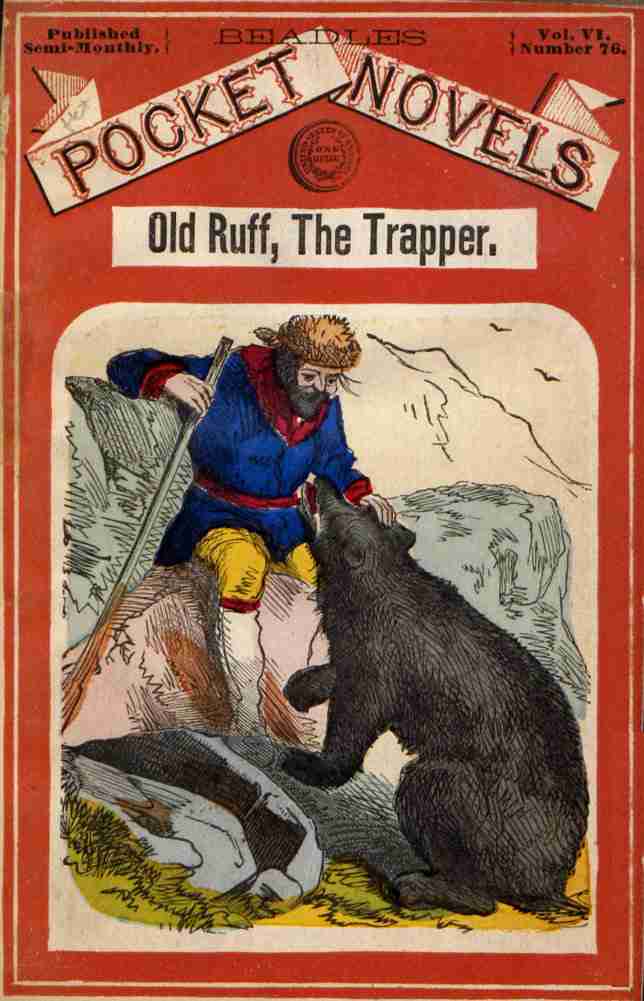
76—Old Ruff, the Trapper. “Bruin” Adams.
77—The Scarlet Shoulders. Harry Hazard.
78—The Border Rifleman. L. W. Carson.
79—Outlaw Jack. By Harry Hazard.
80—Tiger-Tail, the Seminole. R. Ringwood.
81—Death-Dealer. By Arthur L. Meserve.
82—Kenton, the Ranger. By Chas. Howard.
83—The Specter Horseman. Frank Dewey.
84—The Three Trappers. Seelin Robbins.
85—Kaleolah. By T. Benton Shields, U. S. N.
86—The Hunter Hercules. Harry St. George.
87—Phil Hunter. By Capt. Chas. Howard.
88—The Indian Scout. By Harry Hazard.
89—The Girl Avenger. By Chas. Howard.
90—The Red Hermitess. By Paul Bibbs.
91—Star-Face, the Slayer.
92—The Antelope Boy. By Geo. L. Aiken.
93—The Phantom Hunter. By E. Emerson.
94—Tom Pintle, the Pilot. By M. Klapp.
95—The Red Wizard. By Ned Hunter.
96—The Rival Trappers. By L. W. Carson.
97—The Squaw Spy. By Capt. Chas. Howard.
98—Dusky Dick. By Jos. E. Badger, Jr.
99—Colonel Crockett. By Chas. E. Lasalle.
100—Old Bear Paw. By Major Max Martine.
101—Redlaw. By Jos. E. Badger, Jr.
102—Wild Rube. By W. J. Hamilton.
103—The Indian Hunters. By J. L. Bowen.
104—Scarred Eagle. By Andrew Dearborn.
105—Nick Doyle. By P. Hamilton Myers.
106—The Indian Spy. By Jos. E. Badger, Jr.
107—Job Dean. By Ingoldsby North.
108—The Wood King. By Jos. E. Badger, Jr.
109—The Scalped Hunter. By Harry Hazard.
110—Nick, the Scout. By W. J. Hamilton.
111—The Texan Tiger. By Edward Willett.
112—The Crossed Knives. By Hamilton.
113—Tiger-Heart, the Tracker. By Howard.
114—The Masked Avenger. By Ingraham.
115—The Pearl Pirates. By Starbuck.
116—Black Panther. By Jos. E. Badger, Jr.
117—Abdiel, the Avenger. By Ed. Willett.
118—Cato, the Creeper. By Fred. Dewey.
119—Two-Handed Mat. By Jos. E. Badger.
120—Mad Trail Hunter. By Harry Hazard.
121—Black Nick. By Frederick Whittaker.
122—Kit Bird. By W. J. Hamilton.
123—The Specter Riders. By Geo. Gleason.
124—Giant Pete. By W. J. Hamilton.
125—The Girl Captain. By Jos. E. Badger.
126—Yankee Eph. By J. R. Worcester.
127—Silverspur. By Edward Willett.
128—Squatter Dick. By Jos. E. Badger.
129—The Child Spy. By George Gleason.
130—Mink Coat. By Jos. E. Badger.
131—Red Plume. By J. Stanley Henderson.
132—Clyde, the Trailer. By Maro O. Rolfe.
133—The Lost Cache. J. Stanley Henderson.
134—The Cannibal Chief. Paul J. Prescott.
135—Karaibo. By J. Stanley Henderson.
136—Scarlet Moccasin. By Paul Bibbs.
137—Kidnapped. By J. Stanley Henderson.
138—Maid of the Mountain. By Hamilton.
139—The Scioto Scouts. By Ed. Willett.
140—The Border Renegade. By Badger.
141—The Mute Chief. By C. D. Clark.
142—Boone, the Hunter. By Whittaker.
143—Mountain Kate. By Jos. E. Badger, Jr.
144—The Red Scalper. By W. J. Hamilton.
145—The Lone Chief. By Jos. E. Badger, Jr.
146—The Silver Bugle. Lieut. Col. Hazleton.
147—Chinga, the Cheyenne. By Edward S. Ellis. Ready Feb. 10th.
148—The Tangled Trail. By Major Max Martine. Ready Feb. 24th.
149—The Unseen Hand. By J. Stanley Henderson. Ready March 9th.
150—The Lone Indian. By Capt. Chas. Howard. Ready March 23d.
151—The Branded Brave. By Paul Bibbs. Ready April 6th.
152—Billy Bowlegs, the Seminole Chief. Ready April 20th.
153—The Valley Scout. By Seelin Robins. Ready May 4.
154—Red Jacket, the Huron. By Paul Bibbs. Ready May 18th.
BEADLE AND ADAMS, Publishers, 98 William Street, New York.
Transcriber’s Notes
- Silently corrected a few typos.
- Retained publication information from the printed edition: this eBook is public-domain in the country of publication.
- In the text versions only, text in italics is delimited by _underscores_.
- Created a Table of Contents based on the chapter headings.