
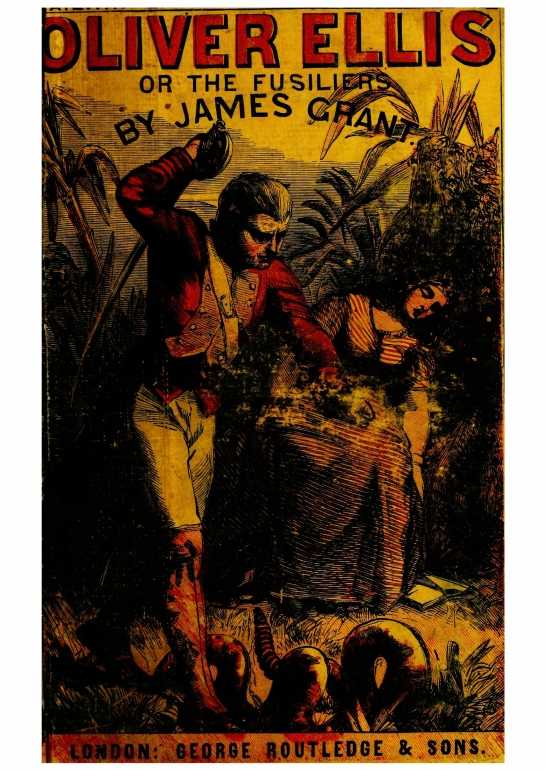
The Project Gutenberg eBook of Oliver Ellis
Title: Oliver Ellis
or, The fusiliers
Author: James Grant
Release date: July 28, 2023 [eBook #71286]
Language: English
Original publication: United Kingdom: George Routledge and Sons, 1865
Credits: Al Haines
OLIVER ELLIS;
OR,
The Fusiliers.
BY
JAMES GRANT, ESQ.
(Late 62nd Regiment),
AUTHOR OF "THE ROMANCE OF WAR," "THE AIDE-DE-CAMP,"
"SECOND TO NONE," ETC. ETC.
A New Edition
LONDON:
GEORGE ROUTLEDGE AND SONS,
BROADWAY, LUDGATE HILL;
NEW YORK: 129, GRAND STREET.
1865.
PREFACE.
"In regard to prefaces," says the author of "Curiosities of Literature,"—"ladies consider them so much space for a love story lost, though the Italians call them la salsa del libra,—the spice of the book."
Be this as it may, I must mention that many of the men whose names occur in these pages, bore the part ascribed to them during the operations of Sir Charles Grey's army in the Antilles.
A duel, nearly similar to that which is described as having taken place on board of the Adder frigate, actually occurred on the deck of one of H.M.'s ships-of-war when lying in a South-American port, in 1821.
The situation of the wreck in the Isle of Tortoises was suggested to me by the discovery of a mysterious vessel in a cavern of the island of Baccalieu, when I was at Fort Townsend in Newfoundland, where it excited much speculation.
As a few Mexican dollars were found on the rocks near, she was supposed to be Spanish; and such rumours were circulated of the vast treasure she contained, that H.M.S. Comus was despatched from Halifax to investigate the matter; but the hull contained a few dead bodies alone.
That the marvellous might not be wanting, there was told a story of a gigantic anchor being thrown by the sea on the desert shore near her. There it lay for a time, till a party came to remove it; but it had vanished, like the treasure,—by no mortal agency, of course!
26, DANUBE STREET, EDINBURGH.
May, 1861.
CONTENTS.
CHAP.
1.—BOYHOOD
2.—THE MINISTER
3.—MESSRS. HARPY, QUIRKY, AND MACFARISEE
4.—APPLEWOOD
5.—THE WILL
6.—AMY LEE
9.—SEQUEL TO THE STORY OF THE WILL
10.—MAHOGANY v. LAW
13.—THE PRESS-GANG
14.—MR. MACROCODILE
17.—JACK THE MARINE
18.—OVERBOARD!
21.—RETRIBUTION
22.—COMPTON RENNEL
25.—HEAD-QUARTERS
26.—THE ROUTE
28.—LAND!
29.—THE SNAKE
32.—STORY OF EULALIE CONTINUED
36.—THE SPY
37.—ANXIETY
38.—A REVELATION
39.—A SEA OF FIRE
40.—THE LANDING
41.—LA CHAPELLE
43.—A HALT
44.—THE SKIRMISH AT LE MORNE ROUGE
48.—LA FLEUR D'EPÉE
49.—THE ASSAULT
51.—THE HURRICANE
54.—A SURPRISE
57.—A SAIL IN SIGHT
58.—SAVED!
59.—CAPTAIN CRANKY
60.—THE YELLOW FEVER
62.—THE DOS D'ÂNE
63.—THE WORSHIPPERS OF THE DEVIL
64.—SCIPIO
66.—THE OBEAH NEGRO
67.—M. DE THOISY
68.—A DISCOVERY
69.—GEORGETTE
70.—A CRISIS
71.—CONCLUSION
OLIVER ELLIS.
CHAPTER I.
BOYHOOD.
"When is a man the arbiter of his own destiny? for he is like the leaf which is torn from a tree, and which the wind of heaven blows about."
This fate has been my own, as peculiarly as it has been that of other military wanderers in life; for your soldier is a great traveller both by sea and land, an errant and a restless spirit; yet his travels and his restlessness are involuntary; for the moment he dons the red coat he ceases to be the master of "his own proper person," or (like the leaf torn from the tree) to be the arbiter of his own destiny; but must march, sail, or fight wheresoever he may be ordered, obedience being the first word in his vocabulary. He becomes a machine in some sort, yet not a machine according to the degrading idea of his sapient majesty of Prussia; for the history of mankind will prove that the most brilliant achievements in war, and the most happy results in peace, like those efforts by which thrones have been won and nations freed, had their origin in the influence of the human heart, and in the mastery of the human passions, when hope, religion, or love of country, fired the soldier's spirit! Who, then, will dare to say that the poor private soldier who mounts a deadly breach, or rushes on a hedge of steel, risking mutilation, wounds, and death, without the hope of future fame if he falls, or the chance of sharing in the glory of the victory his valour wins if he survive,—is the mere automaton, the cold in blood and basely utilitarian would have him to be?
Love of country, a noble sentiment, is ever strong in the heart of a true soldier. When the 67th, or South Hampshire regiment, commanded by Callender of Craigforth, landed at Portsmouth in 1772, after a long career of dangerous foreign service, with one accord and impulse the whole of the men threw themselves on the beach and kissed the pebbles.
The reader will pardon the professional vanity, or esprit de corps, which makes me thus prelude the plain unvarnished story of a soldier's career,—a description of some of the adventures I have passed through, the persons I have met, and the scenes I have witnessed on my march through life.
I was born in the camp of Burgoyne's army when it was on the borders of Lake Champlain: thus, the first sounds to which my infant ears became accustomed were the rattle of the drum, the notes of the Kentish bugle, the tread of marching feet, and the thoughtless hilarity of my father's comrades.
I remember myself first as a little boy, the pet and plaything of the soldiers, who made bats and balls, tops and toys for me; who allowed me to ride on their backs, and to hold on by their queues, whenever I had a mind to do so; who told me old stories of Wolfe's days, of the siege of Belleisle, and of wild adventures in West Florida. I remember of marches from town to town, from camp to barrack, and from fort to fort—all of which seem like dreams to me now; while the troops trod on, through clouds of summer dust or the deep snows of an American winter, and I with other regimental imps, sat merrily and cosily perched on the summit of a baggage-waggon, among trunks, arm-chests, knapsacks, pots, kettles, and soldiers' wives, who smoked, sung, and swore occasionally, and bantered the escort who marched on each side, with bayonets fixed. A thousand childish incidents of the soldiers' kindness to me when a boy (because they loved my father well), are lingering in my memory, while many a more important event of the days and years between that time and this, is forgotten for ever.
My father was a captain in a Scottish regiment, which formed a portion of Sir John Burgoyne's unfortunate army. He had received a severe wound at the storming of a stockaded fort near Skenesborough, and had to undergo the delicate operation of trepanning, which was skilfully done with a silver plate, whereon he had fancifully inscribed his name and the number of the regiment. He was afterwards slain in a skirmish on the banks of the Hudson, and was hastily buried on the field. The last time I saw him, was when my mother, with her eyes full of tears, held me up in her arms that the poor man might kiss me, as he was buckling on his sword, while the troops went hurriedly to the front. The livelong day the roar of the distant musketry rung in the pale woman's ears and in her soul, as the din of battle rose and fell upon the gusty wind. At sunset the troops came back defeated and dispirited; but my father not among them. He was lying at the foot of a pine-tree, shot through the heart!
After this bereavement, my mother returned home with her two children (my sister Lotty and myself), and, renting a small cottage, about a mile from her native town, lived the quiet and secluded life that the scanty pension of a captain's widow allotted her.
I was two years older than dear little Lotty, who was a pretty black-eyed girl, with a fair skin, and great masses of dark-brown hair.
At our mother's side, as children, we prattled and talked of the regiment. It was the centre around which our thoughts revolved; the feature upon which all our conversations and infant recollections hinged, though its ranks were filling fast with new faces, and the old had long since forgotten us; yet it was always "the Regiment"—our once happy, movable home—that we spoke of, as of some good friend that loved us, and was far away; and I loved the coarse red uniform, with its pewter buttons and white braid, for its wearers seemed a race of men apart from the cold and selfish society among which my mother's diminished means and widowhood had cast her. She, poor woman! seemed to feel something of this, too; for more than once, on beholding a wayfaring soldier passing through our quiet little village, I have seen her start, with her eyes full of tears, as her thoughts reverted to him who was sleeping far away in his lonely grave by the shore of the mighty Hudson. Like that old Scottish lady who is so beautifully portrayed in the "Lounger," "when she spoke of a soldier, it was in a style above her usual simplicity; there was a sort of swell in her language which sometimes a tear (for her age had not lost the privilege of tears) made still more eloquent. She kept her sorrows, like the devotions that solaced them, sacred to herself; they threw nothing of gloom over her deportment; a gentle shade only, like the fleckered clouds of summer, that increase, not diminish, the benignity of the season."
The pretty village in which we resided lay at the bottom of a dell, which, in shape, resembled a great natural basin. Its sloping sides were clothed with luxuriant wood. Above the ancient trees, the old grey belfry of the village church—a church in which Knox had preached and the Covenant was signed—peeped forth from a mass of ivy that clambered to its weathercock. Through the dell brawled a rapid stream, which came foaming down from the mountains, and turned the great mossy wheel of an ancient mill, which, with the blue-slated manse, the quaint old kirk, and the ruined fragment of a haunted tower, wherein, as legends averred, a spectre wandered and treasure was buried, formed the four principal features in the valley.
The stream where the spotted trout lurked in the deeper holes, or shot to and fro in the sunbeams, was crossed by a little bridge, which, in my boyhood, I considered a great work of art, though, in after-years, I was astonished to find it so diminutive. The rush of the mill-race, as it poured in white foam over a wooden duct; the voices of the children that played on the green before the village school; the ceaseless clink of the hammer in the forge, which formed the rendezvous of all the male gossips; the occasional note of a blackbird or a cushat dove from the coppice,—were the only sounds that were heard in our valley, save when the tolling of the church bell announced the Sunday, when the air was hushed and still, "and even the forest leaves seemed stirred with prayer."
Though little more than a mile from a large and populous city, our hamlet was as secluded as if it had been twenty leagues distant. No thought had we then of railroads, electric wires, or Atlantic cables; and even the stage-coach passed far from our wooded locality.
Our cottage was neat and small: it was situated on a slope of the dell which faced the south, and was buried among the woodbine, clematis, and sweetbrier, which covered all its rustic porch, grew around the windows, and clambered over the chimney-tops.
I can yet, in memory, see the little parlour in which we used to sit in the long nights of winter, by the cheerful fire, above which hung my father's sword and old gilt gorget, with two engravings of General Wolfe and the Marquis of Cornwallis in full uniform, with white breeches and kevenhuller hats; and where we spent the calm evenings of summer, when the light lingered long in the blushing west, and the perfume of the sweetbrier, the wild roses, the ripening fields, and of the fragrant earth, on which the dew was descending, were borne through the open windows; while my mother—her grey hair smoothly banded under a spotless white cap, her black dress and meek sweet face making her look so like a picture, her work-basket and knitting apparatus at hand—read to Lotty and me, or spoke of scenes and adventures she had seen when far away from our present quiet locality, as she had an excellent memory for anecdotes and a refined literary taste. Thus she became our sole preceptress.
Save old Dr. Twaddel, the minister, and the village doctor, we had no neighbours, and consequently few visitors.
My mother spoke seldom of our father; but we could see by the current of her thoughts that they rarely ran on aught else than his memory. Hopes she had none, save those that were centred on us.
So, for seven years, the blameless tenor of our even life rolled on.
My mother's quiet gentleness and soft ladylike manner, together with her kindness to the poor of the village, the sick and dying, among whom she shared her widow's mite—the mite that in heaven shall become a talent of price,—caused her to be tenderly loved by all; and I repent me now, even after the long lapse of many stirring years, that in her latter days, the tears that rolled over her pale and fast-furrowing cheeks were caused by my errors, and it may be, my selfish and resentful pride.
CHAPTER II.
THE MINISTER.
Time sped the faster that it sped unmarked; and now I had reached that most important and unpleasant period of a boy's life, when the necessity for increased action arrives; and a period it too generally proves to all the delusions, the dreams, and the charms of childhood—I mean the time when grave old gentlemen begin to question us categorically, and, as it often seems, somewhat intrusively, upon our future plans, and to impress upon us the necessity of "doing something for ourselves."
My mother, who had frequently spoken with me on this subject, and seen with regret how my thoughts turned towards the army, of which she had now a terror, as being the too probable means of separating us for ever, resolved to consult Dr. Twaddel, the minister, on the subject; and in Scotland, "the minister" is always esteemed the second person in the parish; so to this consultation I consented, with some outward reluctance and considerable mental repugnance.
Our minister was a good kind of man in his own quiet way, though his excessive views of uprightness and propriety, together with certain severe lectures he had read me for making midnight raids into his orchard, for shooting one of his hens with a penny cannon on the King's birthday (the 4th of June), and for burning "Johnnie Wilkes" in effigy in the churchyard, had made him somewhat of a bugbear to me. He made indifferent sermons, but capital whisky negus, and could take a comfortable share thereof, though eschewing all hearty mirth or levity, and adopting in his deportment that somewhat too solemn gravity and cold, hard external rigidity, with which the mass of the Scottish Lowlanders are tinged, and which makes their most sunny summer Sunday a day of gloom and silence. Like the majority of the northern clergy, he was a humble, meek, and well-meaning man, who, though he preached incessantly against the nothingness of this world and the good things thereof, had taken especial care to provide himself with a remarkably well-dowered helpmate. Without brilliance of talent, he possessed just heart enough to find favour with the poor of his flock; and head enough to accomplish his Sunday task, by emitting a hazy sermon on some old scriptural text, which no one cared a jot about. Yet he was a good man withal, our old parish minister.
I remember, on one occasion, while he was commencing his sermon in the gloomy little village church, an old man propping himself on a staff entered the aisle, and being a stranger, he looked wearily and wistfully round for a seat. Being clad in rather dilapidated garments, and having a canvas wallet for alms, such as meal and broken bread, no attention was paid to him, either by the pew-openers or the congregation. The old man tottered along the aisle, and was about to seat himself humbly on the lower step of the pulpit stair, when the portly minister, with a glance of honest indignation on all around him, descended from the pulpit, and taking the aged mendicant by the hand, led him to his own pew, and placed him on a well-cushioned seat, beside his wife and family, to the no small discomfiture of the Misses Twaddel.
This silent rebuke was worth a thousand homilies; it powerfully affected the whole congregation; and from that moment, the minister, though usually cold and reserved, completely won the esteem of my mother. To consult him on my affairs, we repaired to the manse, which was a handsome and comfortable modern villa, separated from the village church by an orchard and the humble burying-ground, in which "the rude forefathers of the hamlet slept." We were speedily ushered into his presence in a snugly-curtained, richly-carpeted, and fashionably-furnished room, which was so large, that our little cottage might have stood within it altogether. He received us rather kindly than politely, as he had a great esteem for my mother, though, since the advent of the felonious appropriation of a dozen of golden pippins and the slaughter of his best-laying hen, none whatever for me; and while he reclined in an easy-chair and played with a large bunch of gold seals in one hand, or polished his bald head impatiently with the other, my mother, in a voice that was rendered tremulous by her maternal love and anxiety, briefly stated her wishes "concerning her boy Oliver."
After letting her relate her own story unaided, he rather sharply asked me what views I had for myself.
I glanced timidly at my mother; for although now nearly sixteen, I felt like a child in her presence; and at that moment, the influences of her faded cheek, her widow's cap, with its modest crimping, and her sweet sad face, were not lost upon me, though my proud spirit writhed under the humiliation of consulting even such a parish potentate as the minister, concerning me or my affairs.
"What views have you for yourself, sir?" reiterated the minister.
"I wish to be—to be——" I stammered and paused.
"What, sir—speak out!" continued the divine, authoritatively.
"Well, then, I wish to be a soldier."
"A soldier—whew!" he reiterated, with a tinge of surprise and contempt in his tone.
"Like my father before me."
"And leave your poor mother alone in her old age, you ungrateful loon! you should add that," he added, bending his stern grey eyes angrily upon me.
I shrunk at these words, and was silent, for they found an accusing echo in my heart.
"Could you endure his absence, Mrs. Ellis?"
"Alas!" said my poor mother, with her eyes full of tears, "adversity has taught me to endure all things patiently—a bitter art to cultivate; but such a separation would be the hardest of all."
"Then we must put him to some respectable business, where hard work and long hours will knock all silly notions out of his head. What kind of business would you like, young man?"
"I do not know, sir."
"Then who should know, sir? But no doubt you despise all manner of business."
I was silent, and my mother gave me an imploring glance to remain so.
"You are a boy—a mere bairn yet," resumed the minister, in that contemptuous manner often adopted by testy old gentlemen to their juniors; "but the trials of life will teach you the hollowness of those romantic fancies which are fostered by novels, playbooks, and such-like literary trash, of which, I doubt not, you have devoured over many already. You wish to be happy?"
"Of course, sir," said I, with a sigh of impatience; for all this sounded uncomfortably like a lecture, or a scrap of the doctor's sermons.
"Then you will find that it most truly consists in bestowing happiness on others."
I pondered over this remark, for I was too young to understand the application of it.
"Do you know the origin of happiness?" continued the minister.
I could have said, Plenty of money and fun—a fine house, a fine horse, and so forth; but I was silent, or merely said, "No."
"Then hark you, Master Oliver Ellis—the origin of happiness is contentment, and the resources of a mind humbled by the trials with which it pleaseth God to inflict us."
"So I have heard you preach a thousand times," thought I; and while I glanced around the magnificent drawing-room, on his well-cushioned easy-chair, his amplitude of paunch and successive folds of chin, the idea did occur to me, that the apostles were content with fewer of this world's goods; but I was silent again.
In short, the minister talked of morality and duty—of business habits, of close application, and strict honesty, and so forth, until I was heartily weary. I seemed to listen, but heard him not; for my thoughts were running far away on other things, and had soared into the region of sunshine and daydreams, until, after many trite common-places and innumerable pious nothings, he broke the spell by bluntly announcing that "the time was come when I must look about me. I was now sixteen; my mother was getting old; she could not last for ever, and if anything happened to her, what would become of me."
This cruel insinuation, so coldly uttered, cut me to the heart, and my mother's sad eyes involuntarily sought mine. She had often—too often in her sad and lonely hours—thought of the separation death might one day make between her penniless children and herself; but to hear it thus roughly alluded to, was too much for her, and the poor woman wept aloud.
The minister tried to console her by some hackneyed scriptural text: that man was made to mourn,—that he was sent into this world to be miserable, and had no business to be anything else; but this burst of emotion on her part stifled every secret aspiration and every strong wish in me, and I assented to any plan his reverence had to propose, resolving to leave to him the onerous office of opening up the path that was to lead me to fortune and to fame.
He promised "to speak anent me to his doer," a literal, and often fatally literal phrase, applied by the Scots to their lawyer or "man of business," without consulting whom, many of them will not even vote for an M.P., or do the most trivial thing. "I'll tak' a thought—I'll spier o' my doer," being the answer in the country to almost everything proposed.
Hence, in one week after our visit to the manse, I found myself in Edinburgh, and perched on the leathern summit of a high three-legged stool, in the office of Messrs. Harpy, Quirky, and Macfarisee, solicitors, eminent alike for their "sharp practice" and acute manner of handling all troublesome or cloudy cases of insolvency.
CHAPTER III.
MESSRS. HARPY, QUIRKY, AND MACFARISEE.
From the earliest period of which I can remember, I had fixed upon pursuing the career of a soldier. Notwithstanding the grim specimens I had seen of it, during my father's service in the States, I deemed it a life of glitter, change, and jollity—a chain of pleasures—a long and romantic panorama. I saw only scarlet and feathers, gold lace, the glitter of epaulettes and the flash of steel, with music and sunshine; and from amid this chaos came forth those airy castles and brilliant visions, which the mind of every imaginative and impulsive boy can fashion so readily—and too readily at times for his own peace; as such fragile creations are but ill calculated to stand the rough shock of awakening, or the stern realities of every-day life.
So it was with me. My new occupation, with its intolerable monotony, seemed a death-blow to all my hopes and romantic fancies; while the manner and bearing of Messrs. Harpy, Quirky, and Macfarisee, were in no way calculated to reconcile me to my lot, or to enhance the value of the dog's pittance they doled out me, and a few other drudges of the quill. If, after a trial, I liked (ugh!) the law, I was to be indentured for five years, and to commence my legal studies at the college—to dive deep into "Stair's Institutes," "Dirlton's Doubts," and other light literature of a similar kind: money was to be raised to enable me pass muster; but my growing repugnance to a civil life caused many delays in making the final arrangements.
It was my misfortune to have to do with three of the worst specimens of those legal and religious charlatans who bring discredit on a profession which, for three hundred years, has shed a brilliance over Scottish literature and Scottish society. If any such, now living, recognize themselves in my delineation, the resemblance is entirely fortuitous, and they had better not boast of it.
They had, I have said, a vast amount of "sharp practice," and law proved a dear commodity to those who dealt with them.
The first partner was a wealthy idler, who gave himself insufferable airs, and affected to be "a man about town;" but then he brought business to the firm, and gave it an air of respectability; the second was a legal bully, miserly and underbred, longheaded and narrow-hearted; for Mr. Quirky had been educated in one of the many charitable institutions with which the city abounds, and had come forth into the world a master in the science of subtlety, and without an emotion of sympathy for anything human or divine.
Macfarisee was one of the most amusing of rogues. With the vanity of the first and the subtlety of the second, he covered his many failings by a bland aspect of meek sanctity, and that entire garb of accurate blackcloth which, with a long visage and a white necktie, go far to impose upon the simple in Scotland.
He was an elder, and reputed an upright pillar of the Church, and on each successive Sunday might be seen, with hands meekly folded, standing behind the brass platter wherein the offerings of the charitable were dropped. He never hid his holy candle under a bushel, but subscribed only to charities which published lists of the donors; he outwardly and vehemently eschewed strong waters, laughter, gaiety, the world, the flesh, and the devil; and yet, withal, had privately the reputation of being on the best possible terms with the latter.
He presided at all meetings for the conversion of Jews, Sepoys, and Ojibbeways; he inveighed against Sunday travelling, and the laxity of the present age; he harangued most feelingly on the benefit that must accrue from the moral, social, intellectual, and religious improvement of Caffres and Hottentots; while his unfortunate employés were reduced to the veriest of all white slavery, and, toiling fourteen hours out of the four-and-twenty, wrote their eyes blind and dim, during the dreary watches of many a winter night, long after all were hushed in sleep, and the nightly psalms and prayers, with which (in the way of business) he edified the neighbourhood, were ended. On one hand he patronized Bible Societies, and gave flannels to the poor; on the other, he had ungodly yearnings towards the possessions of the rich, whom he spoiled, to use his own phraseology, "even as the Egyptians were spoiled by the Jews of old;" for, as a conveyancer of other people's property into his own breeches pocket, Macfarisee had few equals in Scotland. He was one of a knot of small provincial notorities, who hovered about the Lord Advocate and the city M.P.'s, who got up public dinners and testimonials for their own "glorification," for the purpose of hearing themselves speak, and getting their otherwise very obscure names into the local journals.
Harpy, our first partner, was suave and gentlemanly in manner; thus, his chief occupation was to soothe, flatter, or, as he phrased it, "to talk over" those clients whom his compatriots had offended by insolence, or disgusted by hypocrisy, and who threatened to transfer their business and their papers elsewhere—i.e. to go out of the frying-pan into the fire.
Behold me, then, commencing life on the summit of a three-legged stool, in a dreary room, which overlooked a gloomy back-court, abandoned to weeds and a few broken bottles, and where nought living was seen, save an amatory cat or so prowling along the wall. I was intrenched among green boxes and bundles of musty, dusty papers, which had travelled to and fro for years, from the said dreary office to the various courts of law, increasing in bulk and volume on their travels, until each process—each fatal heir-loom—at last smothered its proprietor, the fool or knave, who, bitten by the amor litigandi of the modern Scots, and spurred on by a faithless and dishonest "man of business," or lost in a sea of duplicates and rejoinders—borrowing up of processes and paying down fees; fighting before Lords Ordinary and extraordinary—bewildered amid the difficulties, endless repetitions and absurd amplifications, doubts, delays, and expenses of the legal maelstrom into which Macfarisee had lured him, found the "record closed," when his last shilling had gone.
To me, the atmosphere in which I found myself was stifling. It was redolent of wax, red-tape, law-calf, and old parchment; and there was around me an incessant jargon about decrees and decisions, quirks, quibbles, statutes of limitation, judgments by default, writs of error and insolvency, acts of cessio bonorum, charges of caption and horning, cases sent through outer and inner houses to avizandum and the devil; and, save a hard-working gentlemanly lad, who died a Lord of Council and Session, and, than whom, no better ever sat upon the Scottish bench, my compeers were selfish, vulgar, and obnoxious to me, as their conversation consisted chiefly of pot-house wit, second-hand jokes, and empty nothings. Save alcohol, all spirit had long since died out of them, and at the voice of Macfarisee, they trembled as if under galvanism. Nothing but my repugnance for them, and daily irritation at the absurd assumption of Harpy and the hypocrisy of Macfarisee, prevented me from sinking into a state of mental atrophy, though exceedingly mercurial in temperament and itinerant in habit.
Hard work, however distasteful to a hero in embryo, I could have endured with patience; but the bearing of the three parvenus whom I served, and who were cold, thankless, consequential as bashaws, and rude at times even to the verge of brutality, soured my temper and maddened my fiery spirit.
On the summit of that legal tripod, the three-legged stool already referred to, I passed the greater portion of the year 1791.
There are times now when I think I viewed the poor ephemeræ, whose drudge I deemed myself, through a false medium; as I considered all who stood between me and the army as the natural enemies of mankind; and, doubtless too often, when I should have been drawing a deed or engrossing an account, I was drawing a phantom sword, engrossed in the pages of a novel, or following the merry drums, the glittering accoutrements, and flaunting cockades of a recruiting party. In short, I believe the reader will already perceive that it was not in human power to make a lawyer out of such quicksilver material as Master Oliver Ellis.
It was towards the close of the year already named, that a change came over the monotonous tenor of my way; and, like many other heroes who have flourished since the days of Mark Antony, I must needs fall in love. The way in which this event—so important in such a narrative as mine—came about was as follows.
One afternoon, when I was indulging in some of my usual day dreams, after reading the gazette which detailed the great treaty by which we prostrated the power of the valiant Tippo Saib, I was roused by the harsh and authoritative voice of Mr. Quirky, commanding me to accompany him and Macfarisee on business a few miles from town, To say whither, or what about, would have been too great a condescension in men of their vast consequence; so I snatched my hat gladly (anything active was a change from the monotony of a desk at which I worked like a negro on monkey's allowance), and, after receiving into my custody a legal green bag, filled with papers, on a hackney-coach being called, we drove out of town.
The month was October, and the woods wore the sombre hues of autumn. The wild rose still bloomed in the wayside hedges; the house-martin, the redwing, and the swallow, were still twittering about in search of the red berries, the haw, the hip, the sloe, and the elder, which now furnished a feast for them all. We whirled on amid copsewood and long lines of trees, that bordered or sheltered the bare fields, and exhibited on their dropping leaves all shades of russet, yellow, amber, dark-green, and red. The time was evening, and the dewy gossamer spread its silver web, laden with dew, from tree to tree; and as those persons whom I accompanied never deigned to address me, but conversed together in whispers, I had nothing to draw my attention from the objects visible on each side of the way, through the hackney-coach glasses, after the dusk enabled me to lay aside a canting tract, which Macfarisee had solemnly put into my hand when we started, and which, in politeness rather than hypocrisy, I had been pretending to peruse for some time.
At last we turned into an avenue of fine sycamores, through the waving branches of which the moonlight fell in flaky gleams, and under which were two lines of the flowering arbutus and monthly rose in full bloom. The hoofs and wheels scattered wide the rustling autumn leaves that lay thick in the old avenue, and we speedily drew up on the gravel that lay before the portico of a handsome mansion.
CHAPTER IV
APPLEWOOD.
As the carriage drew up, the front door of the house was opened by a servant in livery, and in the lighted hall beyond there appeared a young girl, who, by her stature, by her figure—which was light and graceful—and by the unconfined masses of her flowing dark-brown hair, could not have been more than seventeen—the age of all heroines in the good old-fashioned times.
Messrs. Quirky and Macfarisee sprang out and ascended the steps.
"I am so glad you have come at last," said the young lady, in a tremulous voice of welcome. "My aunt has longed for you both so much, but more especially for you, Mr. Macfarisee; she says that your prayers and pious conversation achieve for her a greater ease of mind and body than the ministrations of any clergyman or physician."
"My dear Miss Amy, I fear you flatter my partner," snarled Mr. Quirky; "but we hastened from town (though hard pressed by a first-rate jury case) the moment we received your letter, stating that she wished to settle her worldly affairs."
"And how does the Lord deal with her?" asked Macfarisee, in his most bland and dulcet manner.
"Severely, sir," replied the young girl whom he named Amy, with her eyes full of tears; "you know she is always believing herself to be dying, but she has been in great suffering for three nights, and for these three nights and as many days I have never left her bedside."
I now perceived that the girl's dark-blue eyes were dimmed and bloodshot with tears and watching.
"Miss Amy," said Macfarisee, in the slow and impressive tone, which he used to all but his clerks, to whom he spoke sharply enough, "I feel happy—a holy happiness—that illness has enlightened her mind, and that at last she has resolved to take my advice."
"Sir——"
"I have so frequently recommended her to—to settle her worldly affairs; but she weakly shunned all that reminded her of mortality, ever replying that sufficient for the day was the evil thereof; but, alas! my dear child," he continued, in a sing-song voice, "lo you now, death cometh like a thief in the night; but I trust he finds the Lord's faithful servant duly prepared for the great change that is at hand."
"Bravo, old six-and-eightpence!" thought I, as Quirky, whom his partner's prosing wearied at times, snatched the green bag from me impatiently, saying,—
"Here you, sir,—give me the documents. Miss Amy, your aunt's state of health has long been precarious; but what says the doctor of her?"
"That—that——"
"What?"
"She cannot last long now; and she has been in misery, waiting for you."
"The deuce! then we have no time to lose," said Macfarisee, with one of his keen office glances at Quirky, through a pair of eyes which were always "half-closed, like those of a night-bird in the daytime."
"My dear, dear aunt!" sobbed the poor young girl; "follow me to her room, if you please, and this young gentleman——"
"Oh, he is only one of our young men, and may remain here quite well."
"Here, in this cold lobby? Oh, that would never do! Walk into this room, sir; please to excuse us," said the girl politely; and while my two employers, whom for their pride and hypocrisy I consigned to very warm quarters indeed, walked gingerly up stairs, I was left to my own reflections in a dark parlour.
In this sudden trip to the country there was something mysterious; and as I gazed through the window upon the dark branches of the trees, tossing on the night-wind, and pictured to myself the old woman dying up stairs, strange and gloomy thoughts came over me; but on a footman entering with candles, I asked him the name of the house.
"Applewood," said he.
"The house of Mrs. Rose?"
"Yes."
Then a sudden light broke in upon me. I remembered that we had a wealthy client—an old widowed lady—whose failing health, credulity, and ample funds, had long rendered her a source of the deepest solicitude to Messrs. Quirky and Macfarisee, whose passive victim she had to every purpose and intent become; for she believed devoutly in the worth, piety, and good works of our third partner. In his double capacity of elder of his kirk and legal adviser, Macfarisee had long been one of those who hovered by the bedside of the dying, as vultures hover round a piece of carrion, and this wealthy old lady, Mrs. Rose, of Applewood, had long been marked by him as fair game to be run down at last.
It was by a studied system of cant, and by an external aspect of piety in its most fervid form, that Nathaniel Macfarisee usually recommended himself to those whom he deluded, and the number of legacies left to him by departed friends was really somewhat surprising, though many of them were averred to be for purposes of religion and philanthropy; and when conversing with a bewildered client, whom
He darkened by elucidation,
And mystified by explanation.
it was amusing to hear him interlarding all his remarks with phrases and texts from scripture.
Amy Lee, the only living relation possessed by the old proprietress of Applewood, was the orphan daughter of a younger sister whom she never loved, for having married a young officer whose attentions had been long and provokingly divided between them. Amy had been sent from India to her care and kindness, penniless and otherwise friendless, for her father and mother, with many friends and relations, had perished in the dungeons of Tippo Saib.
The grudge which the old lady bore her sister in youth, for depriving her of a first love, had taken some strange and fantastic form of aversion in maturer years; and thus, though the poor and lonely Amy attended her sick bed, noting anxiously and sedulously all her querulous fancies, seeking to soothe her gusts of petulance, with the filial tenderness of a daughter and the patience of a little saint, she never could win the regard of, and barely earned a smile from, this strange old woman, whose days and ailments were now drawing to a close. Yet, the orphan girl loved this kinswoman who loved not her, for she had traced something of her dead mother's features in her face—a mother for whom she still sorrowed,—and she found the best solace for that grief was to discharge the duties of affection, which fate had transferred from one sister to the other.
Mrs. Rose was the sole residuary legatee of her late husband, an old nabob, who had returned from India with a visage the colour of the gold he had acquired, and a heart that had narrowed and shrunk as his liver increased; thus, her fortune was ample, and, as she was without children, she had long given her whole thoughts and attention to the welfare and success of the Rev. Mr. Pawkie's dissenting meeting-house, of which Macfarisee was an elder, and the porch of which edifice she had become fully assured was the only avenue to Heaven; thus, the three had long gone hand-in-hand, in holding conventicles and meetings for the out-pouring of the spirit, amid tea, toast, and cold water—for humiliation, prayer, and the regeneration of all those wicked and benighted heathens, who did not occupy pews in the square-windowed, low-roofed, and barnlike edifice in which the Rev. Jedediah Pawkie expounded the pure gospel, inspired by the light that shone from the new Jerusalem, and consigned to very hot quarters indeed all who took their own way to Heaven instead of his.
Of this fustian spirit of religion and fanaticism, when combined with an aversion for the only living tie that existed between her and the world, the worthy Macfarisee—that inflexible Mede and upright pillar of the Kirk—hastened to take his usual advantage; and in the sequel he proved himself to be a greater wolf in sheep's clothing than I could ever have imagined.
CHAPTER V
THE WILL.
While seated in the parlour, into which I had been ushered, time passed slowly; and the melancholy voice of Macfarisee, singing a psalm, came drearily and hollowly through the large corridors of the house, from the sick-room up stairs. He was giving ghostly comfort, together with his legal advice, to the departing sinner, whom I had been assured was now hovering between time and eternity, and who, at most, had not many days to live. Knowing his character, as I did, there seemed a horrible mockery in the words of the psalm:—
Lord, bow thine ear to my request,
And hear me by-and-by;
With grievous pain and grief opprest,
Full poor and weak am I.
Preserve my soul, because my ways
And doings holy be;
And save Thy servant, O my Lord!
Who puts his trust in Thee.
As the quivering voice of Macfarisee emitted this verse, I could not repress a shudder of disgust and impatience, and tossed aside the religious tract he had given me; for thus it is that such professors bring a ridicule on piety itself.
I had turned over all the books in the room without finding one to interest me, as they all belonged to the literature of cant; but my eyes frequently reverted to the portrait of a young man in scarlet uniform, for it made me think of my father's regiment,—of honest men, and better things, and days long passed away. Then I thought of my mother and of dear little Lotty, and longed to be at home with them, for the night-wind sighed mournfully through the old sycamores of Applewood, and my heart grew sad, I know not why. Red sheet-lightning occasionally illuminated the far horizon, and cast forward in black outline the stems of the trees and their tossing branches. Then there would be heard the opening and shutting of doors; the sound of steps hurriedly upon the well-carpetted stairs. These made me fear that the old lady was really dead; and solemn thoughts came over me, as I gazed down the dark avenue from the window. Then I burned with impatience to be gone, but had to wait, cypher-like, the time and pleasure of others whom I heartily despised.
After the lapse of nearly two hours, Messieurs Quirky and Macfarisee entered the room. The cunning eyes of the latter were half-closed; his grizzled hair was brushed stiffly up above each ear, till it resembled two horns; and his chin was buried in his loose white necktie. The two legal pundits were so absorbed in conversation as scarcely to notice me.
"She won't last a week, now," said Quirky, in a low voice.
"You think so?"
"I am certain of it. One can never mistake that sad and dreary expression of the face."
"Alas!" said Macfarisee, in his quavering tones, while upturning the whites of his cunning eyes, "all flesh is grass; but, Heaven be praised, the blessed truths of our Christian faith have been poured into her ears by my unworthy tongue to-night; and not in vain,—let us hope—not in vain!"
Quirky made a gesture of impatience; for the spirit of hypocrisy was so strong in Macfarisee that he was now getting into the habit of acting to himself as well as to others.
"It is fortunate that this will," said Quirky, unfolding a slip of paper, "is dated so far back—fully sixty days ago; so she may die when she chooses, now."
"She is at peace with the Lord—she hath satisfied Him."
"She has satisfied you too, I think; and I doubt not you consider that a matter of much greater importance; but, of course, you are aware that a holograph will, like this, does not convey lands and houses in Scotland?"
"Eh?—what?—No. But it conveys furniture, plate, and pictures; and it can be stamped and recorded on payment of a fee. But, alas, as I said, all flesh is grass."
"As a legal document, I fear it is valueless," said Quirky, who, at times, had a strange fancy for teasing his compatriot; "letters of administration will never be granted on it."
"Damn it, Quirky, don't say so!" said Macfarisee, forgetting himself in his anger, "after all the trouble this old woman has given me; confound her obstinacy, that declined a more legal form until it is now too late."
"There will assuredly be a row about it; at least, unpleasant speculations."
"But I shall leave it in the custody of the niece, Amy Lee, and that will lessen all suspicion."
"A good idea—you are a lucky fellow."
"Hush," said Macfarisee, suddenly; "that boy Ellis is there—the devil take him!"
"Where?"
"At the table, reading—Shakspear, I have no doubt, though I have often told him that poetry is a device of the evil one. Mr. Ellis," he added in his blandest voice, handing me the folded document, "seal up this and address it to Miss Lee; a desk is open there, and you will find materials."
"In what way shall I do it?" I stammered, somewhat confused by having been forced to overhear a conversation so singular in character.
"Do it—do it—what d'ye mean?" asked Quirky with great crossness of manner.
"Young man," added our Nathaniel, "the scripture sayeth, 'whatsoever thy hand findeth to do, do it, with thy might.' Seal it up with Mrs. Rose's seal, which I see lying there on the desk, and address it to her niece."
After this they retired into the bay of a window, and conversed for fully ten minutes in low and earnest whispers. Curious to learn what a sheet of note-paper (for it was nothing more) could contain in the form of a will, while slowly and carefully making an envelope, I read the whole at a glance, and, so nearly as I can remember, it ran somewhat in this fashion.
"Applewood, 10th August, 1791.
"I leave to my niece Amy Lee twenty guineas to purchase anything she pleases, as a remembrance of me; but I leave all my property and everything I possess, personal and heritable, Applewood, its house and lands, carriages, horses, cattle, pictures, books, and plate, as per catalogue, to Mr. Nathaniel Macfarisee, my approved friend and dear and worthy brother in the Lord, and him I appoint my sole executor and residuary legatee.
"PRUDENCE ROSE."
This strange and brief document, so terrible in its contents for the unfortunate niece, was written in the tremulous handwriting of the aunt; and was witnessed by Quirky and Macfarisee, whose names were also appended thereto. However, all this was no business of mine; my orders were imperative; I folded, sealed, and addressed it to Miss Lee, who at that moment entered the room, and just as Macfarisee, with his peculiar cunning, wrote his initials above the seal.
"Thank Heaven, sir," said she to Macfarisee, "my poor aunt sleeps at last!"
"My humble ministration hath soothed her perturbed spirit," said he, taking the pale girl's delicate and white hand in his, and caressing it kindly; "but we must now depart, and into your custody we commit this sealed document. Keep it carefully until I ask for it again, and my dear, dear child, you are on no account whatever to break the seal or show it to any one, least of all to your worthy aunt, whose state of health will not permit her to survive much agitation. I know I can trust to your excellent discretion, child; for, as the scripture saith, 'Many daughters have done virtuously, but thou excellest them all!'"
He kissed her on the cheek, as he frequently did young girls of his congregation (our modern saint had a weakness that way), and then retired with his mincing step, with a groan on his lips for the nothingness of this life, and a smile in his stealthy eye at his own success. His partner followed with the same cat-like bearing.
For a moment, boy as I was, I stood bewildered by the astounding game Macfarisee was playing; and with a glance of commiseration at the handsome young girl, who, all-unconscious of the evil intended for her, with trembling white hands was securing the sealed document in her desk, while her charming face was hidden by her dark ringlets as she bent forward. Then I hastened after my august employers, who had now reached the door of the house. Here they paused, and Mr. Quirky patted me on the back, saying,—
"You are a sharp and intelligent lad, Oliver."
"Yes; a most discreet, quiet lad, and not a talker," added the junior partner. "We like you very much, Oliver."
As they never praised me before (in fact, I was a very idle dog), I bowed with a perplexed air, and asked myself what the deuce was in the wind now?
"We have a little piece of business for you to do," said Macfarisee, "and you must remain here for a few days to perform it."
"Here?" I reiterated.
"Here, my dear sir."
"But—but, sir, for what purpose?"
"Not so fast, young man," said Quirky, in his usual grating tones. "You will remain here until you have copied the catalogues of movable effects, which shall be shown to you by the housekeeper and steward; the more complete these lists are made, the longer time you will have here to enjoy yourself. They are required," he added in a whisper, "with reference to the last testament of Mrs. Rose. As soon as the copies are made, get them signed by Miss Lee, the steward, and housekeeper, and return to town. You understand me, sir."
"The fact is, my dear young man, Mrs. Rose is not very strong in health or intellect just now, and we are afraid she may add some stupid codicil to her will, especially if her husband's brother, Colonel Rose, returns from India. You will be left here ostensibly to prepare these lists of her movable property; but the moment he arrives (and he is expected shortly), start for town, and let me know."
"And so I am to be left here?" I asked ponderingly.
"Yes."
"How long?"
"A week—it may be a fortnight—you understand."
I did not understand; but I afterwards divined that I was to be our Nathaniel's spy upon the old lady and her household.
"My mother at home will believe I am lost."
"Oh, without fail I shall make the good lady aware that I have detained you on special business."
All this thoughtfulness and unwonted politeness sorely puzzled me for a time.
"You will find plenty of amusement here—a fine house and fine grounds—books and pictures in plenty. It will be quite a vacation for you."
"They are fortunate who possess such," said I with a sigh, as I thought of my mother's little cottage.
"Young man, be not guilty of envy or covetousness, but work hard and pray that God may keep you poor rather than rich; for wealth leadeth to pleasures and employments which are abominations and vanities in the sight of Heaven; so work, I say, for man was born to earn his bread by the sweat of his brow; and so good night. Do not forget your prayers at bed-time, and to attend church on Sunday while you are here."
Macfarisee bowed and smiled through the window as the hackney-coach was driven off; and I knew well that when he smiled, it was with mockery in his heart and mischief in his soul.
In a minute more, the sounds of the wheels had died away under the trees of the gravelled avenue; and with a feeling of loneliness, and something of dread, lest those two men were preparing a snare for me, bewildered by all that was passing through my mind, I returned to the parlour which I had just left.