
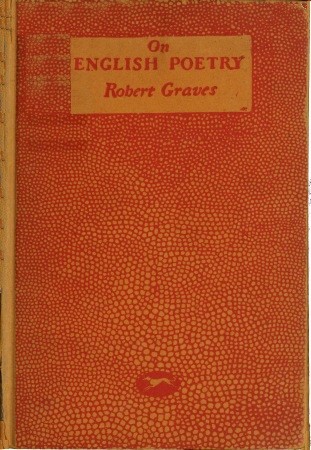
The Project Gutenberg eBook of On English poetry
Title: On English poetry
being an irregular approach to the psychology of this art, from evidence mainly subjective
Author: Robert Graves
Release date: October 10, 2015 [eBook #50174]
Most recently updated: October 22, 2024
Language: English
Credits: Produced by MWS, Chuck Greif and the Online Distributed
Proofreading Team at http://www.pgdp.net (This file was
produced from images generously made available by The
Internet Archive/Canadian Libraries)
ON
ENGLISH POETRY
ON ENGLISH POETRY
of This Art, from Evidence Mainly Subjective
By ROBERT GRAVES
New York ALFRED·A·KNOPF Mcmxxii
COPYRIGHT, 1922, BY
ALFRED A. KNOPF, Inc.
Published, May, 1922
Paper furnished by Henry Lindenmeyr & Sons, New York, N. Y.
Bound by the H. Wolff Estate, New York, N. Y.
MANUFACTURED IN THE UNITED STATES OF AMERICA
To T. E. Lawrence of Arabia and All Soul’s College, Oxford, and to W. H. R. Rivers of the Solomon Islands and St. John’s College, Cambridge, my gratitude for valuable critical help, and the dedication of this book.
problemis to paynt, it longyth to his arte.
John Skelton.
all irreconcilable things.
P. B. Shelley.
NOTE
The greater part of this book will appear controversial, but any critic who expects me to argue on what I have written, is begged kindly to excuse me; my garrison is withdrawn without a shot fired and his artillery may blow the fortress to pieces at leisure. These notebook reflections are only offered as being based on the rules which regulate my own work at the moment, for many of which I claim no universal application and have promised no lasting regard. They have been suggested from time to time mostly by particular problems in the writing of my last two volumes of poetry. Hesitating to formulate at present a comprehensive water-tight philosophy of poetry, I have dispensed with a continuous argument, and so the sections either stand independently or are intended to get their force by suggestive neighbourliness rather than by logical catenation. The names of the glass houses in which my name as an authority on poetry lodges at present, are to be found on a back page.
It is a heartbreaking task to reconcile literary and scientific interests in the same book. Literary enthusiasts seem to regard poetry as something miraculous, something which it is almost blasphemous to analyse, witness the outcry against R. L. Stevenson when he merely underlined examples of Shakespeare’s wonderful dexterity in the manipulation of consonants; most scientists on the other hand, being either benevolently contemptuous of poetry, or if interested, insensitive to the emotional quality of words and their associative subtleties, themselves use words as weights and counters rather than as chemicals powerful in combination and have written, if at all, so boorishly about poetry that the breach has been actually widened. If any false scientific assumptions or any bad literary blunders I have made, be held up for popular execration, these may yet act as decoys to the truth which I am anxious to buy even at the price of a snubbing; and where in many cases no trouble has apparently been taken to check over-statements, there is this excuse to offer, that when putting a cat among pigeons it is always advisable to make it as large a cat as possible.
R. G.
Islip,
Oxford.
CONTENTS
| I | DEFINITIONS, | 13 |
| II | THE NINE MUSES, | 15 |
| III | POETRY AND PRIMITIVE MAGIC, | 19 |
| IV | CONFLICT OF EMOTIONS, | 22 |
| V | THE PATTERN UNDERNEATH, | 24 |
| VI | INSPIRATION, | 26 |
| VII | THE PARABLE OF MR. POETA AND MR. LECTOR, | 27 |
| VIII | THE CARPENTER’S SON, | 31 |
| IX | THE GADDING VINE, | 33 |
| X | THE DEAD END AND THE MAN OF ONE POEM, | 36 |
| XI | SPENSER’S CUFFS, | 38 |
| XII | CONNECTION OF POETRY AND HUMOUR, | 40 |
| XIII | DICTION, | 41 |
| XIV | THE DAFFODILS, | 42 |
| XV | VERS LIBRE, | 45 |
| XVI | MOVING MOUNTAINS, | 50 |
| XVII | LA BELLE DAME SANS MERCI, | 50 |
| XVIII | THE GENERAL ELLIOTT, | 55 |
| XIX | THE GOD CALLED POETRY, | 62 |
| XX | LOGICALIZATION, | 66 |
| XXI | LIMITATIONS, | 69 |
| XXII | THE NAUGHTY BOY, | 71 |
| XXIII | THE CLASSICAL AND ROMANTIC IDEAS, | 72 |
| XXIV | COLOUR, | 76 |
| XXV | PUTTY, | 78 |
| XXVI | READING ALOUD, | 81 |
| XXVII | L’ARTE DELLA PITTURA, | 82 |
| XXVIII | ON WRITING MUSICALLY, | 83 |
| XXIX | THE USE OF POETRY, | 84 |
| XXX | HISTORIES OF POETRY, | 86 |
| XXXI | THE BOWL MARKED DOG, | 87 |
| XXXII | THE ANALYTIC SPIRIT, | 88 |
| XXXIII | RHYME AND ALLITERATION, | 89 |
| XXXIV | AN AWKWARD FELLOW CALLED ARIPHRADES, | 90 |
| XXXV | IMPROVISING NEW CONVENTIONS, | 92 |
| XXXVI | WHEN IN DOUBT..., | 93 |
| XXXVII | THE EDITOR WITH THE MUCKRAKE, | 94 |
| XXXVIII | THE MORAL QUESTION, | 94 |
| XXXIX | THE POET AS OUTSIDER, | 96 |
| XL | A POLITE ACKNOWLEDGEMENT, | 97 |
| XLI | FAKE POETRY, BAD POETRY AND MERE VERSE, | 97 |
| XLII | A DIALOGUE ON FAKE POETRY, | 101 |
| XLIII | ASKING ADVICE, | 102 |
| XLIV | SURFACE FAULTS, AN ILLUSTRATION, | 103 |
| XLV | LINKED SWEETNESS LONG DRAWN OUT, | 106 |
| XLVI | THE FABLE OF THE IDEAL GADGET, | 108 |
| XLVII | SEQUELS ARE BARRED, | 111 |
| XLVIII | TOM FOOL, | 111 |
| XLIX | CROSS RHYTHM AND RESOLUTION, | 113 |
| L | MY NAME IS LEGION, FOR WE ARE MANY, | 116 |
| LI | THE PIG BABY, | 121 |
| LII | APOLOGY FOR DEFINITIONS, | 122 |
| LIII | TIMES AND SEASONS, | 124 |
| LIV | TWO HERESIES, | 125 |
| LV | THE ART OF EXPRESSION, | 126 |
| LVI | GHOSTS IN THE SHELDONIAN, | 129 |
| LVII | THE LAYING-ON OF HANDS, | 130 |
| LVIII | WAYS AND MEANS, | 132 |
| LIX | POETRY AS LABOUR, | 134 |
| LX | THE NECESSITY OF ARROGANCE, | 134 |
| LXI | IN PROCESSION, | 137 |
| APPENDIX: THE DANGERS OF DEFINITION, | 143 |
I
DEFINITIONS
THERE are two meanings of Poetry as the poet himself has come to use the word:—first, Poetry, the unforeseen fusion in his mind of apparently contradictory emotional ideas; and second, Poetry, the more-or-less deliberate attempt, with the help of a rhythmic mesmerism, to impose an illusion of actual experience on the minds of others. In its first and peculiar sense it is the surprise that comes after thoughtlessly rubbing a mental Aladdin’s lamp, and I would suggest that every poem worthy of the name has its central idea, its nucleus, formed by this spontaneous process; later it becomes the duty of the poet as craftsman to present this nucleus in the most effective way possible, by practising poetry more consciously as an art. He creates in passion, then by a reverse process of analyzing, he tests the implied suggestions and corrects them on common-sense principles so as to make them apply universally.
Before elaborating the idea of this spontaneous Poetry over which the poet has no direct control, it would be convenient to show what I mean by the Poetry over which he has a certain conscious control, by contrasting its method with the method of standard Prose. Prose in its most prosy form seems to be the art of accurate statement by suppressing as far as possible the latent associations of words; for the convenience of his readers the standard prose-writer uses an accurate logical phrasing in which perhaps the periods and the diction vary with the emotional mood; but he only says what he appears at first to say. In Poetry the implication is more important than the manifest statement; the underlying associations of every word are marshalled carefully. Many of the best English poets have found great difficulty in writing standard prose; this is due I suppose to a sort of tender-heartedness, for standard prose-writing seems to the poet very much like turning the machine guns on an innocent crowd of his own work people.
Certainly there is a hybrid form, prose poetry, in which poets have excelled, a perfectly legitimate medium, but one that must be kept distinct from both its parent elements. It employs the indirect method of poetic suggestion, the flanking movement rather than the frontal attack, but like Prose, does not trouble to keep rhythmic control over the reader. This constant control seems an essential part of Poetry proper. But to expect it in prose poetry is to be disappointed; we may take an analogy from the wilder sort of music where if there is continual changing of time and key, the listener often does not “catch on” to each new idiom, so that he is momentarily confused by the changes and the unity of the whole musical form is thereby broken for him. So exactly in prose poetry. In poetry proper our delight is in the emotional variations from a clearly indicated norm of rhythm and sound-texture; but in prose poetry there is no recognizable norm. Where in some notable passages (of the Authorised Version of the Bible for instance) usually called prose poetry, one does find complete rhythmic control even though the pattern is constantly changing, this is no longer prose poetry, it is poetry, not at all the worse for its intricate rhythmic resolutions. Popular confusion as to the various properties and qualities of Poetry, prose poetry, verse, prose, with their subcategories of good, bad and imitation, has probably been caused by the inequality of the writing in works popularly regarded as Classics, and made taboo for criticism. There are few “masterpieces of poetry” that do not occasionally sink to verse, many disregarded passages of Prose that are often prose poetry and sometimes even poetry itself.
II
THE NINE MUSES
I SUPPOSE that when old ladies remark with a breathless wonder “My dear, he has more than mere talent, I am convinced he has a touch of genius” they are differentiating between the two parts of poetry given at the beginning of the last section, between the man who shows a remarkable aptitude for conjuring and the man actually also in league with the powers of magic. The weakness of originally unspontaneous poetry seems to be that the poet has only the very small conscious part of his experience to draw upon, and therefore in co-ordinating the central images, his range of selection is narrower and the links are only on the surface. On the other hand, spontaneous poetry untested by conscious analysis has the opposite weakness of being liable to surface faults and unintelligible thought-connections. Poetry composed in sleep is a good instance of the sort I mean. The rhymes are generally inaccurate, the texture clumsy, there is a tendency to use the same words close together in different senses, and the thought-connections are so free as to puzzle the author himself when he wakes. A scrap of dream poetry sticks in my mind since my early schooldays:
It’s Henry the VIII!
I know him by the smile on his face
He is leading his armies over to France.
Here eighth and face seemed perfect rhymes, to the sleeping ear, the spirit was magnificent, the implications astonishing; but the waking poet was forced to laugh. I believe that in the first draft of Coleridge’s Kubla Khan, Abora was the rhyme for Dulcimer, as:—
Singing of Mount Abora”
because “saw” seems too self-conscious an assonance and too far removed from “Abora” to impress us as having been part of the original dream poem. “Could I revive within me” again is surely written in a waking mood, probably after the disastrous visit of the man from Porlock.
Henceforward, in using the word Poetry I mean both the controlled and uncontrollable parts of the art taken together, because each is helpless without the other. And I do not wish to limit Poetry, as there is a new tendency to do, merely to the short dramatic poem, the ballad and the lyric, though it certainly is a convenience not to take these as the normal manifestations of Poetry in order to see more clearly the inter-relation of such different forms as the Drama, the Epic, and the song with music. In the Drama, the emotional conflict which is the whole cause and meaning of Poetry is concentrated in the mental problems of the leading character or characters. They have to choose for instance between doing what they think is right and the suffering or contempt which is the penalty, between the gratification of love and the fear of hurting the person they love, or similar dilemmas. The lesser actors in the drama do not themselves necessarily speak the language of poetry or have any question in their minds as to the course they should pursue; still, by throwing their weight into one scale or another they affect the actions of the principals and so contribute to the poetry of the play. It is only the master dramatist who ever attempts to develop subsidiary characters in sympathy with the principals.
The true Epic appears to me as an organic growth of dramatic scenes, presented in verse which only becomes true poetry on occasion; but these scenes are so placed in conflicting relation that between them they compose a central theme of Poetry not to be found in the detachable parts, and this theme is a study of the interactions of the ethical principles of opposing tribes or groups. In the Iliad, for instance, the conflict is not only between the Trojan and Greek ideas, but between groups in each camp. In the Odyssey it is between the ethics of sea-wandering and the ethics of the dwellers on dry land. I would be inclined to deny the Beowulf as an epic, describing it instead as a personal allegory in epical surroundings. The Canterbury Tales are much nearer to an English Epic, the interacting principles being an imported Eastern religion disguised in Southern dress and a ruder, more vigorous Northern spirit unsubdued even when on pilgrimage.
The words of a song do not necessarily show in themselves the emotional conflict which I regard as essential for poetry, but that is because the song is definitely a compound of words and music, and the poetry lies in this relation. Words for another man’s music can hardly have a very lively independent existence, yet with music they must combine to a powerful chemical action; to write a lyric to conflict with imaginary music is the most exacting art imaginable, and is rather like trying to solve an equation in x, y and z, given only x.
I wonder if there are as many genuine Muses as the traditional nine; I cannot help thinking that one or two of them have been counted twice over. But the point of this section is to show the strong family likeness between three or four of them at least.
III
POETRY AND PRIMITIVE MAGIC
ONE may think of Poetry as being like Religion, a modified descendant of primitive Magic; it keeps the family characteristic of stirring wonder by creating from unpromising lifeless materials an illusion of unexpected passionate life. The poet, a highly developed witch doctor, does not specialize in calling up at set times some one particular minor divinity, that of Fear or Lust, of War or Family Affection; he plays on all the emotions and serves as comprehensive and universal a God as he can conceive. There is evidence for explaining the origin of poetry as I have defined it, thus:—Primitive man was much troubled by the phenomenon of dreams, and early discovered what scientists are only just beginning to acknowledge, that the recollection of dreams is of great use in solving problems of uncertainty; there is always a secondary meaning behind our most fantastic nightmares. Members of a primitive society would solemnly recount their dreams to the wise ones of the clan and ask them to draw an inference. Soon it happened that, in cases of doubt, where the dream was forgotten and could not be recalled, or where it was felt that a dream was needed to confirm or reverse a decision, the peculiarly gifted witch doctor or priestess would induce a sort of self-hypnotism, and in the light of the dream so dreamed, utter an oracle which contained an answer to the problem proposed. The compelling use of rhythm to hold people’s attention and to make them beat their feet in time, was known, and the witch doctor seems to have combined the rhythmic beat of a drum or gong with the recital of his dream. In these rhythmic dream utterances, intoxicating a primitive community to sympathetic emotional action for a particular purpose of which I will treat later, Poetry, in my opinion, originated, and the dream symbolism of Poetry was further encouraged by the restrictions of the taboo, which made definite reference to certain people, gods and objects, unlucky.
This is not to say that verse-recital of laws or adventures or history did not possibly come before oracular poetry, and whoever it was who found it convenient that his word stresses should correspond with beat of drum or stamp of feet, thereby originated the rhythm that is common both to verse and to poetry. Verse is not necessarily degenerate poetry; rhymed advertisement and the memoria technica have kept up the honest tradition of many centuries; witty verse with no poetical pretensions justifies its existence a hundred times over; even the Limerick can become delightful in naughty hands; but where poetry differs from other verse is by being essentially a solution to some pressing emotional problem and has always the oracular note.
Between verse, bad poetry and fake poetry, there is a great distinction. Bad poetry is simply the work of a man who solves his emotional problems to his own satisfaction but not to anybody else’s. Fake poetry, the decay of poetry, corresponds exactly with fake magic, the decay of true magic. It happens that some member of the priestly caste, finding it impossible to go into a trance when required, even with the aid of intoxicants, has to resort to subterfuge. He imitates a state of trance, recalls some one else’s dream which he alters slightly, and wraps his oracular answer in words recollected from the lips of genuine witch doctors. He takes care to put his implied meaning well to the fore and the applicants give him payment and go away as well pleased with their money’s worth as the readers of Tupper, Montgomery and Wilcox with the comfortable verses supplied them under the trade name of “Poetry.”
Acrostics and other verses of wit have, I believe, much the same ancestry in the ingenious double entendres with which the harassed priestesses of Delphi insured against a wrong guess.
IV
CONFLICT OF EMOTIONS
THE suggestion that an emotional conflict is necessary for the birth of true poetry will perhaps not be accepted without illustrative instances. But one need only take any of the most famous lines from Elizabethan drama, those generally acknowledged as being the most essential poetry, and a battle of the great emotions, faith, hope or love against fear, grief or hate, will certainly appear; though one side may indeed be fighting a hopeless battle.
When Marlowe’s Doctor Faustus is waiting for the clock to strike twelve and the Devil to exact his debt, he cries out:
O lente, lente currite noctis equi.
Scholastic commentators have actually been found to wonder at the “inappropriateness” of “Go slowly, slowly, coursers of the night,” a quotation originally spoken by an Ovidian lover with his arms around the mistress from whom he must part at dawn. They do not even note it as marking the distance the scholar Faustus has travelled since his first dry-boned Latin quotation Bene disserere est finis logices which he pedantically translates:
Far less do they see how Marlowe has made the lust of life, in its hopeless struggle against the devils coming to bind it for the eternal bonfire, tragically unable to find any better expression than this feeble over-sweetness; so that there follows with even greater insistence of fate:—
The divel wil come and Faustus must be damnd.
When Lady Macbeth, sleep-walking, complains that “all the perfumes of Arabia will not sweeten this little hand,” these perfumes are not merely typically sweet smells to drown the reek of blood. They represent also her ambitions for the luxury of a Queen, and the conflict of luxurious ambition against fate and damnation is as one-sided as before. Or take Webster’s most famous line in his Duchess of Malfi:
spoken by Ferdinand over the Duchess’ body; and that word “dazzle” does duty for two emotions at once, sun-dazzled awe at loveliness, tear-dazzled grief for early death.
The effect of these distractions of mind is so often an appeal to our pity, even for the murderers or for the man who has had his fill of “vaine pleasure for 24 yeares” that to rouse this pity has been taken, wrongly, I think, as the chief end of poetry. Poetry is not always tragedy; and there is no pity stirred by Captain Tobias Hume’s love song “Faine would I change this note, To which false love has charmed me,” or in Andrew Marvell’s Mower’s address to the glow-worms:
No war nor prince’s funeral,
Shining unto no higher end
Than to presage the grass’s fall.
There is no pity either for Hume’s lover who suddenly discovers that he has been making a sad song about nothing, or for Marvell’s glow-worms and their rusticity and slightness of aim. In the first case Love stands up in its glory against the feeble whining of minor poets; in the second, thoughts of terror and majesty, the heavens themselves blazing forth the death of princes, conflict ineffectually with security and peace, the evening glow-worm prophesying fair weather for mowing next morning, and meanwhile lighting rustic lovers to their tryst.
V
THE PATTERN UNDERNEATH
THE power of surprise which marks all true poetry, seems to result from a foreknowledge of certain unwitting processes of the reader’s mind, for which the poet more or less deliberately provides. The underlying associations of each word in a poem form close combinations of emotion unexpressed by the bare verbal pattern.
In this way the poet may be compared with a father piecing together a picture-block puzzle for his children. He surprises them at last by turning over the completed picture, and showing them that by the act of assembling the scattered parts of “Red Riding Hood with the Basket of Food” he has all the while been building up unnoticed underneath another scene of the tragedy—“The Wolf eating the Grandmother.”
The analogy can be more closely pressed; careless arrangement of the less important pieces or wilfully decorative borrowing from another picture altogether may look very well in the upper scene, but what confusion below!
The possibilities of this pattern underneath have been recognized and exploited for centuries in Far Eastern systems of poetry. I once even heard an English Orientalist declare that Chinese was the only language in which true poetry could be written, because of the undercurrents of allusion contained in every word of the Chinese language. It never occurred to him that the same thing might be unrecognizedly true also of English words.
VI
“INSPIRATION”
PEOPLE are always enquiring how exactly poets get their “inspiration,” perhaps in the hope that it may happen to themselves one day and that if they know the signs in advance, something profitable may come of it.
It is a difficult conundrum, but I should answer somehow like this:—The poet is consciously or unconsciously always either taking in or giving out; he hears, observes, weighs, guesses, condenses, idealizes, and the new ideas troop quietly into his mind until suddenly every now and again two of them violently quarrel and drag into the fight a group of other ideas that have been loitering about at the back of his mind for years; there is great excitement, noise and bloodshed, with finally a reconciliation and drinks all round. The poet writes a tactful police report on the affair and there is the poem.
Or, to put it in a more sober form:—
When conflicting issues disturb his mind, which in its conscious state is unable to reconcile them logically, the poet acquires the habit of self-hypnotism, as practised by the witch doctors, his ancestors in poetry.
He learns in self-protection to take pen and paper and let the pen solve the hitherto insoluble problem which has caused the disturbance.
I speak of this process of composition as self-hypnotism because on being interrupted the poet experiences the disagreeable sensations of a sleep-walker disturbed, and later finds it impossible to remember how the early drafts of a poem ran, though he may recall every word of a version which finally satisfied his conscious scrutiny. Confronted afterwards with the very first draft of the series he cannot in many cases decipher his own writing, far less recollect the process of thought which made him erase this word and substitute that. Many poets of my acquaintance have corroborated what I have just said and also observed that on laying down their pens after the first excitement of composition they feel the same sort of surprise that a man finds on waking from a “fugue,” they discover that they have done a piece of work of which they never suspected they were capable; but at the same moment they discover a number of trifling surface defects which were invisible before.
VII
THE PARABLE OF MR. POETA AND MR. LECTOR
MR. POETA was a child of impulse, and though not really a very careful student of Chaucer himself, was incensed one day at reading a literary article by an old schoolfellow called Lector, patronizing the poet in an impudent way and showing at the same time a great ignorance of his best work. But instead of taking the more direct and prosaic course of writing a letter of protest to the review which printed the article, or of directly giving the author a piece of his mind, he improvised a complicated plot for the young man’s correction.
On the following day he invited Mr. Lector to supper at his home and spent a busy morning making preparations. He draped the dining-room walls with crape, took up the carpet, and removed all the furniture except the table and two massive chairs which were finally drawn up to a meal of bread, cheese and water. When supper-time arrived and with it Mr. Lector, Mr. Poeta was discovered sitting in deep dejection in a window seat with his face buried in his hands; he would not notice his guest’s arrival for a full minute. Mr. Lector, embarrassed by the strangeness of his reception (for getting no answer to his knock at the door he had forced his way in), was now definitely alarmed by Mr. Poeta’s nervous gestures, desultory conversation and his staring eyes perpetually turning to a great rusty scimitar hanging on a nail above the mantelpiece. There was no attendance, nor any knife or plate on the board. The bread was stale, the cheese hard, and no sooner had Mr. Lector raised a glass of water to his lips than his host dashed it from his hands and with a bellow of rage sprang across the table. Mr. Lector, saw him seize the scimitar and flourish it around his head, so for want of any weapon of defence, the unfortunate young man reacted to terror-stricken flight. He darted from the room and heard the blade whistle through the air behind him.
Out of an open window he jumped and into a small enclosed yard; with the help of a handy rainwater tub he climbed the opposite wall, then dashed down a pathway through a shrubbery and finding the front door of a deserted cottage standing open, rushed in and upstairs, then breathlessly flinging into an empty room at the stairhead, slammed the door.
By so slamming the door he had locked it and on recovering his presence of mind found himself a close prisoner, for the only window was stoutly barred and the door lock was too massive to break. Here then, he stayed in confinement for three days, suffering severely until released by an accomplice of Mr. Poeta, who affected to be much surprised at finding him there and even threatened an action for trespass. But cold, hungry and thirsty, Mr. Lector had still had for companion in his misery a coverless copy of Chaucer which he found lying in the grate and which he read through from beginning to end with great enjoyment, thereupon reconsidering his previous estimate of the poet’s greatness.
But he never realized that every step he had taken had been predetermined by the supposed maniac and that once frightened off his balance, he had reacted according to plan. Mr. Poeta did not need to pursue him over the wall or even to go any further than the dining-room door; he counted on the all-or-none principle of reaction to danger finishing the job for him. So out at the window went Mr. Lector and every recourse offered for escape he accepted unquestioningly. Mr. Poeta knew well enough that Mr. Lector would eventually treasure that copy of Chaucer prepared for him, as a souvenir of his terrible experience, that he would have it rebound and adopt the poet as a “discovery” of his own.
The reader in interpreting this parable, must not make too close a comparison of motives; the process is all that is intended to show. The poet, once emotion has suggested a scheme of work, goes over the ground with minute care and makes everything sure, so that when his poem is presented to the reader, the latter is thrown off his balance temporarily by the novelty of the ideas involved. He has no critical weapons at his command, so he must follow the course which the poet has mapped out for him. He is carried away in spite of himself and though the actual words do not in themselves express all the meaning which the poet manages to convey (Mr. Poeta, as has been said, did not pursue) yet the reader on recovering from the first excitement finds the implied conclusion laid for him to discover, and flattering himself that he has reached it independently, finally carries it off as his own. Even where a conclusion is definitely expressed in a poem the reader often deceives himself into saying, “I have often thought that before, but never so clearly,” when as a matter of fact he has just been unconsciously translating the poet’s experience into terms of his own, and finding the formulated conclusion sound, imagines that the thought is originally his.
VIII
THE CARPENTER’S SON
FABLES and analogies serve very well instead of the psychological jargon that would otherwise have to be used in a discussion of the poet’s mental clockwork, but they must be supported wherever possible by definite instances, chapter and verse. An example is therefore owed of how easily and completely the poet can deceive his readers once he has assumed control of their imagination, hypnotizing them into a receptive state by indirect sensuous suggestions and by subtle variations of verse-melody; which hypnotism, by the way, I regard as having a physical rather than a mental effect and being identical with the rhythmic hypnotism to which such animals as snakes, elephants or apes are easily subject.
Turn then to Mr. Housman’s classic sequence “A Shropshire Lad,” to No. XLVII “The Carpenter’s Son,” beginning, “Here the hangman stops his cart.” Ask any Housman enthusiasts (they are happily many) how long it took them to realize what the poet is forcing on them there. In nine cases out of ten where this test is applied, it will be found that the lyric has never been consciously recognized as an Apocryphal account of the Crucifixion; and even those who have consciously recognized the clues offered have failed to formulate consciously the further daring (some would say blasphemous) implications of its position after the last three pieces “Shot, lad? So quick, so clean an ending,” “If it chance your eye offend you” and the momentary relief of “Bring in this timeless grave to throw.”
Among Jubilee bonfires; village sports of running, cricket, football; a rustic murder; the London and North Western Railway; the Shropshire Light Infantry; ploughs; lovers on stiles or in long grass; the ringing of church bells; and then this suicide by shooting, no reader is prepared for the appearance of the historic Son of Sorrow. The poet has only to call the Cross a gallows-tree and make the Crucified call His disciples “Lads” instead of “My Brethren” or “Children,” and we are completely deceived.
In our almost certain failure to recognize Him in this context lies, I believe, the intended irony of the poem which is strewn with the plainest scriptural allusions.
In justification of the above and of my deductions about “La Belle Dame sans Merci” in a later section I plead the rule that “Poetry contains nothing haphazard,” which follows naturally on the theory connecting poetry with dreams. By this rule I mean that if a poem, poem-sequence or drama is an allegory of genuine emotional experience and not a mere cold-blooded exercise, no striking detail and no juxtaposition of apparently irrelevant themes which it contains can be denied at any rate a personal significance—a cypher that can usually be decoded from another context.
IX
THE GADDING VINE
WHEN we say that a poet is born not made, it is saying something much more, that Poetry is essentially spontaneous in origin, and that very little of it can therefore be taught on a blackboard; it means that a man is not a poet unless there is some peculiar event in his family history to account for him. It means to me that with the apparent exceptions given in the next section, the poet, like his poetry, is himself the result of the fusion of incongruous forces. Marriages between people of conflicting philosophies of life, widely separated nationalities or (most important) different emotional processes, are likely either to result in children hopelessly struggling with inhibitions or to develop in them a central authority of great resource and most quick witted at compromise. Early influences, other than parental, stimulate the same process. The mind of a poet is like an international conference composed of delegates of both sexes and every shade of political thought, which is trying to decide on a series of problems of which the chairman has himself little previous knowledge—yet this chairman, this central authority, will somehow contrive to sign a report embodying the specialized knowledge and reconciling the apparently hopeless disagreements of all factions concerned. These factions can be called, for convenience, the poet’s sub-personalities.
It is obviously impossible to analyze with accuracy the various elements that once combined to make a phrase in the mind of a poet long dead, but for the sake of illustration here is a fanciful reconstruction of the clash of ideas that gave us Milton’s often quoted “Gadding Vine.” The words, to me, represent an encounter between the poet’s sub-personalities “B” and “C.” Says “B”:—
“What a gentle placid fruitful plant the vine is; I am thinking of putting it in one of my speeches as emblem of the kindly weakness of the Vegetables.”
C replies very tartly:—
“Gentle placid fruitful fiddle-sticks! Why, my good friend, think of the colossal explosive force required to thrust up that vast structure from a tiny seed buried inches deep in the earth; against the force of gravity too, and against very heavy winds. Placidity! Look at its leaves tossing about and its greedy tendrils swaying in search of something to attack. Vegetable indeed! It’s mobile, it’s vicious, it’s more like a swarm of gad-flies.” B continues obstinate, saying “I never heard such nonsense. A vine is still a vine, in spite of your paradoxes.”
“Anyhow, the juice of the vine makes you gad about pretty lively, sometimes,” says C.
“Grapes are the conventional fruit for the sick-room,” retorts B.
“Well, what did the Greeks think about it?” pursues C. “Wasn’t Dionysos the god of the Vine? He didn’t stop rooted all his life in some miserable little Greek valley. He went gadding off to India and brought back tigers.”
“If you are going to appeal to the poets,” returns B, “you can’t disregard the position of the vine in decorative art. It has been conventionalized into the most static design you can find, after the lotus. When I say Vine, that’s quite enough for me, just V for vegetable.”
They are interrupted by A the master spirit who says with authority:—
“Silence, the two of you! I rule a compromise. Call it a “gadding vine” and have done with it.”
. . . . . . . . . . . . . . . . . . . . . . .
The converse of the proposition stated at the beginning of this section, namely that every one who has the sort of family history mentioned above and is not the prey of inhibitions, will become a poet, is certainly not intended. Poetry is only one outlet for peculiar individual expression; there are also the other arts, with politics, generalship, philosophy, and imaginative business; or merely rhetoric, fantastic jokes and original swearing—
X
THE DEAD END AND THE MAN OF ONE POEM
THE question of why Poets suddenly seem to come to a dead end and stop writing true Poetry, is one that has always perplexed literary critics, and the poets themselves still more. The explanation will probably be found in two causes.
In the first case the poet’s preoccupation with the clash of his emotions has been transmuted into a calmer state of meditation on philosophic paradox: but poetry being, by accepted definition, sensuous and passionate is no vehicle of expression for this state. Impersonal concepts can perhaps be expressed in intellectual music, but in poetry the musical rhythm and word-texture are linked with a sensuous imagery too gross for the plane of philosophic thought. Thus dithyramb, by which I mean the essentially musical treatment of poetry in defiance of the sense of the words used, is hardly a more satisfactory medium than metaphysical verse: in which even a lyrical sugar-coating to the pill cannot induce the childish mood of poetry to accept philosophic statements removed beyond the plane of pictorial allegory.
In the second case the conflict of the poet’s subpersonalities has been finally settled, by some satisfaction of desire or removal of a cause of fear, in the complete rout of the opposing parties, and the victors dictate their own laws, uncontradicted, in legal prose or (from habit) in verse.
Distinction ought to be drawn between the poet and the man who has written poetry. There are certainly men of only one poem, a James Clarence Mangan, a Christopher Smart, a Julian Grenfell (these are instances more convenient than accurate) who may be explained either as born poets, tortured with a lifelong mental conflict, though able perhaps only once in their life to “go under” to their own self-hypnotism, or as not naturally poets at all but men who write to express a sudden intolerable clamour in their brain; this is when circumstances have momentarily alienated the usually happy members of their mental family, but once the expression has brought reconciliation, there is no further need of poetry, and the poet born out of due time, ceases to be.
This temporary writing of poetry by normal single-track minds is most common in youth when the sudden realization of sex, its powers and its limited opportunities for satisfactory expression, turns the world upside down for any sensitive boy or girl. Wartime has the same sort of effect. I have definite evidence for saying that much of the trench-poetry written during the late war was the work of men not otherwise poetically inclined, and that it was very frequently due to an insupportable conflict between suppressed instincts of love and fear; the officer’s actual love which he could never openly show, for the boys he commanded, and the fear, also hidden under a forced gaiety, of the horrible death that threatened them all.
XI
SPENSER’S CUFFS
THE poet’s quarrelsome lesser personalities to which I have referred are divided into camps by the distinction of sex. But in a poet the dominant spirit is male and though usually a feminist in sympathy, cannot afford to favour the women at the expense of his own sex. This amplifies my distrust of poets with floppy hats, long hair, extravagant clothes and inverted tendencies. Apollo never to my knowledge appears in Greek art as a Hermaphrodite, and the Greeks understood such problems far better than we do. I know it is usual to defend these extravagances of dress by glorifying the Elizabethan age; but let it be remembered that Edmund Spenser himself wore “short hair, little bands and little cuffs.”
If there is no definite sexual inversion to account for breaking out in fancy dress, a poet who is any good at all ought not to feel the need of advertising his profession in this way. As I understand the poet’s nature, though he tries to dress as conventionally as possible, he will always prove too strong for his clothes and look completely ridiculous or very magnificent according to the occasion.
This matter of dress may seem unimportant, but people are still so shy of acknowledging the poet in his lifetime as a gifted human being who may have something important to say, that any dressing up or unnecessary strutting does a great deal of harm.
I am convinced that this extravagant dressing up tendency, like the allied tendency to unkemptness, is only another of the many forms in which the capricious child spirit which rules our most emotional dreams is trying also to dominate the critical, diligent, constructive man-spirit of waking life, without which the poet is lost beyond recovery. Shelley was a great poet not because he enjoyed sailing paper boats on the Serpentine but because, in spite of this infantile preference he had schooled his mind to hard thinking on the philosophical and political questions of the day and had made friends among men of intellect and sophistication.
It is from considerations rather similar to these that I have given this book a plain heading and restrained my fancy from elaborating a gay seventeenth-century title or sub-title:—“A Broad-side from Parnassus,” “The Mustard Tart,” “Pebbles to Crack Your Teeth,” or “Have at you, Professor Gargoyle!” But I am afraid that extravagance has broken down my determination to write soberly, on almost every page. And ... no, the question of the psychology of poetesses is too big for these covers and too thorny in argument. When psycho-analysis has provided more evidence on the difference between the symbolism of women’s dreams and men’s, there will be something to say worth saying. Meanwhile it can only be offered as a strong impression that the dreams of normally-sexed women are, by comparison with those of normally-sexed men, almost always of the same simple and self-centred nature as their poetry and their humour.