
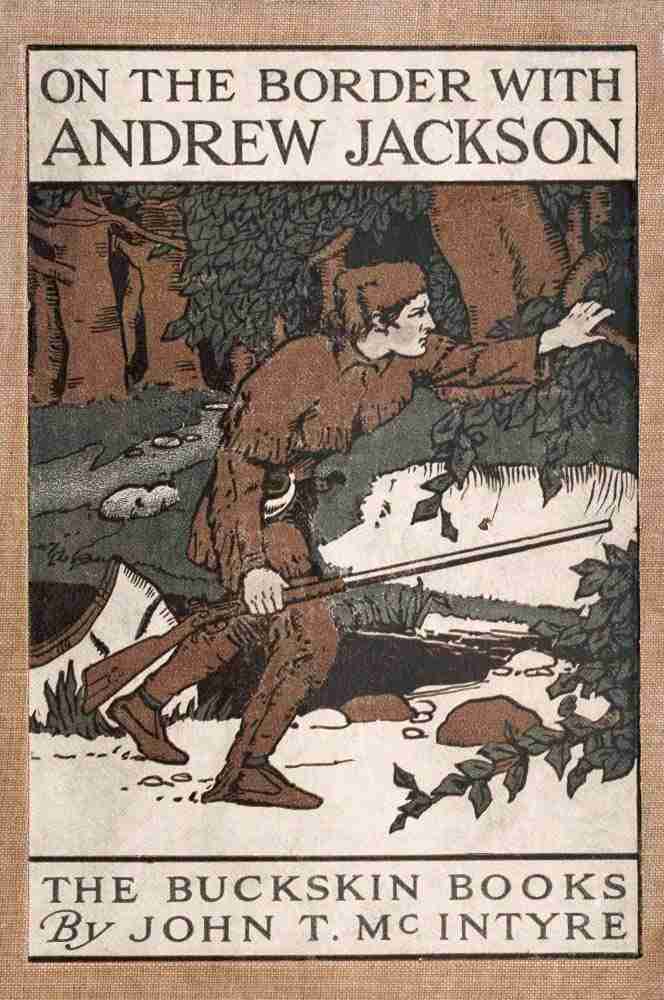
CHAPTER IV
ATTACKED BY INDIANS
Their mounts having had a good rest and the boys themselves being more than usually refreshed, they made considerable progress that day. Night found them at the ford of a large stream.
“Hello,” said Jack, as they drew up at the ford and gazed about, “this looks like a place I’ve seen before.”
“Cache on other side,” said Running Elk, who seldom made a mistake in his observations. “Much dried meat. Put there two snow moons ago.”
Jack’s face lit up with recognition.
“Why, so it is,” said he. “I hadn’t thought we’d gone so far.” Then to Frank he added: “This is the place we’ve been heading for.”
“Is this the Alabama River?” asked the young Virginian.
“Yes,” said Jack. “And from now on we’ll have our bearings pretty well laid out for us. Running Elk and myself hunted hereabouts two winters ago; that’s how we came to have the country so well in mind.”
They forded the river and camped for the night on the opposite bank; next morning, after breakfast, Frank got out his chart, roughly done upon a piece of tanned deerskin in the pigment used by the Indians.
“Here,” said he, his finger indicating the places on the chart, “is the Alabama. Just below is a place where a smaller stream flows into it, and upon the point of land between the two is a small clump of trees under which is written ‘Triple Oaks.’”
“The clump would be three trees, I think,” said Jack, “and pretty big ones, to make them stand out so as to be noticed more than others.”
“I should say so, too,” agreed Frank.
“There is such a place as that not far down-stream,” said Jack. “At least I think there is. I remember some big oaks, just at a place where a creek runs into the river. But how many there are, I don’t know.” Then turning to Running Elk, he asked, “What do you remember about it?”
The young Cherokee’s reply was brief and comprehensive.
“One, two, three,” he counted upon his fingers. “Three oak trees. Grow near creek on river bank. Half a sun’s ride.”
Jack chuckled and nodded to Frank.
“He never forgets anything like that.”
Frank was much gratified.
“Good for you, old chap,” said he, slapping the Cherokee upon the shoulder. To Jack he said: “As we are without instruments, we couldn’t locate the tract without these landmarks, and it’s a great comfort to have some one along who knows where the landmarks are.” Again his fingers went from point to point upon the chart. “Here, to the north, is a hill; and around to the west is a pine forest; I think we ought, by the help of these, to prove if the three oaks you have in mind are the ones in the chart, or no.”
When the horses had finished grazing, they were saddled, and the lads sprang upon their backs with keen excitement. That Running Elk was a most excellent judge of distance as well as topography was soon made manifest. For just about high noon, when the sun was staring like a huge fiery ball from directly overhead, Frank uttered a cry.
“What is it?” demanded Jack, his hand going in the quick, instinctive movement of the frontiersman for his weapon.
“The triple oaks,” was the reply, and Frank pointed over the tree tops.
Sure enough, as they broke through some underbrush upon the river bank, they sighted three massive oaks, growing close together and towering above their neighbors like giants above pigmies. To the left of them flowed a slow shallow stream of yellowish water which entered and discolored the river for some distance below.
“Well, there they are,” said Jack, “just as I saw them last, and as they have been standing for at least a hundred years.”
They all dismounted, and their bridles were thrown across some low limbs close to the water’s edge. Frank got the chart from his saddle-bags, and began unrolling it.
“With any sort of good luck,” said he, “we’ll have this job over sooner than we expected.”
As he spoke he felt a hand upon his shoulder, pressing downward.
“Down!” came the voice of Jack, harshly. “Don’t look up! Down!”
His weeks in the wilderness had not been without their effect upon the young Virginian. He had learned that if a thing must be done in the forest, one must do it promptly and without question. So he at once dropped to the earth; as he did so a flight of arrows sped over his head, and a dozen bullets hummed their course through the trees.
“Red Sticks,” said Running Elk, from behind the gnarled stem of a cottonwood. He fitted an arrow to his bow, and as Frank, astounded by the suddenness of the attack, gazed at him the taut string twanged, and a shrill cry from across the river told of a victim.
Almost at the same moment the long rifle of Jack Davis spoke, and a second yell arose, proving the sureness of his aim. Frank now turned his eyes upon the point of land upon which stood the triple oaks; to his surprise, he saw among the trees all the evidences of a Creek encampment; and a new flight of arrows and volley of rifle shots from behind rocks, stumps and trees, told of the hiding places of the savages.
By great good fortune, the boys’ horses, at the first sound of the rifles of the hostiles, had broken away from their slight restraint and galloped off into the woods, unhurt.
“Keep close to the ground,” warned Jack, “and after them. We must not lose sight of our mounts, or we’re done for.”
Running Elk slipped from tree to tree; Jack crawled along the earth with the supple movements of a snake. Frank followed suit, and in spite of the continuous flight of arrows, they reached unharmed the thick cover of the trees some distance from the river’s brink.
By great good fortune, the packhorse, which was a wise old beast, had brought up a few hundred yards away; and naturally the other horses stopped also, and so were easily caught. The boys sprang upon their backs and went tearing away through the aisles of the forest; and as they did so they heard the yells of the Indians, who now for the first time became aware of their flight.
“Do you think they’ll follow?” asked Frank, as he and Jack rode side by side for a space where the woods was not so dense.
“They will if they have noticed how few we are,” replied the young borderer. “And if they cross the river, our tracks will tell them that.”
After about an hour’s hard riding they slackened their pace, and then at the top of a knoll they halted. They had emerged from the forest some time ago, and from where they were they had a clear view of the surrounding country for miles around.
Away swept the green of the early autumn, all rippling in the breeze and shining in the sunlight. Here and there a splotch of yellow or red marked where the fall had already set its hand. The sky was cloudless and the air very clear.
“It’s the sort of a day when we can see great distances,” said Frank. “I don’t think I remember ever seeing a finer.”
“Well, and just because of that,” said Jack Davis, with the caution of experience, “we’d better not stand here in such full view. If there are any reds on our trail, they’ll mark us, even if they’re still miles away.”
“Ugh!” agreed Running Elk, in prompt approval. “Creek have good eyes. See far!”
So they drew back below the shoulder of the knoll, dismounted and gave the horses a breathing space. Frank, as he watched his friend, saw that his face was serious and that his looks in the direction of the waving green forest which they had left behind were intense. Running Elk also kept his keen black eyes upon the distant woods; as he stood watching, with barbaric composure, he had the appearance of a splendidly wrought bronze, meant to typify vigilance and grace.
Suddenly Jack spoke.
“There they are,” said he, pointing. “There’s a big band of them, and they are following in our tracks like hounds.”
From out the green of the woods came a full score of Creeks. Some were mounted and some were afoot. They carried shields and spears and bows and arrows; and here and there the metal of a rifle barrel glistened as the sun’s rays struck it.
“They seem to come on boldly, and without much thought of concealment,” said Frank, after he had watched them for a moment. “And that is not at all the way I thought Indians made war.”
“Um, Creek no care who see,” stated Running Elk. “Got hill, with ring around him.”
“What’s that?” said Frank, only partly catching the Cherokee’s meaning.
“He means that they’ve got us surrounded,” said Jack Davis. “And he’s right. Just throw a look around.”
Startled, Frank did so; his heart gave a leap and began to beat swifter; from all directions, closing in upon the knoll, were bands of armed savages.