
FOREWORD
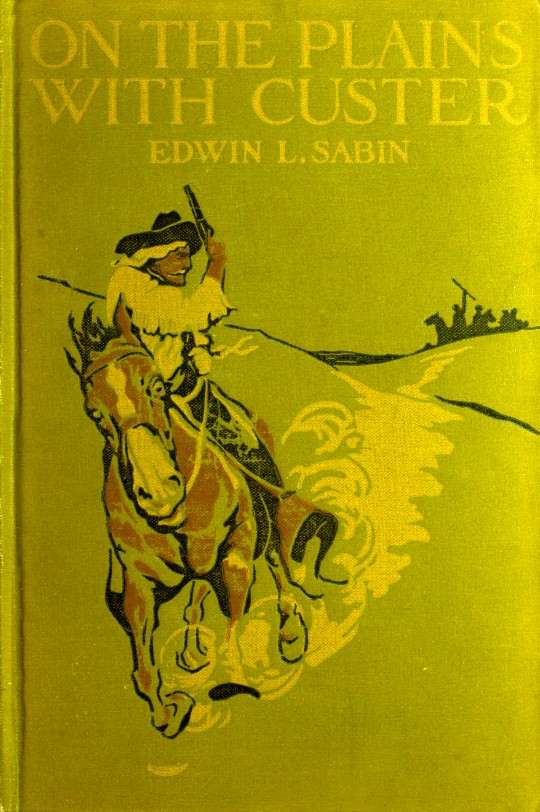
This is a story of Ned Fletcher, and the Seventh Regular Cavalry, United States Army, when upon the Western plains they followed the yellow-haired General Custer. Yet it is not all a story of fighting; for to be a good soldier does not mean that one must serve only to fight. Indeed, there are worthy battles other than those with lead and steel, horse and foot. Every earnest citizen is a good soldier. General Custer was as great in peace as in war; in his home as in the field, and he loved his home duties as much as he loved his other duties, which is token of a true man.
General Custer is real to-day. Men and women live who marched with him. As to Ned Fletcher, who may say? A little girl named Fletcher was captured by Cheyennes and Sioux, as Ned’s sister was captured; and Chief Cut Nose called her “Little Silver Hair.” General Custer would have rescued her, as official records show. Two little children were found in the Cheyenne village on the Washita. In the battle here a bugler boy was wounded just as Ned was wounded. Aye, and at Fort Wallace a little bugler boy was slain. So that boys served in the old Seventh Cavalry, under General Custer. As a brave boy, Ned might have been there, even though by a different name.
General Custer has left his own story of his plains days in Kansas and Nebraska. It lies before me. Mrs. Custer, his comrade of garrison and camp and march, has written several books about him. They lie before me. There is a biography by one Captain Whittaker, written at the close of the last battle, near forty years ago. With General Sheridan and General Custer upon their campaign against the Cheyennes and the Kiowas was a newspaper reporter, Randolph Keim, who also wrote a book. Chapters have there been, in other books and in magazines, and pamphlets of time agone; and, as I say, men and women are now alive who knew the general. From all these more information should be sought. No one pen can describe so fine a thing as a Man.
So this book must tell of the Custer whom Ned the boy and youth saw; and of affairs in which he took part during that final struggle when the white race would supplant the red race, on the plains of north and south. In the narrative of these years I have tried to show how the white race felt and how the red race felt; for each had their rights and their wrongs, and each did right and did wrong. Out of the result came general good, that the church and the school-house might rise and people might work and play in peace, where formerly stood only the unproductive hide lodges, and the main thought was war and Plunder.
Edwin L. Sabin.
Coronado, California, June 1, 1913.
CONTENTS
| CHAPTER | PAGE | |
|---|---|---|
| I. | A Waif on the Prairie | 17 |
| II. | At Old Fort Riley | 34 |
| III. | The Seventh Takes the Field | 48 |
| IV. | Satanta Makes a Speech | 67 |
| V. | In Battle Array | 79 |
| VI. | The Abandoned Indian Village | 89 |
| VII. | Scouting with Custer | 104 |
| VIII. | Pawnee Killer Plays Tricks | 114 |
| IX. | Danger on Every Side | 129 |
| X. | Sad News for the Army Blue | 142 |
| XI. | Grim Days Along the Trail | 153 |
| XII. | Phil Sheridan Arrives | 160 |
| XIII. | The Yellow Hair Rides Again | 173 |
| XIV. | The Winter Warpath | 180 |
| XV. | “We Attack at Daylight” | 192 |
| XVI. | “Garryowen!” and “Charge!” | 204 |
| XVII. | After the Battle | 215 |
| XVIII. | To the Land of the Dakotah | 227 |
| XIX. | Scouting Among the Sioux | 236 |
| XX. | Rain-in-the-Face Vows Vengeance | 249 |
| XXI. | Sitting Bull Says: “Come On!” | 256 |
| XXII. | Out Against the Sioux | 264 |
| XXIII. | Looking for Sitting Bull | 274 |
| XXIV. | Sitting Bull at Bay | 290 |