
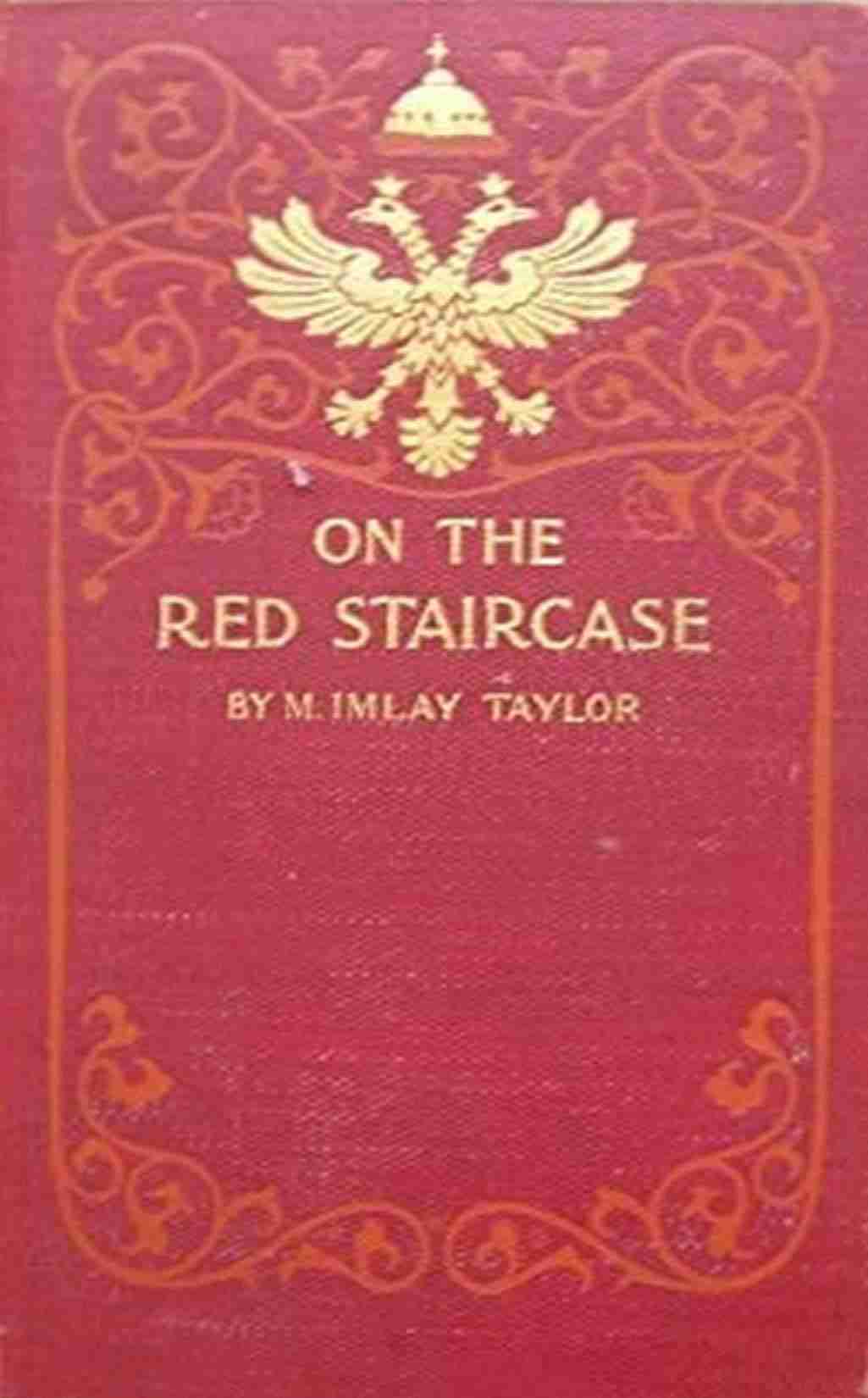
ON THE RED STAIRCASE.
CHAPTER I.
THE RABBLE ELECT A CZAR.
The Patriarch Joachim was standing on the balcony, in front of the Church of the Savior, looking down upon the dense mass of people below in the Grand Square of the Kremlin at Moscow. A purpose was pulsing in the keen face, and he was measuring his audience, weighing too, perhaps, the peril and the cost. They were still; every eye was fixed on the tall figure in the magnificent pontificals of the Greek Church; every ear strained to catch his first word. It was the climax of the day, the chief act in the great drama. He raised his hand, with a majestic gesture, over the people.
“Hear ye, voters of the Moscovite State,” he cried, in a loud voice, “to which of the two princes do you give the rule?”
I could not restrain a smile. I had been long enough about the Russian court to know how fierce was the undercurrent, how intense the resentment felt against the family of the dowager czarina.
An old Russian, who had stepped back with me out of the path of the crowd, suddenly addressed me.
“A short-lived triumph!” he muttered, in a gruff tone. “It is one shout to-day, another to-morrow. Here is only the rabble of Moscow!”
I looked at the man in surprise; it required courage to express an opinion in the open air, and to a stranger. He had the bearing of a soldier, and there was an ugly scar on his cheek. His long cloak slipping aside a trifle, I saw the uniform of the Streltsi, and caught my breath; a trivial remark from one of that body might be significant. Russia, at that time, had no army, only a few troops officered by foreigners, and the peasantry brought into service, in time of war, under the command of the feudal chiefs. The Streltsi therefore occupied a peculiar position; they constituted a national guard, consisting of twenty-two regiments, about a thousand men in each regiment, named after their officers, who were always Russians. The Streltsi had quarters set apart for them, and their own shops, being tradesmen when off duty, and were exempt from taxation. The service was hereditary, a son entering the father’s regiment as soon as he was of age. The root of much discontent was the difficulty with their own officers, whom they charged with the misappropriation of a portion of their pay and interference with their civil occupations,—their privilege to trade being especially dear to them. They had always enjoyed such peculiar liberties that they fretted under injustices, some real and some fancied, and all no doubt deeply colored by the bitterness of the political situation, and the fact that their petitions for redress had been treated with contempt before the Czar Feodor’s death; but now they were strong enough to be courted by both parties, and I was interested at once in my companion.
“I am a stranger here,” I said, purposing to draw him out, “and know little of these matters.”
He turned a keen glance on me, seeming to search my face.
“You are a Frenchman,” he said, addressing me in excellent French, which was the more astonishing because so unusual, especially in his rank in life. Without waiting for my reply, he directed my attention to the balcony. “The patriarch is going to bear the glad tidings to the Czarina Natalia,” he remarked grimly, “and, I presume, to anoint the young czarevitch[1] with all haste; but it takes more than holy oil to make an emperor in these days.”
We were less pressed now, for the crowd was surging away towards the palace, shouting as it went. I examined my new acquaintance with curiosity. If his face had been less rugged and fierce it would have been handsome on the side that had escaped the disfiguring scar. It was a remarkable face: a keen eye, a large straight nose, a strong mouth, and an expression of relentless resolution,—a face that had had a past as dark, as cold, as grim as that close-shut mouth. My curiosity was excited.
“A regent will have to be appointed,” I remarked, “during the minority of the czar.”
He smiled grimly. “And who do you suppose it will be?” he asked, with a keen glance.
“Custom points to the czarina,” I replied with a little hesitation.
“And the Chancellor Matveief,” he added.
I assumed surprise.
“Matveief is an exile,” I exclaimed hastily.
The Russian laughed. “The czarina is his dutiful and indebted ward,” he said. “He is no longer in Archangel but at Lukh, and a summons can reach him the easier. When a guardian has set you on a throne, you cannot be ungrateful. Why, man, where are your senses? What is all this shouting about? It is the Naryshkins. I forget, though, you are a foreigner.”
“A poor gentleman,” I said at once; “a soldier of the king of France.”
The Russian’s glance was following the crowd; whatever his thoughts, they were not pleasant, for his expression was gloomy and cynical.
“You have witnessed a singular event in our history,” he said sternly; “you have seen the Moscovite rabble elect a czar. The younger son setting aside the first-born!”
“The Czarevitch Ivan is said to be indifferent to the high office,” I replied, in a low tone; “he is blind.”
“Ay, and deformed!” said the Russian, promptly. “Yet will the people of Russia demand the recognition of primogeniture. Court intrigues cannot prevail. What a flimsy pretext was this election! The States-General of Russia elected Michael Romanof; the Czar Shuisky fell because he was elected by Moscow alone; and this is not the Moscovite State, but the rabble of the city, and the retainers of the boyars![2] The Miloslavskys are down to-day, but who dares to predict for to-morrow?”
It was indeed a difficult problem, so bitter was the quarrel. The Miloslavskys were the relatives of the first wife of the Czar Alexis, the Naryshkins of his second; and, that day, the latter had succeeded in electing their candidate for the throne, Alexis’ youngest son Peter, setting aside Ivan, his half-brother, and the only surviving son of Alexis by his first wife, the Princess Marie Miloslavsky.
I was endeavoring to place my companion; that he was well born, I could not doubt; at the same time, he was evidently not an officer. I seemed to have seen his face before, and wondered if he could have been in attendance on Prince Dolgoruky, the Chief of the Department of the Streltsi. The ugly scar, which drew the right side of his face, seemed to make identification infallible; yet, it was that scar that baffled me, for I could not remember having seen it before. We were moving along now, and I did not care for his company, but did not like to shake him off too abruptly; he walked close beside me, whether unconsciously or not, I could not be sure. The Grand Square was still densely crowded, and the rabble kept up a continuous uproar. All around us, there were still prolonged shouts for Peter Alexeivitch, and here and there, there were rough-and-tumble fights in progress, due undoubtedly to the reviving sentiment of opposition. I noticed but few boyars threading their way through the mob; for days I had remarked a certain timidity on their part, an avoidance of the crowd. I had no doubt, in my own mind, that the trouble in the Department of the Streltsi was more serious than any one was willing to admit, and it was difficult to estimate the result of to-day’s coup d’état. Partisans and opponents alike were aware of the strong sentiment among the rank and file of the Streltsi in favor of the blind czarevitch, or rather of the great Czarevna Sophia Alexeievna,[3] and of their lukewarm attachment to the child Peter, who had just been so irregularly elected. I could not avoid some speculation, little as the matter seemed then to concern me. I confess that I was moved by a sentiment of gallantry to lean towards the cause of the Czarina Natalia. Her comparative youth, her beauty, and the peril of her situation appealed to me, and I felt, with some regret, that her party scarcely estimated the real strength of her opponents. I sympathized with the young and ambitious mother fighting for the rights of her son, hemmed in as she was by court intrigue and malice, and pitted against a mind that, in diplomacy and subtlety, far surpassed her own; for we were all beginning to realize that the Czarevna Sophia was a power that it was difficult to estimate.
I was half-way across the square now, and my unsolicited companion continued to trail along at my heels. I was just making up my mind to be rid of the fellow, when we found our path obstructed by a dense mass of people, congregated about two Russians who were grappling each other in a fierce hand-to-hand battle. The crowd pushing us aside, I was turning away, when my companion uttered a cry, and leaping into the mass of humanity, pushed his way through, and threw himself upon the combatants. I was caught in the throng and thrust to the front of the ring, an unwilling witness of the hostilities. My unknown companion had seized one of the combatants around the waist and was dragging him off the other, by main force, while the bystanders shouted for fair play. It was evident that the quarrel was purely personal, and that the rabble were merely interested in it as a kind of diversion, and not a little disappointed when my acquaintance succeeded in separating them. Keeping his grip on the smaller of the two men, he told the other to be off before he was thrashed into eternity. The fellow addressed, who looked like some boyar’s retainer, was only too glad to sneak off through the jeering crowd, for he had been badly whipped. The other man allowed himself to be jerked along by the collar, submissive enough in the stranger’s relentless grip. He was a small man to have been so puissant, and I saw that he was a little misshapen, one shoulder being very high, and his thin, pale face was ill-favored. The bystanders began to laugh as they saw how meekly he submitted to the authority of the tall, hard-featured man who had seized him.
“Oh, come!” cried one of the rascals, “what is this new meekness? You fought well, but you can’t keep your head up now!”
“Let go of him, master!” shouted another; “it is a shame to spoil our pastime.”
Without heeding, the stranger forced his way among them, dragging along his captive, and only bestowing a scornful glance on the populace. I was more than ever struck with his air of authority, and saw that these men all gave way to him,—a tacit recognition of his commanding mien, for a less determined man could never have broken up that quarrel and dispersed the crowd. My interest was sufficiently roused to make me forget my anxiety to be rid of him, and as he pushed along with the crestfallen victor, I joined him. As we proceeded, part of the rabble followed, evidently actuated by idle curiosity.
“Let us move faster,” I remarked to the stranger; “now that the election is over, the crowd is breaking away, and we shall presently have the canaille at our heels.”
He looked at me scornfully, I thought, but still mended his pace; and as we were now a little away from the mob, he took his hand off the other’s collar, addressing him sharply.
“You fool!” he said, in his grim way. “You will spoil all with your absurd brawls. Can’t you see that villain’s cook in the highway without thrashing him, and forthwith drawing the notice of all the tale-bearers and spies in Moscow?”
“I beg your excellency’s pardon,” stammered the man, shamefaced, “but it was that carrion Polotsky, and I would rather die than not beat him!”
“Ay!” retorted the other, grimly, “you should have cut his throat long ago; but, as it is, he is the worst one you could have selected for a street brawl. You are an ass, Michael Gregorievitch, and will not only hang yourself, but your master if you can find enough rope!”
The other man glanced at me obliquely out of his narrow eyes, and his master, noting the look and the interrogation in his face, smiled.
“A friend,” he said, and added something in an undertone which escaped me; but I saw his servant’s eyes fasten curiously upon me.
We were approaching the Cathedral of the Assumption, and although a few paces in advance, were still closely followed by a train of curious people. The stranger had drawn his sword when he rushed into the fight, and was still carrying the naked blade in his hand, and his dress being disordered, displayed his uniform. As we approached the cathedral, he seemed to divine my intention of lingering in that vicinity, and pausing, extended his hand with a gesture at once dignified and gracious.
“M. de Brousson,” he said, startling me with my own name, “I believe we part here. I thank you for your company across the square, and if, in the future, you need me, I am Peter Lykof.”
“I am evidently better known to you than I supposed,” I replied as courteously as my astonishment would permit, and conscious of an immediate doubt that I heard the unknown’s true name; “and I am equally beholden for monsieur’s society on this troubled day.”
Lykof waved his hand, as if dismissing further exchange of courtesies, and passed on with the rabble at his heels, while I at once fell into insignificance without him.
As I stood there, marveling at the stranger’s knowledge of my identity, I looked up, and beheld the face that had haunted my memory for weeks and shone like a pale flower out of the dark background of passion and intrigue.