
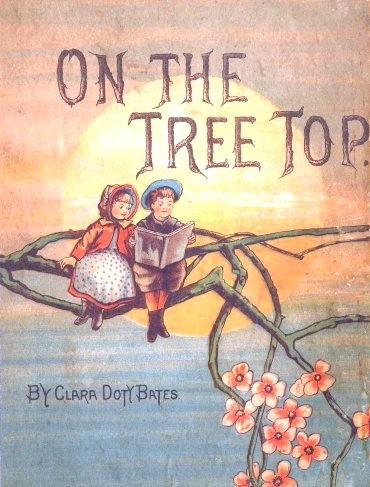
The Project Gutenberg eBook of On the Tree Top
Title: On the Tree Top
Author: Clara Doty Bates
Illustrator: Jessie Curtis
Frank T. Merrill
Release date: February 6, 2008 [eBook #24530]
Language: English
Credits: Produced by Louise Hope, Marilynda Fraser-Cunliffe and the
Online Distributed Proofreading Team at http://www.pgdp.net
(This file was made using scans of public domain works in
the International Children's Digital Library.)
This text uses utf-8 (unicode) file encoding. If the apostrophes and quotation marks in this paragraph appear as garbage, make sure that the browser’s “character set” or “file encoding” is set to Unicode (UTF-8). You may also need to change your browser’s default font.
A few typographical errors have been corrected. They have been marked in the text with mouse-hover popups.
Some illustrations have been modified to fit this e-text. Thumbnail views of all pages are shown at the end of the file. Larger page views are available as links, either from the picture itself (color plates) or in the margin (black-and-white pages). These will open in a separate window or tab.
ON THE TREE TOP
BY
CLARA DOTY BATES AND OTHERS.
ILLUSTRATED BY F. T. MERRILL, JESSIE CURTIS,
AND OTHER WELL KNOWN ARTISTS.
BOSTON:
D. LOTHROP & COMPANY
FRANKLIN STREET, COR. HAWLEY.
Copyright, 1881,
By D. Lothrop & Company.
CONTENTS.
The color plates are not listed in the Table of Contents. Each plate is a single free-standing poem. The inconsistent sequence of “Dick Whittington” and “Puss in Boots” (before or after), and the spelling of “Jack and Gill” (or Jill), are unchanged.
II.
A FISH STORY.
III.
PUSSY CAT’S DOINGS.
VII.
JOHN S. CROW.
VIII.
SILVER LOCKS AND THE BEARS.
XI.
CINDERELLA.
XII.
PUSS IN BOOTS.
XIII.
DICK WHITTINGTON AND HIS CAT.
XIV.
GOLD-LOCKS’ DREAM OF PUSSIE-WILLOW.
XV.
TONY.
XVI.
CAMPING OUT.
XVII.
DAME SPIDER.
XVIII.
HICKORY DICKORY DOCK.
XIX.
DAME FIDGET AND HER SILVER PENNY.
XXI.
ALADDIN.
XXII.
BLUE BEARD.
XXIII.
THE SLEEPING PRINCESS.
XXIV.
JACK AND GILL.
XXV.
LITTLE BO-PEEP.
XXVI.
HOP O’-MY-THUMB.
XXVII.
THE BABES IN THE WOOD.
XXVIII.
THE THREE LITTLE PIGS.
XXIX.
GOODY TWO-SHOES.
XXX.
SAARCHINKOLD.
THE GOLD-SPINNER.
THE GOLD-SPINNER.A miller had a daughter, And lovely, too, she was; Her step was light, her smile was bright, Her eyes were gray as glass. (So Chaucer loved to write of eyes In which that nameless azure lies So like shoal-water in its hue, Though all too crystal clear for blue.) As you would suppose, the miller Was very proud of her, And would never fail to tell some tale As to what her graces were. On the powdery air of his own mill Floated the whispers of her skill; At the village inn the loungers knew All that the pretty girl could do. |
||
|
Oft in his braggart way This foolish tale he told, That his daughter could spin from bits of straw Continuous threads of gold! So boastful had he grown, forsooth, That he cared but little for the truth: But since this was a curious thing It came to the knowledge of the king. He thought it an old wife’s fable, But senseless stuff at best; Yet, as he had greed, he cried, “Indeed! I will put her powers to test.” With a wave of his hand, he further said That to-morrow morning the clever maid Should come to the castle, and he would see What truth in the story there might be. |
|
|
Next day, with a trembling step, She reached the palace door, And was shown into a chamber, where Was straw upon the floor. They brought her a chair and a spinning-wheel, A little can of oil, and a reel; And said that unless the work was done— All of the straw into the gold-thread spun— By the time that the sun was an hour high Next morning, she would have to die. |
|
Down sat she in despair, Her tears falling like rain: She had never spun a thread in her life, Nor ever reeled a skein! Hark! the door creaked, and through a chink, With droll wise smile and funny wink, In stepped a little quaint old man, All humped, and crooked, and browned with tan. She looked in fear and amaze To see what he would do; He said, “Little maid, what will you give If I’ll spin the straw for you?” Ah, me, few gifts she had in store— A trinket or two, and nothing more! A necklace from her throat so slim She took, and timidly offered him. ’Twas enough, it seemed; for he sat At the wheel in front of her, And turned it three times round and round, Whirr, and whirr-rr, and whirr-rr-rr— One of the bobbins was full; and then, Whirr, and whirr-rr, and whirr-rr-rr again, THUMBPAGE Until all the straw that had been spread Had been deftly spun into golden thread. |
||
|
At sunrise came the king To the chamber, and, behold, Instead of the ugly heaps of straw Were bobbins full of gold! |
||
|
This made him greedier than before; And he led the maiden out at the door Into a new room, where she saw Still larger and larger heaps of straw, A chair to sit in, a spinning-wheel, A little can of oil, and a reel; And he said that straw, too, must be spun To gold before the next day’s sun Was an hour high in the morning sky, And if ’twas not done, she must die. | ||
Down sank she in despair,
Her tears falling like rain;
She could not spin a single thread,
She could not reel a skein.
But the door swung back, and through the chink,
With the same droll smile and merry wink,
The dwarf peered, saying, “What will you do
If I’ll spin the straw once more for you?”
“Ah me, I can give not a single thing,”
She cried, “except my finger-ring.”
He took the slender toy,
And slipped it over his thumb;
Then down he sat and whirled the wheel,
Hum, and hum-m, and hum-m-m;
Round and round with a droning sound,
Many a yellow spool he wound,
Many a glistening skein he reeled;
And still, like bees in a clover-field,
The wheel went hum, and hum-m and hum-m-m.
Next morning the king came,
Almost before sunrise,
To the chamber where the maiden was,
And could scarce believe his eyes
To see the straw, to the smallest shreds,
Made into shining amber threads.
And he cried, “When once more I have tried
Your skill like this, you shall be my bride;
|
For I might search through all my life Nor find elsewhere so rich a wife.” Then he led her by the hand Through still another door, To a room filled twice as full of straw As either had been before. There stood the chair and the spinning-wheel, And there the can of oil and the reel; And as he gently shut her in He whispered, “Spin, little maiden, spin.” |
|
|
Again she wept, and again Did the little dwarf appear; “What will you give this time,” he asked, “If I spin for you, my dear?” Alas—poor little maid—alas! Out of her eyes as gray as glass Faster and faster tears did fall, As she moaned, “I’ve nothing to give at all.” Ah, wicked indeed he looked; But while she sighed, he smiled! “Promise, when you are queen,” he said, “To give me your first-born child!” Little she tho’t what that might mean, Or if ever in truth she should be queen Anything, so that the work was done— Anything, so that the gold was spun! She promised all that he chose to ask; And blithely he began the task. Round went the wheel, and round, Whiz, and whiz-z, and whiz-z-z! So swift that the thread at the spindle point Flew off with buzz and hiss. |
|
She dozed—so tired her eyelids were— To the endless whirr, and whirr, and whirr; Though not even sleep could overcome The wheel’s revolving hum, hum, hum! When at last she woke the room was clean, Not a broken bit of straw was seen; But in huge high heaps were piled and rolled Great spools of gold—nothing but gold! It was just at the earliest peep of dawn, And she was alone—the dwarf was gone. |
|
It was indeed a marvellous thing For a miller’s daughter to wed a king; But never was royal lady seen More fair and sweet than this young queen. The spinning dwarf she quite forgot In the ease and pleasure of her lot; And not until her first-born child Into her face had looked and smiled Did she remember the promise made; Then her heart grew sick, her soul afraid. |
|
One day her chamber door Pushed open just a chink, And she saw the well-known crooked dwarf, His wise smile and his blink. He claimed at once the promised child; But she gave a cry so sad and wild That even his heart was touched to hear; And, after a little, drawing near, He whispered and said: “You pledged The baby, and I came; But if in three days you can learn By foul or fair my name— By foul or fair, by wile or snare, You can its syllables declare, Then is the child yours—only then— And me you shall never see again!” |
|
He vanished from her sight, And she called her pages in; She sent one this way, and one that; She called her kith and kin, Bade one go here, and one go there, Despatched them thither, everywhere— That from each quarter each might bring The oddest names he could to the king. |
|
Next morning the dwarf appeared, And the queen began to say, “Caspar,” “Balthassar,” “Melchoir”— But the dwarf cried out, “Nay, nay!” Shaking his little crooked frame, “That’s not my name, that’s not my name!” |
|
The second day ’twas the same; But the third a messenger Came in from the mountains to the queen, And told this tale to her: That, riding under the forest boughs, He came to a tiny, curious house; Before it a feeble fire burned wan, And about the fire was a little man; In and out the brands among, Dancing upon one leg, he sung: “To-day I’ll stew, and then I’ll bake, To-morrow I shall the queen’s child take; How fine that none is the secret in, That my name is Rumpelstiltskin!” |
|
|
The queen was overjoyed, And when, due time next day, The dwarf returned for the final word, She made great haste to say: “Is it Conrade?” “No,”—he shook his head. “Is it Hans? or Hal?” Still “No,” he said. “Is it Rumpelstiltskin?” then she cried. “A witch has told you,” he replied, And shrieked and stamped his foot so hard That the very marble floor was jarred; And his leg broke off above the knee, And he hopped off, howling terribly. |
|
He vanished then and there, And never more was seen! This much was in his dreadful name— It saved her child to the queen. And the little lady grew to be So very sweet, so fair to see, That none could her loveliness surpass; And her eyes—they were as gray as glass! |
|||
A FISH STORY.
|
Sir Arthur, the sinner, Ate twelve fish for dinner, And you may believe it’s just as I say! For if you but knew it, ’Twas I saw him do it, And just as it happened, sir, this was the way: One day this tall fish Swallowed this small fish (He had just eaten a smaller one still); Up came this queer one And gobbled that ’ere one— Didn’t he show the most magical skill? Then came this other And chewed up his brother, Made but one gulp, and behold he was through! He was a gold fish Oh! he was a bold fish— But before he could wink he was eaten up too! Up came a flounder, He was a ten-pounder, Opened his mouth, swallowed him and was gone; Before you could blink, sir, Before he could shrink, sir, This fish came by and the flounder was gone! |
||
|
(Alas for my story, ’Tis getting quite gory! So many swallows a summer might make.) This one came smiling, And, sweetly beguiling, Gobbled the last like a piece of hot cake; A cod followed after; ’Twould move you to laughter To see in his turn how this hake came up, Swallowed that cod, sir, As if he were scrod, sir, And then went by in a kind of a huff! Last, but not least, Came this fellow, the beast— Down went the hake like a small pinch of snuff! |
||
|
Then Cap’en Jim caught him, And then mamma bought him, And then Annie cooked him, served up in a dish; And so this small sinner Who had him for dinner— ’Twas just as I say, sir—had eaten twelve fish! |
||
PUSSY CAT’S DOING.
|
’Twas a good little lady fairy, Who saddled her wee white mouse, And rode away to the village, Long miles from her snug, wee house; She tied her steed to a flower stalk airy, And left him there—this most careless fairy! |
||
|
In Fairyland no dreadful pussies Do prowl, and do growl and slay— In Fairyland the mice have honor, And draw the queen’s carriage gay; And the little lady ne’er thought of danger Because on the fence sat a green-eyed stranger, |
||
|
But hurried away in a twinkling Down a dark and gloomy street, Where daily the charm of her presence Made the children’s dreams more sweet; Then Pussy Cat sprang as quick as magic! One squeal (as I’ve heard the story tragic) |
||
|
And down his throat went steed and saddle, So swiftly; and O, dear me! ’Stead of her gallant mouse, the lady Discovered, where he should be, A monster with blood on his whiskers showing, And dreadful looks in his eyes so knowing! |
|
Back to Fairyland she must walk, then;
In winter no butterfly
Is sailing that way, nor a rose-leaf,
For fairies to travel by;
She reached there at length, but with feet aching
And her little heart with fear most breaking.
And the dreadful story, spreading
Through Elfland circles, may be
The reason why never a fairy
In these later years we see,
While children in all the old, old stories
Found them as plenty as morning glories!
THE THREE LITTLE KITTENS.
Knit, knit, knit, knit!
See old white-capped Pussy sit,
Fairly gray with worry and care,
In her little straight-backed rocking-chair?
Knit, knit, knit,
Till she is tired of it!
Why does she work so? Look and see,
There in the corner, children three!
Plump and furry and full of fun,
(A good-for-nothing is every one.)
And all those kittens
Must have mittens!
Weather is cold; and snow and sleet
Make it bad for their little feet;
And they dare not peep outside, because
Jack Frost stands ready to pinch their paws—
That’s why she sits,
And knits, and knits.
If by any chance she drops her ball,
And if one of them chases it at all,
She peeps out over her glasses’ rim
With a savage, dreadful scowl at him,
And cries out, “Scat,
You saucy cat!”
Or, if her long tail gets uncurled
And sways but the least bit in the world,
And one of them makes a roguish nip
At it, or plays at mouse with the tip,
Somebody hears,
A loud boxed ears!
With them ’tis hurry-scurry and play,
Or sleep in a round coil half the day;
While, creakety-creak, the rockers go,
And the mittens grow, and grow, and grow,
So shapely and fast—
They are done at last!
|
She summons the kittens; each one stands While the mittens are tried on his clumsy hands; Then her glasses drop to the end of her nose, And her wits go wandering off in a doze, And as never before, Does old Puss snore! |
|
|
She is off to that dream-land paradise Of cats, where cupboards are full of mice; Where white and sweet and big as the sea Are the saucers of warm new milk—ah me, There is no cream Like that in a dream! There the ways of things are very absurd; For a bobolink, or a yellow bird, Comes of its own accord, and sits On every knitting-needle that knits, And pipes and sings, As the rocker swings. |
||
Suddenly there is a noise of feet—
Rattle and clatter and patter and beat!
Old Puss makes a flying leap from her chair,
With a half-awake and startled stare,
Striving to see
What it may be.
Helter-skelter the kittens appear;
“Oh mother dear, we very much fear
That we have lost our mittens!” they cry.
“You have? Then you shall have no pie!
Lost your mittens?
You naughty kittens!”
Old mother Puss is dreadfully cross,
At the spoiled dream first, then at the loss;
And with floods of tears down either cheek
Each frightened kitten tries to speak:
“Miew, miew, miew!
Miew, miew, miew!”
|
A smart cuff over their little brains Is the only answer the mother deigns “Not another word from one of you!” It means, so without more ado, Ashamed and slow Away they go. |
|
|
Again she settles herself and sleeps; This time she dreams that she crouches and creeps, A great gray tiger along the grass, While herds of soft-eyed antelopes pass, |
||
When—patter, patter!
“Now what’s the matter?”
Again, with a scramble, the three appear;
“Oh mammy dear, see here, see here,
We have found our mittens—see!” they cry.
“You have? Then you shall have some pie!
Found your mittens?
You nice, nice kittens!”
She goes to the oven; there is a pie;
She sets it out on the floor close by;
’Tis smoking hot, and covered with juice;
And she says to them, “Eat as much as you choose.”
So up to the chin,
They all dip in.
|
Dame Puss goes out to wash her paws, And to comb her whiskers with her claws, When again the troublesome three appear; “Oh mother dear, see here—see here!” Distressed and shy They begin to cry. |
||
No wonder they cry; they did not wait
For a spoon, or knife, or fork, or plate,
But ate with their fingers! ah, how soiled!
Dame Puss declares the mittens are spoiled!
“Miew, miew, miew,
Miew, miew, miew!”
Then all run out to the rain-water tub,
Dip in their mittens, and rub, and rub;
Their little knuckles are fairly bare,
And wet, as if drowned, is every hair—
Still, over the tub,
They rub, rub, rub!
|
Once more they haste to their mother dear; “Oh mammy dear, see here, see here, We’ve washed our mittens clean!” they cry. “You darling kittens, To wash your mittens,” She says, and fondles them till they’re dry— Purr, purr, purr, Purr—pu-r-r—p-u-r-r! |
||
THE GROUND SQUIRREL.
THE GROUND SQUIRREL. |
||||
By PAUL H. HAYNE. |
||||
| I. | ||
|
Bless us, and save us! What’s here? Pop! At a bound, A tiny brown creature, grotesque in his grace, Is sitting before us, and washing his face With his little fat paws overlapping; Where does he hail from? Where? |
||
|
Why, there, Underground, From a nook just as cosey, And tranquil, and dozy, As e’er wooed to Sybarite napping (But none ever caught him a-napping). Don’t you see his burrow so quaint and queer? |
||
II. |
|
|
Gone! like the flash of a gun! |
|
|
This oddest of chaps, Mercurial, Disappears Head and ears! Then, sly as a fox, Swift as Jack in his box, Pops up boldly again! |
|
|
What does he mean by thus frisking about, Now up and now down, and now in and now out, And all done quicker than winking? What does it mean? Why, ’tis plain—fun! Only Fun! or, perhaps, The pert little rascal’s been drinking?— There’s a cider-press yonder all say on the run! |
|
III. |
|
|
Capture him! no, we won’t do it, Or, be sure in due time we would rue it! |
|
IV. |
||||
|
Such a piece of perpetual motion, Full of bother And pother, Would make paralytic old Bridget A Fidget. So you see (to my notion), Better leave our downy Diminutive browny |
||||
|
Alone, near his “diggings;” Ever free to pursue, Rush round, and renew His loved vaulting Unhalting, His whirling, And curling, And twirling, And swirling, |
||||
|
And his ways, on the whole So unsteady! ’Pon my soul, |
||||
|
Having gazed Quite amazed, On each wonderful antic And summersault frantic, For just a bare minute, My head, it feels whizzy; My eyesight’s grown dizzy; And both legs, unstable As a ghost’s tipping table, Seem waltzing, already! |
V. |
|
Capture him! no we won’t do it, Or, in less than no time, how we’d rue it! |
BABY’S TROTTING SONG
|
Come, see how the ladies ride, All so pretty, all so gay, In their beauty, in their pride, Down Broadway; Prancing horses silver shod, All so pretty, all so gay; Princely feathers bend and nod, Down Broadway. |
|||
|
Jiggety-jog, jiggety-jog, Over the mountain, through the bog— That’s the way the farmers go, Hear the news and see the show; Pumpkins round strapped on behind, Eggs in baskets, too, you’ll find, Soon to change for calico— That’s the way the farmers go. |
||
|
Bells a-jingle, fingers tingle, Ditto toes, likewise nose. The wind doth blow, And all the snow Around doth scatter; Our teeth they chatter, But that’s no matter— The song rings clear With a Happy New Year, And never a mutter, As we fly in our cutter. |
||
|
Jingle, jar, horse car, Leave you near, or take you far. Take a seat upon my lap, Cling on, swing on by the strap; Here a stop, and there a start— Let me off, I’ll take a cart! |
|
Sword and pistols by their side, And that’s the way the officers ride! Boots stretched out like a letter V, we belong to the cavalry!Over the hurdles after the hounds, tirra-la! the hunting-horn sounds— Dashaway, slashaway, reckless and fast! Crashaway, smashaway, tumbled at last! |
||
JOHN S. CROW.
|
All alone in the field Stands John S. Crow; And a curious sight is he, With his head of tow, And a hat pulled low On a face that you never see. |
|||||
| KIN-FOLKS OF JOHN S. CROW. | |||||
|
His clothes are ragged And horrid and old, The worst that ever were worn; They’re covered with mold, And in each fold A terrible rent is torn. |
|||||
|
They once were new And spick and span, As nice as clothes could be; For though John hardly can Be called a man, They were made for men you see. |
|||||
|
That old blue coat, With a double breast And a brass button here and there, Was grandfather’s best, And matches the vest— The one Uncle Phil used to wear. |
|||||
|
The trousers are short; They belonged to Bob Before he had got his growth; But John’s no snob, And, unlike Bob, Cuts his legs to the length of his cloth. |
|||||