
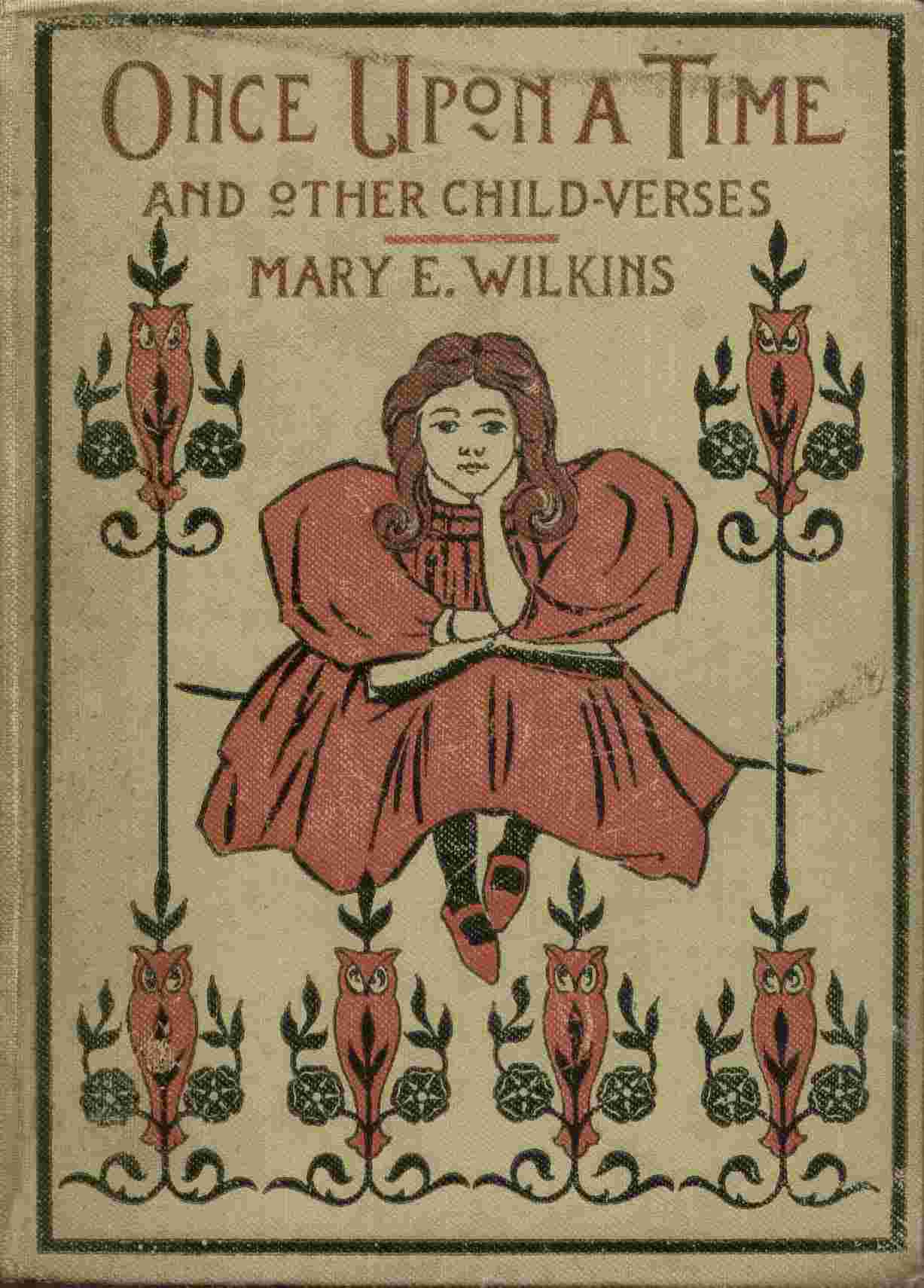
The Project Gutenberg eBook of Once Upon a Time, and Other Child-Verses
Title: Once Upon a Time, and Other Child-Verses
Author: Mary Eleanor Wilkins Freeman
Illustrator: Etheldred B. Barry
Release date: April 1, 2014 [eBook #45300]
Most recently updated: October 24, 2024
Language: English
Credits: Produced by David Widger from page images generously
provided by the Internet Archive
ONCE UPON A TIME AND OTHER CHILD-VERSES
By Mary E. Wilkins
Author Of "The Pot Of Gold," "Jane Field," "A New England Nun," "An Humble Romance," "Pembroke," Etc.
Illustrated By Etheldred B. Barry
Boston:
Lothrop, Lee & Shepard Co.
1897
Original
Original
CONTENTS
THE ENCHANTED TALE OF BANBURY CROSS.
THE BALLAD OF THE BLACK-SMITH'S SONS.
THE TRUE AND LAST STORY OF LITTLE BOY BLUE.
PREFACE
TRUSTING to the sweet charity of little folk
To find some grace, in spite of halting rhyme
And frequent telling, in these little tales,
I say again:—Now, once upon a time!
Original
ONCE UPON A TIME
NOW, once upon a time, a nest of fairies
Was in a meadow 'neath a wild rose-
tree;
And, once upon a time, the violets clustered
So thick around it one could scarcely see;
And, once upon a time, a troop of children
Came dancing by upon the flowery ground;
And, once upon a time, the nest of fairies,
With shouts of joy and wonderment they
found;
And, once upon a time, the fairies fluttered
On purple winglets, shimmering in the sun;
And, once upon a time, the nest forsaking,
They flew off thro' the violets, every one;
And, once upon a time, the children followed
With loud halloos along the meadow green;
And, once upon a time, the fairies vanished,
And never more could one of them be seen;
And, once upon a time, the children sought
them
For many a day, but fruitless was their quest,
For, once upon a time, amid the violets,
They only found the fairies' empty nest.
THE SICK FAIRY.
BREW some tea o' cowslips, make some
poppy-gruel,
Serve it in a buttercup—ah, 'tis very cruel,
That she is so ailing, pretty Violetta!
Locust, stop your violin, till she's feeling better.
THE ENCHANTED TALE OF BANBURY CROSS.
"Ride a cock-horse to Banbury Cross,
To see an old woman jump on a white horse;
With rings on her fingers and bells on her toes,
She shall make music wherever she goes."
—Old Nursery Rhyme.
PRAY show the way to Banbury Cross,"
Silver bells are ringing ;
"To find the place I'm at a loss,"
Silver bells are ringing.
"Pass six tall hollyhocks red and white;
Then, turn the corner toward the right,
Pass four white roses; turn once more,
Go by a bed of gilly-flower,
And one of primrose; turn again
Where, glittering with silver rain,
There is a violet-bank; then pass
A meadow green with velvet grass,
Original
Where lovely lights and shadows play,
And white lambs frolic all the day,
Where blooming trees their branches toss—-
Then will you come to Banbury Cross."
The white horse arched his slender neck,
Silver bells are ringing;
Snow-white he was without a speck,
Silver bells are ringing.
An old wife held his bridle-rein,
(The king was there with all his train),
Her gray hair fluttered in the wind,
Her gaze turned inward on her mind;
And not one face seemed she to see
In all that goodly company.
Gems sparkled on her withered hands;
Her ankles gleamed with silver bands
On which sweet silver bells were hung,
And always, when she stirred, they rung.
The white horse waited for the start,
Silver bells are ringing;
Before him leapt his fiery heart,
Silver bells are ringing.
Up on his back the old wife sprung,
Her silver bells, how sweet
they rung!
She gave her milk-white
steed the rein,
And round they swept,
and round again.
A merry sight it was
to see,
And the silver bells
The Old Wife.
rang lustily.
The gallant horse with gold was shod;
So fleetly leapt he o'er the sod,
He passed the king before he knew,
And past his flying shadow flew.
A pretty sight it was, forsooth,
Silver bells are ringing;
For dame and children, maid and youth,
Silver bells are ringing.
The princess laughed out with delight,
And clapped her hands, so lily-white—
The darling princess, sweet was she
As any flowering hawthorn-tree.
She stood beside her sire, the king,
And heard the silvery music ring,
And watched the white horse, o'er the
Sweep round, and round, and round again
Until the old wife slacked his pace
Before the princess' wondering face,
Then snatched her up before they knew,
Silver bells are ringing;
And with her from their vision flew,
Silver bells are ringing.
The nobles to their saddles spring
And follow, headed by the king!
But, when they reach it, it is gone
The white dew falls, the sun is set,
And no trace of the princess yet.
They gallop over meadows green;
They leap the bars that lie between;
Original
Thro' the cool woodland ride they now,
'Neath rustling branches, bending low;
The silver music draws them
Along the beams of moonlight pale,
Silver bells are ringing;
In violet shadows in the vale,
Silver bells are ringing.
"Return with us, oh, gracious king!
This search is but a bootless thing.
A spell is laid upon our minds,
Our thoughts are tossed as by the winds,
And deeper o'er our senses swells
The music of those silver bells!
Return, oh, king, ere 'tis
late;
The Wise Man by the
palace gate
Will give to thee his
kindly aid,
So shalt thou find the
royal maid."
They galloped back o'er hill and dale,
Silver bells are ringing;
In soft gusts came the southern gale,
Silver bells are ringing.
The trembling king knelt down before
The Wise Man at the palace-door:
"Oh, Wise Man! art thou truly wise—
Find out my child with thy bright eyes!"
"Thy daughter clings to carven stone,
White dove-wings from her shoulders
grown;
In downy dove-plumes is she drest;
They shine like jewels on her breast;
She sits beneath the minster eaves,
Amongst the clustering ivy leaves."
"She was so full of angel-love,"
Silver bells are ringing;
"They could but make her a white dove,"
Silver bells are ringing.
The king stood 'neath the minster wall,
And loudly on his child did call.
A snow-white dove beneath the eaves,
Looked down from 'mongst the ivy leaves,
Then flew down to the monarch's breast,
And, sorely panting, there did rest.
Then spake the Wise Man by his side:
"Oh, king, canst thou subdue thy pride,
And hang thy crown beneath the eaves,
Amongst the clustering ivy leaves
"In thine unhappy daughter's place?"
Silver bells are ringing;
"For thus she'll find her maiden grace,"
Silver bells are ringing.
The jewels in the royal
crown,
Out from the dark
green ivy shone!
The white dove softly
folds her wings,
Then lightly to the ground
she springs—
A princess, sweeter than before,
For being a white dove an hour.
They went home through the happy town,
The king forgot his royal crown,
And soon, beneath the minster eaves,
'Twas hidden by the ivy leaves.
A-BERRYING.
NOW Susan Jane a-berrying goes,
With her dipper and pail a-berry-
ing goes—
Now Susan Jane creeps dolefully home, and
mournfully hangs her head;
For she tumbled down and bumped her
nose,
She tore her frock and she stubbed her toes,
And the blueberries all were green, alas! and
the blackberries all were red!
TWO MOODS.
MEADOWS shadowy and sunny,
Pink with clover, sweet with honey,
Green with grass that shakes and swings,
Rustling 'till it almost sings,
From her open window show
For a pleasant mile or so.
She with earnest, pensive look,
Bending o'er an open book,
Her own happy self forgets
Following a story-child's
Pretty pleasures and regrets.
Straightening up her golden head,
Now she sees the fields instead,
Where the grass and clover stir,
And her glad self and her day
Radiantly come back to her.
THE THREE MARGERY DAWS.
SEE-SAW, see-saw, up and down we gay-
ly go!
See-saw, see-saw, such a lovely teeter, O!
See-saw, see-saw,
grass across a daisy-stalk—
Original
Up and down the robins teetered with their
silvery talk.
See-saw, see-saw! robins, they know how to
play
See-saw, see-saw, as well as children any day;
See-saw, see-saw! lads and lassies, don't you
know,
Grass across a daisy-stalk makes a lovely
teeter, O!
A LITTLE SEAMSTRESS.
SHE sat in her little rocking-chair, a-sigh-
ing and twirling her thumbs:
"Oh, everything for my doll is done, and
never to mending comes!
I haven't a morsel of sewing!—dear mother,
in all the town,
Can't you find me one doll, no matter how
small, who will wear out her gown?"
THE GOLDEN SLIPPERS.
MY lady's ready for the ball;
But she's lost her golden slippers,
And the servants scurry all,
From the pantry, from the hall,
Brooms in hand, and spoons and dippers.
Ah, my lady's golden slippers!
Footman, cook, and housemaid—run!
Hunt ye nimbly, every one!
Round they whirl, the lightsome trippers,
And the music has begun:
Ah, my lady's golden slippers!
Hurry, hurry; for she yet,
If ye find her golden slippers,
May lead off the minuet
With the Prince of Popinet,
Foremost of the stately steppers.
Ah, my lady's golden slippers!
Guess ye where they found them all!
Dancing bravely at the ball,
Original
Of themselves, these frisky slippers,
Wheeling at the fiddle's call—
Ah, my lady's golden slippers!
THE TITHING-MAN.
BONNY sweet-marjoram was in flower,
The pinks had come with their spices
sweet;
Thro' the village sounded the Sabbath-bell,
And the reverent people flocked down the
street.
Little Elizabeth, prim and pale,
A decorous little Puritan maid,
Walked soberly up the meeting-house hill,
With a look on her face as if she prayed.
Her catechism was in her hand,
Unvexed was she by the scholar's art;
Her simple lesson she simply learned,
And loved the Father with all her heart.
Her little kerchief was white as snow,
Like a rose she looked in her Sunday gown
Original
As she soberly climbed the meeting-house
hill,
With her pretty eyes east meekly down.
Little Elizabeth sat alone
In the queer old-fashioned oaken pew,
And earnestly on the parson bent
Her modest, innocent eyes of blue.
But, ah! the sermon was deep and long,
The parson spoke with a weary drone;
And she heard the honey-bees out of doors
Hum, in a drowsy monotone;
The very wind had a sleepy sound—
Little Elizabeth began to nod,
Though she told herself 'twas a dreadful thing
To fall asleep in the house of God.
"My fourthly is," the parson droned;—
"I pray the Lord my soul to keep,"
Mused little Elizabeth in a maze—
And then—ah me! she fell asleep.
The tithing-man crept down the aisle
In solemn state, with his awful rod,
To chide the folk in the meeting-house
Who dared to whisper, or smile, or nod.
Little Elizabeth soundly slept,
All by herself, in the oaken pew,
With the heavy gold-fringed eyelids drooped
Over her innocent eyes of blue.
Close to her tiptoed the tithing-man,
And over her reached his awful rod,
And poked the little Puritan maid
For falling asleep in the house of God.
Dear little Elizabeth, prim and pale!
How her poor heart jumped when she
woke and found
The dreaded tithing-man at her side,
And the queer poke-bonnets all turning
round!
Then she sat straight up in the old oak pew,
Grave and pale as a lily-flower;
But she thought the people all looked at her,
While all their eyes did lower and glower;
And, going home, she fancied the birds
Called back and forth, with a knowing nod:
"There's the little maid whom the tithing-
man
Caught fast asleep in the house of God."