
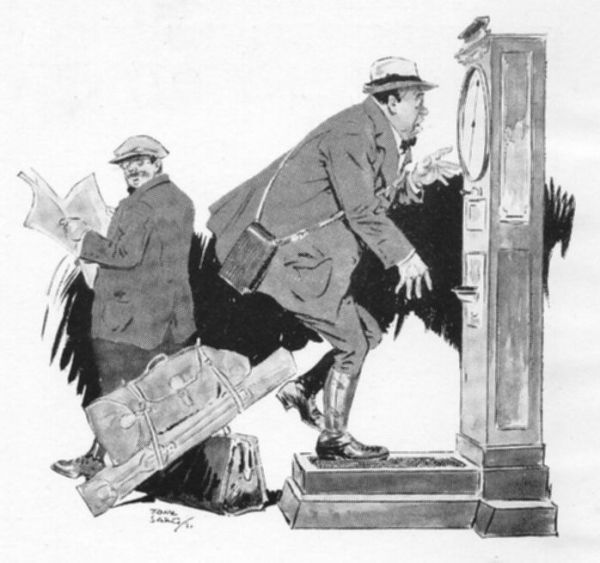
"Say, listen to me," he snapped, "or better still, you'd better write down what I'm about to say and stick it in your hat where you can find it and consult it when your mind begins wandering again. Those special mechanical devices to reduce fat people are contrived for the benefit of men and lazy women who are too slothful to take exercise or else too besotted in the matter of food indulgence to face the alternative of dieting. They may not do any harm—properly operated, they probably do not—but, at best, I would regard them as being merely temporary expedients specially devised as first aid to the incurably lazy.
"And as for pills and boluses and bottled goods guaranteed to reduce your weight, and as for all these patented treatments and proprietary preparations which you see boosted in the papers—bah! Either they are harmless mixtures, in which event they'll probably do you no serious injury, but will certainly do you no real good; or else they contain drugs which, taken to excess, may cut you down in size, but have the added drawback of very probably cutting short your life.
"No, sir-ree! For you it's dieting, now and from now on. You may be able to relax your diet in time, but you can never altogether forego it. Give us this day our daily diet—that's your proper prayer. And you'd better start praying pretty soon, too!"
"All right, doc," I said resignedly. "You've practically converted me. I can't say I'm happy over the prospect, but if you say so I'm prepared to become a true believer. But since, between us, we're about to take all the joy out of life, let's be thorough. What must I do to be saved? Give me the horrible details right here. I might as well hear the worst at one session."
"I'm no dietitian," he said. "I don't profess to be one. That's not my line—my line is the diagnostic. Of course I could lay down a few broad general rules for your guidance—any experienced practitioner could do that—but to get the best returns you should consult a diet specialist. However, in parting—I have several paying guests waiting for me and we are now about to part—I will throw in one more bit of advice without charge. No matter what suggestions you may get from any quarter, I would urge you not to follow any banting formula so rigorous as to take off your superfluous flesh very rapidly. Take your time about it. If you live as long as both of us hope you may you'll have plenty of time. There's no rush, so go at it gradually. Be regular about it, but don't be too ambitious at the outset. Don't try to turn yourself into a tricky sprite in two weeks. For a fat man too abruptly to strip the flesh off his bones I regard as dangerous. It weakens him and depletes his powers of resistance and makes him fair game for any stray microbe which may be cruising about looking for a place to set up housekeeping."
At first blush it might appear to the lay mind that a germ would scarcely care to pick a bone when it had fat meat to feed on, but my own recollections bore out my friend's statements. I remembered a man of my acquaintance, an enormously fleshy and unwieldy man, who, fearing apoplexy, undertook a radical scheme of banting. He lost fifty pounds in three months, so apoplexy did not get him, but pneumonia did with great suddenness. He was sick only three days. Nobody suspected that he was seriously ill until the third day, when suddenly he just hauled off and died.
So I promised to have a care against seeking to hurry myself right out of the flounder class and right into the smelt division.
chapter viii
The Friendly Sons of the Boiled Spinach
My friend gave me the names of several men of acknowledged standing and told me I should be making no mistake did I put myself in the hands of any one on the list. I thanked him and departed from his presence. To the casual eye I may have seemed, going away, to be in high spirits; but, confidentially, I wasn't feeling so very brash. My spirits were low. I had heard the truth—I made no effort to deceive myself there—but the truth was painful.
Still, knowing what I should do, I hesitated, temporizing with myself. I gave a couple of days of intensive meditation to the subject, and then I reached this conclusion: I would read a few standard and orthodox works on dietetics, and, so doing, try to arrive at least at a superficial knowledge of the matter. Also, I would balance what one recognized authority said as against what another recognized authority said, and then, before going to a specialist, I would do a little personal experimenting with my diet and mark the effects.
I arrived at this decision privately, taking no one into my confidence. And without an intent to deprive any hard-worked specialist of a prospective fee, I shall ever continue to believe that the second part of the course I chose to follow was a wise one. It might not serve my brother-in-obesity, but it served me well. I'm sure of that.
But the first part of the system naturally came first. This had to do with research work among the best authorities. Here I struck one of the snags that rise in the pathway of the hardy soul who goes adventuring into any given department of the science of medicine and its allied sciences. I was pained to observe how rare it was for two experts, of whatsoever period, to agree upon a single essential element. An amateur investigator was left at a loss to fathom why such entirely opposite conclusions should have been arrived at by the members of the same school when presumably both had had the same raw materials to work on. By their raw materials I mean their patients. But so it was.
The ancient apostles of dietetics, the original pathfinders into a hitherto untracked field, had disciples who set out to follow in their footsteps, but before they had traveled very far along the alimentary trail the disciples were quarreling bitterly with the masters' deductions and conclusions. To-day's school was snooty touching on the major opinions of yesterday's crowd, and to-morrow's crowd already made faces at to-day's.
On just two points I found a unanimity of opinion among what might be termed the middle group of dietetic explorers as counter-distinguished from the pioneering cult and the modern or comparatively modern. Each one was so absolutely certain that he was so absolutely right and so absolutely certain that all his contemporaries were so absolutely wrong.
At the beginning, it seemed, a reduction of the sufferer's flesh had been attempted by the simple device of bleeding him copiously—not with a monthly statement, as latterly, but with a lancet. Abundant drinking of vinegar also had been recommended as a means to accomplish the desired end. They were noble drinkers in the olden times, but until I began delving into literature of the subject I did not suspect that there had been any out-and-out vinegar topers.
There was citation in an early work of the interesting case of the Marquis of Cortona, a subchieftain under the Duke of Alva, and a fine fat old butcher he must have been, too, by all tellings. Finding himself grown so rotund that no longer could he enter with zest into the massacre bees and torture outings which the Spaniards were carrying on in the harried Netherlands, the marquis had recourse to vinegar; and so efficacious was the treatment that, as the tradition runs, he soon could wrap his loosened skin about him in great slack folds like a cloak, and thus, close-reefed, go merrily murdering his way across the Low Countries.
One pictures the advantages accruing. In cold weather, now, he might overlap his wrinkles in a clapboarded effect and save the expense of laying in heavy underwear. True, this might give to the wearer a clinker-built appearance; still it would keep him nice and warm, and no doubt he had his armor on outside the rest of his things. But likewise there must have been drawbacks. Suppose, now, the marquis were caught out in blowy weather and the wind worked in under his tucks and the ratlines pulled loose and, all full-rigged and helpless, bellying and billowing and flapping and jibing, he went scudding against his will before the gale. Could he hope to tack and go about before he blew clear over into the next county? I doubt it.
And suppose he inflated himself for a party or a reception or something, and a practical joker put a tack in a chair and he sat down on it and had a blow-out. The thought is not a pretty one, yet the thing were possible.
From these crude beginnings I worked my way down toward the present day. Doctor Banting, of England, the father of latter-day dietetics from whose name in commemoration of his services to mankind we derive the verb intransitive "to bant," had theories wherein his chief contemporaneous German rival, Epstein the Bavarian, radically disagreed with him. Voit, coming along subsequently, disagreed in important details with both. Among the moderns I discerned where Dr. Woods Hutchinson had his pet ideas and Doctor Wiley had his, diametrically opposed. So it went. There was almost as much of disputation here as there is when a federation of women's clubs is holding an annual election. It was all so very confusing to one aiming to do the right thing.
One learned savant flatly laid down the ultimatum that the individual seeking to reduce should cut out all pork products from chitterings clear through the list to headcheese and give his undivided support to the red meats and the white. One of his brethren was equally positive that I might partake of bacon and even ham in moderation, but urged that I walk around red meat as though it were a pesthouse. Yet a third—a foe, plainly, to the butcher, but a well-wisher to the hay-and-produce dealer if ever one lived—recommended that I should eliminate all meat of whatsoever character or color and stick closely to fodder, roughage and processed ensilage. I judge he sent his more desperate cases to a livery stable.
According to one dictum, bread was all right up to a certain point, and, according to another, all wrong. This man here held a brief for beans, especially the succulent baked bean; that man yonder served solemn warning upon me that if perversely I persisted to continue to eat baked beans the fat globules would form so fast I would have the sensation that a little boy was inside of me somewhere blowing bubbles. The writer didn't exactly say this, but it was the inference I drew from his remarks.
Eat dried fruits until your seams give, said Doctor A. Avoid dried fruits as you would the plague, counseled the equally eminent Doctor B. Professor C considered the drinking of water with meals highly inadvisable; whereas Professor D said that without adding an extra ounce of weight I might consume water until my fluid contents sloshed up and down in me when I walked, and merely by getting a young lady in Oriental costume to stand alongside me I might qualify at a Sunday-school entertainment for the entire supporting cast of the familiar tableau entitled Rebecca at the Well. He intimated that just so I stopped short of committing suicide as an inside job all would be fine and dandy. I do not claim that these were his words; this is the free interpretation of his meaning. Sink the knife in the butter to the very hilt—there will be no ill effects but only a beneficial outcome—declares such-and-such a food faddist. Eschew butter by all means or accept the consequences, clarions an earnest voice. Well, I never was much of a hand for eschewed butter anyway. We keep our own cow and make our own butter and it seems to slip down, just so.
In the vegetable kingdom the controversy raged with unabated fury. The boiled prune, blandest and most inoffensive of breakfast dishes, formed the basis of a spirited debate. There were pro-prunists and there were con-prunists. The parsnip had its champions and its antagonists; the carrot its defenders and its assailants. In this quarter was the cabbage heartily indorsed, there was it belittled and made naught of. The sprightly spring onion, already socially scorned in some of the best lay circles, suffered attack at the hands of at least one scientific and scholarly professional.
After reading his strictures I remarked to myself that really there remained but one field of useful popularity for the onion to adorn; in time it might hope to supplant the sunflower as the floral emblem of Kansas, as typifying a great political principle which originated in that state: The Initiative, when one took a chance and ate a young onion; the Referendum, while one's digestive apparatus wrestled with it; the Recall, if it disagreed with one. Alone, of all the vegetables, stood spinach, with not a single detractor. On this issue the vote in the affirmative practically was by acclamation. I am tin position to state that boiled spinach has not an enemy among the experts. This seems but fair—it has so few friends among the eating public.
I observed much and confusing talk of the value of nitrogens, proteids and—when I had reached the ultra-modernists—vitamines. Vitamines, I gathered, had only recently been discovered, yet by the progressives they were held to be of the supremest importance in the equation of properly balanced human sustenance. To my knowledge I had never consciously eaten vitamines unless a vitamine was what gave guaranteed strictly fresh string beans, as served at a table-d'hôte restaurant, that peculiar flavor. Here all along I had figured it was the tinny taste of the can, which shows how ignorant one may be touching on vitally important matters. I visualized a suitable luncheon for one banting according to the newest and most generally approved formula:
RELISH
Mixed Gelatinoids
POTAGE
Strained Nitrogen Gumbo
ENTREE
Grilled Proteids With Globulin Patties
DESSERT
Compote Of Assorted Vitamines
Or the alternative course for one sincerely desirous of reducing, who believed everything he saw in print, was to cut out all the proscribed articles of food—which meant everything edible except spinach—and starve gracefully on a diet composed exclusively of boiled spinach, with the prospect of dying a dark green death in from three to six weeks and providing one's own protective coloration if entombed in a cemetery containing cedars.
Personally I was not favorably inclined toward either plan, so I elected to let my conscience be my guide, backed by personal observation and personal experimentation. I was traveling pretty constantly this past spring, and in the smoking compartments of the Pullmans, where all men, for some curious reason, grow garrulous and confidential, I put crafty leading questions to such of my fellow travelers as were over-sized and made mental notes of their answers for my own subsequent use. Since the Eighteenth Amendment put the nineteenth hole out of commission, prohibition and how to evade it are the commonest of all conversational topics among those moving about from place to place in America; but the subject of what a man eats, and more particularly what he eats for breakfast, runs it a close second for popularity.
For example, there is the seasoned trans-atlantic tourist who, on the occasion of a certain terrifically stormy passage, was for three days the only person on board excepting the captain who never missed a single meal. You find him everywhere; there must be a million or more of him; and he loves to talk about it, and he does.
But even more frequently encountered is the veteran drummer—no, beg pardon, the veteran district sales manager, for there aren't any drummers any more, or even any traveling salesmen; but instead we have district sales managers featuring strong selling points—I say, even more frequently encountered is the veteran district sales manager, wearing a gravy-colored waistcoat if a tasty dresser, or a waistcoat of a nongravy-colored or contrasting shade if careless, who craves to tell strangers what, customarily, he eats for breakfast.
I made it a point to study the proportions and hearken to the disclosures of such a one, and if he carried his stomach in a hanging-garden effect, with terraces rippling down and flying buttresses and all; and if he had a pasty, unhealthy complexion or an apoplectic tint to his skin I said to myself that thenceforth I should apply the reverse English to his favorite matutinal prescription.
chapter ix
Adventure of The Fallen Egg
So, having mapped out my campaign of attack against my fat, I rose one morning from my berth in the sleeping car and I dressed; and firmly clutching my new-formed resolution to prevent its escape, I made my way to the dining car and sat down and gave my order to the affable honor graduate of Tuskegee Institute who graciously deigned to wait on me.
Now, theretofore, for so far back as I remembered, breakfast had been my heartiest meal of the entire day, with perhaps two exceptions—luncheon and dinner. Precedent inclined me toward ordering about as many pieces of sliced banana as would be required to button a fairly tall woman's princess frock all the way down her back, with plenty of sugar and cream, and likewise a large porringer of some standard glutinous cereal, to be followed by sausages with buckwheat cakes and a few odd kickshaws and comfits in the way of strawberry preserves and hot buttered toast and coffee that was half cream, and first one thing and then another. But Spartanlike I put temptation sternly behind me and told the officiating collegian to bring me plain boiled prunes, coffee with hot milk and saccharin tablets, dry toast and one dropped egg.
The prunes and the coffee were according to specifications, although, lacking the customary cream and three lumps of sugar, the coffee was in the nature of a profound disappointment. But a superficial inquiry convinced me that the egg was not properly a dropped egg at all.
Here was a fallen egg, if I ever saw one. I was filled with pity for it—poor, forsaken, abandoned thing, with none to speak a kind word for it! And probably more sinned against than sinning, too. Perhaps there was hereditary influences to be reckoned with. Perhaps its producer had been incubator raised, with no mother to guide her and only the Standard Oil Company for a foster parent. And what would a New Jersey corporation know about raising a hen?
Thus in sudden compassion I mused. To the waiter, though, I said:
"There has been a mistake here, alumnus. This egg never was meant to be dropped—it was meant to be thrown. Kindly remove the melancholy evidences."
He offered to provide a substitute, but the edge of my zest seemed dulled. I made dry toast the climax of my chastely simple repast. It was simple and it was chaste, but otherwise not altogether what I should characterize as a successful repast. It lacked, as it were.
Let us pass along to noontime. Ere noontime came I was consumed with gnawing pains of emptiness. As nearly as I might judge, I contained naught save vast hollow spaces and acoustics and vacuums and empty, echoing, neglected convolutions. Sorely was I tempted to relax the rigors of the just-inaugurated régime; nobly, though, I resisted the impulse.
As I look back now on that day I find the memory of my suffering has dimmed slightly. The passage of weeks and months has served to soften the harsh outlines of poignant recollection. What now in retrospect most impresses me is the heroism I displayed, the stark fortitude, the grandeur of will power, the triumph for character. Sheer gallantry, I call it.
For my midday meal I had more dry toast, a reduced portion of boiled tongue and a raw apple—satisfying enough to some, I grant you, but to me no more than a tease to my palate. Long before three o'clock I knew exactly how a tapeworm feels when its landlord goes on a hunger strike. Every salivary gland I owned was standing on tiptoe screaming for help; every little mucous membrane had a sorrow all its own. Each separate fiber of my innermost being cried out for greases and for sugars and for the wonted starchy compounds for to stay it and for to comfort it.
I underwent pangs such as had not been mine since away back yonder in August of 1914, in the time of the sack of Belgium, when the Germans locked up five of us for a day and a night in a cow stable where no self-respecting cow would voluntarily have stayed, and, then sent us by train under guard on a three-day journey into Germany, yet all the while kept right on telling us we were not prisoners but guests of the German Army. And at the end of the third day we reached the unanimous conclusion among ourselves that the only outstanding distinction we could see, from where we sat, between being prisoners of the German Army and guests of the German Army was that from time to time they did feed the prisoners. For throughout the journey the eight of us—since by now our little party had grown—lived rather simply and frugally and, I might say, sketchily on rations consisting of one loaf of soldiers' bread, one bottle of mineral water and a one-pound pot of sour and rancid honey which must have emanated in the first place from a lot of very morbid, low-minded bees.
However, in those exciting days there were many little moving distractions about to keep one from brooding o'ermuch on thoughts of lacking provender. I boast not, but merely utter a verity, when I state that every time I shook myself I shifted the center of population. Where we had been the lesser wild life of midcontinental Europe abounded. In the matter of a distinction which had come to me utterly without solicitation or effort on my part I have no desire to brag, but in justice to myself—and my boarders—I must add that at that moment, of all the human beings in Central Europe, I was the most densely inhabited. My companions scratched along, doing fairly well, too; but I led the field—I was so much roomier than any one of them was.
But here aboard this Pullman on this, the dedicatory day of my self-imposed martyrdom, I could not lose myself as I had on that former historic occasion in the ardor of chasing the small game of the country. By four o'clock in the afternoon I could appreciate the sensations of a conch shell on a parlor whatnot. I had a feeling that if anyone were to press his ear up against me he would hear a murmuring sound as of distant sea waves. Yet, mark you, I held bravely out, fighting still the good fight. This, then, was my dinner, if such it might in truth be called: Clear soup, a smallish slice of rare roast beef cut shaving thin, gluten bread sparsely buttered, a cloud of watercress no larger than a man's hand, another raw apple and a bit of domestic cheese—nothing rich, nothing exotic, no melting French fromages, no creamy Danish pastries.
Only when I reached my demi-tasse, which I took straight, did I permit myself a touch of luxury. I lit my cigar with a genuine imported Swedish parlor match.
Followed then the first comforting manifestation, the first gratefully registered taste of recompense for my privations. I had to speak that night and in a large hall, too, and I found my voice to be clearer and stronger than usual, and found, also, that I spoke with much less effort than usual. I was sure partial fasting during the day was bearing fruits in the evening, and I was right, as subsequent evening experiences proved to me. I had rather dreaded that hunger gripes would make my night a sleepless one, but it didn't happen. I may have dreamed longing dreams about victuals, but I tore off eight solid hours of unbridled and—I dare say—uproarious rest.
chapter x
Wherein Our Hero Falters
Next day I kept it up, varying the first day's menus slightly, but keeping the bulk consumption down, roughly, to about one-half or possibly one-third what my rations formerly had been. Before night of the second day that all-gone sensation had vanished. Already I had made the agreeable discovery that I could get along and be reasonably happy on from 35 to 50 per cent of what until then I had deludedly thought was required to nourish me. Before the week ended I felt fitter and sprier in every way than I had for years past; more alive, more interested in things, quicker on my feet and brisker in my mental processes than in a long time. The chronic logy, foggy feeling in my head disappeared and failed to return. I may add that to date it still has not returned. Relieved of pressure against its valves—at least I assume that was what came to pass—my heart began functioning as I assume a normal heart should function, and at once the sense of oppression in the neighborhood of the heart was gone.
Within the same week I took most joyful note of the fact that I was losing flesh in the vicinities where mainly I craved to lose it amidships and at the throat. I still had a double chin in front, but the third one, which I carried behind as a spare—the one which ran all the way round my neck and lapped at the back like a clergyman's collar—was melting away. And unless I was woefully mistaken, I no longer had to fight so desperate a battle with the waistband of my trousers when I dressed in the mornings.
I was not mistaken. Glory be and likewise selah! My first and second mezzanines were visibly shrinking. By these signs and portents was I stimulated to continue the campaign so auspiciously launched and so satisfactorily progressing.
I shall not deny that in the second week I did some backsliding. The swing of the tour carried me into the South. It was the South in the splendor of the young springtime when the cardinal bird sang his mating song. With brocading dandelions each pasture gloriously became even as the Field of the Cloth of Gold; and lo, the beginning of the strawberry shortcake season overlapped the last of the smoked-hog-jowl-and-turnip-greens period, and the voice of the turtle was heard in the land.
Figuratively, I was swept off my feet when a noble example of Southern womanhood put before my famished eyes the following items, to wit: About half a bushel of newly picked turnip greens, rearing islandwise above a sloshing sea of pot licker and supporting upon their fronded crests the boiled but impressive countenance of a hickory-cured shote, the whole being garnished with paired-off poached eggs like the topaz eyes of beauteous blond virgins turned soulfully heavenward; and set off by flankings of small piping-hot corn pones made with meal and water and salt and shortening, as Providence intended a proper corn pone should be made.
Then the years rolled away like a scroll and once again was I back in the Kentucky foothills, a lean and lathy sprout of a kid, a limber six-foot length of perpendicular appetite; and it was twelve o'clock for some people, but it was dinner time for me!
My glad low gurgle of anticipatory joy smothered the small inner voice of caution as I leaped, as it were, headlong into that bosky dell of young turnip greens. So, having set my feet on the downward path I backslode some more—for behold, what should come along then but an old-fashioned shortcake, fashioned of crisp biscuit dough, with more fresh strawberries bedded down between its multiplied and mounting layers than you could buy at the Fritz-Charlton for a hundred and ninety dollars.
Right then and there was when and where I lost all I had gained in a fortnight of stalwart self-disciplining; rather it was where I regained all I haply had lost. When, gorged and comatose, I staggered from that fair matron's depleted table I should never have dared to trundle over a wooden culvert at faster than four miles an hour. Either I should have slowed down or waited until they could put in some re-enforced-concrete underpinnings.
I was right back where I had started, and for the moment didn't care a darn either. Sin is glorious when you sin gloriously.
But I rallied. I retrieved myself. However, I do not take all the credit to myself for this; circumstances favored me. Shortly I quitted the land of temptation where I had been born, and was back again up North living on dining cars and in hotels, with nothing more seductive to resist than processed pastry and machine-made shortcakes and Thousand Islands dressing; which made the fight all the easier to win, especially as regards the last named. I sometimes wonder why, with a thousand islands to choose from, the official salad mixer of the average hotel always picks the wrong one.
I kept on. The thing proved magically easy of accomplishment. By the fit of my clothing, if by nothing else, I could have told that several of my more noticeable convexes were becoming plane surfaces and gave promise in due season of becoming almost concave, some of 'em. But there was other and convincing testimony besides. I could tell it by my physical feelings, by my viewpoint, by my enhanced zest for work and for play.
Purposely, for the first month I refrained from weighing myself. When I did begin weighing at regular intervals I found I was losing at a rate of between two and three pounds a week. Moreover, I had now proved to my own satisfaction that within sane reasonable limitations I could resume eating most of the things which formerly I ate to excess and which I had altogether eliminated from my menus during the initiatory stages of dieting.
About the time I emerged from the novitiate class I discerned yet one more gratifying fact. If I were in the woods, camping and fishing, or hunting or tramping or riding or taking any fairly arduous form of exercise, I could eat pretty much anything and everything, no matter how fattening it might be. Work in the open air whetted my appetite, but the added exertion burned up the waste matter so that the surplus went into bodily strength instead of into fatty layers. Consumption was larger, but assimilation was perfect.
For my daily life at home, where I am writing this, I have cut out these things: All the cereals; nearly all the white bread; all the hot bread; practically all pastries except very light pastries; white potatoes absolutely; rice to a large extent; sausages and fresh pork and nearly all the ham; cream in my coffee and on fruits; and a few of the starchier vegetables.
Of butter and of cheese and of nuts I eat perhaps one-third the amount I used to eat, and of meats, roughly, one-half as much as before the dawn of reason came. Of everything except the items I just have enumerated I eat as freely as I please. And when a person begins to reckon up everything else among the edibles—flesh, fowl, fish, berries, fruits, vegetables and the rest he finds quite a sizable list.
I shall not pretend that I do not pine often for sundry tabooed things. Take pies, now—if there is any person alive who likes his pie better than I do he's the king of the pie likers, that's all. And I am desolated at being compelled to bar out the rice—not the gummy, glued-together, sticky, messy stuff which Northerners eat with milk and sugar on it, but real orthodox rice such as only Southerners and Chinamen and East Indians know how to prepare; white and fluffy and washed free of all the lurking library paste; with every grain standing up separate and distinct like well-popped corn and treated only with salt, pepper and butter, or with salt, pepper and gravy before being consumed.
And as for white potatoes—well, it distresses me deeply to think that hereafter the Irish potato, except when I'm camping out, will be to me merely something to stopper the spout of a coal-oil can with, or to stab the office pen in on the clerk's desk in an American-plan hotel. For I have ever cherished the Irish potato as one of Nature's most succulent gifts to mankind. I like potatoes all styles and every style, French fried, lyonnaise, O'Brien, shoestring shape, pants-button design, hashed brown, creamed, mashed, stewed, soufflé—if only I knew who blew 'em up—and most of all, baked au naturel in the union suit. And I miss them and shall keep on missing them. But no longer do I yearn for cream in my coffee, now that it is out of it, and I am getting reconciled to dry toast for breakfast, where once upon a time only members of the justly famous Flap Jackson family seemed to satisfy.
Of course I imbibe alcoholic stimulant when and where procurable. From the standpoint of one intent upon cutting a few running feet off the waistline measurements this distinctly is wrong, as full well I know. But what would you? I do not wish to pose as an eccentric. I have no desire to be pointed out as a person aiming to make himself conspicuously erratic by behaving differently from the run of his fellows. Since the advent of Prohibition nearly everybody I meet is drinking with an unbridled enthusiasm; and when not engaged in the act of drinking is discussing the latest and most approved methods of evading, circumventing and defying the Federal and State statutes against drinking. Therefore I drink, too. Even so, I have not yet succeeded in accustoming my palate to strong waters indiscriminately swallowed. I confess to a fear that I shall never make a complete success of the undertaking.
I suppose the trouble with me is lack of desire. Prior to the attempted enforcement of the Eighteenth Amendment potable and vatted mixtures had but small lure for my palate, or my stomach, or my temperament. An occasional mild cocktail before a dinner, and perhaps twice a week a bottle of light beer or a glass of light wine with the dinner—these, in those old wild wicked days which ended in January, 1920, practically made up the tally of my habitual flirtations with the accursed Demon. In the springtime I might chamber an occasional mint julep, but this, really, was a sort of rite, a gesture of salute to the young green year. Likewise at Christmas time I partook sparingly of the ceremonial and traditional egg-nog. And once in a great while, on a bitter cold night in the winter, a hot apple toddy was not without its attractions. But these indulgences about covered the situation, alcoholically speaking, so far as I was concerned. For me the strong, heady vintages, whether still or sparkling, and the more potent distillations had mighty little appeal. Champagne, to me, was about the poorest substitute for good well-water that had ever been proposed; and the Messrs. Haig & Haig never had to put on a night shift at the works on my account.
Yet I came from a mid-section of the republic where in the olden days Bourbon whiskey was regarded as a proper staff of life. The town where I was born was one of the last towns below Mason & Dixon's Line to stand out against the local option wave which had swept the smaller interior communities of America; and my native state of Kentucky was one of the two remaining states of the South, Louisiana being the other, which had not officially gone dry by legislative action up to the time when Br'er Volstead's pleasant little act went over nationally.
While I was growing up, through boyhood, through my youth and on into manhood, I had the example of whiskey-drinking all about me. Many of our oldest and most respected families owned and operated distilleries. Some of them had been distillers for generations past; they were proud of the purity of their product. Men of all stations in life drank freely and with no sense of shame in their drinking. Mainly they took their'n straight or in toddies; in those parts, twenty years ago, the high-ball was looked upon with suspicion as a foreign error which had been imported by misguided individuals up North who didn't know any better than to drown good liquor in charged water. There were decanters on the sideboard; there were jimmy-johns in the cellar; and down at the place on the corner twenty standard varieties of bottled Bourbons and ryes were to be had at an exceedingly moderate price. Bar-rail instep, which is a fallen arch reversed, was a common complaint among us.
Even elderly ladies who looked with abhorrence upon the drinking habit were not denied their wee bit nippy. They got it, never knowing that they got it. Some of them stayed pleasantly corned year in and year out and supposed all the time they merely were enjoying good health. For them stimulating tonics containing not in excess of sixty per cent of pure grain alcohol were provided by pious patent-medicine manufacturers in Chattanooga and Atlanta and Louisville—earnest-minded, philanthropic patriots these were, who strongly advocated the closing-up of the Rum Hole, which was their commonest pet name for the corner saloon, but who viewed with a natural repugnance those provisions of the Pure Food Act requiring printed confession as to fluid contents upon the labels of their own goods. It was no uncommon thing in the Sunny Southland to observe a staunch churchgoer who was an outspoken advocate of temperance rising up and giving three rousing hiccups for good old Dr. Bunkum's Nerve Balm. And distinctly I recall the occasion when a stalwart mother in Israel, starting off to attend a wedding and feeling the need of a little special toning-up beforehand, took three wineglassfuls of her favorite Blood Purifier instead of the customary one which she took before a meal; and, as a consequence, on her arrival at the scene of festivities was with difficulty dissuaded from snatching down the Southern smilax and other decorations that she might twine with them a wreath to crown herself. She somehow had got the idea that she was the queen emeritus of the May. It was reported about town afterward that she tried to do the giant swing on the parlor chandelier. But this was a gross exaggeration; she only tried to hang by her legs from it.
Reared, as I was, amid such surroundings and in a commonwealth abounding in distilleries, rectifying works, blending establishments, bottle-houses, barrel-houses, and saloons, I should have been a hopeless inebriate long before I came of age. The literature of any total abstinence society would prove conclusively that I never had a chance to avoid filling a drunkard's grave. Yet somehow I escaped the fate ordained for me. As I say, I drank sparingly and for long periods not at all, until Prohibition came. Then I began doing as about ninety per cent of my fellow-adult Americans began doing—which was to take a drink when the opportunity offered. As I diagnose it, we nearly all are actuated now by much the same instinct which causes a small boy to loot a jam closet. He doesn't particularly want all that jam but he takes the jam because it is summarily denied him and because he's afraid he may never again get a whack at unlimited jam.
To my way of thinking, the main result of the effort drastically to enforce Prohibition, aside from making us a nation of law-breakers, law-evaders, sneaks, bribers, boot-leggers, bigots, corruptionists and moral cowards, has been to transfer the burden of inebriety from one set of shoulders to another set of shoulders. Men who formerly drank to excess have sobered up, against their will, for lack of cash or lack of chance to buy hard liquor. They cannot rake together enough coin to purchase the adulterated stuff at ten times the price they had paid for better liquor before the law went into effect. On the other hand, men—and women—who formerly drank but little are now drinking to excess, some of them being prompted, I think, by a feeling of protest against what they regard as an invasion of their personal liberties and some, no doubt, inspired by a perfectly understandable impulse to do a thing which is forbidden when the doing of it gives them a sense of adventure and daring.
Far be it from an humble citizen to criticise our national law-making body. Far be it from him, as he contemplates the spectacle frequently presented under the dome of the Capitol at Washington, to paraphrase Ethan Allen's celebrated remark when he took Fort Ticonderoga in the name of Jehovah and the Continental fathers and exclaim: "Congress—oh, my God!" Far be it, I repeat, from such a one to do such things as these. But I trust I may be pardoned for venturing the statements that excessive drinking already was going out of fashion in this country, that the treating evil was in a fair way to die a natural death anyhow, and that the present sumptuary attempt to cure us overnight of a habit which has been ingrained in the very fibre of the race for so far back as the history of the race runs, has only had the effect of making a bad thing worse.
At that, I hold no brief for the brewer and the distiller. They got exactly what was coming to them. Had they, as a class, been content to obey the existing laws, instead of conniving to break them; had they kept their meddling fingers out of local politics; had they realized more fully their responsibilities as manufacturers and purveyors of potentially dangerous products; had they been willing to cooperate with right-thinking men in a sane and orderly campaign for the cleaning-up and the proper regulation of the liquor traffic; had they seen that the common man's inarticulate but very definite resentment against the iniquities of the corner saloon system was tending to the legal abolition of the whole business of licensed drinking, I believe we should have had no Eighteenth Amendment saddled upon us and no Volstead act to bridle us.
In the final analysis, and stripping aside the lesser contributory causes, I maintain there were just two outstanding reasons why this country went dry after the fashion in which it did go dry: One reason was the Distiller; the other was the Brewer. And for the woes of either or both I, for one, decline to shed a single tear.
How a fellow does run on when he gets on the subject which is uppermost in the minds of the American people this year! All I intended to say, when I started off on this tack, a few pages back, was that if I absolutely and completely cut out all alcoholic stimulant no doubt I should be reducing my weight much faster than is the case at this writing. To-day practically all the members in good standing of the Order of Friendly Sons of the Boiled Spinach—I mean the dietetic sharps—agree that he or she who is banting will be well-advised to drink not at all. For the most part they do not make a moral issue of this detail. Some of them refuse to concede that a teetotaler is necessarily healthier or happier or more useful to the world than the moderate imbiber is. They merely point out that whiskies and beers are, for the majority of humans, fattening things and should therefore be eliminated from the diet of those wishful to lose their superfluous adipose tissue. Here, again, they disagree with their professional forebears. The experts of the preceding generations, being mainly Englishmen and Germans, could not conceive of living without drinking. Some advocated wines, some ales, some a mixture of both with an occasional measure of spirits added for the sake of digestion. But among the dependable dietetic authorities of the present day there appears to be no wide range of argument on this point. They pretty generally agree that even a casual indulgence in beverages is not indicated for those who seek to reduce. I am sure they are right. But as I remarked just now, what can you do when you are encompassed about by the bottle-toting, sop-it-up-behind-the-door custom which has sprung up since Prohibition was slipped over on us by the Anti-Saloon League?
I confess that I have not the strength of character to swim, almost alone, against the social current. So I partake of the occasional snort and to that extent stand a self-admitted apologist for an offense which no true reductionist should commit.
But I claim that otherwise—that in so far as the solid foodstuffs are concerned—I have, for my own individual case, exactly the right idea about it.
chapter xi
Three Cheers for Lithesome Grace Regained!
My advice to the man or the woman who is in the same fix I was in is to go and do likewise, with variations to suit the individual temperament. It means self-denial but self-denial persevered in is a virtue, and virtue he will find—or she will—not alone is its own reward but a number of additional rewards as well. Let my late fellow sufferer likewise patronize the gymnasium and the steam room and the cold plunge if he so chooses. If he desires to have automatic pores, all right. As for me, I recall what the Good Book says about the pores which ye have always with ye, and I decline to worry about the present uncultured state of mine. Let him try the electric rollers and the electric baths, if such be his bent; no doubt they have their value. And by all means let him consult a qualified physician if he fears either that he is overdoing or underdoing his banting. Personally, though, I am satisfied with the plan I tried out, of being my own private test tube.
I claim that I have better information touching on what sustenance I need than any outsider ever can hope to have unless he breaks into me surgically. I claim that a series of rational experiments should tell any rational human how much he needs to eat and what he needs to eat in order to reduce his bulk and yet keep his powers and his bodily vigor unimpaired. I am not speaking now, understand me, of those unfortunates with whom obesity is a disease, but of those who owe their grossness of outline to gluttony. Lacking vital statistics on the subject, I nevertheless dare assert that these latter constitute fully 90 per cent of those among the American people who are distinctly and uncomfortably and frequently unhealthily fat.
Remains but one fly in the ointment. Since Tony Sarg is going to illustrate this treatise, then Tony must revise the old working plans. For my figure is not so much pro as once it was. It is more con, if you get my meaning—the profile curves in toward, instead of being, as formerly, so noticeably from.
Still, I should worry about the troubles of an artist, even though a friend. I weighed myself this morning. Three months ago, when I set out to reduce my belt line and my collar size, I snatched the beam down ker-smack at two hundred and thirty-six pounds, stripped. This morning I weighed exactly one hundred and ninety-seven, including amalgam fillings and the rights of translation into foreign languages, including the Scandinavian. One hundred and eighty-five pounds is my ultimate aim. Howsoever, I may keep right on when I attain that figure and justify the title of this book by taking a full one third off. In either event, though, I shall know exactly where I am going and I'm on my way. And I feel bully and I'm happy about it and boastfully proud.
Three rousing cheers for lithesome grace regained!
the end
[Transcriber's note: Obvious typos in this project were corrected.]