
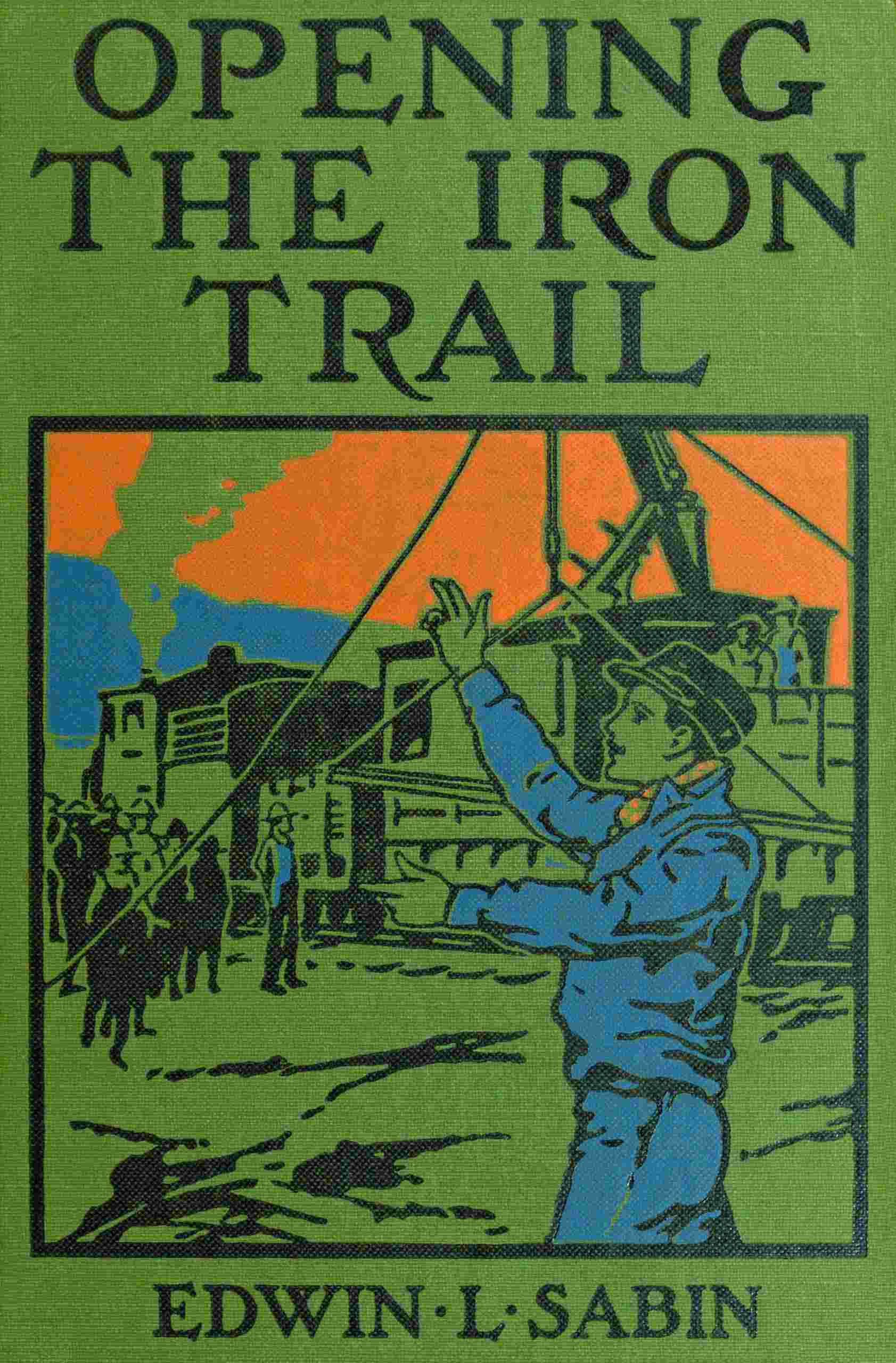
CHAPTER XVI
FAST TIME DOWN ECHO CANYON
“All aboard, now! On wid yez. We’ve no time to lose, on the U. Pay.”
It was the voice of Paddy Miles, construction boss, and also the present “conductor” of the construction-train about to answer a hurry call sent up to Wasatch station from end o’ track, for ties and iron.
Wasatch station, at mile-post 966, had marked end o’ track on New Year’s Day, this 1869. It was eleven miles from Evanston, the supply base, and seven miles on from the sign-board which on the east side said “Wyoming” and on the west side said “Utah.”
But since New Year’s end o’ track had advanced to Echo City, twenty-five miles down Echo Canyon, and was still going, although slowly.
That had been a tough job, to get onward from Evanston. First, the sidings at Evanston were laid, in the deep snow; and just beyond Wasatch, in order to enter the pass of Echo Canyon, two trestles, one 230 feet long and thirty feet high, the other 450 feet long and seventy-five feet high, had to be built, to cross side gulches, and a tunnel 770 feet long—the longest tunnel on the line—had to be bored through sandstone, and frozen clay even harder.
When he learned that the railroad was not to touch Salt Lake City, President Brigham Young of the Mormons had refused to lend any help; but Superintendent of Construction Sam Reed had argued with him, in friendly fashion, and had proved to him that Ogden was the best point.
So President Young had fallen in again, had sent men and teams and supplies, and with Mr. Reed himself overseeing matters on that division the work was being pushed.
“An’ sure, ain’t we got to hustle?” appealed Pat. “For I hear tell that those yaller spalpeens on the C. Pay.’ve jumped ahead o’ their own gradin’ by a matter of a hundred miles an’ are startin’ in on a new division entoirely, so’s to get into Ogden first.”
“Yes. But Mr. Reed has sent some of our own graders 150 miles out, to grade into Humboldt Wells while the C. P. are trying to grade into Ogden,” laughed Terry.
“It’s a game two can play,” Pat admitted. “An’ there’ll be another game if those Chinks get in our way, wance.”
The trestles were still being put in and the long tunnel blasted. To pass around, a temporary road had been laid, in a sort of zigzag—and “Z” it had been named—or series of switchbacks, down from the ridge that divided Wasatch, in the Bear River Valley, and Echo Canyon. That had been quite a job, too; the descent was very sharp—in fact, nearly all the way to Ogden there was a sharp descent, through several canyons, where the roadbed clung to the canyons’ sides.
This day Terry was up at Wasatch, on business; George was going back with him—likewise on business at end o’ track; and Paddy Miles had the construction-train and its ’special hurry load.
“All aboard, now! On wid yez.”
There were sixteen flat-cars, and No. 119. A ride through Echo Canyon was a treat. The narrow canyon curved every which-way, was plumb full of oddly shaped figures like Hanging Rock, Sentinel Rock, Kettle Rocks, Pulpit Rock, The Great Eastern (which resembled a steamboat), and so forth—all curious to the graders and track-layers. And some of the downward pitches were ninety feet to the mile, so that the train swooped along without throttle and with brake-shoes grinding.
To sit on a pile of ties and watch the scenery spin past—that was a privilege for only employes of the U. P. Passengers of the road had no such lark.
The two boys settled themselves comfortably, with their legs hanging over the front end of the pile of ties on the first tie car back from the engine, so as to get a good view ahead. Paddy sat only a short distance behind. There was a brakeman farther along, and on one of the rear cars were a couple of Dutchmen—new hands going forward to one of the grading gangs.
Down the “Z” plunged the train (old No. 119 carefully holding back) for the first eight miles, and struck into Echo Canyon at last at the Castle Rock. The day was fine—sunny and not cold, although snow lay on the north slopes and in the shaded hollows, and the tips of the pines had scarcely commenced to green out. But spring was in the air, for spring came earlier to the west slope of the Rockies than to the east slope.
The train began to roar between the rocky walls; the engine, running almost free, whisked to right, to left with the line of heavy cars whisked after; Fireman Bill repeatedly jerked the whistle cord, and the wails jangled from wall to wall and crag to crag.
It was a glorious ride—a charge by the U. P. construction force, bringing reinforcements to the front. The boys’ hats flared back, the breeze freshly smote their faces, and every minute a new landmark in shape of pinnacle and sculpture appeared, for an instant, flashed by and was succeeded by another. Hurrah!
“Great, eh?” gasped George.
“Sure beats staging. Look at the old stage road, yonder. ’Twould take the stage four hours to make this, and we’ll do it in one.”
“We’re the people, all right,” bragged George. And he burst into song:
Terry interrupted:
“What’s the matter. Gee whiz! Look behind! We’re busted!”
The engine also had interrupted with hoarse shriek after shriek; Paddy was standing upright, waving his arms; the brakeman was running back—and a quarter of a mile behind, up the grade, was the tail of the trains: four cars, two loaded with ties, one with rails and one with fastenings. The train, as Terry had expressed, had “busted.”
“That’s a joke on the Dutchmen,” George cheered. “What we going to do? Run on and leave ’em?”
“Maybe. Yes. No. I dunno! Jiminy, look at ’em come, though! Hope they don’t ram us.”
“Your father’s whistling for brakes. Hear him?”
“That’s not to us; it’s to them.”
Terry and George sat straight, in alarm. The train had reached a short level spot, but the four cars behind were on a steep down grade and fairly leaping in pursuit. The gap rapidly closed, until, still shrieking for “Brakes,” and again for “Clear track,” old 119 sprang forward under open throttle, like a frightened horse under the spur.
Around a curve swept the train; the four cars disappeared, a moment—but here they came, full tilt, their outside wheels almost leaving the rails as they fought the tangent. Their speed had scarcely slackened. Now the train struck into a long down grade; the whistle, like the throttle, was open—but no use. Those four heavy cars roared after, unchecked, and with every yard their pace seemed to increase.
Engineer Richards was giving Number 119 all the steam that he dared, if he would keep the track. The boys’ car bounded and jerked; the pile of ties quivered; rails jingled; the whole train roared, and all the canyon was filled with clamor of wheels and whistle.
The anxious, grimy face of Terry’s father or Fireman Bill might be seen, peering backward from the cab windows, trying to measure the margin of safety, behind.
“What ails those Dutchmen, d’ you suppose?” shouted George, in Terry’s ear. “’Fraid to put on their brakes. That’s all they need do: put on their brakes.”
“Sure thing. Put on their brakes. Why don’t they put on their brakes?” Terry yelled back. “Do they want to smash us?”
The four cars were gaining; down they came, like a thunderbolt, and not a sign of their two passengers was visible.
Terry half stood, the better to see—yes, and the quicker to jump clear, if necessary; George tried to imitate him, but the train hit another curve and they both were thrown to hands and knees and barely escaped going overboard before time.
Around this curve also roared the train, throttle opened wider for the more level stretch, whistle still shrieking wildly; the four cars chased hotly—across a trestle the train boomed, and the rumble of the four cars answered instantly.
Old 119 was now barely holding her own, and there were steep grades ahead. Never had a train gone down this canyon at such a rate; and those four cars acted like a hungry dragon bent upon getting a meal.
Pat and the brakeman were clutching to the ties of the rear car of the train, pitching and swaying as they gazed and waved and gesticulated, warning the four cars to keep distance.
“What they doing? Look! What they doing?” yelled George, on a sudden.
“They’re dumping off the ties! Come on. We got to help.”
That was a difficult journey, to rear of train. The curves were incessant, shooting the train to right and left, and throwing the passengers with it. Crawl, hang hard, take a run, and crawl and hang hard again, was the only way to navigate.
Pat did not pause; neither did the brakeman. They already had cleared one tier of ties from their car.
“Lend a hand here. Pass those ties along,” they only yelped, over their shoulders.
“But you’ll kill those Dutchmen,” screamed Terry.
“No. They’ve jumped, long ago.”
“Sure,” Paddy added, “either they lave the track or we do; an’ if they smash into us wance, then we’ll all be gone together.”
This was the plan: to plant a tie on the track, and derail the four cars. But although everybody worked furiously, heaving the ties over the end of the car, the ties bounded like Indian rubber—seemed scarcely to touch the track before they went hurtling and flying far to one side or the other.
“B’ gorry!” Pat gasped, streaming sweat. And—“If we only can get into Echo City wid time enough for ’em to shunt wan or the other of us into a sidin’——!”
Echo City, at the end of the canyon! There were the sidings. Now the gap narrowed again, the four cars cared nothing for the ties with which they were being bombarded, but the whistle of 119 was changed to the signal “Open switches!”
Would the crews at Echo City understand? Would they have time to work right? Hauling and tugging and dragging, Terry and George had farther and farther to pass the ties back to the outstretched hands of Paddy and the brakeman. It certainly was a mad ride, this—a ride for life, too! Blame those four cars—and blame those two Dutchmen, who ought to have stayed aboard and set their brakes!
“Will we make it, yuh think?” wheezed George, as he labored.
“Close squeeze,” wheezed Terry. “How far, wonder?”
“Dunno. Can’t read mile-posts. Must be near, though.”
Around still another of those dangerous curves—and they roared past a little group of graders, repairing the track. They had just a fleeting glimpse of the staring, startled faces and the red-shirted forms; and with the four cars thundering after they dashed on.
But Echo City was not far. Then, if the station crews failed to work mighty fast, there would be a race clear to end o’ track—and, whew!
“Look! Oh, gee!”
FAST TIME DOWN ECHO CANYON
George had yelped excited, and awed. Terry looked. He was only in time to see the four cars reared high in the air, leaving the track and with a great jump landing, askew, to plunge end over end down the side of the gulch, while the ties and rails sailed in all directions.
They evidently had struck a tie, at last. A minute more, and with whistle open but throttle closed, and the brakeman and Pat scampering from brake to brake, and the scattered section-men gaping, the train rolled triumphant and breathless into Echo City.
The crash of the wreck had been heard. Men ran up track at best speed; down jumped Paddy and the brakeman, and ran, too; with a “Come on, quick!” George legged to see, and Terry panted after.
The wreck was half a mile back; a crowd had already gathered around it—were laughing and whooping, and no wonder: for here were the two Dutchmen, sitting on the bank of the ditch, one of them smoking his pipe, and both well dazed but unharmed. They had been aboard, after all!
“An’ for why didn’t yez set the brakes?” Pat was storming. “Did yez want to kill us all?”
“We knowed noddings,” said the man with the pipe. “Why didn’t you wake us oop, to tell what the troubles vas?”
“Then why didn’t yez say yez were aslape, so we’d wake yez up before wastin’ all the steam by whistlin’ to no use?” raged Pat. “Now look at the ties an’ rails an’ four good cars fed to yez, an’ the Cintral Paycific tryin’ to bate us into Ogden!”
The two Dutchmen really had been fast asleep on a load of ties; and as they had said, they “knowed noddings” about any “troubles” until they found themselves landed with a thump upon this bank!
Not for some days did Pat get done grumbling at the “waste o’ steam an’ time an’ good cars”; but another event speedily made him change his tune.
“Th’ C. Pay.” were already coming up “th’ U. Pay.” canyon, out of Ogden!