
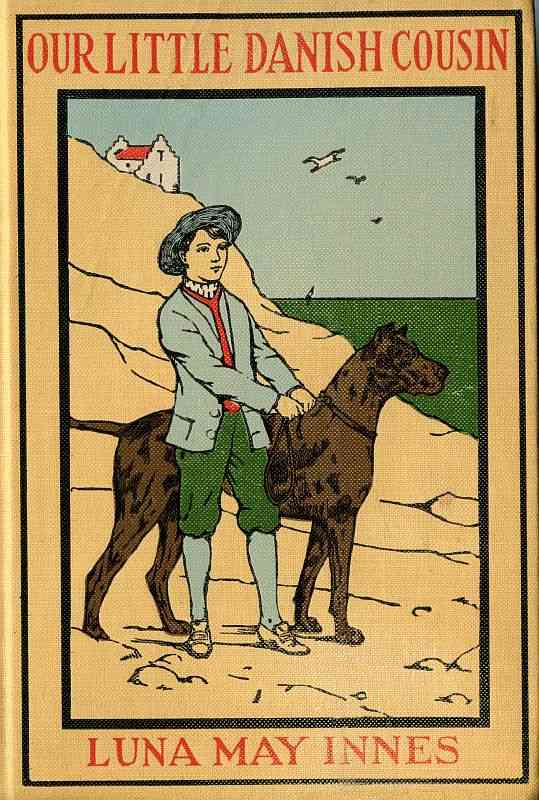
The Project Gutenberg eBook of Our Little Danish Cousin
Title: Our Little Danish Cousin
Author: Luna May Ennis
Illustrator: Elizabeth Otis
Release date: October 25, 2013 [eBook #44030]
Most recently updated: October 23, 2024
Language: English
Credits: Produced by Emmy, Beth Baran and the Online Distributed
Proofreading Team at http://www.pgdp.net
Little Cousin Series
(TRADE MARK)
Each volume illustrated with six or more full page plates in
tint. Cloth, 12mo, with decorative cover
per volume, 60 cents
LIST OF TITLES
By Mary Hazelton Wade, Mary F.
Nixon-Roulet, Blanche McManus,
Clara V. Winlow, Florence E.
Mendel and Others
| Our Little African Cousin |
| Our Little Alaskan Cousin |
| Our Little Arabian Cousin |
| Our Little Argentine Cousin |
| Our Little Armenian Cousin |
| Our Little Australian Cousin |
| Our Little Austrian Cousin |
| Our Little Belgian Cousin |
| Our Little Bohemian Cousin |
| Our Little Boer Cousin |
| Our Little Brazilian Cousin |
| Our Little Bulgarian Cousin |
| Our Little Canadian Cousin |
| Our Little Chinese Cousin |
| Our Little Cossack Cousin |
| Our Little Cuban Cousin |
| Our Little Danish Cousin |
| Our Little Dutch Cousin |
| Our Little Egyptian Cousin |
| Our Little English Cousin |
| Our Little Eskimo Cousin |
| Our Little French Cousin |
| Our Little German Cousin |
| Our Little Grecian Cousin |
| Our Little Hawaiian Cousin |
| Our Little Hindu Cousin |
| Our Little Hungarian Cousin |
| Our Little Indian Cousin |
| Our Little Irish Cousin |
| Our Little Italian Cousin |
| Our Little Japanese Cousin |
| Our Little Jewish Cousin |
| Our Little Korean Cousin |
| Our Little Malayan (Brown) Cousin |
| Our Little Mexican Cousin |
| Our Little Norwegian Cousin |
| Our Little Panama Cousin |
| Our Little Persian Cousin |
| Our Little Philippine Cousin |
| Our Little Polish Cousin |
| Our Little Porto Rican Cousin |
| Our Little Portuguese Cousin |
| Our Little Russian Cousin |
| Our Little Scotch Cousin |
| Our Little Servian Cousin |
| Our Little Siamese Cousin |
| Our Little Spanish Cousin |
| Our Little Swedish Cousin |
| Our Little Swiss Cousin |
| Our Little Turkish Cousin |
THE PAGE COMPANY
53 Beacon Street, Boston, Mass.
OUR LITTLE
|
||
By L. C. Page & Company
(INCORPORATED)
All rights reserved
First Impression, June, 1912
Second Impression, January, 1917
Graeme Lorimer
ON HIS NINTH BIRTHDAY
Preface
Denmark means "Land of dark woods." Although one of the smallest states of Europe, the little kingdom of Denmark holds a very large place in the world's history, having supplied rulers for many of the countries of Europe.
The Dane loves his beautiful country, the land of Thorvaldsen and of Hans Christian Andersen, of blue lakes, and "fairy-tale" castles.
Since the days of Leif and Biarne, Denmark and the United States have been allied, and therefore I feel sure that the children of America will be interested in the story of their little Danish Cousin.
I wish to express grateful acknowledgment to Hr. Georg Beck, Consul for Denmark in Chicago; also to Mr. Haakon Arntz, and to Mr. and Mrs. Oscar Andersen, for generous information given in regard to the manners and customs of the Danish people.
Chicago, February, 1912.
Contents
| |||||||||||||||||||||||||||||||||||||
List of Illustrations
| PAGE | |
"Little children were playing about the statued form of their beloved story-teller, Hans Christian Andersen" (see page 52) |
Frontispiece |
"Valdemar burst into the room" |
13 |
"Where jolly-looking women with quaint headdresses were selling their wares" |
35 |
"They spread them on the grass in the shadow of the great brick tower" |
90 |
"In the centre of the studio stood the unfinished statue of the little Crown Prince" |
119 |
"'Welcome! and Glaedelig Jul!' called out both Grandfather and Grandmother Ingemann" |
145 |
CHAPTER I
THE DISTINGUISHED VISITOR
"Hurtig! kaere Karen, mit lommetørklæde!"
Fru Oberstinde Ingemann and her little flaxen-haired daughter, Karen, were sitting at their embroidery work in the deep window-seat that made one whole side of the cozy Ingemann living-room overlooking the Botanical Gardens. Between stitches, Karen was watching the rain patter on the little diamond window-panes, now and then pausing to take a quick look at some favorite newly-blossomed flower in the brilliant, long line of window-boxes which bordered the windows "like a long bright ribbon," as Karen said.
The bell rang.
"Hurtig! kaere Karen, mit lommetorklaede!" sounds like something terrible, but Fru Ingemann was only saying in Danish: "Quick, dear Karen, my handkerchief!"
"Thank you, Karen," said the lady, as the fair child replaced the sheer bit of linen in her mother's hand with a pretty courtesy, for Karen was a well-bred little girl.
It was a morning of excitement for Fru Else Ingemann. Two important letters had come to her from over the seas. One had come from Chicago in far-away America, saying that her brother-in-law, the Hon. Oscar Hoffman, was coming once more to pay a visit to dear old Denmark. Mr. Hoffman was an important man in America. He was the president of the "Danish-American National Park" in north Jutland, and it was in his loyal Danish brain that the whole idea of the great Park had originated. It had been his dream to save to the glory of Denmark, for all time to come, a wonderful, wild tract of heather-covered hills where, year by year, thousands of loyal Danish-Americans might meet in the Fatherland, and celebrate America's Independence Day on Danish soil. At last the Park was a reality, and he was coming to make necessary arrangements.
He was bringing his son, Karl, with him, and, while they were to be in Copenhagen, they would spend their time with the Ingemanns. He hoped that the little cousins would become great friends. They would arrive in Copenhagen on Saturday. To-day was Thursday.
The other exciting message came from Fru Ingemann's favorite brother, Hr. Thorvald Svensen. It was postmarked Rome, Italy, and informed her that at last he was coming back to live in his dear old home in Copenhagen, and that he would arrive on that day.
Hr. Svensen had been living in Rome for eight long years, and in those years of persistent, hard work he had finally realized his one great ambition, and become Denmark's greatest sculptor—greatest, at least, since the day of Denmark's beloved Thorvaldsen, whose namesake he was.
To Fru Ingemann there was no more welcome news in all the world. His letter said that he longed to see her and the children once more.
Little Valdemar, who was the sculptor's godson, was wild with joy. "Let me stay home from school to-day, mother!" he implored.
"No, no, Valdemar," firmly answered his mother, as she handed him his school luncheon, a box of delicious smörrebröd.[1] When Valdemar's mother said "No, no," he knew that further protests were useless. So he kissed her and was off, calling back: "Good-bye, mother dear; keep Gudfar[2] Thor until I come home from school, please!"
All that morning Fru Ingemann flew about in happy expectancy, making more cozy the pretty little apartment. Karen could hear her mother, as she worked, singing softly those familiar old lines from Baggesen, the well-known Danish poet:
Nowhere so small the thorn,
Nowhere so soft the downy bed
As those where we were born."
Above the patter of the rain came the sound of approaching carriage wheels. Fru Ingemann paused.
"Quick, Karen,—the bell! It may be Uncle Thor!"
And so it proved! All the eight, long, lonesome years since she had last seen this dear brother, years in which she had lost her husband, were quickly forgotten in his great hearty embrace.
"Min kaere Soster!"
"Min kaere Broder!"
Their hearts were so full they could not find words.
Karen, tiptoeing, wanted to fling her tiny arms about her big, yellow-bearded, Viking-like, Uncle Thor's neck, so he lifted the little maid high in his strong arms and kissed her.
"Ah, Karen, min lille skat![3] How you have grown!" he said affectionately. Soft yellow curls framed her pretty face, and two heavy braids of the same glorious hair hung far down her back. "Why, you were just a little, two-year-old baby when I went away to Rome, and now, I've no doubt, you are dreaming of a boarding-school off in France or Switzerland one of these days!"
But Karen only shook her little blond head and laughed, while Uncle Thor's beauty-loving eye beamed on the dainty little damsel in white embroidered frock, half-hose and slippers, as he settled himself comfortably in the big arm-chair near the great, green-tiled stove, whose top almost touched the living-room ceiling.
"Congratulations, dear brother," said Fru Ingemann. "Why didn't you write us all about the great honor you have brought to the family? I saw in this morning's 'Nationaltidende,' that you have just been appointed Court Painter to His Majesty, the King! It is the greatest honor that can come to a Danish artist. I am so proud of you!"
"It is true," he acknowledged, briefly, "but tell me, sister Else, how are the boys, Aage and Valdemar?"
"Oh, Aage is now a big boy of sixteen, off doing his eight years of compulsory military service in the army. Aage will grow up with a straighter back and a better trained body because of his soldiering days. He will be home for Christmas with us."
"And Valdemar?"
"Valdemar is only thirteen, but he is in his second year at the Metropolitan School, one of the best State Latin Schools in all Denmark. He will be back home at three o'clock. I could hardly get him to consent to go to school at all, this morning, after he was told that his Gudfar Thor was coming."
"And Karen studies with her private tutors, here, at home?"
"Yes, Thorvald, besides learning to be a good little housekeeper, as well. But you must be both hungry and tired. It is nearly twelve o'clock. Come, Karen, help me spread the table with something good for Frokost,[4] for Uncle Thor."
A cloth of snowy damask was quickly spread with various viands and meats; tongue, salad, salmon, anchovies, plates of butter, with trays containing French (white) bread, and other trays full of thin slices of rye bread, which is such a favorite with all Danes. Fru Ingemann then placed a bottle of beer beside Hr. Svensen's plate, and brought in the steaming hot tea, which she herself poured into the delicate cups of that wonderful crystalline ware, the famous Royal Copenhagen porcelain—a set doubly cherished by her as an heirloom in her family for many generations.
Karen, who could herself make delicious tea, loved to gaze at the fascinatingly delicate decoration of the cups, which looked, as she said, "like frost on the window-pane;" but she never was allowed to touch this precious set of old Royal Copenhagen, of which not one piece had yet been broken.
"And smörrebröd, brother?" politely urged Fru Ingemann, for no good Danish housewife would ever think of inviting any one to breakfast without having smörrebröd on the table.
"Thanks, sister Else," replied the hungry artist, who immediately set about thickly spreading butter—famous Danish butter—over a slice of rye bread, as did also Karen and her mother, after which each proceeded to select the particular kind of fish or meat preferred, and, arranging it upon the slice of buttered bread, ate it much as we would a sandwich. Uncle Thor made an especially delicious one for Karen, who had already become a great favorite with him.
Frokost over, Fru Ingemann arose, and, bowing slightly to her brother, said: "Velbekomme!"[5] And Hr. Svensen did the same.
"Tak for Mad, Moder,"[6] said Karen courtesying first to her mother and then to her Uncle Thor, and kissing them both—a beautiful old Danish custom.
Uncle Thor was a great lover of flowers. To-day there were beautiful flowers on the table, in the windows, everywhere! In fact, the whole Ingemann apartment seemed overwhelmed with the loveliness of them. Besides the vases, there were little flower-pots galore, all decked in brightly-colored paper, some containing blooming plants, others, little growing trees.
"Ah, Karen, has there been a birthday here?" asked Uncle Thor, in mock surprise. "Run out in the hall and see what came all the way from Naples, Italy, to Frederiksberg-Alle, in Copenhagen, for a good little girl with long pigtails."
Karen came running back with a tiny white kid box in her hand. Opening it, she beheld the most beautiful set imaginable of pale pink corals. She just couldn't wait to put the necklace on before hugging her dear old Uncle Thor, who himself had to fasten the pretty chain around her slender little neck for her.
"Yes, Uncle Thor, we had a splendid time, and mother gave us chocolate, tea and cakes, and this is what all the boys and girls at my party yesterday sang:
Gold is won and bright renown,
Shields resounding, war-horns sounding,
Hild is shouting in the din,
Arrows singing,
Mailcoats ringing,
Odin makes our Olaf win.'"
Karen had hardly finished singing her song describing the days of old, when there had been a mighty encounter on London Bridge between the Danes and King Olaf the Saint, ending in the burning of the bridge, when there came a sudden great clatter and uproar on the stairs, with the loud barking of a dog, and the sound of a boy's heavy boots, and Valdemar burst into the room.
"Oh, my dear, dear Gudfar Thor!" he exclaimed, throwing his arms tight round his uncle's neck.
"Why, Valdemar, you are the very image of your father!" exclaimed Hr. Svensen. "Don't you think so, sister Else?" he questioned, as he gazed admiringly at the sturdy, big frame, rumpled flaxen hair, and the merry twinkle in the honest blue Danish eyes of his godson.
"Oh, yes, Thorvald, Valdemar certainly is the image of his father. The King thinks so, too," agreed Fru Ingemann.
"King Frederik? Why, how is that, sister? Has the king never forgotten Valdemar?" questioned Hr. Svensen in surprise.
"Oh, Thorvald, you know the King's wonderful memory. It never fails him. And you must remember the great friendship that always existed between my dear husband and King Frederik, from the days when, as boys together, they went through the Military College; and later both were recruits in the same regiment, and had to do sentry duty, turn about, outside his grandfather's palace. Only the other day, Valdemar came bounding into the house, overjoyed, to tell me that he had just passed their Majesties, King Frederik and Queen Lowisa, out walking on the Langelinie,[7] entirely unattended, and that, when he doffed his cap to the King, his Majesty immediately returned his salute, with a friendly smile!"
"But, sister Else, how do you know that King Frederik thinks Valdemar the image of his father? I don't understand," persisted Hr. Svensen, perplexed.
"We know!" Fru Ingemann spoke softly as she.
"Valdemar was only a little child when his father died," she continued. "His father had always taught Valdemar to love the King, and he does so with all his boyish little heart. An accident, a broken arm, soon afterwards put the child in the Queen Lowisa Children's Hospital, where, as you know, King Frederik makes a monthly visit to cheer the little sufferers. The King loves children. They say that not one little baby-face ever escapes him, and that he even notes each child's improvement from time to time.
"Valdemar, in his little cot near the door, heard the nurses saying: 'The King comes to-day!'
"His little mind was all expectation. Finally, the King arrived. Valdemar was the first little patient to see him enter, silk hat in his hand as usual. Sick as he was, the boy drew himself quickly from out of the covers, stood up in the middle of his bed, and saluted his King with a low bow, so low that his forehead almost touched his pillow. The King paused in surprise at Valdemar's cot and spoke:
"'My child, why do you do that? Why do you salute me?'
"'Because I like you! You are the King!'
"They say that the King looked into the child's face a moment, drew his hand to his eyes, lost in thought, then, turning quickly to Prince Christian, who accompanied him, exclaimed with a smile:
"'Du ligner din Fader! Oh, vilde jeg onske at din Fader levede! Gid Legligheden maa komme til at hjälpe denne opvagte Dreng, for min käre gamle Ven Ingemann's Skyld!'[8]
"Then, placing his hand on the child's golden locks, he spoke tenderly: 'Yes, little Valdemar Ingemann, I am the King. Always remember that your father and I were great friends,' and he passed on.
"Valdemar has never forgotten that moment. He never will. You and the King are the two great heroes of the world in his eyes."
"Where is he now? Come, Valdemar! Tell me all about what you like most to read," called Uncle Thor.
"Oh, Uncle Thor, I love to read in the old Sagas and Chronicles all about the mighty sea-fights of the Vikings, and about the glorious battles of the Valdemars, in the books that Aage left me. They make me want to be a soldier. Then I love to read everything about Linnæus, who loved the trees and the flowers and the whole outdoors just as I do. But, best of all, I'd rather become a famous sculptor like my Godfather Thor! I'd like that better than anything else in all the world! See, Uncle Thor, I've modelled some little things already. Here is one,—my Great Dane, Frederik,—and here is a stork, and here is a little Viking ship. They're not very good, but—"
"Oh, min lille Billedhugger!"[9] interrupted Hr. Svensen, with feeling, as he took the little toy animals from Valdemar to examine them. "This is not half bad work. But what have you done them in, my boy?"
"In pie-paste!" laughed his mother. "I have to hide the pie-paste when I'm baking, to keep Valdemar from slipping it off to use for modelling!"
"Valdemar, you shall have some modelling clay. Thorvaldsen once made the Lion of Lucerne in butter. I must tell you that story some day," said Hr. Svensen, as he patted his little nephew's head affectionately.
There was a sharp ring at the bell.
Karen flew to the door, then back to her mother, excitedly exclaiming: "A box and a letter for you, mother!"
Fru Ingemann tore the note open and read: "Will be expelled if it occurs again!" The words swam before her eyes.
"Oh, Valdemar, my son, come explain all this to me at once! It is from your Latin teacher. Surely there is some mistake. It is not like my boy!"
Meantime Karen had opened the box, and displayed a most laughable clay caricature of Valdemar's Latin teacher, with the word "TEACHER" scratched underneath in large letters. She burst out giggling. Even Uncle Thor's look of mock horror soon gave way before the cleverly done effigy, and he laughed. He had been a boy once himself, and it was funny.
"Well, that's exactly the way teacher looks!" vehemently protested Valdemar in self-justification. "Indeed he does. Ask Hendrik or any of the boys. None of us like him one bit, and at recess to-day Hendrik drew chalk cartoons of teacher all over the blackboard, and said: 'Oh, Valdemar, you'd never dare do it in clay!'
"'Yes, I would dare do it in clay!' I answered him, and then, mother,—I did it. But I didn't mean Hr. Professor Christiansen to see it. I'm glad school's over for all summer on Friday!"
Even Valdemar's mother had to laugh, as Uncle Thor took the offending statuette in his hand to give it a closer examination, for it was as irresistibly funny as it was clever.
"Brilliant, Valdemar!" he exclaimed. "Your work has merit. Work hard enough, my boy, and you may become a great artist, some day. You have the talent. Come over to my studio to-morrow morning. I'll help you a little with your modelling, and then, after luncheon with me, I will take you through the Thorvaldsen Museum. Would you like that? And, by the way, I think there is something nice for you in my trunk. Now I am due at the Royal Palace. I must go and pay my respects to the King. He will be expecting me."
"Oh, Uncle Thor, I'll be there!" called out Valdemar. "Good-bye, Uncle Thor, good-bye!"
FOOTNOTES:
[1] The great Danish national dish.
[2] Godfather.
[3] "My little treasure."
[4] Breakfast
[5] "Well may it agree with you."
[6] "Thank you for the food, mother."
[7] Long Line.
[8] "The face of his father! Oh, that his father were still living! May the opportunity some day be given me to benefit this bright boy, for my dear old friend Ingemann's sake!"
[9] "My little sculptor."
CHAPTER II
COPENHAGEN
Summer bursts suddenly in Copenhagen. First, winter, with its deep snows, its fogs and frosts and thaws; then a few days of showers and a few of sunshine, Blinkeveir[10] the Danes call this showery weather; and then, all at once, the bare trees throw out their tender green foliage and the spring flowers burst into life! The long cold winter is over. Even then, there sometimes come dense sea-mists which envelop Denmark's capital, and only vanish with the sun's warm rays. So Copenhageners have a popular weather saying:
Friday's weather is Sunday's weather,
Saturday has its own weather."
Saturday's weather fortunately proved ideal, a rare June day. Copenhagen's beautiful Public Gardens and Parks were all aglow with fragrant, blossoming spring flowers. Valdemar's school was at last over.
"Now to the woods!" he cried in joy. "And, mother dear, can't we keep Cousin Karl all summer with us up at our country place on the Strandvej,[11] while Uncle Oscar has to be away in Jutland attending to that Park of his? But I should like to be there with him when they have their big American Fourth of July celebration, and see them raise their great Star Spangled Banner over our beloved flag! Wouldn't you, Karl? I've heard about the American 'Fourth,' with the Stars and Stripes waving everywhere, and of the army manœuvres and big times they have over there in the States on that historic day! But Denmark's never had anything like it before, has she, Uncle Thor?"
They were in Fru Ingemann's pretty dining-room having their twelve o'clock little frokost of tea and smörrebröd, this happy little party of six, for the American relatives had arrived.
Early that morning, Valdemar and his Uncle Thor had hurried to the dock to meet the steamer, "and, but for Uncle Oscar's waving handkerchief, and his good memory for faces, we might have missed them entirely," explained Valdemar, who was delighted with this first acquaintance with his new American cousin.
With the first warm spring day, half of Copenhagen whitewashes her town house windows against the sun's hot rays, and prepares to migrate farther north, to the famous Strandvej, where soft breezes from the blue Sound play all day over the broad sandy beach, and rustle through the leaves of the beech-trees in the Deer Park near by. Rich and poor alike own their own villas, country houses or little cottages, as the case may be, and these thickly dot the beautiful east Sound Shore all the way from Copenhagen to Elsinore, for great is the Dane's love of at ligger på Landet.[12]
Like all the rest, through wise and careful planning, Fru Ingemann had her little country place on the beautiful east Shore, where each summer Karen and Valdemar took long walks through the glorious beech-woods, went swimming, boating and bathing, made their own flower-gardens and dug in the ground to their hearts' content. By the end of each short, happy summer, they were both as tanned and brown as the baskets of beech-nuts they gathered and brought back with them for the winter.
"We will have great times, if only Cousin Karl can come up for the summer with us!" begged little Karen.
"I'll think about it," was the only promise they could get out of Uncle Oscar for the moment. "I'm sure Karl would like it, but I'm not ready to decide anything just now."
"If I'm not mistaken, the first thing Karl wants is to see some of the sights of Copenhagen," said Hr. Svensen, as they were leaving the breakfast table. "Suppose we all go together and give him a bird's-eye view of Copenhagen and the Harbor from the top of the Round Tower! How's that, Karl?"
"Great! Can't we start right away?" said the little American, for Karl was a typical little Chicago boy, eager-minded and anxious to take in everything at once.
"And the Thorvaldsen Museum, Uncle Thor? Can't we go back there again to-day?" urged Valdemar, for the wondrous beauty of Thorvaldsen's masterpieces still filled all his thoughts. On the way home from the Museum, the previous day, he had listened to fascinating stories told him by his godfather, stories about the "Lion of Lucerne," and about the little peasant boy who loved art, and worked hard, and finally became one of the world's greatest sculptors. Valdemar couldn't forget Thorvaldsen's lovely "Guardian Angel," or his wonderful figure of "Christ," with its bowed head and arms outstretched in benediction, or the heavenly beauty of his "Angel of the Baptism kneeling at Christ's feet." Never, thought Valdemar, had he seen anything half so beautiful in all his life! Then, there were mighty gods and heroes, and graceful nymphs. "And only think," continued Valdemar, "when Thorvaldsen was just a little boy eleven years old,—three years less than I am—he so loved his drawing and modelling that his father, who was a poor Icelandic ship-builder and carver of figureheads, placed him in school at the Academy of Arts, where he won prize after prize, not stopping until he had gained even the great gold medal, together with the travelling scholarship which took him to Italy to study. There he worked hard day by day, from early dawn till dark without stopping. No wonder the great Museum is completely filled with masterpieces from his hand!"
"Valdemar, my boy, you, too, shall enter as a student at the Academy next fall, if your work during the summer continues to show the talent and improvement that will justify my sending you. But that means you must work hard. I leave next week for my summer studio up at Skagen, but, until I go, you shall have a lesson each day, if you like, and more lessons up there all summer long, if you will come, for there is no little boy in all the world I would rather help than you, my Valdemar."
"Oh, Uncle Thor!" cried Valdemar, throwing his arms around his godfather's neck, wild with joy. "I will begin to-morrow. And do you really mean that I am to study at the Academy?"
"Yes, my little artist," answered Hr. Svensen. "And now let us start at once and see some of Copenhagen's sights."
"And will Fru Oberstinde not accompany us?" politely inquired Mr. Hoffman, of his sister-in-law.
Danish wives and widows are given the same titles their husbands bear, so that Fru Ingemann, who was the widow of a Colonel, or "Oberst," in the King's army, was often addressed as "Oberstinde," or "Coloneless."
"Not to-day, thank you. Karen and I will wait for you at home," said Fru Ingemann, smiling as she observed the big book in her child's hands. "You see what Karen is reading, Hans Christian Andersen's fascinating 'Billedbog unden Billeder.'[13] Be sure to be back in time for dinner," she called as the party set off.
"God Dag,"[14] said the tram conductor politely as they entered. Karl smiled. Then he began to ask questions, for he had never crossed the ocean before, and never before had he seen any city like Copenhagen. Chicago certainly had its broad avenues, parks and boulevards, great skyscrapers and fine buildings; but Chicago had never dreamed of permitting its one great canal to run right up through the city streets, among the office buildings and houses, with all its shipping, launches and water-craft, as the Copenhagen canals all seemed to do in the friendliest possible fashion.
"Copenhagen must look much more like Amsterdam than like Athens, father. I can't see why it is called the 'Athens of the North.' I don't see any Greek-looking buildings here," protested Karl.
"Yes," agreed Karl's father, who had once lived in Denmark long years ago. "Copenhagen may look much more like Amsterdam, Karl; but, while you will not see Greek buildings here, nevertheless the title of 'Athens' comes justly, not only because of Copenhagen's charming position on the borders of the Sound at the entrance to the Baltic, giving the city a great advantage commercially, and because of its beautifully wooded environs, but particularly on account of its splendid libraries, art galleries, museums and great university and schools, which rank among the best to be found anywhere in Europe. Before we reach the Round Tower we will doubtless get a view of some of these."
"Fa' vel,"[15] said the tram conductor, bowing pleasantly to them as they got off at their destination.
Karl laughed outright. "Dear me! In Chicago car conductors are given prizes for politeness, but I must say, none of them have ever yet reached the point of saying 'farewell' to you as you leave. I'm glad they don't. Gee! We'd never get anywhere in Chicago if we stopped for all that."
"Half of Copenhagen seems to be out on the streets to-day," remarked Mr. Hoffman, who had not been back to Denmark's beautiful capital for so long that he had forgotten what a large city it was. "Look, I believe that must be the New Picture Gallery, isn't it?"
"You are right," replied Hr. Svensen. "Half the charm of Copenhagen must be traced to her museums and rich art treasures. Shall we give the boys a peep inside?"
"Oh, yes!" exclaimed both boys at once, for Karl had pleasant memories of Saturday afternoons he had spent studying all the fine exhibits in the Museum of the Art Institute of Chicago. They had soon climbed the broad granite steps, and were walking through the long corridors and halls filled with great paintings, each bearing the artist's name on the frame.
"The New Picture Gallery affords a good opportunity for studying Danish pictorial art, just as the New Glyptothek does for studying Danish sculpture," said Hr. Svensen, as they were leaving.
"What canal is that?" asked Karl. "It certainly is a pretty one, with that beautiful promenade and park along one side."
"Yes, that is Holmen's Canal, one of the finest in Copenhagen," answered Hr. Svensen. It was full of ships and other water-craft. "And that marble building which looks like an Etruscan tomb is the Thorvaldsen Museum, one of the principal attractions of Copenhagen. We shall have to take another day for that. But, just to please Valdemar, we will spend a moment inside the church where Thorvaldsen's 'Christ,' the 'Angel of the Baptism' and 'The Twelve Apostles' are all standing in the places for which they were designed."
"The Danes have accomplished much more in sculpture than in painting, haven't they, Uncle Thor?" Valdemar asked.
"Yes, you are quite right, Valdemar. Denmark, as yet, has produced no painter to compare with Thorvaldsen."
They paused a moment at the New Raadhus-plads, with its castellated roof, and paved semicircle in front, and again, near by, at the New City Hall.
"What an attractive part of Copenhagen this is," remarked Karl, as he observed the many broad, fine, well-kept Pladser,[16] with their electric cars gliding noiselessly back and forth with American celerity. "Copenhagen seems to me a much cleaner, prettier city than Chicago, father. Don't you think so? But where are its beggars? We've not yet seen one."
Hr. Svensen was quick to answer that they were not likely to see one. That Copenhagen, with a population of nearly five hundred thousand, has a pauper element of less than three per cent. "For the Danes are naturally a thrifty, industrious people, more than half of whom are farmers, and many also go to sea in ships," explained Hr. Svensen.