
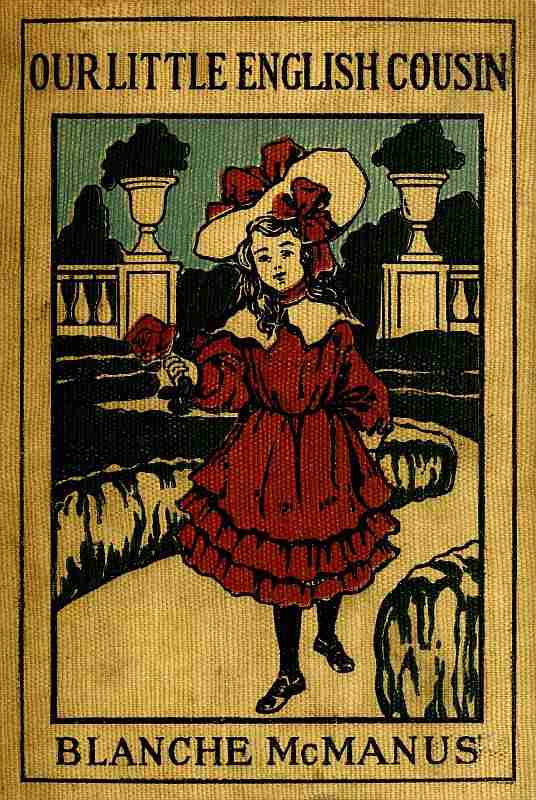
The Project Gutenberg eBook of Our Little English Cousin
Title: Our Little English Cousin
Author: Blanche McManus
Release date: July 19, 2013 [eBook #43250]
Most recently updated: October 23, 2024
Language: English
Credits: Produced by Emmy, Dianna Adair and the Online Distributed
Proofreading Team at http://www.pgdp.net (This file was
produced from images generously made available by The
Internet Archive)
Our Little English Cousin
Little Cousin Series
Each volume illustrated with six or more full-page plates in
tint. Cloth, 12mo, with decorative cover,
per volume, 60 cents
LIST OF TITLES
By Mary Hazelton Wade
(unless otherwise indicated)
| Our Little African Cousin |
| Our Little Alaskan Cousin |
| By Mary F. Nixon-Roulet |
| Our Little Arabian Cousin |
| By Blanche McManus |
| Our Little Armenian Cousin |
| By Constance F. Curlewis |
| Our Little Australian Cousin |
| Our Little Brazilian Cousin |
| By Mary F. Nixon-Roulet |
| Our Little Brown Cousin |
| Our Little Canadian Cousin |
| By Elizabeth R. MacDonald |
| Our Little Chinese Cousin |
| By Isaac Taylor Headland |
| Our Little Cuban Cousin |
| Our Little Dutch Cousin |
| By Blanche McManus |
| Our Little Egyptian Cousin |
| By Blanche McManus |
| Our Little English Cousin |
| By Blanche McManus |
| Our Little Eskimo Cousin |
| Our Little French Cousin |
| By Blanche McManus |
| Our Little German Cousin |
| Our Little Greek Cousin |
| By Mary F. Nixon-Roulet |
| Our Little Hawaiian Cousin |
| Our Little Hindu Cousin |
| By Blanche McManus |
| Our Little Indian Cousin |
| Our Little Irish Cousin |
| Our Little Italian Cousin |
| Our Little Japanese Cousin |
| Our Little Jewish Cousin |
| Our Little Korean Cousin |
| By H. Lee M. Pike |
| Our Little Mexican Cousin |
| By Edward C. Butler |
| Our Little Norwegian Cousin |
| Our Little Panama Cousin |
| By H. Lee M. Pike |
| Our Little Philippine Cousin |
| Our Little Porto Rican Cousin |
| Our Little Russian Cousin |
| Our Little Scotch Cousin |
| By Blanche McManus |
| Our Little Siamese Cousin |
| Our Little Spanish Cousin |
| By Mary F. Nixon-Roulet |
| Our Little Swedish Cousin |
| By Claire M. Coburn |
| Our Little Swiss Cousin |
| Our Little Turkish Cousin |
L. C. PAGE & COMPANY
New England Building, Boston, Mass.
Our Little
|
||
By L. C. Page & Company
(INCORPORATED)
All rights reserved
Published June, 1905
Fifth Impression, June, 1909
Introduction
The lives of Our Little English Cousins are not so widely different from our own in America. It is only the more ancient associations with which they are surrounded that changes their manners and customs.
Their speech is the same and their amusements and tasks are to a great extent quite similar.
Certain details of home life vary considerably, and when they "take their walks abroad," "Our Little English Cousins," as often as not, visit some ancient historic shrine from whose associations have been built up the great British nation.
Little English cousins and Little American cousins alike, however, would have the same affections for the same things were they but to change places, therefore things are not so very different after all.
What Washington is to America, London is to Britain; meaning in this case England, Ireland, and Scotland as well, for our little Scotch and Irish cousins by no means like one to talk or write of England alone when one really means Britain.
"Our Little English Cousin" lives in a less rigorous climate than that which prevails for the most part in America. Their winters are in general not so cold (though they are quite as long) and not usually so bright and sunny. The summers are by no means so hot as ours and are accordingly most delightful.
The open-air pleasures of our English cousins, while existent in our own country, are at least more general than with us, and tea out-of-doors, in the garden, or on the banks of the Thames is an institution which is quite unique, and accordingly, as a summer divertisement, is greatly in vogue.
The Associations which link America with England are many and important; indeed they are so numerous that it were futile to attempt to give place to any in this introductory note beyond recalling to the mind of little American cousins that the great Washington himself was of a well-known English family before they settled in America.
To-day, if the English are not emigrating to America to the extent that they formerly were, our American cousins are returning the visits, if only for pleasure or edification, in astonishingly growing numbers each year.
All this makes for a better understanding and appreciation of each other and cements the growing friendship of years, which in our progressive times is a good thing not to overlook.
"Our Little English Cousin," then, extends a cordial hand of welcome, not only to her cousins across the seas who annually make visits to her native land, but to the stay-at-homes as well, who have that pleasure in store for some future time.
Contents
| CHAPTER | PAGE | |
| I. | Edith's Home on the Thames | 1 |
| II. | A Day at Hampton Court | 13 |
| III. | A Drive to Richmond and Kew Gardens | 28 |
| IV. | With Tom at Windsor Castle and Eton | 44 |
| V. | London—Hyde Park and Westminster Abbey | 54 |
| VI. | The Tower of London | 72 |
| VII. | Madame Tussaud's and the Zoo | 80 |
| VIII. | Henley Week | 89 |
| IX. | Summer Holidays | 95 |
| X. | The Lord Mayor's Show | 103 |
List of Illustrations
| PAGE | |
| Edith | Frontispiece |
| Oldham Manor | 8 |
| "In a few minutes they had landed" | 15 |
| Windsor Castle | 50 |
| "After watching other antics our little friends bade the 'Beefeater' and his pet good-bye" | 76 |
| "She walked down the path by the river Avon" | 96 |
Our Little English Cousin
CHAPTER I.
"Now it is really time to get ready, is it not, Miss Green?" exclaimed Edith, looking up at the clock for the twentieth time during the last half-hour, and breaking off in the middle of the list of English kings and queens which she was trying to commit to memory. Which king came after Henry III., in that far-away time, seemed a small matter compared to the outing which she and her governess had planned to enjoy on the river that lovely afternoon.
Miss Green smiled indulgently as she closed her book. "It does seem a shame to remain indoors a moment longer than one can help such a day as this. Well, I will see Betty about the tea-things and pack them in the basket while you are getting ready."
You may imagine it did not take Edith long to put away her books; then giving her good-natured governess a hug she skipped off for her hat and coat.
"There are Eleanor and Clarence waiting for us now," cried Edith, as she and Miss Green, who was carrying the tea-basket, crossed the gardens. Running over the lawn, which stretched down to the river, she greeted her two little playmates from the vicarage. All three were bubbling over with glee at the prospect of an outing this bright June afternoon upon the river Thames. They were to go up-stream to a pretty little nook, in a quiet "backwater," which was a favourite spot with them, and have a "gipsy" tea under the willows.
The children were soon seated on cushions in the neat little shallow punt. Towser, the big collie dog, was already in the boat, for he knew he was a welcome companion on these trips.
Miss Green, standing at one end, poled the boat gracefully through the water. This looks like an easy thing to do, but it takes a great deal of skill to handle a punt.
"Does not the river look gay?" said Eleanor. "There are lots of people out." The river indeed was covered with pleasure craft of all kinds. There is probably no stream in the world so given up to pleasure as is the Thames, which flows through the very heart of England; indeed it has been called the "River of Pleasure."
It took all Miss Green's skill to steer through the many boats filled with gay parties. Daintily fitted up rowboats with soft-cushioned seats, the ladies in their bright summer dresses, with parasols of gay colours; the men in white flannel suits and straw hats. There were many punts like their own. Also tiny sailboats, some of them with bright red or blue sails; while every now and then a crew of young men from one of the colleges sculled past them, practising for the forthcoming boat-race. All made way for these swift racing boats, for one of the unwritten rules of the river is that boat crews must not be interfered with while practising.
Occasionally our party in the punt would get the effect of a gentle wave from an automobile boat or a steam-launch as it rushed by.
In the midst of it all were to be seen the swans gliding in and out among the boats. The Thames swans are as well known as the river itself. They are very privileged birds and directly under the protection of the government itself. There are special keepers to look after them, and any person who injured a swan in any way would be punished. But no harm ever happens to them, for the lovely white birds are great pets with every one, and the children especially like nothing better than to feed them.
Along the banks, under the shade of overhanging trees, were merry boat-loads of family parties making a picnic of their afternoon tea, as our little party intended to do.
You must know that everybody in England takes what is called "five o'clock tea," and would no more think of going without their tea in the afternoon than their dinner.
Presently the punt glided behind a clump of trees. You would think it was going into some one's garden, but out it came into a quiet bit of water, a miniature bay quite apart from the main river. This is called a "backwater." Catching hold of a tree with the hook on the end of her pole, Miss Green brought the punt up against the bank under the overhanging willows, and the young people were quickly out and on shore.
Then the tea-basket was brought from the punt. "Now, Clarence," said Miss Green, "you fill the teakettle while the girls help me."
Their kettle was especially constructed for these occasions with a hollow space in the bottom into which fits a small spirit-lamp,—this so the wind cannot blow out the flame.
"My! we have got a jolly lot of cake; that's good," and Clarence looked very approvingly at the nice plum-cake and the Madeira cake, which is a sort of sponge cake with slices of preserved citron on top of it,—a favourite cake for teas.
In a few minutes the water boiled in spite of everybody watching it attentively, and Miss Green filled the teapot. Then they all gathered around the dainty cloth spread on the grass, and the slices of bread and butter, known as "cut bread and butter," and the lovely strawberry jam quickly disappeared.
"Why do we always eat more out-of-doors," said Edith, "than when we are indoors eating in the proper way? I suppose it is because we are doing it for fun that it seems different from tea in the schoolroom."
"Perhaps the fresh air has more to do with it than anything else," laughed Miss Green, as she cut them the sixth piece of cake all around.
"Now you rest, Miss Green, and we will pack up everything," said Eleanor.
"Yes, and let's wash up the tea-things. It will be fun," said Edith, "and Betty will be surprised."
So the little girls amused themselves with their housekeeping, while Clarence and Towser ran races up and down the greensward until it was time to return.
The sun was setting when they pulled up at the steps of their boat-landing where Colonel and Mrs. Howard, Edith's parents, were sitting in comfortable wicker garden-chairs, waiting for them.
Oldham Manor, Edith's home, was a fine old house built in the "Tudor" style, of red brick with stone doorways and windows, and quaint, tall, ornamental chimneys, with the lower story entirely covered with ivy.
Colonel Howard was a retired army officer who had seen much service in far-away India. He had to leave the army on account of his health, and now devoted himself to his wife and two children, and his lovely home. Mrs. Howard herself was a handsome and stately woman, rather reserved in her manner, but devoted to her children.
Tom, Edith's brother, was at school at Eton College, so Edith had a double share of petting, and led a very happy existence with plenty of work and plenty of play. She had a pretty little room, with a little brass bed, and an old-fashioned chest of drawers for her clothes. The little dressing-table, which stood in front of one of the windows, was draped with pink-flowered muslin, and the window curtains were of the same material. The chairs were covered with a bright, pretty pink, green, and white chintz, and the carpet was pale green with pink roses.
From the window of this delightful room, one overlooked the rose-garden. Adjoining was the schoolroom, a big room where Miss Green and Edith spent much of their time.
Edith usually dressed quickly, for, when the weather was fine, she and her papa always took a walk around the gardens before breakfast. Colonel Howard was very proud of his roses, and the rose garden of the manor was quite famous; many of the rose-bushes were trained to form great arches over the walks.
Another hobby of Colonel Howard's was his fancy chickens and ducks, of which he had a great variety. Edith had her pet chickens, too, and she and her papa could never agree as to whose chickens were the finest, when they went to feed them in the morning.
Edith would run each morning into the breakfast-room, a bright-faced little girl with sparkling blue eyes and golden brown hair tied up with a pink ribbon and waving loosely over her shoulders—as all English girls wear their hair until they are quite young ladies. Her dress was very simply made, and around the neck was a pink ribbon—pink was her favourite colour—tied in a bow. There was a "good-morning kiss" for mamma, and Edith must help to fasten the rose in her hair, which Colonel Howard always brought his wife.
Edith had a good appetite for her breakfast of porridge and cream, milk, eggs and toast, or fish, or perhaps grilled kidneys and tomatoes, which is a favourite English breakfast dish and very good indeed. Always she finished with marmalade.
Breakfast over, then came the lessons in the schoolroom until one o'clock, when Edith and Miss Green had their dinner served to them here. After dinner she was free to walk or drive with her papa and mamma, or Miss Green, or play games with her little friends in the neighbourhood. Then for an hour in the afternoon Edith studied her lessons for the next day, curled up on the big green sofa near the window, while Miss Green read or sewed beside her, ready to help her out with a hard word. Finally she had tea with Miss Green in the schoolroom at six o'clock, and soon after this was ready for bed.
Thursday was a red-letter day for Edith, for in the afternoon she always took tea with mamma and papa in state, in the drawing-room. This was so that she should learn how to go through with it in the proper manner, which is a very important part of a little English girl's education. Mamma received her just as if she was a grown-up lady visitor, while Edith put on her real "company" manners, and Colonel and Mrs. Howard often could scarcely repress a smile at her great dignity when she began the conversation with, "It's a charming day, is it not." "I take two lumps of sugar only, thank you." Rainy afternoons she often worked on fancy articles for the bazaars held by the Children's League of Mercy. Edith was a member, and the money from the sales was given to help the very poor children in their neighbourhood. So the little girl's days passed pleasantly enough, as you may imagine.
CHAPTER II.
"No, Towser, you can't come with us; you know you will not be allowed to go into the palace, and what should we do with you then," said Edith, patting him on the head, as she closed the gate and left poor doggie looking wistfully after them.
Edith had been looking forward to a visit to Hampton Court for some time. Her mamma had promised that she could invite Eleanor and Clarence Whitworth and that Miss Green would take them all to spend a Saturday half-holiday, or rather a whole holiday, at this beautiful old palace, which was on the river, not very far distant from Oldham Manor.
Several Saturdays had proved disappointingly rainy, but to-day was all they could wish for, and after calling at the vicarage for Eleanor and Clarence, they went down the little village street which led to the river landing, where there was a sign, "Boats to let."
Miss Green intended to engage a waterman to row them up to the Court, as it was a rather long and tiresome pull.
The Thames watermen are quite an institution, and are one of the oldest of English guilds or societies. They are banded together for the mutual protection of their business, which is to hire out boats—and to row boats and the like. Each man wears a badge, and is very jealous of his rights. A new man who wishes to join their band must go through a long apprenticeship before he can become what is publicly known as a "Thames Waterman."
"Good morning, John," said Miss Green, to a bluff, good-natured man who lifted his cap to them. "Have you a good boat for us to-day? we want you to take us up to the Court."
"Yes, indeed, miss, one of the best of the lot." John was their favourite waterman, who often rowed them when the distances were too great for Miss Green.
It was a pretty row past the green lawns of handsome homes, and one or two small river villages, where the principal business is the letting of boats and of fishing-tackle.
John's sturdy strokes soon brought them in sight of the park belonging to Hampton Court, surrounded by a high wall past which the river winds for some distance. Soon they caught sight of the red brick towers of the palace itself, and its beautiful gardens, and in a few minutes they had landed near one of the small excursion steamers that ply between London and Hampton Court, on which so many folk take a charming day's excursion on the Thames.
There is also a little village at Hampton Court, as well as the palace, but one never pays much attention to it, except when one begins to get hungry, for it is mostly made up of little shops, that hang out signs on which is the one word, "Teas," which means one can get there their afternoon tea.
Our little party made straight for the big iron gates which lead into the entrance court. On one side are barracks where soldiers live, and before them rises the red brick lodge or gateway through which is the main entrance to the palace itself.
I fancy one often thinks of a palace as a great, tall, imposing building of many stories. Well, most palaces do cover a great deal of ground, but many of the English ones are not so very tall. This palace is only two stories high, with a sort of attic at the top. Another strange thing about these old-time palaces is that most of the rooms are very small according to our modern ideas, except for a few long rooms, called galleries.
"Let us go through the two courtyards into the gardens and sit on a bench under one of those old yew-trees, and I will tell you children something of the story of the palace; then you will enjoy seeing it much more," said Miss Green, as she led them into the lovely gardens where they could see the building to the best advantage. The children crowded around her as she began:
"It was built several hundred years ago by the great Cardinal Wolsey who was minister or councillor to King Henry VIII. Wolsey became a powerful favourite of the king, who loaded him with royal gifts. He became wealthy and proud, and built for himself many grand homes, until at last he founded this Hampton Court, which was to be the most splendid of them all. But the cardinal had become by this time such a power in the kingdom, and was so arrogant and wealthy that the king was jealous of him, fearing that the cardinal would become his rival.
"To counteract this, the cardinal presented his palace at Hampton Court to the king, and so it became a royal palace. But this did not prevent the cardinal's downfall.
"Until a hundred or more years ago this palace was a favourite home of the Royal Family, but now it is only a show-place for holiday-makers."
"I don't see how the king could have treated the poor cardinal badly after he gave him such a beautiful home," remarked Edith, as they entered the palace.
"Ah, well! perhaps he deserved it," said Miss Green, as they went up the grand stairway and through room after room filled with pictures, and some of the furniture of those old days.
They could see the beds on which had slept many royal persons. Around this furniture were drawn ropes so no one could touch it or sit upon the chairs. The floors were highly waxed, and in every room was a guardian or sort of policeman, who closely watched visitors to see that nothing was disturbed.
"Well, they did have a great number of rooms," said Eleanor, after they had walked through many bedchambers, anterooms, and reception-rooms.
"Yes," answered Miss Green, "they were necessary not only for the Royal Family itself, but for the many people who were always attached to the court.
"Here is the 'throne-room,'" she continued, "where the king or queen sat in that gilt chair which stands on a dais or platform raised several steps above the floor." Above the chair was a velvet canopy surmounted by a gilt crown. Usually the arms of England (the "Lion and the Unicorn") were embroidered in gold and coloured silks on the velvet background behind the throne. Here the kings and queens held their audiences, and saw those who wished to present some petition or ask some royal favour.
"This is one of the most splendid old-time 'banqueting-halls' in our country," said Miss Green, as they came into the great chamber with a high roof of great carved wood beams and windows of coloured glass. Around the walls were great stag heads, and over the entrance door was a gallery where the musicians played while guests ate dinner at the long tables. The guests sat on wooden benches or stools, while the persons of high rank occupied chairs at a table at the end of the hall, which was placed on a raised platform which separated them from those of inferior rank.
"Can't we see the big grape-vine now?" said Edith, as they left the palace itself.
Miss Green led the way through the rose-garden, and past Queen Mary's Bower, a shady and favourite walk of one of the queens, so shut in by trees that it looked like a green tunnel. "There is the vine-house," exclaimed Clarence, as they came to a long, low, glass house which covered the huge vine, nearly two hundred years old, the largest single vine in the world. The trunk looked like that of a small tree, and its branches, hanging thick with bunches of grapes, covered the glass roof. At various times its home had to be added to, and still the vine has to be constantly pruned to keep it within bounds.
"I should like to eat some of those grapes when they are ripe," said Eleanor, looking up at the clusters over her head.
"You would have to be one of the Royal Family to do that," Miss Green smilingly said. "They are all kept for the king's own use."
"Well, are you young people ready for dinner?" asked the governess, looking at her watch as they left the vine-house. "It is nearly one o'clock, so we had better have our dinner, and then we can spend the afternoon in the gardens and park."
"Afterward we can go through the Maze, Eleanor," cried Edith, as, holding each other by the hand, the little girls skipped through the garden paths.
"Yes, but dinner first, by all means," said Clarence, "and let us go to one of the places on the river, please, Miss Green, where we can watch the boats."
On the gallery of one of the inns that overlook the river they found a round table that would just accommodate their party. Here they could enjoy a fine view of the palace and the river, and a substantial meal at the same time.
"Now for the 'Maze,'" cried the young people, when they entered the gardens again. The "Maze" is an elaborate labyrinth, whose pattern is laid out in high-clipped hedges of box-trees. One can lose themselves for some time amid its tangle of paths before it is possible to reach the centre, and come back again to the starting-place.
"By paying a penny I can watch your efforts," said Miss Green, as she paid her penny to the guardian, and mounted a little platform which overlooks the tangle of paths. "I think I shall enjoy this more than rushing around through the hot sun," she said, smiling down on her charges.
Finding the right path through the Maze is one of the favourite amusements of the children when they visit Hampton Court, and our three young friends were soon rushing around laughing in the wildest excitement.
It took nearly an hour's fun before they were able to reach the centre and get out again, Clarence being rather crestfallen that the girls had beaten him out.
"Oh, we are warm," said Edith, as they ran up to Miss Green, panting and fanning their faces with their hats.
"Indeed you are. Come, and we will rest and cool off in the park. The chestnut-trees look lovely with their spikes of white flowers."
Under the great trees, groups of children were playing about, or having picnic lunches, or amusing themselves with the deer, which live in the park, and are so used to visitors that they are very tame, and will even eat out of one's hand.
"I should like to come here next Sunday; it will be 'Chestnut Sunday'" said Clarence, as they threw themselves on the soft grass.
"Oh," said Edith, "that is always one of the first Sundays in May."
"Yes," continued Clarence, "the first Sunday after the chestnut-trees come in full blossom."
Thousands of people come here from London and the surrounding country on that day, that they may drive through this long avenue that leads directly through the park to the palace and admire the display of blossoms on the great trees that line the avenue on both sides.
Clarence grew enthusiastic. "It's a jolly sight, I can tell you, to see vehicles of all kinds, from bicycles and coster's carts to big four-in-hand coaches and automobiles. There is such a jam on the avenue that they can only creep along; it's like a big picnic."
"Is it not nearly tea-time? We are so thirsty, Miss Green," said Eleanor, as the sun began to drop behind the trees. The little girls had amused themselves by making endless daisy chains, and decorating their hats with the "may" as they call the hawthorn-bloom, while Miss Green read to them from a story-book.
"Yes, we must not be too late in getting home; we will stop at one of the little tea-shops near the boat-landing."
It was a neat little cottage which they selected, covered with vines, with a small flower-garden in front. The pleasant-faced hostess soon brought in a big tea-tray covered with a dainty cloth on which was a big pot of tea, cut bread and butter, and delicious strawberries, such as only grow in England. "Nearly as big as my fist," declared Clarence, but this was perhaps putting it rather strongly, though each one made a big mouthful as the young folk ate them, dipping them first into sugar.
They sang songs as they rowed home, and the tunes were taken up by other boats full of young people out for the Saturday half-holiday.
"We have had such a lovely time; thank you so much, Miss Green," said the young Whitworths as they parted at their gate.
"It has been a nice day, and we will have some others, too, when Adelaide comes, won't we?" said Edith.
CHAPTER III.
Adelaide Stamford was Edith's first cousin and lived in London. She was not as strong as Edith, and during the winter her mamma had taken her to Brighton, which is the great winter seaside resort. Although it is also a very fashionable place, many invalids go there to enjoy the warm sunshine. Adelaide was taken up and down the fine promenade in a bath chair, which is a kind of big baby-carriage which a man pulls, or pushes along. She also sat in the glass "shelters" along the sea front, which keep off the wind nicely, and are like small glass houses.
So Adelaide had become much stronger, but the smoky London fog had again made her rather pale and thin, and so she was coming to spend a few weeks with the Howards, to see if Surrey air would not be beneficial.
She was Edith's favourite cousin, and the little girls were nearly of the same age. Edith looked forward to having her share her lessons, and planned many pleasant drives together in their neighbourhood, which is one of the most beautiful and interesting in England.
"My dear, we must not only have roses in our garden, we must get some into your cheeks," said Colonel Howard, as he lifted a little pale-faced girl with dark hair and eyes out of the dog-cart which had brought her from the station.
"She must stay out-of-doors as much as possible, and on the river, and Edith will take her on some of her favourite drives, and we will soon have her looking as plump as our little girl," said her aunt as she kissed her.
Mrs. Howard then took Adelaide up to Edith's room, where another bed had been put up for her.
"Kate will arrange your things in their proper places," said Mrs. Howard, as the neat-capped maid came to take her coat and hat. "I must leave you now, we are very busy. Edith has probably told you that the 'Sunday-school treat' is to be held on our lawn this afternoon, so, when you have rested, come into the garden and help us amuse the little ones."
"A treat" in other words is a picnic, and often only an afternoon picnic, as in this case. The children of the neighbourhood had early gathered in the churchyard, and were marshalled by the vicar and their teachers into a procession.
Marching two by two, they came down the street, and through the big gates of the manor, where they quickly spread themselves in merry groups over the lawns. Soon everybody was in full swing for a good time; games were started, and Clarence with some of the older boys put up a cricket-pitch in one corner of the grounds. The croquet lawn was also well patronized.
Colonel Howard had generously arranged for a small steam-launch to take the children for short trips up the river and back again; this was perhaps more popular than anything else.
Meanwhile Mrs. Howard and Mrs. Whitworth superintended the setting of the tables on the grass under gay red and white awnings.
The summons to tea was welcome, and the children joyfully gathered around the well-filled tables. There were huge plates of sandwiches, cakes, buns, jam, and big strawberries. All the good things melted away so quickly that it kept the older folks running to bring more, while nobody stopped to count the cups of tea that each one stowed away.
There was a little lull after this, while they listened to a band of music placed under the trees.
Adelaide greatly enjoyed it; it was more of a novelty to her than her cousin, and she was much interested in helping feed the swans, who had evidently got wind of the entertainment and knew that their chances for food were good. A number of these graceful birds had gathered along the river bank, and the children were stuffing them with pieces of buns. There was one greedy old swan that amused them very much; he was always trying to peck the more timid ones away and gobble up everything himself, just like some greedy children we all have seen.
The twilight was closing in when the last band of young people left, singing songs, and waving their hats and handkerchiefs; all of them very grateful for the happy time they had enjoyed so much.
"Miss Green says if we are very good she will take us for a drive in the governess-cart to Richmond and Kew Gardens this afternoon," Edith confidentially whispered to Adelaide, as they went up to the schoolroom the next day. Lessons were learned as by magic that morning, and Tony and the cart were at the door early in the afternoon.
Tony was one of the dearest of ponies, and was almost as much of a playmate with the children as Towser.
"Look at Tony as we get in, Adelaide; he has the funniest little way of looking around at you." Sure enough, Tony was peering around at them as much as to say, "I'm watching you; aren't you almost ready to start?"
They halted a moment at the vicarage to arrange that Eleanor and Clarence should meet them at the bird-pond in Kew Gardens. Soon they were driving through the beautiful Richmond Park. Miss Green pointed out White Lodge, one of the many royal residences; a rather small, plain, white house in the centre of the park. "It was here," she continued, "that young Prince Edward, the eldest son of the Prince of Wales, who will some day be King of England, was born. His birthday was celebrated by a great dinner which was given by the late Queen Victoria to all the children of Richmond. Tables were set under the trees in the old park, at which hundreds of children feasted, and speeches were made in honour of the young prince. Afterward each child was given a mug, on which was a picture of the queen and the date, which they could always keep as a souvenir, or remembrance, of the day."
"Oh, yes, Miss Green," said Edith, "you remember that Betty's little sister has one of the mugs, and Betty once showed it to me."
"Look at the deer, Adelaide," said Edith, as she caught her cousin by the hand. "See, they want to cross the road, and are waiting for us to go past." Sure enough, there stood, watching the cart, a great herd of these graceful creatures, very erect, with their dainty heads crowned with big, branching horns. They were evidently undecided whether or not they had time enough to cross the road before the cart would reach them; then one made up his mind and darted across, another followed, and then the entire herd swept swiftly by, then turned again to look at the cart, as much as to say, "Well, we did it."
"Here is the famous view from Richmond Hill, known all over the world," said Miss Green, as she pulled up Tony for a few minutes, that the girls might admire the winding River Thames, far below them, lying like a silver ribbon between green meadows and wooded hills. "Authors and artists alike have helped to make this view celebrated," said Miss Green, "and that big building on the left is the famous 'Star and Garter' hotel. It used to be the fashion to drive down from London and lunch on its terrace, from which one gets a most beautiful view down the Thames valley."
Edith was trying to point out to Adelaide the tower of Windsor Castle, where the king and the Royal Family live when they are not in London. "We will go over there some day while you are with us, Adelaide."
"Miss Green," continued Edith, as the pony trotted down the long, narrow street into the town, "won't you please stop at the 'Maid of Honor' shop, so we can buy some cakes?"
"I can never get Edith past this place," laughed Miss Green, as she pulled up in front of an old-fashioned shop, painted green, with a big sign over the front: "The Original Maid of Honor Shop."
While the little girls make their purchases you might like to hear the story of these famous cakes.
It is said they were first made for King Henry VIII., by one of the Maids of Honor at his court, and this is why they are called "Maid of Honor" cakes. A Maid of Honor is not really a maid or a servant, but a lady who attends upon the queen—a companion.
Well, the king thought the cakes tasted so good that many more were made for him, and the recipe was kept safely guarded in a fine chest with a gold lock and key; but somehow it became known, and was handed down until it became the property of the present owner of the shop, who claims that his cakes are still made by the same recipe as those eaten by King Henry hundreds of years ago.
By this time the little girls were driving past the "Green." Every town and village in England has an open grass plot which is either called the "Green" or the "Common," which means that it is common property, and it is here that the young people play games.
"There is all that is left of Richmond Palace," said Miss Green, pointing to an ancient gateway with a part of a dwelling attached. "Once it was a favourite residence of the great Queen Elizabeth.
"Many great men lived during the reign of 'Good Queen Bess,' as she was called, but you must not forget the greatest of them all—Shakespeare."
"Oh, yes," said Edith, "papa and mamma are going this summer to visit the village where he lived, and they have promised to take me. What is the name of the place, Miss Green? I have forgotten it."
"Stratford-on-Avon, and you must never forget the name of the town where lived the greatest English poet, my dear," replied Miss Green.
"Did not a great many kings and queens live in Richmond, besides Queen Elizabeth?" asked Adelaide.
"Yes, it was a favourite home of royalty, and that is why it was called 'Royal Richmond,' and the town has always been proud of the numbers of great people who have lived here, poets and writers and painters as well as kings and queens.
"I will have the cart put up at one of the little inns near the big gates," said Miss Green, as they drove up to the entrance to Kew Gardens.
Soon our party were strolling over the soft grass and among the lovely flower-beds, for here people can walk and play over the grass as they like, for there are no horrid "Keep off the Grass" signs.
If you want to know what any plant or tree in the whole world looks like, you have only to come here and you will find a specimen of it, either growing out in the open, or in the museum, which makes these gardens of great value. They were begun first by a certain King George, whose palace is still standing in one corner of the gardens, and who afterward made it a present to the nation.
Our party made straight for the pond where they were to meet their little friends.
"There they are now," cried Edith, "and Clarence is feeding that funny old bird that follows everybody around."
"I have given this old fellow two buns already, and he is still begging for more," said Clarence, as the two little girls ran up.
It is a great treat for the children to watch the queer water-birds from all parts of the world whose homes are in and around this pond.
On Saturday afternoons especially, numbers of young people of all ages gather there at the hour when the birds are fed. The birds are petted and fed so much that they are very tame, and the gray gull that Clarence was talking about, follows every one about begging like a kitten or a dog. There are ducks of all kinds, and all colours, that scoot over the water, swallowing the unwary flies and waterbugs who stray in their path, and dive for the bits of cake and bread which are thrown to them by the children. There are beautiful red flamingos, and storks that stand on one leg with their heads under one wing, and all kinds of queer birds with long, stick-like legs. But the funniest of all are the big white pelicans.
"Do look at them," cried Adelaide, "they know their dinner is coming." The five pelicans had been huddled up in a bunch in one corner, with their eyes tight shut, one might think fast asleep. Just then the keeper came down to the water's edge with a big basket of fish. Such a flapping of wings! The pelicans were instantly wide-awake, and, rushing forward, crowded about the keeper, opening their enormously long beaks, to which is attached a kind of natural sack or bag which they use for holding their food until they can better masticate it.
As each one's share of the fish was tossed into its big mouth, it disappeared like lightning. Meanwhile, all the other birds, big and little, had rushed up demanding their share. Such "quacks" and "gowks" and "squeaks"! You never heard such a funny lot of voices. The greedy old gull hopped right under the keeper's feet, until he got the biggest fish of all, and dragged it off into a corner all by himself.
Our young people watched the birds for some time, then went through some of the big greenhouses full of palms, and all sorts of tropical plants, and finally drove back home through the quaint little village of Kew.
"In this churchyard is buried one of our most famous painters," said Miss Green, as they passed the quaint church which stands on one side of the Kew Green,—"Gainsborough, who was especially fond of painting portraits of beautiful women. But we must not stop longer, as it is growing late," she continued, so touching up Tony, they went along all in high spirits, though Adelaide confessed she did feel a bit tired, and both the little girls were quite ready for their tea when they reached the manor.