
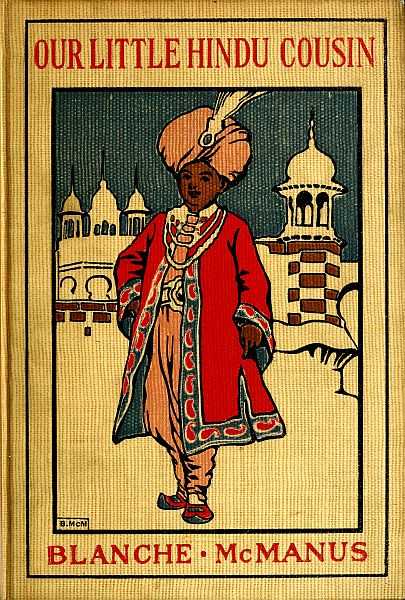
The Project Gutenberg eBook of Our Little Hindu Cousin
Title: Our Little Hindu Cousin
Author: Blanche McManus
Release date: February 3, 2013 [eBook #41977]
Most recently updated: October 23, 2024
Language: English
Credits: Produced by Emmy, Dianna Adair and the Online Distributed
Proofreading Team at http://www.pgdp.net (This file was
produced from images generously made available by The
Internet Archive)
Our Little Hindu Cousin
Little Cousin Series
Each volume illustrated with six or more full-page plates in
tint. Cloth, 12mo, with decorative cover,
per volume, 60 cents
LIST OF TITLES
By Mary Hazelton Wade
(unless otherwise indicated)
| Our Little African Cousin |
| Our Little Alaskan Cousin |
| By Mary F. Nixon-Roulet |
| Our Little Arabian Cousin |
| By Blanche McManus |
| Our Little Armenian Cousin |
| By Constance F. Curlewis |
| Our Little Australian Cousin |
| Our Little Brazilian Cousin |
| By Mary F. Nixon-Roulet |
| Our Little Brown Cousin |
| Our Little Canadian Cousin |
| By Elizabeth R. MacDonald |
| Our Little Chinese Cousin |
| By Isaac Taylor Headland |
| Our Little Cuban Cousin |
| Our Little Dutch Cousin |
| By Blanche McManus |
| Our Little Egyptian Cousin |
| By Blanche McManus |
| Our Little English Cousin |
| By Blanche McManus |
| Our Little Eskimo Cousin |
| Our Little French Cousin |
| By Blanche McManus |
| Our Little German Cousin |
| Our Little Greek Cousin |
| By Mary F. Nixon-Roulet |
| Our Little Hawaiian Cousin |
| Our Little Hindu Cousin |
| By Blanche McManus |
| Our Little Indian Cousin |
| Our Little Irish Cousin |
| Our Little Italian Cousin |
| Our Little Japanese Cousin |
| Our Little Jewish Cousin |
| Our Little Korean Cousin |
| By H. Lee M. Pike |
| Our Little Mexican Cousin |
| By Edward C. Butler |
| Our Little Norwegian Cousin |
| Our Little Panama Cousin |
| By H. Lee M. Pike |
| Our Little Philippine Cousin |
| Our Little Porto Rican Cousin |
| Our Little Russian Cousin |
| Our Little Scotch Cousin |
| By Blanche McManus |
| Our Little Siamese Cousin |
| Our Little Spanish Cousin |
| By Mary F. Nixon-Roulet |
| Our Little Swedish Cousin |
| By Claire M. Coburn |
| Our Little Swiss Cousin |
| Our Little Turkish Cousin |
L. C. PAGE & COMPANY
New England Building, Boston, Mass.
(See page 19)
Our Little Hindu
|
||
By L. C. Page & Company
(INCORPORATED)
All rights reserved
Second Impression, August, 1908
Preface
Our little cousins of Hindustan are charming little people, even though their manners and customs and their religion are so very different from our own.
India is a big country, and there are many different races of people living within its borders, the two principal ones being the Mohammedans and the Hindus. The Mohammedans number about sixty millions and there are about a hundred and eighty millions of Hindus, who are by far the superior race.
The intelligence of the Hindus is of a very high order, but, like all Eastern races, they have many superstitions. Their attention to their food and drink and personal cleanliness is remarkable, and, though their customs in this respect are peculiar, they follow a healthful and sanitary manner of living which might well be practised by Western folk.
The arts and crafts of the Hindus and their trades and professions are very strange and interesting, and the young people themselves invariably grow up in the same occupations as their elders. There is no mixing of the races or castes, and members of one caste always associate with those of the same class.
But the English influence is making itself so strongly felt, that frequently the children learn English as early in life as they do their own language; so our little American cousins would almost always be able to make of them good playfellows and would perhaps be able to learn many valuable lessons from Our Little Hindu Cousins.
Suez, January, 1907.
Contents
| CHAPTER | PAGE | |
| I. | Chola at Home | 1 |
| II. | A Day in the Bazaar | 16 |
| III. | The Children's Holiday | 35 |
| IV. | The Children Travel in the Big Ox-wagon | 50 |
| V. | The Children See Benares and Go Home for a Wedding | 66 |
| VI. | The Little Sahib Sees the Big Elephants | 80 |
| VII. | Chola Goes on a Tiger Hunt | 94 |
List of Illustrations
| PAGE | |
| Chola in His Father's Shop (See page 19) | Frontispiece |
| Buying Sweets in the Bazaar | 30 |
| "First there came a big elephant" | 57 |
| "These the children twisted into wreaths and threw into the river" | 69 |
| The Marriage of Shriya | 76 |
| "Suddenly, up out of the jungle, there sprang a great yellow tiger" | 102 |
Our Little Hindu Cousin
CHAPTER I
It was barely light when little Chola rolled out of his blanket and gave his cousin Mahala a shake as he lay stretched out beside him.
"Lazy one, listen! I hear little kids bleating below in the courtyard; the new goats with the long hair must have come. Hasten! We will be the first to see them!"
"Oh!" said Mahala, sitting up and rubbing his eyes, "thou art the plague of my life. I was in the midst of a beautiful dream. I dreamed that I was sitting beside a clear stream, with many dishes of sweetmeats beside me, and I was just beginning to eat them when thou didst wake me."
"Oh, thou greedy one! 'Tis always of sweets that thou art thinking," laughed Chola, as he and Mahala ran down the little winding stairway which led from their room into the courtyard.
"Here they are, aren't they dear little creatures?" cried Chola, as two little kids came frisking toward them, while the big white mother goat followed them bleating piteously.
"What fine long white hair they have," exclaimed Mahala, trying to catch one of the kids as it bounded past him.
"A lot of fuss over some goats," grumbled the old porter. "This fellow with his goats came hammering before cock-crow at the gate," continued the old man, who did not like having to come down from his little room over the big gateway of the court at such an early hour to open the gate.
"We are early risers in the hills," said the man who had brought the goats. "It is you town folks who are lazy; but I promised your master when he bought the goats in the market yesterday that he should have them this morning."
"Oh, thou art from the hills," exclaimed the boys, looking curiously at the little man in his strange dress.
"Yes, from the far northwest; and both I and my goats are homesick for the tall mountains with the snow on their tops and the great pine-trees. We like not these hot plains; but I must be off to the market," and, twirling his stick, the little man left, clanging the heavy gate behind him.
"Come, we will bathe before our fathers come down," said Mahala, after they had played about with the kids awhile; "they always say we are in their way." So saying the two little boys ran into the big garden where, under a group of mango-trees, there was a big stone tank, or pond, of water, with steps going down into it. Here Chola and Mahala bathed every morning, for it was part of their religion and must be done in a certain way. Indeed, some of our little Hindu cousins bathe before each meal; and this is why, all over India, you will see the people bathing in the rivers, in the public bathing-places, and in their own gardens at all times of the day. Moreover, it is a very pleasant custom for a hot country like India. As the boys were splashing merrily about in the big tank, down dropped a big mango right on top of Chola's head.
"Where did that come from?" he cried, looking around; but there was no one to be seen, so he went on splashing, when down came another mango, and a sound was heard as if some one was chuckling to himself.
"Oh, it's thou, son of mischief!" cried Chola, as a little monkey leaped down and capered around on the edge of the tank.
It was Jam, Chola's pet monkey. A cousin of the gardener had caught it in his field one night when he was guarding his crops from the monkeys. These mischievous animals would often dash out in droves from the near-by forest at night and eat up the farmers' crop. He did not wish to kill the little monkey; for, like many Hindus, he thought it a sacred animal. So he had brought it to Chola for a pet.
The boys had great fun with Jam, though often he would play mischievous pranks on them. To-day Jam thought this was just his chance to have fun. Spying Chola's turban lying beside his clothes on the steps of the tank, he pounced upon it and carried it up into the mango-tree.
"Oh, son of mischief, just wait until I catch thee! Bring back my turban!" cried Chola, as he scrambled out of the water and climbed up after Jam in a jiffy. It would never do for him to lose his turban, for it would be very bad manners for him to be seen without this curious head-covering. But as Chola went up the tree, Jam climbed down by an out-stretching limb and swung himself to the ground, then away he went tearing around the garden with Chola after him. Suddenly Jam tossed the turban over the garden wall and flew to the top of the house, wild with joy at having given Chola such a chase.
"Oh, Mahala, find it for me," said Chola, as he dropped breathless on the grass.
Mahala ran out into the road and was back directly.
"Here is thy turban all unrolled," he laughed, throwing what seemed to be many yards of white cloth at Chola.
"Just wait until I take a good bamboo stick to thee, wicked one," said Chola, shaking his fist at Jam, now safe out of reach, and beginning to wind the cloth around his head.
After their bath it did not take the boys long to dress, for they just wound a long white garment around and around them, and slipped over this a little jacket.
"Let us go to the cook-room now and see what the women are cooking; to dream of sweets does not take away one's hunger," said Mahala, after the boys had given their teeth a vigorous washing and rubbing with little sticks, which was another one of their religious duties.
As the boys ran across the courtyard, scattering the goats, doves, and fowls which were picking up seeds and grain, a voice called out: "Give me food, oh, little princelings!"
"That must be a beggar, but I do not see him," said Mahala, looking around.
"It is old green-coat," said Chola, laughing, and pointing to the other side of the court where hung a hoop in which sat a beautiful parrot, all brilliant green and blue and red. He could talk so well that a stranger who came to the house would look everywhere to find the human being who he thought had spoken to him. Once there came a thief who thought he could steal the fine cock that stood under the veranda with his head under his wing. Just as the thief caught the cock by the neck, such a torrent of abuse came from above that he dropped the cock and rolled in the dust, crying out: "Mercy! mercy! Oh, great one, thy slave will never do this thing again!" Then as he heard a laugh, and no one seized him, he fearfully lifted his head, and there sat the parrot swinging on his hoop-perch. The thief slunk away very much ashamed that he had been fooled by a bird.
"Ah, it smells good!" said Mahala, as they looked in at the door of the cook-house which was near the great gateway.
There were no stoves or even fireplaces in the cook-room, but a series of little holes or cupboards in the wall, in each of which was a pot or pan resting on a few bricks or stones over a tiny fire. These little ovens were near the floor, so that the cook could watch the pots and pans while squatting. No Hindu stands up to any kind of work if he has a chance to sit down.
Three or four women were squatting around watching the cooking, while the boys' old grandmother bustled about scolding everybody within sight.
"Do not linger here," said the grandmother to the boys, "this is no place for children."
"But, grandmother, Shriya is here," objected Mahala; "why can't we stay, too."
"I am helping grandmother," said Mahala's little sister Shriya, who, with a very important air, was sitting on the floor stirring something in a big bowl. Shriya felt that she was a person of importance these days, for was she not going to be married soon!
"Shriya is a useful little girl; besides, why are you not in the great room where thy fathers make sacrifice to the Gods of the Household?" answered the old lady, rather tartly. Like all good cooks she did not like to be bothered while she was preparing her dishes.
"Come away, the grandmother is always cross when she is in the cook-room," whispered Chola; so he and Mahala crossed the court again and went into the house.
If you should come to visit Chola, you would think no one lived there when you first entered the house. You would see no furniture of any kind, no tables or chairs, for every one sits cross-legged on mats or rugs spread on the floor, or squats on their heels. The walls are whitewashed and bare, and there are no pictures or knick-knacks such as you have at home.
The great-room was the sitting-room and dining-room for all the family except the women, who lived in their own part of the house, called the zenana.
At one end of the great-room was a shrine, in which was a curious old idol of baked red clay. This was supposed to be the image of the family god, and each morning offerings were made to it. This morning when the boys came in, they found that the offerings of dishes of rice and wreaths of flowers had already been placed around the old idol.
"Thou art late," called out Chola's father, who was sitting on the wide veranda in front of the great-room, smoking his big pipe called a hookah. It was very comfortable on the veranda, for all around it hung mats of woven grass to keep off the burning sun and yet let in a cooling breeze. You must know that India is a very hot country and that the people make use of all sorts of things to make them comfortable. That is why the houses all have broad verandas, where the folk can sit and keep much cooler than within doors.
"It was all Jam's fault," said Chola, and he sat beside his father and told of the trick the little monkey had played him, which amused his father very much.
"You have spoilt Jam," he said. "Some day he will have to be sent back to the forest if he does not behave himself better."
Meanwhile the steaming dishes of food were being brought from the cook-house and placed on the big mat in the centre of the great-room; this kept the grandmother and the boys' mothers busy, for they had to serve three separate repasts, one for the men, one for the children, and then, last of all, one for themselves. All this took a long time, for there was Harajar Chumjeree, Chola's father, and his wife Lalla, and Murree Rao, Chola's uncle, and his wife, and his son Mahala, and Mahala's little sister Shriya, and the grandmother, and several cousins and cousins' widows. They all lived in the big stone house, built around a square courtyard, which stood in the middle of a large garden on the outskirts of the beautiful city of Lucknow.
"Oh, grandmother, give us the fine white rice this morning with the beautiful curry which thou hast made! None other tastes so good as thine," said Chola, coaxingly, as he and his little cousins seated themselves on the cleanly swept earthen floor of the great-room.
"Aha! art thou young rajahs that you should eat the beautiful rice of the feast-days?" said the old lady, as she bustled back to the cook-room; for the very fine rice is costly, and not usually given to children every time they ask for it. Nevertheless, the old lady was always pleased when they praised her curries, and, like other grandmothers the world over, she quite spoiled her little grandsons. So, presently, she came back with a big bowl of the fine white rice and put a pile of it on each child's plate, taking care not to actually touch the plates themselves, and then she made a hole, or basin, in the centre of each pile and filled it with a steaming hot curry. This is one of the dishes that the children were fondest of and there are many ways of preparing it.
This curry of the grandmother's was made of several kinds of vegetables, and was very hot and spicy indeed, but the children enjoyed it. After this they had flat cakes of fried meal, and then a preserve of fruit.
"Here is milk from the new goats," said the grandmother, placing a big bowl of goat's milk before each child; "but hasten, little ones, for I and the mother and Shriya go with my son to the Bazaar to-day. There are many things to buy for the wedding of my granddaughter," continued the old lady, who was devoted to her grandchildren and really ruled the house.
"Oh, take me, too," cried Chola. "There are no lessons at the school; for thou knowest it is a holiday, and Mahala goes with his father to visit a cousin. I will be all alone."
CHAPTER II
So it was settled that Chola should go, too. A little later the "ekka ghurrie" was ready in the courtyard, and they all stowed themselves away in it somehow. The "ekka ghurrie" is a funny kind of carriage made of bamboo poles hung between two high wheels, with a red canopy to keep off the sun. It was drawn by a little pony, and the shafts were fastened to a stout bamboo stick across his high pointed collar.
They found themselves rather a tight fit, for the "ekka" was small; and the coolie, or servant, who was driving had to balance himself as best he could on one of the shafts. Nobody minded this, however, and away went the little pony along the dusty road, past gardens and many low, rambling two-storied houses very much like their own.
Everything looked wonderfully bright and gay. Many of the houses were painted a brilliant pink or yellow with bright green verandas; and the people, too, were dressed so gaily in all kinds of colours, though some of them wore pure white, which looked nice and cool in the blazing sun.
Soon they passed the great gate of the city and came into the busy streets of the Bazaar.
In all Eastern cities there is a part called the Bazaar, where are all the shops; and in a large city like Lucknow the Bazaar is made up of many streets of nothing but shops.
All the fruit and vegetable shops are in a street to themselves; all the workers in brass and other metals in another. You will find the silk merchants in one street; and, in still another, all the shops that sell cotton goods,—the pretty flowered kinds stamped with tinsel as well as plain white, for every one in India wears light cotton or silk clothes.
When they came to the street where the silk merchants were, the grandmother and Shriya and her mother got out; for it was here they were going to buy Shriya's pretty silk dresses and long veils, and other pretty things.
"I would rather go with thee, father," said Chola, so he and his father turned into another street. Here were the shops where wonderful gold and silver work was made and sold; and where precious stones were set into all kinds of rich and curious jewelry. The shop of Chola's father was one of the largest in the street, though we would think it very small. It was more like a big cupboard in the side of the street than anything else; and he could reach nearly everything in it without getting up from his seat. The shop had no name or sign over it, nor were there any windows, while no doors were needed because the entire front was open to the street, so that customers could look in to see if there was anything they wished to buy without coming inside.
Chola sat on his heels watching his father as he sat cross-legged on a carpet spread on the floor, putting a beautiful blue turquoise into the setting of a silver necklace. Near to his elbow was a low table on which were piles of precious stones. He liked to come with his father to the Bazaar and watch him make the gold and silver into beautiful things. When Chola was older he would come every day to the Bazaar, and his father would teach him to be a silversmith like himself. Every little Hindu boy follows the same trade as his father.
The Hindus love jewelry of all kinds, and both men and women wear quantities of it. In fact much of their wealth is often put into the form of necklaces, rings, and bracelets, which the women wear all the time. The Hindus think this is the safest way to keep their wealth. So you see why the jewellers do such a big trade in India.
"Father, there's a customer," whispered Chola, but Harajar paid not the slightest attention to a tall man in a long silk robe, with a big turban on his head, who stopped to look in the shop. A Hindu merchant usually thinks it beneath his dignity to ask any one to buy his wares.
Presently the tall man said: "Are you happy?"
"I am happy," answered Harajar.
This is the Hindu way of saying "How do you do?"
Harajar then offered the tall man a seat on the rug, and his own hookah to smoke, which is the polite thing to do. The would-be customer puffed away at the great pipe for some minutes, meanwhile saying never a word. Soon he began to pay compliments; and then he looked at, and priced, nearly everything in the shop before he asked the price of the gold-mounted dagger on which he had had his eye all the time. Then came the bargaining.
Chola knew that this would take all the morning, so he slipped away to a shop a little way down the street, where a big yellow and red awning hung across the roadway.
Here were beautiful brass ornaments of all kinds, lamps, vases, pitchers, and what not, and Chola peered among these for a sight of his little friend Nao. Only Nao's father was in sight, and he sat dozing over his hookah. Farther down the street, however, Chola spied Nao's embroidered cap bobbing about between two big camels laden with great bales of cloth.
Nao as quickly caught sight of his friend Chola, and came running up at once. "Oh, Chola," he cried, as he greeted his little friend by touching his forehead and the palm of his right hand, "let us go to where the caravans gather about the city gate; the man with the camels has just told me that all the camels stopped there to rest on entering the city."
"Nay," said Chola, "there are wild, rough doings among the strange men who come down from the hills with the camels. I have heard my father say so."
"Oh, go play with thy sister, then, I will go alone," said Nao, who made out as if he would turn away.
"I am not afraid, I, too, will go and talk with the camel men," Chola answered with spirit. No little Hindu boy likes to be told to stay at home with the girls, because in his country it is a sad fact that little girls are not thought as much of as boys, nor do they have so good a time.
The two boys slipped away through the crowded street, dodging between lumbering wagons drawn by oxen, called buffaloes, and pushing their way through a crowd of folk dressed in a great variety of costumes, all in gay colours and with queer gaudy turbans on their heads. The turban forms a very important part of the dress of the Hindu, and Chola could tell by the colour and shape of each man's turban to just what caste each man belonged and what business he was in. There are many of these castes, or classes, of Hindu people, and each caste keeps strictly to itself. A person of one caste must not marry outside his caste; or touch persons of another caste, even; or eat with them, or have any friendly dealings with them. Not only that, but you would think it very tiresome, would you not, to have to remember not to sit next to that person or touch this one? And that you must find out who cooked your food before you might eat it? But this is what our little Hindu cousins have to think of all the time.
Many of the men carried umbrellas of bright colours. Once only very high and mighty people in Hindustan carried umbrellas, or rather had them carried over them by a servant, but now nearly every one carries one;—and they are needed in a country where the sun shines hotly all the year round. For this same reason the streets are nearly covered in by great spreading awnings drawn from one side to the other and forming a sort of roof.
Just for fun the two boys got in the way of the "bhisti" or water-carrier, so that the stream of water from the goatskin bag, with which he was watering the dusty street, might play on their bare feet; but when he turned it toward their heads, they ran away laughing.
"See! there must be a juggler over there," said Chola, pointing to a circle of people around an old man with a gray beard.
The two boys pushed into the circle until they were near enough to see what wonderful things the man was doing. He had just put a few seeds into the dust under a small mat. "Behold," he cried, "there will grow up a beautiful flower," and, sure enough, as he lifted up the mat, there appeared a pot, and from the pot there began to grow up a stem and green leaves, until finally it became a tall plant from which unfolded a great red flower. All at once, as the juggler held the plant up for every one to see, the flower changed into a cage containing two white doves, and, when the door of the cage was opened, the doves came out and began to circle about the juggler's head. At this there was a murmur of wonder and surprise from the crowd. The doves entered the cage again; but, as the people looked, the cage and doves and the red flower and the plant with the green leaves all vanished; and the juggler stood on his little grass mat with absolutely empty hands. Nothing could have been hidden about him, for he had on no clothes except a cloth wrapped around his waist.
"Is it not wonderful?" whispered Nao. "There be people who say it is magic; and that there are no such things in sight as the flower and the doves, and that it is all the power of the eye of the old man that makes other people see things as he wants them to see them."
"Nay, it is real magic, and the flower did grow up before us," said Chola. It would be hard for any one to believe otherwise; for it is true that the jugglers of India do the most wonderful tricks, far more wonderful than those we see in our own country, and no stranger can really tell how they are done.
"How will you find your camel-man?" asked Chola, when finally the boys came to the great square where the caravans camped. Everywhere were camels and horses and men in strange costumes.
"He said he would be near the great gate," said Nao, as he and Chola crept in and around the big camels and under them, constantly being scolded by the men for getting in their way. Finally Nao spied his friend sitting lazily smoking in the shade of the gateway, while he watched his camels being unloaded.
"Welcome, oh, little friends," said the big, bluff fellow. "I suppose it is no use to ask thee to share my dinner?" he continued, pointing to the big dish of boiled rice, cabbage, and goat's meat which one of his stable boys had just brought him.
The food smelt very good, but Chola and Nao shook their heads. They knew by the blue turban and dress of their new friend that he was a Mohammedan, and they would rather have starved than eaten food with him; but they were quite willing to squat beside him in the dust in true Hindu boy fashion, and listen to his strange tales of the far-away countries which he had visited, as he ate his meal out of the big bowl. They heard how he had come from the great plains of China, across the snow-covered mountains of the north—the great Himalayas, the highest mountains in the world;—and how his camels had waded through snow-drifts up to their necks. He told them marvellous tales of the great cities of Delhi and Lahore, with their marble palaces and beautiful gardens; and of the great rice-fields of Burma. Sometimes he had crossed the great desert going toward the west, and had seen the splendid city of Bombay, and from there had gone on down the coast where the tall palm-trees grow. He and his caravan had crossed India many times, carrying merchandise from one part of the country to another. The camel-man talked on until he had finished eating and was ready for a nap.
"It must be fine fun to ride a camel," said Nao, as he and Chola made their way back to the Bazaar.
"I think it is much nicer to ride a big elephant, as my Uncle Achmed does when he goes about his lumber yards," answered Chola. "But, Nao, the smell of thy friend's dinner has made me hungry. Let us buy some sweetmeats," he continued, darting across the street to a little booth where there were bowls and baskets filled with all kinds of sweet, sticky things to eat that not only Hindu children like, but all the grown-ups as well. When a Hindu wants a real treat, he eats as many sweetmeats as he can.
Just as the boys got to the booth, a big bull buffalo came snorting along. He evidently wanted sweets, too, for he stuck his head under the awning of the little shop and took a big mouthful of preserved fruit from one of the baskets, at the same time upsetting the contents of another basket over the owner of the little shop, who was dozing among his wares.
"Oh, the thief!" cried the man, jumping up angrily, though he dared not do anything to the animal; for it was one of the sacred bulls from a near-by temple. They were allowed to wander through the streets, though they often robbed the shops in this mean fashion.
"'Tis no laughing matter," said the man, turning to the boys, who could not help laughing at his discomfiture.
"Do not be cross," replied Chola, as he and Nao helped to pick up the scattered sweets. "We are a different kind of customer from the buffalo. How many 'cowries' do you want for this almond paste? Not too many, mind you," he continued, with an eye for a bargain, "for we helped you save the others."
"And eaten some, too, I warrant," grumbled the man, still in a bad humour, as he wrapped up the sweets in a large green leaf and gave it to Chola, who paid him with some tiny shells, threaded on a string, which he took from the wallet he carried in his dress. These cowrie shells are used for small pieces of money and are carried on strings. As you may imagine, each shell is not of a great value.
"Let us eat our sweets here," said Chola, squatting in the shadow of a wall; and, with his finger, drawing a circle round them in the dust. This was intended as a sort of a boundary-line to keep any low-caste person from coming too near them while they were eating. The boys greatly enjoyed their candies, which they thought all the better for being made with ghu, a sort of rancid butter.
Just as they were finishing the last bit, some one came up and touched Nao on the shoulder.
"Who comes here to make my food unclean," he cried, jumping up angrily.
"Hush! It is a little Sahib. Doubtless he knows no better," said Chola, as he looked around and saw an English boy standing by.
"I think those things look better than they taste," the boy said, smiling, as he pointed to the sweets; "but I meant no harm. I only wanted to ask if you could tell me where Colonel Scott lives. I think I have lost my way."
"Ah, every one knows the Colonel Sahib; but the house is far from here; in the street with the great trees near the Chutter Munzil," said Chola.
"Where the roofs look like big gold umbrellas, I know," said the English boy. "My name is Harry, and Colonel Scott is my father. My mother and I have just come from England; but my papa has been here a long time. While he was buying something in one of the shops, I followed a man who had a lot of performing birds; and the first thing I knew I had lost my way." Harry rattled away, glad to find some one to talk to.
Chola could understand him fairly well, for he had been taught a little English at his school.
"Yonder stands a 'rickshaw.' It will take you quickly to your home," said Chola, proud to be able to talk to a little Sahib.
The little Hindu boys hailed the "rickshaw," and, nearly bursting with importance, bargained with the man who pulled it to take the little Sahib home.
"Perhaps I shall see you again, for I am going to live here now," said Harry, as he thanked the boys and climbed into the "rickshaw," which looked like a big perambulator. Away the man went with it at a lively trot, with Harry waving his cap in the air as a good-bye to his new-found friends.
Chola could talk of nothing but the "little Sahib" as they jogged home in the "ekka" in the dusk of the evening.
There are many English people in India, because it is now a part of the British Empire. So it is not surprising that Chola and Harry should meet in this way and be able to talk to each other. Mahala was very much disappointed because he had not been there, too, when he heard Chola tell of his adventures as they ate their supper.