
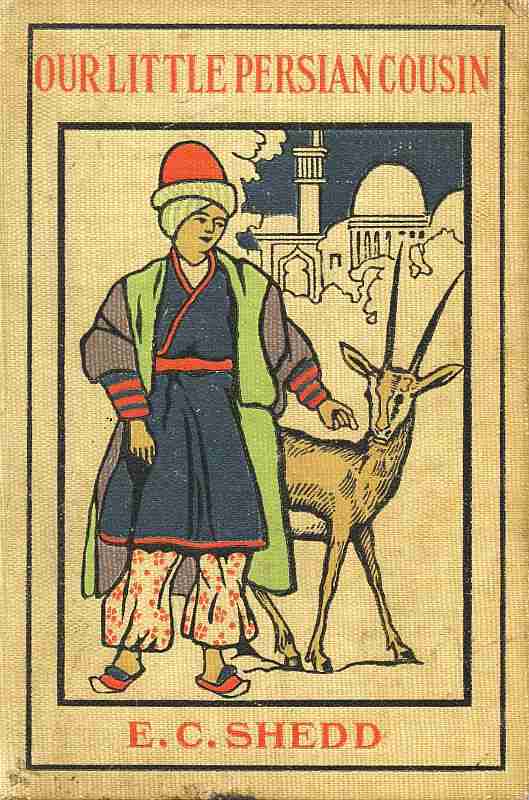
The Project Gutenberg eBook of Our Little Persian Cousin
Title: Our Little Persian Cousin
Author: E. Cutler Shedd
Illustrator: Diantha W. Horne
Release date: May 31, 2014 [eBook #45844]
Most recently updated: October 24, 2024
Language: English
Credits: Produced by Emmy, Beth Baran and the Online Distributed
Proofreading Team at http://www.pgdp.net
Little Cousin Series
Each volume illustrated with six or more full page plates in
tint. Cloth, 12mo, with decorative cover
per volume, 60 cents
LIST OF TITLES
By Mary Hazelton Wade
(unless otherwise indicated)
- Our Little African Cousin
- Our Little Alaskan Cousin
- By Mary F. Nixon-Roulet
- Our Little Arabian Cousin
- By Blanche McManus
- Our Little Armenian Cousin
- Our Little Australian Cousin
- By Mary F. Nixon-Roulet
- Our Little Brazilian Cousin
- By Mary F. Nixon-Roulet
- Our Little Brown Cousin
- Our Little Canadian Cousin
- By Elizabeth R. MacDonald
- Our Little Chinese Cousin
- By Isaac Taylor Headland
- Our Little Cuban Cousin
- Our Little Dutch Cousin
- By Blanche McManus
- Our Little Egyptian Cousin
- By Blanche McManus
- Our Little English Cousin
- By Blanche McManus
- Our Little Eskimo Cousin
- Our Little French Cousin
- By Blanche McManus
- Our Little German Cousin
- Our Little Greek Cousin
- By Mary F. Nixon-Roulet
- Our Little Hawaiian Cousin
- Our Little Hindu Cousin
- By Blanche McManus
- Our Little Hungarian Cousin
- By Mary F. Nixon-Roulet
- Our Little Indian Cousin
- Our Little Irish Cousin
- Our Little Italian Cousin
- Our Little Japanese Cousin
- Our Little Jewish Cousin
- Our Little Korean Cousin
- By H. Lee M. Pike
- Our Little Mexican Cousin
- By Edward C. Butler
- Our Little Norwegian Cousin
- Our Little Panama Cousin
- By H. Lee M. Pike
- Our Little Persian Cousin
- By E. C. Shedd
- Our Little Philippine Cousin
- Our Little Porto Rican Cousin
- Our Little Russian Cousin
- Our Little Scotch Cousin
- By Blanche McManus
- Our Little Siamese Cousin
- Our Little Spanish Cousin
- By Mary F. Nixon-Roulet
- Our Little Swedish Cousin
- By Claire M. Coburn
- Our Little Swiss Cousin
- Our Little Turkish Cousin
L. C. PAGE & COMPANY
New England Building, Boston, Mass.
(See page 92.)
Our Little Persian
|
||
By L. C. Page & Company
(INCORPORATED)
Entered at Stationers' Hall, London
All rights reserved
First Impression, July, 1909
Electrotyped and Printed at
THE COLONIAL PRESS:
C. H. Simonds & Co., Boston, U. S. A.
Preface
Persia is mostly a tableland, from which rise many high mountains. In the winter come storms of snow and rain; in the spring the ground is green with grass and bright with many flowers; but in the late summer and fall it is dry and hot. Over the mountains wander the Kurds, who live in tents, and drive with them the great flocks of goats and sheep whose milk gives them food and from whose wool they weave their clothing and rugs. In many of the valleys are villages. Here live the busy Persian peasants, who have brought the water in long channels from its bed in the valleys to water their fields and orchards. Where plenty of water is found there are towns and cities.
Over two thousand years ago the kings of the Persians were the most powerful in the world, and ruled all the country from India to Europe. Some of them helped the Jews, as is told in the books of Ezra and Nehemiah in the Old Testament. Two of them tried to conquer Greece, but the brave Greeks defeated their armies in the famous battles of Marathon and Salamis. Many years later the Greeks themselves under Alexander the Great invaded Persia and won its empire. But the Persians afterwards regained the power, and for five centuries held their own against the armies of the Roman emperors.
Suddenly great armies of Arabs poured out from the wide desert land of Arabia, eager to conquer the world, and to bring others to accept the new religion taught by their prophet, Muhammad. Thousands of them entered Persia. They induced the Persians to forsake their own religion, called fire worship, and to become Muhammadans.
Six hundred years passed, when new and more terrible invaders spread over the land. These were armies of horsemen armed with bows, who came in thousands from the wide plains of Siberia. They were the ancestors of the Turks. They destroyed a great many villages and cities, and killed tens of thousands of the Persians. Even yet, after more than five hundred years, one may see in Persia ruins made by them. A great many Turks still live in northern Persia.
The Persians are now a weak and ignorant nation; but the most progressive of them are trying to secure good schools and to improve their country in other ways.
Contents

|
| ||||||||||||||||||||||||||||||||||||||||||||||||||||||||||||
List of Illustrations
| PAGE | |
| "He carried it home on his shoulder" (See page 92) | Frontispiece |
| "He was so fat that her back often ached" | 18 |
| "Here Karim sat all day" | 37 |
| "Dada and Karim started very early" | 49 |
| "The sun rose when they were half way over" | 50 |
| The Governor's Palace | 81 |
| "Putting the paper on his knee as he sat on the floor" | 118 |
| A Kurdish Shepherd | 130 |
| Sheikh Tahar and His Horsemen | 150 |
| Karim and His Bride | 164 |
CHAPTER I
KARIM ARRIVES
Every one in the house of Abdullah was smiling on the day when a boy was born. Even Ashak the donkey, as he was bringing big bundles of wheat from the field, did not get half as many pokes as usual from the nail pointed stick that took the place of a whip, and was actually let alone for a whole afternoon to eat the dead grass and crisp thistles by the roadside.
Old Bajee, who was caring for the baby, ran as fast as she could to be the first to tell the news to Abdullah, calling out all the way, "Good news! a boy! a boy!"
"Praise be to God!" exclaimed Abdullah, and gave her a piece of silver money worth half a dollar. Laughing from joy she clutched this tight in her fist, and almost touched the ground with her forehead as she bowed to him. She had never owned half a dollar at one time except twice before in her life.
Abdullah hurried to the little shop around the corner and bought a loaf of sugar and some tea, and the tea urn, or samovar, was soon steaming. His neighbours—all men—came to congratulate him. Some brought raisins as a present, some melons. One brought another small loaf of sugar.
"May his foot be blessed!" they said. (They meant the baby's foot.) "This is light to your eyes!" "May you be the father of eight boys and no girls!"
Said Abdullah, "Praise be to God!" and gave them all small tumblers of tea that was nearly boiling and as sweet as sugar could make it.
Meantime the women were coming to see the baby. Old Bajee had rubbed him all over with salt; then she had tied a dark handkerchief over his eyes and wrapped him up in strips of cotton cloth and a little quilt. He was now lying by his mother. She was thinking about the Evil Eye,—an evil spirit or fairy who was always trying to do bad things,—and looked anxiously at the baby's arm.
"Where is the charm, Bajee?" she asked.
"Yes," said a neighbour, "he needs a charm at once, for he is so very pretty."
"Oh, don't say that," exclaimed the mother; "the Evil Eye will hurt him if you do. Bring the charm."
Bajee brought a piece of paper on which the mullah (or preacher) had written a prayer asking the angels to keep the Evil Eye away, and putting this in a tiny bag she tied it to the baby's right arm. "That prayer will frighten the Evil Eye," she said.
All this seemed very interesting to Almas. How delightful it was to have a baby brother. She wondered why her uncle Mashaddi had not seemed greatly pleased when a baby girl had come to his house two weeks before. No one had even called to congratulate him. But now her father was getting up a dinner party, and they were roasting a whole lamb for it, and cooking, oh! so many other delicious things. She could smell the onions even from the street, so she asked her grandmother for something good.
Grandmother laughed and said, "The front door cried for three days when you were born. But God gave you to us, and we are not sorry."
Then she gave Almas a big piece of bread with rice and meat heaped upon it, and some omelet mixed with molasses.
Meantime mother was sleeping with baby by her side. Her last words had been, "Bajee, be sure to keep the light burning, so that the evil spirits will be afraid and not get the baby."
When baby was just a week old, the preacher, whom they called the mullah, came to give him a name. He brought the holy book which was their Bible, and which they called the Koran. No one in that village believed in Jesus Christ in the way in which Christians do, but were in religion what we call Muhammadans. The mullah stood over the baby and read out of this Koran in a loud, sing-song voice.
Baby was frightened, and cried.
The mullah did not stop, but next made a long prayer in words which no one else could understand, because he was speaking in Arabic, the holy language which Muhammad, the prophet who had composed the Koran, had spoken. Then he called out, "Your name is Karim!"
Almas thought it was quite a funny sight to see his long red beard wagging back and forth while he made such strange sounds, and so she broke into a laugh, at which her father turned and struck her. She went out crying softly. She did not like the mullah. Why had he come to frighten baby? He had not named her little cousin. Old Bajee had shouted in her ear, "Your name is Fatima!" and that was all.
After this Karim was laid in a very narrow cradle without any sides, and long strips of cloth were wrapped around and around him and under the bottom of the cradle. His arms were tied down, and a calico curtain kept the light out. He lay in this dark little place nearly all the time for the first six months, generally asleep.
Although Abdullah was very proud of him, he hardly noticed him for over a month, because the evil spirits would wonder what he was looking at and come to see.
Once a day baby's mother would build the fire for cooking, and the room would fill with smoke, because there was no chimney, but only a hole in the middle of the ceiling. At first he cried every time, for the smoke made his eyes smart with pain. His mother put some medicine upon them when she saw how red they had become, and asked Bajee what the matter was.
"How can I tell?" said Bajee. "Babies always have sore eyes."
When the curtain was loose and it was not too dark the flies came to visit him. There seemed to be hundreds of them, and they walked all over his face and even into his mouth, but were especially fond of his red eyes and gathered in black rows around them. He winked and winked, but they did not care. Then he would begin to cry.
After a while mother would come to fix the curtain and rock the cradle, or perhaps—and this was the best of all—she would undo the wrappings and take him in her arms for a few minutes, singing, "My dear baby! my sweet baby! You are my father! and the father of my father!" She meant that she thought as much of him as of her grandfather, and every one always talked as if people cared more for a grandfather than for any one else.
CHAPTER II
KARIM'S RELATIVES AND HOME
One day Karim's mother, whom he was now learning to call "Nana," said to father Abdullah, "Master, your boy—may his eyes have light!—is now five months old, and ought to come out of his cradle. Buy some calico, and I will make another shirt for him. Do not buy red or any bright colour, so that the Evil Eye may not think him too pretty and so become jealous and strike him."
She made the shirt so short that his fat brown legs were bare to the knee.
When he could crawl around in the house sister Almas watched him. It was too dark for him to see much, for all the light came from the door, when that was open, and from the hole, about a foot square, in the middle of the ceiling, where the smoke at last went out. The door was so low that Nana had to stoop every time she went through it. The walls were black from the smoke, which Karim now found poured out each morning from a hole in the floor about as big as a large barrel. Nana did the cooking with the fire which she kept burning in this hole.
One afternoon Karim looked down, and found that its bottom was all bright with light which came from glowing red lumps. It was the prettiest thing he had ever seen, and he grasped the edge and leaned away over to see still better. Just then Almas screamed and jerked him back by his foot so suddenly that the skin of his hands was scratched by the rough edge. Of course he cried.
Nana came running in, and snatching him up exclaimed between her sobs, "Awý! my precious! he might have fallen in!" Then she struck Almas, so that she, too, cried.
After this Karim had to be satisfied with the bright light shining in through the hole above his head, and with the two round trays which, leaning against the wall, shone like polished silver until at last the smoke darkened them. They remained so until the next year, when a man came from the city and polished them over again.
In the daytime there were large piles of bedclothes tightly rolled up near the cradle. A few rugs lay folded beside them. There were no tables or chairs or bedsteads, and the floor was simply the hard earth. In the corner were a few green bowls, and some wooden spoons and copper plates. These were the dishes for the meals. Just across from the door stood a wooden chest, half as high as the room. This was where all the flour was put in the autumn, when Abdullah had packed it down carefully by stamping upon it with his bare feet. Near it was a door opening into darkness, through which Karim was afraid to crawl.
When he tired of these things, he looked at the chickens,—an old rooster dressed in red and black, but without any tail (he had never had any), and two or three clucking old biddies in sober gray, besides a half dozen others, hungry looking, half grown, with long legs. Like the flies, they came into the house whenever the door was open. If Nana left any food standing even for a minute she had to cover it. They came at meal time as regularly as if they had been invited, and fought with each other for the scraps of bread or bits of gristle that Abdullah threw away. Several times the rooster snatched the piece of bread which Karim was eating right out of his hand; but when he laid the bread down to crow for the biddies, one of the half grown chickens caught it up and ran around the room with it, chased by all of his hungry brothers.
The family got up every morning when it was just beginning to become light. All but Karim were busy nearly the whole of the day. When the sun was two or three hours high—no one had a clock—Abdullah came in for breakfast.
At meal time Nana brought the large tray that took the place of a table, and Abdullah set it upon the floor and laid upon it two or three sheets of bread which looked a good deal like brown paper, and was as thick as heavy pasteboard. It was made of whole wheat flour and tasted very good. Nana poured the soup out of a small kettle into one of the green bowls. Sometimes the soup was mixed with pieces of meat and onions, and was red with pepper; sometimes it was made of curded milk and greens. There were also onions and salted cheese and red peppers for side dishes, with cucumbers and melons and other fruits in summer.
Abdullah sat down on the floor upon his heels and ate alone, until Karim was old enough, when he always ate with "Dada," as he called his father, while Nana and Almas waited upon them. They never dreamed of eating with Dada, for that would have been very impolite, but when he had finished they sat down and ate what was left.
There were no knives and forks—what were fingers made for?—and no plates or tumblers, for all ate out of the same bowl and drank from the same water jug.
Between meals Nana was very busy. First came the milking of the cow; then the bedclothes must be rolled up and the stable cleaned out, and there was sweeping and churning to be done. The water must be brought upon her back in a heavy jar from the spring. In winter the cotton and wool was spun into yarn and knit into bright coloured socks, and in summer she helped Abdullah gather the cotton or the tobacco, and worked in the orchard or wheat-field. In the fall she swept up the leaves which fell from the trees growing on the edges of the streams and carried them home on her back to be stored for kindling.
While Nana was working she usually went barefoot. She had large black eyes, and she made them bright by putting a powder into them. She painted a black streak across her eyebrows to make them darker. Her black hair, hanging in long braids down her back, was banged in front, and was covered by a large handkerchief which she wore all the time. Very carefully, once a month, she dyed her hair and coloured with red the tips of her finger and toe nails.
Because she was careful about all these things and was somewhat fleshy and had red cheeks, her neighbours thought her beautiful; that is, the women thought so. The men hardly ever saw her face, because she always drew something over it whenever any man except Dada came near.
The men never asked him, "How is your wife and little girl?" which would have insulted him, but always said, "How is your boy?" and sometimes, perhaps, "How is the mother of your boy?"
Still Dada was really proud of her, but of course he was careful not to let her see it, "for," he said, "she is a woman, and must be kept under." He seldom called her by any sweet name, but when he wanted to praise her called her simply "the mother of Karim," and thought that, alone, was enough.
CHAPTER III
KARIM GOES EXPLORING
In pleasant weather Nana tied Karim upon Almas' back and sent her out of doors to carry him around. He was so fat that her back often ached, yet when a woman asked her if she was not tired she exclaimed, "Why, of course not! He is my brother." However, they were all so anxious to see him walking that he soon became bow-legged.
He now found what was to be seen out of doors. The yard was small, and there was no grass in it, nothing but the bare earth. When it rained the cattle tramped it into a deep black mud, which made a splendid place to sit in and play. Across the yard was the door of the stable, where the donkey and the cow and two buffalos lived with a few goats. In front was a wall six feet high.
Just before the front door of the house was a small porch, where the big dog and the chickens spent the most of their time. The calves came there, too, and the dog, but he never dared to come into the house. Nana explained that he was "unclean," and the mullah said that it was a wicked thing to allow "unclean" animals to come into the living rooms. Karim liked to hit the dog, who always let him do just what he wanted.
One day when Nana was away, suddenly a fierce barking and snarling was heard, mixed with shouts. Almas ran out to find that a stranger had stepped into the yard, and that the dog had caught him by the ankle and would not let go, although the man was hitting hard with his heavy walking stick. Almas was then only eight years old, but she put her foot on the dog's neck and raised her fist. The dog growled angrily before he obeyed her and slunk away. Some neighbours now came running in.
"Did you not know better than to enter a yard when no one was in sight?" said they to the stranger.
Then Mashaddi had Almas cut off some hairs from the shaggy neck of the dog. He took these hairs into the house and burned them, and brought the ashes to the stranger, who seemed very grateful.
"Thanks to you, if God will, the wound will heal very fast," he said, as he sprinkled the ashes on it and wrapped it around with an old piece of cloth. "Not even a doctor could give me better medicine than this."
The cat was allowed to come into the house, and was often there at dinner time with the chickens. Sometimes Almas petted her a little, and Nana threw her some food once in a while, but even they tried to hit her if she got in their way. She spent the most of the day hiding under the piles of fuel and in the dark stable in the hay. The dogs were anxious to chase her, and the boys were making bets as to who could hit her oftenest. Abbas was bragging because he had done it twice, for she was hard to hit, because she had practised dodging all of her life.
The door which opened into the dark from the family living room led to the store room. Karim often followed his mother when she went in, holding a lighted wax dip. There were no old trunks with newspapers and letters, because no one of the family had even seen a newspaper and no one but Dada had ever learned to read. Instead, there were big wooden shovels, plows, sickles and a pickax. In the autumn grapes hung in long clusters from the ceiling.
The baskets and jars were carefully covered, but Nana used to open them for Karim if he cried hard enough, and let him feel and taste what was in them. Most of the baskets were full of raisins. Two held red peppers. Some jars held salted cheese, and some were filled with butter, which felt very cool and soft. The pickled cucumbers tasted good, and best of all was the molasses.
One day Nana had just taken the heavy cover off from the molasses jar, when she found that she had forgotten a dish. She went out to get it, and Karim was left alone. He pulled the molasses ladle out of the jar and tried to get its bowl to his lips, all dripping as it was. It was half as long as he, and somehow hit him fairly in the eyes, filling them with molasses instead of his mouth. He screamed and ran through the door, dropping the ladle as he went.
Nana ran quickly to Karim. "My darling," she cried, "light of my eyes! Did the molasses hurt my darling? We shall beat the jug. See!" and she took the broom and started for the store room.
Just then Almas appeared in the door.
"Why did you not watch Karim?" Nana cried angrily. "We shall whip you, too! See"—she added to Karim—"shall we whip this naughty girl because she let the molasses hurt you?"
"No," said Karim, picking up a stick, "it was the jug. We shall whip it."
"Wonderful!" exclaimed Nana, "how kind he is to his sister."
Karim felt very much grown up as he thrashed the jug, while Nana laughed proudly because he showed so much spirit, and Almas looked on with smiles because it was the jug that was being whipped, and not herself. The jug was the only one that did not care.
CHAPTER IV
THE EVIL EYE STRIKES KARIM
Karim at this time happened to have only the shirt that he was wearing. He had never had more than two at one time, and one had dropped to pieces from age the week before. Nana had not found time as yet to finish a new one. The shirt was a dirty brown, although if one could have examined the seams he would have found that it had once been a dark red with black stripes. Now, with the molasses streaks, it looked fairly black.
Nana decided that it must be washed at once, for Dada might not like to see his son looking so very dirty, so she took him with her to the pool when she went for water that morning. She washed the shirt thoroughly, while he stood beside her shivering in the cool breeze. When at last it looked somewhat cleaner she wrung the water from it as well as she could, and put it back upon him to dry. Karim fairly howled with cold as he trotted along by her side, and when they reached home, to comfort him, she gave him two cucumbers and some of the raisins that he liked so well.
That afternoon he began to cough severely, and his head was very hot. Nana pulled at her hair in her anxiety.
"The Evil Eye has struck him!" she exclaimed. "The charm fell off from his neck when I washed his shirt, and I did not notice it for some time. The Evil Eye must have struck him then. Why did I not keep him dressed in Fatima's clothes, so that the Evil Eye would think him a girl, and not notice him? or rub his face with ashes, so that he would look ugly? Awý! What can I do?"
"Get up," said Grandmother, "run to the mullah, and have him write another charm; perhaps it will frighten the Evil Eye away."
Nana did so.
Said the mullah, as he gave her the roll of paper, "If there are twenty evil spirits in your son, they will all run away when you tie this prayer around his neck. It is worth fifty cents."
Nana began to cry. "What can I do, O holy man?" she said, "I have only twenty-seven cents, and my son will die."
"Take comfort, my daughter," replied the mullah, "I am God's servant, and He is merciful. The twenty-seven cents are enough."
But that night Karim nearly choked in his coughing. Dada looked very anxious. "Women are donkeys," he said, "and so are mullahs. I will go for the barber."
The barber looked grave. "See the black blood. I will take it out, and he will get well." He cut a vein with his razor, and caught the blood in a bowl, but Karim became worse. The next morning Dada hurried to the best doctor in the village. He looked at the boy a long time.
"Bring me this afternoon," he said, "fifty cents, and that hen with a white tail"—he pointed to the largest of the old biddies—"and with its blood and a mouse's eye I will make a medicine which will cure him. If it does not, take back your money."
When he had gone Bajee and some other women came to see Nana.
"My uncle once was sick like this," said Bajee, "and an old woman told grandmother to take a rooster and cut it in two, and tie the warm, bleeding pieces upon his breast. That made him well."
"My brother," said an old woman, "was cured of a cough by lying in the oven for the whole of one morning."
So Karim spent the afternoon lying upon the warm ashes in the hole where the cooking was done, with the bleeding body of the old rooster pressed tightly against his chest, while the charms were still about his neck and the doctor's medicine at hand. That evening he was much better.
Nana insisted that he was cured because of the mullah's charm; Grandmother believed in the dead rooster, while Dada went to thank the doctor and give him a lamb for a present.
It was some days before Karim was himself again, and as he was fretful his grandmother amused him with stories.
Here is one of them. The others were very similar to this.
THE FOX AND THE WOLF
A fox started to travel to the city of Mashad, because he knew that he was a wicked fox, and such a good man was buried in that city that simply visiting his grave was enough to make one good. On the way he met a wolf, who asked him where he was going.
He replied, "I am a wicked fox and am going to Mashad to be made good."
The wolf said, "I am very bad, too, and ought to go there. Let me go with you."
They went on together, and after a while met a bear.
"Where are you going?" he asked, and when they had told him he wished to go with them.
As they made their journey they came to a country where there was nothing to eat. They all became very hungry; so hungry that the fox and the bear dropped behind, as the three were walking, and, suddenly jumping upon the wolf when he did not expect it, caught him with their teeth in the neck and killed him. Then they each took a part of the body and began to eat. The bear ate until nothing but bones was left, but the fox took some of his meat while the bear was not looking and hid it in a dark corner of a cave near by.
After a while they both began to feel hungry again, for the wolf had been so lean that there was not much of a meal to be made off of him. The fox went into the corner of the cave where he had hidden the meat, and soon the bear heard him smacking his lips very loudly.
He was very much surprised, and asked, "What can you have found to eat?"
"O bear," said the fox, "I was so hungry that I have pulled out my left eye, and am eating it, and you cannot think how good it tastes."
"That is quite an idea!" said the bear, and he pulled out his own left eye, and ate it.
But he was soon very hungry again. Then he heard the fox in the corner once more smacking his lips very loudly, and he exclaimed, "What on earth can you be eating now?"
"O bear," said the fox, "I was so hungry that I pulled out my other eye and am eating it."
"How smart the fox is to think of such things!" thought the bear, and he pulled out his own right eye and ate it.
Then the fox got a long pole, and taking hold of one end he told the bear that if he would take hold of the other end he would lead him (since he was blind) to a place where he would find plenty to eat. But he led him to the edge of a very high rock.
"O bear," he said, "there is a large, fat sheep right in front of you. Now jump!"
The bear jumped, and fell so hard upon the stones below that it killed him. Then the fox ate the body of the bear, and it made him strong enough to go on and reach Mashad, where he visited the grave of the holy man and so was made good.
CHAPTER V
KARIM AT WORK AND PLAY
The village where Karim lived lay at the mouth of a little valley. Down this valley ran a stream of sparkling water that came out of the ground about a quarter of a mile above the village. This was not a spring, but a "kareez," for beyond it could be seen a long line of pits, joined at the bottom by an underground channel, through which the water ran. The road lay by their side, and in two places the path divided, a part passing on each side of a pit.
Once while Karim lay flat on the ground looking over the smooth sides at the water trickling across the bottom of the pit, he asked, "Doesn't any one ever fall in?"