
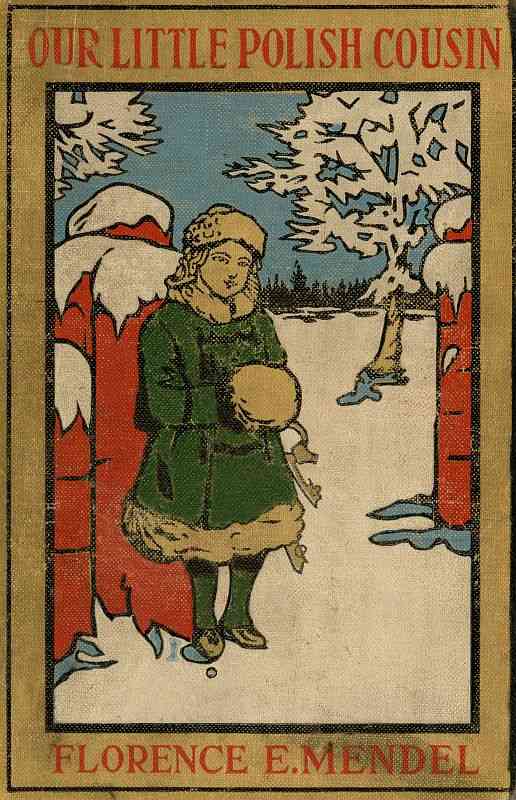
The Project Gutenberg eBook of Our Little Polish Cousin
Title: Our Little Polish Cousin
Author: Florence Emma Voigt Mendel
Illustrator: Harriet O'Brien
Release date: August 20, 2013 [eBook #43513]
Most recently updated: October 23, 2024
Language: English
Credits: Produced by Emmy, Beth Baran and the Online Distributed
Proofreading Team at http://www.pgdp.net
Little Cousin Series
Each volume illustrated with six or more full-page plates in
tint. Cloth, 12mo, with decorative cover,
per volume, 60 cents
LIST OF TITLES
By Mary Hazelton Wade
(unless otherwise indicated)
| Our Little African Cousin |
| Our Little Alaskan Cousin |
| By Mary F. Nixon-Roulet |
| Our Little Arabian Cousin |
| By Blanche McManus |
| Our Little Armenian Cousin |
| Our Little Australian Cousin |
| By Mary F. Nixon-Roulet |
| Our Little Brazilian Cousin |
| By Mary F. Nixon-Roulet |
| Our Little Brown Cousin |
| Our Little Canadian Cousin |
| By Elizabeth R. MacDonald |
| Our Little Chinese Cousin |
| By Isaac Taylor Headland |
| Our Little Cuban Cousin |
| Our Little Dutch Cousin |
| By Blanche McManus |
| Our Little Egyptian Cousin |
| By Blanche McManus |
| Our Little English Cousin |
| By Blanche McManus |
| Our Little Eskimo Cousin |
| Our Little French Cousin |
| By Blanche McManus |
| Our Little German Cousin |
| Our Little Greek Cousin |
| By Mary F. Nixon-Roulet |
| Our Little Hawaiian Cousin |
| Our Little Hindu Cousin |
| By Blanche McManus |
| Our Little Hungarian Cousin |
| By Mary F. Nixon-Roulet |
| Our Little Indian Cousin |
| Our Little Irish Cousin |
| Our Little Italian Cousin |
| Our Little Japanese Cousin |
| Our Little Jewish Cousin |
| Our Little Korean Cousin |
| By H. Lee M. Pike |
| Our Little Mexican Cousin |
| By Edward C. Butler |
| Our Little Norwegian Cousin |
| Our Little Panama Cousin |
| By H. Lee M. Pike |
| Our Little Persian Cousin |
| By E. C. Shedd |
| Our Little Philippine Cousin |
| Our Little Porto Rican Cousin |
| Our Little Russian Cousin |
| Our Little Scotch Cousin |
| By Blanche McManus |
| Our Little Siamese Cousin |
| Our Little Spanish Cousin |
| By Mary F. Nixon-Roulet |
| Our Little Swedish Cousin |
| By Claire M. Coburn |
| Our Little Swiss Cousin |
| Our Little Turkish Cousin |
L. C. PAGE & COMPANY
53 Beacon Street, Boston, Mass.
OUR LITTLE
|
||
By L. C. Page & Company
(INCORPORATED)
All rights reserved
First Impression, April, 1912
Electrotyped and Printed by
THE COLONIAL PRESS
C. H. Simonds & Co., Boston, U.S.A.
My Husband Edward
Preface
There is no doubt whatever but that every little girl and every little boy has heard of the country of Poland, and of its inhabitants the Polacks, or Poles, as you hear them more often spoken of. But there are countless numbers of these same children, I fear, who have not the slightest idea where Poland lies, except in a most vague way; nor how the people live, what they eat, what their pleasures and enjoyments are, and how they dress. Of course, you say at once, "Why, they eat the same things we do; every one eats meat and vegetables, and drinks milk or coffee," but right there you are mistaken. The nations of other lands do not live as we do, for we are the most extravagant nation in the whole world; indeed, other peoples cannot afford to live like us, for most of them are extremely poor; so poor and ignorant, as applied to Polacks, that it would make your heart ache to see them in their homes; they know very little of happiness, and comfort is a thing unknown to them, except for the wealthy, landed class. But these Polish peasants never think of complaining of their lot. They accept it as their fate, to which they were born; and, with light hearts, they make the best of their surroundings and their holidays; and I believe they derive more real pleasure from their infrequent play-days than we are able to do every day in our blessed, happy lives.
The story of Poland, like the story of every other nation, is not dry and dull. It is intensely interesting. It reads like a fairy-tale, and I am certain you will agree with me after you have finished this little volume. I can but hope it will give you a better and clearer understanding of the life of the Polacks, not only as to the rich, but to the poor.
Contents
| CHAPTER | PAGE | |
| Preface | vii | |
| I. | The Origin of Poland | 1 |
| II. | The Arrival at the Dwór | 10 |
| III. | The Sending of the Oplatki | 23 |
| IV. | Christmas at the Dwór | 35 |
| V. | The Visit to the Gaily Painted Cottage | 56 |
| VI. | Carnival Season | 77 |
| VII. | The Village Wedding | 99 |
| VIII. | The Orphanage in the Woods | 111 |
| IX. | What Happened when the Brothers Disagreed | 124 |
| X. | The Harvest Festival | 139 |
List of Illustrations
| PAGE | |
| Marya Ostrowska | Frontispiece |
| "Henryk leaned down and kissed the hand of the little fellow" | 14 |
| "The little ones threw quantities of small coins" | 49 |
| "The procession formed, the march begins to the church" | 79 |
| "She was bundled into the village cart" | 103 |
| "Her heart was beating faster and faster" | 137 |
Our Little Polish Cousin
CHAPTER I
We cross the Atlantic Ocean in one of the great floating palaces which sail from New York; after seven days of good times on board, with not too much sea-sickness, we sight land, the glorious, sunny land of France. We all know and love France, for it has been endeared to us in many ways. Lafayette helped us in our time of need long years ago, and the French school-children have given us that token of their esteem, the Goddess of Liberty, which stands at the entrance of the harbor in New York, a welcome to all the poor, homeless refugees and immigrants who come to this beloved land of ours in search of rest.
After passing through the custom-house at Havre, and our baggage being examined by the officials in charge, to see that we have brought nothing dutiable into their country, we board the waiting train, and are whirled along by the side of the sparkling river Seine, which winds its way lazily among beautiful green fields under the highest state of cultivation, mostly in vegetables, until we reach the charming city of Paris. As we may not linger here, much as we should love to, we are off again in the morning. We leave behind us the sunny, fair skies of France and emerge into the peaceful country of Germany with its rows upon rows of hops so symmetrically strung upon high poles, and its fertile vegetable gardens, where we see whole families, from the old grandparents, much too old to labor, down to the tiny but sturdy four-year-old, bending over the growing plants, weeding and hoeing and ridding of plant-pests. To see the endless truck gardens, as we pass by in the Schnell-zug (express train), one would be justified in believing that the people of Europe ate nothing but vegetables. And it is quite true. The masses have little else to feed upon, as meat is a rarity in poor families. Even the salaried people are not able to afford that luxury more than once a week, and then it frequently happens that only the head of the house may indulge.
As night descends, our train pulls in at the depot at Dresden; but this is not Poland; a little further, and we find ourselves in the city of Cracow, the ancient city of Chief Krakus, which we find nestled snugly and boldly at the junction of the three powerful countries, Russia, Austria-Hungary and Germany. It is here we purpose spending a cycle of months visiting, as Cracow is most typically Polish, with its surrounding vicinities.
What a glorious country we are in! It is true, it is broad, and flat and low, with rugged mountains and rapid rivers separating it, one part from another; nevertheless, it is a wonderful land. At one time it was a large country: now it is divided into three parts, each belonging to a different nation, the Russians, the Austrians and the Germans. The conquering nations have tried very hard to introduce their own customs into this captive land, but the Polacks will not accept them. We shall not enter into this phase of the question, but will visit the native as he is and not as the conquerors would have him.
It is very much more interesting to know just where the country lies about which we are reading, so we shall first learn where Poland lies upon the map of Europe. We open our books, and search the map through, but there is no country marked Poland. We are grieved to say there is no longer any country by that name; it was not enough to wrest the country asunder, but even its very name must be torn from it; therefore, it is in the southwestern part of Russia, the very northeast tip of Austria-Hungary, and the ragged northeast portion of Germany that we must trace the boundaries of Poland. From Riga on the north to the Black Sea on the south Poland had ample outlets for its great quantities of wheat and sugar which it raised, and which brought enormous wealth into the country.
Everything must have a beginning, even countries, and Poland was no exception. It wasn't like Topsy, who wasn't ever born but just "growed;" so here is the story of the birth of Poland.
Once upon a time, oh, very long ago, there lived a king or chief over the lands which lay near the mouth of the Danube River. Now you all know that the Danube rises at the Black Sea on the west, quite close to the southern border of Russia. This chief had three sons, who were great, strong men. At length the king died, leaving his lands and all his wealth to the care of these sons. Now, in those far-away days, the tribes who lived thereabouts were very savage; they had no learning or education. All they cared for was to fight, and make conquests of other nations so as to enlarge their own possessions. When the three brothers found themselves left with their father's small domain, they were not satisfied. They could not all rule upon the same throne and be at peace, one with the other. The estate was too small to divide into three separate kingdoms. Consequently, they determined to go in search of other lands which would be large enough to satisfy their demands. They set out and journeyed along happily for some time, meeting with many dangers by the way, for the land was full of wild beasts of all sorts, dangerous reptiles and savage men, who were worse, indeed, than all the wild things of the earth.
While walking along the highroad, one of the brothers chanced to gaze upward. He saw three eagles high in the air. He thought nothing of this, however, for the air was full of all sorts of birds, large and small. But finally he noticed that the birds were following along with them. At last the brothers began to joke about the incident.
"I choose the white bird," said Lekh, the eldest.
"And I the black one," said Russ.
"Then I must take the only one left," remarked Tchekh. And, in this merry manner, they passed the time as they continued their march.
At length the travellers came to three roads, diverging like the rays of a fan. One road led to the north, the direction they were then pursuing; another turned to the northeast, and the third to the northwest.
"Which shall we take?" asked one of them, as they halted their footsteps in order to decide the important question.
"I am for going straight on," Lekh said.
"And I, too," spoke up the other. "There is no use in separating so soon. Let us wait a while!"
As they were arguing the point back and forth, Lekh saw the white eagle, his eagle, winging its way due north. The other two birds were each following the direction of the other two diverging roads.
"There goes your bird," Lekh said to his brother Russ, as he pointed to the black eagle flying toward the right. "Mine goes straight onward, and so shall I. As for the rest of you, you may do what you like."
"Then I shall follow my bird," Russ replied. "Perhaps it will bring us good luck."
So the three brothers bade one another an affectionate farewell and parted. Russ followed the black eagle until he came to the present country of Russ-ia, which he founded and named. Tchekh founded the country of Bohemia, the people of which are even to-day known as Czechs; as for Lekh, he wandered due north until he came to the broad plain where he settled. As his guide had been a white eagle, he thought it but appropriate to make that his emblem; and, in this way, it happened that Poland has a white eagle upon its flag.
Lekh, as I have just said, settled in an immense plain, the Polish word for which is "Pola." Then Lekh added his own name to that, making Po-Lekh, sometimes written Lakh, and now we have the word Po-lakh, meaning the people of Lekh who lived in the plain.
CHAPTER II
It was snowing fast. The flakes fell in great, thick showers about the occupants of the heavy sleigh, who were fairly covered in a blanket of white, crisp snow. The driver lashed his sturdy, thoroughbred beasts with his long-handled whip, for they were in danger of becoming hopelessly sunk in the heavy drifts which filled the road, and there were yet some miles to go. The sleigh-bells jingled merrily, nevertheless. What cared they whether they were snow-bound or not, so long as they could make their music ring out over the clear, frosty air? It was their purpose in life to chime, and they were doing their best. The harder the horses tugged and the more they floundered about in the great drifts, the more merrily the bells rang out. Some one must keep good-natured, and so they took that task upon themselves. Happy bells!
The horses panted and halted a moment for the much-needed rest. The driver slapped his great arms across his chest to keep the circulation moving; but the occupants in the rear of the sleigh made no motion whatever. For all one could see of them, the sleigh might have been empty except as to fur robes, for not even the tip of a nose was visible. As the driver called out to his team, "Gee up," one corner of the fur robe in the rear seat moved, and a little voice piped up:
"Mother, are we almost there?"
"Just a little while yet, my dear," the mother replied, as she raised her head from the protecting warmth of the robe and looked about her. "I can see the tall trees of the drive now, just ahead of us. Peep your head out, Jan, and see if you can catch sight of grandfather's dwór," said Mrs. Teczynska, as she rearranged the robes so that Jan could sit upright.
Before them, some mile away, lay an immense park enclosed within a high stone fence. The sleigh made headway easier now, for the road about the entrance to the dwór was in better condition than the ordinary public road. Soon they passed the stone brama or gateway, sped down the splendid broad driveway lined on both sides with overhanging trees, mounted the rise at the top, and with a whoop and a hurrah, the driver pulled rein at the porch of the dwór or country-home of Mr. Ostrowski, the father of Mrs. Teczynska.
The tinkle of the sleigh bells had announced the arrival of the guests long before they had reached the porch; and the entire family, big and little, with innumerable servants, were awaiting within the reception-hall to greet the newcomers.
The villa was just the hospitable-looking home in which to meet at the Christmas season. One knew, from its very appearance, that it sheltered a warm welcome. It was built of stone, was two stories high and had a red-tiled roof; red chimneys dotted it all over; you never did see so many chimneys all on one house before. There was an immense veranda running along the entire front of the house, supported by heavy columns, giving it a most substantial air, the air of a home and not merely an expensive residence.
Mr. Ostrowski assisted his daughter and the little grandson Jan to disentangle themselves from the heavy fur robes, and they were hurried into the warm reception-room, where a bright fire was burning on an open hearth. As Mrs. Teczynska passed through the massive front door, which was opened for her by an elderly, not to say old, man-servant, she greeted him kindly.
"And how does Henryk find himself?"
The old man, toothless and very infirm, bowed respectfully.
"Thank you, Mlle. Martha, I keep very well; but it does my old eyes good to see you once more. How you have grown!"
"This is the little Jan, Henryk," Mrs. Teczynska said, as she drew her little son toward the old man. Henryk leaned down and kissed the hand of the little fellow, and tears dimmed his eyes. He had been an old and trusted servant of the family for many, many years, long before Mrs. Teczynska had been born, and was now relegated to the position of doorkeeper, being much too infirm for other duties. Although it is not necessary to have a man sitting in attendance at the front door, yet it is the Polish custom in the upper circles, so as to give employment to as many peasants as possible, and for this service, they receive but a pittance, yet it suffices. It makes the aged feel independent, and that they are not a burden in the already overburdened family.
What a happy reunion! Such hugging and bustle! All the children of the Ostrowski family were once more gathered together under the home-roof for the Christmas season, which was now at the beginning.
Mr. Ostrowski, the father, was a tall man of spare build; he had the kind, blue eye of the Slav and his heavy head of brown hair was tinged slightly with white. He wore a long coat, quite resembling a dressing-gown, edged with fur about the bottom and along the front, and tied about his waist with a long sash of crimson silk. This was the house costume of Mr. Ostrowski, who leaned toward the former luxurious style of dress in Poland.
His wife was a handsome woman, even in her elderly years; her complexion was as fresh and rosy as a young matron's, and her eye as soft a blue as in her younger days. The Polish women of culture do not age; they live a life of luxury and ease, and Time is gentle with them. But for all their seeming idleness they devote many hours of each day among their poor, and Mrs. Ostrowska was no exception to this rule.
Besides the father and mother, there was the younger brother, Peter, a tall, manly-looking fellow of about sixteen years, and Marya, the young sister, who had just passed her fourteenth birthday. Then there was the married sister, Mrs. Lechowicz, her husband and two sons, Francis and Frederic, and the oldest brother, Jan Ostrowski, with his wife and two children, Ignace and Marcella. You may well believe there was much to tell each other, and a great deal of commotion, for the married children lived in dwórs of their own or in the city, and were separated, not only by distance, but by family cares and business interests, so that it was not more often than at the Christmas season they were able to meet.
Jan Teczynski was overwhelmed with so many cousins and aunts and uncles; he was but five years old, and had not made their acquaintance before. He gazed about him in wonderment at all he saw; he could not withdraw his big, blue eyes from the immense boar's head which decorated the chimney-piece, and he asked all sorts of questions concerning it. It amused the older children immensely to hear him ask who had killed it. When told his grandfather had done so, he was very proud to think that his grandfather had been so brave; then he wanted to know if the boar had hurt grandfather with his sharp, curved tusks; but Mr. Ostrowski laughingly told him he had not been harmed, whereupon Jan seemed much relieved. But when he inquired if grandfather was sure the boar had been quite dead before he had cut off its head, the other children burst into roars of merriment. Jan didn't think it a matter to laugh over at all, but from that day he regarded his grandfather as one of the bravest men in the whole world.
The young folks now made off for sports of their own, while Mrs. Teczynska, much fatigued after her long and tiresome journey, went at once to her room to rest before luncheon should be served.
The maid-servant carried up the valises and bags of Mrs. Teczynska and set them down in the room that she had occupied from childhood. Fresh, hot water being brought by yet another maid, and cool drinking water placed upon the night-stand by the side of the great bed, the servants retired and left Mrs. Teczynska alone in her old, familiar room.
It was a very large room, as are all the rooms in Polish homes. The floor was beautifully inlaid in a fancy design with hardwoods of two colors, and polished so highly one had to walk carefully so as not to fall. Against one wall stood a magnificent stove of white glazed tile, with a door of shining brass, most exquisitely designed, and which could be closed so tightly that not one bit of dust or ash could penetrate through into the room. The peculiarity of this stove was, that only half of it was in the room; the other half extended into the adjoining room, so that, in this manner, one stove did duty for two rooms, thus saving expense, space and chimneys. It reached, too, quite to the ceiling; but, as the ceiling was low, it was not as tall as many other European stoves.
And the bed! It looked quite like any other wooden bed, but what a covering! There were no sheets or blankets such as we have. Instead, there was a blue silk comforter of down, so light you would have thought there was nothing in it, daintily tied here and there with little strands of silk. This silk comforter was put over a white linen sheet, much larger every way than the comforter; the edges were then folded over the silk and buttoned to it, the button-holes being worked in the border of the sheet and the buttons placed upon the comforter. At the top, which we usually turn over the blanket, the sheet was shaped like a triangle. In the middle of the point was worked the monogram of the hostess, while the remainder of the space was filled with the most elaborate and exquisite embroidery imaginable, done by the young peasant girls upon the estate. This was not a "company" sheet; no, indeed, not at all; the same kind was used every day in the week and in the year. The pillows, too, were covered with blue silk, and over this was buttoned, just to fit, a handsome pillow-case all inset with lace insertion so that the color of the silk beneath might show through. What a luxurious bed in which to sleep! It certainly was inviting.
In one corner of the room stood a small altar to the Holy Virgin, upon which stood freshly gathered flowers from the greenhouses of the estate, and wax candles were burning. As the majority of the Polacks are Roman Catholics, these altars are found in almost every home, each bedroom having its own altar for its occupant's special devotion.
Four large windows, opening inwards like double doors, looked over the covered veranda without, toward the fields stretching as far as the eye could see, covered now with their blanket of snow, while further yet lay great forests, the tops of whose trees were barely discernible in the dim distance.
Just below the windows lay a most magnificent garden, with fountains and bordered walks; but they, too, like everything else, lay under their blanket of winter's white. The ponds beyond, which supplied the estate with fresh fish, were frozen solid, and here the children had gone for an hour's skating in the crisp air, while their childish voices carried up to where Mrs. Teczynska lay resting upon her couch.
CHAPTER III
At the luncheon table there was great excitement. Something was astir in the air.
"Take your time, children," Mr. Ostrowski said forcibly, as he watched their hurried anxiety. "Brother Paul will be here shortly; but there is p-l-e-n-t-y of time."
"We wish he had come before luncheon," spoke up Peter. "It is now almost too late for Cousin Frederic to receive his oplatki before Christmas."
"A few hours more or less, my son," Mrs. Ostrowska answered, "will make very little difference. We could not have Brother Paul come sooner because we were waiting for your sister to arrive. We all wanted to be together to receive the good Brother."
Turning toward her eldest daughter, Mrs. Lechowicz, she continued:
"Brother Paul, as well as the priest, has had his hands full this winter. There has been a great deal of sickness among the poor."
"It has been so in our part of the country, too," replied the daughter. "It seems to be a bad year all round."
"The crops are poor; but we are thankful to say there will be sufficient for our own people. What the rest of Poland's poor will do, it is difficult to say. I had planned to take the children to Cracow for St. John's Night—"
"Oh, mother," interrupted the young Marya, "will you?"
"Don't interrupt, Marya; it is very bad manners. I was going to say," Mrs. Ostrowska continued, addressing her children, "I had planned to take you to the feast of St. John's Night in the City if all went well upon the estate. But I know you would not care to go and enjoy yourselves if there were sickness and distress here at home among our people."
"But June is so far away," the young girl pleaded, "there is yet lots of time for a good season."
"But illness lingers," the mother added.
"I will join you, mother," Mrs. Teczynska spoke up. "It will not be a long run up and Jan would love to see the celebration of the Wianki, I am sure."
"Let us all plan to go," added the younger married daughter. "It would be great fun."
"And will you take us?" added a chorus of young voices from around the great table, while expectant faces beamed.
"Yes, all of you," the elders replied in one voice.
"What is it all about, mother?" Jan managed to say, after vainly endeavoring for some time to edge in his question.
"Once every year," Mrs. Teczynska replied, "in the city of Cracow, where we got off the train and took the sleigh to come up here, the people have a holiday. They call it the celebration of the Wianki, or wreaths, and it takes place on the twenty-fourth day of June, which is the eve of St. John's Night. They have fireworks and all sorts of gayeties."
"But what does it all mean?" the child persisted.
"Well," his mother continued, seeing that the child did not comprehend as the older children did, "many, many years ago there was a good and very wise king in Cracow named Krakus. He had a most beautiful daughter, Wanda, who was so handsome that the fame of her beauty travelled all over the country. Princes and noblemen from other lands sent their messengers to ask her hand in marriage; but the Princess Wanda did not care for any of them. At length, a fierce, determined German prince, named Rytyger, fell so madly in love with the princess that he swore he would win her for his own. But the father of the princess had meantime died, leaving her in full possession of the kingdom; and, whether it was really the fair princess Rytyger craved, or the kingdom over which she ruled, we may not know for a certainty. However that may be, he sent his messengers to ask her hand in marriage, but the Princess Wanda promptly refused his offer. As soon as the envoys returned with the refusal, Prince Rytyger was more determined than ever to possess the Polish princess. He wrote her a most impertinent letter, demanding that she become his wife at once or else he would march into her domains and carry her off, whether she were willing or not. The Princess Wanda read the letter from the haughty German prince. She set her lips hard with firm determination. If he were determined, so was she. Without a moment's loss of time, she gathered her army together, marched out of Poland and into the country of the German prince. She sent word to him of her arrival, and added that she meant to give battle. The prince was very much surprised at this news, you may be certain; however, there was nothing to do but accept the challenge so long as he had been the one to open the argument. After the battle was finished many of the Germans were left upon the field, while Wanda returned to her castle-fortress of Wawel in Cracow.
"Seeing there was no use to refuse the offers of marriage that were made her, and fearing that other foreign princes might come into her land and wage war against her subjects on her account, she jumped from the top of the great stone wall that surrounded her palace, and fell into the river Vistula, which runs at the foot. And ever since, the Polish people have commemorated her death by casting wreaths into the river, at about the spot where Princess Wanda jumped into the waters. This is the meaning of the feast of St. John's Eve celebration of the Wianki."
"I should love to see it," the little fellow said, after a few moments' silence. "Will you surely take me?"
"Yes, indeed, if the other little cousins go," his mother replied. "When I was a little girl, like your Aunt Marya here," she continued, glancing at her young sister, "I went to the celebration. And you will open your eyes wide, Jan, I'll tell you that."
"Oh, goody, I wish it was the twenty-fourth of June now."
"But we have the Christmas season now," his grandfather spoke up. "That is much better, for we are all together. We have the fine snow for sleighing and snowballing. We have the ponds to skate upon, and we have—the Jaselki."
"What's that?" little Jan asked.
"Jan, dear," his mother said, "please do not ask so many questions. Let your grandfather finish before you interrupt."
"But he says so many things I don't know anything about," the child answered.
"That is right, Martha," Mr. Ostrowski said, "let the little chap learn. Of course he doesn't know what the Jaselki are, for he is too little to know everything. But that is a secret, Jan," the grandfather continued, as he shook a gentle finger at the boy. "You will see something wonderful at this Christmas season."
The maid entered; she said a few words in a low tone to Mrs. Ostrowska, and left the room.
"How we have lingered!" the grandmother said, as she rose from her seat at the table. "Brother Paul has been waiting some little time. Let us all rise to greet him!"
As they obeyed, the door at the farther end of the long dining-room opened, and a monk, clad in a long black robe with a girdle of rope about his waist, stood upon the threshold. In his hand he held his black beaver hat, and under his arm was a small package upon which the children kept their eyes assiduously glued.
"Welcome, Brother Paul," Mr. Ostrowski said as he greeted the monk. "The little folks have been in a fever of impatience; you are well come."
"I hear the same story in every home," the monk replied, as he turned and smiled at the row of happy faces. "They are all anxious for their oplatki."
"Let us go into the library," Mr. Ostrowski said, as he threw open the heavy doors communicating with that room; "the fire burns brightly there, and you must be cold."
"It certainly is raw without," the monk replied. "We are to have a long, hard winter, I fear."
"We just arrived this morning, Brother Paul," Mrs. Teczynska said. "We had a dreadfully cold ride from Cracow. I thought little Jan's nose would be nipped."
"Come here, son, and let's see if Jack Frost got away with any of it," the monk said.
The little fellow obeyed with a very serious face. He had quite an awe for the brotherhood; he held up his face for inspection.
"I believe it's all there," the brother laughingly said, as he examined the boy's serious face. "But you had a narrow escape."
Brother Paul drew up to the great table in the centre of the room, having sufficiently warmed his numbed hands at the welcome fire. Surrounded by the anxious, waiting children he untied the package he had brought. With keen interest they watched the monk draw forth a neat packet which he handed to Mr. Ostrowski, who untied it. Within, lay a quantity of small, round wafers, thin enough to be almost transparent, made from flour and water, upon each of which was impressed a religious picture. Upon one was the image of the Christ, another bore the resemblance of the manger, or of a saint.
"I shall get mine off right away," Peter said. "May I?" turning to his father.
Seeing there was no holding back the children's impetuosity, Mrs. Ostrowska handed the children some of the oplatki, which they at once proceeded to enclose in letters already waiting.
"I hope Cousin Frederic will get this before Christmas Day," Peter said, "but it is pretty late."
The rest of the afternoon was spent in writing letters and sending off the oplatki or Christmas cards to such of the relatives as were unable to be present with the family at this season. It is as much an event in Polish families to send these cards as it is with us; they bear messages of love and good-will, although they have no verses upon them. The priest of the village has put his blessing upon them, and these blessings go forth to the dear, absent ones. No written sentiment is necessary, for the absent know that the home-folks are thinking of them. It is a beautiful custom, and if it should happen that any of you children should receive an oplatki at the Christmas season, you will know what it is meant to convey.
Perhaps some of you more observant readers have remarked the difference in spelling the name of Mr. Ostrowski and his wife. While Mr. Ostrowski's name ends in "i," his wife's name ends with an "a;" this is simply a peculiarity of the Polish language, being the masculine and feminine ending of the name.