
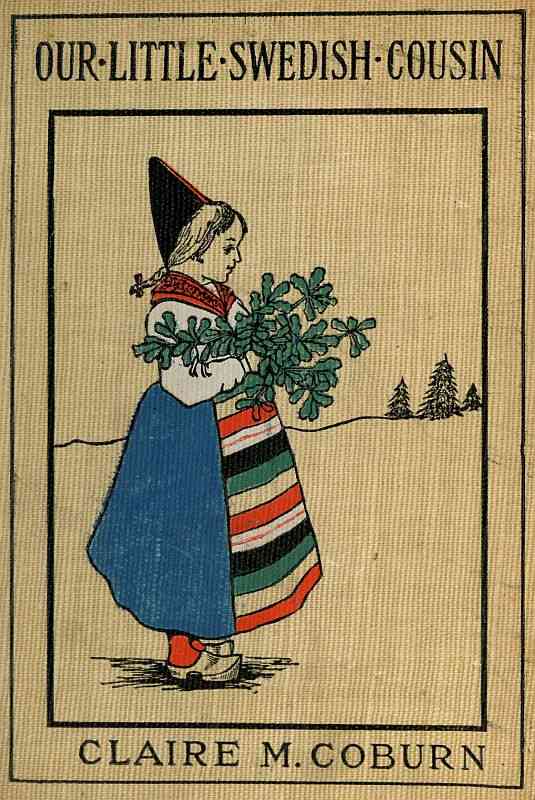
The Project Gutenberg eBook of Our Little Swedish Cousin
Title: Our Little Swedish Cousin
Author: Claire Martha Coburn
Illustrator: L. J. Bridgman
R. C. Woodberry
Release date: September 4, 2013 [eBook #43638]
Most recently updated: October 23, 2024
Language: English
Credits: Produced by Emmy, Beth Baran and the Online Distributed
Proofreading Team at http://www.pgdp.net (This book was
produced from images made available by the HathiTrust
Digital Library.)
in tint. Cloth, 12mo, with decorative cover,
per volume, 60 cents.
LIST OF TITLES
By Mary Hazelton Wade (unless otherwise indicated)
| Our Little African Cousin |
| Our Little Armenian Cousin |
| Our Little Brown Cousin |
| Our Little Canadian Cousin |
| By Elizabeth R. Macdonald |
| Our Little Chinese Cousin |
| By Isaac Taylor Headland |
| Our Little Cuban Cousin |
| Our Little Dutch Cousin |
| By Blanche McManus |
| Our Little English Cousin |
| By Blanche McManus |
| Our Little Eskimo Cousin |
| Our Little French Cousin |
| By Blanche McManus |
| Our Little German Cousin |
| Our Little Hawaiian Cousin |
| Our Little Indian Cousin |
| Our Little Irish Cousin |
| Our Little Italian Cousin |
| Our Little Japanese Cousin |
| Our Little Jewish Cousin |
| Our Little Korean Cousin |
| By H. Lee M. Pike |
| Our Little Mexican Cousin |
| By Edward C. Butler |
| Our Little Norwegian Cousin |
| Our Little Panama Cousin |
| By H. Lee M. Pike |
| Our Little Philippine Cousin |
| Our Little Porto Rican Cousin |
| Our Little Russian Cousin |
| Our Little Scotch Cousin |
| By Blanche McManus |
| Our Little Siamese Cousin |
| Our Little Spanish Cousin |
| By Mary F. Nixon-Roulet |
| Our Little Swedish Cousin |
| By Claire M. Coburn |
| Our Little Swiss Cousin |
| Our Little Turkish Cousin |
New England Building, Boston, Mass.
Our Little Swedish
|
||
By L. C. Page & Company
(INCORPORATED)
All rights reserved
First Impression, July, 1906
COLONIAL PRESS
Electrotyped and Printed by C. H. Simonds & Co.
Boston, U. S. A.
Preface
For more than five thousand years, the ancestors of our little Swedish cousin have dwelt in the Scandinavian peninsula. No wonder she loves the stories of the Vikings, the old legends, customs, and fête-days. They are her priceless heritage from the days of long ago.
The snow and glaciers on the extreme north cut off this long tongue of land, so that it is as separate from the rest of Europe as an island. In the olden days, almost every Swede tilled the soil and lived remote from his neighbour. Villages were few, so that each family created its own little world of work and pleasure. Even the children must be very industrious and ingenious to help supply the needs of the family. Whether she lives in the city or the country, every little Swedish girl to-day is taught this same thrift and industry.
Because the winter months, when the sun shows his face but a few hours each day, are long and dreary, our northern relatives fairly revel in their short summers. The whole nation lives out-of-doors and rejoices in the merry sunshine. All day excursions, picnics, and water trips are crowded into the brief season.
The peasant still owns his little red cottage and the well-to-do farmer and the nobleman live in their old homesteads. The cities continue to be small in number and in size, but slowly, slowly, the great throbbing life of the outside world is creeping in to steal away much of the picturesqueness of this old nation.
You will be surprised to learn in how many ways the life of our little Swedish cousin is similar to that of American children. But she is such a very hospitable and polite little maid, I am sure she will give you a hearty welcome if you visit her and see her for yourself at work and at play.
Contents
List of Illustrations
| PAGE | |
| Sigrid | Frontispiece |
| Brita and Her Foot-pusher | 6 |
| "A sheaf of grain is fastened up in the yard of every country home" | 38 |
| Baking Rye Bread at Grandmother's | 52 |
| "In a twinkling, the children . . . were dancing around the pole" | 62 |
| The Göta Canal | 86 |
CHAPTER I.
"Sigrid, Sigrid, hurry and get your skates. The ice is at last safe, and mother says that we may go to the park with Miss Eklund, this afternoon."
Erik thrust his head through the nursery door to announce the good news to his sister, who was poring over her lessons for the next day.
"Oh!" cried the little girl as she quickly slipped out of her seat at the long table, "I am so glad, for I thought I should never have a chance to wear the new skates that father gave me on my birthday."
In a trice, she had gathered up all her books, packed them neatly away, and was off to put on her warm furs. She was a flaxen-haired little maid, with very blue eyes, and plump rosy cheeks as round as an apple, because she lived out-of-doors a great deal and romped with her brothers.
In just no time at all, she had put on her warm blue coat, lined with gray squirrel, and a little cap to match, with the fur also on the inside. She quickly fastened on her rubber overshoes, which had a border of fur around the top and down the front. When she had found her white woolen mittens with a quaint red and blue pattern knitted right across the back, she was ready to join her brothers Erik and Anders.
They were a jolly little party of merry-makers, for it was the first skate of the season. Our Swedish cousins who live in the city may not go skating whenever they like. They must wait till some wise person appointed by the government says the ice is quite thick and firm.
"I will beat you running down-stairs to the porter's door," called Sigrid, who was bubbling over with good spirits. Away she flew, down the long flight of stone steps, and stood dancing up and down on one foot, waiting for the others.
Sigrid's father was an officer in the king's army, and in the winter-time, she and her big brother Erik and her little brother Anders lived with their parents and their governess, Miss Eklund, in a large apartment house in Stockholm. All the city people in Sweden live in these houses, plain and substantial on the outside, but comfortable inside, and not so very unlike American houses. In the centre of every house is a great stone stairway, and at the entrance sits a doorkeeper behind a tiny port-hole window. Every one who came to call on Sigrid's mother, who was a very hospitable lady, and had many guests, must ring the porter's bell. Then up would bob his head before the little window to see if he should let them in. He peered through the window so quickly after any one rang the bell that he always reminded Sigrid of a Jack-in-the-box.
"Gerda and Per are coming too," said little Anders as he walked by Miss Eklund's side. He had just learned to skate, so that he felt quite grown-up to be allowed to go at all. Everybody can skate in Sweden, so that the children learn when they are very young.
The merry group crossed the street to the left side, instead of to the right as we should go, and started off briskly. Every few steps, Sigrid would make a little bobbing courtesy as she met some older friend. Such a funny little bow it was, made by quickly bending the knee without stopping her walk.
"Brita has such a beautiful new foot-pusher that her father has bought her," exclaimed Sigrid. They had reached the open country near the skating-park, and a couple of children rapidly skimmed past them on these strange sleds. "Don't you think that I am old enough to have a foot-pusher now, Miss Eklund?"
Christmas was very near and the air was already full of secrets, so Miss Eklund smiled to herself and replied, "Perhaps you might ask the good father at home what he thinks about it."
I don't believe that you know what a "foot-pusher" or "kicker" is. I am sure I don't know why you should. Picture to yourself the framework of an ordinary sled with two wooden rods fastened at right angles to each runner. In the front part of this odd-looking object, Brita had strapped her skates to a low narrow seat. She stood on one runner, grasped these rods, and gave a quick little kick with the other foot, which hastened the sled along at a lively pace.
Soon the gleaming sheet of ice spread out before them. Already it was quite dark with people who were gliding merrily about.
"Oh, Sigrid, the band has begun to blow," cried Erik gleefully, for a Swedish ice carnival is never complete without a band "to blow," as they say.
"When I came home from school this noon," continued Erik, "I saw them thrusting the little evergreen trees into the snow around the seats."
Fir-trees and clumps of old beeches grew on the snow-clad hills about the pond, but this wreath of evergreen trees on the rim of the ice, was to shelter the older people who sat wrapped in furs to watch the sport.
"Those boys look like great white birds," said Sigrid, who was already fastening on her skates. She stopped a minute to watch a group of three boys who were skating with sails attached to their backs,—big white sails shaped like a capital A with the top cut off.
"Now for a race," cried Anders, and away they glided over the ice to find Gerda and Per, who lived in the same big apartment house.
Though it was only three o'clock in the afternoon, the sun had already set, for you will remember that in Stockholm the winter days are very short, and in the middle of the winter the lazy sun does not get up till after nine o'clock in the morning. But the twilight lingers for a long time, so that it does not get dark for a couple of hours after sundown.
All too soon, it was time to start for home, but none of the children thought of teasing to stay longer, for Swedish children are taught to obey without asking why.
Already a couple of huge bonfires flamed up along the shore. Just as they were leaving the edge of the pond, a dozen dark figures with blazing torches passed them. So silently and swiftly did the little procession twinkle by, that you might have thought them will-o'-the-wisp lights. But the children knew they were expert ski-runners, who were bound for the smooth hillside.
The long white slope was just the best place for the ski-lobing, and it was quite alive with people, for no winter sport is more wildly exciting. Every one wore narrow strips of wood, sometimes twelve feet long, turned up at the front, to the centre of which the foot was firmly secured. At a given signal, they placed their feet together, and down the hillside they shot, as though they had wings.
"I never see ski-lobing without thinking of the olden times when the fleet-footed peasants on skis were our only postmen," said Miss Eklund.
"They can go over frozen rivers and hills as straight as a bird flies," said Erik.
"Yes," said Miss Eklund, "when we had no post, the only way a message could be sent in winter, was by these ski-runners. The swiftest runner in a hamlet would start for the nearest village. There he would give the message to another runner to carry on to the next hamlet. It is wonderful how soon they could arouse the whole country.
"Instead of a letter, they carried staffs of wood. If this stick was burned at one end, it meant that a forest was afire. But if a red rag was attached, then the enemy had invaded the land and men were called to arms."
They were almost home now, and as they turned a corner a rough shed appeared in the corner of a park. Several people were just coming out. "Please, Miss Eklund, may we stop just a minute to see the ice figures?" exclaimed all the children at once.
"You must be quick or we shall be late to supper," replied Miss Eklund, who always enjoyed these beautiful snow pictures as much as the children.
Inside the low shed, was the figure of a young mother, with a sad but lovely face, who held a wee baby close in her arms. A fierce wind seemed to swirl her draperies, and she was trying to shelter the tiny creature at her breast, while a little boy was weeping bitterly against her skirts. The group was made of snow and ice, yet so wonderfully moulded were the figures, they looked like pure white marble.
As they went out the door, Miss Eklund slipped a coin into a little box which was placed there to receive money for the poor at Christmas.
"Elsa and Karl must have been out in the country to see their grandmother," said Sigrid, as a sleigh jingled past. The mother and two children were cosily packed in front. The driver stood on a little platform built in the rear. A white net with a wide border of tassels covered the back of the horse and the dasher of the sleigh.
"Father," burst out Erik, as he came in from the cold, "we did have the best time. Little Anders can skate as well as the rest of us now."
"Well," replied Major Lund, "you certainly look as though you had enjoyed yourself. But somebody will lose his porridge if he is not ready for supper soon."
The family gathered about the table. Before they began, the father turned to his oldest child and said,
"Erik, I believe it is your turn to say grace to-night. Sigrid said it yesterday."
Every one stood while the boy solemnly bowed his head and said the simple words.
Oh, they were so hungry! Didn't their supper of rice porridge, flat rye bread, pancakes and milk taste good! The three children sat very quietly at the table and ate all the food that was served them. Not a spoonful of porridge or a crumb of rye bread was left.
Perhaps you never saw Swedish flat bread. Even the king's family eat these big brown cakes, which are as much as a foot across, and look like a thin, crisp cookie. They have a large hole in the centre. In the farmers' houses, they run a long pole through this hole, and hang their bread from the ceiling.
When the meal was over, each child rose and shook hands with the father and mother and said, "Tack för matin," or as we should say, "Thanks for food." Then the parents thanked each other. So many thanks may seem very strange to you, but it is an old and beautiful custom in Sweden.
"I am glad my little girl had such a happy afternoon," said Mrs. Lund as she sat embroidering with her daughter beside her. "But there will be very little time for skating, during the next few days. Christmas will be here before we know it, and you can help me about many small things."
"Mother, may I go with you to the Christmas market this year? You know I was sick and could not go last year," said Sigrid.
"I remember, Sigrid," replied her mother. "You must go to bed now, and we will plan about it in the morning."
CHAPTER II.
"Won't mother be surprised, Miss Eklund, when she finds out how fast I have learned to knit?" said Sigrid.
"Yes, I am sure she will be much pleased," replied Miss Eklund.
Sigrid was very soberly knitting a red worsted square, while her governess sat near to help her when the little steel needles behaved badly. It was Sigrid's first piece of knitting, so she was flushed and eager over her task.
The morning sun poured through the window on a pretty picture. Against the heavy dark wooden chair, Sigrid's pale gold hair shone and glistened. It was brushed back very tight and trim, for that is the way Swedish mothers think little girls should wear their hair. The two smooth braids were fastened with a broad blue ribbon. Over her plain dark blue woolen dress, she wore a blue and white checked gingham apron. Except for the aprons which she always wore, Sigrid's dresses were much like those of her little American cousin, only they were very plain and simple. She did not have any rings, or bracelets or necklaces. That was not because she did not love the pretty trinkets. Oh, no. But she must wait till she is older.
The nursery where they were sitting was a large comfortable room with a huge porcelain stove which filled all one corner of the room and reached way to the ceiling. It was made of shiny green tiles, the colour of the walls of the room, and down in the front were two large brass doors, behind which was the fire. This was the only kind of stove that Sigrid had ever seen, so she never thought that it was queer.
I must not forget to tell you about the odd decoration of the nursery windows. After the fashion of all Swedish windows, they swung out from the middle like doors. When the cold winter months came, on went double windows. Though Sigrid was the healthiest child in the world, she never knew what it was like to open a window in winter and let the fresh, pure air blow in, for all around the inside of the frame were neatly pasted narrow strips of paper. You buy these strips at the store with mucilage on the back like a postage stamp. In the little narrow space between the two windows, Sigrid's mother had planted bright green mosses and gray lichens with tiny red cups. A little wooden house and several painted wooden men and women were placed in this miniature park, that kept green all winter. Sigrid liked her window better than any in the house, for all the others had only the mosses and coloured berries.
"Before many months, I believe you will be able to knit a pair of stockings," said Miss Eklund, as she watched her industrious pupil.
"Did you have to make all your stockings when you were a little girl?" said Sigrid.
"Yes, indeed. I was smaller than you are when I began to learn to knit, for my father was a poor farmer and there was a large family of us. The first thing I ever made was a cozy for a coffee-urn, just as you are doing," said Miss Eklund.
"Oh, tell me what you used to do when you were a little girl. Did you learn your lessons at home as Anders and I do?" asked Sigrid.
"It was very different when I was your age, for we lived way out in the country in a big red farmhouse, and our nearest neighbour was two miles away. We lived in the far north, so that when the winter days were only a few hours long, I could not go to school, but I learned a great deal at home. During the long evenings, father and my big brothers could not see to work on the farm or cut timber, so we would all sit together in the living-room with its huge open fire. Father made mother's chairs or a cradle for the baby, or whittled tools for the farm. Brother Olaf carved wooden platters and spoons with wonderful animals and figures. Then in the spring-time he would sell these things in the city markets.
"Mother used to spin and weave our warm clothes, and she taught me how to do all these things, besides sewing and embroidering. Sometimes, father would tell us the same old sagas that you children love to hear."
"Did you have to study catechism, too?" Sigrid's rosy face looked quite solemn at the thought, for every day she had to learn a portion of the catechism, and also Bible history. She loved the stories of David and Saul and Daniel in the lions' den, but the catechism! Oh, that was very, very hard for a little girl!
"All little Swedish girls must learn their catechism, Sigrid, and my father was even more strict than your good parents," replied Miss Eklund.
"Elsa's big sister, who went to England last year, says that English children do not have to learn to knit and sew and embroider just as they learn their geography and spelling. Why do I have to learn to do these things, when my father could buy them for me?" asked Sigrid.
Just then, Sigrid dropped a stitch in her knitting, and had to unravel two rows before Miss Eklund could reply.
"Even though your mother lived in a beautiful house and her father was very rich, she also learned to knit and sew and crochet. You must know how to do these things so you will be able to take care of your own home when you grow up. But it is time for dinner now and I hear your mother's callers going. Make haste and put your knitting away lest she see her present."
Every morning, Sigrid had an early breakfast with her brother Erik, who went to a private school. He was studying very hard to go to the university at Upsala. Then she must study her lessons and learn many of the same things which her governess had been taught in the long winter months on the farm. And after that came her gymnastic exercises every day, as much a lesson as her reading and spelling.
"Erik," called Sigrid, after dinner, as her brother walked past the nursery. Though he was only three years older than his sister, he was a tall, sturdy boy, and Sigrid felt very proud of him. She beckoned him to a quiet corner where they could whisper unobserved.
"I have a surprise for mother. Miss Eklund has taught me to knit, and mother does not know yet. If I can get it finished, it is going to be a cozy for Christmas."
"That's fine," said Erik, "but you wait till I show you something which I learned to make in my sloyd class at school." Erik glanced around cautiously. Nobody was in sight, so he drew a carved tray from his school-bag.
"Oh, it's beautiful!" and Sigrid clapped her hands with glee. "How could you make it? Why, it is just like an old Viking ship with the dragon's head peering at you from the prow. And you have made the sides like the scales of some strange monster. Mother will be so delighted.
"It must be splendid to be a big boy and go to your school," continued Sigrid. "You do such interesting things. I wish that I could go on a school journey with my teacher for two or three days and see some of our wonderful old castles, as you do. Mother says perhaps Miss Eklund and I may go with her and father when they go through the Göta Canal to Göteborg, next summer, to visit Aunt Frederika. That will be better than a school journey."
"But, Sigrid, there are many wonderful things to see right here in our own beautiful Stockholm," said Erik. "Many school-children come here every spring with their teachers."
"Sometime you promised you would tell me an old saga about Stockholm before there was any city here," said Sigrid.
"Oh, you mean about King Agne," said Erik. "Once father pointed out to me the place where he was supposed to have landed with his ships, so I always like that story."
"Yes, yes, that is the one. Do tell me," said Sigrid.
Erik loved to tell his little sister these stories that he had often heard from his mother and father, so he did not need to be urged.
"Many hundred years ago, when the bold Vikings sailed out from our harbours and conquered far and wide, King Agne ruled in Upsala. Where our city is to-day, was only a group of green wooded islands with a few huts. Late in the summer, King Agne came sailing in from the Baltic, and dropped anchor near the large island, where the king's palace is to-day."
"Why, I can see that from mother's window," said Sigrid.
"Yes, we are so high up from the water, we can easily see the island. These old Viking kings often went on voyages of conquest along our shores. Way off to the east, King Agne had warred against King Froste of Finland and slain him. Then the victor plundered the country and sailed over here with much booty. He had taken captive the king's beautiful daughter Skialf, his son Loge, and many others.
"King Agne was exultant over his victory and he wanted to make the Princess Skialf his bride. So he said to his henchmen:
"'Let a spacious tent be erected beneath that fine oak-tree on yonder tongue of land. Then let my swiftest runners carry staffs of invitation to all the chieftains round about and bid them gather at a royal feast to celebrate the wedding of King Agne and the fair Princess Skialf. Command them that they bring a goodly store of meat and drink for the feast.'"
"Miss Eklund told us about the messengers' staffs when we went skating, so I know about them," interrupted Sigrid.
"These sticks were burned at one end, with a noose at the other end. This was a very plain way of telling the chieftains that they would be hanged and their houses burned, if they neglected to send the message on to the next chief.
"So a large number gathered in the huge tent which looked out on the Baltic, where the dragon-prowed ships lay at anchor.
"All this time the poor princess was very unhappy. But she dared not let the king know her fears. She thought and thought how she could escape becoming his bride. Finally a plan grew in her mind and she said to the king:
"'O brave and generous king, I beseech you that, before the royal wedding feast, you hold a funeral banquet in honour of my noble sire. My lord, may you give ear to this great favour which a captive maiden begs for her father.'
"The princess prayed so piteously that the heart of the old Viking was melted, and he again commanded:
"'Let the two feasts for my slain enemy and for my wedding be celebrated at the same time.'
"The goodly company gathered around the royal board, and fell to eating and drinking with great zest. The grave-ale was handed around in a huge drinking-horn, and the lusty warriors drank so long and so deep that soon they became boisterous and began to fight among themselves.
"Now the king wore about his neck a long and massive chain of gold. It was so long that it hung way down on his chest. Many other Viking kings had worn this royal treasure.
"In the midst of the carousal, the princess whispered to the king:
"'My lord, have a care for your beautiful gold necklace, lest you lose it during the revels.'
"'Ah, my lovely bride, you are right. What a prudent and careful wife you will make!' said the king, as he coiled the chain several times around his neck.
"Ere long, the fiery-hearted warriors were so drunk with ale that sleep overcame them, and one by one they fell from their places at the table. As soon as they were soundly slumbering, the princess rose from her place by the king's side. She and the other captives had only pretended to drink. She fastened a ship's rope to the coil of gold about the king's neck and then handed the rope to her brother, who was outside.
"Whist! the men threw the rope over the branch of the huge oak. Up went the tent into the air, and the king was strangled with his own golden chain."
"What a horrible story!" said Sigrid with a shudder. "What became of the princess?"
"Oh, she and the other captives hastened away to the ships and sailed back to Finland. When the Vikings awoke from their heavy sleep, they were wild with rage. But there was nothing to do but to bury the king beneath a great mound of earth, which the waves long since washed away."
"Ugh! I am glad I did not live in those cruel days, aren't you, Erik?"
But Erik shook his head and laughed. "Just think what fun it would be to sail away in a brave ship, out on the wild ocean where no man had ever been before. Those old Vikings were as strong as giants and feared nothing in the world. I must finish studying my lessons now, but I'll tell you another tale some other time."
CHAPTER III.
"I'll bring you a gingerbread goat," said Sigrid to little Anders as she started for the Christmas market with her mother.
"Next year you shall go too, my son," said Mrs. Lund. She kissed the little lad, who was trying to look brave because he must stay at home. From the nursery window, he watched them as far as he could see down the long avenue. Behind Sigrid and her mother, a cheery-faced housemaid followed at a respectful distance. She carried a huge market-basket.
"Just think, mother. There are only three days before Christmas. Won't it be jolly to see grandma and Aunt Frederika and all the cousins?" said Sigrid, who was dancing along beside her mother.
"Yes, indeed. They will all be here by to-morrow night," replied the mother.
"What crowds of people are on the street," said the child, as they wound their way through the good-natured throngs.
"Most of them are bound for the same place that we are," laughed Mrs. Lund, who was rosy-cheeked and flaxen-haired like Sigrid.
"When we come to the big open space at the top of this hill, where all the booths are, you must keep very close to my side, for you might easily lose me."
"I never saw so many little booths before," said Sigrid. "I like their white roofs, for they look like snow. Do they always have the Christmas market on this hilltop?"
"Yes, for hundreds of years the peasants have been allowed to build their shelters here and sell their Christmas wares. In some places, for months, the whole family has been carving, knitting, weaving, and sewing all these things that we shall see as we walk along," replied Mrs. Lund.
"I see a booth with lots of little gingerbread pigs and goats. May I buy one for Anders, over there?" asked Sigrid.
"In a minute. But first I must get some of old Brita's knitted caps for some poor children I know."
They halted in front of one of these booths, which have a few rough boards for a roof and a narrow counter. Here was an old peasant woman, so wrapped up in warm clothes that you could scarcely see her pleasant, wrinkled face. A black shawl was tied over her head, and a second dark woolen shawl was crossed over her breast and tied behind. Her petticoats were so heavily wadded that you wondered how she ever walked at all.
"Doesn't she look funny, mother?" whispered Sigrid, who was clinging to her mother's hand.
"Speak low, child," said Mrs. Lund. "I would not have you hurt the old creature's feelings. It is bitter cold standing here all day. She needs all her warm clothes. As long ago as when I was a child, she came here to sell these garments that she knits and crochets all summer.
"I think that must be King Oscar's sleigh which has just come up the hill," said Sigrid as they turned away from Brita's booth.
"Sure enough. He is making his annual visit to the Christmas market. Let us stand here and watch him for a minute."
Just then the big Christmas crowd burst into a shout: "Long live King Oscar!" The white-haired old gentleman, who is so tall and stately that you would notice him anywhere, bowed graciously to his people.
"Would he ask me what I wanted for Christmas, if I stood near him?" asked Sigrid.
"No, he asks only the poor little children who don't look as though they would have a tree at home," replied Mrs. Lund. "Ah, he is talking to that ragged little fellow who watched us buy the accordion for Karl. By and by, his servant will buy a lot of things and give them to the children. He is a kind-hearted man as well as a good king."
"Hear all those birds singing!" exclaimed the child.
"Listen again and see if you cannot tell where they are," said Mrs. Lund.
"Why, I believe they are cuckoo whistles, only I never heard so many all at once," cried Sigrid.
"Suppose we go over and buy two or three," said Mrs. Lund. They threaded their way to the booth where these cheap little clay birds were so popular.
The buxom maid was loaded with bundles long before Sigrid wanted to go home.
For the next two days, there was a great stir all over the house. Everything that could be washed and scoured was made clean and radiant. All the family were making presents. Oh, such mystery everywhere!
"There, Miss Eklund," said Sigrid. "I have finished the cozy. Now I want some more red sealing-wax. I have helped Anders wrap up his presents, and mine are almost ready."
"Have you fastened on your rhymes?" asked Miss Eklund.
"All except the one for Aunt Frederika's present. I cannot seem to think of a verse for her," was the reply.
"You must be sure and have a pretty verse for your dear aunt, who has come way from Göteborg. Perhaps I can help you later."
Miss Eklund left her little charge labouring with pencil and paper. Sigrid would never think her Christmas gifts complete without a verse for each one.
"Here come father and Erik with the tree," shouted Anders.
"Isn't this a beauty?" inquired Erik, as he and his father rested for a minute.
"Did you get it in the Christmas market, father? Mother and I saw a whole forest of little Christmas trees there," said Sigrid.
"Yes," replied Major Lund. "I wanted to take you children out in the country and cut it down myself. Sometime, when we have Christmas at grandmother's, that's what we will do. Then you all shall help choose the tree before I cut it.
"No one must go into the parlour now," he continued, as he carried the tree through the doorway. "Mind you, not one peep till to-morrow night." He shook his finger playfully at the children.
"I always like 'Dipping Day,'" said Sigrid, the day before Christmas, to her brother Erik. "It is such fun to eat in the kitchen."
She was waiting for her turn to dip the piece of black bread on her plate, into the kettle of sizzling hot fat. All the family, the relatives who had come to spend the holidays and the servants, stood about in the clean kitchen, eating the noonday meal. The walls fairly gleamed with copper and brass pans and kettles. Even the brick oven had a fresh coat of whitewash, in honour of the day. Every other little Swedish girl over the land was eating her dinner in the kitchen on that day, just as Sigrid was doing.
In the centre of the room, a long table was loaded with good things to eat. And here was the big kettle in which the Christmas ham and other meats had been cooked.
Later in the afternoon, when the children returned from a brisk walk in the park, they gathered in the nursery for afternoon coffee. How Sigrid loved this coffee-drinking on Christmas Eve! All the grown-up people in Sweden drink a great deal of coffee. But Sigrid was seldom allowed to have it except on a few holidays.
The children could hear the pleasant chatter of the older people, whose coffee was served in the parlour. But they knew what was waiting for them in the nursery.
On the little table there, a plate was prepared for each child with a pyramid of different kinds of bread. Some of these rolls were in such odd shapes that I am sure you would not call them bread at all. There was black bread, white bread, saffron-coloured bread, some shaped like little men and others like pigs and goats. Of course there were gingerbread men, and even chocolate bread figures.
Each little mound had candy and nuts tucked away in the corners. The kind of candy which Sigrid liked best was done up in a small package with bright paper. Pictures and mottoes were pasted on the outside.