
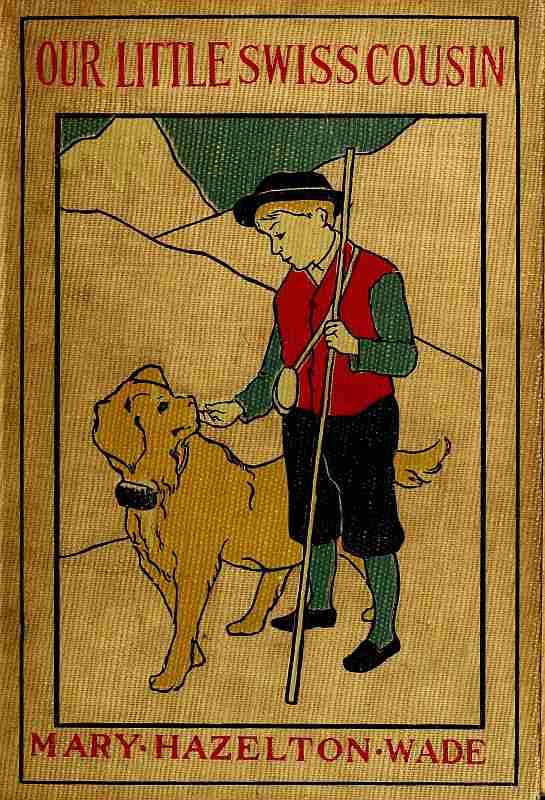
The Project Gutenberg eBook of Our Little Swiss Cousin
Title: Our Little Swiss Cousin
Author: Mary Hazelton Blanchard Wade
Illustrator: L. J. Bridgman
Release date: September 4, 2013 [eBook #43639]
Most recently updated: October 23, 2024
Language: English
Credits: Produced by Emmy, Beth Baran and the Online Distributed
Proofreading Team at http://www.pgdp.net (This file was
produced from images generously made available by The
Internet Archive)
in tint. Cloth, 12mo, with decorative cover,
per volume, 60 cents.
LIST OF TITLES
By Mary Hazelton Wade (unless otherwise indicated)
| Our Little African Cousin |
Our Little Armenian Cousin |
Our Little Brown Cousin |
Our Little Canadian Cousin |
| By Elizabeth R. Macdonald |
Our Little Chinese Cousin |
| By Isaac Taylor Headland |
Our Little Cuban Cousin |
Our Little Dutch Cousin |
| By Blanche McManus |
Our Little English Cousin |
| By Blanche McManus |
Our Little Eskimo Cousin |
Our Little French Cousin |
| By Blanche McManus |
Our Little German Cousin |
Our Little Hawaiian Cousin |
Our Little Indian Cousin |
Our Little Irish Cousin |
Our Little Italian Cousin |
Our Little Japanese Cousin |
Our Little Jewish Cousin |
Our Little Korean Cousin |
| By H. Lee M. Pike |
Our Little Mexican Cousin |
| By Edward C. Butler |
Our Little Norwegian Cousin |
Our Little Panama Cousin |
| By H. Lee M. Pike |
Our Little Philippine Cousin |
Our Little Porto Rican Cousin |
Our Little Russian Cousin |
Our Little Scotch Cousin |
| By Blanche McManus |
Our Little Siamese Cousin |
Our Little Spanish Cousin |
| By Mary F. Nixon-Roulet |
Our Little Swedish Cousin |
| By Claire M. Coburn |
Our Little Swiss Cousin |
Our Little Turkish Cousin |
L. C. PAGE & COMPANY
New England Building, Boston, Mass.
Our Little Swiss
|
||
By L. C. Page & Company
(INCORPORATED)
All rights reserved
Published, July, 1903
Fourth Impression, December, 1906
Colonial Press
Electrotyped and Printed by C. H. Simonds & Co.
Boston, Mass., U. S. A.
Preface
In the very heart of Europe lies a small country nestling among the mountains. It is unlike any other in the world. Its people speak four different languages; they believe in different religions; the government is not alike in different parts; yet the Swiss states are bound together by a bond stronger than unity of language or creed can possibly make.
Our brave Swiss cousins believe in liberty for all and brotherly love. These make the most powerful of ties.
In their mountains and valleys they have fought against the enemies who would have destroyed them, and the tyrants who would have made them slaves. They have driven out their foes again and again, for their cause was noble and unselfish, and to-day the republic formed by them can teach other countries many wise and worthy lessons.
How the stories of William Tell and Arnold von Winkelried stir our hearts whenever we hear them repeated! These were only two of many heroes who have made the country famous for its bravery and unselfishness.
Surely we shall be glad to turn our minds for a while to its fertile valleys, beautiful lakes, and the noble mountains among which the good monks live with their trusty dogs, that they may give aid and comfort to unfortunate travellers overtaken by cold and storm.
Contents
| CHAPTER | PAGE | |
| I. | Carl's Holiday | 9 |
| II. | The Mountain Pasture | 27 |
| III. | The Schoolmaster's Visit | 43 |
| IV. | The Brave Archer | 51 |
| V. | The Haymakers | 63 |
| VI. | The Marmot | 76 |
| VII. | Glacier and Avalanche | 92 |
| VIII. | Santa Claus Night | 105 |
| IX. | The Wonderful Abbey | 110 |
List of Illustrations
| PAGE | |
| Carl | Frontispiece |
| The Chalet | 30 |
| "'Following its master about just like a dog'" | 49 |
| Climbing the Matterhorn | 79 |
| "It was a river of solid ice!" | 95 |
| On the Lake | 121 |
CHAPTER I.
"To-morrow, to-morrow!" Carl kept repeating to himself.
He was standing at the window of the little cottage and looking out toward the great mountain. He had lived under its shadow all his life. Its snowy summit was coloured a fiery red as it stood against the sky in the sunset light. People in far-away lands would give a great deal to see such a glorious sight.
But Carl saw another picture in his mind. It was the grand procession of the next day, that would celebrate the close of school before the summer vacation. Thousands of children would march in the line. They would carry the flag of Switzerland,—the white cross on a red ground. It was the emblem of their country's freedom, and they loved it well.
There would be bands of music; there would be a speech by the mayor of the city. Feasts would be spread, to which all the children were invited. Yes, the glorious day was near, and Carl was very happy.
"Carl, my boy, are you thinking of the good time to-morrow?" said a voice at the other side of the room.
Carl started, and, turning round, he saw his father standing in the doorway.
"O father, is that you? How glad I am to see you!" and the little boy rushed into the good man's arms.
"Yes, I am all ready for the festival. Mother has my best clothes laid out on the bed. She is planning to go, too, and now you are home just in time to go with us. I am very, very glad." Carl was so excited that he talked faster than usual.
"I am tired of working in a hotel in the city, the country is so much pleasanter," answered his father. "And now I shall spend the summer with your mother and you. The people of the village wish me to take the cows to the mountain pasture. You shall go, too, and we will have a good time together."
"That will be fine. I never spent the whole summer there before. How soon are we to start, father?"
"Next week. The days are growing warmer and the flowers must already be in bloom upon the Alps. But now we must see your mother and talk about to-morrow. On my way home I heard in the village that you were going to the festival. Nearly all the neighbours are going too, aren't they?"
At this moment the door opened and a kind-faced woman came in, bringing a pail of milk in each hand. Her eyes were as blue as the sky, and her hair was nearly as fair as Carl's. It was easy to see that she was the boy's mother.
A happy smile lighted her face when she saw who was in the room. It was as much a surprise to her as it had been to Carl. She supposed her husband was still working in the big hotel at Lucerne, where so many strangers came from other lands.
When her husband told her of the work he had been doing, the heavy trunks which he had to lift till his back had grown lame, her face grew full of pity.
"It was too hard for you, Rudolf," she cried. "It is far better for you to take care of the cows this summer. We will go with you, Carl and I, and we shall have a merry time."
She moved quickly about the room as she strained the milk into the crocks and made ready the simple supper. In a few minutes the little family gathered around the table. There was sweet, fresh milk from the cows. There was the black rye bread which Carl had been used to eating all his life,—indeed, he had never seen white bread in his home. Besides these, there was a round cheese, from which each one cut a slice as he wished.
Best of all, there was a sort of cake made of dough and chopped dried fruits. Apples and cherries and almonds were all mixed in this cake and Carl thought it was very nice. It was put on the table to-night in honour of his father's home-coming.
Night after night Carl had a supper like this. Morning after morning, the breakfast was the same. The only difference was that sometimes there was the cake with the dried fruits.
Yet Carl was very happy and healthy. To be sure, he had meat and coffee for dinner only once a week. This was on Sunday. It was no wonder that he looked forward to that day as the best of all, for it seemed a feast day to him. At the noon meal on other days there was only soup or potatoes with the bread and cheese. There was little change through the year except at the time when the fruit and nuts were ripe and they could be eaten fresh.
After the supper was over, the family sat a while longer around the table and talked about the school festival. Carl's father had just come from Lucerne. He told the boy how the buildings were decorated. He named the bands that would furnish the music.
"I am to march, father," Carl said. "And I am to carry the flag of my country. Children from all the villages around the lake are to take part, I hear. Just think! although we are back in the country, our school has its place in the procession."
Carl's mother showed her husband the bright red skirt that she was going to wear. It would reach to the tops of her shoes. There was a white waist with big sleeves that she had starched and ironed. There was a new black bodice she had just made; it would be laced about the waist, and it fitted her finely. She had polished the bands of silver to fasten across the back of her head above the long braids of glossy hair. She would certainly look very well in her finery, and her husband would be proud of her. Oh, yes, that was certain.
What kind of a hat would she wear? None at all! There was no need, and it would be a shame to hide the silver bands; they were too pretty. What did it matter if some of the women of Switzerland dressed like the people of other lands? Carl's mother was not ready to follow new fashions yet awhile. The old customs of her village were good enough for her.
It was a small room where Carl and his parents sat and talked. Everything was fresh and clean; the floor had been scrubbed so that no spot could be seen upon it. The table was unpainted. The chairs had straight, stiff backs; no rocking-chair or lounge had ever found a place here. Carl's mother had never rested herself on such a piece of furniture in her life.
There was one strange-looking object in the room. It was large and white. It reached far up toward the ceiling, and was made of porcelain. It was the family stove. It had belonged to Carl's great-grandfather, and had stood in this very place, summer and winter, for a hundred years at least. It would not seem like home without it.
When baby Carl was first old enough to notice things around him, he used to creep up to the stove and try to touch the pictures painted on its sides. One was the scene of a battle where the Swiss were driving their enemies down a mountain. On the other side, a hunter was painted. He was bringing home a chamois that hung from his shoulders.
When the boy grew older, he used to climb the steps that led up to the top of the stove. It was so nice and warm there behind the curtains that hung from the ceiling down to the front edge. It made a cosy little room where Carl could lie and warm himself after a walk in the winter air. Sometimes the boy slept there all night long; but that was only in the coldest weather.
In the daytime his mother often put her fruit there to dry, or perhaps she hung wet clothes there. It had many uses.
There were no real stairs in the house. There was an upper room, however, and when a person wished to enter it he must first climb on top of the stove and then pass through a hole in the ceiling. It was a strange way of building the house; don't you think so?
Perhaps you wonder that Carl did not get burned when he lay on top of the stove. That was because there was never any fire in it! This probably seems the strangest thing about it, but you must understand that the fire was built in a sort of furnace out in the hall. The heat passed from this furnace into the porcelain stove, so it was not unpleasantly warm when one touched it.
After talking a while with his father, Carl climbed up to the top of the stove, and creeping through the hole in the ceiling, he entered his bedroom. He quickly said his prayers and then jumped into bed. He must get to sleep as early as possible, for he would be called before daybreak. At least, his mother promised to call him, but she did not need to do so,—he was the first one in the house to wake.
"Father! mother!" he shouted, before the clock cried "cuckoo," three times.
It was none too early; lights moving from room to room could already be seen in the neighbours' houses. The whole village was astir.
There was a walk of several miles for all who were going to the celebration. This walk would bring them to the shores of the lake. A steamer would be waiting at the pier to take them across to the city of Lucerne on the other side. A party of merry people moved along the road just as the sunrise coloured the mountain-tops. Every one was dressed in his Sunday best.
There were many little girls, all in white, their yellow hair hanging in long braids. Some of them had immense wreaths of flowers or laurel leaves to carry in the procession, but the flags were carried by the boys.
See! there is the beautiful lake just ahead. How blue its waters are! The shadows of lofty mountains can be seen if you look down upon the clear surface. Brave men have lived on its shores. Noble deeds have been done near by. Every Swiss loves this lake, as he thinks of the history of his country.
The little steamer was quickly loaded with its gay passengers, and made its way over the waters. Other steamers soon came in sight, but all were moving in the same direction,—toward the city of Lucerne.
Such a festival is not held every year. Each village generally celebrates the close of school by a picnic or steamer-ride. There is usually something pleasant for the children, but not always a time like this.
When the day was over, it was hard for Carl to tell what he had enjoyed most. In the morning, after the children had marched around the city to lively music, they went out to a large open space where the feast was served. Every one had all the coffee and cakes he wished. There were many odd little cakes that only Swiss women know how to make. The children enjoyed them hugely.
After the feast games were played, and there were rides on the flying horses. You will laugh when you hear the name of one of the games. It is "Blind Cow." Carl is very fond of it. It is much like our "Blind Man's Buff." Carl and his friend Franz chose one corner of a large field. Marie, Franz's sister, and Freda, another little friend, were with them. They were soon joined by other children, and they had a lively game.
Carl was the cow oftener than any one else. He didn't care. It was great fun stumbling around with blinded eyes, and trying to catch the others. When they thought they were quite safe and out of reach, one of them was sure to laugh and show where he was. Then Carl would make a sudden spring, and catch the laugher.
Before the afternoon was over, the mayor spoke to the children about the kind teacher who had helped not only the Swiss, but children all over the world. That teacher's name was Pestalozzi. Carl knew the story well, but he loved to hear it over and over again.
More than a hundred years ago there was a good man who lived in Switzerland very near Carl's house. It was a time of war. Soldiers from other countries had chosen Switzerland for their battle-field. They took possession of the homes of the people. They destroyed their crops. They ate their supplies of food. The Swiss suffered greatly. After these enemies had gone away, they found themselves poor, and many of them were starving.
Pestalozzi was not a rich man, but his heart was filled with pity. He went among the poor and gave them all he had. He was especially fond of the children. He cared for them as well as he could; he got them bread to eat and clothes to wear; best of all, he taught them and kept their minds busy. But at last his money was all spent. What could he do now?
He gathered the ragged, hungry boys around him. They had grown to love him, and were willing to do anything he directed. He showed them how to sew and spin and do many other kinds of work. They were soon able to earn enough money to support themselves and their school.
Pestalozzi did not teach in the way others did. He said:
"It is not enough for these children to study their lessons from books and then be whipped if they do not get them. They must see how real things are; they must study from objects. The living birds and flowers should help them. They must learn to shape things for themselves, and see as much as possible with their own eyes. Then they will love to study; they will enjoy their schools, and be happiest when there."
He set a new fashion for the world. His pupils learned so fast and well that other teachers came to watch and learn his ways. His fame spread to other countries, to England and America. They also copied his manner of teaching. Not only Swiss children, but those of different lands, began to enjoy their schools better. It all came about through the kind and loving work of Pestalozzi.
Carl has never known of a boy being whipped in his school. Such a punishment is seldom given in Switzerland. The teacher tries love and kindness first. If these fail, the boy is turned out of school. It is a terrible disgrace; it will follow the boy all his life, and he dreads it above everything.
After the mayor had spoken of Pestalozzi to the children, he bade them be proud of their schools and their school-buildings, which were finer than even the council-houses. He told them to be glad that all children of Switzerland, no matter how poor they were, could go to these schools and learn of the great world around them.
As he spoke, he could see in the faces of thousands of little ones that they were proud indeed.
Carl whispered to Franz, who stood beside him:
"There is no country like ours, is there, Franz? We could not be happy anywhere else, I'm sure."
His friend replied, "No, indeed, Carl. It is the home of free men, and we must grow up to keep it so. I don't care if we do have to study for six hours every school-day. We learn all the faster and, besides, we have ever so many holidays."
The best part of the holiday came in the evening, for that was the time for fireworks. There was a grand display on the shore of the lake. There were rockets, and Roman candles, and fire-pictures, and many other beautiful pieces which lighted the sky and were reflected in the waters of the lake. Many of the people watched the display from the decks of the little steamers, which were also bright with coloured lights.
The time came all too soon for the homeward journey.
"What a lovely time I've had," sighed Carl, as he reached his own door. "I only wish it were going to be to-morrow instead of to-day."
"It was a fine show indeed," said his father. "Everybody looked well and happy. But I must say that I liked the dress of the people of our own village better than that of any other."
CHAPTER II.
"Here, Carl, take this kettle, and you, Franz, may carry the other," said Carl's mother.
It was two days after the school holiday, and again the village was astir before sunrise. There was a great jingling of cow-bells as the men and boys moved about from farm to farm and gathered the cattle together.
Rudolf was to take all the cows in the village to the mountain pastures for the summer. Carl and his friend Franz would help him in taking care of them. Carl's mother would make the cheese. In the autumn, they would bring the cows back and divide the cheese according to the number of cows each family owned.
It was a joyful time and well deserving a holiday. Almost every one in the village would keep the herder and his family company on his way up the mountainside. Their food and cooking dishes must be carried; the cows must be kept in the right path, while their friends, who were leaving them for months, must be cheered and kept in good heart.
At last everything was made ready. Brown Katze, the handsomest cow in the village, led the line. She tossed her head as though she could already sniff the fresh air of the uplands. How the bells jingled! What gay songs rang out! Carl was a fine singer himself, and if you listened you could hear his voice above all the rest.
The procession at first followed a narrow path through the woods. There were many beech and chestnut trees where Carl would go nutting in the fall. After a while these were left behind, and evergreens were the only trees to be seen.
It was already growing cooler and the cows pushed onward. They seemed to know of the pleasure before them,—the sweet grass and herbs which they would soon be able to eat to their hearts' content.
Ah! the woods came to an end at last, and the beautiful pastures were reached. There is nothing in the world like them. It is no wonder that the cheeses made here are noted all over the world.
Here were thousands of the lovely Alpine roses, royal red-purple in colour. Here too, harebells, violets, and pansies were growing wild. It was difficult to walk without stepping on some delicate, beautiful flower.
The party followed a narrow path through the meadow. They soon came to the little cottage where Carl would pass the summer. The building was broad and low, and had a wide, overhanging roof on which great rocks were lying, here and there. They were needed to keep it from blowing off during the hard storms of the winter.
Carl's father opened the door and looked carefully around to see if everything had remained safe since the summer before. Yes, it was all right; no one would know from the appearance that people had not been inside the room for eight months at least.
There was the stove over which the milk would be heated before it could be made into cheese. The rough table stood in the corner, while at the farther end was a supply of hay to be used in case the cattle had need of it.
It was a large room, but there were many low windows, so it would be bright and cheerful when the shutters had been taken down. Just back of this room was the stable, where the cows could find shelter at night.
Shouldn't you think Carl would be lonely here? No other houses could be seen, no matter in what direction he turned. He might not look upon any human faces except those of Franz and his father and mother for days at a time. In whatever way he might turn, his eyes would meet mountains,—mountains everywhere. But he loved to be here; he loved these mountains with all his heart. They gave him a feeling of freedom and of strength, and he would often say to himself:
"Ah! the good God has given us a wonderful world to live in, and we are a part of it all."
Day after day of the short summer Carl and Franz would drive the cows higher and higher in search of new feeding-grounds. At last they would come to the bare, brown rocks near the summit, and they would know that the season's work was nearly over.
The villagers who had come with the family had a picnic dinner at the chalet, as the Swiss call a mountain cottage like Carl's. Then a few songs were sung with a hearty good-will. The time passed so quickly that the people came near forgetting how late it was growing when one of the party, standing in the doorway, heard the clock strike four.
"Good friends, we must start homeward at once," he cried. "Think of the long climb down and the dark path through the woods."
What a bustle and commotion there was now! What hearty hand-shakings were given! Then away they went, calling back from time to time, or blowing another farewell upon their horns when they were hidden from sight by the trees below.
Carl and Franz turned to help Rudolf in the care of the cows, for the milking must be done before nightfall. Carl's mother made up fresh beds from the hay and put away the provisions. She would soon have plenty to do besides, for the cheese-making would be her work.
"Carl," she said to her boy that night, "you will be old enough to be a herder yourself before long. In four or five years you and Franz can bring the cows here to pasture by yourselves, and do all the work, too. You must learn how to make cheese this summer."
So it was that the two boys took their first lessons, and before many days they had become good helpers inside the house as well as outdoors.
They would lift the great kettles of milk and place them over the fire to heat. At just the right moment, the rennet must be put in to curdle the milk and separate the curds from the whey. Now for the beating with a clean pine stick. Carl's strong arms could aid his mother well in this work, upon which the goodness of the cheese depended.
"Well done," the herder's wife would say. "It is easy enough to make cheese with two such good lads to help me."
She was very fond of Franz, and loved him like a son. The faces of both boys grew bright when they were praised like this, and they were all the more eager to work. There was plenty to do yet, for the boiling and pressing must come next.
At last a big mould was ready to set away; but even now it must be watched and turned, day after day.
Carl's mother proudly watched her store grow larger as the weeks passed by. Those cheeses would bring large sums of money,—at least, it seemed so to her. But, of course, the money would be divided among the different families, according to the number of cows each sent to the pasture.
One morning as Carl was watching the herd, he looked down the mountainside and saw a party of strangers coming up the winding path. Then he heard a voice call:
"Hullo, hullo, little boy! Is your home near by? And can we get a little something to eat? We are very hungry."
It was a gentleman who spoke these words. A lady and a little girl about ten years old were with him. They looked like Americans. Carl had seen many strangers from other lands, and he said to himself:
"Yes, they must be Americans."
The little girl was very pretty, and she gave Carl a sweet smile when he ran to help her up over a rough place.
"Yes, sir, I'm sure my mother will welcome you," said our little Swiss cousin. "There she is, now." And he pointed to the cottage a short way off, where his mother sat knitting in the doorway.
When Carl went home to dinner an hour afterward, he found the strangers still there. They had lunched on bread and cheese and the rich sweet milk, and they declared they had never tasted anything nicer in their lives.
"Oh, my!" said the little girl, "I believe I was never so hungry in my life before."
"Carl," she went on, for his mother had told her his name, "do you ever carve little houses to look like this one? If you do, I will ask my father to buy one. He told me that Swiss boys do carve all sorts of things."
"I am sorry," answered Carl, "but I never did work of that kind. Over to the west of us are villages where every one carves. The men do so as well as the boys. One family will make the toy houses all their lives; another will carve chamois and nothing else; still another will cut out toy cows. But we in our village have other work."
"But why don't the wood-carvers change? I should think they would get tired of always doing the same thing," said Ruth, for this was the child's name.
"I suppose they never think about it. It is hard work living among these mountains of ours. People wish to earn all they can, and if one makes the same kind of thing, over and over again, he learns how to do it very quickly."
"I understand now," answered Ruth. "And I see, too, why the Swiss have such a queer way of making watches. One man in a village keeps making one part of the works; another man works steadily, year after year, on another part, and so on. All these different parts are sent to the factory in the city, and quickly put together into complete watches. That is what my father told me, and he must know, I'm sure."
"Yes, that is the work of the people around Geneva," answered Carl. "I have never been to that city yet, but I hope to go there before long."
"We stayed there a week. Nearly every one I met spoke in French, while you talk German all the time, Carl. That seems so queer. You live in the same country, and yet you speak in different languages. Why, father says we shall soon visit another part of Switzerland where I shall hear nothing but Italian."
"I suppose it must seem strange to you," replied Carl, thoughtfully, "yet we all love our country, and each other. We would fight promptly to save Switzerland, or to help any part in time of danger. We even have different religious beliefs; but while we of our village are Catholics, and try to do as the good priests tell us, there are many others not far away who are Protestants. Yet we are at peace with one another. Oh, I believe our country is the freest and best in all the world. Excuse me, please; I can't help thinking so."
Ruth laughed. "I like you all the better, Carl, for feeling in this way. Of course, I love America the best, and shall be glad to get home again after we have travelled awhile longer. But I think your country is the most beautiful I have ever seen. And father says we Americans can learn some good lessons from Switzerland. I shall understand more about that, however, when I am older."
"How long have you been here in Switzerland?" Carl asked.
"It is two months, I think. But we haven't been travelling all the time. Mother wasn't well and we stayed most of the time at the queerest place I ever heard of. This was so mother could drink the waters and get cured."
"Do you remember the name of the place?" asked Carl.
"Yes, it is called the Leuken Baths."
"I've often heard of those waters. They are boiling as they come bursting out of the ground, aren't they?"
"Yes, but that is not the odd part of it, because there are many other boiling springs in the world. It is the way that people are cured at these baths that made me laugh. Why, Carl, some of them stay in the water all day long! They wear flannel gowns and sit soaking while they play games on floating tables, and even eat their dinners there. The men smoke, while the women laugh and chat. The hot water brings out a rash all over the body, and the blood, after a while, becomes purer."
Carl laughed when he pictured the food on floating tables and people sitting around them with only heads and shoulders out of water.
"Did your mother do like these others?" he asked, and he turned his head toward the beautifully dressed lady who sat talking with his parents.
"No, she said that was too much, but she drank a good deal of the water, and she feels better than she has for years," replied Ruth.
"Come, come, my dear, we have stayed a long time. I fear we have kept these good people from their work. We must thank them, and go back to the town."
It was Ruth's father who said these words. He was standing in the doorway, and ready to start.
"I shall not forget you, Carl," said the little girl. "I shall often think of this little cottage up on the mountain, with the pretty flowers growing around it and the cows feeding near by."
After they had gone, Carl hastily picked a bunch of Alpine roses.
"She thought they were beautiful," he said to himself. "Perhaps she will press one of them, and keep it to remember me by."
Then with strong bounds and leaps the little boy overtook the party before they had gone very far. When he reached them, however, he was suddenly overcome with shyness. He hastily put the flowers into the hands of Ruth's mother, and was far away again before she could thank him.
"He is a dear little fellow," said the lady. "He will make a strong man, and a good one, too, I believe. We will always keep these beautiful flowers. Perhaps we may come here again in a year or two, Ruth. Then we can tell Carl how much we thought of his little gift."