
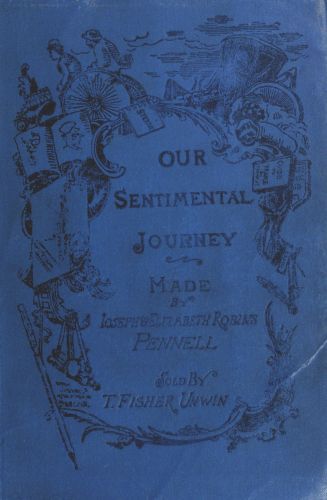
The Project Gutenberg eBook of Our sentimental journey through France and Italy
Title: Our sentimental journey through France and Italy
Author: Joseph Pennell
Elizabeth Robins Pennell
Release date: January 26, 2018 [eBook #56438]
Most recently updated: January 24, 2021
Language: English
Credits: Produced by Suzanne Shell, Chuck Greif and the Online
Distributed Proofreading Team at http://www.pgdp.net (This
file was produced from images generously made available
by The Internet Archive/American Libraries.)
|
(In certain versions of this etext [in certain browsers] clicking on the image will bring up a larger version.) (etext transcriber's note) |
By the same Author and Artist.
Play in Provence.
With nearly 100 Illustrations.
The Stream of Pleasure:
A Narrative of a Journey on the
Thames from Oxford to
London.
———
London: T. FISHER UNWIN.
OUR
SENTIMENTAL JOURNEY
THROUGH
FRANCE AND ITALY
BY
JOSEPH & ELIZABETH ROBINS
PENNELL
A NEW EDITION
WITH APPENDIX
LONDON
T. FISHER UNWIN
PATERNOSTER SQUARE
1893
PREFACE TO THE FIRST EDITION.
OUR great ambition when we first set out on our tricycle, three years ago, was to ride from London to Rome. We did not then know exactly why we wanted to do this, nor do we now. The third part of the journey was “ridden, written, and wrought into a work” before the second part was begun; and, moreover, when and where we could not ride with ease—across the Channel and over the Alps, for example—we went by boat and train. In our simplicity we thought by publishing the story of our journey, we could show the world at large, and perhaps Mr. Ruskin in particular, that the oft-regretted delights of travelling in days of coach and post-chaise, destroyed on the coming of the railroad, were once more to be had by means of tricycle or bicycle. We can only hope that critic and reader are not, like Mr. Ruskin, prepared to spend all their best “bad language” “in reprobation of bi-tri-and-4-5-6 or 7-cycles,” and that the riding we found so beautiful will not to them, as to him, be but a vain wriggling on wheels. We also thought we might prove to the average cycler how much better it is to spend spare time and money in making Pilgrims’ Progresses and Sentimental Journeys than in hanging around racetracks. However that may be, we have at length accomplished the object of our riding, and that is the great matter after all. As to future rides and records, if we make any, it is our intention to for ever keep them to ourselves, and so—spare the public.
PREFACE TO THE NEW EDITION.
TANDEM tricycling, like Mr. Laurence Sterne’s graveyard, has virtually disappeared. But the pleasures of cycling are so all-enduring that we venture to issue a new edition of Our Sentimental Journey.
J. & E. R. P.
14 Buckingham St., Strand,
March 27, 1893.
Dedication.
TO
LAURENCE STERNE, Esq.,
&c. &c. &c.
London, Jan. 2d, 1888.
Dear Sir,—
We never should have ventured to address you, had we not noticed of late that Mr. Andrew Lang has been writing to Dead Authors, not one of whom—to our knowledge—has taken offence at this liberty. Encouraged by his example, we beg leave to dedicate to you this history of our journey, laying it with the most respectful humility before your sentimental shade, and regretting it is without that charm of style which alone could make it worthy.
And as, in our modesty, we would indeed be unwilling to trouble you a second time, we must take advantage of this unhoped-for opportunity to add a few words of explanation about our journey in your honour. It is because of the conscientious fidelity with which we rode over the route made ever famous by you, that we have included ourselves in the class of Sentimental Travellers, of which you must ever be the incomparable head. To other sentiment, dear Sir, whatever we may have thought in the enthusiasm of setting out, we now know we can lay no claim. Experience has taught us that it depends upon the man himself, and not upon his circumstances or surroundings. Nowadays the manner of travelling through France and Italy is by rail, and mostly on Cook’s tickets, and chaises have become a luxury which we at least cannot afford. The only vehicle by which we could follow your wheel-tracks along the old post roads was our tricycle, an ingenious machine of modern invention, endeared to us, because without it Our Sentimental Journey would have been an impossibility. In these degenerate days, you, Sir, we are sure, would prefer it to a railway carriage, as little suited to your purposes as to those of Mr. Ruskin—an author whose rare and racy sayings you would no doubt admire were you still interested in earthly literature. Besides, in a tandem, with its two seats, there would be nothing to stir up a disagreeable sensation within you. You would still have a place for “the lady.”
Because it was not possible to follow you in many ways, we have spared no effort to be faithful in others. We left out not one city which you visited, and it was a pleasure to learn that the world is still as beautiful as you found it, though to-day most men of culture care so little for what is about them, they would have us believe all beauty belongs to the past. However, it will be gratifying to you, who did not despise fame during your lifetime, to know that you are one of the men of that past who have not wholly died.—And again, dear Sir, as it was your invariable custom to borrow the thoughts and words of any writer who particularly pleased you—a custom your enemies have made the most of—we have not hesitated to use any pictures of other men, or any descriptions and expressions in your works, that seemed appropriate to the record of our journey. More honest than you, Sir, we have given credit to the artists, that their names may enhance the value of our modest offering. But as you will recognise your own words without our pointing them out, we have not even put them into quotation marks, an omission which you of all men can best appreciate.
In conclusion: we think you may be pleased to hear something of your last earthly resting-place in the burying-ground belonging to St. George’s, Hanover Square. We made a pilgrimage to it but a few Sundays ago. Though your grave was neglected until the exact spot is no longer known, the stone, since raised near the place, is so often visited that, though it stands far from the path, a way to it has been worn in the grass by the feet of the many, who have come to breathe a sigh or drop a tear for poor Yorick. We scarce know if it will be any comfort to you in your present life, to learn that this cemetery is a quiet, restful enclosure, near as it is to the carriages and ’busses about Marble Arch and the Socialist and Salvationist gatherings in Hyde Park. In the spring it is pretty as well, laburnums shading the doorway of the little chapel, through which one can see from the street the grey gravestones that dot the grass, and seem no less peaceful than the sheep in the broad fields of the park opposite.
We have the honour to be, dear Sir, your most obedient and most devoted and most humble servants,
JOSEPH PENNELL.
ELIZABETH ROBINS PENNELL.
CONTENTS.
OUR
SENTIMENTAL JOURNEY,
&c. &c.
—“THE roads,” said I, “are better in France.”
“You have ridden in France?” said J——, turning quick upon me with the most civil sarcasm in the world.
“Strange!” quoth I, arguing the matter with him, “you have so little faith in cyclers that you cannot take their word for it.”
“’Tis but a three hours’ journey to Calais and French roads,” said J——; “why not ride over them ourselves?”
—So, giving up the argument, not many days later we put up our flannels and our ulsters, our “Sterne” and our “Baedeker,” a box of etching plates, and a couple of note-books—“Our old cycling suits,” said I, darning a few rents, “will do”—took our seats in a third-class railway carriage at Holborn Viaduct; and the Calais-Douvres sailing at half-past twelve that same morning, by two we were so incontestably in France, that a crowd of shouting, laughing, jesting, noisy Frenchmen in blue blouses were struggling up the gang-plank with the tricycle, which at Dover half the number of stolid Englishmen in green velveteen had delivered into the hands of the sailors.—But before we had set foot in the French dominions we had been treated by the French with an inhospitality which, had it not been for the sentiment of our proposed ride, would have made us forget the excellence of the roads beckoning us to its coast, and have sent us back in hot haste to England.——
“To pay a shilling tax for the privilege of landing in France,” cried J——, fresh from his “Sterne,” “by heavens, gentlemen, it is not well done! And much does it grieve me ’tis the lawgivers and taxmakers of a sister Republic whose people are renowned for courtesy and politeness, that I have thus to reason with.”
—But I confess we were much worse treated by the English, who seemed as unwilling to lose our tricycle as the French were to receive us.——
“Eight shillings to carry it from London to Dover; ’tis no small price,” said J——, putting the change in his purse. “But fifteen from Dover to Calais, as much as we pay for our two tickets, tax and all, I tell you ’tis monstrous! To seize upon an unwary cycler going forth in search of good roads, and make him pay thus dearly for sport taken away from England——ungenerous!”
—But we had scarce begun our sentimental journey.
CALAIS.
NOW, before I quit Calais, a travel-writer would say, it would not be amiss to give some account of it.—But while we were there we were more concerned in seeking the time and occasion for sentiment than in studying the history and monuments of the town. If you would have a short description of it, I know of none better than that of Mr. Tristram Shandy, who wrote without even having seen by daylight the places he described.—The church with the steeple, the great Square, the town-house, the Courgain, are all there still, and I fancy have changed but little in a hundred years.
To travellers eager for sentiment, nothing could have been more vexatious than the delay at the Custom-House, where the tandem was weighed, its wheels measured, and its number taken; and we were made to deposit fifty francs, three-fourths of which sum would be returned if we carried the machine out of France within three months, the remaining fourth going to pay the Government for our wear and tear of French roads.—There was another delay at the Hôtel Meurice while a room was found for us, and a femme-de-chambre insisted upon Madame’s going to bed at once, because of the terrible wind that had prostrated two English ladies. But, finally rid of officials and femmes-de-chambre, we walked out on the street.
Now was the moment for an occasion for sentiment to present itself.
It is a rude world, I think, when the wearer of a cycling suit (even if it be old and worn) cannot go forth to see the town but instantly he is stared at and ridiculed by the townspeople. For our part,
being but modest folk, we keenly felt the glances and smiles of the well-dressed men and women on the Rue Royale. To find a quiet place we walked from one end of the town to the other; through the Square where Mr. Shandy would have put up his fountain, and where a man at an upper window yelled in derision, and a woman in a doorway below answered——
“What wouldst thou have? ’Tis the English fashion.”
—Down a narrow street, where, “For example!” cried a little young lady in blue, laughing in J——’s very face—for we had turned full in front on a group of girls—while a child clapped her hands at sight of him, and a black dog snapped at his stockings. And then up a second street, that led to the barracks, where two soldiers on duty put down their guns and fairly shrieked. Into the Cathedral children followed us, begging, “Won sous, sare! won sous, sare!” until we longed to conceal our nationality. At its door a poor wretch of a fisherman, who had looked upon the wine when it was red, came to our side to tell us in very bad English that he could speak French.—There was no peace to be had in the town.
If there was one thing we hoped for more than another, it was to see a monk, the first object of
our master’s sentiment in France; and, strange as it may seem, our hope was actually fulfilled before the afternoon was over.—On the outskirts of the city, where we had taken refuge from ridicule, we saw a brown hooded and cloaked Franciscan, and in our joy started to overtake him. But he walked quite as fast across the yellow-flowered sand-dunes towards St. Pierre. Had he known what was in our hearts, I think he too would have introduced himself with a little story of the wants of his convent and the poverty of his order.
We soon discovered that it was a fête day in Calais, and that a regatta was being held down by the pier.—When we were there three Frenchmen in jockey-caps were pulling long out-riggers against the wind over a chopping sea. Looking on was a great crowd, sad-coloured in the grey afternoon light, for all its holiday dress, but touched here and there with white by the caps—their wide fluted borders blowing back on the breeze—of the peasant women.
As every one who has passed in the Paris train knows, at the entrance of the town is the town-gate, a heavy grey pile, with high-gabled roof and drawbridge, the chains of which hang on either side the archway. Now that Dessein’s was gone, J—— declared that it interested him more than anything else in Calais, since Hogarth had painted it; and he began an elaborate study. It was not easy work. To the people in their holiday humour the combination of knee-breeches and sketch-book was irresistibly comic. But he went bravely on. I have rarely seen him more conscientious over a sketch. Indeed he was so pleased with this gate that later, when, at the end of a street, we came to another, under a tall turreted house, and leading into a large courtyard, nothing would do but he must have that as well.—In a word, he was in a mood to draw as many gates as he could find; but by this time at the Hôtel Meurice dinner was on the table.
It was not until many weeks after, when we were back in London, that, on looking into the matter, J—— discovered that Hogarth painted, not the gate facing the sea, but that at the other end of the town—I verily believe the only gate in all Calais of which he did not get a sketch.
On the whole the afternoon was a disappointment. In little more than a single hour our Master had grasped seventeen chapters of adventures. In thrice that time we, with hearts interested in everything, and eyes to see, had met with a paltry few, easily disposed of in as many lines.—To add vexation to vexation, at the table d’hôte we learned from the waiter, that though the old inn had long since ceased to exist, there was a new Dessein’s in the town, where, for the name’s sake, it would have been more appropriate to begin our journey. Had we carried a “Baedeker” for Northern as well as Central France, we should have been less ignorant.
We left the champions of the regatta toasting each other at the next table, and went into the salon to study a chapter of our sentimental guide-book in preparation for the first day’s ride. But an American was there before us, and began, instead, a talk about Wall Street and business, Blaine and torchlight processions. As Americans do not travel to see Americans, we retired to our room.
BY A FAIR RIVER AND OVER TERRIBLE MOUNTAINS.
THE milkman, followed by his goats, was piping through the town, and the clock over the geraniums in the court was just striking eight, as we disposed of our bill—not without numerous complaints, in which every one but some English tourists joined—and wheeled the tricycle out to the street.—Though the old motherly femme-de-chambre had come to see us ride, and stopped a friend to share this pleasure, and though there were many faces at the dining-room windows, the sight of the pavé, or French paving, kept us from mounting. We walked, J—— pushing the tricycle, to the Place, past the grey town-hall, into the Rue Royale. We had been told that where La Fleur’s hotel once stood a museum was being built. To sentimental travellers, perhaps, this destruction of old landmarks was as worthy of tears as a dead donkey.—But it is easier to weep in a private post-chaise than in the open streets.
We got through the town without trouble, but we could not ride even after we went round the city-gate which Hogarth did paint, and to which we gave but a passing glance. It was only beyond the long, commonplace, busy suburb of St. Pierre that the pavé ended and the good road began.
The morning was cool, the sky grey with heavy clouds, and the south wind we were soon to dread was blowing softly. It seemed a matter of course, since we were in France, that we should come out almost at once on a little river. It ran in a long line between reeds, towards a cluster of red-roofed cottages, and here and there fishermen sat, or stood, on the banks. When it forsook its straight course, the road and the street-car track from
Calais went winding with it,—grassy plains, where cows and horses wandered, stretching seaward on the right. In front we looked to a low range of blue hills, that gradually took more definite shape and colour as we rode. They were very near when we came to Guignes, a silent, modest little village, for all its royal associations and memories of the “Field of the Cloth of Gold.” On its outskirts old yellow houses rose right on the river’s edge; and when we passed, a girl in blue skirt stood in one doorway, sending a bright reflection into the grey water, and in another an old man peacefully smoked his pipe, taking it from his mouth to beg we would carry packets for him to Paris. Behind one cottage, in the garden among the apple-trees, was a large canal boat, like a French Rudder Grange. Beyond, high steep-roofed houses faced upon the street, and the stream was lined with many barges.—But just here we turned from river and street-car track to walk to the other end of the town, over pavé and up a steep hill, where we were told by a blushing young man, in foreign English, that we had but to follow the diligence then behind us if we would reach Marquise.
Though we thought this a rare jest at the time, we carried his advice out almost to the letter.—We had come to the terrible mountains for which we had been prepared in Calais. It is at this point, according to Mr. Ruskin, that France really begins, the level stretch we first crossed being virtually but part of Flanders. ’Tis a bad beginning, from a cycler’s ideal. For many miles I walked—and even J—— at times—along the white road, barren of the poplars one always expects in France, over the rolling treeless moors, where we were watched out of sight by gleaners, their white caps and dull blue skirts and sacks in pale relief against a grey blue-streaked sky; and by ploughmen, whose horses, happier than they, ate their dinners as they worked.—Always to the north of the moorland was the grey sea-line, and farther still the white cliffs of England.
Sometimes I rode, for each tiny village nestled in a valley of its own, giving us a hill to coast as well as to climb. There were occasional windmills in the distance; and close to the road large farm-houses and barns, with high sloping red roofs and huge troughs in front, where we knew cattle would come in the twilight and horses would be watered in the morning. And when Calais, with smoking chimneys, was far behind and below, we came to black crosses by the wayside and better manners among the people. The peasants now wished us good day.
At this early stage there was nothing we looked for less than trouble with the tricycle. It had been carefully put in order by the manufacturers before we left London. But now already the luggage-carrier loosened, and swung around on the backbone of the machine. Do what we would, we could not keep it straight again. In Marquise we bought a leather strap, in hopes to right it, and there also ate our lunch.—From the window of the estaminet we could see that the men and boys who came up to examine the tricycle never once touched it, while a man with a cart of casks, though it was in his way, rather than disturb it, stopped a little farther down the street, and rolled the casks along the pavement. Inside the estaminet, the brisk, tidy woman who cooked and served our coffee and omelette, kept talking of the weather and France and the tricycle, and what a wise manner of travelling was ours. My faith! from the railway one sees nothing.
But, indeed, for hours afterwards we saw as little as if we had been in a railroad train. We were conscious only of the great hills to be climbed, and of our incessant trouble with the luggage-carrier. The new strap did not mend matters. Every few minutes the carrier with the bag took an ugly swing to one side.—We never began to enjoy a coast, we never got fairly started on an up-grade, that it did not force us to stop and push it straight. And then the lamp in its turn loosened, and every few kilometres had to be hammered into place.
The other incidents of that long afternoon I remember merely because of their association with hills. It was at the top of one, where I arrived breathless, we had our first view of the dome and monument of Boulogne; it was at the bottom of another that we came to the pavé of Wimille; it was half-way on a third, up which J—— worked slowly, standing up on the pedals and leaning far over to grasp the front handle bars, while I walked, that I was stopped by an Englishman and Englishwoman.——
“Oh,” said the man, as he watched J——, “you’re making a walking tour together, I suppose?”
“We’re riding!” cried I, aghast.
“Oh!” he exclaimed, “I see; you ride by turns.”
—I was so stupefied by his impudence or ignorance that at first I could say nothing. Then,——
“We ride together,” said I; “and we’ve come from England, and we’re going to Paris and Lyons, into Savoy, and over the Mont Cenis pass.”
—And with that I turned my back and left them, open-mouthed, in the middle of the road.
But their unconscious sarcasm had its sting. The thought that, if these hills went on, I might really have to walk half-way to Italy almost brought sentiment to an end.——
“Boulogne! and ’tis but half-past three. We’ll go on,” said J——.
—As we did not even enter the town, I cannot of my own knowledge say if there is anything in it worth seeing. But from the outside we learned that it has a picturesque old city-gate under the shadow of the dome; that the people are polite, and some of the men wear baggy blue breeches; and that close to the grim grey walls is an unpaved tree-lined boulevard which is very good riding. It led to a down-grade which a woman called a terrible mountain, though she thought it might be “good for you others.”
Only the highest ranges are mountains to an Italian, but to a Frenchman the merest hillock is une montagne terrible.—The hill outside of Boulogne
was steep, but unrideable only on account of the pavé. And, oh! the pavé that afternoon! We went up pavé and down pavé, and over long level stretches of pavé, until, if any one were to ask me what there is between Boulogne and Pont-de-Brique, my only answer would be pavé! We had heard of it before ever we landed in France, but its vileness went beyond our expectation. The worst of it was, that for the rest of our journey we were never quite rid of it. To be sure it was only once in a long while we actually rode over it, but then we had always to be on the look-out. We came to it in every town and village; we found bits of it in lonely country districts; it lay in wait for us on hillsides. The French roads without the pavé are the marvels of symmetry, cleanliness, and order Mark Twain calls them. If they are not jack-planed and sand-papered, they are at least swept every day. With the pavé, they are the ruin of a good machine and a better temper. And yet, all things considered, France is the cycler’s promised land.
By the time we reached Pont-de-Brique the luggage-carrier hung on by one screw. Fortunately we found a carpenter in a café, and he and J——went to work.—In the meantime I saw, under the shade of a clump of trees, a green cart with windows and chimney, a horse grazing near by, and a man and woman sitting in front of a fire kindled on the grass. I walked towards the cart.——
“Kushto divvus, Pal te Pen” (“Good-day, brother and sister”), said I.
“What?” asked the woman, without looking up from the tin-pan she was mending.
“Kushto divvus,” said I, louder; adding, “Me shom une Romany chi” (“I’m a Gipsy”).