
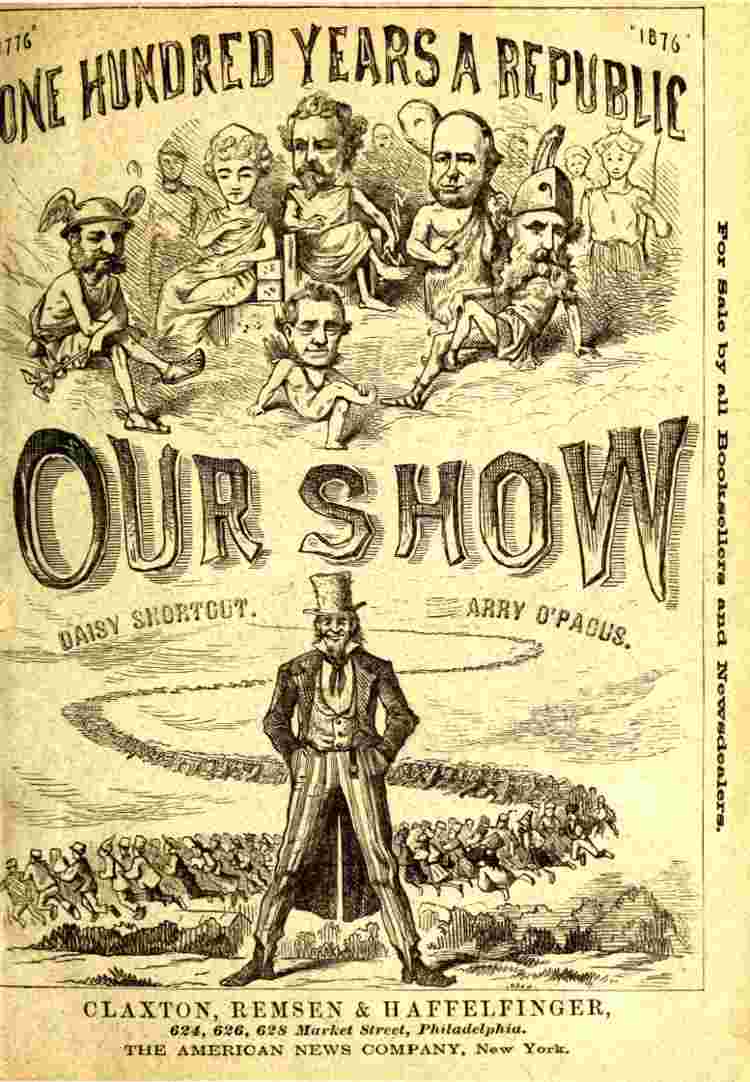
CHAPTER V.
“THE CRACKLING.” ... Preparations for the blaze.
The morning smiled bright, and the mist rose on high, and the lark whistled “Hail Columbia” in the clear sky, on the tenth day of May, 1876, the day set apart for, and consecrated to, the opening of the Centennial Exposition.
Old Probabilities himself was in the city, with his weather eye open. Early in the morning he fixed the barometer in front of McAllister’s at “set fair,” arranged the thermometer at 65°, and engaged a refreshing southern breeze to be around lively during the entire day. After this he ate his breakfast, enjoying a quiet conscience and a correspondingly good appetite.
Shortly before daylight a very curious incident occurred—fortunately it ended happily.
OH SHAH,
WHAT A FUSS!The Shah of Persia, his son John, and the Sultan of Turkey, arrived
together at Broad and Prime Street Depot. The city being weary of
receiving dignitaries, no official and but little private notice was taken
of their arrival. They jumped into a Union Line car. Unthinkingly, the
Sultan put a dollar bill into the “Slawson box,” and then demanded his
change from the conductor. Of course, the conductor was unable to open
the box, and refused to give it to him, telling him he deserved to lose it
for his stupidity. The Sultan became furious.
“My change,” he cried; “I want my change, and I’m going to have it; seven cents for me, seven cents for the Shah, and four cents for little Shah, that’s eighteen cents; give me eighty-two cents change. You can’t cheat me, you swindling Americans!”
Again the conductor refused and remonstrated; the Sultan was perfectly wild with rage; he drew his scimetar, and caught that conductor by the throat, and there would certainly have been an immediate vacancy for a conductor on the Union Line, had not Mr. McMichael been just then returning from a late banquet. Mr. McMichael, being a sportsman, was thoroughly conversant with wild turkey gobble; he smoothed matters over. He refunded the eighty-two cents from his own pocket, took the Eastern monarchs home with him, and afterwards secured them a bed in the coal cellar of the House of Correction, apologizing to them because they were obliged to share it with Mr. Carlyle, the English essayist.
The Egyptian Sphynx, kindly loaned by the Khedive, also arrived in the morning, and was at once placed in position on Belmont Avenue. We regret being obliged to record the disgraceful fact, that it was entirely carried away in small bits by relic fiends before night. The Khedive immediately presented a bill of damages to the President, and levied on the Exhibition buildings in toto, the Capitol at Washington, and Mayor Stokley’s house on Broad Street. Happily the matter was amicably settled. The President promised the Khedive that Congress should have a new Sphynx made for him, a much better one than that destroyed, of bronze, and with all modern improvements. The order was subsequently given to Messrs. Robt. Wood & Co., of Philadelphia, and before the close of the Exposition they shipped to Cairo a bronze Sphynx, which will certainly add greatly to the attractions of the desert. We doubt not that the Messrs. Wood will receive orders for bronze Pyramids, provided they will take the old ones in part payment.
THE MODERN SPHYNX.
The proprietor of the Public
Ledger was so pleased with the
Sphynx which our Philadelphia firm
turned out, that he immediately
ordered a duplicate for his back
garden. He also composed the following
touching linesAND HIS RHYME,
IT WAS CHIL-DLIKE
AND BLAND. for the poet’s
corner of his journal. A copy of
them, translated into Egyptian characters,
was sent to the Eastern potentate
with the Sphynx:—
It was her pride and wonder,
She sent it to Amerikay,
Where it was knocked to thunder.
Her grief seemed all in vain,
Till one as good was made by Wood,
And Egypt smiled again.
Original One.”
The great feature of the day was
THE PROCESSION,
the march from Independence Square to the Exposition grounds. We shall endeavor, in brief style, not to do justice to, but to give some slight account of the grandest pageant which any nation has yet witnessed in its midst.
The immense body, consisting of
representative military from every
nation under the sun and in the
shade, was divided into two hundred
and forty divisions, each with
a commanding general and aids.BENJAMIN’S
COAT.
General Joseph E. Johnston, of
Georgia, was to have been Grand
Marshal. His uncle Andrew being
dead, unfortunately, he was obliged
to have his only military coat repaired
by a tailor who was not
punctual, and who failed to express
it to him in time. General Butler,
of Massachusetts, however, who
happened to have two coats with
him, very kindly loaned one to
Johnston, who appeared in the
afternoon. Attached to the back
of the loaned garment was a neat
show-card, bearing this inscription—
ANOTHER BRIDGE
ACROSS THE
BLOODY CHASM.
THE TRIBUTE OF
MASSACHUSETTS
TO
GEORGIA.
The General was lustily cheered wherever he went, and General Butler was the subject of more praise during this day, than during any portion of his life subsequent to his occupation of New Orleans.
The position of honor, the First Division, was given to the Philadelphia regiments by a unanimous vote of the generals of divisions.
Col. Hill and Dale Benson led off with his command, which appeared for the first time in its new uniform. The immense black fur muffs, which the members borrowed from their sisters and wore upon their heads, gave them a very ferocious appearance, though most of their noses were completely hidden from view. Company “C” attracted particular attention. It had adopted a new “hop” for marching, which was both graceful and unique, though evidently fatiguing.
The “State Fencibles” turned out in fine style. With their accustomed liberality they presented arms to all the pretty girls they met on the way. The “City Troop” brought up the rear of the division. These warriors were arrayed in all their awful panoply of war—white ties and white kid gloves, with gold vinaigrettes, containing salts and extracts, dangling from their belts. Their horses were also supplied with vinaigrettes, which they sniffed occasionally in lieu of their usual odor—the smoke of battle. The Troop carried a magnificent banner, inscribed—
First in Peace—First in War—
and
First in the Hearts of their
Countrywomen.
And, on the reverse side—
PRESENTED TO THE
CITY TROOP OF PHILADELPHIA
BY THEIR
LADY FRIENDS AND ADMIRERS,
AT THEIR
FIRST ANNUAL PICNIC,
Schuylkill Falls Park, July 1, 1872.
The Pennsylvania Veterans, G. A. R., marched in the centre of the Second Division, and a moving incident occurred as they passed by the Mint near Broad Street.
The first distinguished warrior to appear was Colonel Mann, the hero of ~0007 fights, mounted upon the gallant steed which had borne him safely through them all. Along the route, his iron front proudly erect, his bronzed and battered features flushed with the nobility of a natural pride, he was greeted by the enthusiastic cheers of the assembled thousands. Maidens from beyond the seas—officers (no mean heroes themselves) from the armies of the old world, joined in the gracious tumult. One bald-headed veteran (a Marshal of the Windsor Castle Guards, who had left a leg at Balaklava, an arm at Waterloo, an eye in the Crimea, and who expected to distribute the rest of himself upon various other battle-fields before he died) turned to the Chevalier De Lafayette, who with Senator Sam Josephs occupied the barouche with him, and asked—
“Who is passing, Chevalier, that the people appear so excited?”
“Quely vous motre dio, do you really not know?” exclaimed the Chevalier, “Zat is, graciosa poverisi, zat is ze Kunel Mann, pardieu, ze great Kunel Mann.”
“What!” shouted the veteran, and
pulling from his coat the diamond
order of “St. George and the Dragon
fly” which blazed among an hundred
others upon his breast, he rose
in his coach and flung it gracefully
to the Colonel, who caught it quite
as gracefully upon the fly. At this
moment a great shout arose. The
populace imagined that a shot had
been fired at the Colonel, that an
attempt had been made to assassinate
their pet hero.THE PET OF
THE
POPULACE. The mob rushed
for the carriage which contained the
veteran, with cries of “kill him,”
etc. etc. The Colonel took in the
situation at a glance. Rising in his
stirrups he spread wide his arms to
show he was uninjured.
“Hold,” he shouted, in that same voice of loud and deep toned beauty which oft had brought the briny tears to eyes of hardened criminals in the dock, “Hold; he is my friend: he has given me this badge (‘Cape May diamonds,’ he added sotto voce); who touches a hair of his bald head, dies like a dog—march on,” he said.
The cries for vengeance changed to wild cheers of joy, and the procession moved on.
The Foreign Divisions followed the Pennsylvanians in rotation adopted by lot. The Caledonian club was a marked feature of the English Division among which it was numbered, being the only representation from Scotland. The members appeared in full Highland costume, kilt, sash, and checker-board stockings. The chiefs danced the Highland Fling all along the route to the inspiring strains of the regimental bagpipes. The company of Orangemen with their Lemon aids was also a part of this division; they were commanded by Col. Terrence McDougall.
The brigade of French Chasseurs in the Fifth Division, commanded by Marshal Benzine, presented a splendid appearance, and wore the strings of doughnuts which were thrown around their shoulders with a truly fascinating French abandon.
The “French Lancers,” in the same division, danced the quadrille named after them at each lamp-post along the line.
A number of survivors of the late French war were carried along in Sedan chairs. This must have been a sad sight for Frenchmen. We are not Frenchmen.
The German Landsturm soldiers were artistically decorated with pretzels and oranges. Their division was preceded by the Emperor William and his family, drawn in one of the ambulances of the German Hospital, the horses being appropriately decorated with German and American bunting.
The Austrian Grenadiers (division seventy), carried a miniature hydrant, emblematic of temperance; also an open Bible on a velvet cushion.
The Centennial managers were somewhat annoyed by the appearance in line of a commission from the African interior, which insisted on taking part in the procession, or eating the Director General. They marched along in their native costume, consisting of a skewer through their back hair.
Of course they were not aware of
anything out of the way in their get
up, but Mr. Goshorn said that rather
than have the thing occur again, GOSHORN’S
NOBLE
RESOLVE.he
would sacrifice himself on the altar
of propriety, and be eaten. His
brother commissioners encouraged
him in this resolve.
Immediately after the Foreign Divisions, came the “National Centennial Guards,” formed of companies from the thirteen original States. They were headed by Generals Grant, Sherman, Butler, and Hartranft, and were followed by the Centennial Commissioners in barouches.
The Commissioners were paired off with foreign civil dignitaries and potentates. The Prince of Wales was inveigled into a carriage with two of our city officials: he left for home next day. Queen Victoria (his mother) enjoyed the society of the Chief of the Fire Department: she remained until the close of the Exposition.
One carriage was cheered vociferously. It contained Vice-President Wilson, Mr. Jefferson Davis, Simon Cameron, and Robert Toombs.
The American divisions, which included companies and regiments from every State and city in the Union, succeeded the barouches. A great many of these organizations brought their own bands with them, or as the saying is, “blew their own horns,” but many others depended upon the well-known musical resources of Philadelphia. They discovered that delays were dangerous. They had to do the best they could.
The “Duquesne Greyhounds,” of Pittsburgh, were preceded by Signor Maccaroni’s band—two harps and a female violinist, while the “Charleston Fusileers” were obliged to fusileer to the strains of seven jews-harps, kindly volunteered by juvenile American talent.
A noticeable company was the “Palmetto Guards,” of South Carolina, dressed in dusters and straw hats, and bearing palm-leaf fans. The “Ancient Artillery,” of Boston, thorough sons of guns, every man of them, also attracted much attention. Their step was the Boston glide.
The “Norfolk Blues” and the “Virginia Carbuncles” entered upon the march with highly polished rifles and well filled canteens. Their rifles were still highly polished when the march was over.
The “Seventh Regiment,” of New York, composed entirely of officers, was much applauded. Its discipline was apparent in its style of marching and the waxed moustaches of its members.
The brigade of American Indians was under the command of General Sheridan. The warriors were conveniently and economically uniformed in blankets. Each chief had his initials plainly visible upon the corner of his blanket. By a strange coincidence, almost a fatality, the initials of the name of every man in the brigade were the same letters—U and S.
The “West Point Cadets” were
also in line. They made a peaceful
and pleasing show with their little
tin swords and wooden guns. They
looked very neat too, clean faces and
well-brushed hair showing that they
were tenderly cared for. Their jackets
were buttoned tight up to their
necks. The ladies were charmed
with them, and “little dears,”THE
“LITTLE
DEARS.”
“sweet, ain’t they?” were the expressions
heard on all sides. Much
sympathy was expressed for them on
account of the great length of the
route—entirely too long for children
to traverse. The cadets were to
have remained during two weeks of
the Exposition, but they got to eating
unripe cherries from the trees in the
Park, and falling into the Schuylkill
River, so the Commissioners were
compelled to send them home.
The “Naval Cadets” were marshalled under Secretary Robeson. This old salt was arrayed as Neptune, with a trident in his hand, and a crown of real sea-shells upon his aged, weather-beaten brow. The cadets were taken care of during their stay by a file of marines.
The procession started at 10 o’clock, and by two P. M. one-half of the main body having passed the Continental Hotel, the head of the procession reached Memorial Hall, while the tail was wagging here, there and everywhere, about the sacred shadows of Independence Hall.
At Memorial Hall, amid the salvos of artillery, the pealings of bells, and music of the band; the hymns of the singers, and the cheering of the vast, innumerable multitude, the
CHAPLAIN OF THE UNITED STATES SENATE
ascended the decorated pulpit.
Mayor Stokley stepped forward. Tear-drops glistened in his translucent orbs. He raised his arm; his hand, so used to threaten and command, implored silence.SILENCE. In a single moment the firing ceased, the bells pealed no more; the last echoes of the hymns were carried heavenward upon the gentle breeze; the people ceased shouting, and a holy, solemn silence reigned supreme.