
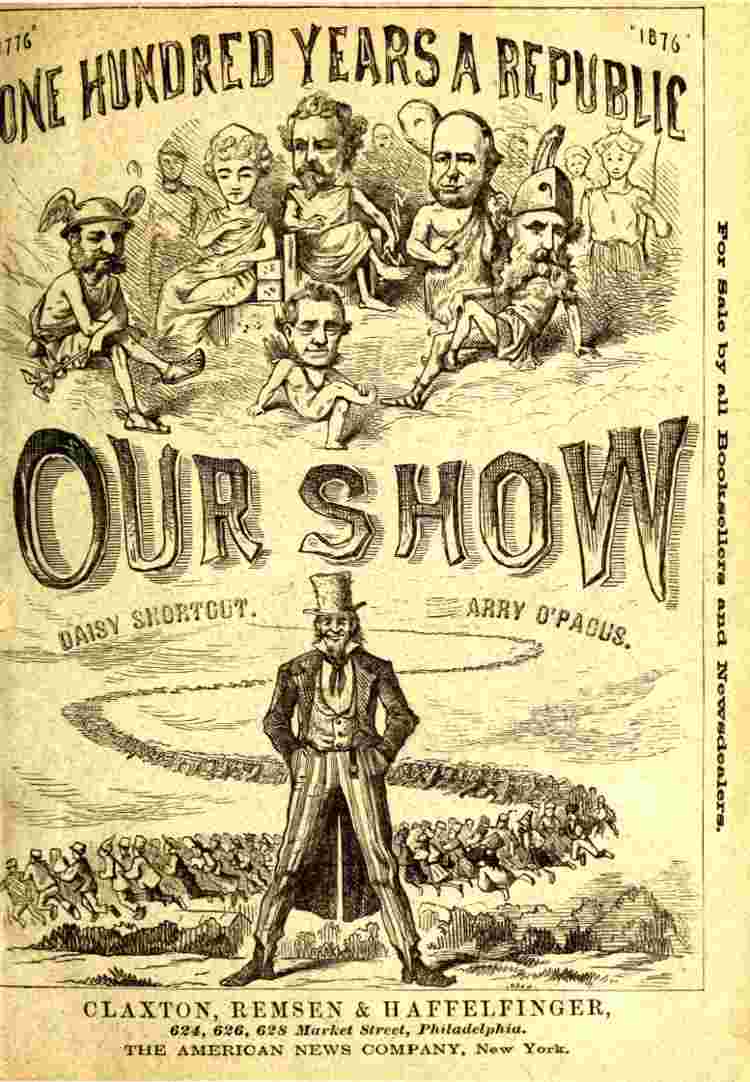
OUR SHOW.
OUR SHOW.
CHAPTER I.
“THE SPARK.” ... How it all came about.
If the late Christopher Columbus, Esq., could have foreseen, as an indirect result of his little excursion in the spring of 1492, the infliction of the following pages upon posterity, Mr. Columbus, very likely, would have stayed at home. Think kindly, therefore, of the dead; let no blame attach to him. Perhaps a few remarks concerning the ancient mariner may prove instructive to the reader. Being both happy and able to impart useful and interesting information, we cheerfully devote a paragraph to the defunct navigator.
The capitalists of our country are familiar with Christopher, principally through a cut of that nautical gentleman which an artistic government has placed upon the reverse side of its five-dollar bills. The elevated cross in the hands of the piratical-looking monk kneeling beside him, has given rise to a wide-spread belief that Mr. Columbus was a bishop or a cardinal. It is our duty to dispel this grievous misconception. He was simply a Brazilian sea captain, who believed there were two sides to every question, even to such a serious question as the world. Having taught Queen Isabella of Spain, who had not then abdicated, how to make an egg stand and drink an egg-flip, she gave him, under the influence of the latter, command of the steamer “Mayflower,” with permission to row out and see what he could find. He landed at Plymouth Rock; discovered the city of Boston, first, by special request, being presented with the freedom of The Common by the grateful inhabitants, and welcomed in a neat speech by Mrs. Harriet Byron Stowe.
Shortly after this, George III. of England commanded that all the male children born in the Colonies should be cast into the Atlantic ocean. He also advanced the price of postage stamps. These injustices were more than the people could stand; they met in Concord, and drove the British out of Lexington. This alarmed George, who immediately passed the famous “stamp act,” and telegraphed to Benjamin Franklin, then postmaster at Philadelphia, authorizing him to distribute free rations of postage stamps three times a day. But the wires clicked back the touching refrain—
“Too late! Too late! Of all sad words of tongue or pen, the saddest are these ‘too late.’
Yours, Ben.”
Benjamin then convened a job lot of patriots at Philadelphia, and they resolved that these United States were, and of right ought to be, free and easy. Commodore John Hancock, of the Schuylkill Navy, was chairman of the convention. On motion of Robert Morrissey (whose nephew John, late M. C. from New York, inherits his uncle’s statesmanlike and financial abilities), a bell to proclaim liberty was purchased for the State-House steeple. They practised economy in those brave days, and bought a cracked one, because they got it at half price. It is still in Independence Hall, a monument of our veracity.
The world knows well what followed, and ’tis well for the world that it does. General Cornwallis finally surrendered to General Scott at the Germantown Intersection. The “Junction” depot now marks the spot. So, dismissing our historical reminiscences, we would respectfully request both the gentle and the savage reader, to imagine, after the manner of the modern drama, the lapse of one hundred years, ere we proceed with the second act.
This century being buried in that popular mausoleum, the vast ocean of eternity, a universally expressed desire to celebrate the nation’s centennial birthday in a style befitting its present power and importance, gradually assumed the form of an International Exposition, to be held during six months of the year 1876. Philadelphia was selected as the site, partly on account of historical associations and the proprietorship of the cracked bell, but principally to gratify the inhabitants of the adjoining Dutch settlement, New York.
Congress was naturally appealed
to for countenance and assistance.
Unfortunately, however, Congress,
having bestowed all its material aid
upon railroad and steamship subsidies,
had nothing but its moral support
to offer. Having a large stock
of this commodity, it was tendered
with the usual CONGRESSIONAL
MODESTY.
modesty and circumspection
which marks the action of
that body in national affairs. The
President was authorized to invite
the world to the Exposition—without
expense to Congress. Philadelphia
was granted permission to hold
the Exposition—without expense to
Congress; each State was allowed
the privilege of appointing a commission—without
expense to Congress;
and, to be brief, the economic
representatives of the people resolved
that these United States might go
in and have a good time generally—without
expense to Congress.
Jubilant with this encouragement, the State Commissioners organized an Executive Committee, which appointed a Board of Finance, and auxiliary committees upon everything and anything, including mining, manufactures, calisthenics, art, science, primogeniture, horticulture, pisciculture, agriculture, infanticulture, and hydrostatics. City committees were constituted. These were jobbed out to wards, and again sublet to precincts, through which domestic juntas were established in every household. Thus the voice of the people woke the echoes of the capitol, and reverberated to the furthermost corners of the universe.
The Building Committee immediately
contracted with GEE UP
DOBBINS!Mr. Richard
J. Dobbins (the inventor of Dobbins’
electric soap) for the construction of
THE MAIN EXHIBITION HALL.
He agreed to furnish the very first quality of soapstone for the masonry, and to use Castile only, for the girders. The following were the chief points of the contract:—
1st. The building to form a parallelopipedon, in order to secure the choicest location to each exhibitor.
2d. To be thoroughly waterproof. Dr. McFadden of the Aqua Fontana department, and several other eminent surgeons, to fill it up to the ceiling as a test previous to the opening. The contractors to take it back if the test proved unsatisfactory.
3d. The walls to be of gutta percha; to be distributed after the closing of the exhibition to the pupils of the public schools for chewing and erasing purposes.
4th. A transcript to meander through the centre of the building, with a knave to right and left. Cucumber pumps of the Louis Quatorze pattern on the east and west detours, alternating with eight green cellar doors, to give the same effect and finish which marked the tout ensemble of the Vienna buildings. A main curricle on the right to be flanked by iron decades, with arched approaches for bipeds, tripods, and quadrilaterals.
5th. The general appearance of the exterior to favor the Polynesian style, which is replete with architectural beauties. Fac similes of the Tower of Babel, Tower of London, Leaning Tower of Pisa, and Tower Hall, to adorn the four corners. The trusses and bandages supporting the roof, to be of purple and fine linen, with brass mountings. The roof itself to be perpetually covered with wet towels, to guard against sunstroke.
6th. The centre aisle to be covered with canton flannel matting, with the grass sloping up to the back door. Nineteen hotel candles to illuminate the ground floor, with a citrate of magnesia light in the attic window.
This extraordinary structure was completed according to agreement, and upon being weighed at the corner grocery, kicked the beam at 1234567890 pounds, 19 shillings and sixpence.
Mr. Dobbins was also entrusted with the erection of
MEMORIAL HALL.
This is a permanent building, so adapted that it may be used hereafter as an Art Gallery or a Station-house. The foundation is not only cemented with Spalding’s glue, but the iron posterns run through to China, and are tied on the other side with the back hair of coolies, detailed for the service through the courtesy of the Pekin government.
Notwithstanding Mr. Dobbins’
immense labors in completing these
two buildings, he still found time
to run over to Rome and MORITURI
SALUTAMUS.purchase
the Colosseum. He brought it home
with him for the purpose of exhibiting
Prince Bismarck and the
Pope in gladiatorial contests during
the exhibition months.
The contract for
MACHINERY HALL
was awarded to Mr. Philip Quigley, of Wilmington, Delaware. When it grew too big for his State, he removed it to and finished it upon the ground it occupied. The machinery exhibited was worked by forty horse-power, and a neat stable was attached to the rear for the care and accommodation of the forty horses, the contribution of the city passenger railway companies.
All the shaftings were of sandal wood, and the belting of Russia leather, supplied by the family of the Czar himself. An “hydraulic annex” was also tacked on to the building. It contained a tank 60 by 180 feet, with 10 feet depth of water for fishing and bathing purposes. A portion was fenced off for the preservation and display of “The Falls,” which the hotel keepers and hackmen of Niagara kindly loaned for the occasion. The hydraulic rams and other live stock were watered here every morning, and at stated intervals during the day hydrodynamic and hydrostatic performances were given in the tank by the pupils of the “Girls’ Normal School.” The former were very unique.
The consideration for the construction of this building, as per Commissioners’ report, was $542,300, including drainage, water-pipe, plumbing, and silver-plated door knobs, but exclusive of interior white-washing. This, however, was performed gratuitously by Professor Johnson of the African Commission.
Mr. John Rice, a healthful and nutritious builder, was selected to erect the beautiful
HORTICULTURAL HALL,
which remains a permanent ornament to our park, and an attractive target for the shots of the young idea visiting the locality. The immense expanse of glass will doubtless provide innocent amusement to many generations of young America. May they ever appreciate the kind consideration which placed the building convenient to a line of soft rocks, supplying ready-made boulders of all sizes. We believe, however, that the building is taken in at nights; we know its visitors are taken in during the day. Some idea of its vastness may be given by stating that more than 7000 acres of land are situated around it.
AGRICULTURAL HALL,
being of papier maché, inlaid with mother-in-law of pearl, was cut out by steam, and work was not commenced upon it until September, 1875. The pens for live stock adjoining the building were of steel (a favorite material in public edifices), and were a part of the contract. They were fashioned after the manner of the famous floating palace, “Adelaide Neilson,” of the Noah family. The plans were furnished by the Shemitic commission from rough drafts now in possession of the descendants of Admiral Noah.
At a late date the
UNITED STATES GOVERNMENT
decided to erect a few buildings, including a hospital. They thought the latter might come handy in Washington after the exhibition, for resigning officials. When we first learned that the United States had obtained 100,000 feet for their buildings, we thought it another display of persevering frugality. We imagined they desired to save a hardware bill by using the nails accompanying the material. We discovered that the feet merely meant the ground for the buildings to stand on.
As the Grecian government had
expressed itself too poor to take part
in the Exposition, Mr. Windrim, the
architect, was instructed to design
these buildings in the shape of a
Greek cross. Through this delicate
A COMPLIMENT
TO SAPPHO.compliment, the land where Sappho
lived and sung, was represented after
all.
These, with the offices for managers, gas men, stage carpenters, etc. etc., and some national, state, and special buildings, which may claim our attention further on, complete the list of structures erected upon the Centennial grounds for exhibition purposes. Men of all nationalities vied for the privilege of taking part in the glorious work. The Teuton and Celt underbid the native American; the co-patriots of Garibaldi did still better, only to be put to shame in their turn by a Chinese colony. Ignoring all natural partiality and national prejudice, the contractors, in a spirit of true republicanism, gave the most work to those who labored for the least money.