
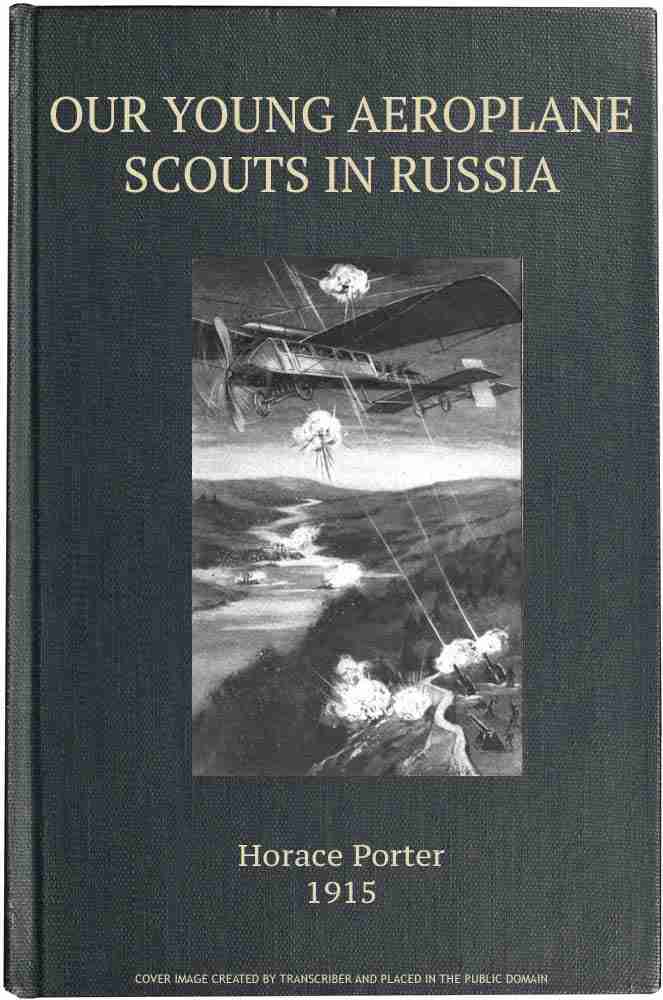
CHAPTER XX.
RUSSIA’S GREATEST AEROPLANE.
There had been a solemn council, lasting several hours, in the spacious drawing room of the Sergius palace in Odessa, and the majority of the participants wore the insignia of preeminent rank in the Russian navy.
It was evident that some momentous question was in the foreground, and having to do with a war move of consequence.
In the aerodrome, down on the bay front, another conference was in progress, of no less importance to those there gathered—aviators all. The supreme assemblage on the hill had its problems, but no more intense interest therein than these aerial experts manifested over the display of the greatest of all aeroplanes—the Russian “Sikorsky”—just received for particular use in the Black Sea fleet, the second of its kind constructed, and in which achievement of one of his subjects the Czar himself had been reported as taking personal pride and keen practical interest.
“The first time I ever threw up my hands for anything that didn’t come out of our factory,” exclaimed Billy, walking in wonder around the gigantic aircraft.
With its curtained “cabin,” many-windowed “control house,” searchlight, powerful engines, steering wheels, projecting bow, “corridor,” and a proved carrying capacity of seventeen men, this creation may seem more of imaginative invention than the actual production of a machine shop.
But the “Sikorsky” is a sure thing, and just as represented in the sight of our boys on the day they first marveled at its bulk.
They had no idea, though, at the moment of an experience in this huge machine that would set a capsheaf on their war zone sky-riding.
So when Billy and Henri studied in detail the points of this wonderful craft it was solely by the prompting of professional enthusiasm and no intent of going into training to handle it.
They noted that the mighty flyer, of biplane type, was fitted with four German Daimler engines, had double control, with two steering wheels, while each of the four engines drove a separate propeller.
“The wind would have to hustle to keep up with that force,” commented Henri, strongly inclined to the mechanical exhibit.
Lieutenant Moppa called attention to the fact that the craft had also been fitted with floats, “which about provides for every emergency,” he concluded.
“Think of an aeroplane pilot working behind glass windows; he will feel as stuck up as a chauffeur in a first-class automobile.”
“And as high-toned as the steersman of an ocean liner, pard,” said Henri, adding to Billy’s comparison.
The council on the hill in the meantime had marked a map with a red line—the Bosphorus at the end of it.
The warships that the aviators had left shelling the cliff battery near the entrance of the strait were to be tremendously reinforced.
“Great news, men,” announced Lieutenant Moppa, after perusing a slip of paper handed to him by a trim sailor who had been serving the war council as messenger. “Everything that flies has been ordered into service for convoy duty with the squadron that sails in the morning. The new airship will lead the way.”
“It would not surprise me a bit,” volunteered one of the soldier-aviators, “to see the new airship flying over the Bosphorus batteries before we are very much older, and loaded with bombs, too.”
“A prophet has come among us,” laughed Lieutenant Atlass, “but more power to him if he rings true, and rings me into the venture.”
“Give another pull to that bell,” suggested Lieutenant Moppa.
The influence of Sergius was in evidence when assignments to honor places in the new crafts were made, and the boys found themselves listed among the pilots who would take turns at the steering wheels of the mighty “Sikorsky.”
However, the recent performance of the young aviators before Fort Killis, reported in dispatches, had the effect of reducing any feeling that favoritism had been wholly responsible for this advancement.
“Really, it is more than we had any right to expect,” said Billy, in discussing the selection of the airmen who were to serve aboard Russia’s greatest aeroplane.
“Suppress your modesty, my boy; it may be that I have given you a short lease on life by my recommendation, but in your work you take the chances anyhow, so I put you in the way of dying at the top of the profession.”
It was the voice of Sergius, half serious and half in the lighter vein.
He had stepped quietly into the air station, and was contemplating with interest the lines of the new wonder of the air.
Already experts were at work within the enclosed rigging, oiling and polishing the machinery, filling the tanks and in every way putting in perfect shape the mammoth flyer.
When, the next morning, the great bird of passage was driven aloft, and leading a flock of lesser ’planes, the wheelmen on the job were Billy Barry and Henri Trouville.
There were fourteen, all told, on board, and Lieutenant Moppa was in command. Two guns showed, one fore and the other aft, manned by practiced marksmen, while equally proficient in their line were several riflemen in the crew. The two lieutenants could be depended upon to take care of the explosive-dropping assignment.
Though the motion of the huge machine through the air was very smooth and graceful, the roaring sound made by the four powerful engines, as the airship forged ahead, high above the sea, was nothing less than terrifying.
The commanding officer kept his sailing orders to himself, but, nevertheless, the belief among those aboard, which would not down, was that the big craft was going over the Bosphorus batteries, straight to Islam’s capital, to give the ancient city, for the first time in history, an air bombardment.
When the rumor reached Billy, he thought of Sergius’ remark about “dying at the top of the profession!”
To his brother wheelman, close enough to catch his words, he had just been saying:
“This is the kind of a gear we will have to put together for our trip across the Atlantic.”
Then the thought that the contract they had immediately on hand, if the rumor had foundation, might take all they had to give.
A few miles from the entrance of the Bosphorus, Lieutenant Moppa, instead of issuing a stop order, in stentorian voice sounded the word:
“Attention!”
Above the roar of the engines the crew heard again a shouted command:
“Pilots, guide left!”
Then all hands knew that the airship was headed for Constantinople. The first link in the chain of Bosphorus forts was below, and the sea of Marmora only eighteen miles distant! The great airship was going a mile a minute, following the water line between the two continents, yet running so high that gun flashes from the batteries were as the explosion of so many firecrackers to the aviators.
The boy pilots leaned hard against the steering wheels; they were feeling the strain of continuous effort, but made no call for relief. It was a red-letter chapter in their flying record.
Now the sea of Marmora, stretching away 170 miles to the straits of the Dardanelles, on the other end of which the allies had concentrated twenty great battleships, eight powerful cruisers and a land force of 50,000.
Over Pera, the residence section of Constantinople, Lieutenant Atlass sent down a shower of bombs, and for miles of Moslem territory the onrushing airship left a blazing trail behind it. The “Sikorsky” had drawn the fire of many guns in its dash between seas, and but for one stray bullet that splintered the glass front of the pilot house would have escaped unscathed.
By fort fire the aviators were driven high again over the Dardanelles, but the forty-two miles in these straits were traversed in fifty minutes.
Landing on the floats was made off Tenedos island, in the Ægean sea.
“You looked like a Zeppelin coming in,” hailed a bluff Briton from the conning tower of a submarine that had bobbed up alongside of the floating aircraft, “and your colors just saved you from being blown to smithereens. That’s the biggest thing on wings you have there.”
“And it has carved a new niche for aviators to reach, this day,” proudly proclaimed the Russian airman.