
CHAPTER XXII.
THE CUTTING OF A CABLE.
Submarine E-16, taking an air bath off Tenedos, and floating in the shadow of the mighty “Warspite,” awaited orders that would send her night-groping under the strong current of the Dardanelles channel, and with the set purpose of clipping a cable connecting the European and Asiatic shores of the straits.
If not detected by the Turkish searchlights, the expedition might win forward, and, perhaps, back. Captain Montgomery, a regular fire-eater, was in command, with a picked crew, including our young friend, Jimmy Stetson.
The enterprise was to have aviation aid, and sure-shot candidates for such participation were the veteran pair, Johnson and Freeman. As there was possibility of a bit of a scrap before the affair ended, it was deemed expedient to carry extra pilots in case of accident.
“Keeping it all in the family,” was Johnson’s humorous way of later telling Billy and Henri that he wanted them to go along.
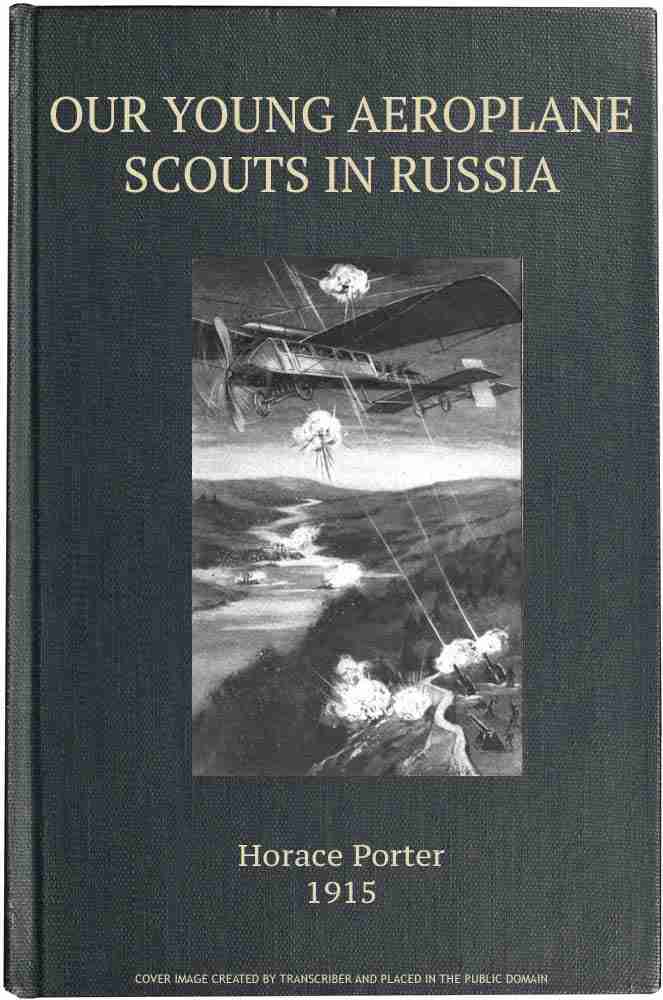
The upshot of it was that in the late afternoon of the day fixed for the undertaking, two biplanes rose high above the Ægean sea, high enough to make them appear as mere specks in the sky. Turning north, their course followed the line of the Dardanelles.
The submarine waited for nightfall before it made the plunge that would start its journey in the same direction pursued by the aircraft on high.
Porus-Tabia battery, on the European shore of the straits, stands close to the ruins of the ancient stone fort, Bokal-Kale, from where there is a submarine cable that connects it with Nagara on the Asiatic shore.
This was the cable that the military promoters of the submarine journey proposed to sever, if they got near enough to it.
The aviators were to play into the scheme in some manner yet to be developed. It would not be Johnson or Freeman if their long heads failed them on this or any other occasion. It was a safe wager that they had some sort of working plan up their sleeves, and the two boys in their company were certainly ready to produce a vote of confidence.
The lay of the land here is an elevation, not approachable from the front without sure discovery, but some opportunity for concealment at the rear—more favorable, for example, for a drop-down party to operate and escape immediate detection.
Four aviators, at least, were taking the chance of a night prowl here, after coming down at dusk, with muffled motors, behind a clump of trees, and within fairly easy reach of the ruins of the ancient fortress.
“Now, my hearties,” advised Captain Johnson, when the four edged against a clammy stone wall for council, “this is only a two-gun battery; the garrison is not expecting company at the back door, and for this reason it’s a fair shake that we might be able to attend to a little business here and get away with it.
“The active end of this position, further up,” he continued, “I propose to visit a little later on, and it is a crawling contract all the way. I feel sure that the two guns here are in need of repair, and I guess I’ll have to fix them!”
The captain mixed a chuckle with these concluding words, and set a deep bite in a lengthy plug of tobacco.
“What’s the object, anyhow, of this cable-cutting business?” asked Billy, who liked to dig at the roots of anything that puzzled him.
“To strike terror in the heart of the Turk,” commenced the captain—but he switched off to the practical statement that he only knew that military strategy demanded it—and so ordered. To the soldier this latter was all-sufficient reason.
This conversation was in tone audible only to the closely knit group in hiding.
Now the captain was making ready to “repair” the guns above the water front. He took off his boots and his topcoat, transferring therefrom to the inside of his blouse a tool commonly known as a monkey-wrench, tightened his belt and pulled his cap down to his ears. Revolvers swelled both of his hip-pockets.
“If you hear any shooting,” he whispered, “just make a break for the biplanes, stand by until you see ’em coming, if I don’t get there first, and then pull out.”
With these words the veteran airman disappeared in the darkness with all the stealth of an Indian in moccasins.
“When the submarine crowd gets to work on the shore end of the cable there will be a stew in the operating room up here. The captain fears that in the excitement those defective guns might explode and hurt somebody. That’s the reason he is so anxious to get everything fixed to prevent accident.”
Josh’s explanation was taken no more seriously than he intended it to be. The boys knew well enough that the captain was taking his life in his hands to so upset the mechanism of the guns that they could not be used in throwing lead at the submarine, if discovered during the cable-cutting performance.
An hour passed, in which the anxious waiters, in the chill precincts of the ruins, would have promptly testified was six times sixty minutes.
Billy started to say as much, when Josh gave him a poke in the ribs in the way of mute advice to keep still.
There was some sort of commotion breaking out in the quarters of the cable operators, at the north end of the ruins.
“Something doing now, sure.”
Henri sidestepped further along the wall in order to get a little closer to the scene of action.
“The connection’s shut off, that’s what’s the matter,” predicted Josh, speaking into Billy’s ear. “The job down below is going on. We’ll know in a minute or two whether or not the captain has ‘fixed’ the big guns.”
A door was flung open and a broad stream of light penetrated the outside darkness. In the illuminated opening was framed a stalwart Turk, and he started a yell, which found echo in the high-pitched voices of several more of the fez wearers behind him.
The sentries at the fort, two hundred yards distant, responded quickly to the summons, coming in twos and threes, pell mell, toward the cable station, brandishing their rifles, and doing some shouting on their own account.
“Gee whiz,” muttered Billy, “it’s a regular riot!”
Then to the rear of this noisy demonstration, the real note of alarm to the trio of watchers in the ruins rang out in the night.
Crack, crack—the whiplike snap of small-bore shooting irons!
The last words of the captain had been for his companions to make for the biplanes when shooting commenced. In compliance, the trio retreated in single file, close to the wall, and then ran like deer across the open, luckily for them a little way and partially screened by trees.
Up to the moment there was never a boom from the big guns, and even the spatting of the lesser weapons had ceased after the first few shots.
As instructed, Josh and the boys “stood by” the biplanes. The captain had failed to get there first, and it did not look like he was going to even get there next, for already the soldiers of the garrison were scattering in search of a certain disturber, who had the nerve to fire back when he was fired at.
The entire garrison appeared to be charging about except the disgusted gunners, who found that they could not pump even a single shell at a suspicious-looking object off the water front.
The cable operators, with a number of the sentries, had raced down the steep incline to where the cable lifted from under the current of the straits. The casing of the wires on shore had twisted up like a great snake, hacked apart from the tension-creating line under the channel.
For a scant minute or two the far-reaching rays from the lighthouse tower on Bakkal headland splintered on a polished surface like a whale’s back, which quickly disappeared in a circle of foam below the rushing tide.
The gunners above had seen much more of the submarine before it dived, but that is about all the good it did them.
It was dawn before any of the Turks stumbled upon the hiding place of the aviators and their craft, and there was only four of this advance guard.
Josh counted a red furrow across the cheek after the first fire, and retaliated with one of the big service revolvers he carried, sending the marksman who marked him to the ground with a shattered knee-pan. Another of the attacking party got a chunk of lead in the shoulder, and the remaining two backed out for reinforcements.
In the meantime, the boy pilots had started the motors to humming, and Josh, though his fighting blood was up, concluded that there were too many coming just then, and hopped aboard with Henri.
“Not by a blamed sight are we leaving the captain to skirmish for himself,” he announced with the uprise; “we’ll hang around here till doomsday but what we’ll get him out.”
It was a mighty brief hang-around, after all, for the aviators were barely out of range of the Turks’ rifles, when Billy’s quick and roving eye caught the vivid flutter of a bandana handkerchief, Captain Johnson’s favorite colors, from a cactus cluster in the sandy expanse over which the aircraft circled.
The Turkish troopers had ceased fire at the biplanes—a mere waste of powder now—but when they saw one of the machines dip and dive, a dozen or more of them, howling in triumph over the belief that their bullets really had winged one of the big flyers, charged full tilt across the plain.
Billy, however, had the bulge on the quick-comers, in that he was skimming the sandy soil before the Turks were fairly started, and Captain Johnson swung a leg in the aeroplane without compelling a stop.
The soldiers popped away with their rifles, but made no holes in the deceptive target. On the rise, Captain Johnson gave them a couple of rounds from his revolvers, and shouted, as a farewell salute:
“Dern your pictures, haven’t you got enough yet? We’ll come back some day and carry off the whole fort!”
“Of course,” concluded the captain, settling into his seat in the space-killing biplane, “they couldn’t understand a word, but there is nothing like relieving your mind of extra pressure.”
He also relieved the tobacco plug of about a third of its weight.