
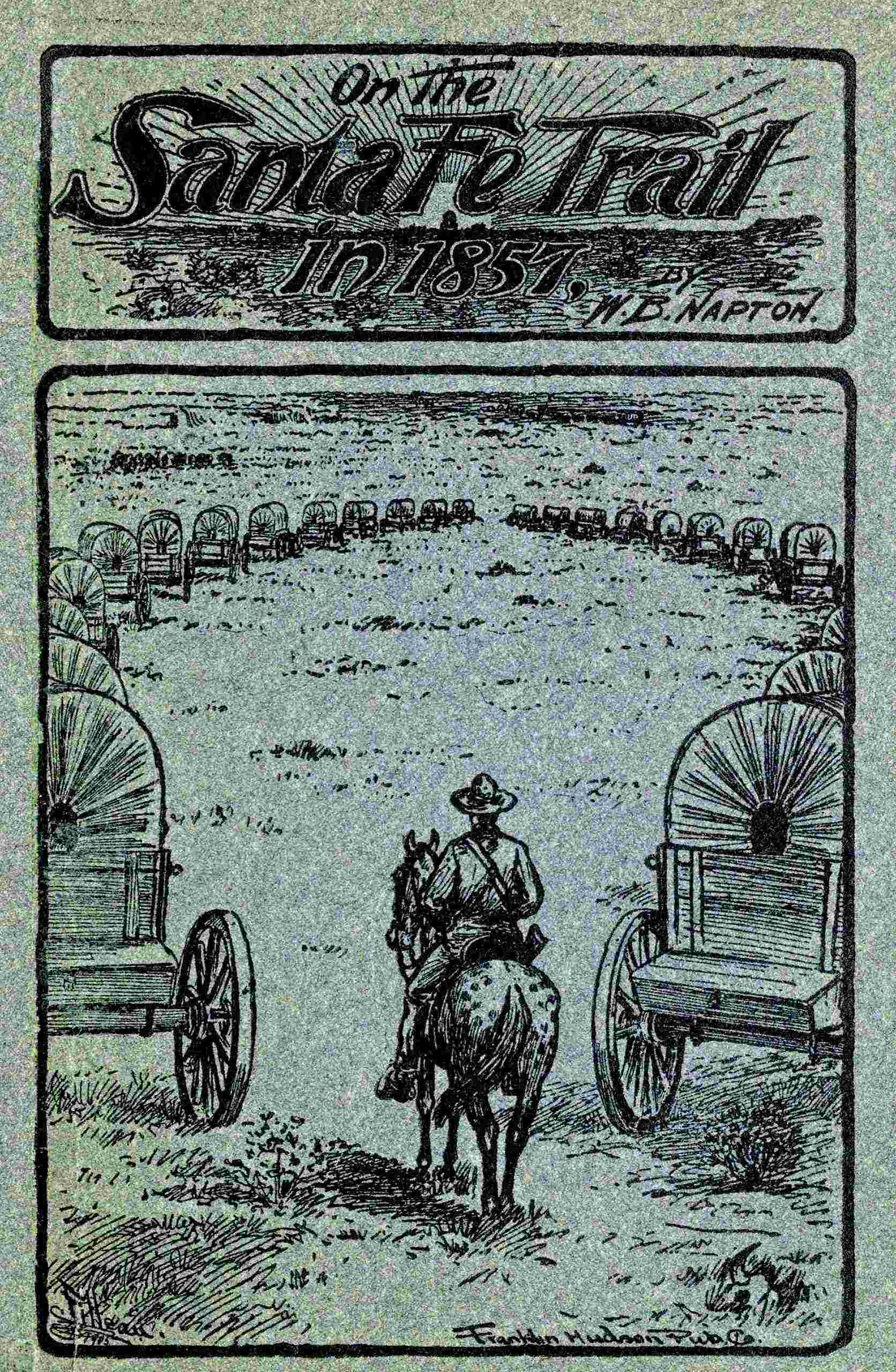
Over the Santa Fé Trail, 1857.
I.
Captain “Jim Crow” Chiles.
When I was a lad of 12 years of age my father had a red-headed overseer, good-natured, loquacious and fond of telling stories, the kind that suited the understanding and tickled the fancy of a boy. His stories were always related as being truthful accounts of actual occurrences, although I suspected they were frequently creatures of his own imagination. This overseer, a Westerner born and bred, had driven an ox wagon in a train across the plains to New Mexico; had made two trips across—in 1847 and 1848—one extending as far as Chihuahua, in Old Mexico. His observation was keen, and his memory unexcelled, so that, years afterwards, he could relate, in minute detail, the events of every day’s travel, from the beginning to the end of the journey. I was charmed with his accounts of the Indians and buffalo, wolves, antelope and prairie dogs.
Reaching the age of 18 in 1857, with indifferent health, my father acquiesced in my determination to cross the plains to New Mexico. The doctor said the journey would benefit my health. Already an expert with a gun or pistol, I had killed all kinds of game to be found in Missouri, and had read Gordon Cumming’s book of his hunting exploits in South Africa, so that I felt as if nothing less than killing big game, like buffalo and elk, could gratify my sporting proclivities.
Colonel James Chiles of “Six Mile,” Jackson County, was a state senator, and while at Jefferson City during the session of the legislature, my father telling him of my desire to go out to Santa Fé, the colonel sent me an invitation to come to his house by the middle of April and go out with a train belonging to his son. So in the early spring of 1857 I set out from my home in Saline County, well mounted and equipped for the journey.
The spring was backward, and when I reached Colonel Chiles’s house in the middle of April winter was still “lingering in the lap of spring.” The grass was not good on the plains until the 10th of May. It was arranged for me to go out with the train commanded by “Jim Crow,” a son of Colonel Chiles.
“Jim Crow” was then about twenty-five, not over medium height, but strong, athletic and wiry, and had a pretty well established reputation as a fighter among the frontiersmen. He had killed a lawyer named Moore, who lived at Leavenworth, in the Noland hotel at Independence. After the Civil War he killed two other men at Independence, and he himself was eventually killed in a fight with the Independence town marshal. But I found “Jim Crow” a kind and considerate friend, jovial and good natured generally, but subject to violent fits of anger, and when angry, a very dangerous man. One night on the “trail,” while he and I were riding some distance ahead of the train, amid the solitude of the darkness and the vast plains, the conversation drifted into a confidential vein. He recalled the killing of Moore, saying he regretted it beyond measure; that the affair had haunted him day and night; that he would willingly give up all that he owned or expected to acquire to be relieved of the anguish and trouble and remorse the act had caused him. But he was possessed of the kind of courage and combativeness which never suggested the avoidance of a fight then or afterward.
Kansas City was even then, in 1857, an aspiring town. For a month or two in the spring the levee was covered with wagons and teams, and sometimes four or five steamboats were at the wharf discharging freight. General John W. Reid had recently bought forty acres, the northwest corner of which is now the intersection of Broadway and Twelfth street, for $2,000. The land was covered with timber, which he cut into cord wood and sold to the steamboats for about enough to pay for the land.
There were no streets, and only one road from the levee, leaving the river front at Grand avenue, running obliquely across to Main street and back again to Grand avenue, in McGee’s addition. Colonel Milton McGee had taken down his fences and laid off his cornfields into lots.
The work cattle and wagons were collected and a camp established, about the first of May, on the high, rolling prairie near the Santa Fé trail, three miles southwest of Westport. The wagons were heavy, cumbrous affairs with long deep beds, covered with sheets of heavy cotton cloth, supported by bows. A man six feet high could stand erect in one of them, and they were designed to hold a load of seven or eight thousand pounds of merchandise each. Those in our train were made by Hiram Young, a free negro at Independence, and they were considered as good as any except those with iron axles. The freight consisted of merchandise for the trade in New Mexico. Two of the wagons were loaded with imported champagne for Colonel St. Vrain of Las Vegas and Mora.
There was a shortage of good ox drivers that spring and Captain “Jim Crow” found it difficult to supply the number he needed. Twenty-five dollars a month “and found” were the wages. One evening, while we were lounging around the corral, waiting for supper, three men came up on foot, inquiring for the captain of the train. They were good looking, well dressed men, two of them wearing silk hats, but bearing no resemblance to the ordinary ox driver. They said they were stranded and looking for work. They proposed to Captain Chiles to hire to him for drivers, while they disclaimed any knowledge of the calling.
“Jim Crow” laughed, and after interrogating them as to their antecedents, said he would hire them on probation. “I will take you along,” he said, “and if I find you can learn to drive cattle before we get to Council Grove, the last settlement on the road, then I’ll keep you; otherwise not, and you must look out for yourselves.”
They were invited to supper and assigned to a mess. One of them was named Whitcom. He hailed from Massachusetts and had never seen a yoke of oxen in his life, but he was strong, sturdy and active, and before we reached New Mexico he was rated the most dextrous driver in the outfit. Moreover, his team looked better than any in the train when we reached the end of our journey. Ten years ago Whitcom was living in Cheyenne, and was one of the wealthiest cattle raisers in the state of Wyoming.
Another of the three hailed from Cincinnati. He wore a threadbare suit of broadcloth and a “plug” hat, and was tall, angular, awkward, slip-shod and slouchy in appearance. He had been employed in his father’s banking house in Cincinnati, and was accomplished in penmanship and a good accountant; but he proved to be utterly unfit for an ox driver. He could not hold his own among his rough companions, and became the object of their jeers and derision. By unanimous consent he was given the name of “Skeesicks,” and by this name he was known ever afterwards.
The third of the trio proved to be a fairly good driver, and is now a prosperous merchant in the state of Montana.
Among the drivers was a young Mexican, Juan, who had been in the employ of the Chiles brothers for years. Through him we were enabled to converse with the Kiowas and Comanches when we reached them. Many of the Indians could speak or understand Spanish, but could not understand a word of English. We had men among the teamsters from Tennessee, Kentucky, Arkansas and Texas. They soon became known and answered to the name of their own state. “Tennessee” and “Texas” prided themselves on the size and weight of their whips, and the loudness of the noise they could make in popping them.
Young Reece, from Missouri, went out with the train for his health. He had consumption and hoped the journey over the plains would be of benefit to him. He was very tall, being six feet four inches, of large bone and frame, but thin as a huge skeleton, and had allowed his heavy black hair to grow until it hung below his shoulders. He was well off so far as property was concerned, and rode a splendid dapple gray horse, muscular, tough and graceful, with handsome mane and tail, which could fairly fly over the prairie.