
II.
In Camp, South of Westport.
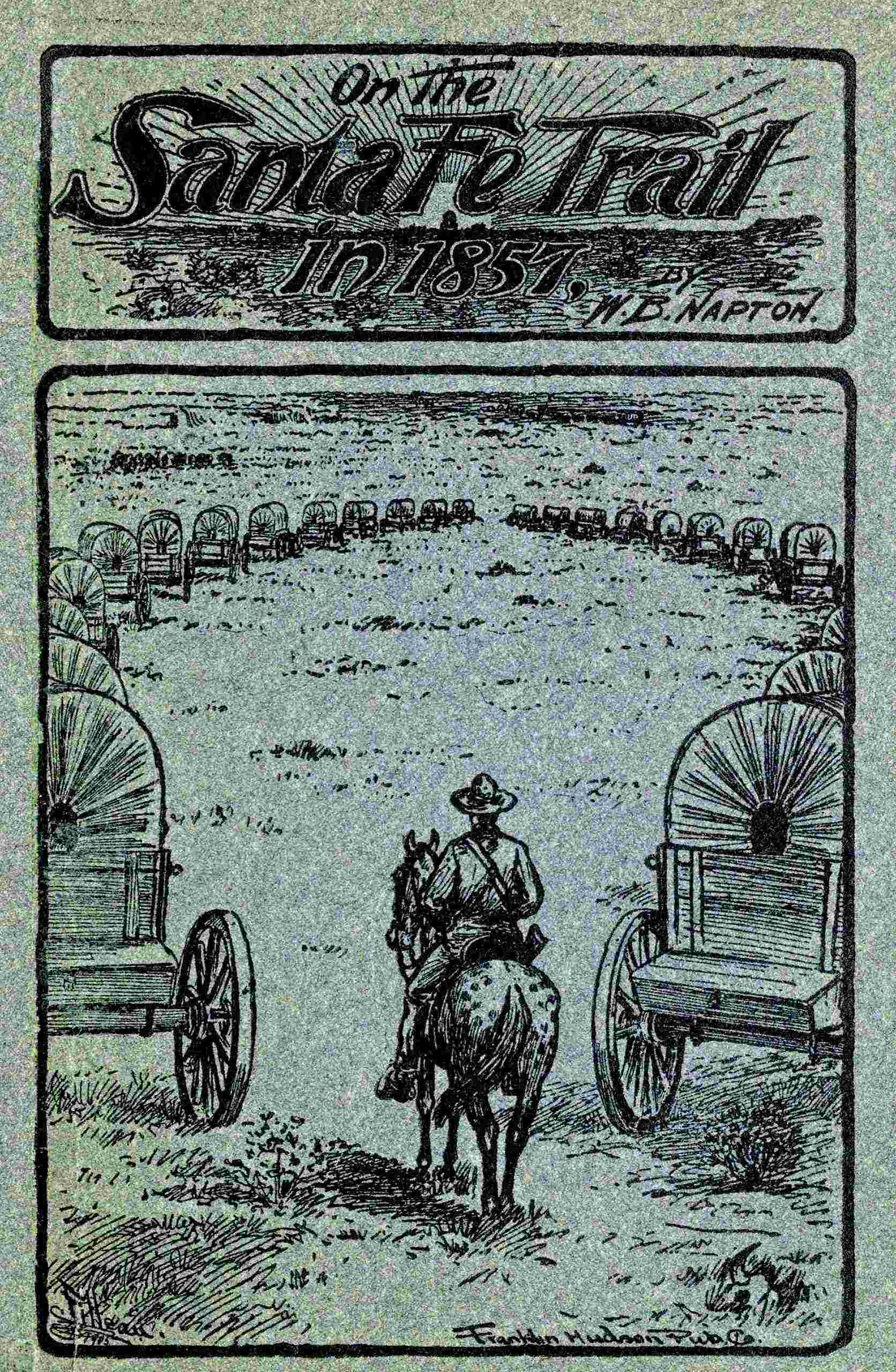
In the camp, three miles southwest of Westport, we were detained for a fortnight or more, awaiting the arrival of our freight at Kansas City. There were twenty-six wagon, five yoke of oxen to each, carrying about seven thousand pounds of freight each. There were no tents, so we slept on the ground, either under a wagon or, if we preferred it, the broad canopy of heaven.
Captain “Jim Crow” commanded the company, with Rice as assistant wagonmaster. There was one driver for each wagon, and a boy of 16, of frontier origin and training, whose duty it was to drive the “cavayard” or loose cattle, taken along in case any of the teams should get lame or unfit for service. “Jim Crow,” immediately on his arrival at the camp, gave the boy the nickname of “Little Breeches,” suggested by his very tight-fitting trousers, and the name, abbreviated to “Little Breech,” stuck to him.
While encamped below Westport I was fortunate in purchasing a first rate “buffalo horse,” a California “lass horse,” that had been brought across the plains the previous year. He proved his excellence afterward, was very fast and would run up so close to a buffalo that I could sometimes touch him with the pistol point.
Camped in our vicinity were several corrals of trains belonging to Mexican merchants, who used mules instead of oxen, and had lately come up from New Mexico. These Mexicans subsisted altogether on taos (unbolted) flour, and dried buffalo meat, while our mess wagon was filled with side bacon, flour, coffee, sugar, beans and pickles.
I soon got on fair terms of acquaintance with the master of one of these Spanish trains. He was a successful buffalo hunter, but I was surprised to find he used a spear for killing them, instead of a pistol. When a buffalo was found at a distance from the road or camp he would goad the animal, until so enraged, it would turn upon and follow him, and in this manner he would get the game to a more convenient place for butchering, before finally dispatching it.
There were no farms fenced up in sight of our camp at that time, but the prairie was dotted with the houses of the “squatter sovereigns,” who were “holding down” claims.
On the 10th day of June we yoked up and started on the long journey. At the outset everybody about the train, from the captain to the cavayard driver, was filled with good humor. The weather was perfect, the view of the apparently boundless prairie exhilarating. The road having been surveyed and established by the government before the country was at all occupied, was almost as straight as an arrow toward the southwest. The wagonmaster would arouse the men before daylight in the morning and the cattle would be driven up to the corral, yoked up and hitched to the wagons by the time the cooks could prepare breakfast, a cook being assigned to each mess of six or eight men. Some of the oxen were not well broken to the yoke, and it was a difficult task at the dim break of day for a green man to select each steer that belonged to his team in the corral, where the 250 were crowded together so that their sides would almost touch.
Once on the road the drive was continued for from eight to twelve miles, the stops being governed by the convenience of camping-places, where grass and water could be found for the cattle. Familiarity with the route was essential in the wagonmaster, who, riding some distance ahead, would select the camping-place, and when the train came up direct the formation of the corral. The cattle were immediately unyoked and turned loose, herded by two of the teamsters. Often it was necessary to drive the cattle a mile or more from the corral in order to find sufficient grass, that near the road being kept short by the incoming trains from Mexico and the outgoing trains ahead of us.
At Council Grove there was a considerable settlement of Indian traders. There we found assembled a large band of Kaw Indians, who had just reached there from a buffalo hunt on the Arkansas. The Kaws were not classed as “wild” Indians, and I think had been assigned to a reservation not far off, but when they got off on a hunt their native savage inclinations made them about as dangerous as those roaming the plains at will, and whose contact with the white man was much less frequent.
Beyond the Diamond spring we met two men on horseback, who were hunting cattle belonging to a train then corralled some distance ahead. The cattle had been stampeded by Indians in the night and they had lost fifty head. The train could not be moved without them. The men had been in search of them for two days and thought they would be compelled to offer a reward for them, that being found necessary sometimes, along the border. The Indians and “squawmen”—white men married to, or living with, Indian squaws—would stampede cattle at night, drive them off and hold them until they ascertained that a reward had been offered for them. Then they would visit the corral, learn with seeming regret of the cause of the detention of the train, declare that they were well acquainted with the surrounding country and could probably find them and bring them in, offering to perform this service for so much a head. After the bargain was struck the cattle would be delivered as soon as they could be driven from the place of their secretion. It was not infrequent for a band of Kaws to strike a wagon master in this way for as much as from $100 to $500.
Here we learned that Colonel Albert Sidney Johnson, in command of a considerable force, had moved out from Fort Scott against the Cheyennes, who were on the warpath up on the Republican river, in the western part of Kansas, but we missed seeing the command until months later, on our homeward journey in September.