
CHAPTER XXXIII
TANKS AND “WATER CURE”
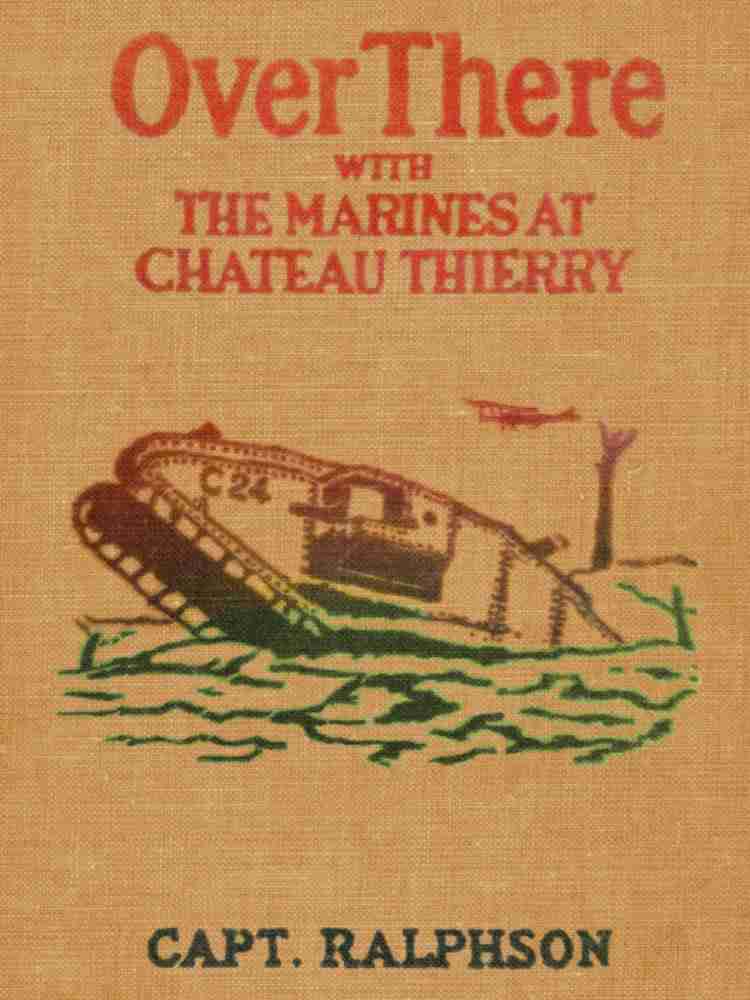
Phil had never before seen the inside of a tank, and in spite of the uncomfortable situation in which he now found himself, his first impulse was to look about him and see what sort of affair a “land battleship” might be.
But he was not given much opportunity for an undisturbed inspection of the interior of the huge war engine at this time. Almost immediately after the metal door was closed, events began to take place with much greater volume and intensity than at any time during the machine guns and infantry battle amid the ruins of the town. Apparently, this tank had just arrived on the scene of the fight and, finding the battle going hopelessly against the boches, turned and fled. But the reason for the flight did not spring from any menace of infantry or machine guns. The big war engine might have cleaned up a whole army of such comparative pygmies and toys. It was the advance of half a dozen British tanks into the fight that caused the crew of the “land battleship” to see the unwisdom of tarrying on the field of the already lost battle and to turn about and seek safety in flight.
Phil was unable to see much outside. All the portholes were occupied by members of the crew who manned the guns or handled the driving and steering apparatus. Now and then he was able to get a narrow peek through one of these ports, but with little satisfaction. The evidence of the new turn of events since his capture came to his ears from without and to his eyes within the car.
The firing of what seemed to be a battery of heavy guns apprised him of the approach of a “fleet” of British tanks. The din of the firing of the guns of the huge war engine in which he was imprisoned and of the attacking tanks was terrific. It seemed as if some of the shells that struck the armor plate of the fleeing machine must surely pierce it through and explode inside the car.
Up and down over the heaps of debris went the big “land ship,” and after it came the pursuing “caterpillar batteries.” Phil watched the contest with every sense of perception on the alert. The inside of the boche tank was illuminated principally with electric bulbs, for little light came in through the portholes. Five men, a driver, a mechanician, and three gunners, constituted the crew. The driver sat on a low cushioned seat in the forward part of the car. About him, and within easy reach, were the controlling apparatus, directing lever, clutch and brake pedals, gear lever and steering clutch. Behind him was the starting crank, and behind this were the radiator, ventilator, fuel tank and motor.
Every member of the crew was desperately busy with his own duties in connection with the operation of the war engine and its battery. The driver looked straight ahead as if he hoped to pull the tank along at greater speed by fastening his gaze on a distant object; the gunners sat in their hammock-like seats that swung easily back and forth and from side to side to suit the will of the occupants as they loaded and fired; and the mechanician was busy most of the time with an oil can, the nozzle of which he poked into more holes and cups than a layman would have imagined to exist in a machine several times the size of this one.
Phil had no technical knowledge of artillery, but he saw at once that the battery of this tank was heavy and of very destructive character. The three pieces sent forth their murderous messages almost as rapidly, it seemed, as the fire of a machine-gun. One of the gunners sat up in a revolving turret, while the other two were in swinging “half-turrets” at both sides.
“Count Topoff” forced his prisoner into a sitting position on what appeared to be a closed tool-chest near the starting crank and then sat down beside him. There they waited and watched and listened, both strung to the highest tension of eagerness, apprehension, expectancy.
Phil, of course, longed for victory to crown the efforts of the pursuing tanks, and yet he had to admit to himself that probably his own safety depended upon the escape of his captors. Their defeat could be effected only by crippling the caterpillar tread, or “chain-feet,” or by exploding shells in the machinery. The former was difficult to do because of the peculiar construction of the treads with many slanting surface-sections, and about the only kind of shell that could be thrown into the machinery was an explosive bullet about two inches in diameter, specially made to pierce armor plate.
Phil had no sure way of determining how near the British tanks approached to the fleeing boche engine, but he inferred from the sound of their guns that it would require a long and continued peppering away to put the big enemy tank out of business. He suspected, too, that this land-dreadnaught carried at least one anti-tank rifle capable of firing high power explosives through the armor of the attacking “fleet.” He gathered this suspicion from the one grim and gleeful remark that “the count” screamed into his ear “between shots”:
“We’ve knocked two of them out already, and we’ll fix all the rest the same way if they don’t keep a slanting front to that gimlet-twist up there.”
Phil was unable to figure out how Topoff could determine the number of British tanks that had been put out of commission, if indeed any had suffered such disaster, but he now observed for the first time the smaller gun alongside the heavy shell-piece in the revolving turret. He also watched the gunner in the turret more closely and before long he understood clearly that the fellow was constantly on the alert for an opening for an effective shot with the smaller piece.
The battle continued thus for half an hour, but the British tanks seemed to be unable to stop the big boche battler. At last the firing ceased.
“What’s happened?” Phil ventured to inquire of the boche of big circumference.
“It’s all over and we’ve won, as we always will do,” was the latter’s answer. “It was a stern chase for your British friends and we’ve sunk half their fleet and peppered the sails of the rest of them so full of holes that they won’t hold a cupful of wind.”
“I’ll admit you’ve got a good pair of sea legs and ran a good race for a tank, but I’d like to know how you can tell what your gunners did without being able to see much farther than the end of your nose,” Phil returned skeptically.
“Ah,” said the other with an air of deep mystery; “that remark demonstrates one of the great failings of you Americans. You can’t understand the superior intelligence of the race you are foolishly trying to whip. But you are going to wake up before long.”
“What is going to wake us up?” Phil inquired curiously. His curiosity, however, was directed more at the personal puzzle in “the count” than the information “the count” might be able to communicate.
“Water,” replied the “war prophet.”
Phil looked at his captor a little more keenly, wondering if, after all, this supposed relative of the kaiser were not a little off in his “turret.”
“Maybe he thinks he has an anti-tank gun in his head and has just fired an explosive bullet into me,” the boy mused. “My! what a wise squint he has in his eyes.”
“How is water going to wake us up?” Phil asked after a few moments’ silent contemplation of the strange fellow on the box beside him.
“How?” repeated the latter, looking his prisoner hard in the face. “Don’t you know what’ll wake a sleeping man up quicker than anything else?”
“No,” replied Phil calmly, but with a well-mimicked open-mouthed ingenuousness. “What will wake a sleeping man up quicker than anything else?”
“Throw a pail of water on him,” said Topoff.
“Well?” Phil queried with sustained simple-mindedness.
“Well!” roared “the count” with voluminous contempt; “I believe you’re just fool enough to think that’s the way we’re going to wake you up.”
“Isn’t it?” Phil asked, provokingly.
“No!” the boche officer bellowed, and the boy began to fear he had carried the matter too far. Perhaps even now an attack of insane violence could not be averted.
“No,” repeated “the count,” his face becoming flushed with, crimson hate; “we’re going to push you all, Americans, English, French, Belgians, into the Atlantic Ocean; then you’ll wake up.”