
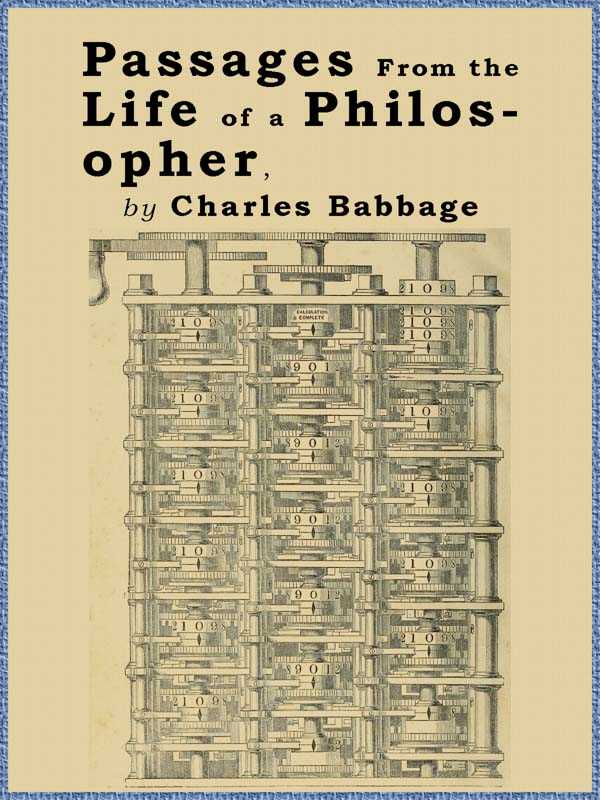
Explanation of the Difference Engine.
Those who are only familiar with ordinary arithmetic may, by following out with the pen some of the examples which will be given, easily make themselves acquainted with the simple principles on which the Difference Engine acts.
It is necessary to state distinctly at the outset, that the Difference Engine is not intended to answer special questions. Its object is to calculate and print a series of results formed according to given laws. These are called Tables—many such are in use in various trades. For example—there are collections of Tables of the amount of any number of pounds from 1 to 100 lbs. of butchers’ meat at various prices per lb. Let us examine one of these Tables: viz.—the price of meat 5 d. per lb., we find
| Number. Lbs. |
Table. Price. | |
|---|---|---|
| s. | d. | |
| 1 | 0 | 5 |
| 2 | 0 | 10 |
| 3 | 1 | 3 |
| 4 | 1 | 8 |
| 5 | 2 | 1 |
There are two ways of computing this Table:—
- 1st. We might have multiplied the number of lbs. in each line by 5, the price per lb., and have put down the result in l. s. d., as in the 2nd column: or,
- 2nd. We might have put down the price of 1 lb., which is 5 d., and have added five pence for each succeeding lb.
Let us now examine the relative advantages of each plan. We shall find that if we had multiplied each number of lbs. in {50} the Table by 5, and put down the resulting amount, then every number in the Table would have been computed independently. If, therefore, an error had been committed, it would not have affected any but the single tabular number at which it had been made. On the other hand, if a single error had occurred in the system of computing by adding five at each step, any such error would have rendered the whole of the rest of the Table untrue.
Thus the system of calculating by differences, which is the easiest, is much more liable to error. It has, on the other hand, this great advantage: viz., that when the Table has been so computed, if we calculate its last term directly, and if it agree with the last term found by the continual addition of 5, we shall then be quite certain that every term throughout is correct. In the system of computing each term directly, we possess no such check upon our accuracy.
Now the Table we have been considering is, in fact, merely a Table whose first difference is constant and equal to five. If we express it in pence it becomes—
| Table. | 1st Dif- ference. | |
|---|---|---|
| 1 | 5 | 5 |
| 2 | 10 | 5 |
| 3 | 15 | 5 |
| 4 | 20 | 5 |
| 5 | 25 |
Any machine, therefore, which could add one number to another, and at the same time retain the original number called the first difference for the next operation, would be able to compute all such Tables.