
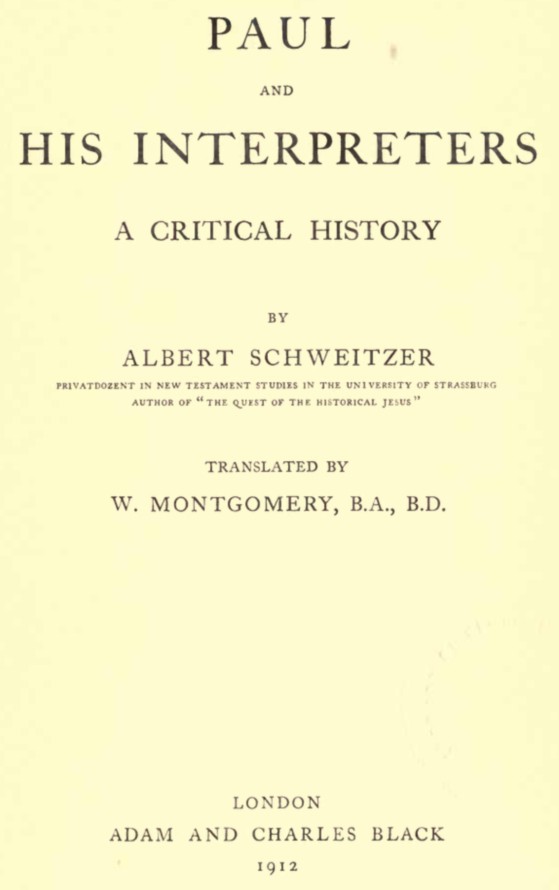
The Project Gutenberg eBook of Paul and his interpreters
Title: Paul and his interpreters
A critical history
Author: Albert Schweitzer
Translator: W. Montgomery
Release date: June 13, 2025 [eBook #76284]
Language: English
Original publication: London: Adam and Charles Black, 1912
Credits: Actonian Press
PAUL
AND
HIS INTERPRETERS
A CRITICAL HISTORY
BY
ALBERT SCHWEITZER
PRIVATDOZENT IN NEW TESTAMENT STUDIES IN THE UNIVERSITY OF STRASSBURG
AUTHOR OF “THE QUEST OF THE HISTORICAL JESUS”
TRANSLATED BY
W. MONTGOMERY, BA., BD.
LONDON
ADAM AND CHARLES BLACK
1912
PREFACE
THE present work forms the continuation of my History of the Critical Study of the Life of Jesus, which appeared in 1906 under the title “Von Reimarus zu Wrede.”1
Any one who deals with the teaching and the life and work of Jesus, and offers any kind of new reading of it, ought not to stop there, but must be held under obligation to trace, from the stand-point at which he has arrived, the pathway leading to the history of dogma. Only in this way can it be clearly shown what his discovery is worth.
The great and still undischarged task which confronts those engaged in the historical study of primitive Christianity is to explain how the teaching of Jesus developed into the early Greek theology, in the form in which it appears in the works of Ignatius, Justin, Tertullian and Irenaeus. How could the doctrinal system of Paul arise on the basis of the life and work of Jesus and the beliefs of the primitive community; and how did the early Greek theology arise out of Paulinism?
Strauss and Renan recognised the obligation, and each endeavoured in a series of works to trace the path leading from Jesus to the history of dogma. Since their time no one who has dealt with the life of Jesus has attempted to follow this course.
Meanwhile the history of dogma, on its part, has come to place the teaching of Jesus, as well as that of Paul, outside the scope of its investigations and to regard its own task as [pg vi] beginning at the point where the undisputed and general Hellenisation of Christianity sets in. It describes therefore the growth of Greek theology, but not of Christian theology as a whole. And because it leaves the transition from Jesus to Paul, and from Paul to Justin and Ignatius, unexplained, and therefore fails to arrive at any intelligible and consistent conception of Christian dogma as a whole, the edifice which it erects has no secure basis. Any one who knows and admires Harnack’s “History of Dogma” is aware that the solid mason-work only begins in the Greek period; what precedes is not placed on firm foundations but only supported on piles.
Paulinism is an integral part of the history of dogma; for the history of dogma begins immediately upon the death of Jesus.
Critical theology, in dividing up the history of the development of thought in primitive Christianity into the separate departments, Life of Jesus, Apostolic Age, History of Dogma, and clinging to this division as if it were something more than a mere convention of the academic syllabus, makes a confession of incompetence and resigns all hope of putting the history of dogma on a secure basis. Moreover, the separate departments thus left isolated are liable to fall into all kinds of confusions and errors, and it becomes a necessity of existence to them not to be compelled to follow their theories beyond the cunningly placed boundaries, or to be prepared to show at any moment how their view accords with the preceding and following stages in the development of thought.
This independence and autonomy of the different departments of study begins with the downfall of the edifice constructed by Baur. He was the last who dared to conceive, and to deal with, the history of dogma in the large and general sense as the scientific study of the development of the teaching of Jesus into the early Greek theology. After him begins, with Ritschl, the narrower and more convenient conception of the subject, which resigns its imperial authority over the departments of study dealing with the Life of Jesus, [pg vii] Primitive Christianity and Paulinism, and allows these to become independent. In the works of Ritschl himself this new departure is not clearly apparent, because he still formally includes the teaching of Jesus, of Paul, and of primitive Christianity within the sphere of the history of dogma. But instead of explaining the differences between the various types of belief and doctrine, he glosses them over in such a way that he practically denies the development of the thoughts, and makes it impossible for a really scientific study of the teaching of Jesus and of Paulinism to fit into the ready-made frame which he provides.
Ritschl shares with Baur the presupposition that primitive dogma arose out of the teaching of Jesus by an organic and logical process. The separate disciplines which began after them have shown that this assumption is false. Of a “development” in the ordinary sense there can be no question, because closer investigation has not confirmed the existence of the natural lines of connexion which might à priori have been supposed to be self-evident, but reveals instead unintelligible gaps. This is the real reason why the different departments of study maintain their independence.
The system of the Apostle of the Gentiles stands over against the teaching of Jesus as something of an entirely different character, and does not create the impression of having arisen out of it. But how is such a new creation of Christian ideas—and that within a bare two or three decades after the death of Jesus—at all conceivable?
From Paulinism, again, there are no visible lines of connexion leading to early Greek theology. Ignatius and Justin do not take over his ideas, but create, in their turn, something new.
According to the assumption which in itself appears most natural, one would be prepared to see in the teaching of Jesus a mountain-mass, continued by the lofty summits of the Pauline range, and from these gradually falling away to the lower levels of the early Catholic theology. In reality the teaching of Jesus and that of the great Apostle are like two separate ranges of hills, lying irregularly disposed in [pg viii] front of the later “Gospel.” Even the relation which each severally bears to primitive Christianity remains uncertain.
This want of connexion must have some explanation. The task of historical science is to understand why these two systems of teaching are necessarily independent, and at the same time to point out the geological fault and dislocation of the strata, and enable us to recognise the essential continuity of these formations and the process by which they have taken their present shape.
The edifice constructed by Baur has fallen; but his large and comprehensive conception of the history of dogma ought not to be given up. It is wholly wrong to ignore the problem at which he laboured and so create the false impression that it has been solved. Present day criticism is far from having explained how Paulinism and Greek theology have arisen out of the teaching of Jesus. All it has really done is to have gained some insight into the difficulties, and to have made it increasingly evident that the question of the Hellenisation of Christianity is the fundamental problem of the history of dogma.
It could not really hope to find a solution, because it is still working away with the presuppositions of Baur, Ritschl, and Renan, and has already tried three or four times over all the experiments which are possible on this basis, without ever attaining to a real insight into the course of the development. It has approached this or that problem differently, has given a new version—not to say in some cases a perversion—of it; but it has not succeeded in giving a satisfactory answer to the question when and how the Gospel was Hellenised.
It has not even attained to clearness in regard to the condition in which the Gospel existed prior to its Hellenisation. It has not ventured to mark off with perfect distinctness the two worlds of thought with which the process is concerned, and to formulate the problem as being that of explaining how the Gospel, which was originally purely Jewish and eschatological, became Greek in form and content. That this could really have come about, it takes to be à priori [pg ix] impossible. It therefore seeks to soften down the antitheses as much as possible, to find in the teaching of Jesus thoughts which force their way out of the frame of the Jewish eschatological conceptions and have the character of universal religion, and in the teaching of Paul to discover a “genuinely Christian,” and also a Hellenic element, alongside of the Rabbinic material.
Theological science has in fact been dominated by the desire to minimise as much as possible the element of Jewish Apocalyptic in Jesus and Paul, and so far as possible to represent the Hellenisation of the Gospel as having been prepared for by them. It thinks it has gained something when in formulating the problem it has done its best to soften down the antitheses to the utmost with a view to providing every facility for conceiving the transition of the Gospel from one world of thought to the other.
In following this method Baur and Renan proceed with a simple confidence which is no longer possible to present day theology. But in spite of that it must still continue to follow the same lines, because it has still to work with the old presuppositions and the weakening down of the problem which they imply. The result is in every respect unsatisfactory. The solution remains as impossible as it was before, and the simplifications which were supposed to be provided in the statement of the problem have only created new difficulties.
The thoroughgoing application of Jewish eschatology to the interpretation of the teaching and work of Jesus has created a new fact upon which to base the history of dogma. If the view developed at the close of my “Quest of the Historical Jesus” is sound, the teaching of Jesus does not in any of its aspects go outside the Jewish world of thought and project itself into a non-Jewish world, but represents a deeply ethical and perfected version of the contemporary Apocalyptic.
Therefore the Gospel is at its starting-point exclusively Jewish-eschatological. The sharply antithetic formulation of the problem of the Hellenisation of Christianity, which it was always hoped to avoid, is proved by the facts recorded in the Synoptists to be the only admissible one. Accordingly, [pg x] the history of dogma has to show how what was originally purely Jewish-eschatological has developed into something that is Greek. The expedients and evasions hitherto current have been dismissed from circulation.
The primary task is to define the position of Paul. Is he the first stage of the Hellenising process, or is his system of thought, like that of primitive Christianity, to be conceived as purely Jewish-eschatological? Usually the former is taken for granted, because he detached Christianity from Judaism, and because otherwise his thoughts do not seem to be easily explicable. Besides, it was feared that if the teaching of the Apostle of the Gentiles, as well as primitive Christianity, were regarded as purely Jewish-eschatological, the problem of the Hellenisation of the Gospel would become so acute as to make the possibility of solving it more remote than ever.
Moreover, the theological study of history is apt, even though unconsciously, to give ear to practical considerations. At bottom, it is guided by the instinct that whatever in the primitive Gospel is capable of being Hellenised may also be considered capable of being modernised. It therefore seeks to discern in Paul’s teaching—as also in that of Jesus—as much as possible that “transcends Judaism,” that has the character of “universal religion” and “essential Christianity.” It is haunted by the apprehension that the significance of Christianity, and its adaptation to our times, is dependent on justifying the modernisation of it on the lines hitherto followed and in accordance with the historical views hitherto current.
Those who have faced the recognition that the teaching of Jesus is eschatologically conditioned cannot be brought by considerations of this kind, scientific or unscientific, to entertain any doubt as to the task which awaits them. That is, to apply this new view to the explanation of the transition to the history of dogma, and as the first step in that direction, to undertake a new formulation of the problem of Paulinism. They will naturally endeavour to find out how far the exclusively eschatological conception of the [pg xi] Gospel manifests its influence in the thoughts of the Apostle of the Gentiles, and will take into account the possibility that his system, strange as this may at first sight appear, may have developed wholly and solely out of that conception.
As in the case of the study of the life of Jesus, the problem and the way to its solution will be developed by means of a survey of what has hitherto been done. At the same time this method of presentation will serve to promote the knowledge of the past periods of the science. Since it is impossible for students, and indeed for the younger teachers, to read for themselves all the works of earlier times, the danger arises that on the one hand the names will remain mere empty names, and on the other that, from ignorance, solutions will be tried over again which have already been advanced and have proved untenable. An attempt has therefore been made in this book to give a sufficient insight into what has been done so far, and to provide a substitute for the reading of such works as are not either of classical importance or still generally accessible.
For practical reasons the method adopted in my former book, of attaching the statement of the new view to the history of earlier views, has not been followed here. This view will be developed and defended in a separate work bearing the title “The Pauline Mysticism” (“Die Mystik des Apostels Paulus”), which will appear at an early date.
The English and American literature of the subject has not been included in this study, since the works in question were not in all cases accessible to me, and an insufficient acquaintance with the language raised a barrier.
Nor have I aimed at giving, even with this limitation, a complete enumeration of all the studies of Paul’s teaching. I have only desired to cite works which either played a part of some value in the development of Pauline study, or were in some way typical. The fact that a work has been left unmentioned does not by any means necessarily imply that it has not been examined.
ALBERT SCHWEITZER.
19th Sept. 1911.
Contents
- CHAPTER I
- THE BEGINNINGS OF THE SCIENTIFIC METHOD . . . [1]
- CHAPTER II
- BAUR AND HIS CRITICS . . . [12]
- CHAPTER III
- FROM BAUR TO HOLTZMANN . . . [22]
- CHAPTER IV
- H. J. HOLTZMANN . . . [100]
- CHAPTER V
- CRITICAL QUESTIONS AND HYPOTHESES . . . [117]
- CHAPTER VI
- THE POSITION AT THE BEGINNING OF THE TWENTIETH CENTURY . . . [151]
- CHAPTER VII
- PAULINISM AND COMPARATIVE RELIGION . . . [179]
- CHAPTER VIII
- SUMMING-UP AND FORMULATION OF THE PROBLEM . . . [237]
- INDEX . . . 251
- ENDNOTES
PAUL
AND HIS INTERPRETERS
I
THE BEGINNINGS OF THE SCIENTIFIC METHOD
Hugo Grotius. Annotationes in Novum Testamentum. 1641-1646.
Johann Jakob Rambach. Institutiones hermeneuticae sacrae. 1723.
Siegmund Jakob Baumgarten. Unterricht der Auslegung der heiligen Schrift. (Instructions in the art of Expounding Holy Scripture.) 1742.
Johann Christoph Wolf. Curae philologicae et criticae. 1741.
Johann August Ernesti. Institutio interpretis Novi Testamenti. 1762. (Eng. Trans., Biblical Interpretation of the New Testament, Edinburgh, 1832-1833.)
Johann Salomo Semler. Vorbereitung zur theologischen Hermeneutic. (Introduction to Theological Hermeneutic.) 1760-1769.
Abhandlung von freier Untersuchung des Canons. (Essay on the free Investigation of the Canon.) 1771-1775.
Neuer Versuch die gemeinnützige Auslegung und Anwendung des Neuen Testaments zu befördern. (A New Attempt to Promote a Generally Profitable Exposition and Application of the New Testament.) 1786.
Latin Paraphrases of the Epistles to the Romans (1769) and Corinthians (1770, 1776).
Johann David Michaelis. Einleitung in die göttlichen Schriften des Neuen Bundes. (Introduction to the Divine Scriptures of the New Covenant.) 1750. (Eng. Trans. by H. Marsh, Cambridge, 1793.)
Übersetzung des Neuen Testaments. (Translation of the New Testament.) 1790.
Anmerkungen für Ungelehrte zu seiner Übersetzung des Neuen Testaments. (Notes for Unlearned Readers on his Translation of the New Testament.) 1790-1792.
Friedrich Ernst David Schleiermacher. Über den sogenannten ersten Brief des Paulus an den Timotheus. (On the so-called First Epistle of Paul to Timothy.) 1807.
Johann Gottfried Eichhorn. Historisch-kritische Einleitung in das Neue Testament. (Historical and Critical Introduction to the New Testament.) 3 vols. 1814.
Gottlob Wilhelm Meyer. Entwicklung des paulinischen Lehrbegriffs. (The Development of the Pauline System of Doctrine.) 1801.
Leonhard Usteri. Entwicklung des paulinischen Lehrbegriffs. (The Development of the Pauline System of Doctrine.) 1824.
August Ferdinand Dähne. Entwicklung des paulinischen Lehrbegriffs. (The Development of the Pauline System of Doctrine.) 1835.
Karl Schrader. Der Apostel Paulus. 1830-1836.
J. A. W. Neander. Geschichte der Pflanzung und Leitung der christlichen Kirche durch die Apostel. (History of the Planting and Guidance of the Christian Church by the Apostles.) 1832. (Eng. Trans. by J. E. Ryland, 1851.)
W. M. Leberecht De Wette. Erklärung der Briefe an die Römer, Korinther, Galater und Thessalonicher. (Exposition of the Epistles to the Romans (2nd ed., 1838), Corinthians, etc. (1841).)
H. E. G. Paulus. Des Apostels Paulus Lehrbriefe an die Galater- und Römer-Christen. (The Apostle Paul’s Doctrinal Epistles to the Galatian and Roman Christians.) 1831.
THE Reformation fought and conquered in the name of Paul. Consequently the teaching of the Apostle of the Gentiles took a prominent place in Protestant study. Nevertheless the labour expended upon it did not, to begin with, advance the historical understanding of his system of thought. What men looked for in Paul’s writings was proof-texts for Lutheran or Reformed theology; and that was what they found. Reformation exegesis reads its own ideas into Paul, in order to receive them back again clothed with Apostolic authority.
Before this could be altered, the spell which dogma had laid upon exegesis needed to be broken. A very promising beginning in this direction was made by Hugo Grotius, who in his Annotationes in Novum Testamentum2 rises superior to the limitations of ecclesiastical dogma. This work appeared in 1641-1646. The Pauline Epistles are treated with especial gusto. The great Netherlander makes it his business to bring out by patient study the simple literal meaning, and besides referring to patristic exegesis, cites parallels from Greek and Roman literature. He does not, however, show any special insight into the peculiar character of the Pauline world of thought.
[pg 003] In the ensuing period the principle gradually became established that exegesis ought to be independent of dogma. Pietism and Rationalism had an equal interest in promoting this result. The accepted formula was that Scripture must be interpreted by Scripture. This thought is common ground to the two famous works on exegesis which belong to the first half of the eighteenth century, the Institutiones hermeneuticae sacrae3 of Johann Jakob Rambach, which is written from the stand-point of a moderate pietism, and Siegmund Jakob Baumgarten’s rationalistically inclined “Instruction in the art of expounding Holy Scripture.”4
On the soil thus prepared by pietism and rationalism it was possible for a philologically sound exegesis to thrive. One of the most important attempts in this direction is Johann Christoph Wolf’s Curae philologicae et criticae.5 This was regarded as authoritative for several decades, and even later is frequently drawn on by exegetes, either with or without acknowledgment. The merit of having gained the widest recognition for the principles of philological exegesis belongs to Johann August Ernesti, the reformer of the St. Thomas’s School at Leipzig and the determined opponent of its famous “Preceptor,” Johann Sebastian Bach. His Institutio interpretis Novi Testamenti appeared in 1762.6 It is on the plan of the “Hermeneutics” of Rambach and Baumgarten, and deals with grammar, manuscripts, editions, translations, patristic exegesis, history and geography as sciences ancillary to exegesis.
But Ernesti’s work suffices to show that the undogmatic philological method did not in itself lead to any [pg 004] result. Its author is in reality by no means free from dogmatic prepossessions, but he skilfully avoids those questions which would bring him into conflict with Church doctrine. In fact the use he makes of philology is more or less formal. He does not venture to treat the books of the New Testament without prepossession as witnesses from the literature of a distant period, and to show the peculiar mould in which Christian ideas are there cast in comparison with subsequent periods and with the period for which he writes. He did not realise that the undogmatic, philological method of exegesis must logically lead to a method in which philology is the handmaid of historical criticism.
His great contemporary, Johann Salomo Semler, ventures to give expression to this truth, and so becomes the creator of historical theology. In his theoretical works on the Scriptures and on exegesis—“Introduction to theological Hermeneutics” (1760-1769),7 “Essay on the free Investigation of the Canon” (1771-1775),8 “A new attempt to promote a generally profitable Exposition and Application of the New Testament” (1786)9—the Halle professor explains again and again what is to be understood by a “historical” method of exegesis. He demands that the New Testament shall be regarded as a temporally conditioned expression of Christian thought, and examined with an unprejudiced eye. In making this claim he does not speak as a [pg 005] disinterested representative of historical science, but makes it in the name of religion. If religion is to develop progressively and purify itself into an ethical belief, the special embodiments which it has received in the past must not lay the embargo of a false authority upon its progress. We must acknowledge to ourselves that many conceptions and arguments, not only of the Old Testament but also of the New, have not the same significance for us as they had for the early days of Christianity. In his work of 1786, Semler even demands that “for present day Christians there should be made a generally useful selection from the discourses of Jesus and the writings of the Apostles, in which the local reference to contemporary readers shall be distinguished or eliminated.”
This theory of historical exegesis is carried out in dealing with the great Pauline Epistles. Semler points the way to the critical investigation of the Apostle’s thought. He gives paraphrases of the Epistle to the Romans and the Epistles to the Corinthians, and attempts to make clear the content and the connection of thought by a paraphrastic and expanded rendering of each individual verse.10 Exegesis is no longer to be encumbered with a panoply of erudition; it is no longer to be interpenetrated with homiletic and dogmatic considerations, and to defer to the authority of the old Greek expositors, who, “when it is a question of historical arguments, had no better or clearer knowledge than we have ourselves.” It must let the Scriptural [pg 006] phrases say openly and freely what they mean in their literal sense, and devote itself simply to that dispassionate, objective study of facts which has hitherto been too much neglected.
The importance of the paraphrases does not however consist, as might be supposed, in their exhibiting the distinctive character of the Pauline trains of thought in comparison with the views of the other New Testament writers. By his use of a paraphrastic rendering of the text Semler puts an obstacle in the way of his gaining an insight into the specifically Pauline reasoning, and unconsciously imports his own logic into the Apostle’s arguments.
On the other hand, his brilliant powers of observation enable him to call attention to some fundamental problems of literary criticism. He is the first to point out that we do not possess the Pauline Epistles in their original form, but only in the form in which they were read in the churches. The canonical Epistle is therefore not, as a matter of a priori certainty, identical with the historical letter. It is quite possible, he argues, that the letters as read in the churches were produced by joining together, or working up together, different letters, and also that written directions and messages, which originally existed in a separate form, were attached in later copies to the Epistles in order that no part of the heritage left by the Apostle might be lost.
On the basis of considerations of this kind Semler arrives at the result that the fifteenth and sixteenth chapters of Romans did not belong to the original Epistle. The sixteenth is, in his view, a series of greetings which Paul—who, it is assumed, was writing from Ephesus—gave to the bearers of the Epistle to be conveyed to the churches which they would visit on their way through Macedonia and Achaia. In the ninth chapter of 2 Corinthians there is preserved, he thinks, a writing intended for another city in Achaia, which was only later welded into the Epistle to the Corinthians. From the [pg 007] fourteenth verse of the twelfth chapter of 2 Corinthians to the close of the thirteenth chapter we have to assume the presence of a separate writing, of later date than the original Second Epistle to the Corinthians. Thus Semler takes the first steps upon the road of literary hypothesis. Theology at first took little notice of these investigations. In the third edition of his “New Testament Introduction” (1777),11 the great Göttingen philologist and theologian J. D. Michaelis treats the letters of the Apostle in a quite uncritical spirit, and does not enter at all into the literary problems; in his “Translation” and “Exposition” of the New Testament12 he follows the old tracks and makes no attempt to carry out the task which Semler had assigned to historical exegesis. In general the eighteenth century, after Semler, contributed very little to the investigation of Paulinism. Schleiermacher was the first to take a step forward, when, in a letter to Gass, he expressed his doubts as to the genuineness of I Timothy.13
Shortly before the battle of Jena—so he recounts in the preface—he had communicated his doubts to his friend, but had not got the length of setting them forth in a reasoned argument. “The battle—though indeed it ended all too quickly—the consequent unrest in the town, and even in the house, the confused hurrying to and fro, the sight of the French soldiers, which was interesting in so many ways . . . the still incomprehensible blow which struck our University even before you left, and the sad sight of the students saying their farewells and taking their departure,—these were certainly not the surroundings [pg 008] in which to set up a critical judgment-seat. Although, on the other hand, you would perhaps have been more ready then, when all seemed lost, to give up a New Testament book, than you are now.” The verbal promise then given but not fulfilled is now discharged in writing.
Schleiermacher bases his argument against I Timothy upon 2 Timothy and Titus. While the same general conceptions are present in the longer letter as in the two shorter ones, they are not there found in the natural connections in which they occur in the others. It makes the impression of being a composite structure, and in its vocabulary, too, shows remarkable differences from the remaining letters taken as a whole.
Strictly speaking it was not Schleiermacher the critic, but Schleiermacher the aesthete who had come to have doubts about 2 Timothy. The letter does not suit his taste. He fails to perceive that, so far as the language goes, the two other letters diverge from the rest of the Pauline Epistles in the same way as I Timothy, and that they also show the same looseness and disconnectedness; only that, in consequence of their smaller extent, it is not so striking. And, most important of all, it escapes him that as regards their ideas all three letters agree in diverging from the remainder of the Pauline Epistles.
Schleiermacher’s omissions are supplied by Eichhorn in his well-known Introduction.14 He lays it down that the three Epistles are all by the same author, and are all spurious. His criticism deals first with the language and thought of the letters, which he shows to be un-Pauline; then he argues that the implied historical situations cannot be fitted into the life of the Apostle, as known to us from the remaining letters and the Acts of the Apostles; finally, he points to the unnaturalness of the relation [pg 009] between Paul and his helpers as it is represented by these Epistles.
The Apostle, he points out, gives them in writing exhortations and directions which on the assumption of a real personal acquaintance and a long period of joint work with them are in any case unnecessary, and become much more so from the fact that the letters look forward to an early meeting. From this Eichhorn concludes that “some one else has put himself in Paul’s place,” and he sees no possibility of the success of any attempt to defend the genuineness of the Epistles against the arguments which he has brought forward. In particular he gives a warning against the seductive attempt to save the genuineness of 2 Timothy by the assumption of a second imprisonment. No hypothesis, he declares, can in any way help the Pastorals, since they must be pronounced from internal evidence—because of their divergence from the remaining Epistles—not to be by the Apostle. This was a long step forward. The circle of writings which have come down under the name of Paul had undergone a restriction which made it possible to give an account of his system of thought without being obliged to find a place in it for ideas which already have a quite early-Catholic ring.
Ten years after Eichhorn’s literary achievement, in the year 1824, the Swiss theologian Leonhard Usteri, a pupil of Schleiermacher’s, published his “Development of the Pauline System of Doctrine,”15 which is generally regarded as the starting-point of the purely historical study of Paulinism, the first attempt to give effect to the demands of Semler.16
Usteri wishes to show the subjective imprint and [pg 010] enrichment which ordinary Christianity received at the hands of the Apostle, and he sees in the Epistle to the Galatians the outline of his whole doctrine. He does not, however, venture to give full recognition to the idea of a real antithesis between the Pauline conceptions and those of the primitive Apostles, and consequently is led to soften down the peculiarities of the former so far as possible. The spirit of Schleiermacher, which tended to level down everything of a historical character, influences the book more than the author is aware.17 A peculiar interlude in the investigation of Paulinism was due to the Heidelberger H. E. G. Paulus.18 He published, in the year 1831, a study of the Epistles to the Galatians and Romans, which was in reality an essay on the Apostle’s system of doctrine. The work is undertaken entirely in the interests of a rationalism bent on opposing the reaction to orthodoxy.
According to the arguments of Paulus it is not the case that the letters speak of expiatory suffering and imputed righteousness. Paul cannot have upheld “legality” as against “morality” and have maintained an “unpurified conception of religion.” The “chief sayings,” the characteristic terms, are to be given a purely moral interpretation. The Apostle means that “faith in Jesus” must become in us “the faith of Jesus,” and the narrower conception of righteousness must be enlarged into the [pg 011] conception of “the righteousness of God.” The “righteousness of God” betokens righteousness such as it exists in God, and is demanded by Him in man’s spirit as its “true good,” “the only real atonement which brings us into harmony with the Deity.” Thus a proper interpretation enables us to discover in these writings “the agreement between the Gospel and a rational faith.”
The book appeared two or three decades too late. The rationalism which it represents had had its day. But there is something imposing in this determined wresting of the Apostle’s views. It is parallel to that which was practised by the Reformation. The latter interpreted the whole of Paulinism by the passages on the atoning death, and ignored the other thoughts in the Epistles. The Heidelberg rationalist starts from the conceptions connected with the “new creature,” which were later to be described as the ethical system of the Apostle, and interprets everything else by them.
The fact that the two views—the only ones which endeavoured to grasp Paulinism as a complete, articulated system—thus stand over against each other antithetically is significant for the future. Critical study in the course of its investigations was to come to a point where it would have to recognise both views as justified, and to point out the existence in Paul of a twofold system of doctrine—a juridical system based on the idea of justification, and an ethical system dominated by the conception of sanctification—without at first being able to show how the two are interrelated and together form a unity.
II
BAUR AND HIS CRITICS
Ferdinand Christian Baur. Die Christuspartei in der korinthischen Gemeinde. (The Christ-party in the Corinthian Church.) Appeared in the Tübinger Zeitschrift für Theologie, 1831 and 1836. Über Zweck u. Veranlassung des Römerbriefs (Purpose and occasion of Rom.), ib. 1836. Die sogenannten Pastoralbriefe. (The so-called Pastoral Epistles.) 1835.
Paulus der Apostel Jesu Christi (1st ed., 1845; 2nd ed., 1866-67). (Eng. Trans. by “A. P.” and A. Menzies, 1873-75.)
Beiträge zu den Briefen an die Korinther, Thessalonicher und Römer. (Contributions to the elucidation of the Epistles to the Corinthians, Thessalonians and Romans.) Tübinger Jahrbücher für Theologie. 1850-57.
Vorlesungen über neutestamentliche Theologie. 1864. (Lectures on New-Testament Theology.)
Vorlesungen über die christliche Dogmengeschichte. (Lectures on the History of Dogma.) Vol. i., 1865.
Albert Schwegler. Das nachapostolische Zeitalter. 1846. (The Post-Apostolic Age.)
Carl Wieseler. Chronologie des apostolischen Zeitalters. 1848. (The Chronology of the Apostolic Age.) On the Pauline Epp., 225-278.
Albrecht Ritschl. Die Entstehung der altkatholischen Kirche. (The Origin of the Early Catholic Church.) 1st ed., 1850; 2nd ed., 1857.
Gotthard Viktor Lechler. Das apostolische und nachapostolische Zeitalter. (The Apostolic and Post-Apostolic Age.) 1852. (Eng. Trans. by A. J. K. Davidson, Edinburgh, 1886.)
Richard Adalbert Lipsius. Die paulinische Rechtfertigungslehre. (The Pauline Doctrine of Justification.) 1853.
IN the fourth number of the Tübinger Zeitschrift für Theologie for the year 1831, F. C. Baur gave to the study of Paulinism a new direction, by advancing the opinion that the Apostle had developed his doctrine in complete opposition to that of the primitive Christian community, and that only when this is recognised can we expect to grasp the peculiar character of the Pauline ideas.
The great merit of the Tübingen critic was that he allowed the texts to speak for themselves, to mean what they said. On the ground of the striking difference between Acts and Galatians regarding Paul’s relation to the original Apostles, and in view of the divisions and contentions which reveal themselves in the Epistles to the Corinthians, Baur concludes that in the early days of Christianity two parties—a Petrine party or party of the original Apostles, and a Pauline party—stood opposed to one another, holding divergent views on the subject of the redemption wrought by Christ.
In the gradual adjustment of these differences he sees the development which led up to the formation of the early Catholic Church, and he traces the evidence for this process in the literature. He thinks he can show that the two parties gradually approached each other, making concessions on the one side and the other, and finally, under the pressure of a movement which was equally inimical to both of them—the Gnosticism of the early part of the second century—they coalesced into a single united Church.
The recognition of the character and significance of Gnosticism makes it possible for Baur to introduce a new kind of criticism. Before him it was only possible to arrive at the negative result that a writing was not by the author to whom it was traditionally ascribed. Now, according to him, it is possible to determine to what period it belongs. It is only necessary to show what position it occupies in the process of reconciliation of the two parties, and, especially, whether it deals with speculative error. This Baur calls “positive” criticism.
He applies it in the first place to the Pastoral Epistles, and argues that the heretics combated in them do not belong to primitive Christianity but are representatives of the Gnostic movement of the second century. By the “myths and genealogies” here mentioned are meant the great speculative systems which are known from Church history. The description given of the heretics is [pg 014] intentionally couched in terms which are neither too general nor too special, in order to sustain the fiction that the false doctrine arising at this later period only revives a movement which had already been attacked and defeated by Paul.
That neither the assumption of a second imprisonment, nor any other possible or impossible hypothesis, can restore to the Pastorals their lost genuineness is as firm a conviction with Baur as it was with Eichhorn.
In the course of his study of the Pastoral Epistles the Tübingen master had expressed the opinion that the criticism of the Pauline writings would probably not “come to a halt” with these Epistles. The results of his further study were offered ten years later (1845) in the brilliantly written work, “Paul the Apostle of Jesus Christ.” He here treats first the life and work, then the letters, and lastly the system of doctrine. The result arrived at in his investigation of the documents is that only the Epistles to the Galatians, Corinthians, and Romans can be confidently used as sources. Compared with these four, all the others must be classed as “anti-legomena,” “which does not at all imply the assertion that they are not genuine, but only indicates the opposition to which their claim to genuineness is in some cases already exposed, in others, may be exposed in the future, since there is not a single one of the smaller Pauline epistles against which, if the four main epistles are taken as the standard, there cannot be raised some objection or other.” There are strong grounds for questioning the Epistles to the Ephesians and Colossians; those to the Thessalonians and Philippians are to be suspected because of the small amount of dogma they contain. Baur’s reason for taking up such a critical attitude towards the “smaller epistles” is that he is bound to see in the heritage which has come down to us from the Apostle, writings “which belong to the history of the party which based itself on his name, and refer to the relations of the various parties,” and show us how Gentile Christianity [pg 015] softens down its principles and its peculiarities in order to meet the Jewish Christianity, which on its part was going through a similar process, in the unity of the early Catholic Church.
This radical view was attacked on all sides. It gave rise to a kind of reaction even within the sphere of scientific theology, and led to the calling in question of results which the labours of Eichhorn had brought into general acceptance. Thus Carl Wieseler prefaces his detailed study on the date of composition of the Pauline letters with the remark that he held all the thirteen letters which are attributed to the Apostle in the Canon to be authentic.
The Apostle’s system of doctrine culminates, according to Baur’s representation, in the doctrine of the Spirit. In the brilliant disquisitions of this section it is not so much the historian who speaks as the pupil of Hegel. Paulinism is in its own way an announcement of the unity of the subjective spirit with the objective spirit. It is only from this point of view that a consciousness of freedom such as is found in the Apostle of the Gentiles can exist. His doctrine is concerned with union with Christ and with God by faith, from which comes Spirit. “Righteousness” is “the proper relation towards God, to place men in which is the highest duty of all religion.”
Baur does not enter into the details of the Pauline doctrine of justification. Detail is in fact somewhat neglected in his treatment. Strictly speaking, he only includes that which can be in some way or other expressed in Hegelian thought-forms, and that in which Paulinism may be exhibited as representing absolute religion. Everything else is thrown into the background, and receives only a partial appreciation—or depreciation—in a separate chapter entitled “A special discussion of some subsidiary dogmatic questions.” The characteristic stamp of the Pauline doctrine is largely obliterated. In particular, Paul’s views about the “last things” and the angels are not allowed to become disturbingly prominent. Baur does not, indeed, hesitate practically to eliminate [pg 016] them. The angelology he dismisses with the following remark: “Of the angels the Apostle says little in the letters which we have here to take into consideration, and that little not dogmatically, but only metaphorically and in current popular phraseology.”
The Tübingen scholar, in fact, uses the language of Paul in order to set forth an imposing philosophy of religion instinct with Hegelian influence. He gives no authentic account of the Apostle’s thought. Nevertheless this book breathes the spirit of Paul the prophet of freedom more fully than almost any other which has been devoted to him. That is what gives it its remarkable attractiveness.
A year after the appearance of Baur’s “Paulus”—in 1846—Albert Schwegler published his work on the post-apostolic age.19 The founder of the Tübingen School had hitherto only, so to speak, hinted at the phases of development by which the early Church grew up out of the controversy between the two parties. Schwegler undertakes a more detailed description, and in doing so draws the lines so sharply that, along with the greatness of the construction, its faults become obvious. He has no deeper knowledge of Paulinism to impart.
Schwegler’s work had made it apparent from what side the Tübingen position was open to attack, and on this side Albrecht Ritschl proceeded to attack it in his well-known work on the origin of the early Catholic Church.20 The first edition (1850) is primarily directed against Schwegler only; in the second (1857) he develops his opposition of [pg 017] principle to Baur. He offers proof that the earliest literature is not dominated by the negotiations for a compromise between the two parties which was postulated by the Tübingen School, and at the same time he attacks the basis of the whole hypothetical construction. Baur, he urges, must have formed a false conception of Jewish Christianity and Gentile Christianity, since, on his view, it cannot be explained what was the common element that held the two together. Had they only, as the Tübingen School was obliged to assume, had the external bond of profession of faith in Christ, it would never be possible to explain why both parties felt the need of approaching one another by mutual concessions until finally they coalesced in a single united Church.
The extent of the doctrinal material common to both must, Ritschl argues, have been much greater than Baur represents. He has not discharged the first duty of a historian of the Apostolic age, for this requires “that the points should be clearly shown in which Jewish Christianity and Paulinism coincide.” Baur had only given a negative description of the Apostle’s doctrine, because he never gives any hint “that Paul in very essential points held views which were common also to Jewish Christianity.”
The problem regarding the nature of the unity between Paulinism and primitive Christianity is thus recognised and formulated.
But it was not so easy for Ritschl to say exactly what constituted the common element of doctrine, the existence of which he postulated. That is especially evident in the second edition of “The Origin of the Early Catholic Church.” He is then only willing to admit an “opposition of practice” between Paul and the original apostles; the area of this opposition is so restricted that “the essential agreement in the leading ideas laid down by Christ will be only the more clearly evident.” But since in Paulinism little enough is to be found of the “leading [pg 018] ideas laid down by Christ” the proof of the “essential agreement” remains a pious aspiration.
The only solid fact which Ritschl is able to adduce is the expectation of the parousia. He assumes that it formed a very important part of the common doctrinal material, and inclines to believe that Paulinism and Jewish Christianity agreed in an ideal-real expectation of the Second Coming in order to make common cause against Chiliasm, though the latter in its coarser form only appeared later.
But in thus recognising eschatology Ritschl did not take the matter very seriously. He uses the eschatology, in fact, only in order to score a dialectical point against Baur, who had taken too little account of it. In Ritschl’s “Justification and Reconciliation,” where he later on had occasion to give a positive description of Paulinism, he avoided the faintest hint of any eschatological colouring of the Apostle’s ideas.
Another work which is occupied with the question of the unity between Paulinism and primitive Christianity is Lechler’s “Apostolic and Post-Apostolic Age.”21 The work is a prize essay in answer to the problem proposed by the Teylerian Society in Holland, as to what constituted “the absolute difference between the doctrine and attitude of the Apostle Paul and that of the other Apostles,” by which the “so-called Tübingen School endeavours to justify its hostile treatment of Christianity.” Lechler opposes his teacher, but is not able to make any advance upon Ritschl in producing evidence of the common elements in the two doctrinal systems.