
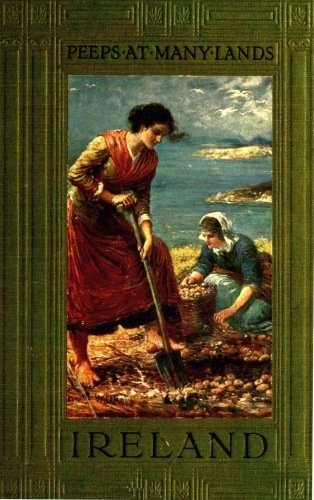
The Project Gutenberg eBook of Peeps at Many Lands: Ireland
Title: Peeps at Many Lands: Ireland
Author: Katharine Tynan
Illustrator: Francis Sylvester Walker
Release date: September 2, 2013 [eBook #43623]
Most recently updated: October 23, 2024
Language: English
Credits: Produced by Chuck Greif and the Online Distributed
Proofreading Team at http://www.pgdp.net (This file was
produced from images generously made available by The
Internet Archive)
|
Every attempt has been made to replicate the original as printed. Some illustrations have been moved from mid-paragraph for ease of reading. In certain versions of this etext, in certain browsers, clicking on this symbol above the image will bring up a larger version of the image. Contents List of Illustrations (etext transcriber's note) |
VOLUMES UNIFORM WITH THIS
| PEEPS AT MANY LANDS AND CITIES | ||
|---|---|---|
| EACH CONTAINING 12 FULL-PAGE ILLUSTRATIONS IN COLOUR | ||
| AUSTRALIA BELGIUM BERLIN BURMA CANADA CEYLON CHINA CORSICA DENMARK EDINBURGH EGYPT ENGLAND FINLAND FRANCE GERMANY |
GREECE HOLLAND HOLY LAND HUNGARY ICELAND INDIA IRELAND ITALY JAMAICA JAPAN KASHMIR KOREA LONDON MOROCCO NEW YORK |
NEW ZEALAND NORWAY PARIS PORTUGAL ROME RUSSIA SCOTLAND SIAM SOUTH AFRICA SOUTH SEAS SPAIN SWEDEN SWITZERLAND TURKEY WALES |
| PEEPS AT NATURE | ||
|---|---|---|
| WILD FLOWERS AND THEIR WONDERFUL WAYS BRITISH LAND MAMMALS |
BIRD LIFE OF THE SEASONS THE HEAVENS | |
| PEEPS AT HISTORY | ||
| CANADA INDIA |
JAPAN SCOTLAND | |
| PEEPS AT GREAT RAILWAYS | ||
| THE LONDON AND NORTH-WESTERN RAILWAY THE NORTH-EASTERN AND GREAT NORTHERN RAILWAYS | ||
| PUBLISHED BY ADAM AND CHARLES BLACK SOHO SQUARE, LONDON, W. | ||
| AGENTS | |
| AMERICA | THE MACMILLAN COMPANY |
| 64 & 66 Fifth Avenue, NEW YORK | |
| AUSTRALASIA | OXFORD UNIVERSITY PRESS |
| 205 Flinders Lane, MELBOURNE | |
| CANADA | THE MACMILLAN COMPANY OF CANADA, LTD. |
| St. Martin’s House, 70 Bond Street, TORONTO | |
| INDIA | MACMILLAN & COMPANY, LTD. |
| Macmillan Building, BOMBAY | |
| 309 Bow Bazaar Street, CALCUTTA | |
First printed November, 1909
Reprinted October, 1910, and September, 1911
CONTENTS
| CHAPTER | PAGE | |
| I. | ARRIVAL | 1 |
| II. | DUBLIN | 6 |
| III. | THE IRISH COUNTRY | 20 |
| IV. | THE IRISH PEOPLE | 27 |
| V. | SOUTH OF DUBLIN | 38 |
| VI. | THE NORTH | 44 |
| VII. | CORK AND THEREABOUTS | 49 |
| VIII. | GALWAY | 58 |
| IX. | DONEGAL OF THE STRANGER | 65 |
| X. | IRISH TRAITS AND WAYS | 76 |
LIST OF ILLUSTRATIONS
| THE EAGLE’S NEST, KILLARNEY | Frontispiece |
| FACING PAGE | |
| A VILLAGE IN ACHILL | viii |
| SACKVILLE STREET, DUBLIN | 9 |
| DUBLIN BAY FROM VICTORIA HILL | 16 |
| BLARNEY CASTLE | 25 |
| OFF TO AMERICA | 32 |
| A WICKLOW GLEN | 41 |
| THE RIVER LEE | 48 |
| RALEIGH’S HOUSE, MYRTLE GROVE | 57 |
| GLENCOLUMBKILLE HEAD | 64 |
| A DONEGAL HARVEST | 73 |
| A HOME IN DONEGAL | 80 |
| DIGGING POTATOES | on the cover |
| Sketch-Map of Ireland on p. vii | |
IRELAND
CHAPTER I
ARRIVAL
IT may safely be said that any boy or girl who takes a peep at Ireland will want another peep. Between London and Ireland, so far as atmosphere and the feeling of things is concerned, there is a world of distance. Of course, it is the difference between two races, for the Irish are mainly Celtic, and the Celtic way of thinking and speaking and feeling is as different as possible from the Saxon or the Teuton, and the Celt has influenced the Anglo-Irish till they are as far away from the English nearly as the Celts themselves. If you are at all alert, you will begin to find the difference as soon as you step off the London and North Western train at Holyhead and go on board the steamer for Kingstown. The Irish steward and stewardess will have a very different way from the formal English way. They will be expansive. They will use ten words to one of the English official. Their speech will be picturesque; and if you are gifted with a sense of humour—and if you are not, you had better try to beg, borrow or steal it before you go to Ireland—there will be much to delight you. I once heard an Irish steward on a long-sea boat at London Docks remonstrate with the passengers in this manner:
“Gentlemen, gentlemen, will yez never get to bed? Yez know as well as I do that every light on the boat is out at twelve o’clock. It’s now a quarter to wan, and out goes the lights in ten minutes.”
There is what the Englishman calls an Irish bull in this speech; but the Irish bull usually means that something is left to the imagination. I will leave you to discover for yourself the hiatus which would have made the steward’s remark a sober English statement.
These things make an Irish heart bound up as exultantly as the lark springs to the sky of a day of April—that is to say, of an Irish exile home-returning—for the dweller in Ireland grows used to such pearls of speech.
Said a stewardess to whom I made a request that she would bring to my cabin a pet-dog who, under the charge of the cook, was making the night ring with his lamentations: “Do you want to have me murdered?” This only conveyed that it was against the regulations. But while she looked at me her eye softened. “I’ll do it for you,” she said, with a subtle suggestion that she wouldn’t do it for anyone else; and then added insinuatingly, “if the cook was to mind the basket?” “To be sure,” said I, being Irish. “Ask the cook if he will kindly mind the basket and let me have the dog.” And so it was done, and the cook had his perquisite, while I had the dog.
At first, unless you have a very large sense of humour—and many English people have, though the Irish who do not know anything about them deny it to them en bloc—you will be somewhat bewildered. Apropos of the same little dog, we asked a policeman at the North Wall, one wintry morning of arrival, if the muzzling order was in force in Dublin.
“Well, it is and it isn’t,” he said. “Lasteways, there’s a muzzlin’ order on the south side, but there isn’t on the north, through Mr. L—— on the North Union Board, that won’t let them pass it. If I was you I’d do what I liked with the dog this side of the river, but when I crossed the bridge I’d hide him. You’ll be in a cab, won’t you?”
After you’ve had a few peeps at Ireland, you won’t want the jokes explained to you, perhaps, or the picturesqueness of speech demonstrated.
Before you glide up to the North Wall Station you will have discovered some few things about Ireland besides the picturesqueness of the Irish tongue. You will have seen the lovely coast-line, all the townships glittering in a fairy-like atmosphere, with the mountains of Dublin and Wicklow standing up behind them. You will have passed Howth, that wonderful rock, which seems to take every shade of blue and purple, and silver and gold, and pheasant-brown and rose. You will have felt the Irish air in your face; and the Irish air is soft as a caress. You will have come up the river, its squalid and picturesque quays. You will have noticed that the poor people walking along the quay-side are far more ragged and unkempt generally than the same class in England. The women have a way of wearing shawls over their heads which does not belong naturally to the Western world, and sets one to thinking of the curious belief some people have entertained about the Irish being descended from the lost tribes. A small girl in a Dublin street will hold her little shawl across her mouth, revealing no more of the face than the eyes and nose, with an effect which is distinctly Eastern. The quay-side streets are squalid enough, and the people ragged beyond your experience, but there will be no effect of depression and despondency such as assails you in the East End of London. The people are much noisier. They greet each other with a shrillness that reminds you of the French. The streets are cheerful, no matter how poor they may be. I have always said that there is ten times the noise in an Irish street, apart from mere traffic, than in an English one. An Irish village is full of noise, chatter of women, crying of children, barking of dogs, lowing of cattle, bleating of sheep, crowing of cocks, cackling of hens, quacking of ducks, grunting of pigs. The people talk at the top of their voices, so that you might suppose them to be quarrelling. It is merely the dramatic sense. I have heard an Irish peasant make a bald statement—or, at least, it would have been bald in an English mouth—as though she pleaded, argued, remonstrated, scolded, deprecated.
Accustomed to Irish ways, English villages have always appeared very dead to me. Unless it be on market morning, one might be in the Village of the Palace of the Sleeping Beauty. I once visited Dunmow of the Flitch of a golden May-day. It was neither Flitch Day nor Market Day, and I aver that I walked through the town and saw no living creature, except a cat fast asleep, right in the midst of the sun-baked roadway. Such a thing could not have happened in Ireland.
CHAPTER II
DUBLIN
DUBLIN is a city of magnificences and squalors. It has the widest street in Europe, they say, in Sackville Street, which, after the manner of the policeman and the muzzling order, half the population calls O’Connell Street. The public buildings are very magnificent. These are due, for the greater part, to the man who found Dublin brick and left it marble—that great city-builder, John Claudius Beresford, of the latter half of the eighteenth century, whose name is at once famous and infamous to the Irish ear, because when he had made a new Dublin he flogged rebels in Beresford’s Riding-School in Marlborough Street with a thoroughness which left nothing to be desired except a little mercy. Beresford, who was one of the Waterford Beresfords, was First Commissioner of Revenue, as well as an Alderman of the City of Dublin. Before he went city-building, Dublin was a small place enough. For centuries it consisted chiefly of Dublin Castle, the two cathedrals—Patrick’s and Christ’s Church; Dublin is alone in Northern Europe in possessing two cathedrals—and the narrow streets that clustered about them. Somewhere about the middle of the eighteenth century St. Stephen’s Green was built—the finest square in Europe, we say; I do not know if the claim be well founded. A little later Sackville Street began to take shape, communicating with the other bank of the river by ferry-boats. Essex Bridge was at that time the most easterly of the bridges, and the banks of the river were merely mud-flats, especially so where James Gandon’s masterpiece, the Custom-House, was presently to rear its stately façade. The latter part of the eighteenth century was the great age of Dublin. Ireland still had its Lords and Commons, who had declared their legislative independence of England in 1782. Society was as brilliant as London, and far gayer. It was certainly a time in which to go city-building, for these splendours needed housing. Before Beresford began his plans, calling in the genius of James Gandon, with many lesser lights, to assist him, Sackville Street and Dublin generally were as insanitary as any town of the Middle Ages. Open sewers ran down the middle of the streets. There was no pretence at paving. The streets were ill-lit by smelly oil-lamps. The Dublin watchmen found plenty to do, as did their brethren in London, in protecting peaceful citizens from the pranks of the Dublin brethren of the London Mohocks in the tortuous and ill-lit streets. Dublin, the city of the English pale, remained and remains an English city—with a difference. The Anglo-Irish did the things their London brethren were doing—with a difference. If there were unholy revels at Medmenham Abbey on the Thames, they were imitated or excelled by their Irish prototypes, whose clubhouse you will still see standing up before you a ruin on top of the Dublin mountains. In many ways the society of Dublin models itself on London to this day.
The Lords and Commons of Ireland were already living about the Rotunda in Sackville Street, Rutland Square, Gardiner’s Row, Great Denmark Street, Marlborough Street, and North Great George’s Street, when John Claudius Beresford began his work. He bridged the river with Carlisle—now O’Connell—Bridge. He constructed Westmoreland Street right down to the Houses of Parliament.
He built the Custom-House, now a rabbit-warren of Government offices, on a scale proportioned to the needs of the greatest trading city in Europe, oblivious of the fact that Irish trade was going or gone; or, perhaps—who knows?—building for the future. All that part of the city lying between the new bridge and the Custom-House was laid out in streets. Meanwhile the nobility and gentry who had town-houses were seized with the passion for beautifying them. The old Dublin houses were of an extraordinary stateliness and beauty. Money was poured out like water on their beautification. The floral decoration in stucco-work on walls and ceilings still makes a dirty glory in some of the old houses. Famous artists, like Cipriani and Angelica Kauffmann, painted the wall-panels and ceilings with pseudo-classical goddesses and nymphs. A certain Italian named Bossi executed that inlaying in coloured marbles which made so many of the old mantelpieces things of beauty. The old Dublin houses still retain their stately proportions, although some of them have been dismantled and others come down to be tenement-houses. But there is yet plenty to remind us that Dublin had once its Augustan Age.
If you have the tastes of the antiquary, the old Dublin houses and buildings will afford you matter of great interest.
In the first place, there is Dublin Castle, which was built by King John. Of the four original towers, only one now remains. The castle has been the town residence of the Lord-Lieutenant of Ireland since Sidney established himself there in the reign of Queen Elizabeth. For the rest, it is a congerie of Government offices of one sort or another.
The castle was built over the Poddle River, which now creeps in darkness, degraded to a common sewer, under the dark and dismal houses, and empties itself in an unclean cascade through a grating in the Quay walls, whence it flows away with the Liffey to the sea. You can visit the Chapel Royal, if you will, and the viceregal apartments are sometimes open to inspection if the Viceroy is not in residence. I lived many years in Dublin without desiring to inspect what may be seen of Dublin Castle, though I have often stood in the castle yard under the Bermingham Tower, and, looking up at that great keep, have remembered how Hugh O’Donnell and his companions escaped by way of the Poddle one Christmas Eve in the spacious days of great Elizabeth, and how the young chieftain of Tyrconnel narrowly escaped the frozen death which befell his companions as they climbed those Dublin mountains over yonder to find refuge with the O’Tooles and O’Byrnes of the Wicklow Hills.
Those were the Irish clans that used to make the English burghers of Dublin shake in their shoes. While they sold their silks or woollens, or sat at meals or exchange, or said their prayers in their churches, they never could be sure that the wild Irish cry would not come ringing at their gates. The O’Byrnes and O’Tooles would swoop down at intervals, and raid the cattle from the fat pastures of the pale, sweeping back again with their spoil to their impregnable fastnesses. Some years ago a Father O’Toole published a book on the Clan of O’Toole, which contained the genealogical tree of the O’Tooles, tracing their descent without a break from Noah. This is a matter of interest to me, as I myself am an O’Toole.
The history of nations is, after all, the history of men—of men and of movements—and it is individual and outstanding men who make for us the milestones of history. Ireland has produced, in proportion to her population, a more than usual number of outstanding men; and, thinking of Dublin houses and monuments of one kind or another, we find it is of men we are thinking, after all.
Thinking of Christ Church, that beautiful Gothic cathedral, I think of St. Patrick, because his staff was preserved there, and was an object of great reverence till it was burnt by a too-zealous reforming Bishop in the days of Elizabeth. St. Patrick was a very delightful saint. One loves the legends that gather about him. I like especially how he wrestled with the angel on Croagh-Patrick, and would not come down from the mountain till he had been granted his several prayers. There were three in particular. The first one was that Ireland should never depart from the Christian faith. “Very well, then,” said the angel, “God grants you that.” “Next,” said Patrick, “I ask that on the Judgment Day I may sit on God’s right hand and judge the Irish people.” “That you can’t have,” said the angel. “Be quiet now, and go down from the mountain.” “What!” said Patrick, “is it for this that I have fasted so many days on the mountain, wrested with evil ones, been exposed to the rain and tempest, prayed hard, fought temptations—only for this?” “Very well, you shall have this,” replied the angel. “And now that you have your wish satisfied, go down from the mountain.” “Not till my third prayer be granted.” “What! a third prayer?” cried the angel. “You ask too much, O Patrick, and you shall not have it. You are too covetous.” “Was it for this?” began Patrick again, with a recital of all he had done and suffered. “Very well, then,” said the angel, tired out; “have your third prayer, but ask no more, for it will not be given to you.” “I ask that all who recite my prayer” (i.e., the prayer known as St. Patrick’s Breastplate) “shall not be lost at the Last Day.” “Very well, then,” said the angel, “you shall have that; but now go down.” “I am content now,” said Patrick; “I will go down.”
He was a fighting saint, despite his many gentlenesses. At Downpatrick, where he built his cathedral, he took a little fawn which his men would have killed, and carried it in his breast. I like the description of him by his friend St. Evan of Monasterevan, which tells us how he was sweet to his friends, but terrible to his enemies.
I think of St. Patrick at Christ Church rather than of St. Lawrence O’Toole, Archbishop of Dublin, who, with Strongbow, that fierce Norman who seized Ireland for Henry II. of England, built Christ Church. St. Lawrence O’Toole’s heart lies here in a reliquary. Here also Lambert Simnel was crowned; but who thinks of that ignoble impostor now?
Christ Church presents an effect of lightness and brightness very different from St. Patrick’s, in which it seems to me it is always afternoon, and winter afternoon. Patrick is in a particularly picturesque slum of the city, in the Earl of Meath’s liberty, hard by the Coombe, which was once a pleasant dell, no doubt, but is now the raggedest of slums. To the Earl of Meath’s liberty came the French silk-weavers expelled from France after the revocation of the Edict of Nantes, and established the industry of poplin-weaving there.
The man with whom St. Patrick’s Cathedral is associated is Jonathan Swift, and for his sake it is perpetually dark. It is haunted by the tragedy of his life and death. Here Esther Johnson is buried; and over yonder, in the Deanery House, Swift, a sick man, lay in bed and watched the torches in the great church when they were making ready her grave. The strange bitterness of the terrible inscription which commemorates that most unhappy great man seems to colour the atmosphere of St. Patrick’s. “Where fierce indignation can no more lacerate his heart,” he rests by the side of the woman who was faithful to him with a long patience, whose death left him to loneliness and madness.
The whole place is haunted by him, as is the deanery close by and the old library of Dr. Marsh, which is said to have a ghost that flings the books about at night.
What ghosts meet one in the Dublin streets! There is Wesley. He was visiting the Countess of Moira at Moira House, which now, docked of its upper story, is the Mendicity, or, as the Irish put it, the “Mendacity” Institution. It was a splendid mansion when Wesley was there. One room with a bay-window was lined with mother-o’-pearl. “Alas,” said Wesley prophetically, “that all this must vanish like a dream!” The Moiras were not only religious: they were cultivated, refined, patriotic in the truest sense—altogether noble and generous. They received poor Pamela, Lady Edward Fitzgerald, with kindly open arms when that romantic hero, Lord Edward, lay dying of his wounds.
You shall see, if you will, the old House of Lords, preserved in its old state by the Governors of the Bank of Ireland, who have made it their board-room. The House of Commons has become the Bank’s counting-house, and there is no trace of its former state. What ghosts you might meet there at night!—Grattan, Flood, Curran, Hussey Burgh, Plunket, to say nothing of lesser worthies. Over against the Parliament Houses was Daly’s Club-House, where forgathered the wits, the bucks, the duellists. There was Buck Whaley, who walked to Jerusalem for a wager, and for the same reason once sprang out of the window of his house on Stephen’s Green into a carriage full of ladies. That house is now University College, and has its associations with Newman; and you might see there some of the most beautiful specimens of the eighteenth-century decoration still remaining—the Bossi mantelpieces, the stucco-work, the beautiful old doors of wine-red mahogany, and all the rest of it. Buck Whaley had a friend, Buck Jones, who is commemorated in Jones’s Road. When I was a little girl—and how long ago that is I shall not tell you—Buck Jones’s ghost still walked the road which is named after him. You see, Dublin still ranged itself alongside London; and we had our Buck Whaley and our Buck Jones if London and Bath had their Beau Brummel and their Beau Nash.
Cheek by jowl with the Houses of Parliament is the ancient college of Queen Elizabeth—the College of the Holy and Undivided Trinity. That, too, has memories and ghosts. The University has had illustrious sons. Swift, Goldsmith, Bishop Berkeley, Edmund Burke, were among them. Swift was “stopped of his degree for dulness,” and had no love for his alma mater. She had other sons, such as Robert Emmet and Theobald Wolfe Tone and Thomas Davis, among her brightest jewels, though she would not have it so. She spreads a quiet place of grey quadrangles and green park and gardens midmost of the city, and she helps to give dignity to Dublin, already by her Viceregal Court marked as no provincial town.
If I were to talk to you of the ancient history of Dublin, this book would become, not “A Peep at Ireland,” but “A Peep at Dublin.” You will see for yourself the ancient houses of the nobility, the Lords and Commons of Ireland. Some of them have come to strange uses. Aldborough House is a barracks; Powerscourt House was in my day a wholesale draper’s; Marino, the splendid residence of the Earls of Charlemont at Clontarf, is in the hands of the Christian Brothers. Many of these old houses are turned into Government offices.
“Alas, that all this must vanish like a dream!” said John Wesley. And how quickly he was justified! In the latter part of the eighteenth century Dublin prided itself on being the gayest capital in Europe. Perhaps Dublin had always too many pretensions. However, it was sufficiently gay and extraordinarily picturesque. The Rutland viceroyalty marked, perhaps, its highest water-mark of gaiety. It was said that the Rutlands were sent over “to drink the Irish into good-humour”—that is, to distract them from serious matters, such as legislative independence and the like. However that may be, they did set the capital to dancing. After all, it was always the Anglo-Irish who counted in the rebellious movements. One has to go as far back as Owen Roe O’Neill to find a Celtic leader. For the time, at all events, Dublin gave itself up to the fascinations of the gallant and gay young Duke and his wonderful Duchess. The Irish allowed that the Duchess was one of the handsomest women in Ireland. Elsewhere she was reputed among the loveliest in Europe. We hear of her dancing at a ball attired in light pink silk, with diamond stomacher and sleeve-knots, and wearing a large brown hat profusely adorned with jewels. Every night there were balls at the castle or the Rotunda. The Duchess was dancing Dublin into good-humour. There were all manner of other social festivities. Every Sunday the Duchess drove on the North Circular Road, with six cream-coloured ponies to her phaeton, all the rank and fashion of Dublin following in coaches-and-six, coaches-and-four, and less pretentious equipages. There was card-playing; there was hard drinking; there were all manner of distractions, disedifying and edifying. For then, as now, the representatives of the King and Queen took the charities under their wing; and dancing at the Rotunda supported the Rotunda Hospital, to say nothing of the tax on the waiting sedan-chairs, which put a few hundred pounds more into the hospital’s coffers.
“Alas, that all this must vanish like a dream!” To be sure, many of the most illustrious of the Anglo-Irish, more Irish than the Irish, refused to be either danced or drunk into good-humour. The brilliant viceroyalty lasted not quite four years, and the gay and handsome Duke left Ireland in the saddest way, carried high on men’s shoulders.
Afterwards there were other things than dancing. There was the Rebellion of 1798. There was the Legislative Union with Great Britain, which meant for Ireland the absence of her Lords and gentry, and the spending in London of revenues derived from Ireland.
In the early years of the nineteenth century grass grew in the streets of Dublin. Famine and pestilence followed each other in monotonous succession. Emmet’s Rebellion broke out in 1804. If you were interested in such things, you would penetrate the slummy parts of Dublin as far as Thomas Street to see where, in front of St. Catharine’s Church, Emmet died, and the house where Lord Edward Fitzgerald was arrested.
Dublin is full of memories, of associations, of ghosts: no city in Europe is richer in such. There is hardly a stone of her streets which is not storied.
CHAPTER III
THE IRISH COUNTRY
DUBLIN possesses great natural advantages. The sea, the mountains, the green country, are at her gates. You take one of her many trams, and at the terminus you step into solitudes, into “dear secret greenness” of country; on to expanses of sea-sand, with the waves breaking in little crisped curls of foam at your feet. She is ringed about with mountains. She has a most beautiful coast-line. Turn which way you will on leaving her, you are safe to turn to beauty. Round about her are clustered various beauties. Beyond the Dublin mountains, the Wicklow Mountains, into which they gently pass, invite you. The mountains have the most beautiful colouring. It is an effect of the mists and clouds. I have seen a mountain red as a rose, and I have seen one black as a black pansy and as velvety. Sometimes they are veiled in silver, with the soft feet of the flying rain upon them; and sometimes, because the sun is shining somewhere, that same rain will be a garment of silver or of the rainbow.
She is the greenest country ever was seen. England may think she wears the green; but as compared with Ireland her green is rust-coloured and dust-coloured. I have gone over from London in May and have found a green in Ireland that absolutely made me wink.
Bids the rash gazer wipe the eye,”
says Herbert; but the green, which is the eye’s comforter of all the colours, is, in an Irish May, of so intense a greenness as to have something of the same effect as Herbert’s rose. I think of the fat pasture-lands at the gates of Dublin, as well I know them. In May they are drifts of greenness, with the cattle sunken to their knees, while the meadows white with daisies, gold with buttercups, presently to be brown and green with seeding-grasses, have an exceeding cleanness and brightness of aspect. Grass-green, milk-white, pure gold—these are fields of delight. There used to be luxuriant hedges, too, ten or twelve feet high. What hedges they were in May! with the hawthorn in full bloom—no one calls it may in Ireland—and, later, the woodbine—honeysuckle in Ireland is the white and purple clover—and with the woodbine the sheets of wild roses flung lavishly over every hedge. Since my young days an improving county surveyor has cut down the hedges, though not so ruthlessly as here in Hertfordshire, where they are noted hedgers and ditchers, and so strip the poor things to the earth almost, just as they are coming into leaf, leaving the roads pitiless indeed for the summer days.
I think of the lavish Irish hedges and of the strip of grass white with daisies which ran either side of the footpath. There was always a clear stream singing along the ditch. It had come down from the mountains, and was amber-brown in colour, and clear as glass; it ran over pebbles that were pure gold and silver and precious stones, now and again getting dammed around a boulder, making a leap to escape, and coming around the boulder with a swirl and a few specks of foam floating upon it. Ireland of the Streams is one of the old names for Ireland, and it is justified; for not only are there lordly rivers like the Shannon and the Blackwater, to mention but two of them, but there are innumerable little streams everywhere, undefiled—at least, as I know them—by factories. You can always kneel down of a summer’s day by one, fill your two hands full and drink your fill; and that mountain water is better than any wine. You may track it, if you will, up to the mountains, where you will find it welling out, perhaps, through the fronds of a hartstongue fern, the first tiny gush of it; and you will find it widening out and almost hidden by a million flowers and plants that like to stand with their feet in water. Or you will see it, cool and deep, with golden shadows sleeping in it, slipping round little boulders and clattering over stones, in a tremendous hurry to escape from these sweet places to the noisome city, where it will lose itself in the sewer water before it finds its way to the sea.
There is no such order in an Irish as in an English landscape: none of the rich, ordered garden air which in England so delights Americans and colonials. The Irish landscape is always somewhat forlorn, wild and soft, with an impalpable melancholy upon it—this even in the fat pasture-lands of Dublin County. How much more so when the bogs spread their beautiful brown desolation over miles of country, or in the wild places where man asks for bread and Nature gives him a stone! At its most prosperous the country is always a little wild, a little mournful, a barefooted colleen with cloudy hair and shy eyes sometimes tearful, and no conventional beauty—only something that takes the heart by storm and holds it fast.
Irish skies weep a deal. That accounts, of course, for the great vegetation, the intense greenness. If I did not know the Irish green I should be unable to realize the mantle of grass-green silk which so often the old ballad-makers gave their knights and ladies. Knowing the Irish grass, I see an intenser green than if I did not know it. Where there are not rocks and stones and mountains, where there is cultivation in Ireland, there is leafage and grass of great luxuriousness. Of a wet summer in Ireland you could scarcely walk through the grass; it might meet above a child’s head. Contrariwise, the flora of Ireland, as I know it, is much less various and luxuriant than that of England. In a childhood and youth spent in the Irish country—it was round about Dublin—I recall only the simpler and commoner wild-flowers. On a chalk cliff at Dover, when May spread a carpet of flowers, I have seen a greater variety of wild-flowers than I knew in a lifetime in Ireland—most of them unknown to me by name.
Nor do I think the birds are so many as in England, perhaps because so much of Ireland is stripped of its woods; perhaps because Ireland has been slower to protect the birds than England; perhaps, also, because of the scantier population, which leaves the birds to suffer hunger in the winter. There are no nightingales in Ireland, but I do not think we have missed them, having the thrush and the blackbird, which seem to me to sing with a richer sweetness in Ireland than in England; but that may be because the Irish-born person is prone to exaggerate the sweetness he has lost. But the most characteristic note of the Irish summer is the corn-crake’s. Somehow the Irish corn-crake has a bigger note and is much more in evidence than his English brother. All the nights of the early summer in Ireland he saws away with his rasping note, till the hay is cut, when he disappears. I suppose one hears him as much in the day-time, but one does not notice him. He is the harsh Irish nightingale. Poor fellow! he is often immolated before the mowing-machine; and you shall see him flying with his long-legged wife and children—or rather scurrying—to the nearest hedgerow, where there is always a plentiful supply of grass to cover him till he can make up his mind to go elsewhere. It is a saying in Ireland that you never see a corn-crake after the meadows are cut. A learned doctor has assured me that they migrate to Egypt for the good of their voices.
For the rest, in the Irish country there are villages of an incredible poverty. The Irish village mars a landscape, whereas so often an English one enhances its beauty. There are farmhouses and isolated cottages. The farmhouses are seldom even pretty. Irish house architecture is terribly ugly, as a rule, except for the few eighteenth-century houses which derive from the English. The Irish farmhouse is generally a two-story building, slated and whitewashed. It is too narrow for its height, although the height may be no great thing. A mean hall-door in the middle, with a mean window to either side, three mean windows above—that is the Irish farmer’s idea of house-building. I remember an Irishman of genius objecting to Morland that his cottages were impossible; there was never the like out of Arcadia. As a matter of fact, the cottages were such as are the commonplaces of English villages. But no good Irishman will concede to England a beauty, natural or otherwise, which Ireland does not possess. The country shows many ruins—ruined houses, the houses of the Irish gentry; ruined mills; ruined churches and castles; and behind grey stone walls, unthought of, uncared for, old disused graveyards filled with prairie grass to the height of the crumbling walls.
When the Irish go away they are always lonely for the mountains. No other mountains are so soft-bosomed and so mild. They have wisps of cloud lying along the side of them and the blue peak showing above. I have seen a rainbow, one end of the arch planted in the sea, the other somewhere behind the mountains, “over the hills and far away.” Seeing that incomparable sight, I understood why the Irish peasant imagines fairy treasures hidden at the foot of the rainbow. I, too, have been in Arcadia.
CHAPTER IV
THE IRISH PEOPLE
I MUST warn you, before proceeding to write about the Irish people, that I have tried to explain them, according to my capacity, a thousand times to my English friends and neighbours, and have been pulled up short as many times by the reflection that all I have been saying was contradicted by some other aspect of my country-people. For we are an eternally contradictory people, and none of us can prognosticate exactly what we shall feel, what do, under given circumstances; whereas the Englishman is simple. He has no mysteries. Once you know him, you can pretty well tell what he will say, what feel, and do under given circumstances. You have a formula for him: you have no formula for the Irish. The Englishman is simple, the Irish complex. The Anglo-Irish, who stand to most English people for the Irish, have had grafted on to them the complexity of the Irish without their pliability. It makes, perhaps, the most puzzling of all mixtures, and it may be the chief difficulty in a proper estimate of the Irish character.
They will tell you in Ireland that you have to go some forty or fifty miles from Dublin before you get into Irish Ireland. There are a good many Irish in Anglo-Ireland, usually in the humbler walks of life, whence you shall find in Dublin servants, car-drivers, policemen, newspaper-boys, and so on, the raciness, the vivacity, the charm, which in Irish Ireland is a perpetual delight. Dublin drawing-rooms are not vivacious, nor are the manners gracious, although the Four Courts still produce a galaxy of wit, and Dublin citizens buttonhole each other with good stories all along the streets, roaring with laughter in a way that would be regarded as Bedlam in Fleet Street.
Get into Irish Ireland and the manners have a graciousness which is like a blessing. I asked the way in Ballyshannon town once. The woman who directed me came out into the street and a little way with me, and when she left me called to me sweetly, “Come back soon to Donegal!” which left a sense of blessing with me all that day. There was a certain curly-haired “Wullie,” who drove the long car from Donegal to Killybegs. I can see “Wullie” yet helping the women on and off the car with their myriad packages, can see the delightful grief with which he parted from us, his shining face of welcome when he met us again a fortnight later. To set against “Wullie” were the car-drivers, who certainly are unpleasant if the “whip-money” does not come up to their expectations. We say of such that they are “spoilt by the tourists,” yet I remember some who were not spoilt by the tourists, although they were perpetually in touch with them—boatmen and pony-boys at Killarney; and a certain delightful guide, whose winning gaiety was not at all merely professional.
Thinking over my country-people, I say, “They are so-and-so,” and then I have a misgiving, and I say, “But, after all, they are not so-and-so.”
They are the most generous people in the world. They enjoy to the fullest the delight of giving; and what a good delight that is! I pity the ungiving people. You will receive more gifts in Ireland in a twelvemonth than in a lifetime out of it. The first instinct of Irish liking or loving is to give you something. The giving instinct runs through all classes. If you sit down in a cabin and see an old piece of lustre-ware or something else of the sort, do not admire it unless you mean to accept it; for it will be offered to you, not in the Spanish way which does not expect acceptance, but in the Irish way which does. I have many little bits of china given so, usually the one thing of any consideration or value the donor possessed. I once sought to buy an old china dish, much flawed and cracked by hot ovens, in a Dublin hotel, as much to save it from following its fellows to destruction as for any other reason. The owner would not sell the dish, but he offered it for my acceptance in such a way that I could not refuse. When I go back to my old home, the cottagers bring a few new-laid eggs or a griddle-cake for my acceptance. I have a friend in an Irish village whose income from an official source is £10 a year. She has a cottage, a few hens, and enough grass for a cow when she can get one. Her gifts come at Christmas, at Easter, on St. Patrick’s Day, and on some special, private feasts of my own—eggs, sweets, flowers, a bit of lace, or a fine embroidered handkerchief, and, in times of illness, a pair of chickens. That is royal giving out of so little; and I assure you that it blesses the giver as well as the recipient.
On the other hand, the farmers grow thriftier and thriftier. Sir Horace Plunkett and men like him, truly patriotic Irishmen, are showing them the way. Successive Land Acts lift them more and more into a position of security from one of precariousness. They have more money now to put in the savings-banks. Their prosperity does not mean a higher standard of living, although that is badly needed. It means more money in the banks—that is all.
The Irish are very like the French. If the day should come when they should learn, like the French, to be thrifty and usurious, I hope I shall not be there to see it. Better—a thousand times better—that they should remain royal wastrels to the end.
As yet we need not fear it. Still, if you ask a drink of water at a mountain cabin in the poorest parts of Ireland, you are given milk; and do not offer to pay for it, lest you sink to the lowest place in the estimation of these splendid givers.
The hospitality is truly splendid. There is a saying in Ireland that they always put an extra bit in the pot for “the man coming over the hill.” It is an unheard-of thing that you should call at an Irish house and not be asked if “you’ve a mouth on you.” If your visit be within anything like measurable distance of meal-time you will be obliged to stay for the meal.
In England, when people are poor, or comparatively so, or feel the need of retrenchment, they “do not entertain.” It is almost the first form of retrenchment which suggests itself to the Englishman; whereas to curtail his hospitalities would be the last form of retrenchment to an Irishman, and you will be entertained generously and lavishly by people you know to be poor. The Englishman’s different way of looking at the matter is no doubt partly due to the fact that he is a much more domestic person than the Irishman, and depends mainly on his family life for his happiness and pleasure. Now, the French do not give hospitality at all outside the large family circle, so that in that regard at least the Irish will have a long way to travel before they touch with the French.