
A TURKISH LADY IN OUTDOOR DRESS.
The rug spread out, the party will all sit cross-legged upon it, and as other groups of women also congregate in the same place, dressed in garments of variegated colours, you would imagine yourself amid beds of many-coloured tulips, while the boys and girls playing around suggest fluttering butterflies.
The enjoyment of the women consists in smoking cigarettes, and gazing between each puff at the glorious scenery. Vendors of all sorts of eatables surround them, and, we will say, a shekerdgi, or dealer in sweeties, answers to their call, and places his circular tray, which he carries on his head, on the tripod-stand which he rests on the ground. The children flock around him, puzzled what to choose in that array of Turkish delight and shekers of every kind and colour. At last a choice is made, and the sweets are placed in a brown-paper bag shaped like a cone, and shared by the party. Shortly afterwards an Albanian selling halva as described in Chapter II., is called to contribute his wares. Then walnuts, pistachios, and peanuts come in for their turn, then ices, maybe, and something more solid in the shape of simits, or ring-cakes, as shown in the illustration in Chapter II. At sunset the boktchas are made up, and the party wends its way home to partake of a more substantial meal.
But should the night be bright, with moonlight, the party often start out again, and prolong their enjoyment until late hours, or until a policeman or old Turk passing by reminds them it is time to retire. It is amusing, in connection with these moonlight promenades, to see the women walking about or sitting with open sunshades to protect themselves from the lunar rays, imagining, no doubt, that they occasion lunacy.
Sometimes a too close proximity to the Bosphorus is selected for spreading the family rug, and an unusually large wash from a steamer passing by breaks unexpectedly on the shore, showering clouds of spray over the women's heads. The cold douche sets them all on their feet, screaming, and the bed of tulips now looks like one dashed by a storm.
But sometimes the ladies are more enterprising; a picnic to some distant part is decided upon, and arabas, or carts, drawn by oxen or buffaloes, are engaged. These conveyances are springless, and about 9 feet long by 4 feet wide. Those intended for excursion purposes have highly ornamented boards of carved, gilt, and painted wood on the two long sides, and an arched awning overhead, made usually of crimson cloth, with gilt or silver fringes.
The yoke attached to the oxen's necks has also an arched projection over it, on which tassels of various colours, and sometimes bells, are suspended in two or more tiers.
The driver, in baggy trousers, short jacket (often dispensed with), and a red fez, walks leisurely alongside the oxen, with a goad in his hand to direct them.
The cart has no seats, but the occupants provide themselves with carpets and cushions. The jolting on bad roads is, of course, tremendous, but this is considered part of the fun of the excursion.
Packed as closely as possible, with the children to fill up odd corners, the cart proceeds on its way groaning and creaking, while its inmates roar with continued laughter, especially when an unusually big jolt has jostled them together.
Having arrived at their destination, the carpets are spread out, and while some prepare and lay out the appetizing viands, others disport themselves in the fields, and return laden with flowers and with great yellow marigolds stuck in their hair.
The repast may consist of such hors-d'œuvres as salted sardines, black olives, caviar, and salad of tchiros, or dried mackerel. This mackerel is the fish that in spring-time migrates from the Mediterranean, where it has spawned, into the Black Sea, and is in such an emaciated condition that the expression "thin as a tchiros" is used in Turkey to designate a person of extreme leanness. Nevertheless, it is caught and dried in the sun in such large quantities that the fields over which they are suspended look blue from a distance. They are sold by the pair, or "married couples," as the vendors cry out, and are grilled, shredded, and prepared into salad with oil and vinegar, and the tender leaves of the cummin (tereot).
Next to the hors-d'œuvres follow dolmaz or rissoles of rice, raisins, and pine-nuts, seasoned with oil, and wrapped and boiled in vine-leaves. Keftez or meat rissoles come next, and then the fruits of the season, such as strawberries, cherries, and plums, or, should it be autumn, grapes, peaches, melons, water-melons, figs, etc. Cheese is frequently eaten with these fruits. Hoshaf, or the sweetened water in which fruit has been stewed, is generally drunk during meals, and when the humble repast is over, coffee is prepared, and served round in little cups which will barely hold an ounce.
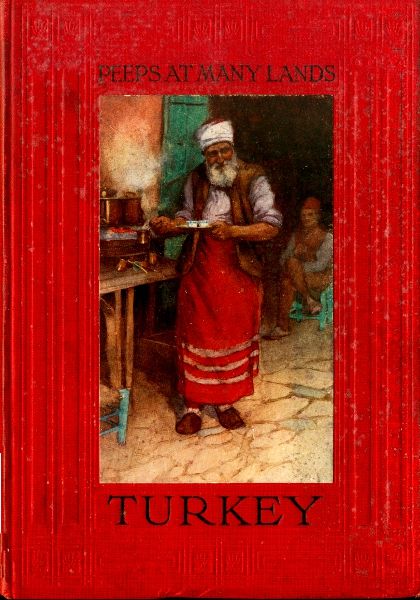
Turkish coffee owes its excellence to the beans being newly roasted and newly ground. The grinding is done with a small machine, which pulverizes the beans very finely. The coffee is prepared in a special brass pot, the bottom of which is wider than the top. A teaspoonful is put in for every cup required, and the water is gently brought to a simmer over a slow fire. The coffee is allowed to rise thrice, and after resting the pot for a minute for the grounds to settle, it is poured out into the cups and drunk while quite hot, with or without sugar. The cups containing a creamy foam are the most recherché. The dregs are not drunk. The illustration on the cover of this book shows a Kafedji in the act of preparing coffee.
Before and after partaking of food, hands are washed, and this is all the more necessary, as meals are eaten with the fingers, the party sitting round a low tray, and dipping into a common dish. Should the hostess desire to confer a special attention on a guest, she takes up a dainty morsel in her fingers, and exclaiming Buyrum (Welcome), places it gently into the guest's mouth. It would be the grossest insult to refuse. Cigarettes invariably follow, and then comes the lounging and the sleeping, and the return home with the lingering rays of the setting sun.
Accompanying the Arabas large parties of Turkish women and children may often be seen riding astride on donkeys, with donkey-drivers at their heels. No Oriental or Turkish lady would think of riding otherwise, and it is reported that quite a sensation was created when a European lady was first seen riding on a side-saddle. The conclusion was that the unfortunate creature had lost a leg, and people wondered how she could keep on with only the other.
But perhaps the pleasantest method of locomotion is by caik—that daintiest of all boats that float on the surface of the waters. Slender and tapering, its side view may be compared to a half-bent long-bow, and when looked upon from above to two such bows lying opposite each other, string to string. A picture of a heavy sort of caik, used for ferrying passengers across the Golden Horn, may be seen in the frontispiece. A caik is about 20 feet long by 4 feet broad in the middle; it is constructed with slender boards, and is only decked at the bows and the stern. The boatman sits on a seat in the middle of the boat, and its two to four passengers on cushions in the bottom, while a servant sits cross-legged on the raised stern. The oars are long and slender, with a peculiar bulge at the upper extremity to balance them. They are fixed to the rowlock peg by leather thongs, which the boatman continually greases. He is clad in a shirt of transparent gauze, with long hanging sleeves, and bordered round the open chest with a scalloping of needlework. His feet are bare, his ample trousers are of white cotton, and his shaven head is only partially covered by a red fez with tassels of purple silk. At each stroke of the oars the arrowy boat flies and skims the waters like a thing of life. Yet, though swift and graceful, the caik is not so safe nor commodious as an ordinary boat, and in this practical age the barka is rapidly replacing it.
Friday, the Turkish Sunday, is par excellence the day for excursions during the summer to Geuk-sou or the Heavenly Waters, a lovely spot on the Asiatic shores of the Bosphorus. A rivulet there discharges itself into the latter, and hundreds of boats may be seen shooting towards it from all directions. A vast concourse of people meet and sit on rugs or low stools, making kef under the shade of superb Oriental plane-trees which abound on that spot, and while sipping coffee or smoking hubble-bubbles, they watch the various performances going on for their benefit. Here is a Punch and Judy show, called cara-geuz, or the black eye, closely resembling our own, and equally popular with the children. There goes a Pomak with a huge Olympian bear, fastened through the nose with a ring; it has been trained to dance at the sound of a tambourine played by its master, and then to go round with it for coppers. Children are always delighted with the bear-show, but the street-dogs set up a tremendous barking, and their cry of alarm is so peculiar and distinctive that one can always tell from the sound when a bear is in sight.
There is frequently also on these occasions an open-air theatrical performance on an improvised stage, but the acting is coarse and vulgar, and admission is generally limited to men.
Of course at this, as at every open-air gathering, vendors of eatables and temperance drinks abound.
Among them I may enumerate yiaourtgis or sellers of that curdled milk, resembling curds, which is now so largely advocated in this country for promoting longevity. It is sold in little bowls, carried in two wooden trays, which are suspended like a pair of scales on either side of a yoke thrown over the shoulders. Dondulmagis or ice-cream vendors, who also carry their burden over the shoulders, one side containing the ice-cream box wrapped in folds and folds of snow-white sheeting, and the other a polished brass receptacle for spoons, cups, and saucers, and water to wash them after use.
A brazier with live coal may also be seen, on which heads of Indian corn are roasted, and greedily munched by the purchasers. Hoshaf and sherbet, or syrup vendors, are also there, with a stand for bottles and glasses, and an ingenious contrivance for revolving, by means of dropping water, a small wheel or paddle, the flaps of which strike against a glass and produce a merry jingling sound which draws attention.
The charm of this concourse of people is the primitive orderly enjoyment of outdoor life, without the disgraceful accompaniments of drunkenness.
CHAPTER X
THE FAITH OF ISLAM
A peep at Turkey cannot be complete without a passing reference to the religious beliefs of its people, but space will only allow me to mention those of Mahomedans.
Broadly speaking, without counting Arabia, there are 13,000,000 Mahomedans or Moslems, as they are also called; 12,000,000 Christians; and 1,000,000 Jews and members of other persuasions. In Asiatic Turkey, Mahomedans form the majority, but only the minority in European Turkey.
Moslems are the followers of Mahomet, who was born in Mecca, Arabia, in the year 569 of our era, and declared himself to be the Prophet of God, sent to introduce a fuller revelation of Him, which was to supersede Judaism and Christianity.
The Koran, which was the great book of his faith, was declared to have been revealed to him by the Archangel Gabriel. The Koran claims to be the completion of the Law and the Gospel, and it proclaims Mahomet to be the last and greatest of the line of prophets, among whom is included Jesus Christ, but whose divinity is denied.
INTERIOR OF THE MOSQUE OF SULTAN AHMED I.
The new faith, which received the name of Islam, implying submission to God, was a protest against the heathenish practices of his countrymen in Arabia, and the worship of the Saints and the Virgin Mary among the Christians. The corner-stone was the unity of God, and its leading dogma was expressed in the formula, "La illah il Allah" ("There is no God but God"), to which was added, "Mohamet Resoul Allah" ("Mahomet is the Prophet of God").
In addition to the unity of God, Moslems believe in the existence of good and evil spirits, in the efficacy of prayer, and in a future life with its rewards or punishments.
Prayer with them is homage which the worshippers are required to offer five times a day, according to a fixed ritual, with prescribed genuflections, prostrations, and touching of the ground with the forehead.
When the hour of prayer arrives they will suspend their occupations, spread a rug facing Mecca, and pray wherever they happen to be, shaming Christians by their disregard of ridicule.
The summons to pray or to attend the mosque is made by the muezzim or crier, who ascends the minaret or tower, attached to the mosque (see frontispiece), and from its balcony proclaims the Unity of God, and invites believers to prayer, as follows: "Come to prayers, come to prayers. God is great. There is no God but God." To which, at dawn of day, the exhortation is added: "Prayer is better than sleep, prayer is better than sleep."
Before prayer Turks wash their hands, feet, and faces, and remove the shoes from off their feet. Lines of fountains are found outside the mosques for these ablutions. The head of the worshipper remains covered.
Among the observances enjoined upon Moslems are those of charity, fasting, and pilgrimage.
They are bidden to lay aside one-tenth of their income for religious or charitable purposes. Their fasting takes place during the holy month of Ramazan, and lasts from morning twilight to sunset. Abstinence from food, drink, and smoking must be total. At sunset a gun announces that the day is over, and feasting commences and lasts all night. The day is thus transformed to night, and the night to day.
The pilgrimage enjoined is to Mecca, and has to be performed by every Moslem at least once in his lifetime, either in person or by proxy. He then acquires the title of Hadji, or Pilgrim, which he prefixes to his name. The shrine or temple visited at Mecca is called the Caaba, and tradition records that it was there Hagar discovered the well Zem Zem, which saved Ishmael's life, and that the latter, assisted by Abraham, built a tabernacle. An angel brought the corner-stone, which all pilgrims go and kiss. It was originally of crystalline whiteness, but is now coal-black, owing to its absorption of the sins of worshipping pilgrims. On the Day of Judgment it will testify in favour of those who kissed it, whether men or women.
The first mosque was built by Mahomet in Medina, and was of a very simple structure. But as his successors grew wealthier and more powerful, they vied with one another in the magnificence of the buildings erected for God's worship. They were more or less on the model of the Greek churches around them, lofty, and surmounted with a circular dome imitating the canopy of the sky. The dome is covered with lead and on the spike that crowns it is a gilt crescent. The apex of each minaret is also covered with lead and tipped with gold. The dome and the minarets standing side by side remind one of the umbrella pine-tree and the cypress—so characteristic of an Eastern landscape.
The interior of a mosque is a mixture of simplicity and grandeur. The dome is supported by columns, which, in the case of the mosque of Sultan Achmet, represented in the illustration facing this chapter, are inlaid with coloured tiles, and decorated with verses from the Koran. The sunlight streams in from the numerous windows encircling the dome, or from those on the walls of the mosque, many of which are of beautiful stained glass, but without figures of any kind, as Moslems consider this would be breaking the commandment relating to images.
All mosques point toward Mecca, and at the Mecca end stands a mihrab, or niche, from which the imam conducts the devotions. Beside it, supported by pillars, is a terrace for the choir, which consists entirely of men. They chant, seated cross-legged on rugs. South of the mihrab is the minber, or pulpit, from which prayers and addresses are delivered on Fridays. The pulpit in Sultan Achmet's mosque (see illustration) is a masterpiece in marble, and a copy of that in Mecca. Stands for Korans, shaped like the letter X, and inlaid with tortoiseshell and mother-of-pearl, are placed about the building for public reading, and from the roof hang chandeliers on which are attached numerous lamps fed with olive oil. Interspersed among the lamps are ostrich-eggs and glass-ball ornaments.
Mosques are not seated, but mats and carpets are laid on the stone floor for the use of the faithful. "The luxurious inhabitant of the East, who in his selamlik is wont to recline on cushions, does not pass into the House of God to tenant a crimson-lined and well-padded pew; he takes his place among the crowd—the effendi stands beside the water-carrier, the bey near the charcoal-vendor—he is but one item among many; he arrogates to himself no honour in the temple where all men are as one family."
There is a mistaken idea that Moslems consider that women have no souls, and need not perform devotions. The Koran is explicit to the contrary. They may not worship in the mosques with the men, but groups of them are met, worshipping apart, and during the Ramazan special services are held for women.
Among the various Orders of Dervishes, or Moslem Monks, are those of the Ruffai Order, or Howlers, illustrated in Chapter XI. They are the most fanatical, and meet in a rectangular building to perform their devotions, the idea being to produce such an ecstasy of the soul as will separate it from the body and enable it to contemplate God.
Their sheik, or chief, takes his seat on a carpet, while his followers sit in front of him and repeat passages from the Koran. They then stand and repeat their formula of faith, "La illah," etc., bending forward and backward at each syllable. This recital, which is at first slow, becomes more and more rapid, until you can only distinguish the syllables il and lah. The sheik then stamps his foot, and the Dervishes, growing frantic, quicken their swinging motion, shouting lah, and interposing every now and then the exclamation Hu yia hu, implying "He, O He" (is God). The ninety-nine names or attributes of God are then recited, while the sheik counts the ninety-nine beads of his chaplet.
When the last bead is reached their fury knows no bounds, and, holding each other's hands in a circle, they swing forwards and backwards until they foam at the mouth, and, falling exhausted to the ground, lie in an apparent trance. This they claim to be spiritual ecstasy!
Another sect, the Mevlevis, find this ecstasy in whirling until they sink exhausted. The third Order the Bektashis, who are the most tolerant, maintain that the contemplation of God can be best attained by their carrying out their motto, "Keep thy tongue, thy hand, and thy heart," and by the observance of His precepts.
CHAPTER XI
GAMES
The Turk is too indolent by nature to care for any sports requiring physical exertion, and he would rather be a spectator than take an active part in them. There is, besides, a feeling among those that have reached the age of manhood, especially if they are holding some Government office, that their dignity would be lowered if they were seen engaged at play.
A very interesting and pretty sport is the djirat. Two companies of horsemen, armed with muffled lances, or in some places the stalks of palm-leaves, give each other chase. The pursuers hurl their missiles when at full speed, and those assailed endeavour to avoid the stroke or to capture the weapon.
Watching ram-fights is a favourite recreation, and crowds gather round the village green to witness these huge creatures, with their long crumpled horns, dashing at each other at full speed. Their heads strike with a resounding thud, and you expect that a skull or two will be broken, but no, it is only fun, and the rams caper gracefully back, to return again to the charge.
Cock-fights are likewise in repute, and in Cyprus a spur is grafted on to the crest of the bird, giving it the appearance of a sort of winged unicorn.
Professional wrestling is much enjoyed. The two contending parties or pehlivans, as they are called, are frequently a negro and a white man; their attire is nothing but a leather pair of drawers. Their bodies are smeared over and made slippery with abundance of olive-oil. The struggle commences by their measuring distances and touching each other's shoulders; then they manœuvre about and dodge each other, and finally come to grips, until the stronger forces his opponent to the ground. Turkish wrestlers are so celebrated that they often find their way to this country.
Another entertainment is the "Shadow Pantomime." This performance consists in throwing shadows of little cardboard figures against a curtain, on the other side of which the spectators are seated. The exhibitors, carefully hidden from sight, work their marionettes with strings and wires, and are clever in making them move and bow, strike each other, and perform all sorts of feats and somersaults, while a ventriloquist makes them carry on the most animated conversation.
Horse-racing is seldom indulged in in Turkey, except among European residents. An effort made several years ago to introduce racing failed, because, it is alleged, foreign jockeys dared to allow their horses to beat the Sultan's stud. Occasionally, however, Turks get up children's races; they strap the youngsters to the saddle, give them the reins, and speed the horses off with a tremendous swipe.
Fox-hunting is not only unheard of, but is prohibited as cruel, and a Spanish bull-fight was attempted last year for the first time, only on the understanding that no blood would be shed.
Football has recently come somewhat into fashion, but it is only occasionally that the real game is played. Departure from rule is preferred to its observance, and often the game consists of mere kicking of the ball from one to another. This is done with great swagger and conceit, but without any of the true sporting dash.
Tennis is played to some extent, and bicycling is fairly popular, but principally because it allows the rider to show off.
There are some keen sportsmen among the Turks; and hunting the wild boar offers lively sport coupled with a zest of danger, as these savage animals, if not killed outright, often turn and rip their assailants with their powerful tusks.
The "gentle art" of fishing is largely indulged in as a recreation, and the Bosphorus yields excellent sport. The favourite fishing there is that of the lufer, which weighs from 1 to 3 pounds, and is caught by night, with bright lamps throwing down a beam of light from the boat into the water. A peculiar hook, soldered to a sinker, which is brightened with mercury, is used. Gourmet fishers often take a brazier, with live coals, in the boat, and grill and eat the fish as soon as it is secured.
A HOWLING DERVISH.
Chess—that most antiquated of games—is known under the name of satrach, and differs somewhat from our own, but is as highly scientific. However sceptical we may be about the story in the "Arabian Nights" of the monkey which played chess with a Grand Vizier, I can vouch for the accuracy of one regarding an Armenian banker who played it with Sultan Aziz. The stakes were properties belonging to the Crown, and so successful was the banker that, finally, his landed possessions extended from the Bosphorus to the Black Sea.
Backgammon is a favourite game; draughts differs slightly from our own, and there is a peculiar form of it played with pebbles, on a checkered board traced on a stone.
Cards are played to some extent, but as gambling and games of chance are forbidden by the Koran, cards are looked upon with suspicion, and their use discouraged. So also is betting, which ensnares young and old in our own country.
Among games for boys I may mention top-spinning. Turkish tops are made from hard wood, turned in a lathe, and painted with bands of various colours. They are spun with the thumb and the finger, or with a string, and then kept in motion with a whip and cord. A point in the game is to direct the top so that it should bump against the opponent's, and topple it over.
Kite-flying is popular, and in early spring hundreds of kites may be seen flying from the terraces over the house-tops. They are shaped like our own, and are made with bright-coloured paper, with long tails of paper strips. Little splints of wood or cane are attached to the tail for the purpose of entangling and capturing other kites. This is done by manœuvring them about, letting them drop momentarily or rise suddenly, so as to swoop over their adversary and capture it. When these air-ships have boarded, both the fliers pull in the string as rapidly as possible, and it sometimes happens that the vanquished kite is after all the victor.
Hop-scotch is as ancient as the hills, and is played in Turkey in much the same way as with us. So also are marbles and tip-cat, with the same risks, in the case of tip-cat, to the eyes of beholders as in this country.
Walnuts enter largely into the composition of boys' games. One of these consists in rolling them down a sloping board, each boy playing in turn. The person who hits any of the nuts on the floor appropriates all he can gather. The game goes on, each player retiring when his stock of walnuts is exhausted. Another game is that of placing the walnuts in a ring, and throwing (not rolling) other nuts at them from a distance. All displaced walnuts belong to the displacer.
Knifey, or bitchak, as it is called in Turkey, is popular among girls as well as boys. They sit in a circle on the village green, and, placing an open pocket-knife on the back of their hand, throw it up in the air so that it shall on descending stick in the ground. Knuckle-bones is allied to the above, and is played with five bones, as with us, and with much the same variations.
Pendavola, or five pebbles, is the Greek name of knuckle-bones, when played with stones instead of bones. Both the above games date back to remote antiquity, and exist in some form with every nation.
A practice indulged in by boys and young men is that of bird-catching by means of nets, snares, or bird-lime twigs.
In autumn, when Nature shows the first hectic flushes of decay, and birds know that winter will soon be upon them, innumerable flocks traverse the regions around Constantinople on their way south. Quails arrive by scores of thousands, and, exhausted with their flight over the Black Sea, they alight near the mouth of the Bosphorus, and are easily caught in nets, and served on the tables of even the poorest inhabitants.
Smaller birds also, such as bullfinches, goldfinches, and other finches, linnets and the like, are on the wing, and to secure them bird-lime twigs are placed on an isolated tree, or one improvised for the occasion, and a booth is constructed near it, in which boys hide and watch unobserved. Some half-dozen birds of various kinds are tied by the leg to a long string, one end of which is held by the occupants of the booth, and when a flock of birds is seen in the air these decoys are made to rise. Their chirping attracts the attention of the birds overhead, and, alighting on the tree, the great majority are glued to the twigs. The best are put in cages and sold as song-birds; the remainder are killed, and strung with twine through their bills, they are sold for food. Roasted and mixed with pillaf, the national rice dish, they are most savoury.
In contrast to this inhospitable reception of Nature's winged songsters while travelling through the land, it it pleasant to visit the bird-market, and there see venerable Turks opening their purses and buying as many of these captives as they can afford. They then throw open the prison-doors, and as the birds fly skyward with chirps of delight, the faces of the liberators grow radiant with satisfaction.
My list of games and sports is by no means exhausted, but I must close it by referring to stone-throwing, which, although not exactly a game, is in universal practice among boys, and even girls. To such an extent is it carried that dogs attacking you will often disregard a stick, but, remembering their sad experiences with stones, will take to their heels when you stoop to pick up one.
The writer himself still carries a lively impression of a fight carried on with these missiles. The scene of this skirmish, which took place when he was a boy, was near the seashore of a village on the Bosphorus, where he and one or two English boys met a squad of Turkish children. The latter took refuge behind a row of Turkish houses, and stones were thrown by both parties over the roofs. They fell fast and thick from the unseen foe, until at last one, doubtless thrown "at a venture," hit the writer on the head, and made the impression already referred to.
CHAPTER XII
DOGS
Everybody has heard of Turkish dogs, and I am sure you will consider this book incomplete if I pass them over in silence.
Their origin is shrouded in mystery, but naturalists would probably find them allied to the wolf and the jackal.
Tradition, however, has it that they originated in Tartary, and followed the Mongolians and Turks across the steppes, gorging themselves on the carnage of a thousand battle-fields, and finally settling down with the conquerors.
How much truth there is in this gruesome legend it is impossible to say, but the fact remains that wherever the Turk is found, there, too, the ubiquitous kiopek, or skilo, is seen. Nor does it seem to exist north of Vienna—that outermost ring of Turkish invasion. Dogs, very like skilos, are to be met in Hungary; you have no doubt of their existence when you cross the Danube into Servia; they are numerous in Bulgaria, and you fall into the thick of them when you reach Constantinople, where until recently they were supposed to number 80,000.
In size and appearance they resemble the short-haired Scotch collie, but without the sharpness of nose, and their ears are shorter. With all the instincts of the nomad—unkempt, unkept, and owning no master—their home is the street, where they are born and die, a boon and a bane to mankind. They are the former because they are the scavengers—sometimes the only scavengers—that clean the streets of the refuse thrown into them, and which would otherwise putrefy and breed disease. They are the latter because they collect at night over refuse-heaps, and fight, bark, and yell over the disputed possession of coveted morsels. Their noise disturbs your slumbers and irritates your nerves. Then, lying as they do in the street, you might in the darkness stumble against one, and experience in return something hard and sharp, which would send you howling in your turn.
But skilos do not thrive on refuse alone; they hang about butchers' shops, and are plentiful near the Sultan's palace-kitchens and soldiers' barracks, where remains of food are dispensed to them. At the Ministry of War, in Stamboul, a special man is employed to give them fragments of the soldiers' bread. These he carries in a capacious hamper on his back, and, holding a thick stick in his hand, he proceeds to the public square, where hundreds of dogs await and surround him. His first action is to clear a wide circle with his stick around him, and then he suddenly empties the contents of his hamper. A rush and charge of skilos follows. They tumble over one another in that hissing sea of dogs, but do not seem to mind, provided they can seize a fragment of bread and bolt away. There is strategy, however, even in dogdom, and some, more cunning and fleet-footed than others, do not join in the scrimmage, but quietly await the result at some point of vantage, and, spotting any dog that retires laden with spoil, pursue it, and snatch away its prize.
Yet, with all their habits of the tramp, they seem imbued with a sense of order, and come to an agreement among themselves as to what streets groups of them are to occupy. Woe to the dog that dares to overstep the assigned boundaries. On one condition alone is he allowed to cross through another district—that of lowering his flag—i.e., that he puts his tail under his legs, keeps his head submissively low, and walks in the middle of the street, while all the dogs of the quarter rend the air with their barking.
You must not conclude from what precedes that skilos are devoid of finer feelings and even chivalry. The following incident, related by a friend, regarding one with which I was acquainted, proves the contrary. When a pup, Carabash (black head), as he was called, was picked up in the street, and coddled in a comfortable home. On growing up, he was provided with a kennel in the garden. One frosty morning, when the snow was lying thick on the ground, Carabash was discovered sleeping outside the kennel, which he had surrendered to an emaciated bitch. The intruder was driven away, but next morning was again found in occupancy, and was gruffly expelled. Carabash seemed vexed, and refused to eat his food. On the third morning the strange dog was again found in the kennel, and was this time thrashed out of the premises. She went, like Eve from Paradise, but her Adam followed, took up his residence with her under the shelter of an old tombstone in the Turkish Cemetery, and never again returned to his comfortable home. Their descendants live in the cemetery to this day.
Such romantic incidents would doubtless have met with recognition on behalf of the whole race of dogs in the days of Haroun-al-Raschid, or other heroes of the "Arabian Nights," but the Young Turkey party of to-day are not to be moved by such considerations. They are practical men, and, desiring to cleanse the streets of Constantinople of a recognized nuisance, they decreed the extermination of skilos. But, taking into consideration the Moslem abhorrence of taking away animal life, a curious compromise was made. They were to be banished to a large enclosure at the city walls. A special forceps was invented for the purpose of trapping them, and at dead of night municipal officers gripped the sleeping dogs by the neck or the body, and pitched them into a cart, which conveyed them to their so-called "hotel." Terrible fights occurred there between dogs already in residency and new arrivals, but it frequently happened that kind-hearted Turks waylaid the carts and liberated the captives.
Within their enclosure the dogs were fed and received water at the expense of the State, a grant of £5,000 a year having been voted in Parliament for their maintenance; but soon the space allotted them proved inadequate, and their cries and smells became so horrible that it was decided to move them to another locality.
A little uninhabited island, called Oxya, about fifteen miles from the city, was selected for the purpose, and 30,000 were transported to it. But the island had no water, and the supply of bread was difficult and irregular, and the result was that six months after their transportation only one solitary dog, of which I have the photograph, survived to tell the tale.
Discouraged by their want of success, Government has, I understand, now given up the attempt to exterminate the skilos, and any of my readers who happen to visit Constantinople will probably have the pleasure of forming their acquaintance.
CHAPTER XIII
THE GALATA BRIDGE AND THE BAZAARS
An attempt has been made in these pages to conduct the reader over the domains of the Sultan of Turkey, and to introduce him to some of his subjects, but there is perhaps no better place in the world for getting a panoramic view of the various races depicted than on the bridge which spans the Golden Horn, and joins Stamboul with the Galata quarter of Constantinople (see frontispiece). Nor can you find the various products of the Empire exhibited within a more suitable compass than in the bazaars of Stamboul.
It is computed that no less than twenty million persons pass over the bridge in the course of a year—i.e., about 50,000 daily. The races there represented are too numerous to mention. Each wears its distinctive dress, and foot and head gear, and the contrast of design and colour is wonderful, and not limited to women, as in a European crowd. Here comes an Albanian in white petticoats and crimson sash bristling with pistols; there goes an Embassy cavass resplendent in scarlet; there is an Ulema, or high ecclesiastic, with green turban and flowing robes of white, and another dressed in magenta and a white turban; soldiers in khaki or in pale blue come next, and Young Turk officers all spick and span in new uniforms. A Whirling Dervish, with tall, conical, brown head-dress then moves majestically along, followed by a Bedouin, with camel-hair mantle over his shoulders, and silken kerchief over his head. Alongside him is an M.P. from Arabia, with flowing green coat, and white cap with green turban around it, indicating consanguinity with Mahomet. As for representatives of the other sex, you see groups shuffling along in soft yellow boots, and dragging loose overshoes—overshoes which often prove serviceable weapons of attack to any Turkish woman who has been insulted.
The Turkish ladies' dress is frequently bright-coloured, and a white veil is thrown over the head and face, but sometimes the dress itself is used for that purpose. The fashion, however, is prevailing that black should be used, and the women look like silhouettes flitting along.
Should it happen to be a Friday, sounds of military music greet your ear, and you hear the tramp of infantry as the Sultan's soldiers march along to line the streets through which he must pass on his way to mosque.
Nothing can rival the physical appearance, dogged perseverance, and power of endurance of the soldiers streaming before you, and the prancing steeds ridden by the officers excite your admiration.
But another sound, less musical, may disturb your ear, and a horde of half-naked savages appear, carrying on poles what you would call a garden-pump, but which is really a fire-engine. A man carrying the hose-nozzle precedes, and as they tear along, shouting "Sagh ol!" ("Clear out"; literally, "Keep yourself uninjured!"), you imagine a band of maniacs has been let loose.
There is now a regular fire-brigade in Constantinople, available where the streets are wide enough to permit its use, but you will not wonder that under the old system conflagrations sometimes destroyed thousands of houses at a time, and still do so in quarters where the streets are too narrow and the houses of wood.
Ambulating vendors of all sorts are also to be found on the bridge, advertising their goods in loud falsetto notes, or sometimes singing metrical eulogies over them. Hamals, and porters, too, of every description, are there, conveying their burdens, and Turkish sailors, whose duty it is to police the bridge, while at either end are men clad in long white shirts, without pockets, to collect the toll, and not pocket it. And as if to connect the new with the old order of administration, a motorbus, with the words "Progres" emblazoned upon it, traverses the bridge with passengers, while British-built steamers moor on pontoons attached to the bridge, and convey travellers to the villages of the Bosphorus and other suburbs.
Crossing the bridge, you arrive at Stamboul, the Turkish quarter, and enter into a long street, arched over, and with numerous windows. It is called the Missir Tcharchi, or Egyptian Spice Bazaar, owing to the drugs and spices sold in it. It is dark and badly ventilated; its odours overpower you, but you see there a display of drugs and perfumes never dreamt of before, and gathered from all parts of the empire. Each shop within the bazaar is known by its special sign—a ship, a broom, a bird's-cage, the model of a mosque, a flag, bows and arrows, and so on—while its occupant sits, like a spider in his den, inviting you into his parlour.
Among the articles offered are musk and seraglio pastilles, frankincense, cedar-wood, and other perfume-emitting substances which Turks delight in throwing on the brazier to scent their apartments; otto of roses, produced in Bulgaria, rose-water, patchuli, jessamine, and other native fragrant oils, with which to perfume their person. Rouge, native hair-dyes, and henna for improving the complexion, painting the eyebrows until they meet, or staining the nails and finger-tips; corrosive sublimate, that deadly poison, for giving a flash to the eye; red and black pepper, and all sorts of condiments; seeds of the "love-in-the-mist" to protect yiaourt and pastry from the evil-eye; gum mastic from the island of Chio, which women love to chew and chew for hours, and children to blow into bubbles; herbal and quack medicines of all kinds, and even gall-stones from an ass to renew the vigour of youth. Nearer the sea are several streets, roofed with glass, called the Yemish, or fruit-bazaar, where dried fruits and nuts of every description are to be found. Among its peculiarities are fruit-pastes of plum, apricot, quince, mulberry, etc., which have been mashed, sun-dried, and rolled into thin long sheets; grape-juice, thickened with flour; unfermented grape-treacle; and honey from Angora, unrivalled for the whiteness of its comb.
The Wood-turners' bazaar gives you an insight into the native method of turning, which is performed with a bow in one hand and a chisel in the other, while the big toe supplies a third hand for holding the object in position. The Brass-turners' bazaar provides you with samovars, or special brass urns, for boiling water and preparing tea, and mangals, or braziers, for holding ignited charcoal to warm houses.
The main bazaars consist of a labyrinth of streets and alleys, arched over with masonry, and pierced with numerous domes from which the light enters. They extend over a surface of more than a mile, and their windings are so intricate that a traveller may easily lose his way.
Articles of every description, new and old, may be found there. Whole streets, for instance, are reserved for boots, shoes, and slippers of all kinds, shapes, and colours: soft yellow ones for Turkish women; patent-leather ones, with overshoes, for men; red shoes with turned-up points for Anatolians; sandals for Albanians; Parisian ones for those dressed à la Française; slippers of softest native tanned leather; slippers embroidered with seed-pearls and jewels, etc. Another street is reserved for silks from Brusa, Damascus, Syria, etc., another for pipes, hubble-bubbles, amber mouthpieces etc. Another, styled Manchester Street, is stocked with cotton prints, of flashy colours and designs, made specially for the East.
In the heart of the bazaar is the bezesten, an inner bazaar, with gorgeous carpets from all parts of the land, diamonds, pearls, turquoises, and all manner of precious stones; old armour, antiquities, curios, and relics of all kinds.
But the muezzim's cry now reverberates through the bazaar; the sun is setting, and the gates are to be closed. You rise to depart, but the crowds, the sights, the colours, the noises, the smells, the various costumes around—these will be there on the morrow as they have been in the past, and they will still in the future allure and charm all those who come in contact with the bewitching East.
BILLING AND SONS, LTD., PRINTERS, GUILDFORD
LIST OF VOLUMES IN THE PEEPS AT MANY LANDS AND CITIES SERIES
EACH CONTAINING 12 FULL-PAGE ILLUSTRATIONS IN COLOUR
BURMA
CANADA
CEYLON
CHINA
CORSICA
DENMARK
EDINBURGH
EGYPT
ENGLAND
FINLAND
FRANCE
GERMANY
GREECE
HOLLAND
HOLY LAND
ICELAND
INDIA
IRELAND
ITALY
JAMAICA
JAPAN
KOREA
MOROCCO
NEW ZEALAND
NORWAY
PARIS
PORTUGAL
RUSSIA
SCOTLAND
SIAM
SOUTH AFRICA
SOUTH SEAS
SPAIN
SWITZERLAND
A LARGER VOLUME IN THE SAME STYLE
THE WORLD
Containing 37 full-page illustrations in colour